 Getting around London is pretty easy to do. Transport, though often criticized, is very effective in and around London – at least when the Underground is running uninterrupted. However, since 9pm on Tuesday 4th February until the morning of 7th February, the underground will be operating well below full capacity, as strike action affects many workers.
Transport for London has plans to cut many jobs, in particular through the closure of ticket office at all stations. Modernisation to the network is said to be essential, not just to improve the existing system, but also as it is predicted to save £50 million per year. Data suggests that only 3% of transactions involve people using ticket offices and thus the argument is that having offices manned is a waste of money and these workers would be better allocated to manning stations. David Cameron said:
I unreservedly condemn this strike. There is absolutely no justification for a strike. We need a modernised tube line working for the millions of Londoners who use it every day.
Workers on London Underground are naturally concerned about the impact this will have, in particular on their jobs, despite assurances that there will be no compulsory redundancies.
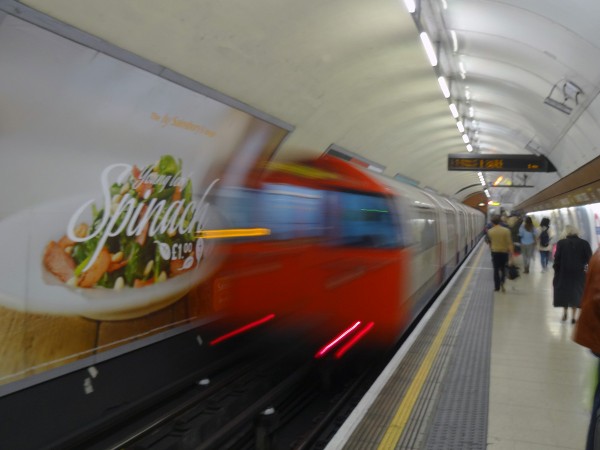 The impact of these strikes on workers in London is clearly evident by any pictures you look at. Buses were over-crowded, despite more than 100 extra being provided, pavements were packed with pedestrians and the roads were full of cyclists. At least the strike action has led to a little more exercise for many people! The disruption to business in London is likely to be relatively large and the loss in revenue due to the action will also be high, estimated by Business leaders to be tens of millions of pounds. It is perhaps for this reason that there is discussion as to whether the underground should be declared an ‘essential service’ as a means of minimising future disruptions.
Discussions have been ongoing between both sides to try to prevent this action and talks are likely to continue in the future. Boris Johnson has declared the strikes as ‘completely pointless’ and both sides have argued that the other has been unwilling to negotiate and discuss the ticket office closures. Boris Johnson said:
A deal is there to be done. I am more than happy to talk to Bob Crow if he calls off the pointless and unnecessary strike.
 The impact on London and the economy will only be fully known after the strike action is over, but there are plans for further strikes next week. The greater the disruption the bigger the calls for further strikes on key services, such as the tube, to be prevented. In particular, this may mean new powers to curtail the rights of unions in these types of areas, which will require a minimum service to be provided. The following articles consider the strike action on the London Underground.
Articles
Questions
- If there is strike action in a labour market, what can we conclude about the market in question in terms of how competitive it is?
- If only 3% of transactions take place via ticket offices, is it an efficient use of resources to maintain the presence of ticket offices at every station?
- Is industrial action ‘completely pointless’?
- What other solutions are there besides strike action to problems of industrial dispute?
- What is the role of ACAS in negotiations?
- What is the economic impact of the strike on the London Underground? Think about the impact on businesses, revenues, sales and both micro and macro consequences.
- Should the tube be seen as an essential service such that strike action by its workers would be restricted?
 Conservative Party leaders are considering the benefits of an above-inflation rise in the minimum wage. This policy has been advocated by both the Labour Party and the Liberal Democrats as a means of helping the lowest paid workers. From 2008 to 2013, minimum wage rates fell 5.2% in real terms: in other words, nominal increases were less than the increase in both the RPI and CPI (see UK minimum wage: a history in numbers).
Advocates of a real rise in the minimum wage argue that not only would it help low-paid workers, many of whom are in severe financial difficulties, but it would benefit the Treasury. According to Policy Exchange, a free-market think tank closely aligned to the Conservative Party, increasing the minimum wage by 50p would save the Government an estimated £750m a year through higher tax revenues and lower benefit payments.
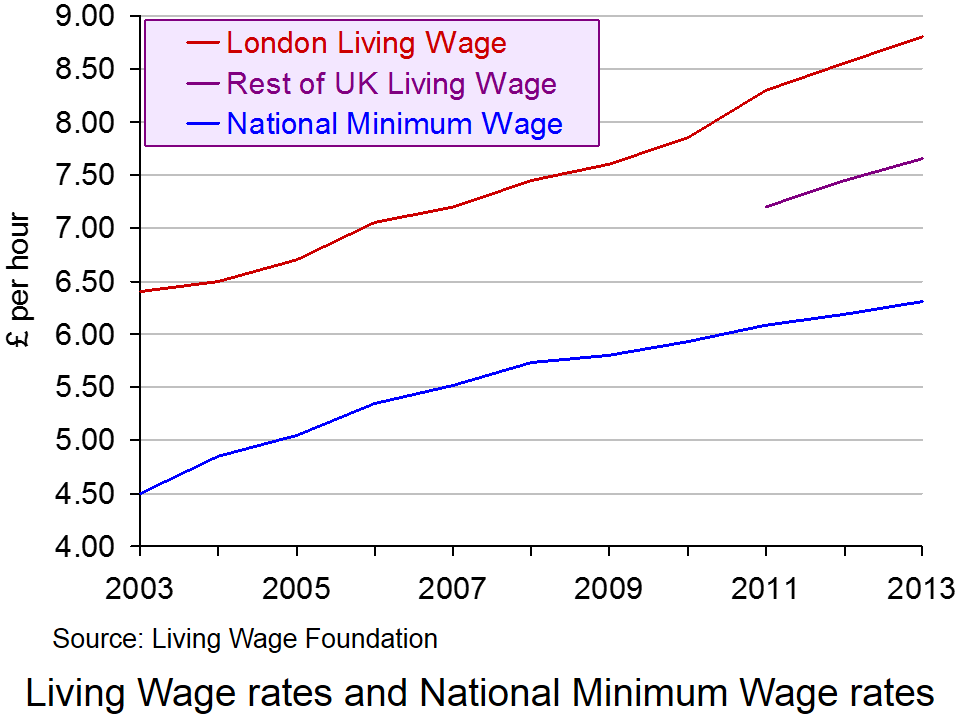 But even such a rise to £6.81 would still leave the minimum wage substantially below the living wage of £8.80 in London and £7.65 in the rest of the UK, as estimated by the Living Wage Foundation (see The cost of a living wage). Although many businesses are now paying at least the living wage, many others, especially small businesses, argue that a rise in the minimum wage above the rate of inflation would force them to consider cutting the number of employees or reducing hours for part-time workers.
Meanwhile, in the USA 13 states have raised their minimum wage rates from the 1st January 2014 (see). Some of the rises, however, were tiny: as little as 15 cents. In a couple of cases, the rise is $1. Currently 21 states and DC have minimum wage rates above the Federal level of $7.25 (approx. £4.40); 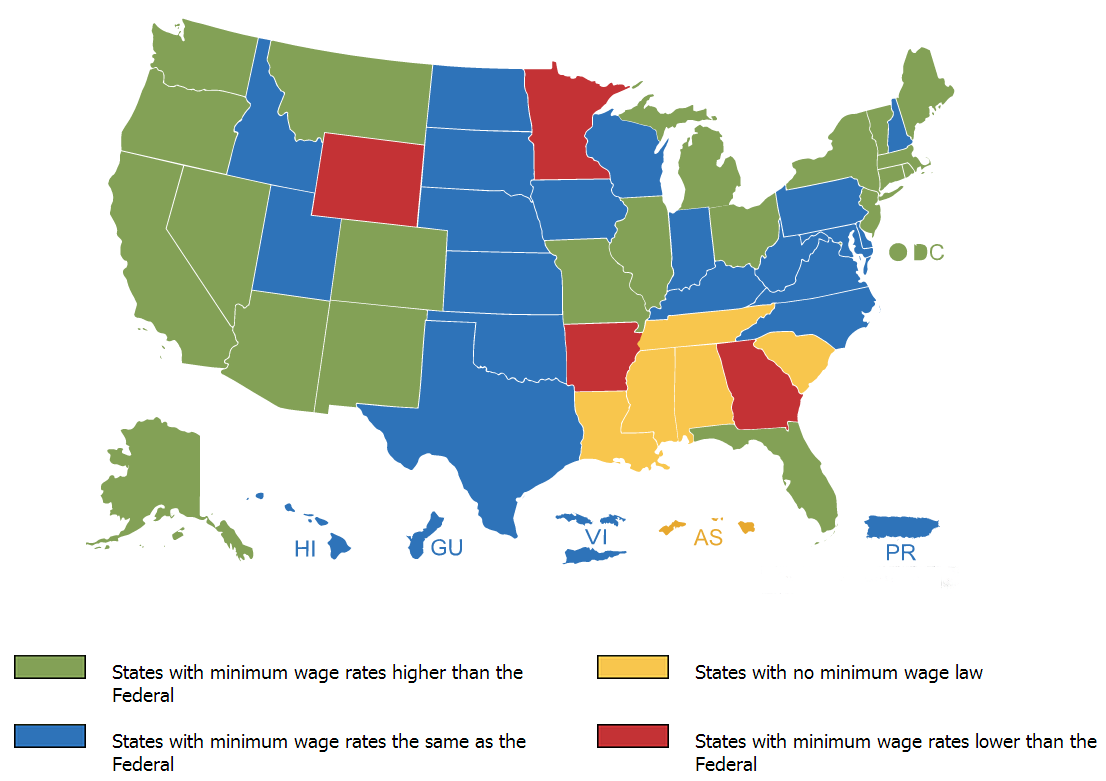 20 states have rates the same as the Federal level; 4 states have rates below the Federal level. At $9.32 per hour, Washington State has the highest state minimum wage; the lowest rates ($5.15) are in Georgia and Wyoming. In 5 states there is no minimum wage at all. As the ABC article below states:
The piecemeal increases at the local level are occurring amidst a national debate over low wages and income inequality. Fast food and retail workers have been staging protests and walking off work for more than a year, calling for better pay and more hours. Currently, fast food workers nationally earn an average of about $9 per hour.
Workers from McDonald’s, Wendy’s, Burger King and other fast food joints are calling for $15 per hour. Wal-Mart workers organizing as part of the union-backed OUR Walmart aren’t asking for a specific dollar amount increase, but they say it’s impossible to live on the wages they currently receive.
President Obama has been throwing his weight behind the issue. Earlier this month, the President said in a speech that it’s “well past the time to raise the minimum wage that in real terms right now is below where it was when Harry Truman was in office.” But such legislation has a bleaker outlook if it reaches the Republican-led House of Representatives. House Speaker John Boehner has said that raising the minimum wage leads to a pullback in hiring.
So what are the costs and benefits of a significant real rise is the minimum wage on either side of the Atlantic? The articles explore the issues.
Articles: UK
Lib Dems accuse Tories of ‘stealing’ their policy as George Osborne prepares to approve above-inflation rise in minimum wage Independent, Andrew Grice (7/1/14)
Lib Dems accuse Tories of ‘nicking’ party’s policy on low wages The Guardian, Nicholas Watt (7/1/14)
Cut housing benefit? A higher minimum wage would help The Guardian, Patrick Collinson (6/1/14)
Miliband prepares to wage war The Scotsman, Andrew Whitaker (8/1/14)
Increasing the minimum wage is only a half answer to poverty New Statesman, Helen Barnard (8/1/14)
Raise the bar: Economically and socially, Britain needs higher wages Independent (7/1/14)
Another Tory says there’s a ‘strong case’ for raising the minimum wage The Spectator, Isabel Hardman (8/1/14)
Fairness and the minimum wage Financial Times (7/1/14)
Osborne wants above-inflation minimum wage rise BBC News (16/1/14)
George Osborne backs minimum wage rise to £7 an hour The Guardian, Nicholas Watt, (16/1/14)
Minimum wage: in his efforts to defeat Labour, Osborne risks mimicking them The Telegraph, Benedict Brogan (16/1/14)
Minimum wage announcement is not just good economics The Guardian, Larry Elliott (16/1/14)
Articles: USA
13 states raising pay for minimum-wage workers USA Today, Paul Davidson (30/12/13)
Minimum wage increase: Wage to rise in 13 states on Jan. 1 ABC15 (30/12/13)
NJ minimum wage sees $1 bump on Jan. 1 Bloomberg Businessweek, Angela Delli Santi (31/12/13)
Minimum wage hike a job killer ctpost, Rick Torres (7/1/14)
A Business Owners Case For Raising The Minimum Wage Grundy Country Herald, David Bolotsky (7/1/14)
Raising the Minimum Wage Isn’t Just Good Politics. It’s Good Economics, Too. New Republic, Noam Scheiber (31/12/13)
Minimum wage rises across 13 US states Financial Times, James Politi (1/1/14)
Information
National Minimum Wage rates GOV.UK
UK minimum wage: a history in numbers Guardian Datablog
List of minimum wages by country Wikipedia
Questions
- Draw two diagrams to demonstrate the direct microeconomic effect of a rise in the minimum wage for two employers, both currently paying the minimum wage, where the first is operating in an otherwise competitive labour market and the other is a monopsonist.
- What is meant by the term ‘efficiency wage rate’? How is the concept relevant to the debate about the effects of raising the minimum wage rate?
- What are the likely macroeconomic effects of raising the minimum wage rate?
- What is the likely impact of raising the minimum wage rate on public finances?
- Is raising the minimum wage rate the best means of tackling poverty? Explain your answer.
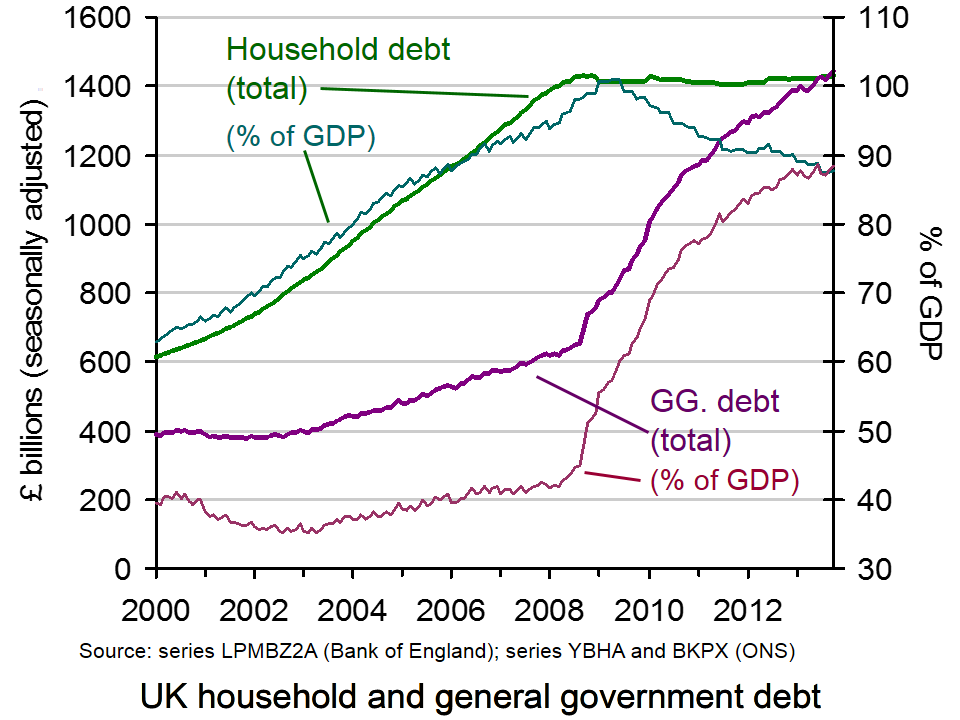 Household debt in the UK has reached a record level. Individuals now owe £1430 billion. This compares with the UK’s general government debt of £1443 billion – also at a record level. These figures are illustrated in the chart (click here for a PowerPoint).
But these figures are nominal. If you look at the real figures (i.e. corrected for inflation), household debt has been falling. In today’s prices, household debt peaked at £1668 billion in March 2008. Also, if you look at household debt as a proportion of GDP, it fell from a peak of 100.96% in May 2009 to 87.43% in July 2013 (see chart). However, since then it has begun rising again, standing at 87.65% in October 2013.
So has household debt become less of a problem? In aggregate terms, the answer is probably yes. However, it is too early to know whether a continuing recovery in the economy will be fuelled by real debt rising again and whether the recovery will encourage people to take on higher levels of debt?
For many people, however, debt has become more and more of a problem. In other words, the aggregate figures conceal what has happened in terms of the distribution of debt. According to a Centre for Social Justice (CSJ) study:
Indebted households in the poorest 10 per cent of the country have average debts more than four times their annual income. Average debt repayments within this group amounted to nearly half their gross monthly income.

And the poorest families, often with very poor credit ratings, are frequently forced to turn to payday lenders, charging sky-high interest rates (see Capping interest rates on payday loans: a government U-turn?).
As mainstream banks reduced access to credit following the financial crash, the market for short-term high-cost credit (payday lenders, pawnbrokers, rent-to-buy and doorstop lenders) increased dramatically and is now worth £4.8 billion a year.
Payday lenders have increased business from £900 million in 2008/09 to just over £2 billion (or around 8 million loans) in 2011/12. Around half of payday loan customers reported taking out the money because it was the only form of credit they could get. The number of people going to loan sharks is also said to have increased – the most recent estimate puts it at 310,000 people.
With rising energy and food bills hitting the poorest hardest, this section of the population could find debt levels continuing to rise, especially if interest rates rise. As Chris Pond, who chaired the CJS study, stated:
The costs to those affected, in stress and mental disorders, relationship breakdown and hardship is immense. But so too is the cost to the nation, measured in lost employment and productivity and in an increased burden on public services.
Articles
£1,430,000,000,000 (that’s £1.43 trillion): Britain’s personal debt timebomb Independent, Andrew Grice (20/11/13)
Average household debt ‘doubled in last decade’ The Telegraph, Edward Malnick (20/11/13)
UK household debt hits record high BBC News (29/11/13)
UK debt crisis: poorest face ‘perfect storm’ Channel 4 News (20/11/13)
One in five struggle with serious debt The Telegraph, Nicole Blackmore (27/11/13)
It doesn’t matter what we do with Wonga: personal debt is about to rocket The Telegraph, Tim Wigmore (26/11/13)
Poorest families ‘need more help over debt’ BBC News (20/11/13)
Report
More than 5,000 people a year ‘homeless’ as household debt crisis deepens, CSJ warns Centre for Social Justice Press Release (20/11/13)
Data
Monthly amounts outstanding of total (excluding the Student Loans Company) sterling net lending to individuals and housing associations (in sterling millions) seasonally adjusted Bank of England
Public Sector Finances First Release – Public Sector Consolidated Gross Debt ONS
Household debt (Economics Indicators update) House of Commons Library (29/11/13)
Questions
- What are the macroeconomic implications of rising levels of household debt?
- Why may an economy which has high levels of household debt be more subject to cyclical fluctuations in real GDP?
- What are the problems of having a recovery driven largely by increased consumer expenditure?
- Why have many people in the poorest sectors of society found their debt levels rising the fastest?
- Why may rising levels of debt of the most vulnerable people make it harder for the Bank of England to use conventional monetary policy if recovery becomes established?
- What policies could be pursued to try to reduce the debts of the poorest people?
- Discuss the effectiveness of these various policies.
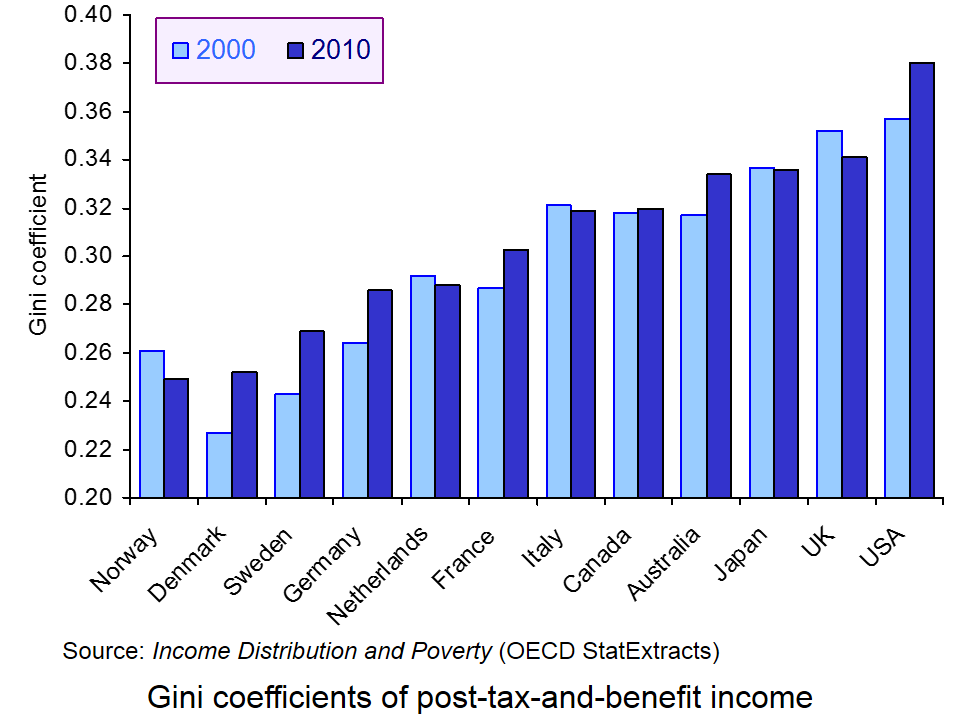 Growing inequality of income and wealth is a common pattern throughout the world. In the boom years up to 2008, the rich got a lot richer, but at least those on low incomes generally saw modest rises in their incomes. Since 2008, however, the continually widening gap between rich and poor has seen the poor and many on middle incomes getting absolutely poorer.
The problem is particularly acute in the USA. Indeed, in his 2012 State of the Union address, President Obama said that it was the ‘defining issue of our time.’
No challenge is more urgent. No debate is more important. We can either settle for a country where a shrinking number of people do really well, while a growing number of Americans barely get by. Or we can restore an economy where everyone gets a fair shot, everyone does their fair share, and everyone plays by the same set of rules.
The good news for the poor in the USA is that at last their incomes have stopped falling, thanks to stronger economic growth. But their share of the growth in GDP is tiny. As The Economist article states:
The main message is a grim one. Most of the growth is going to an extraordinarily small share of the population: 95% of the gains from the recovery have gone to the richest 1% of people, whose share of overall income is once again close to its highest level in a century. The most unequal country in the rich world is thus becoming even more so.
Apart from the ethical question of whether it is desirable for a society, already highly unequal, to become even more so, there is the question of whether this growth in inequality threatens economic recovery. Joseph Stiglitz argues that the rich have a low marginal propensity to consume and that this is threatening recovery.
Then there is the question of investment. Because most Americans have not seen any significant rise in incomes, it is easy for them to believe that the country cannot afford to invest more. And certainly it is difficult to persuade people that higher taxes are warranted to fund education, infrastructure or research.
The following articles consider the problem and its implications and look at various policy alternatives.
Articles and videos
Inequality: Growing apart The Economist (21/9/13)
What is income inequality, anyway? CNN, John D. Sutter (29/10/13)
Inequality is literally killing America Press TV (22/11/13)
It’s Economic Inequality Stupid – What to Do About the Biggest Crisis Facing America Huffington Post, Robert Creamer (14/11/13)
US Inequality Now Literally Off the Chart Truthout, Salvatore Babones (8/6/13)
Inequality moves to the front line of US politics Financial Times, Richard McGregor (20/11/13)
 Is wealth inequality slowing growth? BBC News, Linda Yueh (21/11/13)
American Inequality in Six Charts The New Yorker, John Cassidy (18/11/13)
Income Inequality ‘Profoundly Corrosive’ Wall Street Journal, Larry Summers (19/11/13)
21 Charts On US Inequality That Everyone Should See Business Insider, Gus Lubin (12/11/13)
Data, information and reports
Income inequality in the United States Wikipedia
Inequality Data & Statistics Inequality.org
Income Main United States Census Bureau
World of Work Report 2013: Snapshot of the United States ILO
World of Work Report 2013 ILO
StatExtracts OECD (Search for Gini)
Questions
- How may income inequality be measured?
- Comment on the Gini coefficients in the above link to the StatExtracts site.
- Why has inequality grown in the USA?
- The Swiss have just voted in a referendum to reject a proposal to limit executive pay to 12 times that of the lowest paid worker in the same company. What are the arguments for and against the proposal?
- What features of an unequal society tend to perpetuate or even deepen that inequality over time?
- What features of a well functioning market economy would help to reduce income inequality?
- Are higher marginal tax rates and higher welfare payments the best way of reducing inequality? What other policy options are there?
- Compare the views of Paul Krugman and Joseph Stiglitz on the effects of growing inequality on economic growth. How significant is the difference in the marginal propensity to consume of the rich and the poor in explaining the relatively low rate of US economic growth?
 The enormous amounts of money broadcasters are willing to pay for the rights to show live football astonish most people. The figures have continued to rise despite the impact of a recession, slow economic growth and static or falling real incomes.
The deal to broadcast live games in the English Premier League (EPL) for the three seasons from 2007-10 was 65% higher than the agreement that ran from 2004-07. The recession did appear to slow growth down as the contract covering the seasons 2010-13 was only 5% higher than the previous one. However the total size of this deal was still a staggering £1.78billion or approximately £593 million per season. BSkyB was the most successful bidder in all of these auctions for live TV rights and successfully saw off competition from ITV Digital, ESPN and Setanta.
However in the last few years, BT Sport has entered the bidding process and has provided BSkyB with much stronger competition than its previous rivals. As a result, BskyB had to pay £2.3 billion in order to outbid BT Sport in the most recent auction.  The three-year deal beginning in the 2013-14 season gives BSkyB the rights to show 116 lives matches each year. BT Sport also paid £738 million for the rights to show 38 live matches a season. In total this means that the EPL earns approximately £1billion per season from the sale of broadcasting rights in the domestic market – an increase of 70%!
The Champions and Europa League also auction the rights to broadcast live matches and there was a real shock when BT Sport recently announced that it had secured the exclusive rights to show all 350 live games in these competitions. Once again the figure it paid – just under £900 million for a three-year deal – took most people by surprise. It represented a 125% increase on the previous three-year deal with BSkyB and ITV. What was also surprising was that there was only one round in the sealed bid auction which suggests that BT Sport’s offer was well in excess of the one submitted by BSkyB.
Most of the initial reaction to this new deal has focused on its implications for the number of matches that will be available free to air: i.e. without having to pay for a subscription channel. The BT Sport contract does specify that the Champions League final and at least one match involving each British team will be shown free to air each season. However, this will be a significant reduction in the number of free to air games currently shown by ITV.
The new deal may also have implications for competitive balance in the EPL. This concept was discussed in a previous blog on this New Site Parachute payment problems for the English Football League and refers to how equally the most talented players are distributed amongst the teams in a league. This distribution will be heavily influenced by the degree to which the revenues of the teams in the league vary. Commenting on this latest contract Liverpool’s former managing director Christian Purslow stated that:
The fundamental effect of the BT deal will be additional wealth for England’s big teams. You will now have six teams (Manchester City, Chelsea and Manchester United, Arsenal, Liverpool and Spurs) playing for four Champions league places with the other 14 teams playing for survival. Never again will the likes of Everton, Newcastle or Villa get near the top – the difference in revenues will simply be too great.
To understand this statement one has to examine how the Champions League distributes the revenue it raises back to the teams that participate in the tournament. One part of the distribution mechanism is determined by the sporting performance of the teams in the competition. For example all 32 teams that make it to the group stages of the Champions League receive a minimum of €8.6 million. Each win in the group games earns a team an additional €1 million while a draw earns €500,000. The teams that make it to the last 16 receive an additional payment of €3.5 million, the quarter finalists earn an additional €3.9 million while the semi-finalists each receive €4.9 million. For example in the 2012-13 season, Manchester United received prize money of €16.1 million for reaching the last 16, whereas Bayern Munich received €35.9 million of prize money for winning the competition. If broadcasting revenues for the Champions League increase across the whole of Europe then the size of the prizes will almost certainly increase.
Teams also receive a share of the broadcasting revenue generated by the Champions League known as the market pool. The total size of the market pool allocated to the teams in any particular country depends on the value of the deal between the broadcasters in that country and UEFA. In the 2012-13 season the total market pool to be divided between the four English teams in the Champions League was €86.6 million. This was the second highest figure behind Italy. In contrast the four Portuguese teams had just over €7 million from the market pool to share between them because the value of the broadcasting deal in that country was so much lower. The market pool is split between the clubs based on (a) their finishing position in the domestic league the previous season and (b) how many games they played in the Champions League from the group stage onwards. FC BATE Borisov were the only representative from Belarus so did not have to share the market pool with any other team. Unfortunately for them the size of the market pool was only €290,000. Manchester United received a market pool payment of €19.45 million.
Given the dramatic increase in value of the broadcasting rights the size of the market pool for the English teams will rise significantly in 2015-16 season. The battle in the 2014-15 EPL season for the four Champions League places will be even stronger and more intense than ever. As a result, the competition for the services of the most talented players will probably push up their wages to ever higher levels.
Monopoly money: Football’s TV war makes the rich unreachable’ BBC Sport (17/11/13)
Champions League TV deal in focus BBC Business (11/11/13)
Champions League: BT Sport wins £897 football rights deal BBC Sport (9/11/13)
Top Soccer Leagues Get 25% Rise in TV Rights Sales, Report Says Bloomberg (11/11/13)
BSkyB could face Premier League premium The Guardian (11/11/13)
Clubs benefit from Champions League revenue UEFA (23/7/13)
Sky pleaded with football officials to reopen champions league talks The Telegraph (11/11/13).
Questions
- What is a sealed bid auction? How does it compare with different types of auctions?
- Suggest some reasons why BT Sport were willing to pay so much more than BSkyB for the broadcasting rights for the Champions League.
- Do you think that the potentially higher revenues for the top clubs might actually reduce attendances at their matches? Explain your answer.
- Explain how the potentially higher future revenues for teams participating in the Champions League in 2015-16 can be discounted in order to give them a present value.
- Draw a diagram to illustrate the impact of the new broadcasting deal on the marginal revenue product of the most talented players.
- Is the labour market for the most talented players competitive or is it an oligopsony? What implications does this have their wages? How does your answer change if the labour market is a bilateral monopoly?
 Getting around London is pretty easy to do. Transport, though often criticized, is very effective in and around London – at least when the Underground is running uninterrupted. However, since 9pm on Tuesday 4th February until the morning of 7th February, the underground will be operating well below full capacity, as strike action affects many workers.
 The impact on London and the economy will only be fully known after the strike action is over, but there are plans for further strikes next week. The greater the disruption the bigger the calls for further strikes on key services, such as the tube, to be prevented. In particular, this may mean new powers to curtail the rights of unions in these types of areas, which will require a minimum service to be provided. The following articles consider the strike action on the London Underground.