 The French have elected Emmanuel Macron as their new President. He claims to be from the economic centre. But just what does this imply for his vision of how the French economy should be run? What policies is he likely to put in place? Can these policies rightly be described as ‘centrist’? In practice, some of his policies are advocated by the centre right and some by the centre left.
He wants to institute policies that are pro business and will have the effect of stimulating private investment, increasing productivity and resulting in faster economic growth.
His pro-business policies include: reducing corporation tax from its current 33.3% to 25%, the hope being that firms will invest the money that this will free up; reducing labour taxes on companies for employing low-wage workers; making the current 35-hour working week less rigid by giving firms greater ability to negotiate special arrangements with trade unions.
Other policies drawn from the centre right include reducing the size of the state. Currently, general government spending in France, at 56.5% of GDP, is the highest of the G7 countries. Italy’s is the next highest at 49.6%, followed by Germany at 44.3%, Canada at 40.8%, the UK at 39.4%, Japan at 36.8% and the USA at 35.2%. President Macron wants to reduce the figure for France to 52% over his five-year term.  This will be achieved by cutting 120,000 public-sector jobs and reducing state spending by €60bn. He plans, thereby, to reduce the general government deficit from its 2016 level of 3.4% of GDP to 1% by 2022 and reduce the general government debt from 96.0% of GDP to 93.2% over the same period.
Drawing from centre-left policies he plans to increase public investment by €50bn, including €15bn on training, €15bn on green energy and €5bn each on transport, health, agriculture and the modernisation of public administration. But as this additional expenditure is less than the planned savings through greater efficiency and as GDP is projected to grow, this is still consistent with achieving a reduction in the general government deficit as a percentage of GDP. He has also pledged to extend welfare spending. This will include making the self-employed eligibile for unemployment benefits.
M Macron isalso strongly supportive of France’s membership of the EU and the euro. Nevertheless he wants the EU to be reformed to make it more efficient and achieve significant cost savings.
Articles
Macronomy: What are Emmanuel Macron’s economic plans? BBC News, Simon Atkinson (8/5/17)
Factbox: Emmanuel Macron’s presidential election policies Reuters, Brian Love (14/4/17)
What Analysts Are Saying About Macron’s Victory Bloomberg, Chris Anstey (8/5/14)
The Main Points of Emmanuel Macron’s Economic Programme NDTV, India (9/5/14)
Can Emmanuel Macron solve France’s economic riddle? The Guardian, Larry Elliott (30/4/17)
Why Emmanuel Macron’s bid to haul France out of its economic malaise will be harder than he thinks The Telegraph, Szu Ping Chan and Tim Wallace (30/4/17)
Macron’s policies on Europe, trade, immigration and defence Financial Times, Hannah Murphy (7/5/17)
French presidential election: Investors, economists and strategists react to Macron’s victory Independent, Josie Cox (8/5/17)
Questions
- Compare the performance of the French, German and UK economies over the past 10 years.
- Why does France have much lower levels of inequality and much higher productivity than the UK?
- How would (a) a neoliberal and (b) Keynesian economist explain the slow growth performance of France?
- Give some other examples of centre-right economic policies that could be pursued by a centrist government.
- Give some other examples of centre-left economic policies that could be pursued by a centrist government.
- How do M Macron’s policies differ from those of the (a) Conservative, (b) Labour and (c) Liberal Democrat parties in the manifestos for the 2017 General Election in the UK?
- What economic difficulties is M Macron likely to find in carrying out his policies?
- Would you describe M Macron’s macroeconomic policies as demand-side or supply -side policies? Explain.
- What specific economic policies does France want Germany to pursue?
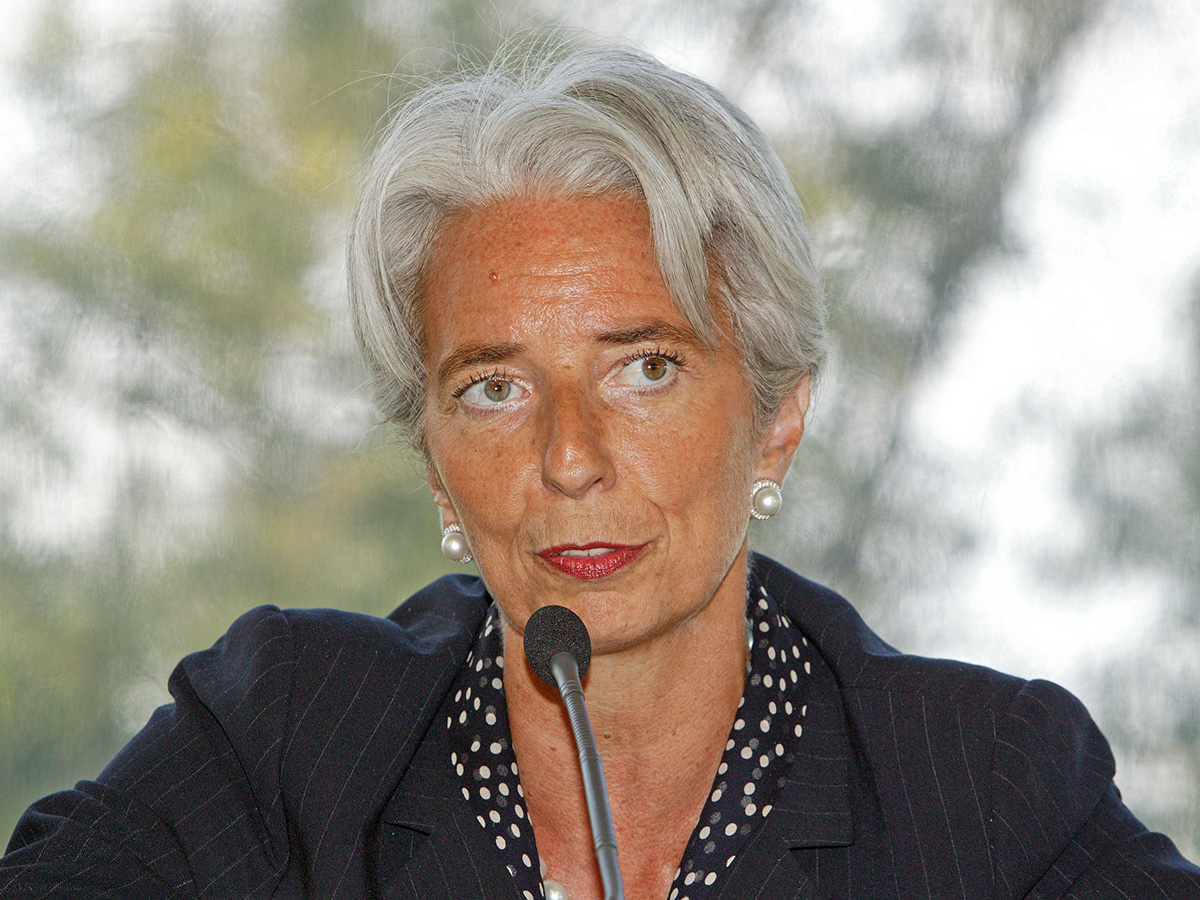
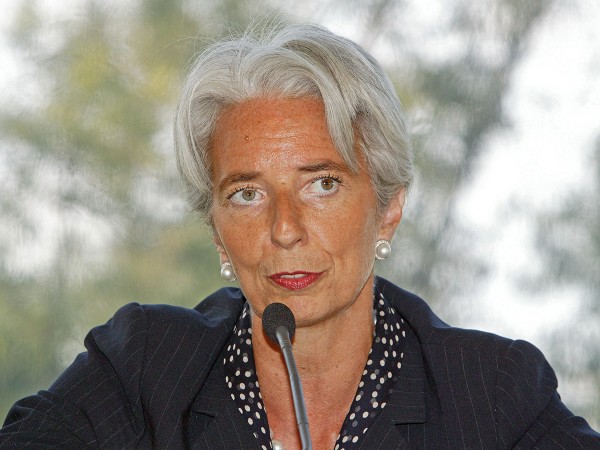 According to Christine Lagarde, Managing Director of the IMF, the slow growth in global productivity is acting as a brake on the growth in potential income and is thus holding back the growth in living standards. In a recent speech in Washington she said that:
Over the past decade, there have been sharp slowdowns in measured output per worker and total factor productivity – which can be seen as a measure of innovation. In advanced economies, for example, productivity growth has dropped to 0.3 per cent, down from a pre-crisis average of about 1 per cent. This trend has also affected many emerging and developing countries, including China.
We estimate that, if total factor productivity growth had followed its pre-crisis trend, overall GDP in advanced economies would be about 5 percent higher today. That would be the equivalent of adding another Japan – and more – to the global economy.
So why has productivity growth slowed to well below pre-crisis rates? One reason is an ageing working population, with older workers acquiring new skills less quickly. A second is the slowdown in world trade and, with it, the competitive pressure for firms to invest in the latest technologies.
 A third is the continuing effect of the financial crisis, with many highly indebted firms forced to make deep cuts in investment and many others being cautious about innovating. The crisis has dampened risk taking – a key component of innovation.
What is clear, said Lagarde, is that more innovation is needed to restore productivity growth. But markets alone cannot achieve this, as the benefits of invention and innovation are, to some extent, public goods. They have considerable positive externalities.
She thus called on governments to give high priority to stimulating productivity growth and unleashing entrepreneurial energy. There are several things governments can do. These include market-orientated supply-side policies, such as removing unnecessary barriers to competition, driving forward international free trade and cutting red tape. They also include direct intervention through greater investment in  education and training, infrastructure and public-sector R&D. They also include giving subsidies and/or tax relief for private-sector R&D.
Banks too have a role in chanelling finance away from low-productivity firms and towards ‘young and vibrant companies’.
It is important to recognise, she concluded, that innovation and structural change can lead to some people losing out, with job losses, low wages and social deprivation. Support should be given to such people through better education, retraining and employment incentives.
Articles
IMF chief warns slowing productivity risks living standards drop Reuters, David Lawder (3/4/17)
Global productivity slowdown risks social turmoil, IMF warns Financial Times, Shawn Donnan (3/4/17)
Global productivity slowdown risks creating instability, warns IMF The Guardian, Katie Allen (3/4/17)
The Guardian view on productivity: Britain must solve the puzzle The Guardian (9/4/17)
Speech
Reinvigorating Productivity Growth IMF Speeches, Christine Lagarde, Managing Director, IMF(3/4/17)
Paper
Gone with the Headwinds: Global Productivity IMF Staff Discussion Note, Gustavo Adler, Romain Duval, Davide Furceri, Sinem Kiliç Çelik, Ksenia Koloskova and Marcos Poplawski-Ribeiro (April 2017)
Questions
- What is the relationship between actual and potential economic growth?
- Distinguish between labour productivity and total factor productivity.
- Why has total factor productivity growth been considerably slower since the financial crisis than before?
- Is sustained productivity growth (a) a necessary and/or (b) a sufficient condition for a sustained growth in living standards?
- Give some examples of technological developments that could feed through into significant growth in productivity.
- What is the relationship between immigration and productivity growth?
- What policies would you advocate for increasing productivity? Explain why.
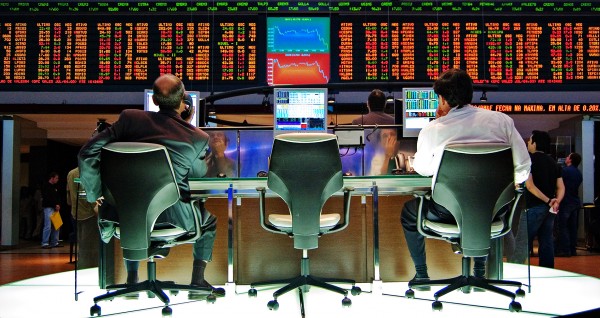 Both the financial and goods markets are heavily influenced by sentiment. And such sentiment tends to be self-reinforcing. If consumers and investors are pessimistic, they will not spend and not invest. The economy declines and this further worsens sentiment and further discourages consumption and investment. Banks become less willing to lend and stock markets fall. The falling stock markets discourage people from buying shares and so share prices fall further. The despondency becomes irrational and greatly exaggerates economic fundamentals.
This same irrationality applies in a boom. Here it becomes irrational exuberance. A boom encourages confidence and stimulates consumer spending and investment. This further stimulates the boom via the multiplier and accelerator and further inspires confidence. Banks are more willing to lend, which further feeds the expansion. Stock markets soar and destabilising speculation further pushes up share prices. There is a stock market bubble.
 But bubbles burst. The question is whether the current global stock market boom, with share prices reaching record levels, represents a bubble. One indicator is the price/earnings (PE) ratio of shares. This is the ratio of share prices to earnings per share. Currently the ratio for the US index, S&P 500, is just over 26. This compares with a mean over the past 147 years of 15.64. The current ratio is the third highest after the peaks of the early 2000s and 2008/9.
An alternative measure of the PE ratio is the Shiller PE ratio (see also). This is named after Robert Shiller, who wrote the book Irrational Exuberance. Unlike conventional PE ratios, which only look at average earnings over the past four quarters, the Shiller PE ratio uses average earnings over the past 10 years. “Because this factors in earnings from the previous ten years, it is less prone to wild swings in any one year.”
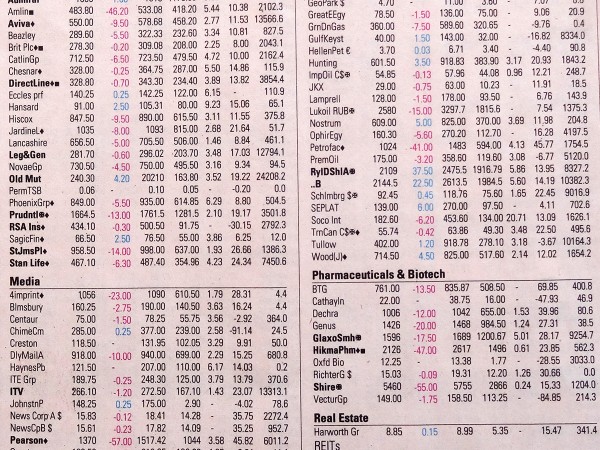 The current level of the Shiller PE ratio is 29.14, the third highest on record, this time after the period running up to the Wall Street crash of 1929 and the dot-com bubble of the late 1990s. The mean Shiller PE ratio over the past 147 years is 16.72.
So are we in a period of irrational exuberance? And are stock markets experiencing a bubble that sooner or later will burst? The following articles explore these questions.
Articles
2 Clear Instances of Irrational Exuberance Seeking Alpha, Jeffrey Himelson (12/2/17)
Promised land of Trumpflation-inspired global stimulus has been slow off the mark South China Morning Post, David Brown (20/2/17)
A stock market crash is a way off, but this boom will turn to bust The Guardian, Larry Elliott (16/2/17)
The “boring” bubble is close to bursting – the Unilever bid proves it MoneyWeek, John Stepek (20/2/17)
Questions
- Find out what is meant by Minksy’s ‘financial instability hypothesis’ and a ‘Minsky moment’. How might they explain irrational exuberance and the sudden turning point from a boom to a bust?
- Is it really irrational to buy shares with a very high PE ratio if everyone else is doing so?
- Why are people currently exuberant?
- What might cause the current exuberance to end?
- How does irrational exuberance affect the size of the multiplier?
- How might the behaviour of banks and other financial institutions contribute towards a boom fuelled by irrational exuberance?
- Compare the usefulness of a standard PE ratio with the Shiller PE ratio.
- Other than high PE ratios, what else might suggest that stock markets are overvalued?
- Why might a company’s PE ratio differ from its price/dividends ratio (see)? Which is a better measure of whether or not a share is overvalued?
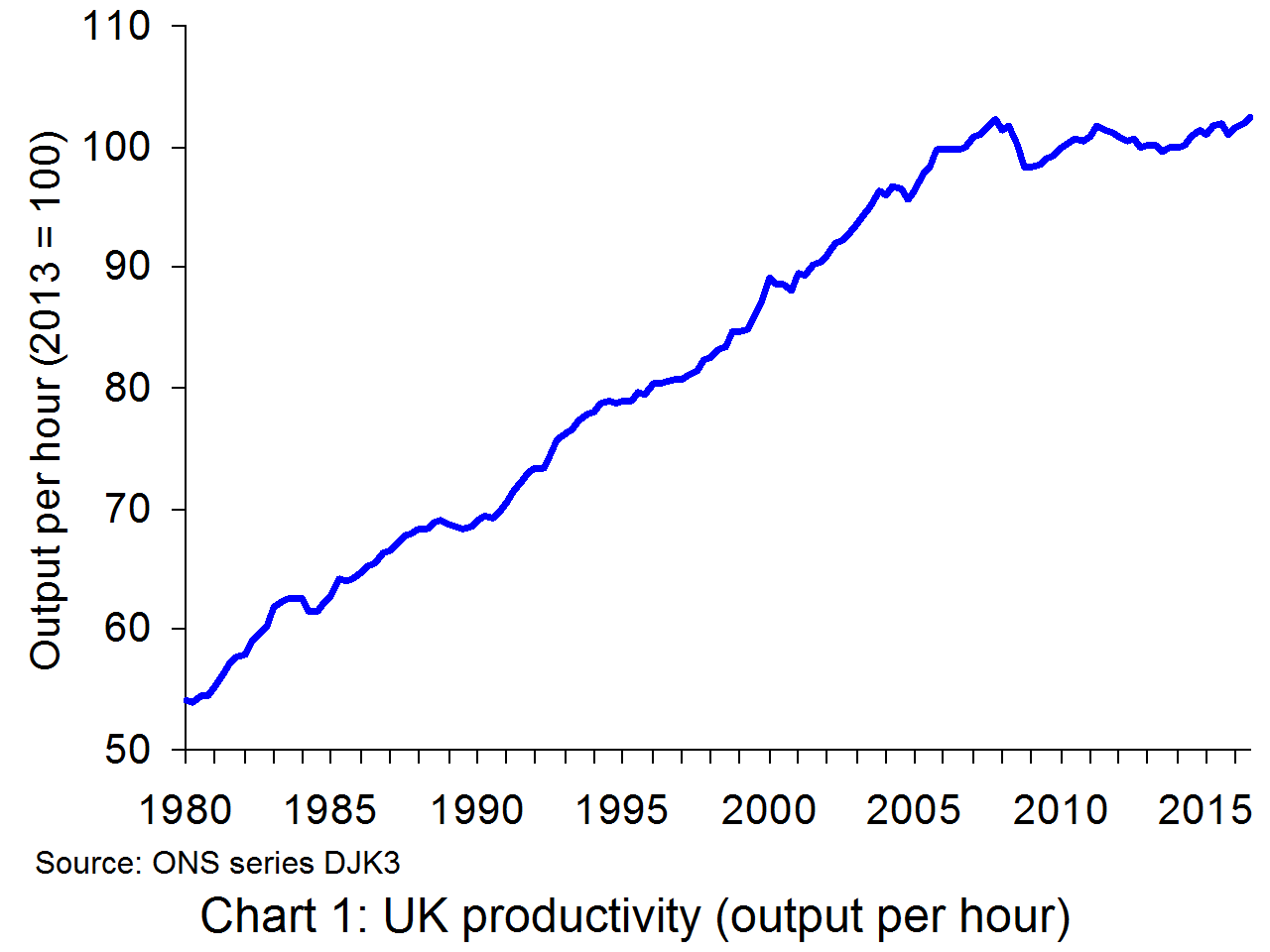 UK productivity growth remains well below levels recorded before the financial crisis, as Chart 1 illustrates. In fact, output per hour worked in 2016 Q3 was virtually the same as in 2007 Q4. What is more, as can be seen from Chart 2, UK productivity lags well behind its major competitors (except for Japan).
But why does UK productivity lag behind other countries 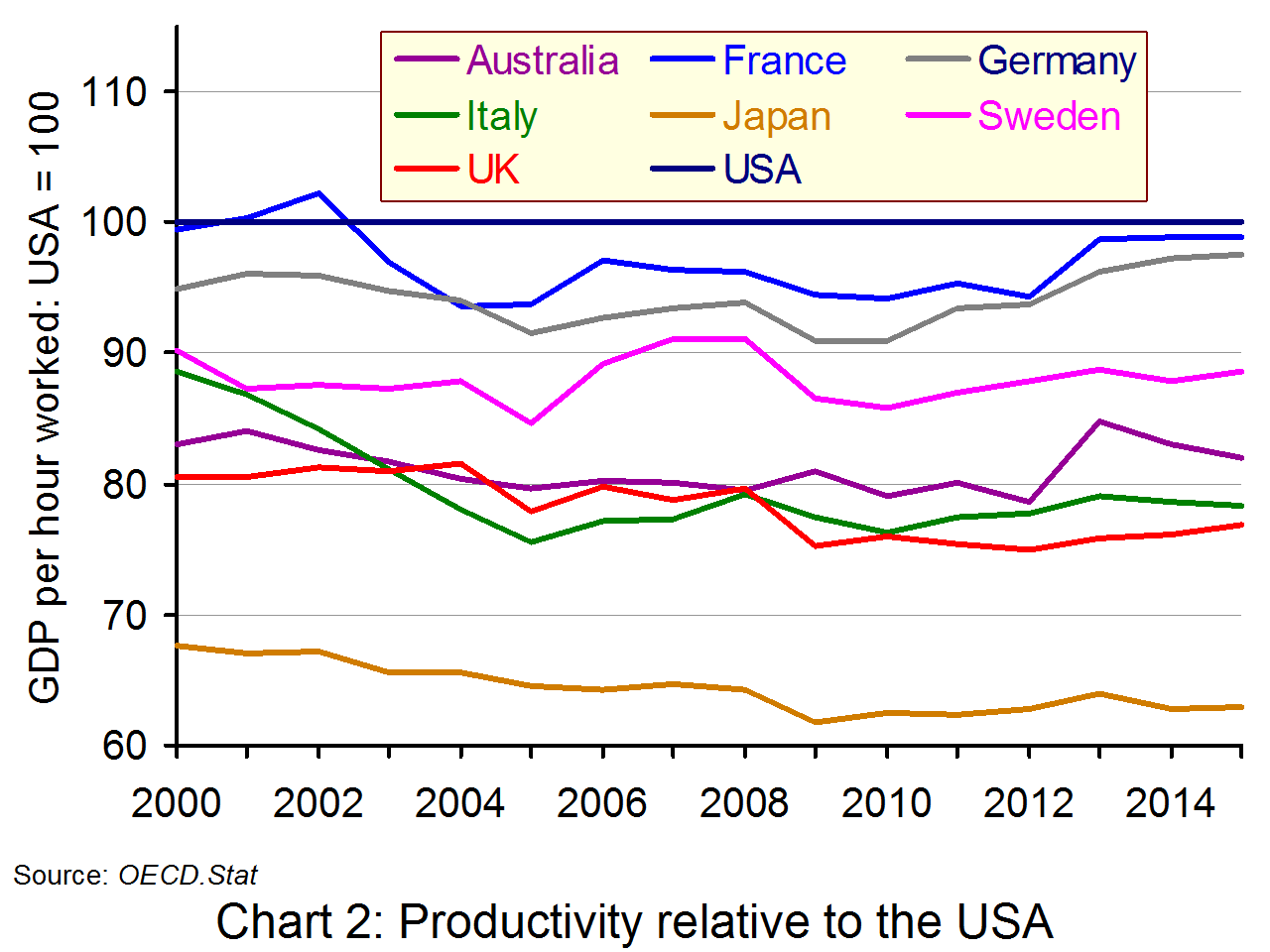 and why has it grown so slowly since the financial crisis? In its July 2015 analysis, the ONS addressed this ‘productivity puzzle’.
Among the many reasons suggested are low levels of investment, the impact of the financial crisis on bank’s willingness to lend to new businesses, higher numbers of people working beyond normal retirement age as a result of population and pensions changes, and firms’ ability to retain staff because of low pay growth. While these and other factors may be relevant, they do not provide a complete explanation for the weakness in productivity.
The lack of investment in technology and lack of infrastructure investment have been key reasons for the sluggish growth in productivity. Many companies are prepared to continue using relatively labour-intensive techniques because wage growth has been so low and this reduces the incentive to invest in labour-saving technology.
Another factor has been long hours and, for many office workers, being constantly connected to their work, checking and responding to emails and messages away from the office. The Telegraph article below reports Ann Francke, chief executive of the Chartered Management Institute, as saying:
“This is having a deleterious effect on the health of managers, which has a direct impact on productivity. UK workers already have the longest hours in Europe and yet we’re less productive.”
Another problem has been ultra low interest rates, which have reduced the burden of debt for poor performing companies and has allowed them to survive. It may also have prevented finance from being reallocated to more dynamic companies which would like to develop new products and processes.
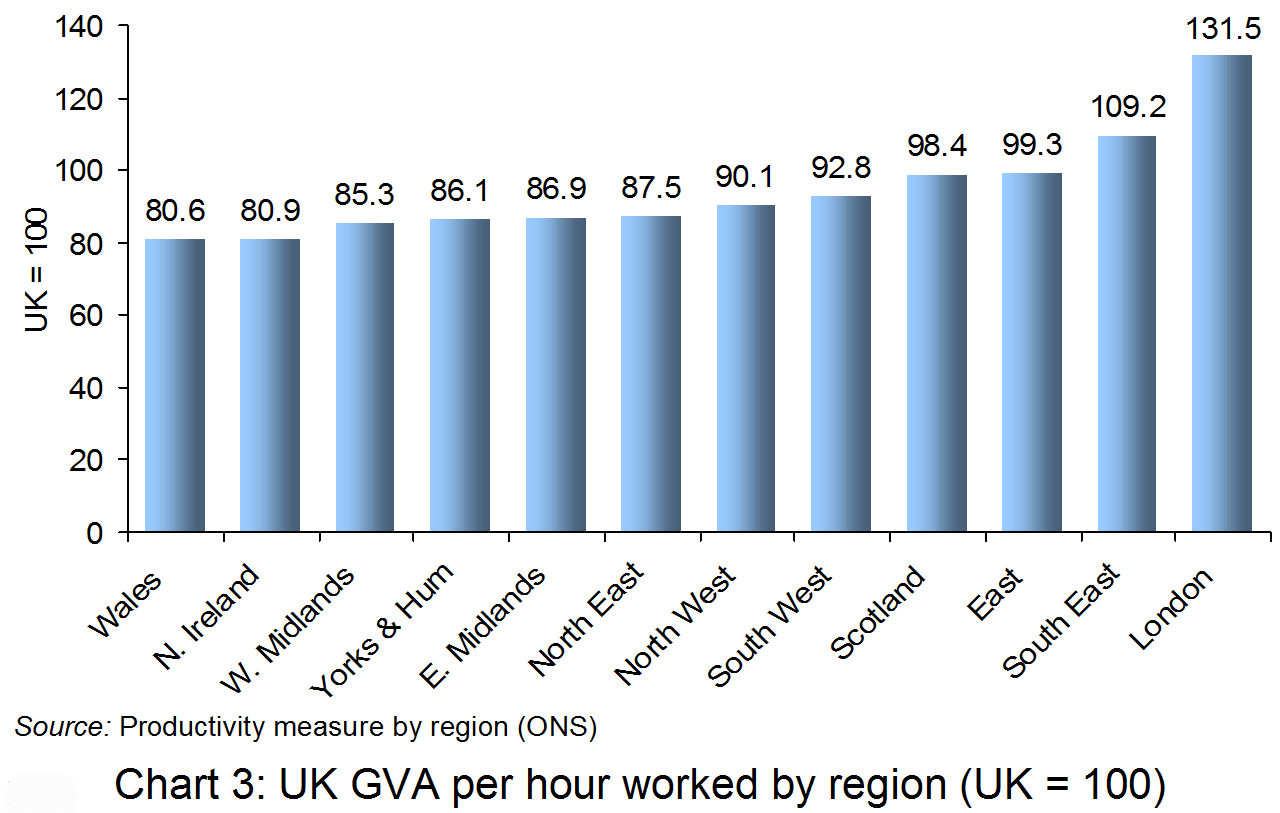
Another feature of UK productivity is the large differences between regions. This is illustrated in Chart 3. Productivity in London in 2015 (the latest full year for data) was 31.5% above the UK average, while that in Wales was 19.4% below.
This again reflects investment patterns and also the concentration of industries in particular locations. Thus London’s financial sector, a major part of London’s economy, has experienced relatively large increases in productivity and this has helped to push productivity growth in the capital well above other parts of the country.
Another factor, which again has a regional dimension, is the poor productivity performance of family-owned businesses, where ownership and management is passed down the generations within the family without bringing in external managerial expertise.
The government is very aware of the UK’s weak productivity performance. Its recently launched industrial policy is designed to address the problem. We look at that in a separate post.
Articles
UK productivity edges up but growth still flounders below pre-crisis levels The Telegraph, Julia Bradshaw (6/1/17)
Weak UK productivity spurs warnings of living standards squeeze The Guardian, Katie Allen (6/1/17)
Productivity gap yawns across the UK BBC News, Jonty Bloom (6/1/17)
The UK productivity puzzle Fund Strategy. John Redwood (26/1/17)
Productivity puzzle remains for economists despite UK growth in third quarter of 2016 City A.M., Jasper Jolly (6/1/17)
Portal site
Solve the Productivity Puzzle Unipart
Report
Productivity: no puzzle about it TUC (Feb 2015)
Data
Labour Productivity: Tables 1 to 10 and R1 ONS (6/1/17)
International comparisons of UK productivity (ICP) ONS (6/10/16)
Gross capital formation (% of GDP) The World Bank
Questions
- In measuring productivity, the ONS uses three indicators: output per worker, output per hour and output per job. Compare the relative usefulness of these three measures of productivity.
- How would you explain the marked difference in productivity between regions and cities within the UK?
- How do flexible labour markets impact on productivity?
- Why is investment as a percentage of GDP so low in the UK compared to that in most other developed countries (see)?
- Give some examples of industrial policy measures that could be adopted to increase productivity growth.
- Examine the extent to which very low interest rates and quantitative easing encourage productivity-enhancing investment.
 Many politicians throughout the world,
not just on the centre and left, are arguing for increased spending on infrastructure. This was one of the key proposals of Donald Trump during his election campaign. In his election manifesto he pledged to “Transform America’s crumbling infrastructure into a golden opportunity for accelerated economic growth and more rapid productivity gains”.
Increased spending on inffrastructure has both demand- and supply-side effects.
Unless matched by cuts elsewhere, such spending will increase aggregate demand and could have a high multiplier effect if most of the inputs are domestic. Also there could be accelerator effects as the projects may stimulate private investment.
On the supply side, well-targeted infrastructure spending can directly increase productivity and cut costs of logistics and communications.
The combination of the demand- and supply-side effects could increase both potential and actual output and reduce unemployment.
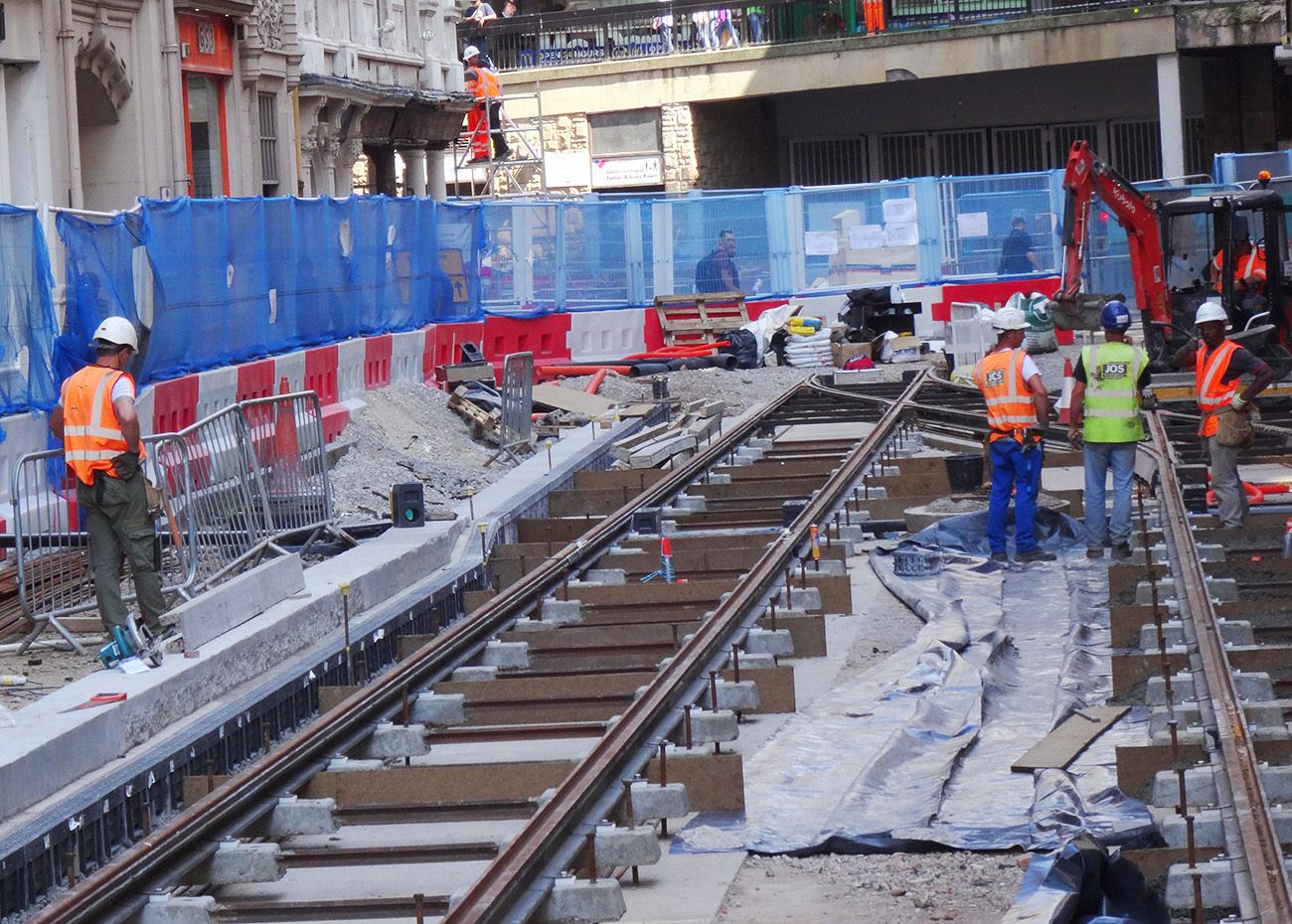 So, if infrastructure projects can have such beneficial effects, why are politicians often so reluctant to give them the go-ahead?
Part of the problem is one of timing. The costs occur in the short run. These include demolition, construction and disruption. The direct benefits occur in the longer term, once the project is complete. And for complex projects this may be many years hence. It is true that demand-side benefits start to occur once construction has begun, but these benefits are widely dispersed and not easy to identify directly with the project.
Then there is the problem of externalities. The external costs of projects may include environmental costs and costs to local residents. This can lead to protests, public hearings and the need for detailed cost–benefit analysis. This can delay or even prevent projects from occurring.
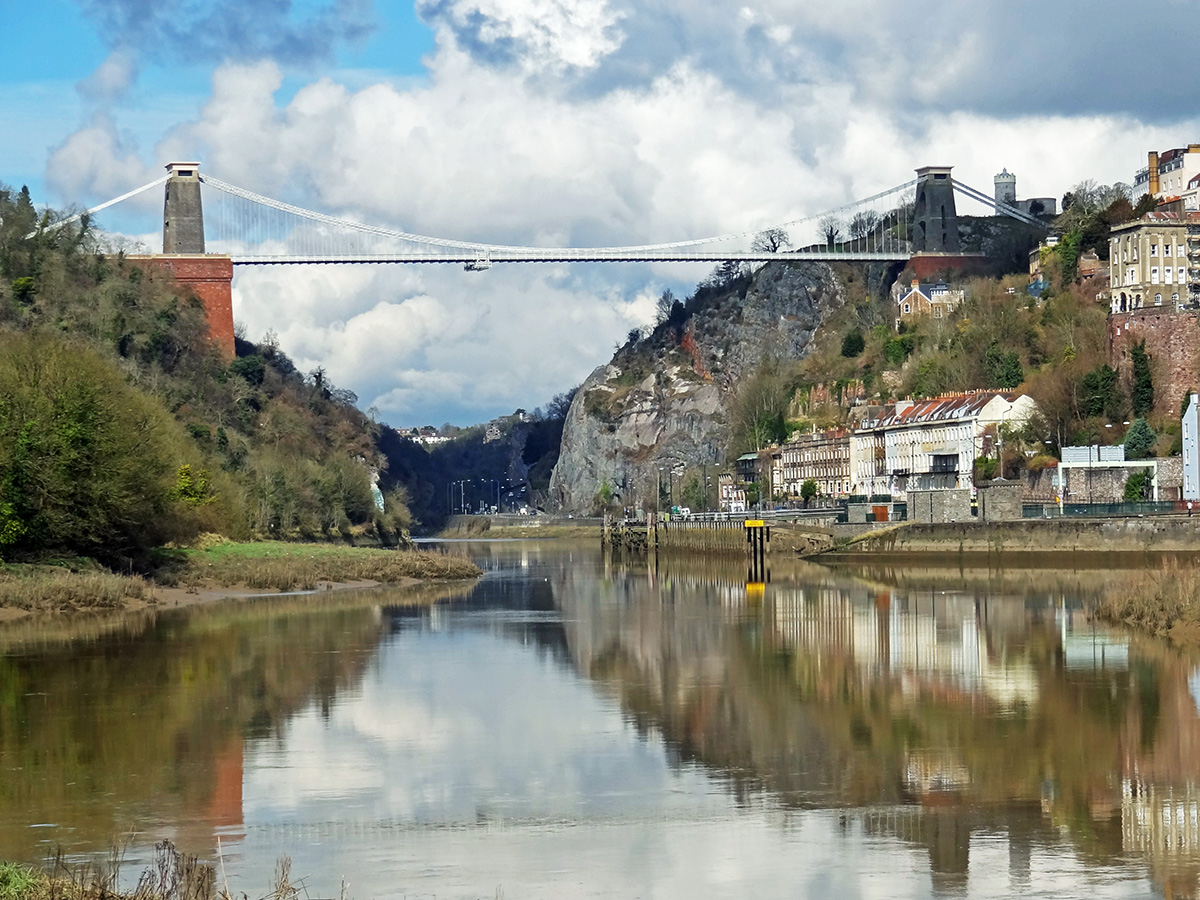
The external benefits are to non-users of the project, such as a new bridge or bypass reducing congestion for users of existing routes. These make the private construction of many projects unprofitable, except with public subsidies or with public–private partnerships. So there does need to be a macroeconomic policy that favours publicly-funded infrastructure projects.
One type of investment that is less disruptive and can have shorter-term benefits is maintenance investment. Maintenance expenditure can avoid much more costly rebuilding expenditure later on. But this is often the first type of expenditure to be cut when public-sector budgets as squeezed, whether at the local or national level.
The problem of lack of infrastructure investment is very much a political problem. The politicians who give the go-ahead to such projects, such as high-speed rail, come in for criticisms from those bearing the short-run costs but they are gone from office once the benefits start to occur. They get the criticism but not the praise.
Articles
Are big infrastructure projects castles in the air or bridges to nowhere? The Economist, Buttonwood’s notebook (16/1/17)
Trump’s plans to rebuild America are misguided and harmful. This is how we should do it. The Washington Post, Lawrence H. Summers (17/1/17)
Questions
- Identify the types of externality from (a) a new high-speed rail line, (b) new hospitals.
- How is discounting relevant to decisions about public-sector projects?
- Why are governments often unwilling to undertake (a) new infrastructure projects, (b) maintenance projects?
- Is a programme of infrastructure investment necessarily a Keynesian policy?
- What accelerator effects would you expect from infrastructure investment?
- Explain the difference between the ‘spill-out’ and ‘pull-in’ effects of different types of public investments in a specific location. Is it possible for a project to have both effects?
- What answer would you give to the teacher who asked the following question of US Treasury Secretary, Larry Summers? “The paint is chipping off the walls of this school, not off the walls at McDonald’s or the movie theatre. So why should the kids believe this society thinks their education is the most important thing?”
- What is the ‘bridge to nowhere’ problem? Why does it occur and what are the solutions to it?
- Why is the ‘castles in the air’ element of private projects during a boom an example of the fallacy of composition?
 The French have elected Emmanuel Macron as their new President. He claims to be from the economic centre. But just what does this imply for his vision of how the French economy should be run? What policies is he likely to put in place? Can these policies rightly be described as ‘centrist’? In practice, some of his policies are advocated by the centre right and some by the centre left.
 This will be achieved by cutting 120,000 public-sector jobs and reducing state spending by €60bn. He plans, thereby, to reduce the general government deficit from its 2016 level of 3.4% of GDP to 1% by 2022 and reduce the general government debt from 96.0% of GDP to 93.2% over the same period.