 European wine producers have seen one of the worst grape harvests for decades. With exceptionally wet weather in the northern European growing areas and exceptionally hot and dry weather in the southern ones, yields are well down in most countries.
In France, the world’s largest wine producer, wine production is forecast to be 19% down on the previous year. In Italy and Spain, Europe’s second and third largest producers, production is forecast to be 3% and 6% down respectively. Production in the EU as a whole, which produces some 57% of world output, is expected to be 9% down and at a historically low level. What is more, the past five years in the EU have all seen modest harvests.
And the poor harvests are not confined to Europe. Argentina’s production is some 24% down on 2011, with New Zealand’s 17% down. And despite a few countries expecting an increase, including the USA and Chile, overall world production is expected to be 6% down on 2011 and more than 7% down on the average for 2008–11.

So is this good news or bad? At first sight it would seem to be bad, especially for the countries with large falls in output. It would also seem to be bad news for the consumer, with prices set to rise.
But for some it’s good news. If prices rise, then producers experiencing an increase in output will have a double gain. And a fall in output is only part of the story. For some producers, the smaller yield has been accompanied by an increase in quality. And then there’s the question of stocks. For several years, global production of wine has exceeded consumption. Indeed the gap widened after the financial crisis and recession of 2007–9 as consumption of wine fell. This year’s poor global harvest should help to slow down the increase in stocks or may even lead to a reduction in stocks, depending on the extent to which demand recovers.
Articles
World Wine Output to Fall to 37-Year Low, Depleting Stocks BloombergBusinessweek, Rudy Ruitenberg (30/10/12)
World wine drought after weather ruins harvests The Telegraph, John-Paul Ford Rojas (31/10/12)
Wine Experts: Drought, Cold Bring Worst Harvest in 50 Years Skye (30/10/12)
Wine experts: worst grape harvest in half century Washington Examiner (17/10/12)
Small 2012 harvest sparks supply fears thedrinksbusiness.com, Gabriel Savage (30/10/12)
Wine shortage to follow poor 2012 grape harvest BBC News (31/10/12)
 Hot summer cools business prospects for Madrid vintners BBC News, Jaime Gonzales (24/9/12)
World awash in wine, so Europe’s poor grape harvest won’t hit Edmonton goblets just yet Edmonton Journal, Dan Barnes (17/10/12)
Data
Wine in figures Wines from Spain
2012 global economic vitiviniculture data Wines from Spain (Note that the countries in Table 1 have been entered in the wrong order.)
Questions
- Illustrate the effect of the global wine harvest on a demand and supply diagram.
- Will a fall in grape production of x per cent lead to a rise in the price of wine of more or less than x percent? How is the price elasticity of demand relevant to your answer?
- What elements are there in the supply chain from planting vines to consuming wine?
- How does the holding of stocks affect (a) the profitability of wine production; (b) the price volatility of wine?
- The Greek grape harvest is predicted to be higher in 2012 than in 2011. How will this affect the prices of Greek wines in (a) Greece; (b) outside Greece?
- How is the fallacy of composition relevant in assessing the benefits to owners of vineyards of a good grape harvest?
 10 of the 17 eurozone countries have agreed to adopt a financial transactions tax (FTT), often known as a ‘Tobin tax’ after James Tobin who first proposed such a tax back in 1972. The European Commission has backed the proposal, which involves levying a tax of 0.1% on trading in bonds and shares and 0.01% on trading in derivatives.
The 10 countries, France, Germany, Austria, Belgium, Greece, Italy, Portugal, Slovakia, Slovenia and Spain, and possibly also Estonia, hope to raise billions of euros from the tax, which will apply whenever at least one of the parties to a trade is based in one of the 10 (or 11) countries.
On several occasions in the past on this site we’ve examined proposals for such a tax: see, for example: Pressure mounts for a Tobin tax (update) (Nov 2011), A ‘Robin Hood’ tax (Feb 2010), Tobin or not Tobin: the tax proposal that keeps reappearing (Dec 2009) and A Tobin tax – to be or not to be? (Aug 2009). Tobin taxes are also considered in Economics (8th ed) (section 26.3) and Economics for Business (5th ed) (section 32.4).
As we noted last year in the blog Is the time right for a Tobin tax?, the tax is designed to be too small to affect trading in shares or other financial products for purposes of long-term investment. It would, however, dampen speculative trades that take advantage of tiny potential gains from very short-term price movements. Such trades account for huge financial flows between financial institutions around the world and tend to make markets more volatile. The short-term dealers are known as high-frequency traders (HFTs) and their activities now account for the majority of trading on exchanges. Most of these trades are by computers programmed to seek out minute gains and respond in milliseconds. And whilst they add to short-term liquidity for much of the time, this liquidity can suddenly dry up if HFTs become pessimistic.
Supporters of the tax claim that it will make a major contribution to tackling the deficit problems of many eurozone countries. Critics claim that it will dampen investment and growth and divert financial business away from the participating countries. The following articles look at the arguments.
EU Commission backs 10 countries’ transaction tax plan Reuters, Jan Strupczewski (23/10/12)
EU ‘Robin Hood’ tax gets the nod fin24 (23/10/12)
European financial transaction tax moves step closer The Guardian, Larry Elliott (23/10/12)
Financial transaction tax for 10 EU states BBC News (23/10/12)
Rejecting a Robin Hood tax would be a spectacular own goal The Guardian, Max Lawson (11/10/12)
More than 50 financiers back Robin Hood Tax The Robin Hood Tax (23/10/12)
Topical Focus – Transaction Taxes Tax-News (23/10/12)
Could a transactions tax be good for capitalism? BBC News, Robert Peston (3/10/11)
A Tax to Kill High Frequency Trading Forbes, Lee Sheppard (16/10/12)
Questions
- Explain how the proposed financial transactions tax will work.
- Why would many parties to trades who are not based in one of the 10 participating countries still end up paying the tax?
- What are likely to be the advantages and disadvantages of the proposed tax?
- Is it appropriate to describe the proposed FTT as a ‘Robin Hood Tax’?
- How does a financial transactions tax differ from the UK’s stamp duty reserve tax?
- Explain why the design of the stamp duty tax has prevented the flight of capital and trading from London. Could a Tobin tax be designed in such a way?
- What are HFTs and what impact do they have on the stability and liquidity of markets?
- Would it be desirable for the FTT to ‘kill off’ HFTs?
 Two of the biggest publishing companies, Pearson of the UK and Bertelsmann of Germany are to form a joint venture by merging their Penguin and Random House imprints. Bertelsmann will have a majority stake in the venture of 53% and Pearson will have 47%.
The Penguin imprint, with a turnover of just over £1bn, has an 11% share of the English language book publishing market. Random House has a 15% share, with turnover of around £1.5bn. The new ‘Penguin Random House’, as it will be called, will have nearly 26% of the market, which should give it considerable market power to combat various threats in the book publishing market.
One threat is from online retailers, such as Amazon, Apple and Google, which use their countervailing power to drive down the prices they pay to publishers. Another threat is from the rise of electronic versions of books. Although e-books save on printing costs, competition is driving down prices, including the prices of paper books, which may make publishers more reluctant to publish new titles in paper form.
There has been a mixed reception from authors: some are worried that an effective reduction in the number of major publishers from six to five will make it harder to get books published and may squeeze royalty rates; others feel that an increased market power of publishers to take on the online retailers will help to protect the interests of authors
The following videos and articles look at the nature of this joint venture and its implications for costs, revenues and publishing more generally.
Videos and webcasts
Penguin and Random House merge to take on digital giants Channel 4 News, Matthew Cain (29/10/12)
Penguin and Random House confident merger will be approved BBC News, Will Gompertz (29/10/12)
Penguin Books and Random House to merge BBC News, Matt Cowan (29/10/12)
Articles
Random House and Penguin merge to take on Amazon, Apple Reuters, Kate Holton (29/10/12)
Pearson’s Penguin joins Random House Independent, Amy Thomson and Joseph de Weck (29/10/12)
Penguin and Random House sign merger deal Financial Times, Gerrit Wiesmann and Robert Budden (29/10/12)
March of the Penguin The Economist, Schumpeter blog (29/10/12)
Penguin chief: News Corp can’t derail Random House deal The Guardian, Mark Sweney (29/10/12)
Penguin and Random House confident merger will be approved BBC News, Anthony Reuben (29/10/12)
And so I bid Penguin a sad farewell Independent, Andrew Franklin (29/10/12)
Questions
- How does a joint venture differ from a merger?
- What types of economies of scale are likely to result from the joint venture?
- How are authors likely to be affected?
- Will the joint venture benefit the book reading public?
- The relationship between publishers and online retailers can be described as one of ‘bilateral oligopoly’. Explain what this means and why it is impossible to determine an ‘equilibrium’ wholesale price of books in such a market.
- What criteria would the competition authorities use to assess whether or not the joint venture should be permitted to proceed?
- What is likely to be the long-term outlook for Penguin Random House?
- Assess the benefits and costs of a News Corporation takeover of the Penguin division? This was an alternative offer to Pearson had it not gone with Bertelsmann. (News Corp. has the Harper Collins imprint.)
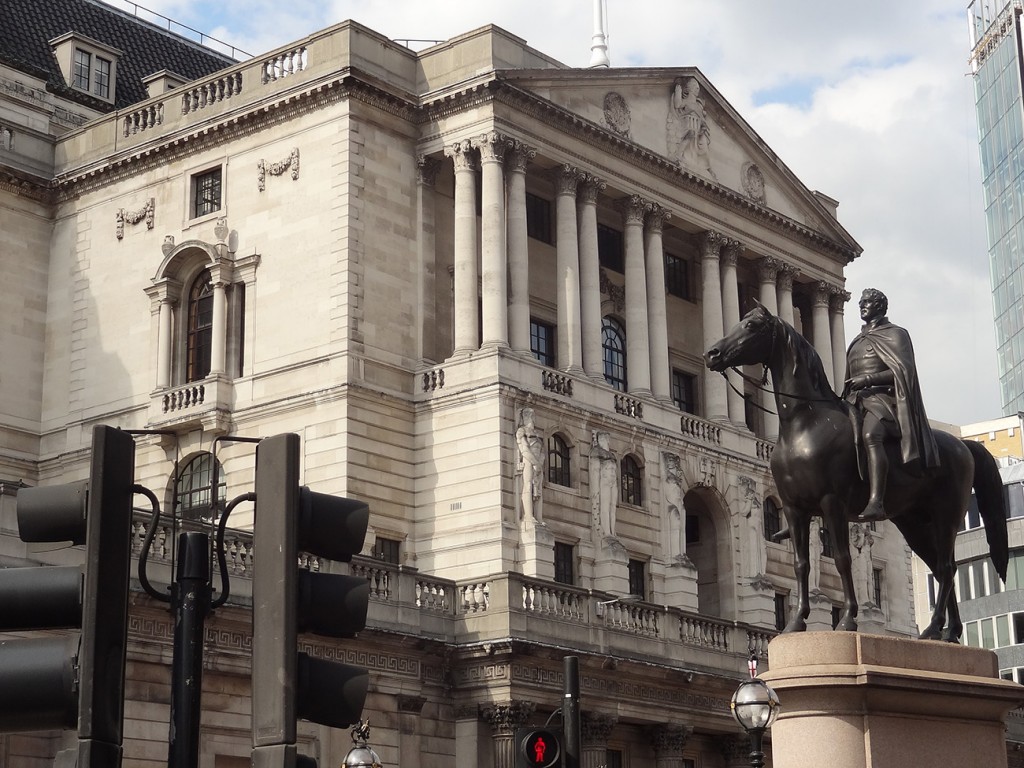 Should the object of monetary policy be simply one of keeping inflation within a target range? In a speech given on 9 October, the Governor of the Bank of England, Sir Mervyn King, questioned whether the interest-rate setting policy of the Monetary Policy Committee (MPC) has been too narrow.
He considered whether interest rates should have been higher before the financial crisis and crash of 2007–9. This could have helped to reduce the asset price bubble and discouraged people from taking out excessive loans.
But then there is the question of the exchange rate. Would higher interest rates have pushed the exchange rate even higher, with damaging effects on exports? Today the trade weighted exchange rate is some 20% lower than before the crash. The government hopes that this will encourage a growth in exports and help to fuel recovery in demand. But as Dr King said, “The strategy of reducing domestic spending and relying more on external demand is facing a real problem because not everyone can do it at the same time.”
 Then there is the question of economic growth. Should a target rate of growth be part of the MPC’s target? Should the MPC adopt a form of Taylor rule which targets a weighted average of the inflation rate and the rate of economic growth?
Certainly monetary policy today in the UK and many other countries is very different from five years ago. With interest rates being close to zero, there is little scope for further reductions; after all, nominal rates cannot fall below zero, otherwise people would be paid for borrowing money! So the focus has shifted to the supply of money. Several attempts have been made to control the money supply through programmes of quantitative easing. Indeed many economists expect further rounds of quantitative easing in the coming months unless there is a substantial pick up in aggregate demand.
So what should be the targets of monetary policy? The following articles look at Dr King’s speech and at various alternatives to a simple inflation target.
Articles
Mervyn King says must face up to monetary policy’s limits’ Reuters, David Milliken and Sven Egenter (9/10/12)
Bank of England’s Mervyn King defends low interest rates pre-crisis The Telegraph, Emma Rowley (9/10/12)
Banks should have had a leverage cap before crash, says Mervyn King The Guardian, Heather Stewart and Phillip Inman (9/10/12)
King Says BOE Must Keep Targeting Inflation as Tool Revamp Looms Bloomberg, Scott Hamilton and Svenja O’Donnell (9/10/12)
After 20 years, time to change Merv’s medicine? Channel 4 News blogs, Faisal Silam (9/10/12)
King signals inflation not primary focus Financial Times, Norma Cohen and Sarah O’Connor (9/10/12)
Should Bank start the helicopter? BBC News, Stephanie Flanders (12/10/12)
Speech
Twenty years of inflation targeting Bank of England speeches, Mervyn King (9/10/12)
Questions
- What are the arguments for using monetary policy to target a particular rate of inflation?
- Would it ever be a good idea to adjust the targeted rate of inflation up or down and if so when and why?
- Explain how a Taylor rule would work and in what ways it is superior or inferior to pursuing a simple inflation target.
- Are attempts to control the money supply through quantitative easing (or tightening) consistent or inconsistent with pursuing an inflation target? Explain.
- What are the arguments for and against abandoning targeting in monetary policy and replacing it with discretionary policy that takes a number of different macroeconomic indicators into account?
 There has been considerable discussion recently about whether the government should introduce a property tax on high value properties. The government, finding it difficult to reduce the public-sector deficit and yet determined to do so, is looking for additional measures to reduce government expenditure or raise tax revenue.
But would it favour a mansion tax as a means of raising additional revenue?
The imposition of such a tax is favoured by both Liberal Democrats and the Labour Party. It is strongly opposed, however, by Conservatives. But just what would such a tax look like and what are the arguments for and against it?
One alternative would be to impose a one-off tax on property valued over a certain amount, such as £2 million. Alternatively it could be levied only for as long as the government is seeking to make substantial inroads into the deficit.
Another would be to add one or more bands to council tax. At present, council tax in England is levied in 8 bands according to the value of a person’s property. The highest band is for property valued over £320,000 in 1991 prices, with the amount of tax due for each band varying from local authority to local authority. (Average UK house prices in 2012 are 135% higher than in 1991.) In Scotland the bands are lower with the top band being for property valued over £212,000 in 1991 prices. In Wales, there is an additional band for property valued over £424,000, but properties are valued in 2003 prices, not 1991 prices.
With low top bands for council tax, people in mansions end up paying the same as people in much more modest property. It would be relatively easy to add additional bands, with the top band applying only to property worth, say, over £1 million or more.
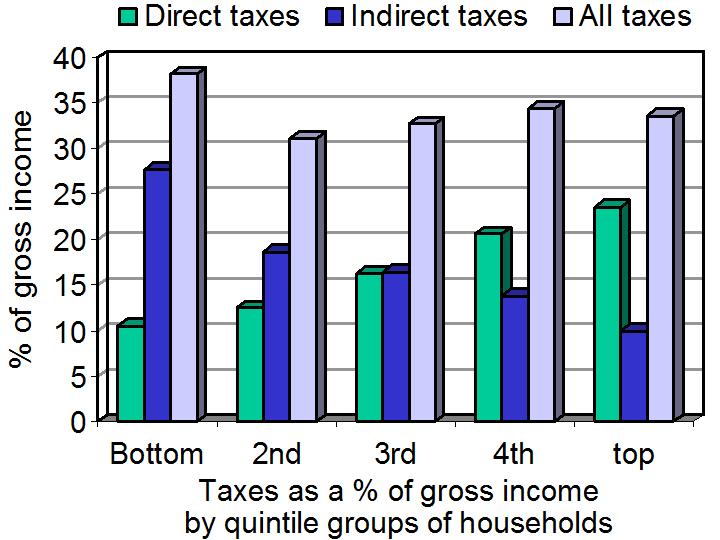 The arguments in favour of a mansion tax are that it is progressive, relatively easy to collect, hard to evade and with minimal disincentive effects. The arguments against are that it would make the tax system ‘too progressive’, would not necessarily be related to an individual’s ability to pay and could have substantial disincentive effects.
The progressiveness of the UK tax system is illustrated in the chart, which looks at the proportion of income paid in direct, indirect and all taxes by quintile groups of households – that is, households grouped into five equal sized groups ranked from lowest to highest gross income. (Click here for a PowerPoint of the chart.)
The following articles look at the debate as it has raged over the past few weeks. Try to unpick the genuine arguments from the political rhetoric!
Articles
Clegg Says U.K. Could Apply Mansion Tax ‘in Five Seconds’ Bloomberg, Robert Hutton (25/9/12)
Two thirds back mansion tax on £1m homes Metro, Tariq Tahir (8/10/12)
Mansion tax would ‘tackle inequality’ This is Tamworth (27/9/12)
Council tax: the easy way to make mansion-dwellers pay Guardian, Simon Jenkins (25/9/12)
Rich must pay fair share in tax BBC Andrew Marr Show, Nick Clegg (23/9/12)
We will get mansion tax on £2 million homes through next budget, promise Lib Dems The Telegraph, Rowena Mason (25/9/12)
Trying to tax the wealthy not worth the price The Scotsman, George Kerevan (31/8/12)
Tax on wealth is true to Tory principles Financial Times, Janan Ganesh (24/9/12)
How would Clegg’s emergency wealth tax work? Guardian, Hilary Osborne (29/8/12)
Labour considers mansion tax on wealthy Financial Times, George Parke (5/9/12)
Conservative conference: Cameron rules out ‘mansion tax’ BBC News (7/10/12)
Don’t make wealth tax a habit Financial Times, Howard Davies (29/8/12)
George Osborne blocks mansion tax, but insists wealthy will pay more The Telegraph, Robert Winnett (8/10/12)
Why George Osborne had to kill the mansion tax The Spectator, Matthew Sinclair (7/10/12)
David Cameron rules out mansion tax and plans further welfare cuts Guardian, Hélène Mulholland (7/10/12)
Viewpoint: Would a wealth tax work? BBC News, Mike Walker (29/8/12)
For all the claims made about wealth taxes, it’s not correct to say the rich are paying their fair share Independent, Jonathan Portes (2/10/12)
Data
House price data links Economics Network
The Effects of Taxes and Benefits on Household Income, 2010/2011 ONS (26/6/12) (see especially Tables 2 and 3 and Table 26 for historical data)
Questions
- Explain the distinction between direct and indirect taxes, and between progressive and regressive taxes. For what reasons do the poor pay a higher proportion of their income in indirect taxes than the rich?
- What forms can a tax on wealth take?
- How progressive are taxes in the UK (see the ONS site in the Data section above)?
- Assess the arguments in favour of a mansion tax.
- Assess the arguments against a mansion tax.
- What type of wealth tax would be hardest to evade?
- What are the likely income and substitution effects of a wealth tax?
 European wine producers have seen one of the worst grape harvests for decades. With exceptionally wet weather in the northern European growing areas and exceptionally hot and dry weather in the southern ones, yields are well down in most countries.