Many developing Asian countries have experienced rapid and yet relatively stable economic growth over a number of years. In other words, this has not been a short-term unsustainable boom associated with the expansionary phase of the business cycle – with aggregate demand expanding more rapidly than aggregate supply. Rather it is the result of a rapid growth in aggregate supply.
Over the period from 2000 to 2011, several Asian countries experienced average annual growth rates of over 4% and some, such as China and India, much more than that, as the following table shows. The table also shows forecasts for the period from 2012 to 2017. The high forecast growth rates are based on a continuing rapid growth in aggregate supply as the countries invest in infrastructure and adopt technologies, many of which have already been developed elsewhere.
But for aggregate supply to continue growing rapidly there must also be a stable growth in aggregate demand. With the recession in the developed world, some of the more open economies of Asia, such as South Korea, Taiwan, Malaysia and Singapore themselves suffered a slowdown or recession as demand for their exports fell. The Malaysian economy, for example, contracted by 1.5% in 2009.
Given the continuing macroeconomic problems in the developed world, many Asian countries are seeing the need to rebalance their economies away from a heavy reliance on exports. China, for example, is putting more emphasis on domestic-led demand growth. Others, such as Indonesia, have already embarked on this route. As The Economist article states:
Household consumption contributed half of the growth of just over 6% Indonesia enjoyed in the year to the third quarter (its eighth consecutive quarter of growth at that pace). Exports have fallen from about 35% of GDP ten years ago to less than a quarter in 2011. Developing Asia’s combined current-account surplus, which reflects its dependence on foreign demand, more than halved from 2008 to 2011 and is expected to fall further this year.
The continuing success story of many developing Asian economies thus lies in a balance of supply-side policies that foster continuing rapid investment and demand-side policies that create a stable monetary and fiscal environment. A crucial question here is whether they can emulate the ‘Great Moderation’ experienced by the Western economies from the mid-1990s to 2007, without creating the conditions for a crash in a few years time – a crash caused by excessive credit and an excessively deregulated financial system that was building up greater and greater systemic risk.
In a previous blog, Anyone got a crystal ball?, we reported on the Bank of England’s and other agencies’ difficulty in making forecasts. As the Governor, Mervyn King, said, “There is just enormous uncertainty out there.”
The Bank of England has just published its November Inflation Report. This quarterly publication gives forecasts of inflation, GDP and other indicators. It is clear that forecasting hasn’t become any easier. In his opening remarks, Dr. King says:
Continuing the recent zig-zag pattern, output growth is likely to fall back sharply in Q4 as the boost from the Olympics in the summer is reversed – indeed output may shrink a little this quarter. It is difficult to discern the underlying picture. It is probably neither as good as the zigs suggest nor as bad as the zags imply.
The Inflation Report looks at the various factors affecting aggregate demand, inflation, unemployment and aggregate supply. It is quite clear on reading the report why there is so much uncertainty.
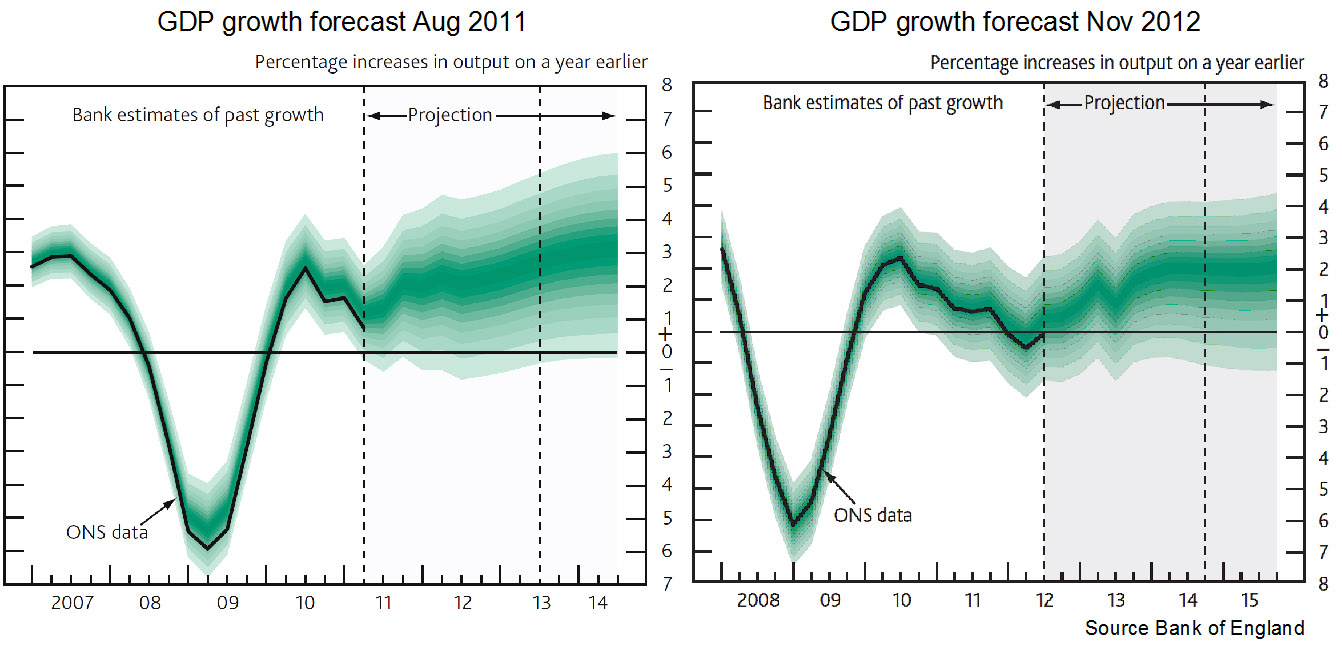
A salutary lesson is to look back at previous forecasts and see just how wrong they have been. The chart above shows the forecasts for GDP made in the Inflation Reports of Nov 2012 and Aug 2011. You can see that they are significantly different and yet just 15 months apart. You might also like to compare the forecasts made a year ago (or even two!) about 2012 with the actual situation today. A good source for this is the Treasury’s Forecasts for the UK economy. This collates the forecasts from a range of independent forecasters.
The inaccuracy of forecasting is an inevitable consequence of a highly interdependent world economy that is subject to a range of economic shocks and where confidence (or lack of it) is a major determinant of aggregate demand. But when firms, governments, individuals and central banks have to make plans, it is still necessary to project into the future and try to forecast as accurately as possible – even though it might mean keeping your fingers firmly crossed.
What was being forecast for economic growth and inflation for 2012 (a) one year ago; (b) two years ago?
What are the main reasons for the inaccuracy of forecasts?
How might forecasting be made more reliable?
If sentiment is a key determinant of economic activity, how might politicians increase the confidence of firms and consumers? What are the political constraints on doing this?
Explain the following statement from the Guardian article: “The problem … is that last decade’s tailwind has become this decade’s headwind.” Why is it difficult to forecast the strength of this ‘headwind’?
How useful is it to use past trends as a guide to the future course of the economy?
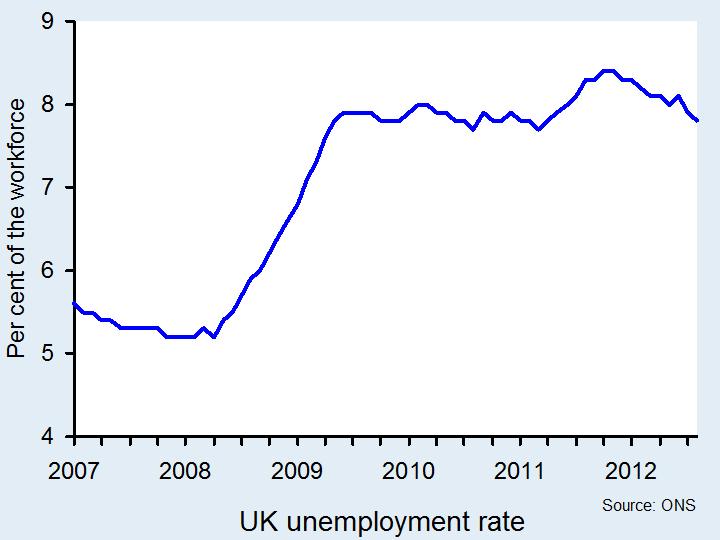
UK Unemployment figures for the July to September period have just been published. Perhaps surprisingly, the rate has fallen to 7.8% from 8.0% in the previous 3-month period. What is more, there have been similar 0.2 percentage-point falls in each of the two 3-month periods prior to that (see chart below).
This would normally suggest that the economy has been growing strongly and faster than the growth in potential output. But, despite positive economic growth in quarter 3 (see A positive turn of events?), the economy has been experiencing a prolonged period of low or negative growth.
So what is the explanation for the fall in unemployment? (For a PowerPoint of the chart, click here)
One reason is a greater flexibility in the labour market than in previous recessions. People are more willing to accept below inflation wage increases, or even nominal wage cuts, in return for greater job security. Others are prepared to reduce their hours.
The other reason is a fall in productivity (i.e. output per hour worked). One explanation is that people are not working so hard because, with a lack of demand, there is less pressure on them to be productive; a similar explanation is that firms are ‘hoarding’ labour in the hope that the market will pick up again.
Another explanation is that employment growth has often occurred in the low productivity industries, such as labour-intensive service industries; another is that when people leave their jobs they are replace by less productive workers on lower wages; another is that workers are making do with ageing equipment, whose productivity is falling, because firms cannot afford to invest in new equipment. An range of possible explanations is given on page 33 of the Bank of England’s November 2012 Inflation Report.
But with many predicting that growth will be negative again in 2012 quarter 4, the fall in unemployment may not continue. Britain may join many other countries in Europe and experience rising unemployment as well as falling output.
What possible explanation are there for the latest fall in unemployment?
What has been happening to employment, both full time and part time?
What are the different ways of measuring productivity? Why will they be affected differently by a fall in the average number of hours worked?
Why might it be in firms’ interests to maintain the level of their workforce despite falling sales?
Assume that there has been a fall in aggregate demand. Compare the resulting effect on consumption of (a) a fall in wages rates; (b) a rise in unemployment. How might the design of the benefit system affect the answer?
More and more food banks are opening every week across the developed world. In the UK alone, there are over 250 food banks. These are run by volunteers and provide food and other basic provisions to those who struggle to feed themselves and their children. The food is donated by people or sometimes supermarkets. Some food banks receive financial help from local authorities.
According to the Trussell Trust, which runs many food banks in the UK, “In 2011-12 food banks fed 128,687 people nationwide, 100% more than the previous year.” But why, in mixed economies, where the State is expected to provide benefits to the poor, do so many people have to resort to food handouts?
Partly the problem is a cut in benefits – a response of many countries to rising public-sector deficits; partly it’s delays in receiving benefits or the complexities in claiming; partly it’s because some people have had their benefits suspended because of a change in their circumstances or changes in the conditions for claiming benefits; partly it’s the inability of people to afford to feed their families properly in times of rising food and energy prices and rising rents, where incomes are not rising in line with the personal rates of inflation that poor households experience; partly it’s the sky-high interest rates that many poor people, often deep in debt, have to pay to continue obtaining credit – often from ‘payday loan companies’ or ‘doorstep lenders’; partly it’s the inability of many poor people to find work which pays enough to feed their families and pay all their other bills.
Food poverty is a real and growing problem. But are food banks the answer? The following videos and articles look at the issues.
Original post Starbucks’ UK sales in 2011 were worth £398m. Costa’s UK sales were worth £377m. But while Costa paid £15m in corporation tax in 2011/12, Starbucks paid nothing! In fact since opening its first coffee shop in the UK in 1998 it has paid just £8.6m in taxes on UK sales of £3bn.
How is this possible? Let’s look at Starbuck’s 2011 UK sales. Even though these were worth £398 million, its costs were recorded as £426.2m, giving a loss of £28.2m. Costa, by contrast, reported a taxable profit of £49.7m.
So is Starbucks a commercial failure in the UK, recording year after year of losses? Not at all. Starbucks regards the UK as a highly profitable part of its business. As the Independent article below states:
…in its briefings to stock market investors and analysts during the past 12 years, Seattle-based Starbucks has consistently stated that its UK unit is “profitable” and three years ago even promoted its UK head, Cliff Burrows, to run its vastly larger US operation.
So how can reported UK losses be reconciled with a profitable UK operation? The answer lies in transfer pricing.
Transfer pricing refers to the prices a company charges itself when goods or services are transferred within the company but from one country to another. By varying the transfer prices, a company can choose where to make its profits. Thus if Starbucks’ US operation charges high prices to its UK operation for various services, such as royalties for the use of branding or for management services, or lends money to its UK operation at high interest rates, Starbucks’ profits will rise in the USA and fall in the UK.
Companies employ tax advisers (see for example) and ‘transfer pricing managers’ to help them move their profits from high tax countries to low tax countries. In Starbuck’s case, by charging its UK operation high prices for such things as ‘use of its logo’ it has chosen to move all its profits out of the UK and thus avoid UK corporation tax.
Apart from denying the UK government tax revenues, the practice by Starbucks distorts competition as competing UK companies, such as Costa, AMT, Caffè Ritazza and the many small independents, do not have the same opportunity for transfer pricing and do pay UK corporation tax. As the Guardian article by Richard Murphy below states:
We do have homegrown coffee shops in the UK. A lot of them. And they have to pay their taxes in full here in the UK. They can’t make payments to offshore entities for the use of their logos or advice on how to add hot water to coffee just to avoid tax: they have to pay in full on what they earn in this country. What Starbucks is doing may be legal, but what it also shows is that business does not operate on a level playing field in the UK.
And, as some of the articles below demonstrate, it’s not just Starbucks. Amazon, Facebook and Google have also been accused of avoiding taxes in the UK by engaging in forms of transfer pricing.
Update On 12 November senior executives from Starbucks, Google and Amazon appeared before the House of Commons Public Accounts Committee to give evidence on their non-payment of corporation tax and their apparent lack of profits in the UK. As you will see from the videos, the MPs were unimpressed by the answers they received.
At the G20 finance ministers meeting in Mexico the previous week, George Osborne, the UK Chancellor, and Wolfgang Schäuble, the German Finance Minister, called for “concerted international co-operation to strengthen international tax standards that at the minute may mean international companies can pay less tax than they would otherwise owe”.
There seems to be mounting international pressure on multinationals to cease using transfer pricing as a means of avoiding paying taxes. Whether it will be successful remains to be seen.
Further Update (June 2013) In June 2013, After continuing criticism of its tax avoidance policies, Starbucks agreed to pay £10m in corporation tax tin 2013/14 and a further £10m in 2014/15.
Explain how a multinational company can use transfer pricing as a means of reducing its overall tax liability.
Why may transfer pricing lead to an inefficient allocation of resources?
What policies can governments adopt to clamp down on the use of transfer pricing to limit their tax liability in their country?
What insights are shed by game theory in explaining why it may be very difficult to reach international agreement to clamp down on tax avoidance?
Is it immoral for companies to seek to minimise their tax liability? What are the limits of economics as a discipline in establishing an answer to this question?
 Many developing Asian countries have experienced rapid and yet relatively stable economic growth over a number of years. In other words, this has not been a short-term unsustainable boom associated with the expansionary phase of the business cycle – with aggregate demand expanding more rapidly than aggregate supply. Rather it is the result of a rapid growth in aggregate supply.