 Wes Streeting and Andy Burnham are seeking to become UK Prime Minister in a challenge to Keir Starmer. They have both responded to an essay by Tony Blair, former Labour Prime Minister, where he argued that current Labour policies were holding back business. But the essay never mentioned inequality. According to Burnham and Streeting, inequality and the related issue of poverty are fundamental to the crises facing society in western democracies. Countries’ economic success is typically measured in terms of growth in GDP. But when the benefits of growth go largely to those at the top of the income scale, while people on lower incomes struggle to make ends meet, this feeds resentment. Populist politicians stoke such resentment and offer simplistic solutions, such as protectionism, blaming outsiders and promising a return to better times.
But just what has happened to inequality over recent years and has poverty deepened? How are inequality and poverty affecting people’s lives and what is the impact on the economy? And what policies should governments follow to tackle the problem?
Income inequality
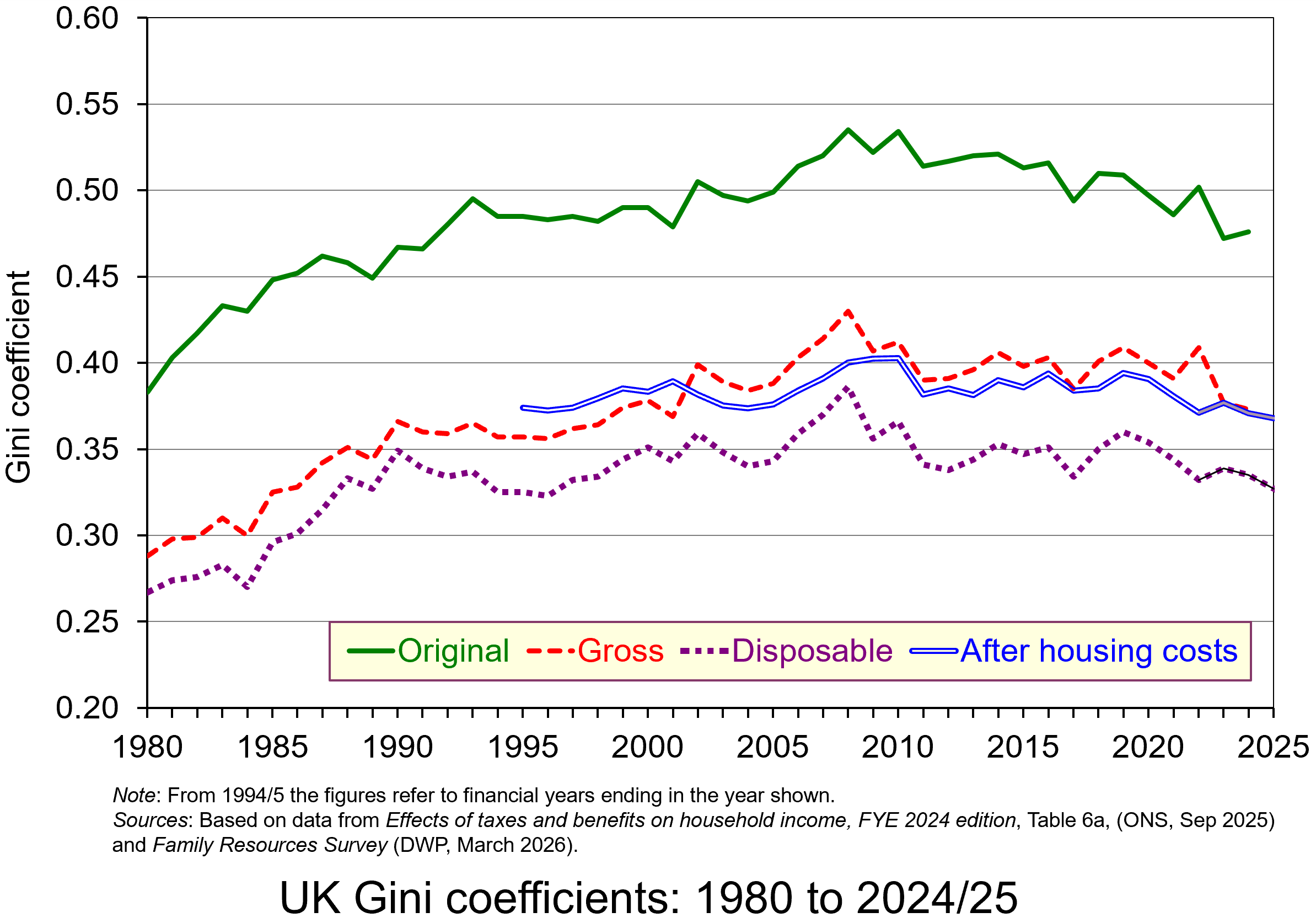 The chart shows UK inequality as given by the Gini coefficient, where 1 represents complete inequality, with one person earning the whole of national income and 0 represents perfect equality, with everyone earning the same. The higher the figure, therefore, the greater the inequality. As you can see, inequality is greatest when looking at original income – that is, income before taxes and benefits. Gross income includes benefits, and disposable income is income after both benefits and taxes. You can see that both benefits and taxes reduce inequality. When we take housing costs into account with the disposable income measure, however, inequality increases.
The chart shows that income inequality rose until the early 2000s, since when there have been only slight changes, although there has been a small decline recently.
The UK has higher income inequality than most high-income countries, although it is not as high as in the USA. It is sixth most unequal of the 38 OECD countries and the most unequal OECD member in Europe.
Globally, in 2025, the top 10% of the world’s population earned 53% of global income, while the bottom half earned just 8%. The reports listed below provide data and analysis on UK and global inequality.
Wealth inequality
 When we turn to wealth, inequality in the UK is even greater. The richest 10% of households hold around 41% of wealth, while the poorest 50% hold just under 10%. The Gini coefficient is around 0.6. This has been drive by a rise in property and share prices and the system of inheritance whereby family wealth can accumulate over the generations.
Globally, the top 10% of the world’s population held 75% of global wealth in 2025, whereas the bottom 50% held just 2%. And a tiny group of people – the top 0.001% of the adult population (about 56,000 individuals) – held about 6% of global wealth, up from 4% in 1995. Such extreme wealth inequality has thus increased.
Inequality and poverty
 There is no single measure of poverty. It could be measured in terms of basic needs. Here poverty would be where a person is unable to afford basic food, shelter, heating and lighting, clothing, footwear and basic toiletries. Normally, however, it is measured in relative terms. A typical measure, and one used by the Joseph Rowntree Foundation, is based on a proportion of median income. Poverty is defined as income below 60% of the median income, with deep poverty below 50% and very deep poverty below 40%.
In 2023/24, 14.2 million people were in poverty (20% of the population), of whom around 4.5 million were children. Of the 14.2 million, 6.8 million people (nearly half) were in very deep poverty,
 Causes of poverty include one or more of the following: low skills or education, low pay, unemployment, inadequate benefits or a benefit system that is confusing or difficult to access, chronic sickness, disability, unavailability or cost of suitable housing, discrimination, a breakdown of personal relationships, substance abuse, abuse from others, a criminal record. Once in poverty, it becomes difficult to escape as people become deskilled, demotivated and judged by society.
But even if people are not earning less than 60% of median income, they can still struggle to escape inequality. Many people have low skills; many routine jobs are being replaced by automation or AI; many graduates face high debts; people struggle to get on the housing ladder; the rising cost of basic items dampens real incomes, especially of the low paid; people may face discrimination of various sorts; people do not have an option of joining a union in their workplace; people may have a large number of dependants.
The policy agenda
If inequality rises up the political agenda in the UK, especially with a potential leadership race in the Labour party, what might politicians focus on? The government has already done the following:
- It has raised the minimum wage (the ‘National Living Wage’) substantially from £10.42 in 2023/24 to £11.44 in 2024/25, to £12.21 in 2025/26 and lowered the age limit from 23 to 21. There have been larger percentage rises for 18–20 year-olds and those under 18.
- The two-child limit to the child benefit element in Universal Credit has been scrapped and so now parents are eligible for benefits for all children.
- The Employment Rights Act has ended exploitative zero-hour contracts by providing rights to guaranteed hours.
- It has expanded free school meal entitlements.
- It has capped Universal Credit debt deductions at 15% of increased incomes (down from 25%) to help the poorest households retain more of their monthly income.
- It has expanded free school meals and made more money available for free nursery place.
- Landlords can no longer evict tenants for no reason; they must have a valid reason such as wanting to sell the property or severe rent arrears.
- Landlords cannot increase rents more than once per year and tenants can appeal excessive or above-market rent increases to an independent tribunal.
But despite these policy measures, many claim that they will do too little to tackle inequality and poverty. Some on the left argue that taxes on property and other forms of wealth will be required to tackle wealth inequality. Others argue that more emphasis on education and training is necessary to provide workers with the skills to earn more in the labour market. Others argue for greater expenditure on public services.
Generally, however, measures to tackle inequality and poverty require government expenditure, which must be funded. This is why many on the centre left argue that economic growth is a necessary condition for any significant redistribution. It is, they argue, the best way of providing the tax revenue to fund redistribution.
Incentives and disincentives
 Many on the right argue that redistributing incomes through higher taxes and benefits will act as a disincentive to work and to invest. As we argue in Essentials of Economics, higher income taxes could discourage people from working and investing; higher wealth taxes could discourage people from saving and investing.
The key to analysing these arguments is to distinguish between the income effect and the substitution effect of raising taxes. Raising income tax does two things.
- It reduces disposable incomes. People therefore are encouraged to work more in an attempt to maintain their consumption of goods and services. This is the income effect. ‘I have to work more to make up for the higher taxes’, a person might say.
- It reduces the opportunity cost of leisure. Since higher income taxes reduce take-home pay, an extra hour taken in leisure now involves a smaller sacrifice in consumption. Thus people may substitute leisure for consumption, and work less. This is called the substitution effect. ‘What is the point of doing overtime’, another person might say, ‘if so much of the overtime pay is going in taxes?’
The relative size of the income and substitution effects is likely to differ for different types of people. For example, the income effect is likely to dominate for those people with a substantial proportion of long-term commitments, such as those with families, with mortgages and other debts. They may feel forced to work more to maintain their disposable income. Clearly for such people, higher taxes are not a disincentive to work. The income effect is also likely to be relatively large for people on higher incomes, for whom an increase in tax rates represents a substantial cut in income.
The substitution effect is likely to dominate for those with few commitments: those whose families have left home, the single, and second income earners in families where that second income is not relied on for ‘essential’ consumption. A rise in tax rates for these people is likely to encourage them to work less.
Although high income earners may work more when there is a tax rise, they may still be discouraged by a steeply progressive tax structure. If they have to pay very high marginal rates of tax, it may simply not be worth their while seeking promotion or working harder.
What those on the centre and left argue is that tackling inequality and poverty requires more than just changing the tax and benefits system. What is required is policies that encourage greater upward social mobility, greater social cohesion and greater expenditure on infrastructure that will support the poor, such as greater expenditure on education and training, on support for very young children, on preventative healthcare, on social housing and on local public transport.
Articles
- Burnham and Streeting accuse Blair of ignoring inequality as they hit back at ex-PM
BBC News, Brian Wheeler and Richard Wheeler (27/5/26)
- Streeting and Burnham accuse Blair of failing to confront inequality in Labour criticism
The Guardian, Jessica Elgot (27/5/26)
- Alan Milburn is right, a young generation has been betrayed. Forget Tony Blair: we must attend to this
The Guardian, Polly Toynbee (28/5/26)
- Blair wants to leave our future to the markets. I believe democracy can still shape our lives for the better
The Guardian, Wes Streeting (27/5/26)
- New evidence on international inequality of opportunity – how does the UK rank?
The Sutton Trust, Opinion, Esme Lillywhite (25/9/25)
- Sorry, comrade Burnham. Inequality is a good thing
Telegraph on archive.today, Luke Johnson (29/5/26)
- Why America’s rich keep getting richer
CNN, David Goldman (29/5/26)
- Concern about inequality is not mere envy
LSE blogs, David Lay Williams (13/1/26)
- Are new technologies fuelling wage inequality? Evidence from Spain
LSE blogs, Raquel Sebastián, Pedro Salas-Rojo, Juan César Palomino and Juan Gabriel Rodríguez (24/3/26)
- 56,000 people own three times more wealth than half of humanity
LSE blogs, Ricardo Gómez-Carrera (12/5/26)
- The broad economic impact of inequality
Harvard Institute for Business in Global Society, Drew Keller and Susan Milligan (8/7/25)
- The New Inequality
Substack, Paul Krugman (31/5/26)
- Global Justice Report: the World Inequality Lab maps a path to €5,000-a-month average incomes for all countries within +1.8°C of warming
World Inequality Lab (4/6/26)
- ‘An equal and habitable world is possible’: academics set out sweeping vision for planetary survival
The Guardian, Jonathan Watts (4/6/26)
Reports
- Living standards, poverty and inequality in the UK
Institute for Fiscal Studies (26/3/26)
- Are fewer people living in poverty than previously thought?
Institute for Fiscal Studies, Jed Michael, Sam Ray-Chaudhuri and Tom Wernham (26/3/26)
- Income inequality in the UK
House of Commons Library, Brigid Francis-Devine (14/5/26)
- The Scale of Economic Inequality in the UK
Equality Trust
- Causes of inequality
Equality Trust
- UK Poverty 2026
Joseph Rowntree Foundation (27/1/26)
- Households Below Average Income: An analysis of the UK income distribution: FYE 1995 to FYE 2025
Department for Work & Pensions (26/3/26)
- Household income inequality, UK: financial year ending 2024
ONS (2/5/25)
- Unequal Chances: Children and economic inequality
UNICEF Innocenti (May 2026)
- To Have and Have Not – How to Bridge the Gap in Opportunities
OECD (22/9/25)
- World Inequality Report 2026
World Inequality Lab, Lucas Chance, Ricardo Gómez-Carrera (Lead Author), Rowaida Moshrif and Thomas Piketty
- The Global Justice Report
World Inequality Lab, L Chance, C Mohren, R Moshrif, M Odersky, T Piketty, A Somanchi, et al (4/6/26)
Data
Questions
- Is the UK becoming more or less equal? Does the answer depend on how inequality is measured?
- Is the world becoming more or less equal?
- Summarise the arguments against redistributing incomes from the rich to the poor.
- Summarise the arguments in favour of redistributing incomes from the rich to the poor.
- Explain the income and substitution effects of making income tax more progressive.
- How is the greater adoption of AI likely to affect income distribution?
- How does social mobility affect income distribution? What measures can be adopted to increase social mobility?
- Compare the relative merits and problems of raising income taxes, wealth taxes and expenditure taxes as means of redistributing incomes more equally.
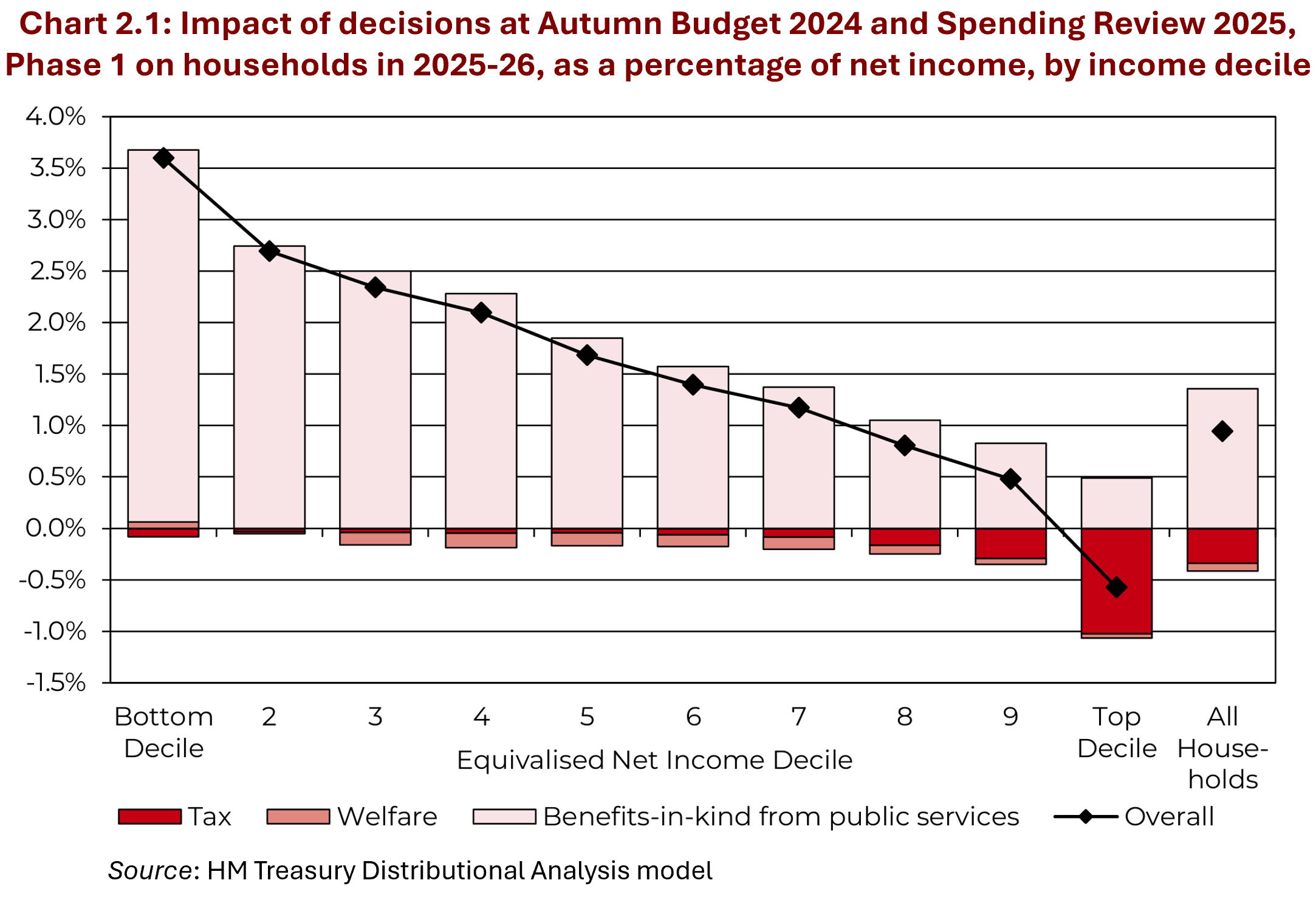 The first Budget of the new UK Labour government was announced on 30 October 2024. It contained a number of measures that will help to tackle inequality. These include extra spending on health and education. This will benefit households on lower incomes the most as a percentage of net income. Increases in tax, by contrast, will be paid predominantly by those on higher incomes. The Chart opposite (taken from the Budget Report) illustrates this. It shows that the poorest 10% will benefit from the largest percentage gain, while the richest 10% will be the only decile that loses.
But one of the major ways of tackling inequality and poverty was raising the minimum wage. The so-called ‘National Living Wage (NLW)’, paid to those aged 21 and over, will rise in April by 6.7% – from £11.44 to £12.41 per hour. The minimum wage paid to those aged 18 to 20 will rise 16.3% from £8.60 to £10.00 and for 16 and 17 year-olds and apprentices it will rise £18% from £6.40 to £7.55.
 It has been an objective of governments for several years to relate the minimum wage to the median wage. In 2015, the Conservative Government set a target of raising the minimum wage rate to 60 per cent of median hourly earnings by 2020. When that target was hit a new one was set to reach two-thirds of median hourly earnings by 2024.
The Labour government has set a new remit for the minimum wage (NLW). There are two floors. The first is the previously agreed one, that the NLW should be at least two-thirds of median hourly earnings; the second is that it should fully compensate for cost of living rises and for expected inflation up to March 2026. The new rate of £12.41 will meet both criteria. According to the Low Pay Commission, ‘Wages have risen faster than inflation over the past 12 months, and are forecast to continue to do so up to March 2026’. This makes the first floor the dominant one: meeting the first floor automatically meets the second.
How effective is the minimum wage in reducing poverty and inequality?
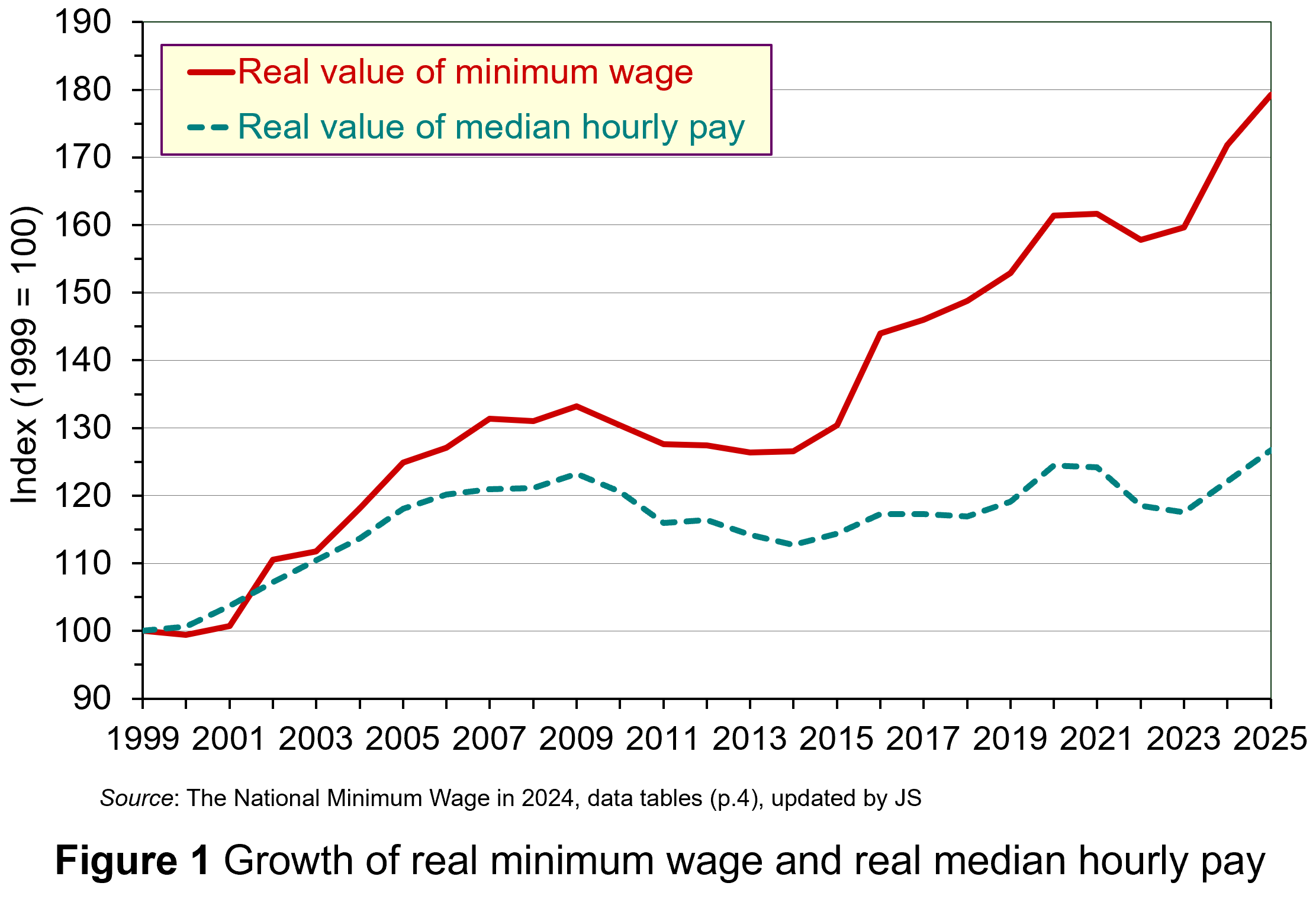 Figure 1 shows the growth in minimum wage rates since their introduction in 1999. The figures are real figures (i.e. after taking into account CPI inflation) and are expressed as an index, with 1999 = 100. The chart also shows the growth in real median hourly pay. (Click here for a Powerpoint.)
As you can see, the growth in real minimum wage rates has considerably exceeded the growth in real median hourly pay. This has had a substantial effect on raising the incomes of the poorest workers and thereby has helped to reduce poverty and inequality.
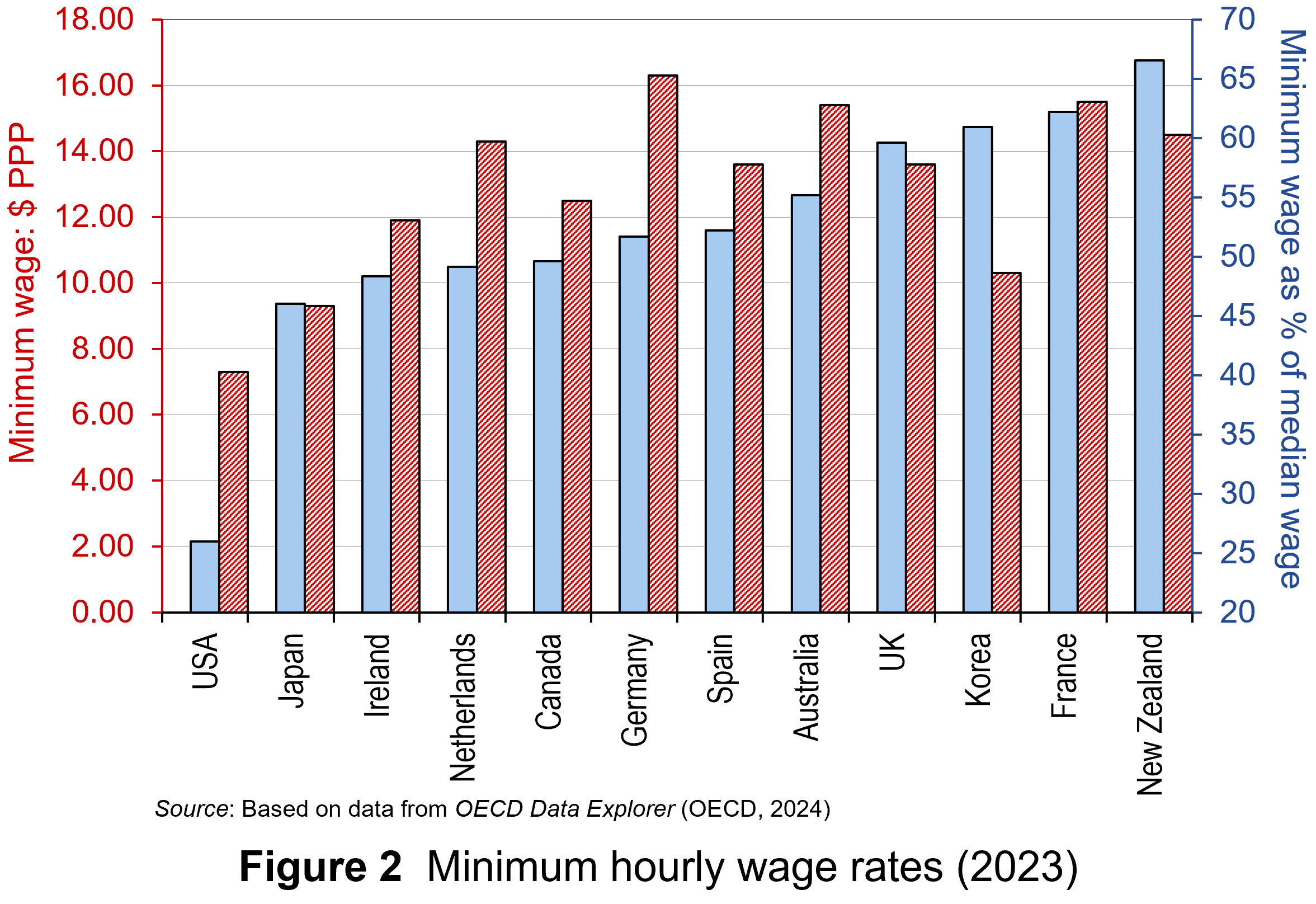 The UK minimum wage compares relatively favourably with other high-income economies. Figure 2 shows minimum wage rates in 12 high-income countries in 2023 – the latest year for which data are available. (Click here for a PowerPoint.) The red bars (striped) show hourly minimum wage rates in US dollars at purchasing-power parity (PPP) rates. PPP rates correct current exchange rates to reflect the purchasing power of each country’s currency. The blue bars (plain) show minimum wage rates as a percentage of the median wage rate. In 2023 the UK had the fourth highest minimum wage of the 12 countries on this measure (59.6%). As we have seen above, the 2025 rate is expected to be 2/3 of the median rate.
Minimum wages are just one mechanism for reducing poverty and inequality. Others include the use of the tax and benefit system to redistribute incomes. The direct provision of services, such as health, education and housing at affordable rents can make a significant difference and, as we have seen, have been a major focus of the October 2024 Budget.
The government has been criticised, however, for not removing the two-child limit to extra benefits in Universal Credit (introduced in 2017). The cap clearly disadvantages poor families with more than two children. What is more, for workers on Universal Credit, more than half of the gains from the higher minimum wages will lost because they will result in lower benefit entitlement. Also the freeze in (nominal) personal income tax allowances will mean more poor people will pay tax even with no rise in real incomes.
Effects on employment: analysis
A worry about raising the minimum wage rate is that it could reduce employment in firms already paying the minimum wage and thus facing a wage rise.
In the case of a firm operating in competitive labour and goods markets, the demand for low-skilled workers is relatively wage sensitive. Any rise in wage rates, and hence prices, by this firm alone would lead to a large fall in sales and hence in employment.
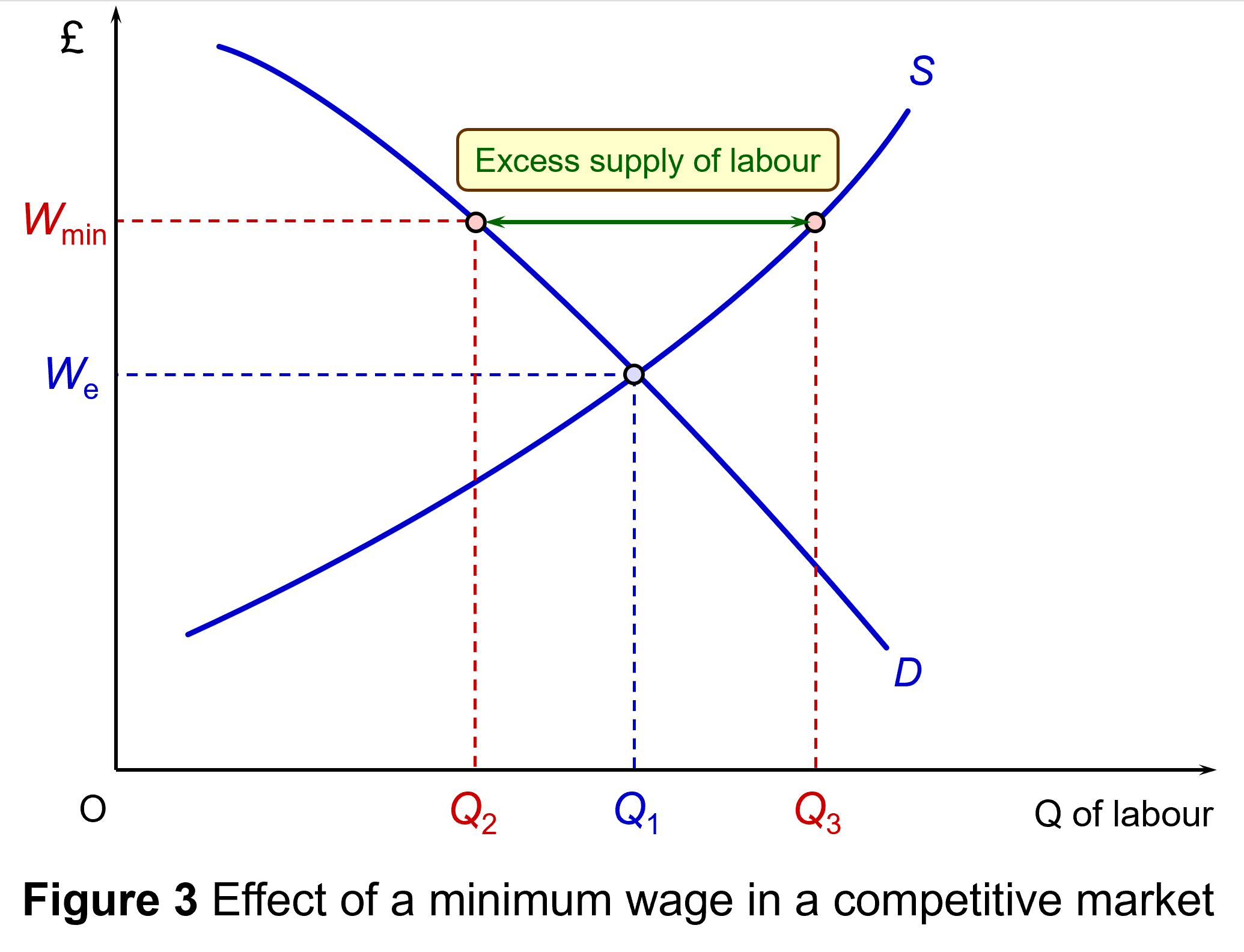 This is illustrated in Figure 3 (click here for a PowerPoint). Assume that the minimum wage is initially the equilibrium wage rate We. Now assume that the minimum wage is raised to Wmin. This will cause a surplus of labour (i.e. unemployment) of Q3 – Q2. Labour supply rises from Q1 to Q3 and the demand for labour falls from Q1 to Q2.
But, given that all firms face the minimum wage, individual employers are more able to pass on higher wages in higher prices, knowing that their competitors are doing the same. The quantity of labour demanded in any given market will not fall so much – the demand is less wage elastic; and the quantity of labour supplied in any given market will rise less – the supply is less wage elastic. Any unemployment will be less than that illustrated in Figure 3. If, at the same time, the economy expands so that the demand-for-labour curve shifts to the right, there may be no unemployment at all.
When employers have a degree of monopsony power, it is not even certain that they would want to reduce employment. This is illustrated in Figure 4: click here for a PowerPoint (you can skip this section if you are not familiar with the analysis).
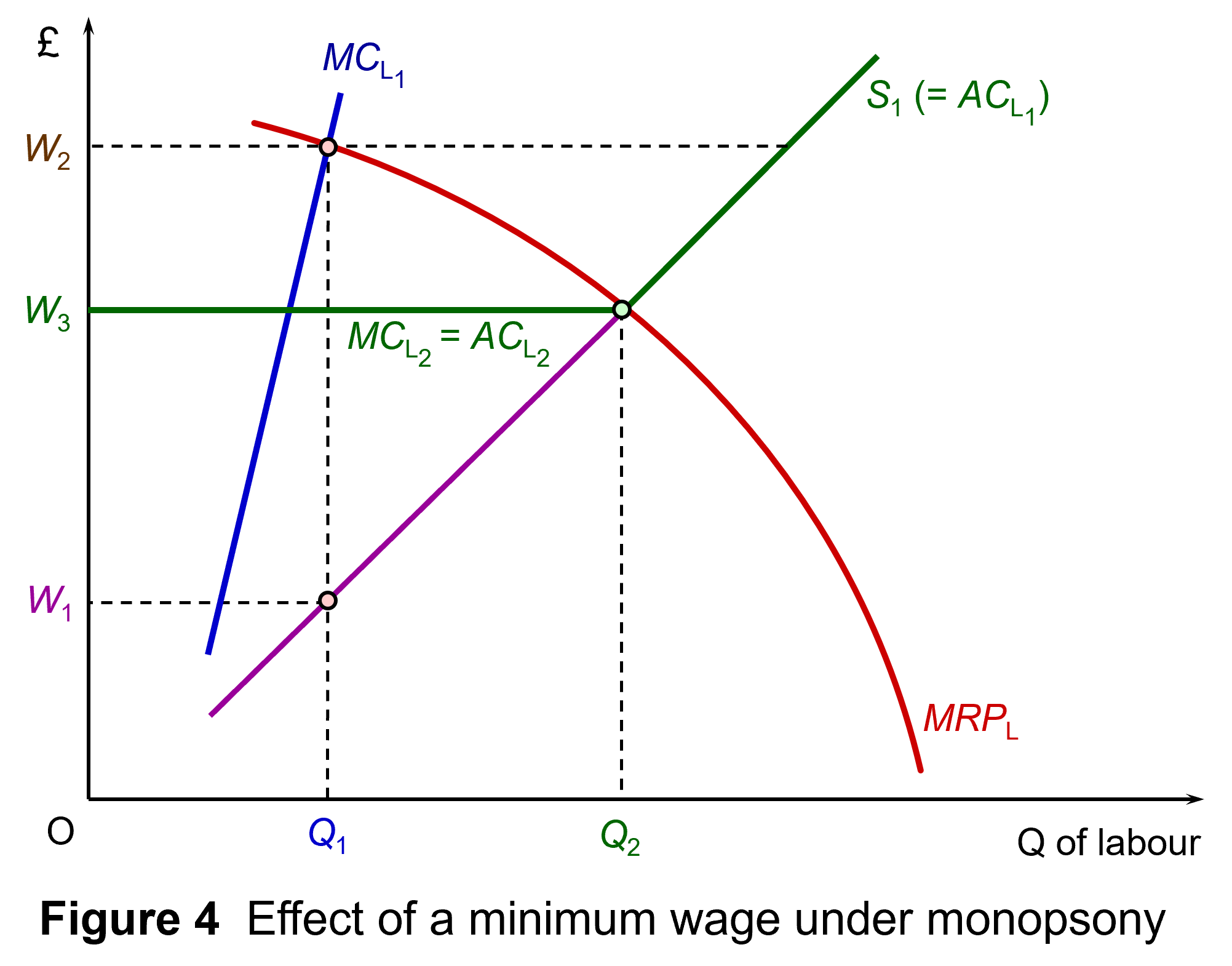 Assume initially that there is no minimum wage. The supply of labour to the monopsony employer is given by curve SL1, which is also the average cost of labour ACL1. A higher employment by the firm will drive up the wage; a lower employment will drive it down. This gives a marginal cost of labour curve of MCL1. Profit-maximising employment will be Q1, where the marginal cost of labour equals the marginal revenue product of labour (MRPL). The wage, given by the SL1 (=ACL1) line will be W1.
Now assume that there is a minimum wage. Assume also that the initial minimum wage is at or below W1. The profit-maximising employment is thus Q1 at a wage rate of W1.
The minimum wage can be be raised as high as W2 and the firm will still want to employ as many workers as at W1. The point is that the firm can no longer drive down the wage rate by employing fewer workers, and so the ACL1 curve becomes horizontal at the new minimum wage and hence will be the same as the MCL curve (MCL2 = ACL2). Profit-maximising employment will be where the MRPL curve equals this horizontal MCL curve. The incentive to cut its workforce, therefore, has been removed.
Again, if we extend the analysis to the whole economy, a rise in the minimum wage will be partly passed on in higher prices or stimulate employers to increase labour productivity. The effect will be to shift the (MRPL) curve upwards to the right, thereby allowing the firm to pass on higher wages and reducing any incentive to reduce employment.
Effects on employment: evidence
There is little evidence that raising the minimum wage in stages will create unemployment, although it may cause some redeployment. In the Low Pay Commission’s 2019 report, 20 years of the National Minimum Wage (see link below), it stated that since 2000 it had commissioned more than 30 research projects looking at the NMW’s effects on hours and employment and had found no strong evidence of negative effects. Employers had adjusted to minimum wages in various ways. These included reducing profits, increasing prices and restructuring their business and workforce.
Along with our commissioned work, other economists have examined the employment effects of the NMW in the UK and have for the most part found no impact. This is consistent with international evidence suggesting that carefully set minimum wages do not have noticeable employment effects. While some jobs may be lost following a minimum wage increase, increasing employment elsewhere offsets this. (p.20)
There is general agreement, however, that a very large increase in minimum wages will impact on employment. This, however, should not be relevant to the rise in the NLW from £11.44 to £12.41 per hour in April 2025, which represents a real rise of around 4.5%. This at worst should have only a modest effect on employment and could be offset by economic growth.
 What, however, has concerned commentators more is the rise in employers’ National Insurance contributions (NICs) that were announced in the Budget. In April 2025, the rate will increase from 13.8% to 15%. Employers’ NICs are paid for each employee on all wages above a certain annual threshold. This threshold will fall in April from £9100 to £5000. So the cost to an employer of an employee earning £38 000 per annum in 2024/25 would be £38 000 + ((£38 000 – £9100) × 0.138) = £41 988.20. For the year 2025/26 it will rise to £38 000 + ((£38 000 – £5000) × 0.15) = £42 950. This is a rise of 2.29%. (Note that £38 000 will be approximately the median wage in 2025/26.)
However, for employees on the new minimum wage, the percentage rise in employer NICs will be somewhat higher. A person on the new NLW of £12.41, working 40 hours per week and 52 weeks per year (assuming paid holidays), will earn an annual wage of £25 812.80. Under the old employer NIC rates, the employer would have paid (£25 812.80 + (£25 812.80 – £9100) × 0.138) = £28 119.17. For the year 2025/26, it will rise to £25 812.80 + ((£25 812.80 – £5000) × 0.15) = £28 934.72. This is a rise of 2.90%.
This larger percentage rise in employers’ wage costs for people on minimum wages than those on median wages, when combined with the rise in the NLW, could have an impact on the employment of those on minimum wages. Whether it does or not will depend on how rapid growth is and how much employers can absorb the extra costs through greater productivity and/or passing on the costs to their customers.
Articles
- National Living Wage to increase to £12.21 in April 2025
Low Pay Commission, Press Release (29/10/24)
- Rachel Reeves hands low-paid a £1,400 boost as minimum wage to rise by 6.7%
Independent, Archie Mitchell and Millie Cooke (31/10/24)
- Minimum wage to rise to £12.21 an hour next year
BBC News, Michael Race (29/10/24)
- What Labour’s first budget means for wages, taxes, business, the NHS and plans to grow the economy – experts explain
The Conversation, Rachel Scarfe et al. (30/10/24)
- The two-child limit: poverty, incentives and cost
Institute for Fiscal Studies, Eduin Latimer and Tom Waters (17/6/24)
UK Government reports and information
Data
Questions
- How is the October 2024 Budget likely to affect the distribution of income?
- What are the benefits and limitations of statutory minimum wages in reducing (a) poverty and (b) inequality?
- Under what circumstances will a rise in the minimum wage lead or not lead to an increase in unemployment?
- Find out what is meant by the UK Real Living Wage (RLW) and distinguish it from the UK National Living Wage (NLW). Why is the RLW higher?
- Why is the median wage rather than the mean wage used in setting the NLW?
 On March 23, Rishi Sunak, the UK’s Chancellor of the Exchequer, delivered his Spring Statement, in which he announced changes to various taxes and grants. These measures were made against the background of rising inflation and falling living standards.
CPI inflation, currently at 6.2%, is still rising and the Office for Budget Responsibility forecasts that inflation will average 7.4% this year. The poor spend a larger proportion of their income on energy and food than the rich. With inflation rates especially high for gas, electricity and basic foodstuffs, the poor have been seen their cost of living rise by considerably more than the overall inflation rate.
According to the OBR, the higher inflation, by reducing real income and consumption, is expected to reduce the growth in real GDP this year from the previously forecast 6% to 3.8% – a much smaller bounce back from the fall in output during the early stages of the pandemic. Despite this growth in GDP, real disposable incomes will fall by an average of £488 per person this year. As the OBR states:
With inflation outpacing growth in nominal earnings and net taxes due to rise in April, real living standards are set to fall by 2.2 per cent in 2022/23 – their largest financial year fall on record – and not recover their pre-pandemic level until 2024/25.
Fiscal measures
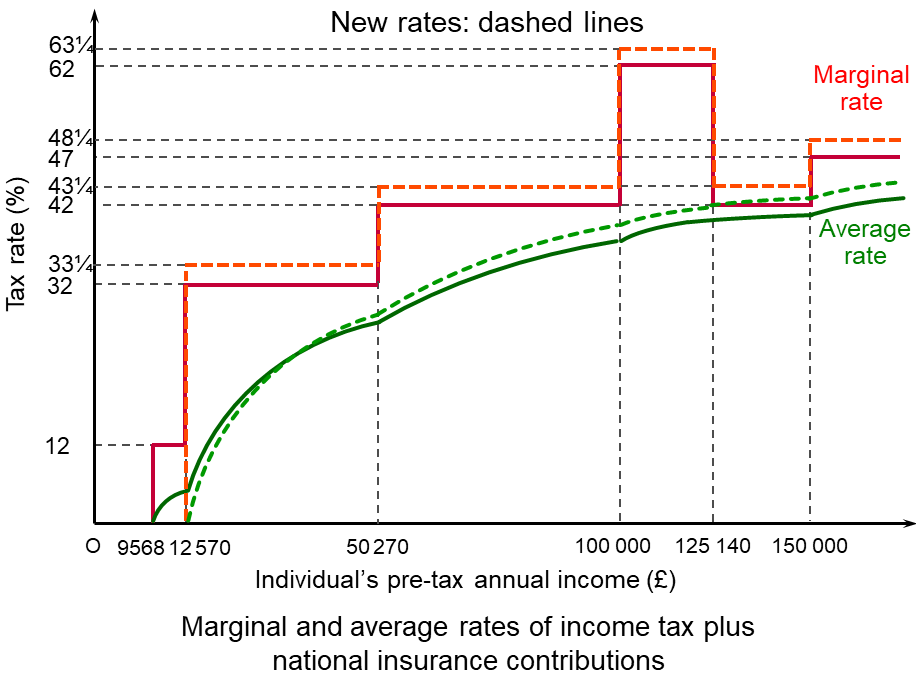 The Chancellor announced a number of measures, which, he argued, would provide relief from rises in the cost of living.
- Previously, the Chancellor had announced that national insurance (NI) would rise by 1.25 percentage points this April. In the Statement he announced that the starting point for paying NI would rise from a previously planned £9880 to £12 570 (the same as the starting point for income tax). This will more than offset the rise in the NI rate for those earning below £32 000. This makes the NI system slightly more progressive than before. (Click here for a PowerPoint of the chart.)
- A cut in fuel duty of 5p per litre. The main beneficiaries will be those who drive more and those with bigger cars – generally the better off. Those who cannot afford a car will not benefit at all, other than from lower transport costs being passed on in lower prices.
- The 5% VAT on energy-saving household measures such as solar panels, insulation and heat pumps will be reduced to zero.
- The government’s Household Support Fund will be doubled to £1bn. This provides money to local authorities to help vulnerable households with rising living costs.
- Research and development tax credits for businesses will increase and small businesses will each get another £1000 per year in the form of employment allowances, which reduce their NI payments. He announced that taxes on business investment will be further cut in the Autumn Budget.
- The main rate of income tax will be cut from 20% to 19% in two years’ time. Unlike the rise in NI, which only affects employment and self-employment income, the cut in income tax will apply to all incomes, including rental and savings income.
Fiscal drag
 The Chancellor announced that public finances are stronger than previously forecast. The rapid growth in tax receipts has reduced public-sector borrowing from £322 billion (15.0 per cent of GDP) in 2020/21 to an expected £128 billion (5.4 per cent of GDP) in 2021/22, £55 billion less than the OBR forecast in October 2021. This reflects not only the growth in the economy, but also inflation, which results in fiscal drag.
Fiscal drag is where rises in nominal incomes mean that the average rate of income tax rises. As tax thresholds for 2022/23 are frozen at 2021/22 levels, a greater proportion of incomes will be taxed at higher rates and tax-free allowances will account for a smaller proportion of incomes. The higher the rate of increase in nominal incomes, the greater fiscal drag becomes. The higher average rate of tax drags on real incomes and spending. On the other hand, the extra tax revenue reduces government borrowing and gives the government more room for extra spending or tax cuts.
The growth in poverty
 With incomes of the poor not keeping pace with inflation, many people are facing real hardship. While the Spring Statement will provide a small degree of support to the poor through cuts in fuel duty and the rise in the NI threshold, the measures are poorly targeted. Rather than cutting fuel duty by 5p, a move that is regressive, removing or reducing the 5% VAT on gas and electricity would have been a progressive move.
Benefits, such as Universal Credit and the State Pension, are uprated each April in line with inflation the previous September. When inflation is rising, this means that benefits will go up by less than the current rate of inflation. This April, benefits will rise by last September’s annual inflation rate of 3.1% – considerably below the current inflation rate of 6.2% and the forecast rate for this year of 7.4%. This will push many benefit recipients deeper into poverty.
One measure rejected by Rishi Sunak is to impose a temporary windfall tax on oil companies, which have profited from the higher global oil prices. Such taxes are used in Norway and are currently being considered by the EU. Tax revenues from such a windfall tax could be used to fund benefit increases or tax reductions elsewhere and these measures could be targeted on the poor.
Articles
- Overview of the March 2022 Economic and fiscal outlook
Office for Budget Responsibility (23/3/22)
- Spring Statement: Key points at a glance
BBC News (23/3/22)
- Spring statement 2022: key points at a glance
The Guardian, Richard Partington and Jessica Elgot (23/3/22)
- People face biggest drop in living standards since 1956
BBC News (23/3/22)
- Spring Statement: Rishi Sunak accused of not doing enough for poorest households
BBC News (24/3/22)
- Chancellor provides minimal help to households on cost of living crisis
Financial Times, Chris Giles (23/3/22)
- Britain’s poorest left to bear brunt of squeeze on cost of living
Financial Times, Delphine Strauss (23/3/22)
- Spring statement: How does Rishi Sunak’s national insurance change affect you?
Sky News, Daniel Dunford and Ganesh Rao (24/3/22)
- Spring Statement 2022 – An initial response from IFS researchers
Institute for Fiscal Studies Press Release, Stuart Adam, Carl Emmerson, Paul Johnson, Helen Miller, Isabel Stockton, Tom Waters and Ben Zaranko (23/3/22)
- Chancellor prioritises his tax cutting credentials over low-and-middle income households with £2 in every £3 of new support going to the top half
Resolution Foundation press release (23/3/22)
- Richest handed £480 boost in Spring Statement, say researchers
Politics.co.uk (23/3/22)
- UK’s most vulnerable face crunch as Rishi Sunak helps better-off
The Guardian, Larry Elliott and Heather Stewart (23/3/22)
- Rishi Sunak tackled over failure to help poorest families
The Guardian, Richard Partington and Aubrey Allegretti (24/3/22)
- A Spring Statement for White Wealth Drivers
Byline Times, Stan Norris (23/3/22)
- Rishi Sunak’s Fiscal Drag Race
Evening Standard, Jack Kessler (23/3/22)
- Rishi Sunak fails to address the hit to living standards
Financial Times, Martin Wolf (23/3/22)
- Why Rishi Sunak refused a windfall tax on oil and gas companies
The New Statesman, Philippa Nuttall (23/3/22)
OBR data and analysis
Questions
- Are the changes made to national insurance by the Chancellor progressive or regressive? Could they have been made more progressive and, if so, how?
- What are the arguments for and against cutting income tax from 20% to 19% in two years’ time rather than reversing the current increases in national insurance at that point?
- What will determine how rapidly (if at all) public-sector borrowing decreases over the next few years?
- What are automatic fiscal stabilisers? How does their effect vary with the rate of inflation?
- Examine the public finances of another country. Are the issues similar to those in the UK? Recommend fiscal policy measures for your chosen country and provide a justification.
In a series of five podcasts, broadcast on BBC Radio 4 in the first week of January 2021, Amol Rajan and guests examine different aspects of inequality and consider the concept of fairness.
As the notes to the programme state:
The pandemic brought renewed focus on how we value those who have kept shelves stacked, transport running and the old and sick cared for. So is now the time to bring about a fundamental shift in how our society and economy work?
The first podcast, linked below, examines the distribution of wealth in the UK and how it has changed over time. It looks at how rising property and share prices and a lightly taxed inheritance system have widened inequality of wealth.
It also examines rising inequality of incomes, a problem made worse by rising wealth inequality, the move to zero-hour contracts, gig working and short-term contracts, the lack of social mobility, austerity following the financial crisis of 2007–9 and the lockdowns and restrictions to contain the coronavirus pandemic, with layoffs, people put on furlough and more and more having to turn to food banks.
Is this rising inequality fair? Should fairness be considered entirely in monetary terms, or should it be considered more broadly in social terms? These are issues discussed by the guests. They also look at what policies can be pursued. If the pay of health and care workers, for example, don’t reflect their value to our society, what can be done to increase their pay? If wealth is very unequally distributed, should it be redistributed and how?
The questions below are based directly on the issues covered in the podcast in the order they are discussed.
Podcast
Questions
- In what ways has Covid-19 been the great ‘unequaliser’?
- What scarring/hysteresis effects are there likely to be from the pandemic?
- To what extent is it true that ‘the more your job benefits other people, the less you get paid’?
- How has the pandemic affected inter-generational inequality?
- How have changes in house prices skewed wealth in the UK over the past decade?
- How have changes in the pension system contributed to inter-generational inequality?
- How has quantitative easing affected the distribution of wealth?
- Why is care work so poorly paid and how can the problem be addressed?
- How desirable is the pursuit of wealth?
- How would you set about defining ‘fairness’?
- Is a mix of taxation and benefits the best means of tackling economic unfairness?
- How would you set about deciding an optimum rate of inheritance tax?
- How do you account for the growth of in-work poverty?
- In what ways could wealth be taxed? What are the advantages and disadvantages of such taxes?
 The UK benefits system is complex and this is just one reason why some people fall through the safety net. There are criticisms that it doesn’t reward work and doesn’t provide sufficient incentives to move off benefits and into work. One rather radical policy that has been discussed in numerous countries is the idea of a ‘Basic Income’.
The Basic Income or Citizen’s Income is a policy where individuals receive a regular payment from the government, essentially for doing nothing. The income is paid and aims to cover basic living costs and on top of this, individuals can then work, earn income and pay tax on it. Experiments of this policy are already in place and over the next few years, we may see many more being trialled and much discussion of the possibility of implementing this in the UK. We tend to be fairly risk averse when it comes to radical policies and so while we may see discussion of it in the UK, I imagine we’ll want to see the relative success of the policy in other countries first!
There are many variations of the scheme and lots of questions that need addressing. Will it encourage people to work more or less? Might it reduce the stigma of claiming benefits, if this is a basic income that everyone receives? Does it simplify the system and hence provide more people with a basic income thus targeting poverty?
Some proposals have this payment as a universal one – non means tested and not conditional on anything.  Other proposals, including one in Finland, sees just the unemployed receive the benefit and appears to be a social experiment to see if such a policy discourages the unemployed from taking jobs. Traditionally individuals receive a benefit if they are out of work, but this benefit can be cut (in some cases quite substantially) if they begin to work. This creates a disincentive to supply labour. However, under the basic income scheme, those who moved into work would continue to receive the basic income payment and hence the disincentive effect is removed. The policy thus creates a basic level of economic security. As Howard Reed and Stewart Lansley argue, it would offer:
“…financial independence and freedom of choice for individuals between work and leisure, education and caring, while recognising the huge value of unpaid work”.
There isn’t universal support for this type of scheme and many remain very cautious about such a radical policy and how the incentives will work. Key questions focus around the marginal rate of income tax that might be needed to finance such a policy. Furthermore, there is discussion about the equity of the policy if it is universal and hence non means-tested.
In Switzerland, the policy was put to a public referendum and it was rejected, with 75% of voters voting against such a policy. However, with changes in the structure of economies and, in many countries, technological change increasingly leading to automation, some argue that such a system will help to protect people. Lord Skidelsky, Professor of Political Economy at Warwick University said:
“Credible estimates suggest it will be technically possible to automate between a quarter and a third of all current jobs in the western world within 20 years … It [Basic Income] would ensure the benefits of automation were shared by the many, not just the few.”
Basic Income or Citizen’s Income is certainly something we are likely to hear a lot about during 2017. Whether or not the time has come for implementation is another matter, but it’s a good idea now to look into both sides and the relative success of the upcoming trials around the world.
8 basic income experiments to watch out for in 2017 Business Insider, Chris Weller (24/1/17)
What is basic income? Basic Income Earth Network (January 2017)
Finland trials basic income for unemployed The Guardian, Jon Henley (3/1/17)
Howard Reed and Stewart Lansley, Universal Basic Income: An idea whose time has come? Citizen’s Income Trust (14/6/16)
Is the world ready for a guaranteed basic income? Freakonomics, Stephen Dubner (13/4/16)
France’s Benoit Hamon rouses Socialists with basic income plan BBC News, Lucy Williamson (24/1/17)
Universal basic income trials being considered in Scotland The Guardian, Libby Brooks (1/1/17)
Questions
- What is basic income?
- What are three advantages of this policy? If you can, try to use a diagram to explain why this is an advantage.
- What are three disadvantages of moving towards this type of policy?
- Why does the provision of benefits affect an individual’s labour supply decision?
- Do you think that income tax would have to rise in order to finance this policy? Do you think high income earners would be prepared to pay a higher rate of tax in order to receive the basic income?
- If the trials showed that the policy did create an incentive to work in countries like Finland, do you think the results would also occur in the UK?
