 Wes Streeting and Andy Burnham are seeking to become UK Prime Minister in a challenge to Keir Starmer. They have both responded to an essay by Tony Blair, former Labour Prime Minister, where he argued that current Labour policies were holding back business. But the essay never mentioned inequality. According to Burnham and Streeting, inequality and the related issue of poverty are fundamental to the crises facing society in western democracies. Countries’ economic success is typically measured in terms of growth in GDP. But when the benefits of growth go largely to those at the top of the income scale, while people on lower incomes struggle to make ends meet, this feeds resentment. Populist politicians stoke such resentment and offer simplistic solutions, such as protectionism, blaming outsiders and promising a return to better times.
But just what has happened to inequality over recent years and has poverty deepened? How are inequality and poverty affecting people’s lives and what is the impact on the economy? And what policies should governments follow to tackle the problem?
Income inequality
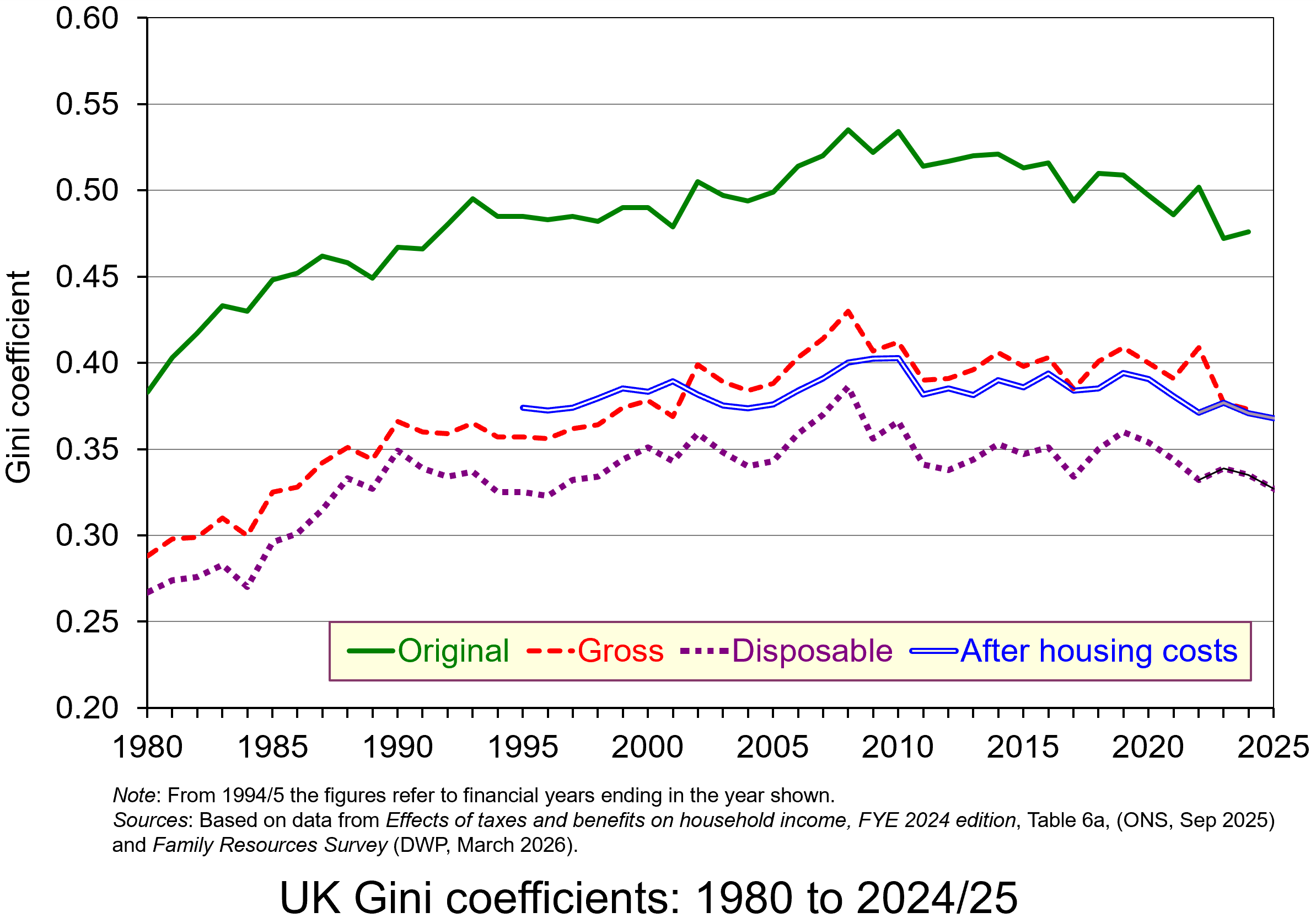 The chart shows UK inequality as given by the Gini coefficient, where 1 represents complete inequality, with one person earning the whole of national income and 0 represents perfect equality, with everyone earning the same. The higher the figure, therefore, the greater the inequality. As you can see, inequality is greatest when looking at original income – that is, income before taxes and benefits. Gross income includes benefits, and disposable income is income after both benefits and taxes. You can see that both benefits and taxes reduce inequality. When we take housing costs into account with the disposable income measure, however, inequality increases.
The chart shows that income inequality rose until the early 2000s, since when there have been only slight changes, although there has been a small decline recently.
The UK has higher income inequality than most high-income countries, although it is not as high as in the USA. It is sixth most unequal of the 38 OECD countries and the most unequal OECD member in Europe.
Globally, in 2025, the top 10% of the world’s population earned 53% of global income, while the bottom half earned just 8%. The reports listed below provide data and analysis on UK and global inequality.
Wealth inequality
 When we turn to wealth, inequality in the UK is even greater. The richest 10% of households hold around 41% of wealth, while the poorest 50% hold just under 10%. The Gini coefficient is around 0.6. This has been drive by a rise in property and share prices and the system of inheritance whereby family wealth can accumulate over the generations.
Globally, the top 10% of the world’s population held 75% of global wealth in 2025, whereas the bottom 50% held just 2%. And a tiny group of people – the top 0.001% of the adult population (about 56,000 individuals) – held about 6% of global wealth, up from 4% in 1995. Such extreme wealth inequality has thus increased.
Inequality and poverty
 There is no single measure of poverty. It could be measured in terms of basic needs. Here poverty would be where a person is unable to afford basic food, shelter, heating and lighting, clothing, footwear and basic toiletries. Normally, however, it is measured in relative terms. A typical measure, and one used by the Joseph Rowntree Foundation, is based on a proportion of median income. Poverty is defined as income below 60% of the median income, with deep poverty below 50% and very deep poverty below 40%.
In 2023/24, 14.2 million people were in poverty (20% of the population), of whom around 4.5 million were children. Of the 14.2 million, 6.8 million people (nearly half) were in very deep poverty,
 Causes of poverty include one or more of the following: low skills or education, low pay, unemployment, inadequate benefits or a benefit system that is confusing or difficult to access, chronic sickness, disability, unavailability or cost of suitable housing, discrimination, a breakdown of personal relationships, substance abuse, abuse from others, a criminal record. Once in poverty, it becomes difficult to escape as people become deskilled, demotivated and judged by society.
But even if people are not earning less than 60% of median income, they can still struggle to escape inequality. Many people have low skills; many routine jobs are being replaced by automation or AI; many graduates face high debts; people struggle to get on the housing ladder; the rising cost of basic items dampens real incomes, especially of the low paid; people may face discrimination of various sorts; people do not have an option of joining a union in their workplace; people may have a large number of dependants.
The policy agenda
If inequality rises up the political agenda in the UK, especially with a potential leadership race in the Labour party, what might politicians focus on? The government has already done the following:
- It has raised the minimum wage (the ‘National Living Wage’) substantially from £10.42 in 2023/24 to £11.44 in 2024/25, to £12.21 in 2025/26 and lowered the age limit from 23 to 21. There have been larger percentage rises for 18–20 year-olds and those under 18.
- The two-child limit to the child benefit element in Universal Credit has been scrapped and so now parents are eligible for benefits for all children.
- The Employment Rights Act has ended exploitative zero-hour contracts by providing rights to guaranteed hours.
- It has expanded free school meal entitlements.
- It has capped Universal Credit debt deductions at 15% of increased incomes (down from 25%) to help the poorest households retain more of their monthly income.
- It has expanded free school meals and made more money available for free nursery place.
- Landlords can no longer evict tenants for no reason; they must have a valid reason such as wanting to sell the property or severe rent arrears.
- Landlords cannot increase rents more than once per year and tenants can appeal excessive or above-market rent increases to an independent tribunal.
But despite these policy measures, many claim that they will do too little to tackle inequality and poverty. Some on the left argue that taxes on property and other forms of wealth will be required to tackle wealth inequality. Others argue that more emphasis on education and training is necessary to provide workers with the skills to earn more in the labour market. Others argue for greater expenditure on public services.
Generally, however, measures to tackle inequality and poverty require government expenditure, which must be funded. This is why many on the centre left argue that economic growth is a necessary condition for any significant redistribution. It is, they argue, the best way of providing the tax revenue to fund redistribution.
Incentives and disincentives
 Many on the right argue that redistributing incomes through higher taxes and benefits will act as a disincentive to work and to invest. As we argue in Essentials of Economics, higher income taxes could discourage people from working and investing; higher wealth taxes could discourage people from saving and investing.
The key to analysing these arguments is to distinguish between the income effect and the substitution effect of raising taxes. Raising income tax does two things.
- It reduces disposable incomes. People therefore are encouraged to work more in an attempt to maintain their consumption of goods and services. This is the income effect. ‘I have to work more to make up for the higher taxes’, a person might say.
- It reduces the opportunity cost of leisure. Since higher income taxes reduce take-home pay, an extra hour taken in leisure now involves a smaller sacrifice in consumption. Thus people may substitute leisure for consumption, and work less. This is called the substitution effect. ‘What is the point of doing overtime’, another person might say, ‘if so much of the overtime pay is going in taxes?’
The relative size of the income and substitution effects is likely to differ for different types of people. For example, the income effect is likely to dominate for those people with a substantial proportion of long-term commitments, such as those with families, with mortgages and other debts. They may feel forced to work more to maintain their disposable income. Clearly for such people, higher taxes are not a disincentive to work. The income effect is also likely to be relatively large for people on higher incomes, for whom an increase in tax rates represents a substantial cut in income.
The substitution effect is likely to dominate for those with few commitments: those whose families have left home, the single, and second income earners in families where that second income is not relied on for ‘essential’ consumption. A rise in tax rates for these people is likely to encourage them to work less.
Although high income earners may work more when there is a tax rise, they may still be discouraged by a steeply progressive tax structure. If they have to pay very high marginal rates of tax, it may simply not be worth their while seeking promotion or working harder.
What those on the centre and left argue is that tackling inequality and poverty requires more than just changing the tax and benefits system. What is required is policies that encourage greater upward social mobility, greater social cohesion and greater expenditure on infrastructure that will support the poor, such as greater expenditure on education and training, on support for very young children, on preventative healthcare, on social housing and on local public transport.
Articles
- Burnham and Streeting accuse Blair of ignoring inequality as they hit back at ex-PM
- Streeting and Burnham accuse Blair of failing to confront inequality in Labour criticism
- Alan Milburn is right, a young generation has been betrayed. Forget Tony Blair: we must attend to this
- Blair wants to leave our future to the markets. I believe democracy can still shape our lives for the better
- New evidence on international inequality of opportunity – how does the UK rank?
- Sorry, comrade Burnham. Inequality is a good thing
- Why America’s rich keep getting richer
- Concern about inequality is not mere envy
- Are new technologies fuelling wage inequality? Evidence from Spain
- 56,000 people own three times more wealth than half of humanity
- The broad economic impact of inequality
- The New Inequality
- Global Justice Report: the World Inequality Lab maps a path to €5,000-a-month average incomes for all countries within +1.8°C of warming
- ‘An equal and habitable world is possible’: academics set out sweeping vision for planetary survival
BBC News, Brian Wheeler and Richard Wheeler (27/5/26)
The Guardian, Jessica Elgot (27/5/26)
The Guardian, Polly Toynbee (28/5/26)
The Guardian, Wes Streeting (27/5/26)
The Sutton Trust, Opinion, Esme Lillywhite (25/9/25)
Telegraph on archive.today, Luke Johnson (29/5/26)
CNN, David Goldman (29/5/26)
LSE blogs, David Lay Williams (13/1/26)
LSE blogs, Raquel Sebastián, Pedro Salas-Rojo, Juan César Palomino and Juan Gabriel Rodríguez (24/3/26)
LSE blogs, Ricardo Gómez-Carrera (12/5/26)
Harvard Institute for Business in Global Society, Drew Keller and Susan Milligan (8/7/25)
Substack, Paul Krugman (31/5/26)
World Inequality Lab (4/6/26)
The Guardian, Jonathan Watts (4/6/26)
Reports
- Living standards, poverty and inequality in the UK
- Are fewer people living in poverty than previously thought?
- Income inequality in the UK
- The Scale of Economic Inequality in the UK
- Causes of inequality
- UK Poverty 2026
- Households Below Average Income: An analysis of the UK income distribution: FYE 1995 to FYE 2025
- Household income inequality, UK: financial year ending 2024
- Unequal Chances: Children and economic inequality
- To Have and Have Not – How to Bridge the Gap in Opportunities
- World Inequality Report 2026
- The Global Justice Report
Institute for Fiscal Studies (26/3/26)
Institute for Fiscal Studies, Jed Michael, Sam Ray-Chaudhuri and Tom Wernham (26/3/26)
House of Commons Library, Brigid Francis-Devine (14/5/26)
Equality Trust
Equality Trust
Joseph Rowntree Foundation (27/1/26)
Department for Work & Pensions (26/3/26)
ONS (2/5/25)
UNICEF Innocenti (May 2026)
OECD (22/9/25)
World Inequality Lab, Lucas Chance, Ricardo Gómez-Carrera (Lead Author), Rowaida Moshrif and Thomas Piketty
World Inequality Lab, L Chance, C Mohren, R Moshrif, M Odersky, T Piketty, A Somanchi, et al (4/6/26)
Data
- Households Below Average Income (HBAI): data tables
- Dataset: Effects of taxes and benefits on household income
- Income and wealth distribution databases
- World Inequality Database
- Economic Inequality
- Poverty & Inequality Platform
Department for Work & Pensions (26/3/26)
ONS (25/9/25)
OECD
WID (2026)
Our World in Data, Joe Hasell, Bertha Rohenkohl, Pablo Arriagada, Esteban Ortiz-Ospina and Max Roser (2024)
World Bank (2026)
Questions
- Is the UK becoming more or less equal? Does the answer depend on how inequality is measured?
- Is the world becoming more or less equal?
- Summarise the arguments against redistributing incomes from the rich to the poor.
- Summarise the arguments in favour of redistributing incomes from the rich to the poor.
- Explain the income and substitution effects of making income tax more progressive.
- How is the greater adoption of AI likely to affect income distribution?
- How does social mobility affect income distribution? What measures can be adopted to increase social mobility?
- Compare the relative merits and problems of raising income taxes, wealth taxes and expenditure taxes as means of redistributing incomes more equally.