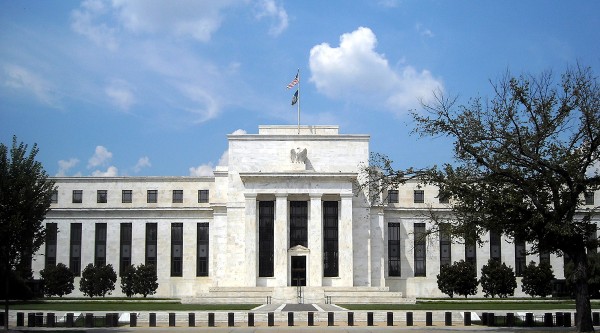
 Donald Trump has suggested that the Fed should cut interest rates by 1 percentage point and engage in a further round of quantitative easing. He wants to see monetary policy used to give a substantial boost to US economic growth at a time when inflation is below target. In a pair of tweets just before the meeting of the Fed to decide on interest rates, he said:
China is adding great stimulus to its economy while at the same time keeping interest rates low. Our Federal Reserve has incessantly lifted interest rates, even though inflation is very low, and instituted a very big dose of quantitative tightening. We have the potential to go up like a rocket if we did some lowering of rates, like one point, and some quantitative easing. Yes, we are doing very well at 3.2% GDP, but with our wonderfully low inflation, we could be setting major records &, at the same time, make our National Debt start to look small!
But would this be an appropriate policy? The first issue concerns the independence of the Fed.
It is supposed to take decisions removed from the political arena. This means sticking to its inflation target of 2 per cent over the medium term – the target it has officially had since January 2012. To do this, it adjusts the federal funds interest rate and the magnitude of any bond buying programme (quantitative easing) or bond selling programme (quantitative tightening).
The Fed is supposed to assess the evidence concerning the pressures on inflation (e.g. changes in aggregate demand) and what inflation is likely to be over the medium term in the absence of any changes in monetary policy. If the Federal Open Market Committee (FOMC) expects inflation to exceed 2 per cent over the medium term, it will probably raise the federal funds rate; if it expects inflation to be below the target it will probably lower the federal funds rate.
In the case of the economy being in recession, and thus probably considerably undershooting the target, it may also engage in quantitative easing (QE). If the economy is growing strongly, it may sell some of its portfolio of bonds and thus engage in quantitative tightening (QT).
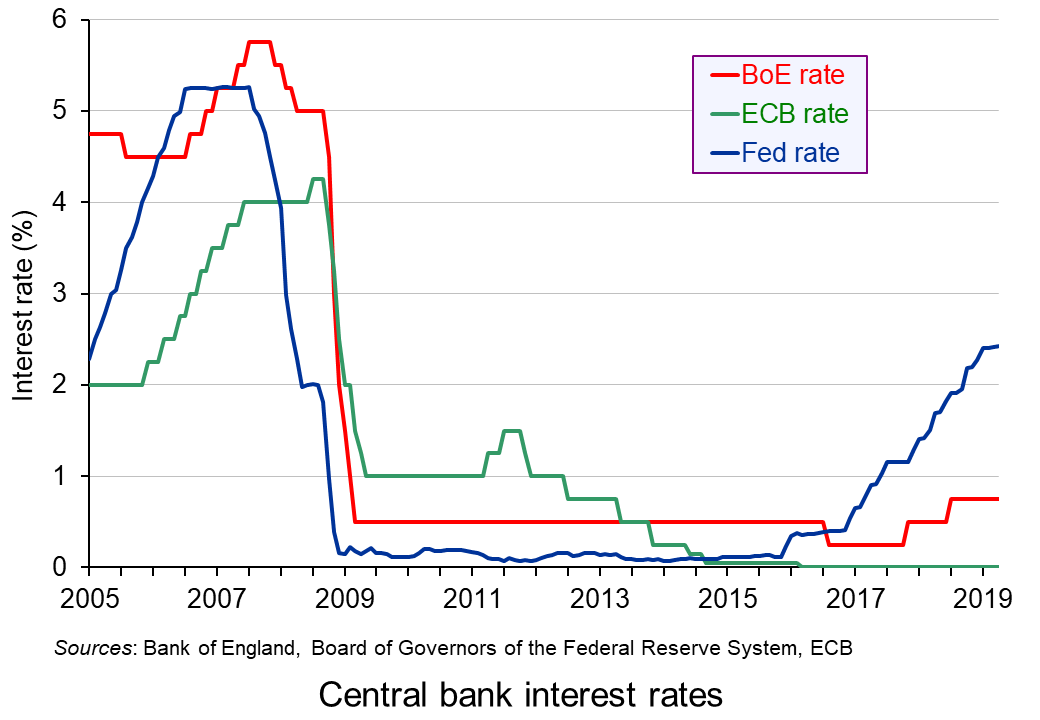 Since December 2015 the Fed has been raising interest rates by 0.25 percentage points at a time in a series of steps, so that the federal funds rate stands at between 2.25% and 2.5% (see chart). And since October 2017, it has also been engaged in quantitative tightening. In recent months it has been selling up to $50 billion of assets per month from its holdings of around $4000 billion and so far has reduced them by around £500 billion. It has, however, announced that the programme of QT will end in the second half of 2019.
This does raise the question of whether the FOMC is succumbing to political pressure to cease QT and put interest rate rises on hold. If so, it is going against its remit to base its policy purely on evidence. The Fed, however, maintains that its caution reflects uncertainty about the global economy.
 The second issue is whether Trump’s proposed policy is a wise one.
Caution about further rises in interest rates and further QT is very different from the strongly expansionary monetary policy that President Trump proposes. The economy is already growing at 3.2%, which is above the rate of growth in potential output, of around 1.8% to 2.0%. The output gap (the percentage amount that actual GDP exceeds potential GDP) is positive. The IMF forecasts that the gap will be 1.4% in 2019 and 1.3% in 2020 and 2021. This means that the economy is operating at above normal capacity working and this will eventually start to drive up inflation. Any further stimulus will exacerbate the problem of excess demand. And a large stimulus, as proposed by Donald Trump, will cause serious overheating in the medium term, even if it does stimulate growth in the short term.
 For these reasons, the Fed resisted calls for a large cut in interest rates and a return to quantitative easing. Instead it chose to keep interest rates on hold at its meeting on 1 May 2019.
But if the Fed had done as Donald Trump would have liked, the economy would probably be growing very strongly at the time of the next US election in November next year. It would be a good example of the start of a political business cycle – something that is rarer nowadays with the independence of central banks.
Articles
FOMC meeting
Questions
- What are the arguments for central bank independence?
- Are there any arguments against central bank independence?
- Explain what is meant by an ‘output gap’? Why is it important to be clear on what is meant by ‘potential output’?
- Would there be any supply-side effects of a strong monetary stimulus to the US economy at the current time? If so, what are they?
- Explain what is meant by the ‘political business’ cycle? Are governments in the UK, USA or the eurozone using macroeconomic policy to take advantage of the electoral cycle?
- The Fed seems to be ending its programme of quantitative tightening (QT). Why might that be so and is it a good idea?
- If inflation is caused by cost-push pressures, should central banks stick rigidly to inflation targets? Explain.
- How are expectations likely to affect the success of a monetary stimulus?
 Growth in the eurozone has slowed. The European Central Bank (ECB) now expects it to be 1.1% this year; in December, it had forecast a rate of 1.7% for 2019. Mario Draghi, president of the ECB, in his press conference, said that ‘the weakening in economic data points to a sizeable moderation in the pace of the economic expansion that will extend into the current year’. Faced with a slowing eurozone economy, the ECB has announced further measures to stimulate economic growth.
First it has indicated that interest rates will not rise until next year at the earliest ‘and in any case for as long as necessary to ensure the continued sustained convergence of inflation to levels that are below, but close to, 2% over the medium term’. The ECB currently expects HIPC inflation to be 1.2% in 2019. It was expected to raise interest rates later this year – probably by the end of the summer. The ECB’s main refinancing interest rate, at which it provides liquidity to banks, has been zero since March 2016, and so there was no scope for lowering it.
 Second, although quantitative easing (the asset purchase programme) is coming to an end, there will be no ‘quantitative tightening’. Instead, the ECB will purchase additional assets to replace any assets that mature, thereby leaving the stock of assets held the same. This would continue ‘for an extended period of time past the date when we start raising the key ECB interest rates, and in any case for as long as necessary to maintain favourable liquidity conditions and an ample degree of monetary accommodation’.
Third, the ECB is launching a new series of ‘quarterly targeted longer-term refinancing operations (TLTRO-III), starting in September 2019 and ending in March 2021, each with a maturity of two years’. These are low-interest loans to banks in the eurozone for use for specific lending to businesses and households (other than for mortgages) at below-market rates. Banks will be able to borrow up to 30% of their eligible assets (yet to be fully defined). These, as their acronym suggests, are the third round of such loans. The second round was relatively successful. As the Barron’s article linked below states:
Banks boosted their long-term borrowing from the ECB by 70% over the course of the program, although they did not manage to increase their holdings of business loans until after TLTRO II had finished disbursing funds in March 2017.
Whether these measures will be enough to raise growth rates in the eurozone depends on a range of external factors affecting aggregate demand. Draghi identified three factors which could have a negative effect.
- Brexit. The forecasts assume an orderly Brexit in accordance with the withdrawal deal agreed between the European Commission and the UK government. With the House of Commons having rejected this deal twice, even though it has agreed that there should not be a ‘no-deal Brexit’, this might happen as it is the legal default position. This could have a negative effect on the eurozone economy (as well as a significant one on the UK economy). Even an extension of Article 50 could create uncertainty, which would also have a negative effect
- Trade wars. If President Trump persists with his protectionist policy, this will have a negative effect on growth in the eurozone and elsewhere.
- China. Chinese growth has slowed and this dampens global growth. What is more, China is a major trading partner of the eurozone countries and hence slowing Chinese growth impacts on the eurozone through the international trade multiplier. The ECB has taken this into account, but if Chinese growth slows more than anticipated, this will further push down eurozone growth.
Then there are internal uncertainties in the eurozone, such as the political and economic uncertainty in Italy, which in December 2018 entered a recession (2 quarters of negative economic growth). Its budget deficit is rising and this is creating conflict with the European Commission. Also, there are likely to be growing tensions within Italy as the government raises taxes.
Faced with these and other uncertainties, the measures announced by Mario Draghi may turn out not to be enough. Perhaps in a few months’ there may have to be a further round of quantitative easing.
Articles
- ECB statement following policy meeting
Reuters, Larry King (7/3/19)
- European Central Bank acts to boost struggling eurozone
BBC News, Andrew Walker (7/3/19)
- The European Central Bank Tries to Avoid Repeating Past Mistakes
Barron’s, Matthew C. Klein (8/3/19)
- ECB pushes back rate hike plans, announces fresh funding for banks
CNBC, Silvia Amaro (7/3/19)
- Why the ECB Followed the Fed’s Flip-Flopping
Bloomberg, Mohamed A. El-Erian (7/3/19)
- Central Banks Don’t Have the Answer and Markets Know It
Bloomberg, Robert Burgess (7/3/19)
- Missing out on monetary normalisation
OMFIF, David Marsh (12/4/19)
- The ECB is attempting to get ahead of event
Financial Times, The editorial board (8/3/19)
- Explainer: What is the fuss about European Central Bank TLTRO loans?
Reuters, Balazs Koranyi (4/3/19)
Videos
ECB publications
Questions
- Investigate the history of quantitative easing and its use by the Fed, the Bank of England and the ECB. What is the current position of the three central banks on ‘quantitative tightening’, whereby central banks sell some of the stock of assets they have purchased during the process of quantitative easing or not replace them when they mature?
- What are TLTROs and what use of them has been made by the ECB? Do they involve the creation of new money?
- What will determine the success of the proposed TLTRO III scheme?
- If the remit of central banks is to keep inflation on target, which in the ECB’s case means below 2% HIPC inflation but close to it over the medium term, why do people talk about central banks using monetary policy to revive a flagging economy?
- What is ‘forward guidance’ by central banks and what determines its affect on aggregate demand?
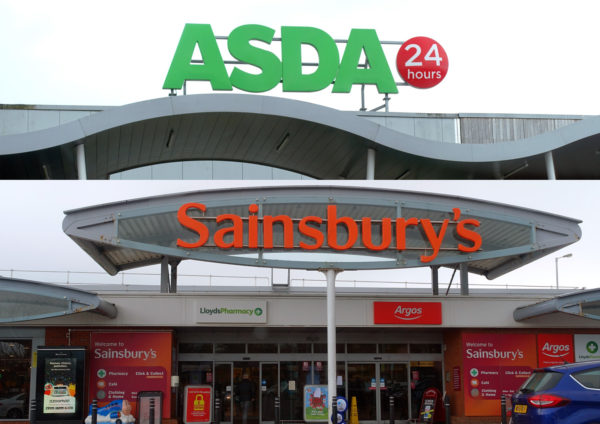 The ‘Big 4’ supermarkets in the UK – Tesco, Sainsbury’s, Asda and Morrisons – have a 69.5% share of the Great Britain grocery market (see data link below). The next four – Aldi, Co-op, Lidl and Waitrose – have a 23.8% share. If two of the Big 4 were to merge, would there be a significant decline in competition? This is a question the Competition and Markets Authority (CMA) has been considering in the light of Sainsbury’s planned £7.3 billion takeover of Asda (owned by the US retailing giant, Walmart).
In a recently published provisional report, the CMA argues that “the merger could lead to a substantial lessening of competition at both a national and local level.” The CMA has concerns that the merger:
…could lead to a worse experience for in-store and online shoppers across the UK through higher prices, a poorer shopping experience, and reductions in the range and quality of products offered. It also has concerns that prices could rise at a large number of Sainsbury’s and Asda petrol stations. …The combined impact means that people could lose out right across the UK and that the deal could also cost shoppers through reduced competition in particular areas where Sainsbury’s and Asda stores overlap.
Sainsbury’s and Asda currently have a combined market share of 31.2%. This is slightly larger than Tesco’s 27.7%. But would this give the merged companies too much market power? Would there not still be intense competition between the new Big 3? 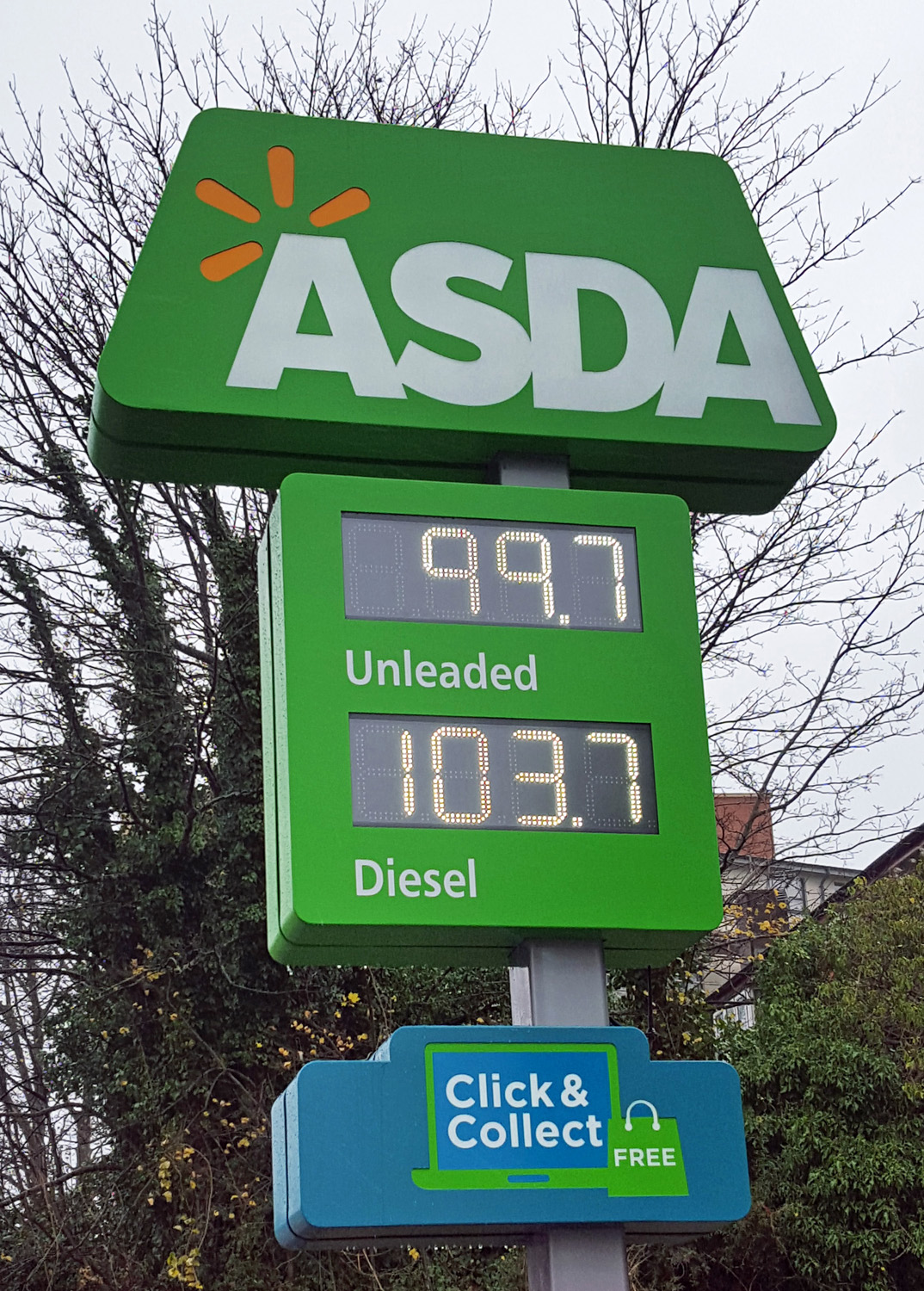 And, with the growth in the German discounters, Aldi and Lidl, as well as competition from Waitrose, the Co-op, Marks & Spencer and Iceland, would there be any significant decline in competition and choice and a rise in prices?
To answer this, it is crucial to define the grocery market. The CMA argues that the major competitors to any Big 4 company are the other Big 4 companies, rather than the German discounters or other supermarkets. Unlike Aldi and Lidl, the Big 4 have a range of facilities, such as fish and meat counters, delivery and a large range of branded products.
At a national level the CMA finds that the merger would reduce competitive pressure, so that a Big 3 would be less competitive than the Big 4, with higher prices and with reduced quality, range of products and in-store services.
At the local level the effects are likely to be serious. Often the consumer has very limited choice of supermarkets at a local level. If a particular area has just two supermarkets, Sainsbury’s and Asda, then the merger of the two could result in a substantial loss of competition. The only alternative for consumers in such areas would be to use small shops, which tend to be more highly priced anyway and do not compete head-to-head with the supermarkets, or to drive to another area or to shop online, depending on how far rival supermarkets are prepared to deliver. Similar arguments apply to supermarket petrol stations, where the only competition to supermarkets is from roadside petrol stations, often selling more highly priced petrol.
 In response to the CMA’s findings, Sainsbury’s chief executive, Mike Coupe, claims that they focus too much on competition between the Big 4 and do not take into account competition from Lidl and Aldi, both of which are expending rapidly and now have a combined market share of 12.8% (compared with 10.7% two years ago).
Sainsbury’s and Asda also claim that there would be considerable scope for economies of scale, with lower costs being achieved through purchasing and logistics. In a joint statement they state that:
Combining Sainsbury’s and Asda would create significant cost savings, which would allow us to lower prices. Despite the savings being independently reviewed by two separate industry specialists, the CMA has chosen to discount them as benefits.
The two companies and other interested parties have until 13 March to respond to the provisional findings. The CMA will then issue its final report by 30 April 2019. If it sticks to its provisional findings, then either the merger will be blocked or the merging companies would have to ‘sell off a significant number of stores and other assets – potentially including one of the Sainsbury’s or Asda brands – to recreate the competitive rivalry lost through the merger.’ This might be very difficult to achieve as the new buyer would have to be big enough to provide effective competition to the remaining Big 3. Perhaps this could be an opportunity for Amazon to move into in-store grocery retailing. Or there may be some private equity company that would like to do the same.
It is likely that if the CMA sticks to its ruling, the two supermarkets will apply for a judicial review of the CMA’s decision.
Articles
Competition and Markets Authority Report
Data
Questions
- In what market segments do the Big 4 supermarkets compete?
- Research earlier investigations of the supermarket sector by the UK competition authorities. What were their findings?
- In what ways might the proposed takeover of Asda by Sainsbury’s affect consumers’ interests (a) at a national level; (b) at the local level?
- What is the ‘GUPPI index’? How is it calculated and how is it used in assessing the effects of the proposed takeover? (See pages 88–91 and 109–11 of the CMA’s Provisional Report and pages I5–I15 of the Appendices and Glossary.)
- Distinguish between horizontal and vertical mergers. How is the distinction relevant in drawing lessons from the Tesco takeover of Booker for the Sainsbury’s takeover of Asda?
- Rather than blocking the takeover, one alternative would be for the CMA to permit it, subject to the sale of specific stores where there are problems of the merger limiting competition in a particular locality. Do you think that this would be a better alternative than blocking the takeover? Explain.

Late January sees the annual global World Economic Forum meeting of politicians, businesspeople and the great and the good at Davos in Switzerland. Global economic, political, social and environmental issues are discussed and, sometimes, agreements are reached between world leaders. The 2019 meeting was somewhat subdued as worries persist about a global slowdown, Brexit and the trade war between the USA and China. Donald Trump, Xi Jinping, Vladimir Putin and Theresa May were all absent, each having more pressing issues to attend to at home.
 There was, however, a feeling that the world economic order is changing, with the rise in populism and with less certainty about the continuance of the model of freer trade and a model of capitalism modified by market intervention. There was also concern about the roles of the three major international institutions set up at the end of World War II: the IMF, the World Bank and the WTO (formerly the GATT). In a key speech, Angela Merkel urged countries not to abandon the world economic order that such institutions help to maintain. The world can only resolve disputes and promote development, she argued, by co-operating and respecting the role of such institutions.
But the role of these institutions has been a topic of controversy for many years and their role has changed somewhat. Originally, the IMF’s role was to support an adjustable peg exchange rate system (the ‘Bretton Woods‘ system) with the US dollar as the international reserve currency. It would lend to countries in balance of payments deficit to allow them to maintain their rate pegged to the dollar unless it was perceived to be a fundamental deficit, in which case they were expected to devalue their currency. The system collapsed in 1971, but the IMF continued to provide short-term, and sometimes longer-term, finance to countries in balance of payments difficulties.
 The World Bank was primarily set up to provide development finance to poorer countries. The General Agreement on Tariffs and Trade (GATT) and then the WTO were set up to encourage freer trade and to resolve trade disputes.
However, the institutions were perceived with suspicion by many developing countries and by more left-leaning developed countries, who saw them as part of the ‘Washington consensus’. Loans from the IMF and World Bank were normally contingent on countries pursuing policies of market liberalisation, financial deregulation and privatisation.
Although there has been some movement, especially by the IMF, towards acknowledging market failures and supporting a more broadly-based development, there are still many economists and commentators calling for more radical reform of these institutions. They advocate that the World Bank and IMF should directly support investment – public as well as private – and support the Green New Deal.
Articles
Address
Questions
- What was the Bretton Woods system that was adopted at the end of World War II?
- What did Keynes propose as an alternative to the system that was actually adopted?
- Explain the roles of (a) the IMF, (b) the World Bank, (c) the WTO (formerly the GATT).
- What is meant by an adjustable exchange rate system?
- Why did the Bretton Woods system collapse in 1971?
- How have the roles of the IMF, World Bank and WTO/GATT evolved since they were founded?
- What reforms would you suggest to each of the three institutions and why?
- What threats are there currently to the international economic order?
- Summarise the arguments about the world economic order made by Angela Merkel in her address to the World Economic Forum.
 With the UK parliament in Brexit gridlock, the Labour opposition is calling for a general election. Although its policy over Brexit and a second referendum is causing splits in the party, the Labour party is generally agreed that pubic expenditure on health, education and transport infrastructure needs to increase – that there needs to be an end to fiscal austerity. However, to fund extra public expenditure would require an increase in taxes and/or an increase in government borrowing.
One of the arguments against increasing government borrowing is that it will increase public-sector debt. The desire to get public-sector debt down as a percentage of GDP has been central to both the Coalition and Conservative governments’ economic strategy. Austerity policies have been based on this desire.
But, in the annual presidential address to the American Economics Association, former chief economist at the IMF, Olivier Blanchard, criticised this position. He has argued for several years that cutting government deficits may weaken already weak economies and that this may significantly reduce tax revenues and potential national income, thereby harming recovery and doing long-term economic damage. Indeed, the IMF has criticised excessively tight fiscal policies for this reason.
In his presidential address, he expanded the argument to consider whether an increase in government borrowing will necessarily increase the cost of servicing government debt. When the (nominal) interest rate (r) on government borrowing is below the nominal rate of economic growth (gn), (r < gn), then even if total debt is not reduced, it is likely that the growth in tax revenues will exceed the growth in the cost of servicing the debt. Debt as a proportion of GDP will fall. The forecast nominal growth rate exceeds the 10-year nominal rate on government bonds by 1.3% in the USA, 2.2% in the UK and 1.8% in the eurozone. In fact, with the exception of a short period in the 1980s, nominal growth (gn) has typically exceeded the nominal interest rate on government borrowing (r) for decades.
When r < gn, this then gives scope for increasing government borrowing to fund additional government spending without increasing the debt/GDP ratio. Indeed, if that fiscal expansion increases both actual and potential income, then growth over time could increase, giving even more scope for public investment.
But, of course, that scope is not unlimited.
Articles
Presidential Address
Questions
- What do you understand by ‘fiscal illusion’?
- What is the justification for reducing government debt as a proportion of GDP?
- What are the arguments against reducing government debt as a proportion of GDP?
- Explain the significance of the relationship between r and gn for fiscal policy and the levels of government debt, government borrowing and the government debt/GDP ratio.
- Under what circumstances would a rise in the budget deficit not lead to a rise in government debt as a proportion of GDP?
- Does Blanchard’s analysis suggest that a combination of both loose monetary policy and loose fiscal policy is desirable?
- Under Blanchard’s analysis, what would limit the amount that governments should increase spending?
 Trump Urges Steep Fed Rate Cut as Central Bankers Hold Meeting