 The latest balance of payments data for the UK show that in the final two quarters of 2013 the current account deficit as a percentage of GDP was the highest ever recorded. In quarter 3 it was 5.6% of GDP and in quarter 4 it was 5.4% of GDP. The previous highest quarterly figures were 5.3% in 1988 Q4 and 5.2% in 1989 Q3. The average current account deficit from 1960 to 2013 has been 1.1% of GDP and from 1980 to 2013 has been 1.6% of GDP.
The current account has four major components: the balance on goods, the balance on services, the balance on current transfers and the balance on income flows (e.g. investment income). The chart below shows the annual balances of each of these components, plus the overall current account balance, from 1960 to 2013.
There are large differences in the balances of these four and the differences seem to be widening. (Click here for a PowerPoint of the chart.)
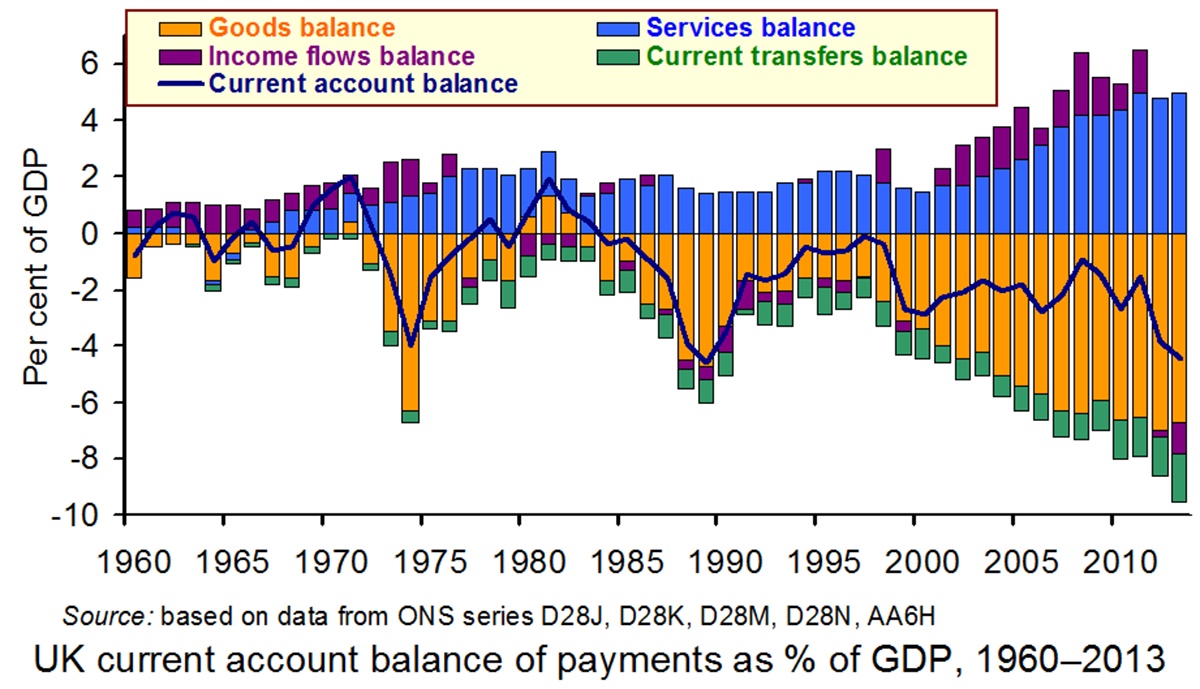
Traditionally the balance on goods has been negative. In 2013 Q3 the deficit on goods reached a record 7.3% of GDP. It fell back somewhat in Q4 to 6.5%, still significantly above the average since 2000 of 5.5%. With the economy still recovering slowly, it would normally be expected that the trade deficit would be low. However, the high exchange rate has made it difficult for UK exporters to compete. Also with consumer confidence returning, imports are rising, again boosted by the high exchange rate, which makes imports cheaper.
The services balance, by contrast, is typically in surplus. In the final two quarters of 2013, the surpluses were 4.9% and 5.1% of GDP respectively. These compare with an average of 3.3% since 2000. It seems that the service sector, which includes banking, insurance, consultancy, advertising, accountancy, law, etc., is much more able to compete in a global environment.
The balance of current transfers to and from such bodies as the EU and UN have traditionally been negative, although as a proportion of GDP this has gradually widened in recent years. In 2013 the deficit was 1.7% compared with an average of 1.0% since 2000.
 The most dramatic change has been in income flows and particularly those from investment. Before the crash in late 2008, the returns to many of the risky investments abroad made by UK financial institutions were very high. Income flows in the 12 months 2007 Q4 to 2008 Q3 averaged a surplus of 2.8% of GDP. They stayed positive, albeit at lower levels, until 2012 Q1, but then became negative as UK institutions reduced their exposure to overseas investments and as earnings in the UK by overseas investors increased. In the last two quarters of 2013, the deficits on income flows were 1.4% and 2.5% of GDP respectively.
How do these figures accord with the Chancellor’s desire to rebalance the economy towards exports? In terms of services, the export performance is good. In terms of goods, however, exports actually fell in the last two quarters from £78.4bn to £74.8bn. Although imports fell too in the final quarter, there is a danger that, with recovery and a high pound, these could begin to rise rapidly
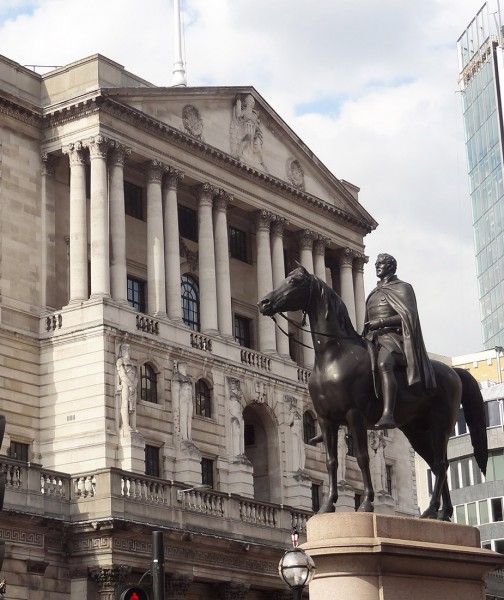 So should the Bank of England attempt to bring the sterling exchange rate down? After all, the exchange rate index has risen from 79.1 in March 2013 to 85.9 in February 2014 (an appreciation of 8.6%). But if it did want to do so, what could it do? The traditional methods of reducing Bank rate and increasing the money supply are not open to it at the present time: Bank rate, at 0.5%, is already about as low as it could go and the Bank has ruled out any further quantitative easing.
The articles consider the latest balance of payments figures and their implications for the economy and for economic policy
Articles
UK current account deficit far bigger than forecast The Guardian, Katie Allen (28/3/14)
UK current account deficit near record high at £22.4bn BBC News (28/3/14)
UK current account gap second widest on record The Telegraph, Szu Ping Chan (28/3/14)
When will the UK pay its way? BBC News, Robert Peston (28/3/14)
Current account deficit crisis creeping up on UK can no longer be ignored The Guardian, Larry Elliott (30/3/14)
Data
Balance of Payments, Q4 and annual 2013 ONS (28/3/14)
Statistical Interactive Database – interest & exchange rates data Bank of England
Questions
- If the current account is in deficit, how is the overall balance of payments in balance (i.e. is in neither deficit nor surplus)?
- If the current account is in record deficit, why has sterling appreciated over recent months? What effect is this appreciation likely to have on the balance on trade in goods and services?
- Why has the balance on investment income deteriorated? In what ways could this be seen as a ‘good thing’?
- To what extent do the balance of payments figures show a rebalancing of the economy in the way the Chancellor would like?
- What could the Bank of England do to bring about a depreciation of sterling?
- What would be the benefits and costs of a depreciation of sterling?
- Why do investors overseas seem so willing to lend to the UK, thereby producing a large surplus on the financial account?
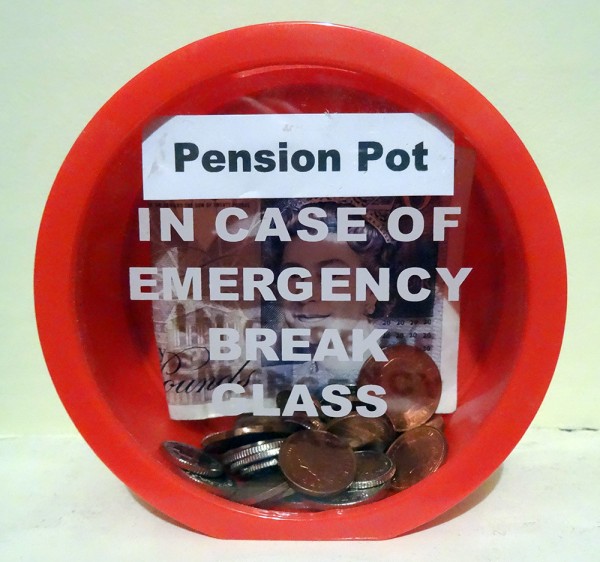 In his Budget on March 19, the Chancellor of the Exchequer, George Osborne, announced fundamental changes to the way people access their pensions. Previously, many people with pension savings were forced to buy an annuity. These pay a set amount of income per month from retirement for the remainder of a person’s life.
But, with annuity rates (along with other interest rates) being at historically low levels, many pensioners have struggled to make ends meet. Even those whose pension pots did not require them to buy an annuity were limited in the amount they could withdraw each year unless they had other guaranteed income of over £20,000.
Now pensioners will no longer be required to buy an annuity and they will have much greater flexibility in accessing their pensions. As the Treasury website states:
This means that people can choose how they access their defined contribution pension savings; for example they could take all their pension savings as a lump sum, draw them down over time, or buy an annuity.
While many have greeted the news as a liberation of the pensions market, there is also the worry that this has created a moral hazard.  When people retire, will they be tempted to blow their savings on foreign travel, a new car or other luxuries? And then, when their pension pot has dwindled and their health is failing, will they then be forced to rely on the state to fund their care?
But even if pensioners resist the urge to go on an immediate spending spree, there are still large risks in giving people the freedom to spend their pension savings as they choose. As the Scotsman article below states:
The risks are all too obvious. Behaviour will change. People who no longer have to buy an annuity will not do so but will then be left with a pile of cash. What to do with it? Spend it? Invest it? There are many new risky choices. But the biggest of all can be summed up in one fact: when we retire our life expectancy continues to grow. For every day we live after 65 it increases by six and a half hours. That’s right – an extra two-and-a-half years every decade.
The glory of an annuity is it pays you an income for every year you live – no matter how long. The problem with cash is that it runs out. Already the respected Institute for Fiscal Studies (IFS) has said that the reform ‘depends on highly uncertain behavioural assumptions about when people take the money’. And that ‘there is a market failure here. There will be losers from this policy’.
We do not have perfect knowledge about how long we will live or even how long we can be expected to live given our circumstances. Many people are likely to suffer from a form of myopia that makes them blind to the future: “We’re likely to be dead before the money has run out”; or “Let’s enjoy ourselves now while we still can”; or “We’ll worry about the future when it comes”.
The point is that there are various market failings in the market for pensions and savings. Will the decisions of the Chancellor have made them better or worse?
Articles
Pension shakeup in budget leaves £14bn annuities industry reeling The Guardian, Patrick Collinson (20/3/14)
Chancellor vows to scrap compulsory annuities in pensions overhaul The Guardian, Patrick Collinson and Harriet Meyer (19/3/14)
Labour backs principle of George Osborne’s pension shakeup The Guardian, Rowena Mason (23/3/14)
Osborne’s pensions overhaul may mean there is little left for future rainy days The Guardian, Phillip Inman (24/3/14)
Let’s celebrate the Chancellor’s bravery on pensions – now perhaps the Government can tackle other mighty vested interests Independent on Sunday, Mary Dejevsky (23/3/14)
A vote-buying Budget The Scotsman, John McTernan (21/3/14)
L&G warns on mis-selling risks of pension changes The Telegraph, Alistair Osborne (26/3/14)
Budget 2014: Pension firms stabilise after £5 billion sell off Interactive Investor, Ceri Jones (20/3/14)
Budget publications
Budget 2014: pensions and saving policies Institute for Fiscal Studies, Carl Emmerson (20/3/14)
Budget 2014: documents HM Treasury (March 2014)
Freedom and choice in pensions HM Treasury (March 2014)
Questions
- What market failures are there in the market for pensions?
- To what extent will the new measures help to tackle the existing market failures in the pension industry?
- Explain the concept of moral hazard. To what extent will the new pension arrangements create a moral hazard?
- Who will be the losers from the new arrangements?
- Assume that you have a choice of how much to pay into a pension scheme. What is likely to determine how much you will choose to pay?
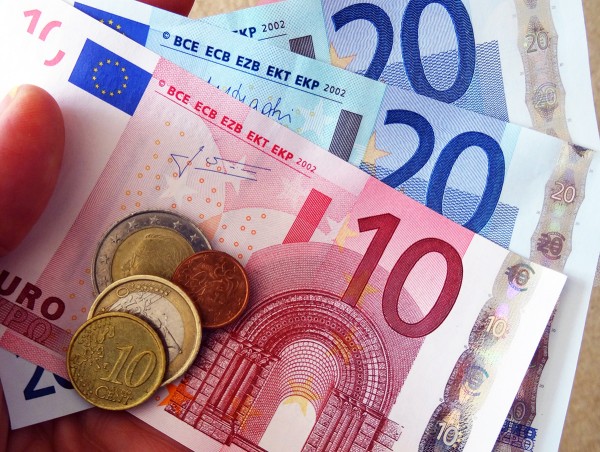 In August 2012, the ECB president, Mario Draghi, said that the ECB would ‘do whatever it takes‘ to hold the single currency together and support the weaker economies, such as Greece, Portugal and Spain. At the same time, he announced the introduction of outright monetary purchases (OMTs), which would involve purchasing eurozone countries’ bonds in the secondary markets. There were no limits specified to such purchases, but they would be sterilised by the sale of other assets. In other words, they would not increase the eurozone money supply. But despite the fanfare when OMTs were announced, they have never been used.
Today, the eurozone economy is struggling to grow. The average annual growth rate across the eurozone is a mere 0.5%, albeit up from the negative rates up to 2013 Q3. GDP is still over 2% below the peak in 2008. Inflation is currently standing at 0.8%, well below the 2% target. The ECB’s interest rate (‘main refinancing operations rate’) is 0.25%.
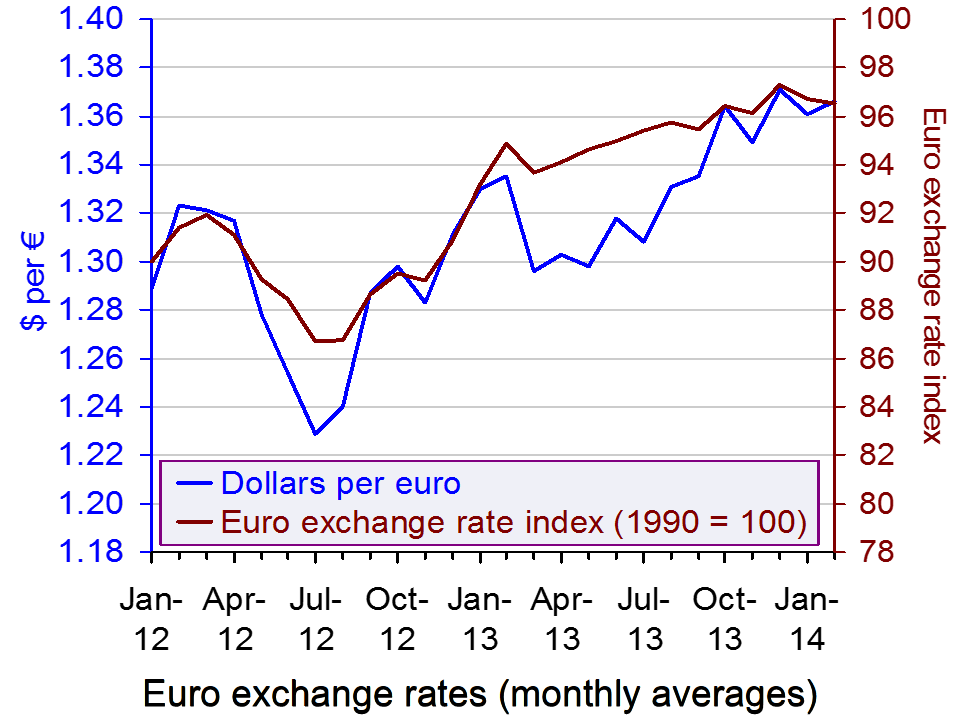
The recovery is hindered by a strong euro. As the chart shows, the euro has been appreciating against the dollar. The euro exchange rate index has also been rising. This has made it harder for the eurozone countries to export.
So what can the ECB do to stimulate the eurozone economy? Other central banks, such as the Bank of England, the US Federal Reserve and the Bank of Japan have all had substantial programmes of quantitative easing. The ECB has not. Perhaps OMTs could be used without sterilisation. The problem here is that there are no eurozone bonds issued by the ECB and hence none that could be purchased, only the bonds of individual member countries. Buying bonds of weaker countries in the eurozone would be seen as favouring these countries and might create a moral hazard.
Reducing interest rates is hardly an option given that they are at virtually zero already. And expansionary fiscal policy in the weaker countries has been ruled out by having to stick to the bailout conditions for these countries, which require the pursuit of austerity policies.
One possibility would be to intervene in the foreign currency market by buying US and other countries’ bonds. This would drive down the euro and provide a stimulus to exports. This option is considered in the Jeffrey Frankel article.
Articles
Why the European Central Bank should buy American The Guardian, Jeffrey Frankel (13/3/14)
Draghi holds course in face of deflation threat Reuters, Paul Carrel and Leika Kihara (13/3/14)
ECB’s Draghi: Strong Euro Pulling Down Euro Zone Inflation Wall Street Journal, Christopher Lawton and Todd Buell (13/3/14)
Draghi Bolstering Guidance Seen as Convincing on Rates Bloomberg, Jeff Black and Andre Tartar (13/3/14)
ECB president Mario Draghi counters euro upswing Financial Times, Claire Jones (13/3/14)
Turning Japanese? Euro zone exporters must hope not Reuters, Neal Kimberley (14/3/14)
Prospect of ECB QE drives eurozone bond rally Financial Times, Laurence Mutkin (12/3/14)
Data
Statistical Data Warehouse ECB
Winter forecast 2014 – EU economy: recovery gaining ground European Commission: Economic and Financial Affairs DG
AMECO online European Commission: Economic and Financial Affairs DG
Questions
- Why is the ECB generally opposed to quantitative easing of the type used by other central banks?
- What is meant by ‘sterilisation’? Why does sterilisation prevent OMTs being classed as a form of quantitative easing?
- Would it be possible for OMTs to be used without sterilisation in such as way as to avoid a moral hazard for the highly indebted eurozone countries?
- Is the eurozone in danger of experiencing deflation?
- What are the dangers of deflation?
- Why does the ECB not cut its main refinancing rate below zero?
- If the ECB buys US bonds, what effect would this have on the euro/dollar exchange rate?
- Would purchasing US bonds affect the eurozone money supply? Explain.
- What other means are there of the ECB stimulating the eurozone economy? How effective would they be likely to be?
 GDP figures are often a poor measure of a country’s economic well-being. By focusing on production, they may not capture the contribution of a range of social and environmental factors to people’s living standards, including the various negative and positive externalities from production and consumption themselves. A case in point is internet innovation: an issue considered in the first linked article below by the eminent economist, Joseph Stiglitz.
The effects of innovations that directly lead to an increase in output are relatively easy to measure. Many innovations, however, may allow those with power to consolidate that power, resulting in less competition and a possible decline in welfare. If, for example, companies such as Amazon, invest in online retailing and gain a first-mover advantage, they may be able to use this power to drive out competitors. In other words, innovations may not simply lower the cost of production and hence prices: they may even lead to an increase in prices.
Then there are innovations, such as faster broadband, that result in higher quality. While higher quality in one sphere may lead to higher output elsewhere, in many cases it is just improving the experience of consumers without being reflected in a way that can be easily measured.
Some innovations may be judged as socially harmful. Thus improved gaming functionality and realism may encourage people to spend more time online. The social and health implications of this may be considered as undesirable and resulting in a reduction in well-being. Of course, many gamers would disagree!
The point is that technological innovations often result in a change in tastes. These changes in tastes may involve negative externalities, themselves very hard to quantify. Consequently,  resulting changes to GDP may be a very poor indicator of changes in social well-being.
The articles below consider some of these issues. The Stiglitz article gives an example of innovation in financial services. Although highly profitable for many working in the sector – at least until the crash of 2008/9 – according to the author, these innovations led to both lower GDP growth and a net contribution to social welfare that was negative.
The benefits of internet innovation are hard to spot in GDP statistics The Guardian, Joseph Stiglitz (10/3/14)
Economist argues for happiness over GDP Yale Daily News, Joyce Guo (19/2/14)
‘GDP: A Brief But Affectionate History’ by Diane Coyle and ‘The Leading Indicators: A Short History of the Numbers That Rule Our World’ by Zachary Karabell Washington Post, Tyler Cowen (21/2/14)
Emerging Markets: Income Returns To Innovation (GDP Per Capita Vs. Innovation Index) Seeking Alphz, Jon Harrison (4/3/14)
Questions
- What does GDP measure?
- What factors affecting the welfare of society are not measured in GDP?
- What alternative indicators are there to GDP as a measure of living standards?
- How would you set about measuring the effects on living standards of a technological revolution, such as the ability to access 4G on the move on laptops and smartphones (e.g. on trains)?
- How should the net benefits of installing more ATMs (cash machines) be calculated?
- Revisit the blog Time to leave GDP behind? and answer question 8.
- Referring to the Jon Harrison article, how would you construct an innovation index? How is innovation related too GDP per capita?
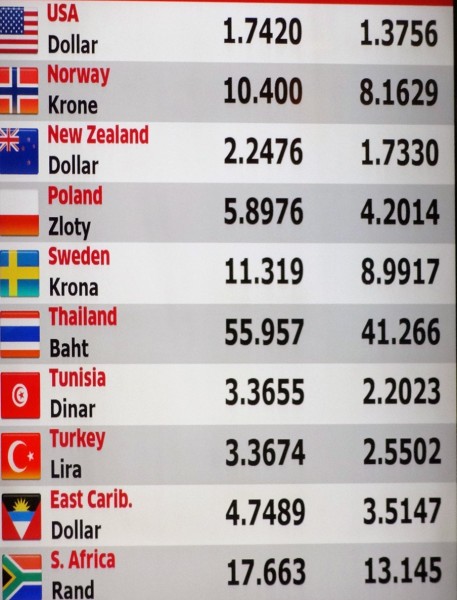 According to latest evidence from the Bank for International Settlements, in April 2013 some £3.2 trillion ($5.3 trillion) of foreign exchange was traded daily on global foreign exchange (forex) markets. About 40% of forex dealing goes through trading rooms in London. This market is highly profitable for the UK economy. But all is not well with the way people trade. There is a scandal about rate fixing.
Exchange rates on the forex market are freely determined by demand and supply and fluctuate second by second, 24 hours a day, except for weekends. Nevertheless, once a day rates are fixed for certain trades. At 4pm GMT a set of reference rates is set for corporate customers by banks and other traders. The rates are set at the free market average over the one minute from 16:00 to 16:01. The allegation is that banks have been colluding, through text messaging and chat rooms, to manipulate the market over that one minute.
Since the early summer of 2013, the Financial Conduct Authority (FCA) in the UK, along with counterparts in the USA, Switzerland, Hong Kong and elsewhere, has been looking into these allegations. Last week (4/3/14), the Bank of England suspended a member of its staff as part of its own investigation into potential rigging of the foreign exchange market. The allegation is not that the staff member(s) were involved in the rigging but that they might have known about it.The Bank said that, “An oversight committee will lead further investigations into whether bank officials were involved in forex market manipulation or were aware of manipulation, or at least the potential for such manipulation.”
Meanwhile, the House of Commons Treasury Select Committee has been questioning Bank of England staff, including the governor, Mark Carney, about the scandal. Speaking to the Committee, Martin Wheatley, head of the FCA said that the investigation over rigging had been extended to 10 banks and that the allegations are every bit as bad as they have been with Libor.
Forex rigging ‘as serious as’ Libor scandal: Carney Yahoo News, Roland Jackson (11/2/14)
Forex manipulation: How it worked HITC (Here Is The City), Catherine Boyle (11/3/14)
Bank of England Chief Grilled Over Forex Scandal ABC News, Danica Kirka (11/3/14)
Carney Faces Grilling as Currency Scandal Snares BOE Bloomberg, Scott Hamilton and Suzi Ring (10/3/14)
UK financial body urges quick action over foreign exchange ‘fixing’ Reuters, Huw Jones (11/3/14)
Timeline -The FX “fixing” scandal Reuters, Jamie McGeever (11/3/14)
Forex in the spotlight Financial Times (16/2/14)
Forex scandal: What is that all about? BBC News (11/3/14)
 Bank of England in shake-up after rate manipulation criticism BBC News (11/3/14)
Mark Carney faces Forex questions from MPs BBC News, Hugh Pym (11/3/14)
Bank of England’s Paul Fisher: ‘It’s not our job to go hunting for market wrongdoing’ Independent, Russell Lynch , Ben Chu (11/3/14)
Questions
- For what reasons would sterling appreciate against the dollar?
- Most of forex trading is for speculative purposes, rather than for financing trade or investment. Why is this and does it benefit international trade?
- If foreign exchange rates fluctuate, is it not a good thing that banks collude to agree the 4pm fixed rate? Explain.
- What was the Libor scandal? Why are some people arguing that the current forex scandal is worse?
- What can the FCA do to prevent collusion over exchange rates?
 The latest balance of payments data for the UK show that in the final two quarters of 2013 the current account deficit as a percentage of GDP was the highest ever recorded. In quarter 3 it was 5.6% of GDP and in quarter 4 it was 5.4% of GDP. The previous highest quarterly figures were 5.3% in 1988 Q4 and 5.2% in 1989 Q3. The average current account deficit from 1960 to 2013 has been 1.1% of GDP and from 1980 to 2013 has been 1.6% of GDP.
 The most dramatic change has been in income flows and particularly those from investment. Before the crash in late 2008, the returns to many of the risky investments abroad made by UK financial institutions were very high. Income flows in the 12 months 2007 Q4 to 2008 Q3 averaged a surplus of 2.8% of GDP. They stayed positive, albeit at lower levels, until 2012 Q1, but then became negative as UK institutions reduced their exposure to overseas investments and as earnings in the UK by overseas investors increased. In the last two quarters of 2013, the deficits on income flows were 1.4% and 2.5% of GDP respectively.
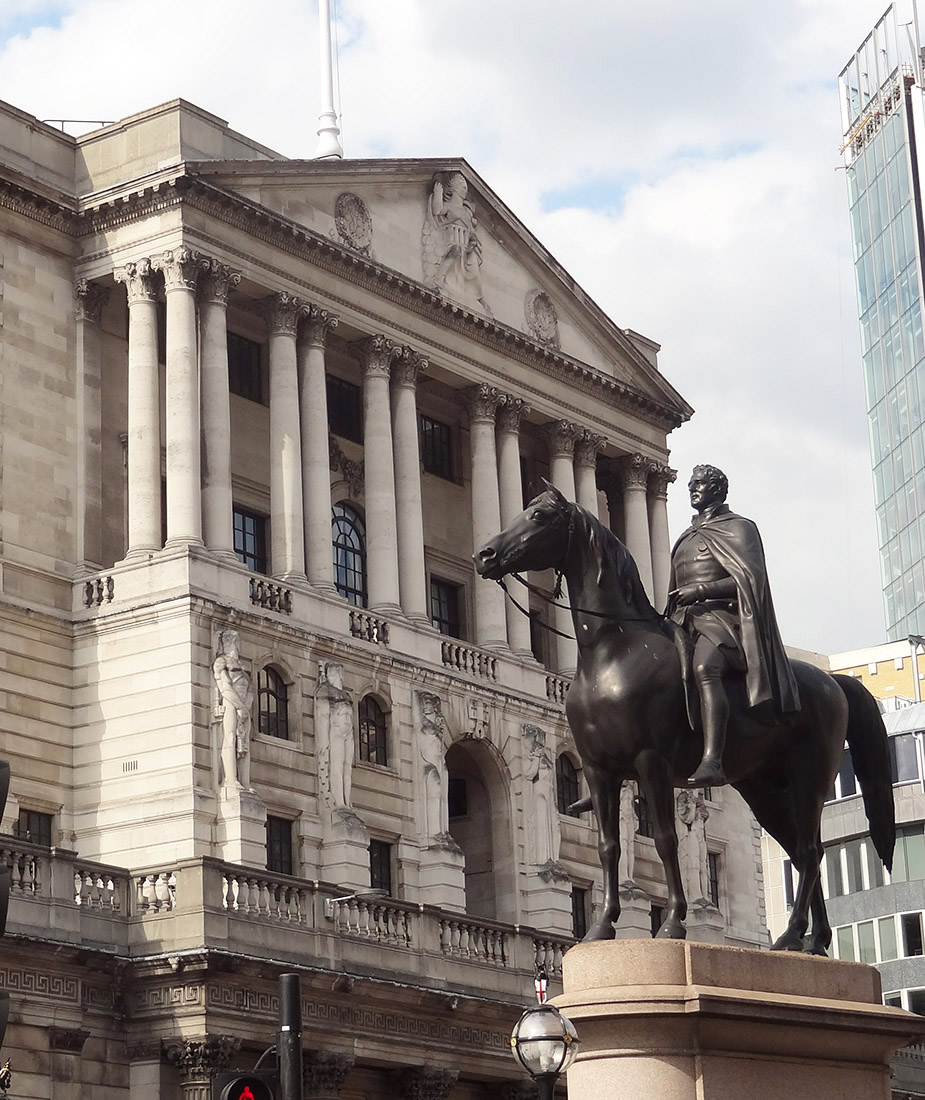 So should the Bank of England attempt to bring the sterling exchange rate down? After all, the exchange rate index has risen from 79.1 in March 2013 to 85.9 in February 2014 (an appreciation of 8.6%). But if it did want to do so, what could it do? The traditional methods of reducing Bank rate and increasing the money supply are not open to it at the present time: Bank rate, at 0.5%, is already about as low as it could go and the Bank has ruled out any further quantitative easing.