 The government has announced outlines of the new system of immigration controls from January 2021 when the Brexit transition period is scheduled to finish. It plans to introduce an Australian-style points-based system. This will apply to all EU and Non-EU citizens. The aim is to attract skilled workers, while preventing non-skilled or low-skilled workers from entering the UK for employment.
But even skilled workers will need to meet three criteria in order to obtain a work visa: (i) having the offer of a job paying a minimum of £25,600 per annum, except in designated jobs where there is a shortage of labour; (ii) being able to speak English; (iii) having qualifications equivalent to A levels.
To apply for a work visa, applicants must have at least 70 points according to the following table:
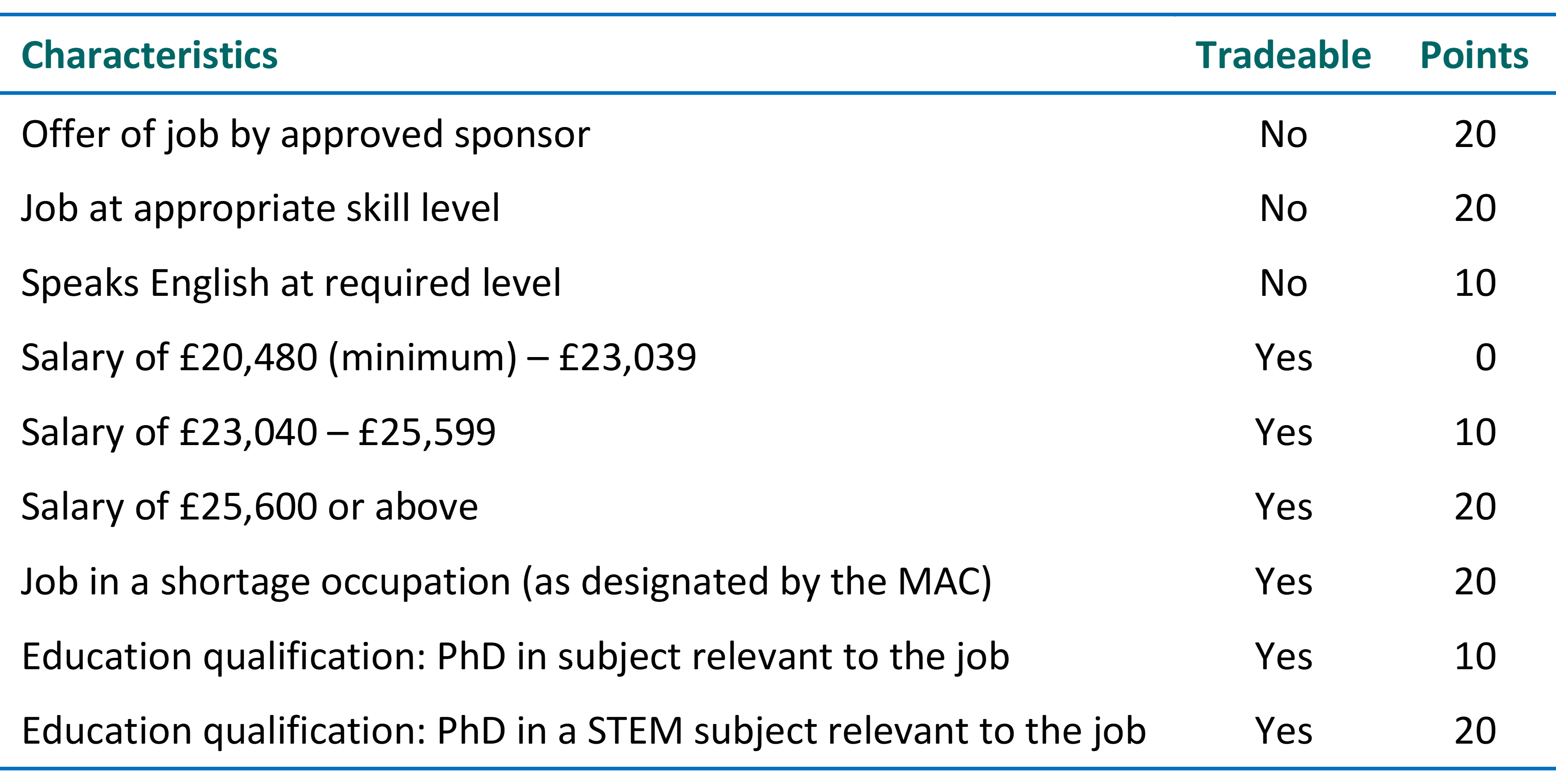
In certain jobs where there is a shortage of labour, designated by the Migration Advisory Committee (MAC), immigrants will be able to earn a lower income, provided it is above £20,480 per annum. They will earn 20 points for such jobs, which can offset not meeting the £25,600 threshold. Such jobs could include those in healthcare and farming. There will also be temporary visas for seasonal workers, such as fruit pickers.
The government argues that the new system will encourage employers to substitute technology for labour, with greater investment in equipment and computers. This would increase labour productivity and wages without reducing employment.
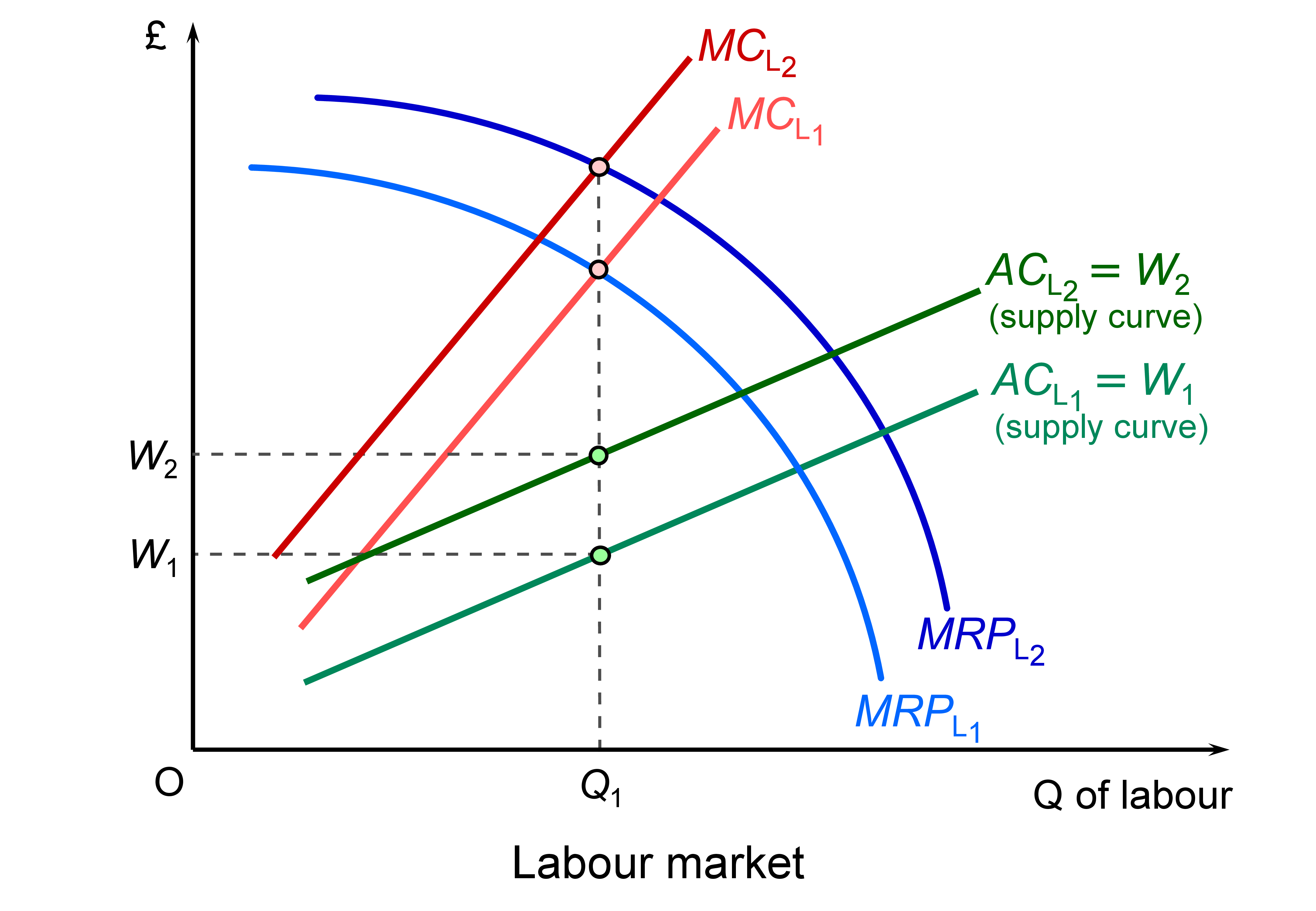 This is illustrated in the diagram, which illustrates a low-paid job which will be impacted by the restrictions. If there is a rise in productivity through technological change, the marginal revenue product of labour curve shifts upwards from MRPL1 to MRPL2 and offsets the leftward shift in labour supply (caused by the decline in immigration) from ACL1 to ACL2 and the marginal cost of labour from MCL1 to MCL2. Employment is where the marginal cost of labour equals the marginal revenue product of labour. This remains at Q1. Wages are given by the supply curve of labour and rise from W1 to W1. (Click here for a PowerPoint of the diagram.)
Even if the upward shift in the MRPL curve is not sufficient to offset the leftward shift in the labour supply curve, wages will still rise, but there will be a fall in employment.
In higher-paid skilled jobs where people meet the points requirement, there will be little effect on wages and employment, except where people are generally discouraged by a points system, even if they have the points themselves.
The government also argues that there is a large pool of UK residents who can take up jobs that would otherwise have been filled by immigrants. The Home Secretary referred to the 8.48 million people who are economically inactive who could fill jobs no longer filled by immigrants. However, as the data show, most  of these people are not available for work. Some 2.3 million are students, 1.9 million are carers at home looking after relatives, 2.1 million are long-term sick and 1.1 million are retired. Only 1.9 million (22.1% of the economically inactive) would like a job and not all these would be able to take up one (e.g. the long-term sick).
One the biggest problems concerns low-paid sectors where it is very difficult to substitute capital for labour through use of technology. Examples include social care, health care, the leisure and hospitality industry and certain jobs in farming. There could be severe shortages of labour in such industries. It remains to be seen whether such industries will be given exemptions or more relaxed conditions by the government in line with advice from the Migration Advisory Committee.
More details will emerge of the points system in the coming months. It will be interesting to see how responsive the government will be to the concerns of employers and workers.
Videos
Articles
Questions
- Find out how the proposed points-based system for immigration differs from the current system that applies to non-EU citizens.
- What will be the likely impact of reducing immigration of unskilled and low-skilled people?
- What barriers are there to substituting capital for labour in the caring and leisure sectors?
- What would be the macroeconomic effects of a substantial reduction in immigration?
 Since the financial crisis of 2008–9, the UK has experienced the lowest growth in productivity for the past 250 years. This is the conclusion of a recent paper published in the National Institute Economics Review. Titled, Is the UK Productivity Slowdown Unprecedented, the authors, Nicholas Crafts of the University of Sussex and Terence C Mills of Loughborough University, argue that ‘the current productivity slowdown has resulted in productivity being 19.7 per cent below the pre-2008 trend path in 2018. This is nearly double the previous worst productivity shortfall ten years after the start of a downturn.’
According to ONS figures, productivity (output per hour worked) peaked in 2007 Q4. It did not regain this level until 2011 Q1 and by 2019 Q3 was still only 2.4% above the 2007 Q4 level. This represents an average annual growth rate over the period of just 0.28%. By contrast, the average annual growth rate of productivity for the 35 years prior to 2007 was 2.30%.
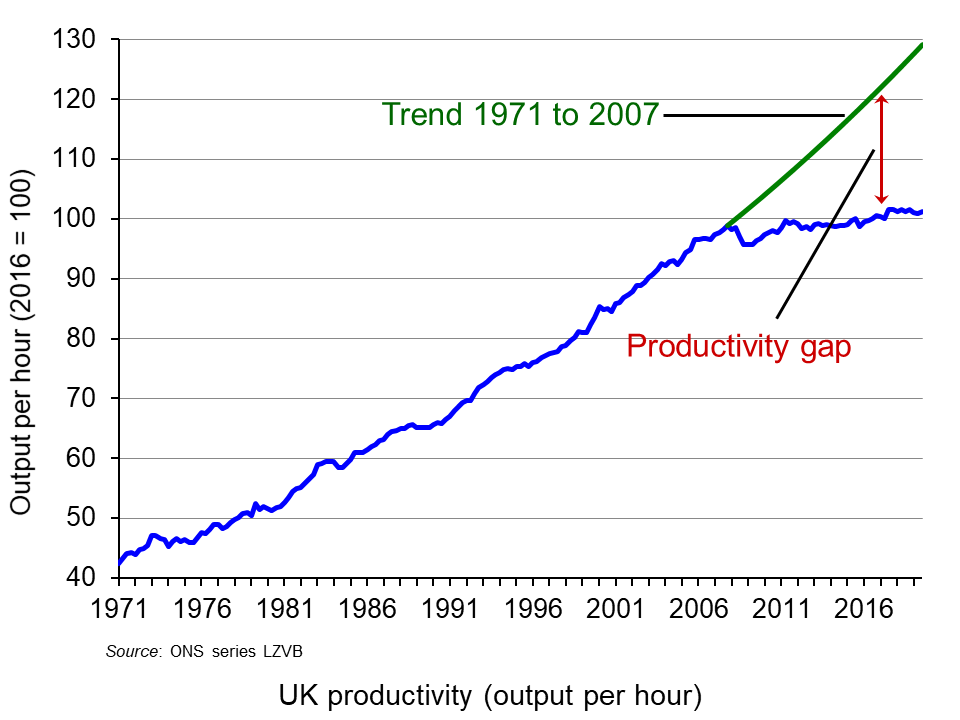 The chart illustrates this and shows the productivity gap, which is the amount by which output per hour is below trend output per hour from 1971 to 2007. By 2019 Q3 this gap was 27.5%. (Click here for a PowerPoint of the chart.) Clearly, this lack of growth in productivity over the past 12 years has severe implications for living standards. Labour productivity is a key determinant of potential GDP, which, in turn, is the major limiter of actual GDP.
Crafts and Mills explore the reasons for this dramatic slowdown in productivity. They identify three primary reasons.
 The first is a slowdown in the impact of developments in ICT on productivity. The office and production revolutions that developments in computing and its uses had brought about have now become universal. New developments in ICT are now largely in terms of greater speed of computing and greater sophistication of software. Perhaps with an acceleration in the development of artificial intelligence and robotics, productivity growth may well increase in the relatively near future (see third article below).
The second cause is the prolonged impact of the banking crisis, with banks more cautious about lending and firms more cautious about borrowing for investment. What is more, the decline in investment directly impacts on potential output, and layoffs or restructuring can leave people with redundant skills. There is a hysteresis effect.
The third cause identified by Crafts and Mills is Brexit. Brexit and the uncertainty surrounding it has resulted in a decline in investment and ‘a diversion of top-management time towards Brexit planning and a relative shrinking of highly-productive exporters compared with less productive domestically orientated firms’.
Articles
Paper
Questions
- How suitable is output (GDP) per hour as a measure of labour productivity?
- Compare this measure of productivity with other measures.
- According to Crafts and Mills, what is the size of the impact of each of their three explanations of the productivity slowdown?
- Would you expect the growth in productivity to return to pre-2007 levels over the coming years? Explain.
- Explain the underlying model for obtaining trend productivity growth rates used by Crafts and Mills.
- Explain and comment on each of the six figures in the Crafts and Mills paper.
- What policies should the government adopt to increase productivity growth?
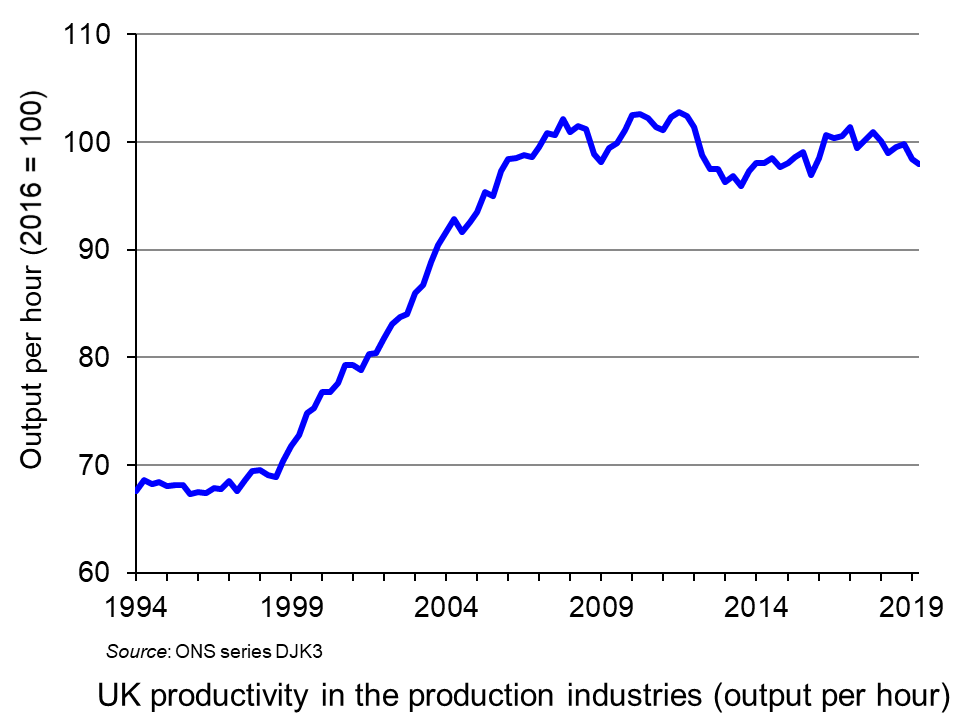 A lack of productivity growth has been a major problem for the UK economy over the past decade (click here for a PowerPoint of the chart). Is it possible that the new decade may see a pick-up in the growth in output per hour worked?
One possible solution to low productivity growth is to reduce working hours and even to move to a four-day week, but not to reduce total pay. If people work fewer hours, they may well be more productive in the hours they do work. In fact, not only may output per hour increase, but so too may output per worker, despite fewer hours being worked. What is more, the quality of output may increase with people being less tired and more motivated.
Several companies have experimented with a four-day week, including Microsoft in Japan, which employees 2300 workers. It found that, despite a 20% reduction in hours worked, output per hour worked increased by 40%, with total output thereby increasing. Workers were generally happier and more motivated and asked for fewer days off.
And it is not just a question of output: fewer hours can result in lower costs. The effect on costs will depend on the nature of new work patterns, including whether everyone has the same extra day off.
But a four-day week is only one way of cutting working hours for full-time employees. Another is to reduce the length of the working day. The argument is that people may work more efficiently if the standard working day is cut from eight to, say, five hours. As the first Thrive Global article article (linked below) states:
Just because you’re at your desk for eight hours doesn’t mean you’re being productive. Even the best employees probably only accomplish two to three hours of actual work. The five-hour day is about managing human energy more efficiently by working in bursts over a shorter period.
If people have more leisure time, this could provide a boost to the leisure and other industries. According to a Henley Business School study:
An extra day off could have a knock-on effect for the wider society. We found 54% of employees said they would spend their day shopping, meaning a potential boost for the high street, 43% would go to the cinema or theatre and 39% would eat out at restaurants.
What is more, many people would be likely to use the extra time productively, undertaking training, volunteering or other socially useful activities. Also family life is likely to improve, with people spending less time at work and commuting and having more time for their partners, children, other relatives and friends. In addition, people’s physical and mental health is likely to improve as they achieve a better work-life balance.
So, should firms be encouraged to reduce hours for full-time workers with no loss of pay? Many firms may need no encouragement at all if they can see from the example of others that it is in their interests. But many firms may find it difficult, especially if their suppliers and/or customers are sticking with ‘normal’ working hours and want to do business during those hours. But, over time, as more firms move in this direction, so it will become increasingly in the interests of others to follow suit.
In the meantime, should the government introduce incentives (such as tax breaks) or regulations to limit the working week? Indeed, it was part of the Labour manifesto for the December 2019 election that the country should, over time, move to a four-day week. Although this was a long-term goal, it would probably have involved the use of some incentives to encourage employers to move in that direction or the gradual introduction of limits on the number of hours or days per week that people could work in a particular job. It is unlikely that the new Conservative government will introduce any specific measures, but would probably not want to discourage firms from reducing working hours, especially if it is accompanied by increased output per worker.
But despite the gains, there are some problems with reduced working hours. Many small businesses, such as shops, restaurants and firms offering technical support, may not have the flexibility to offer reduced hours, or may find it hard to increase productivity when there is a specific amount of work that needs doing, such as serving customers.
Another problem concerns businesses where the output of individuals is not easy to measure because they are part of a team. Reducing hours or the working week may not make such people work harder if they can ‘get way with it’. Not everyone is likely to be motivated by fewer hours to work harder.
Then there is the problem if reduced hours don’t work in boosting productivity. It may then be very difficult to reintroduce longer hours.
But, despite these problems, there are many firms where substantial gains in productivity could be made by restructuring work in a way that reduces hours worked. We may see more and more examples as the decade progresses.
Podcast
Articles
- Economics of a four-day working week: research shows it can save businesses mone
The Conversation, Miriam Marra (11/11/19)
- Less hours for work, more time on Earth: Why a four-day working week is good for you
Independent, Steve Taylor (16/12/19)
- Microsoft Japan Launched A Four-Day Workweek To Much Success: Is This The Key To Attracting Talent In The Tight U.S. Job Market?
Forbes, Jack Kelly (5/11/19)
- Will The Five-Hour Work Day Catch On In America?
Forbes, Jack Kelly (28/10/19)
- My Company Implemented a 5-Hour Workday — and the Results Have Been Astounding
Thrive Global, Stephan Aarstol (3/10/19)
- Why Does a Four-Day Work Week Achieve Better Results?
Thrive Global, Stephanie Lin (16/12/19)
- Four-Day Working Week Improves Staff’s Mental Health By 87%, Company Finds
Unilad, Niamh Shackleton (10/12/19)
- Hull business launches four-day working week as well as your birthday off and ‘Beer Fridays’
Hull Live, Phil Winter (5/12/19)
- A four-day work week? Sounds nice, but here’s the real deal
Sydney Morning Herald, Tony Featherstone (21/11/19)
- The four-day debate: Fantasy or feasible?
The Hindu, Business Live, Kamal Karanth (20/11/19)
- Finland’s ministry of transport floats tech-enabled four-day week
Computer Weekly, Gerard O’Dwyer (20/11/19)
- Should You Consider a 4 Day Work Week?
Small Business Trends, Rob Starr (5/12/19)
Report
Questions
- Distinguish between different ways of measuring labour productivity.
- Give some examples (from the linked references) of employers which have tried introducing a four-day week or reduced hours for full-time workers. What has been the outcome in each case?
- In what ways may reducing working hours reduce a firm’s total costs?
- What are the advantages and disadvantages of the government imposing (at some point in the future) a maximum working week or a four-day week?
- What types of firm might struggle in introducing a four-day week or a substantially reduced number of hours for full-time employees?
- What external benefits and costs might arise from a shorter working week?
 Firms are increasingly having to take into account the interests of a wide range of stakeholders, such as consumers, workers, the local community and society in general (see the blog, Evolving Economics). However, with many firms, the key stakeholders that influence decisions are shareholders. And because many shareholders are footloose and not committed to any one company, their main interests are short-term profit and share value. This leads to under-investment and too little innovation. It has also led to excessive pay for senior executives, which for many years has grown substantially faster than the pay of their employees. Indeed, executive pay in the UK is now, per pound of turnover, the highest in the world.
So is there an alternative model of capitalism, which better serves the interests of a wider range of stakeholders? One model is that of employee ownership. Perhaps the most famous example of this is the John Lewis Partnership, which owns both the department stores and the Waitrose chain of supermarkets. As the partnership’s site claims, ‘when you’re part of it, you put your heart into it’. Although the John Lewis Partnership is the largest in the UK, there are over 330 employee-owned businesses across the UK, with over 200 000 employee owners contributing some £30bn per year to UK GDP. Again, to quote the John Lewis site:
Businesses range from manufacturers, to community health services, to insurance brokers. Together they deliver 4% of UK GDP annually, with this contribution growing. They are united by an ethos that puts people first, involving the workforce in key decision-making and realising the potential and commitment of their employees.
A recent example of a company moving, at least partly, in this direction is BT, which has announced that that every one of its 100 000 employees will get shares worth £500 every year. Employees will need to hold their shares for at least three years before they can sell them. The aim is to motivate staff and help the company achieve a turnaround from its recent lacklustre performance, which had resulted in its laying off 13 000 of its 100 000-strong workforce.
 Another recent example of a company adopting employee ownership is Richer Sounds, the retail TV and hi-fi chain. Its owner and founder, Julian Richer, announced that he had transferred 60% of his shares into a John Lewis-style trust for the chain’s 531 employees. In addition to owning 60% of the company, employees will receive £1000 for every year they have worked for the retailer. A new advisory council, made up of current staff, will advise the management board, which is taking over the running of the firm from Richer.
According to the Employee Ownership Association (EOA), a further 50 businesses are preparing to follow suit and adopt forms of employee ownership. As The Conversation article linked below states:
As a form of stakeholder capitalism, the evidence shows that employee ownership boosts employee commitment and motivation, which leads to greater innovation and productivity.
Indeed, a study of employee ownership models in the US published in April found it narrowed gender and racial wealth gaps. Surveying 200 employees from 21 companies with employee ownership plans, Joseph Blasi and his colleagues at Rutgers University found employees had significantly more wealth than the average US worker.
The researchers also found that the participatory management practices that accompanied the employee ownership schemes led to employees improving their communication skills and learning management skills, which had helped them make better financial decisions at home.
But, although employee ownership brings benefits, not only to the employees themselves, but also more widely to society, there is no simple mechanism for achieving it when shareholders are unlikely to want to relinquish their shares. Employee buyout schemes require funding; and banks are often cautious about providing such funding. What is more, there needs to be an employee trust overseeing the running of the company which takes a long-term perspective and not just that of current employees, who might otherwise be tempted to sell the company to another seeking to take it over.
Articles
Report
Questions
- What are the main benefits of employee ownership?
- Are there any disadvantages of employee ownership and, if so, what are they?
- What are the main barriers to the adoption of employee ownership?
- What are the main recommendations from The Ownership Effect Inquiry? (See linked report above.)
- What are the findings of the responses to the employee share ownership questions in the US General Social Survey (GSS)? (See linked Global Banking & Finance Review article above.)
 The IFS has launched a major five-year review into all aspects of inequality. The review is led by Sir Angus Deaton, the Scottish-born Professor of Economics and International Affairs at Princeton University. In 2015, he was awarded the Nobel Prize in Economic Sciences for his analysis of consumption, poverty, and welfare. The review will cover all aspects of inequality, including inequality of income, wealth, health, life-span, education, social mobility, housing, opportunity and political access, and by gender, age, ethnicity, family and geography. It will look at trends in and causes of inequality, the impacts of globalisation and political change, barriers to tackling inequality and poverty, and at various policy measures.
Although the published Gini coefficient in England and Wales has not changed much over the past 15 years, largely because of support given to the poor by tax credits, it did rise from 31.7 to 33.2 from 2015/16 to 2017/18 (the latest year for which figures are available). Other measures of inequality, however, have changed more dramatically. There is huge geographical inequality in income in the UK, reflected in inequality in health.  Average weekly earnings in London are 66% higher than in the north east of England. And, according to the IFS, ‘Men in the most affluent areas can expect to live nearly 10 years longer than those in the most deprived areas, and this gap is widening’.
The UK has the greatest inequality of income of developed countries, with the exception of the USA. The IFS warns that the UK could follow the USA:
…where wages for non-college-educated men have not risen for five decades, and where rising mortality for less-educated white men and women in middle age has caused average life expectancy in America to fall for the last three years – something that has not happened for a century. We have not experienced anything similar in the UK but we have now had a decade of stagnant wages and there is recent evidence that ‘deaths of despair’ – deaths from suicide and drug and alcohol abuse – are now rising among middle-aged Britons. Sir Angus will go on to say:
‘I think that people getting rich is a good thing, especially when it brings prosperity to others. But the other kind of getting rich, “taking” rather than “making”, rent-seeking rather than creating, enriching the few at the expense of the many, taking the free out of free markets, is making a mockery of democracy. In that world, inequality and misery are intimate companions.’
The initial report, which introduces the IFS Deaton Review, points to some possible causes of growing inequality, including the dramatic decline in union membership, which now stands at just 13% of private-sector employees, with more flexible labour markets with growing numbers of workers on temporary or zero-hour contracts. Other causes include growing globalisation, rapid technological change making some skills redundant, the power of large companies and their shareholders, large pay rises given to senior executives, growing inequality of access to education and changing family environments with more single parents.

About one in six children in the UK are born to single parents – a phenomenon that is heavily concentrated in low-income and low-educated families, and is significantly less prevalent in continental Europe.
Then there is the huge growth in housing inequality as house prices and rents have risen faster than incomes. Home ownership has increasingly become beyond the reach of many young people, while many older people live in relative housing wealth. Generational inequality is another major factor that the Deaton Review will consider.
Inequalities in different dimensions – income, work, mental and physical health, families and relationships – are likely to reinforce one another. They may result in, and stem from, other inequalities in wealth, cultural capital, social networks and political voice. Inequality cannot be reduced to any one dimension: it is the culmination of myriad forms of privilege and disadvantage.
The review will consider policy alternatives to tackle the various aspects of inequality, from changes to the tax and benefit system, to legislation on corporate behaviour, to investment in various structural resources, such as health and education. As the summary to the initial report states:
The Deaton Review will identify policy responses to the inequalities we face today. It will assess the relative merits of available policy options – taxes and benefits, labour market policies, education, competition policy, ownership structures and regulations – and consider how policies in different spheres can be designed to complement each other and minimise adverse effects. We aim not just to further our understanding of inequalities in the twenty-first century, but to equip policymakers with the knowledge and tools to tackle those inequalities.
Articles
IFS Deaton Review
Questions
- Identify different aspects of inequality. Choose two or three aspects and examine how they are related.
- Why has inequality widened in most developed countries over the past 20 years?
- What is meant by ‘rent seeking’? Why may it be seen as undesirable? Can it be justified and, if so, on what grounds?
- What policies could be adopted to tackle poverty?
- What trade-offs might there be between greater equality and faster economic growth?
- What policies could be adopted that would both reduce inequality and boost long-term economic growth?
 Post-Brexit Immigration System Explained