 First the good news. Employment is rising and unemployment is falling. Both claimant count rates and Labour Force Survey rates are down. Compared with a year ago, employment is up 279,092 to 29,869,489; LFS unemployment is down from 7.87% to 7.69%; and the claimant count rate is down from 4.7% to 4.0%.
Now the bad news. Even though more people are in employment, real wages have fallen. In other words, nominal wages have risen less fast than prices. Since 2009, real wages have fallen by 7.6% and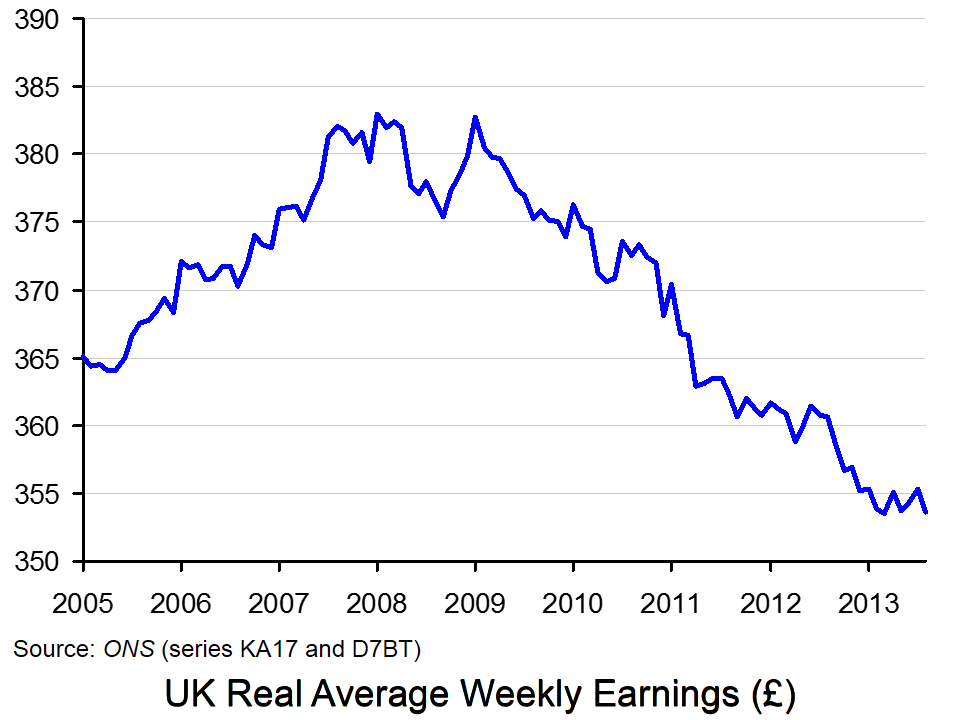 have continued to fall throughout this period. The first chart illustrates this. It shows average weekly wage rates in 2005 prices. (Click here for a PowerPoint of the chart.)
The fall in real wages is an average for the whole country. Many people, especially those on low incomes, have seen their real wages fall much faster than the average. For many there is a real ‘cost of living’ crisis.
But why have real wages fallen despite the rise in employment? The answer is that output per hour worked has declined. This is illustrated in the second chart, which compares UK output per worker with that of other G7 countries. UK productivity has fallen both absolutely and relative to other G7 countries, most of which have had higher rates of investment.
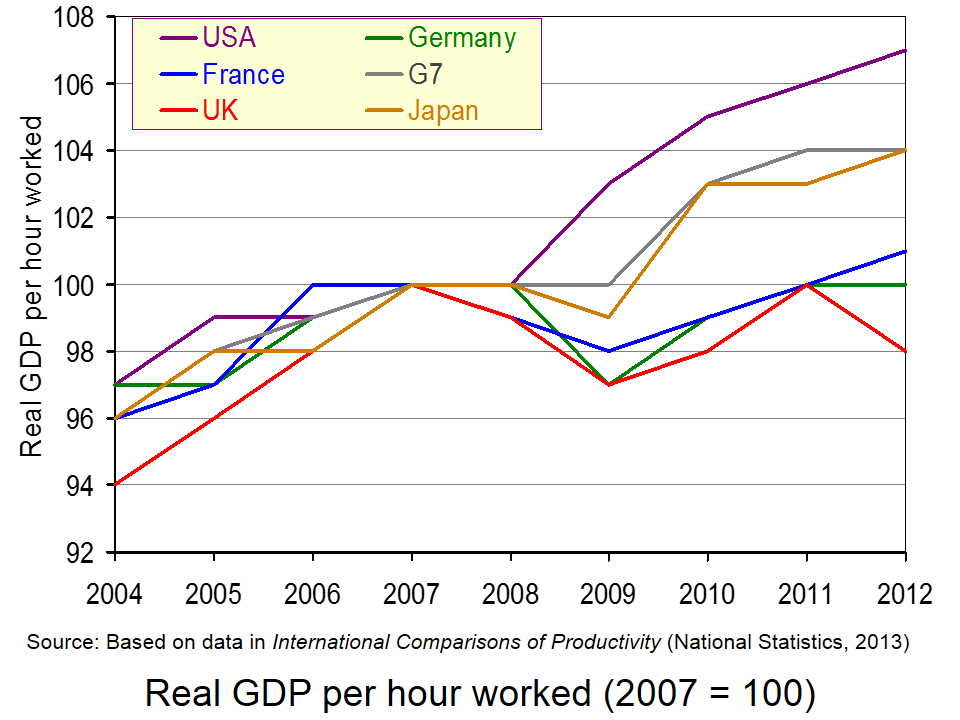 The falling productivity in the UK requires more people to be employed to produce the same level of output. Part of what seems to be happening is that many employers have been prepared to keep workers on in return for lower real wages, even if demand from their customers is falling. And many workers have been prepared to accept real wage cuts in return for keeping their jobs.
Another part of the explanation is that the jobs that have been created have been largely in low-skilled, low-wage sectors of the economy, such as retailing and other parts of the service sector.
But falling productivity is only part of the reason for falling real wages. The other part is rising prices. A number of factors have contributed to this. These include a depreciation of the exchange rate back in 2008, the effects of which took some time to filter through into higher prices in the shops; a large rise in various commodity prices; and a rise in VAT and various other administered prices.
So what is the answer to falling real wages? The articles below consider the problem and some of the possible policy alternatives.
Articles
Inflation, unemployment and UK ‘misery’ BBC News, Linda Yueh (16/10/13)
Employment is growing, but so are the wage slaves The Guardian, Larry Elliott (16/10/13)
Living standards – going down and, er, up BBC News, Nick Robinson (26/7/13)
Revealed: The cost of living is rising faster in the UK than anywhere in Europe, with soaring food and energy bills blamed Mail Online, Matt Chorley (16/10/13)
Cutting prices to raise living standards is just a waste of energy The Telegraph, Roger Bootle (6/10/13)
Downturn sees average real wages collapse to a record low Independent, Ben Chu (17/10/13)
Why living standards and public finances matter Financial Times, Gavin Kelly (29/9/13)
Social Mobility Tsar Alan Milburn Calls on Government to Boost Wages to End UK Child Poverty International Business Times, Ian Silvera (17/10/13)
Do incorrect employment growth figures explain low UK productivity? The Guardian, Katie Allen (23/10/13)
Data
Unemployment data ONS
Average Weekly Earnings dataset ONS
Consumer Prices Index ONS
International Comparison of Productivity ONS
Questions
- How are real wages measured?
- Why have real wage rates fallen in the UK since 2009?
- What factors should be included when measuring living standards?
- Why has employment risen and unemployment fallen over the past two years?
- What factors could lead to a rise in real wages in the future?
- What government policies could be adopted to raise real wages?
- Assess these policies in terms of their likely short-term success and long-term sustainability.
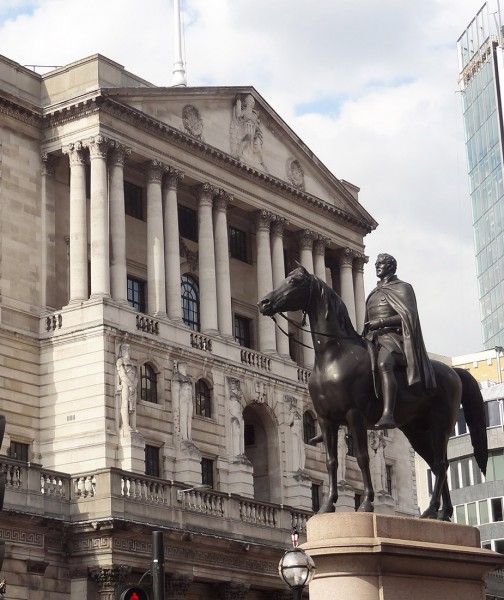 In an interview with the Yorkshire Post, Mark Carney, Governor of the Bank of England, said that under current circumstances he did not feel that further quantitative easing was justified. He said:
My personal view is, given the recovery has strengthened and broadened, I don’t see a case for quantitative easing and I have not supported it.
In response to his speech, the pound strengthened against the dollar. It appreciated by just over 1 cent, or 0.7%. But why should the likelihood of no further quantitative easing lead to a strengthening of the pound?
The answer lies with people’s anticipation of future interest rates. If there is no further increase in money supply through QE, interest rates are likely to rise as the economy recovers and thus the demand for money rises. 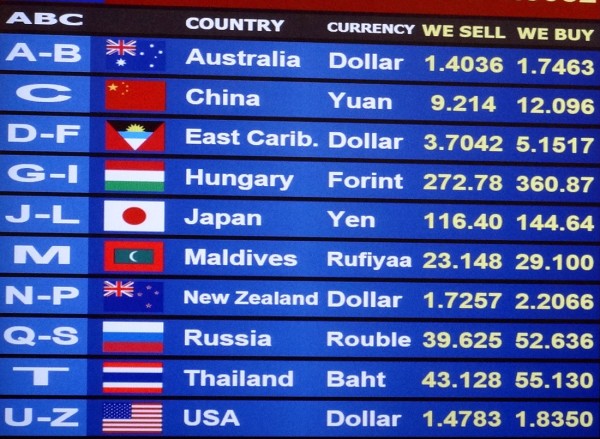 A rise in interest rates, in turn, is likely to lead to an inflow of finance into the country, thereby boosting the financial account of the balance of payments. The increased demand for sterling will tend to drive up the exchange rate.
However, an increase in aggregate demand will result in an increase in imports and a likely increase in the balance of trade deficit. Indeed, in July (the latest figures available) the balance of trade deficit rose to £3.085bn from £1.256bn in June. As recovery continues, the balance of trade deficit is likely to deteriorate further. Other things being equal, this would lead to a depreciation of the pound.
So if the pound appreciates, this suggests that the effect on the financial account is bigger than the effect on the current account – or is anticipated to be so. In fact, given the huge volumes of short-term capital that move across the foreign exchanges each day, financial account effects of interest rate changes – actual or anticipated – generally outweigh current account effects.
Articles
Yorkshire can reap benefits from turnaround says Mark Carney Yorkshire Post (27/9/13)
Sterling Jumps as BOE Chief Signals No More Bond Buying Wall Street Journal, Nick Cawley and Jason Douglas (27/9/13)
Carney’s Northern Exposure Sends Sterling Soaring Wall Street Journal, David Cottle (27/9/13)
Pound Gains as Carney Sees No Case for QE, Confidence Improves Bloomberg, Anchalee Worrachate & David Goodman (28/9/13)
Exchange Rate Bounces as Strong UK Data Supports Sterling FCF (Future Currency Forecast), Laura Parsons (30/9/13)
Currency briefing: What if the pound sterling has been overbought? iNVEZZ, Tsvyata Petkova (30/9/13)
Pound rises after Carney rejects increasing QE BBC News (27/9/13)
Pound Rises for Fourth Day Versus Euro on Housing, Mortgage Data Bloomberg, Emma Charlton (30/9/13)
Data
$ per £ exchange rate (latest month) XE (You can access other periods and currencies)
Effective exchange rate indices (nominal and real) Bank for International Settlements
Balance of Payments, Q2 2013 Dataset ONS
Questions
- Explain how quantitative easing affects exchange rates.
- What is happening concerning quantitative easing in the USA? How is this likely to affect the exchange rate of the US dollar to sterling; other currencies to sterling?
- Why may an increase in the balance of trade deficit lead directly to an appreciation of the exchange rate?
- Why is an anticipation of a policy change likely to have more of an effect on exchange rates than the actual policy change itself? Why, indeed, may a policy change have the reverse effect once it is implemented?
- Under what circumstances may speculation against exchange rate changes be (a) stabilising; (b) destabilising?
- How is quantitative easing (or an anticipation of it) likely to affect each of the main components of the current and financial accounts of the balance of payments?
- For what reasons might sterling have been ‘overbought’ and hence be overvalued?
- What is meant by the real exchange rate (REER)? Why may reference to the REER suggest that sterling is not currently overvalued?
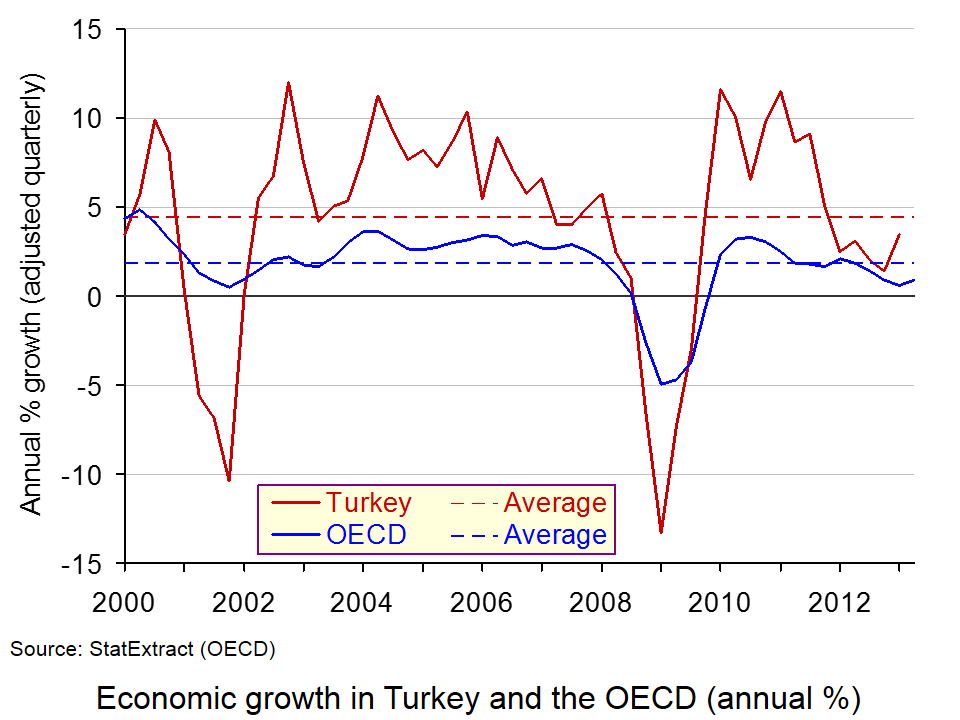
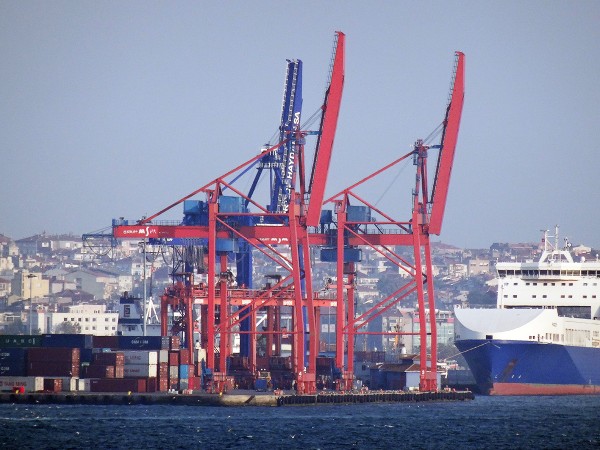 Turkey has experienced rapid economic growth in recent years and has attracted large inflows of foreign capital. The chart below illustrates how growth in real GDP in Turkey in most years since 2000 has considerably exceeded that in the OECD as a whole (click here for a PowerPoint). As you can see from the chart, growth in Turkey over the period has averaged 4.5%, while that in the OECD has averaged just 1.8%.
Indeed, Turkish growth has been compared with that of the BRICs (Brazil, Russia, India and China). However, like the BRICs, Turkey has been experiencing slowing growth in the past few months. Indeed, the slowdown has been especially marked in Turkey.
 In recent years Turkey has benefited from large inflows of foreign capital. Partly these were direct investment flows, encouraged by a large and rapidly growing internal market, boosted by a rapid expansion of consumer credit, and also by a growing export sector. But to a large extent, especially in recent years, there has been a large rise in portfolio and other investment inflows. This has been encouraged by a large increase in global money supply resulting from policies of quantitative easing in the USA and other developed countries.
 But the economic climate has changed. First investors have become worried about the conflict in Syria escalating and this impacting on Turkey. Second Turkey’s large financial account surpluses have allowed it to run large current account deficits and have maintained a high exchange rate. Third the tapering off and possible reversal of quantitative easing have led to recent outflows of finance from various countries perceived as being vulnerable, including Turkey.
The effect of this has been a depreciation of the Turkish lira and upward pressure on inflation. The lira has fallen by 14% since the beginning of 2013 and by nearly 7% since the beginning of August alone.
The question is whether the supply side of the Turkish economy has become robust enough to allow the country to ride out its current difficulties. Will foreign investors have sufficient faith in the long-term potential of the Turkish economy to continue with direct investment, even if short-term financial inflows diminish?
Articles
Turkey’s economy faces uncertainties amid possible military intervention in Syria Xinhua, Fu Peng (29/8/13)
Turkey may cut 2014 growth target to 4% Turkish Daily News (8/9/13)
Turkish lira at record low, threatening growth Daily News Egypt (7/9/13)
Turkish lira may need higher interest rates to escape emerging markets rout Reuters, Sujata Rao and Seda Sezer (20/8/13)
Turkey Economic Crisis: Crises from Both Sides Wealth Daily, Joseph Cafariello (9/8/13)
Western financial prescription has made Turkey ill The Observer, Heather Stewart (1/9/13)
Turkish Deputy PM Babacan calm amid economic fluctuations Turkish Daily News (8/9/13)
 The Fragile Five BBC News, Linda Yueh (26/9/13)
Data
Economic growth rates (annual) for Turkey, Brazil, Russia, India and China: 2000–13 IMF Economic Outlook Database (April 2013)
Quarterly growth rates of real GDP for OECD countries and selected other countries and groups of countries OECD StatExtracts
Turkey and the IMF IMF
Turkey: data World Bank
Links to Turkish Official Statistics Offstats
Country statistical profile: Turkey OECD Country Statistical Profiles
Spot exchange rate, Turkish Lira into Dollar Bank of England
Questions
- Why has the Turkish economy experienced such rapid growth in recent years and especially from 2010 to 2012?
- Why has Turkish growth slowed over the past year?
- Why has “Western financial prescription made Turkey ill”
- Why has the Turkish lira depreciated? What has determined the size of this depreciation?
- What are the beneficial and adverse effects of this depreciation?
- Why must any surplus on the combined financial and capital accounts of the balance of payments be matched by a corresponding deficit on the current account?
- How is a tapering off of quantitative easing likely to impact on developing countries? What will determine the size of this impact?
- Istanbul has lost its bid to host the 2020 Olympic Games? How is this likely to affect the Turkish economy?
 House prices in the UK are rising and the rise seems to be accelerating – at least until the latest month (August). They are now growing at an annualised rate of nearly 4%. This is the fastest rate for three years (see chart below: click here for a PowerPoint of the chart).
This may be worrying for Mark Carney, the Governor of the Bank of England, who is committed to avoiding a new house price bubble. 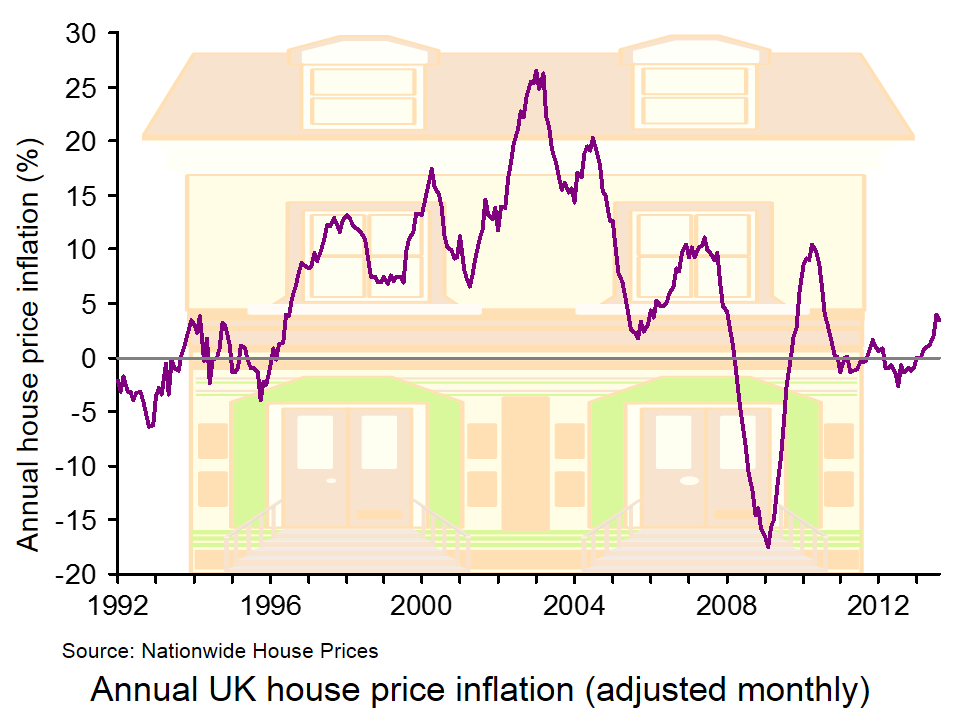 The problem is that, under the recently issued forward guidance, the Bank of England is set to retain the current historically low Bank rate of 0.5% until unemployment has fallen to 7%. But that could be some time – probably around two years.
So what can the Bank do in the meantime and what will be the consequences?
The following article from The Guardian looks at the options.
Article
How can the Bank of England prick the house price bubble? The Guardian, Patrick Collinson and Heather Stewart (30/8/13)
Data
Links to house price data The Economics Network, John Sloman
Questions
- What constitutes a housing price boom? Is the UK currently experiencing such a boom?
- What factors have led to the recent house price rises? Have these factors affected the demand or supply of houses (or both)?
- Who gains and who loses from rising house prices?
- Explain the policy adopted in New Zealand to curb house price inflation.
- Consider the merits of this option?
- Could borrowers find ways around this measure?
- Are there any other options open to the Bank of England?
 The rate of growth in India has fallen to its lowest level since the first three months of 2009 – the period when many countries were plunging into recession. Although the annual rate was still 4.4% in Q2 2013 (a rate most Western governments would love to achieve!), it had averaged 8.2% from 2003 to 2007 and 9.5% from 2010 to 2011 (see).
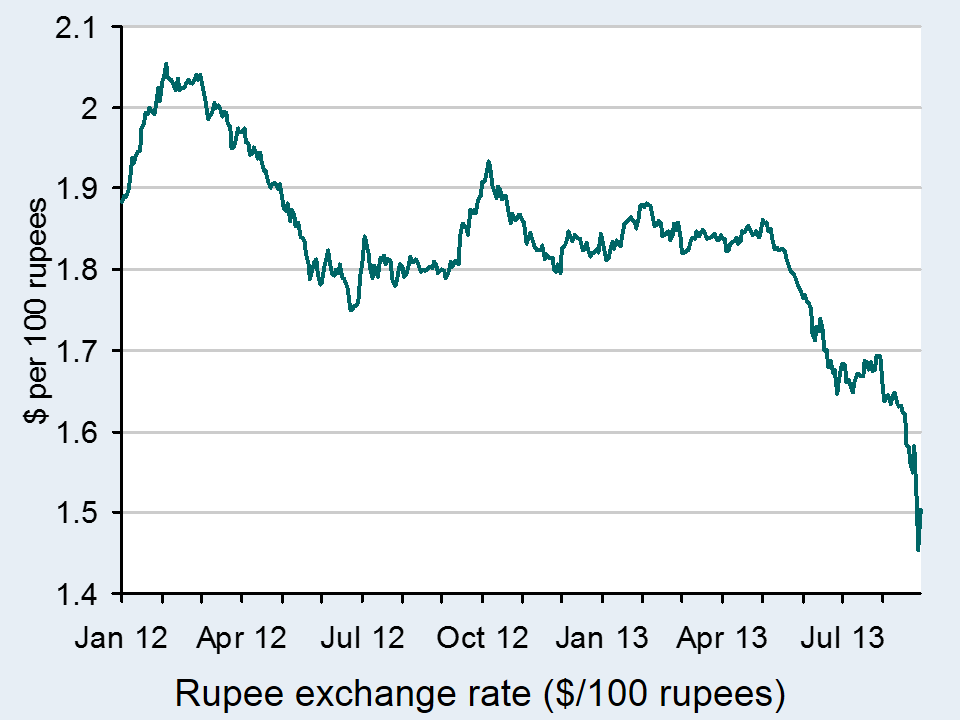
And the rupee has been falling in value (see chart below). The exchange rate of the rupee to the dollar has depreciated by 21% since the start of the year and by 14% since the beginning of August (click here for a PowerPoint of the chart). This has pushed up the price of imports and raised fears that inflation, already approaching 10%, will rise.
 There have also been concerns about the health of India’s banking sector, with worries over the possible rise in bad loans.
One result of all these factors is that the confidence of investors has been shaken. Bond prices have fallen and so too have share prices. The Mumbai Sensex index fell by 11.5% from 22 July to 27 August. Worried about possible capital flight, the Indian government imposed capital controls on Indian residents on 14 August. It has, however, since ruled out limiting the outflow of funds by foreign investors.
The following articles and videos look at the causes of the current economic problems and what can be done about them.
Webcasts
India’s sliding economy Aljazeera (24/8/13)
Economic woes grow for Indians as rupee continues to slide BBC News, Sanjoy Majumder (30/8/13)
What is behind the Indian economy’s fall from grace? BBC News, Yogita Limaye (30/8/13)
Indian rupee: How onions reflect health of economy BBC News, Nitin Srivastava (30/8/13)
The rise and fall of India’s economy NDTV (20/8/13)
Is the Indian economy heading for a doom? NDTV, Dr Arvind Virmani, Adi Godrej, P N Vijay, Sanjay Nirupam and Prakash Javadekar (20/7/13)
Can Rajan stabilise India’s economy? FT Video, Stuart Kirk and Julia Grindell (7/8/13)
Articles
India in trouble: The reckoning The Economist (24/8/13)
PM warns of short term shocks, attacks BJP for stalling Parliament The Economic Times of India (31/8/13)
External global factors led to rupee slide: Manmohan in Lok Sabha Hindustan Times (30/8/13)
India seeks allies to defend rupee as growth skids to four-year low Reuters, Manoj Kumar and Frank Jack Daniel (30/8/13)
Rupee charts in uncharted territory Reuters, Saikat Chatterjee and Subhadip Sircar (30/8/13)
Indian Prime Minister Says Rupee Crisis Will Only Make Country Stronger Time World, ilanjana Bhowmick (30/8/13)
Is India in danger of another crisis? BBC News, Linda Yueh (8/8/13)
India’s GDP shows continuing slowdown BBC News (30/8/13)
Slowest India Growth Since 2009 Pressures Singh to Support Rupee Bloomberg, Unni Krishnan (30/8/13)
Questions
- Why has the rupee fallen in value so dramatically? Is there likely to have been overshooting?
- What are the economic consequences of this large-scale depreciation? Who gain and who lose?
- What factors are likely to affect the rate of growth in India over the coming months?
- Why is the Indian economy more vulnerable than many other Asian economies?
- What economic policies are being pursued by the Indian government? How successful are they likely to be?
 First the good news. Employment is rising and unemployment is falling. Both claimant count rates and Labour Force Survey rates are down. Compared with a year ago, employment is up 279,092 to 29,869,489; LFS unemployment is down from 7.87% to 7.69%; and the claimant count rate is down from 4.7% to 4.0%.