 There has been considerable discussion recently about whether the government should introduce a property tax on high value properties. The government, finding it difficult to reduce the public-sector deficit and yet determined to do so, is looking for additional measures to reduce government expenditure or raise tax revenue.
But would it favour a mansion tax as a means of raising additional revenue?
The imposition of such a tax is favoured by both Liberal Democrats and the Labour Party. It is strongly opposed, however, by Conservatives. But just what would such a tax look like and what are the arguments for and against it?
One alternative would be to impose a one-off tax on property valued over a certain amount, such as £2 million. Alternatively it could be levied only for as long as the government is seeking to make substantial inroads into the deficit.
Another would be to add one or more bands to council tax. At present, council tax in England is levied in 8 bands according to the value of a person’s property. The highest band is for property valued over £320,000 in 1991 prices, with the amount of tax due for each band varying from local authority to local authority. (Average UK house prices in 2012 are 135% higher than in 1991.) In Scotland the bands are lower with the top band being for property valued over £212,000 in 1991 prices. In Wales, there is an additional band for property valued over £424,000, but properties are valued in 2003 prices, not 1991 prices.
With low top bands for council tax, people in mansions end up paying the same as people in much more modest property. It would be relatively easy to add additional bands, with the top band applying only to property worth, say, over £1 million or more.
 The arguments in favour of a mansion tax are that it is progressive, relatively easy to collect, hard to evade and with minimal disincentive effects. The arguments against are that it would make the tax system ‘too progressive’, would not necessarily be related to an individual’s ability to pay and could have substantial disincentive effects.
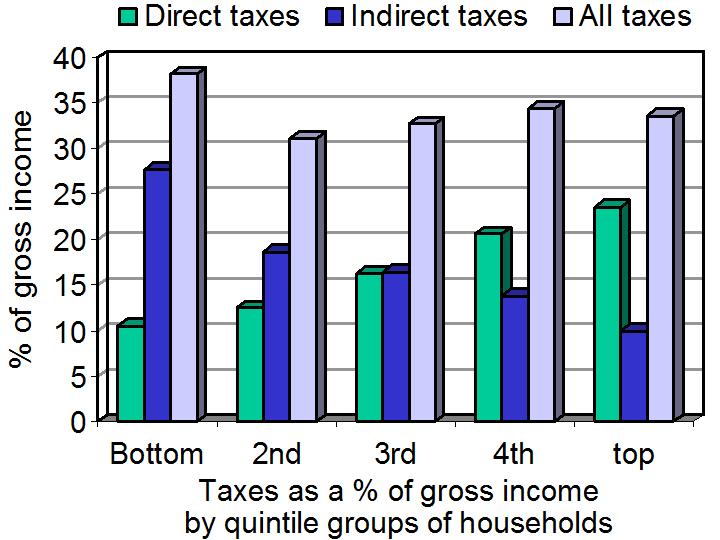
The progressiveness of the UK tax system is illustrated in the chart, which looks at the proportion of income paid in direct, indirect and all taxes by quintile groups of households – that is, households grouped into five equal sized groups ranked from lowest to highest gross income. (Click here for a PowerPoint of the chart.)
The following articles look at the debate as it has raged over the past few weeks. Try to unpick the genuine arguments from the political rhetoric!
Articles
Clegg Says U.K. Could Apply Mansion Tax ‘in Five Seconds’ Bloomberg, Robert Hutton (25/9/12)
Two thirds back mansion tax on £1m homes Metro, Tariq Tahir (8/10/12)
Mansion tax would ‘tackle inequality’ This is Tamworth (27/9/12)
Council tax: the easy way to make mansion-dwellers pay Guardian, Simon Jenkins (25/9/12)
 Rich must pay fair share in tax BBC Andrew Marr Show, Nick Clegg (23/9/12)
We will get mansion tax on £2 million homes through next budget, promise Lib Dems The Telegraph, Rowena Mason (25/9/12)
Trying to tax the wealthy not worth the price The Scotsman, George Kerevan (31/8/12)
Tax on wealth is true to Tory principles Financial Times, Janan Ganesh (24/9/12)
How would Clegg’s emergency wealth tax work? Guardian, Hilary Osborne (29/8/12)
Labour considers mansion tax on wealthy Financial Times, George Parke (5/9/12)
Conservative conference: Cameron rules out ‘mansion tax’ BBC News (7/10/12)
Don’t make wealth tax a habit Financial Times, Howard Davies (29/8/12)
George Osborne blocks mansion tax, but insists wealthy will pay more The Telegraph, Robert Winnett (8/10/12)
Why George Osborne had to kill the mansion tax The Spectator, Matthew Sinclair (7/10/12)
David Cameron rules out mansion tax and plans further welfare cuts Guardian, Hélène Mulholland (7/10/12)
Viewpoint: Would a wealth tax work? BBC News, Mike Walker (29/8/12)
For all the claims made about wealth taxes, it’s not correct to say the rich are paying their fair share Independent, Jonathan Portes (2/10/12)
Data
House price data links Economics Network
The Effects of Taxes and Benefits on Household Income, 2010/2011 ONS (26/6/12) (see especially Tables 2 and 3 and Table 26 for historical data)
Questions
- Explain the distinction between direct and indirect taxes, and between progressive and regressive taxes. For what reasons do the poor pay a higher proportion of their income in indirect taxes than the rich?
- What forms can a tax on wealth take?
- How progressive are taxes in the UK (see the ONS site in the Data section above)?
- Assess the arguments in favour of a mansion tax.
- Assess the arguments against a mansion tax.
- What type of wealth tax would be hardest to evade?
- What are the likely income and substitution effects of a wealth tax?
 The UK has always been an attractive place for investment, as foreign companies look to cities such as London for stable investment opportunities. This provides not only jobs and output, but also tax revenue for the government. However, one drawback is the lost tax revenue through tax avoidance schemes and big businesses say that if the UK is to remain competitive it needs to look at cutting taxes and bureaucracy.
In recent months, we have seen cases of individuals being prosecuted for tax evasion and more recently in the USA, Microsoft and Hewlett-Packard have been criticized by the Senate for allegedly moving an estimated £13bn to offshore accounts. (Microsoft and HP deny any wrong-doing). It is cases like this that provide an argument for governments to cut business rates and avoid losing business and jobs to other tax havens. Lord Fink, who is a Director of Firms located in a variety of tax havens said:
’I don’t see why the UK should not compete for jobs that at present are going to the Cayman Islands’
 Tax havens are obviously attractive to firms, as they provide a means of retaining more of a firm’s earnings and hence their profits. By offering a much lower rate of tax than countries such as the UK, they help to ease the tax burden on wealthy individuals and investors in hedge funds, along with many others.
The question is, do these lower tax rates discourage investment into the UK and thus would a relaxation of Revenue Customs’ rules mean an increase in inward investment and the other positive things that this would bring? Or would a decrease in tax rates for wealthy investors send the wrong message?
 In a time of austerity, tax cuts for the rich are never going to be a popular policy – at least not amongst the ‘non-rich’ – in truth, the majority of the population. Furthermore, many simply see tax havens as morally wrong – or as George Osborne put it ‘morally repugnant’. The use of them provides the better off with a means of paying less to the taxman, whilst the worse off continue to pay their share.
The controversy surrounding tax havens is perhaps even more of an issue given the size of the public-sector deficit. With tax havens being used by those who should be paying the most, tax revenues are lower than would be the case without tax evasion and avoidance. Is this adding to the burden of basic rate tax payers?
This doesn’t help the gap between government expenditure and revenue, which has contributed to the largest amount of UK public-sector borrowing in August 2012 since records began. Net borrowing reached £14.4bn, as things like corporation tax receipts fell and benefit payments rose. Money that should go in to the government’s coffers is undoubtedly making its way into tax havens, but does that also mean that jobs are making their way out of the country? If tax rates in the UK were cut, cities such as London may become even more attractive places to invest, which could potentially create a much needed boost for the economy. But, at what cost? The following articles consider the controversy of tax havens.
Microsoft and HP rapped by US Senate over tax havens BBC News (20/9/12)
Morally repugnant tax avoiders can rest easy under David Cameron Guardian, Tanya Gold (21/9/12)
Britain could prevent the use of tax havens by ending ‘archaic’ business rules Telegraph, Rowena Mason (21/9/12)
UK public-sector borrowing hits record high of £14.4bn BBC News (21/9/12)
The top Tory who wants to make Britain a tax haven for millionaires Guardian, Martin Williams and Rajeev Syal (20/9/12)
Make UK a tax haven to attract investment from millionaires, urges Tory treasurer Mail Online, Daniel Martin (21/9/12)
Microsoft saved billions using Irish tax havens Irish Times, Genevieve Carbery (21/9/12)
Microsoft, HP skirted taxes via offshore units: U.S. Senate Panel Reuters, Kim Dixon (21/9/12)
Danny Alexander says tax avoidance ‘adds 2p in every £1 to basic tax rate’ Independent, Oliver Wright (24/6/12)
Questions
- What are the key features of tax havens?
- Briefly explain the arguments in favour of tax havens and those against. Think about them from all points of view.
- Explain the way in which a cut in UK tax rates could create jobs and how the multiplier effect may provide a boost for the UK economy.
- If tax rates were cut, how might this affect an individual’s decision to work? What about an individual’s decision to invest? Use indifference analysis to help explain your answer.
- How does tax avoidance and evasion affect public sector borrowing? Is there any way a cut in tax rates on foreign investment could improve the government’s finances?
- Do you think there is any truth in the argument that the UK is losing out to other countries because of its higher tax rates? Is a reduction in tax rates necessary to help us compete?
 Trade union action has been a feature of the British labour market over the past few years, as discussed in this first and second blog. With the government’s austerity measures still in place and ongoing issues over pension provision, there are many explosive issues that will undoubtedly be discussed at this year’s TUC Conference in Brighton.
We have already heard from numerous unions that strike action over the coming year is ‘inevitable’. With rising prices, static or even falling wages, reduced pension provision and increased contributions, the cost of living has become increasingly unaffordable for many members of the trade unions. Dave Prentis, the General Secretary of Unison said:
‘I think people have been pushed into a corner. They are moving into poverty … The threat is that if we can’t move forward in negotiations to find a way through it then we will move to industrial action. There is no doubt whatsoever that we can create disputes throughout next year.’
Although few would argue against the notion that the government’s finances are in a dire state and spending cuts together with tax rises are needed, the controversy seems to lie in exactly when these cuts should take place and how severe they should be. For many, cutting government spending and raising taxes whilst the economy is still in recession is asking for trouble. For others, it’s the right thing to do and everyone should play a part in helping to return government finances to a semblance of balance. The Labour government has traditionally supported trade unions, but even their leadership backed the government’s plan for pay restraint for public sector workers. This, together with the continuing debates over public sector pensions has clearly angered many public sector workers, thus creating this ‘inevitable’ industrial action over the coming year.
Unison and GMB have said that they will be working together in order to try to better pay and conditions for its members, by co-ordinating public-sector strikes around Spring next year. Co-ordinated strikes across a variety of sectors could create havoc for the economy. Not just disruption for the everyday person, but losses for businesses and the economy. A general strike has not taken place since 1926, but it is thought that TUC delegates will be voting on whether or not one should be planned. So, when faced with these inevitable strikes, should the government back down and cut back on austerity or stand up to them and suffer the disruption of a strike, whilst continuing on with bringing its budget back on track? The following articles look at the TUC Congress and the proposed strike action.
Public sector unions plan Spring strikes Guardian, Dan Milmo (9/9/12)
Trade union warns of further strikes Financial Times, Brian Groom (7/9/12)
Trade union officials gather for TUC Congress in Brighton BBC News, John Moylan (9/9/12)
Unite union leader warns of wave of public sector strikes Guardian, Dan Milmo (7/9/12)
Unison and GMB unions planning co-ordinated strikes over pay BBC News, Justin Parkinson (9/9/12)
TUC Conference 2012: a mixture of new and old Channel 4 News (9/9/12)
Government must stand up to these TUC bully tactics Express, Leo McKinstry (9/9/12)
Questions
- What is the purpose of a trade union?
- What is the difference between individual and collective bargaining? Why is collective bargaining likely to be more successful in achieving certain aims?
- If there is co-ordinated strike action, what are the likely costs for (a) the workers on strike (b) the non-striking workers (c) businesses and (d) the economy?
- What are the main issues being debated between unions and the government?
- Explain the economic reasoning behind Dave Prentis’ statement that people are being moved into poverty.
- Do you agree with strike action? Do you think it has any effect?
- When do you think is the right time to implement austerity measures? Has the government got it right? As always, make sure you explain your answer!!
 For some people, a pint of beer is a regular thing each week. Add all your pints of beer together, then add your friend’s pints, their friends’ pints and … you get the idea. Once you’ve done that for the entire population, you have an estimate of total beer consumption in the UK. This can then be compared with total consumption of beer in other countries and between continents.
Prior to 2007, Europe and the Americas were the biggest beer drinking continents, but since then, Asia has emerged as the leader of pints of beer consumed, drinking 67bn litres of beer compared with the Americas’ 57bn and Europe’s 51bn in 2011. In per capita terms, Asia is still some way off, with Japan leading the way as the highest Asian country in 41st place, consuming 64 litres of beer per year per capita of the population. So how is this relevant to economics and business?
 Consumption of anything provides jobs – bar workers, manufacturers and in the case of beer, probably law enforcement! It probably also increases utility – after all, why consume it if it’s not going to give you some degree of satisfaction!
We can analyse the demand for beer and see how it varies with changes in price and income. Minimum prices for alcohol have been proposed as a means of reducing consumption, and tax and excise duties are always linked to alcoholic beverages and clearly have an effect on demand. In this case, however, we can also consider the emergence of Asia and how tastes have changed. It is the fastest growing beer market in the world; so what can we deduce from that? As the BBC News article states, it is ‘a sign of a young, upwardly mobile, and increasingly hedonistic population.’
Experts also say that the increased consumption of beer in Asian countries is closely correlated with growing incomes and prosperity. A consumer research analyst from Standard Chartered, Nirgunan Tiruchelvam, said:
“Beer has a clearer correlation with strong economic growth … People tend to drink beer in times of growth. They drink spirits when times are good and when times are bad.”
Data suggest that when a certain level of prosperity is reached in a nation, beer sales begin to rise. As many Asian economies begin to develop rapidly, beer sales have taken off. This could be regarded as a good thing for Europe. With stagnant Western economies, beer producers within Europe may be grateful for a growing demand in Asia. Indeed, many of the world’s biggest breweries are expanding rapidly, providing jobs and income. Consumers in Europe will also be happy to see that beer production remains profitable in other parts of the world. With unemployment still high and recession ongoing, a pint of beer will be a much needed pick-me-up for many people. At least, that’s what the evidence from the Great Depression of the 1930s suggested!!
It’s not good news for everyone, however. Beer production has also increased in Asian countries, most notably in China, which now leads the world as the largest beer producer. This clearly reduces the export potential for European beer producers.
Also, many argue that the growing consumption of beer in Asia is simply an illustration of growing Western influence and it is likely to create severe medical problems in the future. Binge drinking and under-age consumption is already a big problem in Western countries and this could soon begin to extend across the world. The following articles consider the growth in consumption of beer.
Brewers thirsty for expansion as taste for beer grows in emerging markets Guardian, Simon Neville (3/9/12)
Beer in Asia: the drink of economic growth BBC News, Saira Syed (6/9/12)
Study says world beer production hits new high Long Island Business News, Associated Press (8/8/12)
Global beer sales go up for 27th year running News Track India (9/8/12)
Questions
- Use a supply and demand diagram to analyse recent trends in beer consumption across the world.
- Which factors have caused demand in emerging markets to increase? Based on your answer to the previous question, how might that have affected equilibrium prices?
- How has growth in beer consumption throughout Asia benefited Western producers?
- What would you expect the price and income elasticities of demand to be for a product such as beer? Explain your answer.
- To what extent do you think this trend in beer production is a sign of globalisation?
- Evaluate the extent to which the growth in consumption and production of beer in Asia is a good thing. You should consider everyone who and everything might be affected!
Let’s face it – no-one likes paying tax! After all, to see your monthly pay decline by £1000 through taxation and national insurance has got to hurt. Yet, taxation and national insurance contributions are essential sources of government revenue to finance benefits and public and merit goods.
However, with so much attention given to the UK’s ‘culture of dependency’, many people are increasingly angry with having to pay so much in taxation to see it being spent by the government on individuals who in some cases choose not to work and at the same time seeing other rich people paying so little in taxation. The increase in the top rate of tax received a lot of coverage. Although it did make the tax system more progressive, there were many concerns that it would lead to lower growth, a lack of innovation and enterprise and increased tax evasion and avoidance, as the super-rich were being hit with phenomenal tax bills. The post on the 50p income tax available here is worth looking at again to think about the effect that taxes have on incentives.
The issue of tax avoidance is by no means new, but with a large budget deficit in the UK, tax avoidance by the super-rich has become something that everyone has an opinion on. The average household has seen its income squeezed more and more, as the government continues its efforts to cut the deficit. The fact that the super rich are avoiding sometimes millions in taxation, while the average household struggles to pay even the basic rate of tax, creates a rather contentious issue. The Chief Secretary to the Treasury, Danny Alexander, has said that the basic rate of tax could be cut by 2p in the pound if tax avoidance came to an end. He commented to the BBC’s Sunday Politics Programme that:
‘We have to make sure that everybody, especially the rich and famous, are paying their fair share of tax…These sorts of schemes that save wealthy people potentially tens of millions of pounds in tax, they are paid for by everybody else… If we could narrow the tax gap in this country by a quarter we could reduce income tax for every basic rate payer by 2p in the pound.’
This would clearly have some very positive effects on some of the poorest people living in the UK.
There is a variety of tax avoidance schemes available and the one receiving the most attention at present is the Jersey-based K2 scheme, which Jimmy Carr and others are thought to be using. The Public Accounts Committee will be reporting on the problem of using private companies to pay salaries, as a means of avoiding income tax and national insurance contributions.
If tax avoidance could be stopped, or at least reduced, then not only could basic rate tax payers benefit, but it might go some way to cutting the budget deficit, giving the government more flexibility in stimulating the economy. According to HMRC, tax avoidance and evasion cost the economy some £42 billion – enough to pay off one-third of Britain’s budget deficit.
The following articles consider the problem of tax avoidance and then try answering the questions on the issue of taxation.
Five-point plan to curb tax cheating by big firms and super-rich Guardian (27/6/12)
Stop tax dodgers or there will be ‘riots on the streets’, warns top lawyer designing new anti-avoidance rules Mail Online, Julian Gavaghan (26/6/12)
Danny Alexander describes aggressive tax avoidance as ‘morally repugnant’ Guardian, Patrick Wintour (24/6/12)
Basic tax ‘could be cut by 2p’ if avoidance ended BBC News(24/6/12)
Danny Alexander says tax avoidance ‘adds 2p in every £1 to basic tax rate’ Independent, Oliver Wright (24/6/12)
Make tax returns public, urges peer The Press Association (28/6/12)
Tax officials reveal scale of probe Financial Times, Jim Pickard (27/6/12)
Questions
- What are the key principles of a good tax system?
- Explain how taxation affects the incentive to work?
- What is the difference between tax evasion and tax avoidance?
- Using indifference analysis, illustrate the effect of a cut in the basic rate of income tax. How does it affect the decision to work more or less? You should consider the income and substitution effects in your answer and which rate of tax (if any) an individual is paying.
- Why is tax avoidance of such concern at the moment? Think about the current state of the economy.
- What are taxes and national insurance contributions used to pay for?
- To what extent do you think tax avoidance is a natural consequence of any tax system?
 There has been considerable discussion recently about whether the government should introduce a property tax on high value properties. The government, finding it difficult to reduce the public-sector deficit and yet determined to do so, is looking for additional measures to reduce government expenditure or raise tax revenue.