 The instability of the economy was clearly demonstrated by the events of the late 2000s. Economists have devoted considerable energies to understanding the determinants of the business cycle. Increasing attention is focused on the role that credit cycles play in contributing to or exacerbating cycles. Therefore, data on lending by banks is followed keenly by policymakers who wish to avoid the repeat of the pace of growth in credit seen in the period preceding the financial crisis. Interestingly, the latest data from the Bank of England show that lending by financial institutions to households (net of repayments) rose in July to its highest level since November 2009.
The idea of credit cycles is not new. But, the financial crisis of the late 2000s has helped to reignite analysis and interest. Many economists have revisited the work of Hyman Minsky (1919–1996), an American economist, who argued that financial cycles are an inherent part of the economic cycle and contribute to fluctuations in real GDP. Notably, he argued that credit extended to households and businesses is pro-cyclical so that flows of credit extended by banks are larger when the growth of the economy’s output is stronger. Since credit flows are dependent on the phase of the business cycle, they are said to be endogenous to the path of output. The key point here is that there is an inherent mechanism within the economy which is potentially destabilising.
Banks, it is argued, may use the growth of the economy’s output as an indicator of the riskiness of its lending. Households and businesses may undertake a similar assessment. After a period of sustained growth banks and investors become more confident about the future path of the economy and, consequently, in the returns of assets. This means that there is a role for psychology in understanding the business cycle.
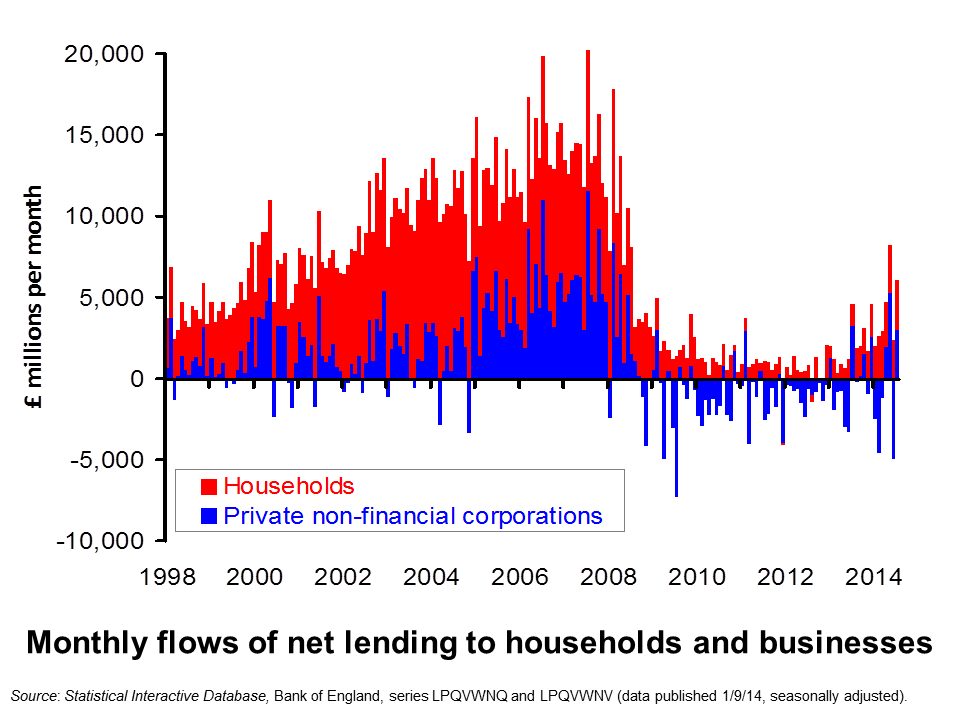 If we look at the chart, this period of heightened confidence may correspond with the period starting from the late 1990s. Between 1998 and 2007 the average monthly net flow of credit to private non-financial corporations and households was £9.4 billion. In other words, households and businesses were acquiring a staggering £9.4 billion of additional debt from banks each month. But, this was as high as £14.0 billion per month in 2007. (Click here for a PowerPoint of the chart.)
What helped to fuel the impact of heightened confidence on credit provision was financial innovation. In particular, the bundling of assets, such as mortgages, to form financial instruments which could then be purchased by investors helped to provide financial institutions with further funds for lending. This is the process of securitisation. The result was that during the 2000s as households and businesses began to acquire larger debts their financial well-being became increasingly stretched. This was hastened by central banks raising interest rates. The intention was to dampen the rising rate of inflation, partly attributable to rising global commodity prices, such as oil. Suddenly, euphoria was replaced with pessimism.
Some argue that a Minsky moment had occurred. Many countries then witnessed a balance sheet recession. As individual households and businesses try and improve their own financial well-being they collectively contribute to its worsening. For instance, large-scale attempts to sell assets, such as shares or property, only help to cause their value to decline.
A global response to the events of the financial crisis has been for policy-makers to pay more attention to the aggregate level of credit provision. The chart shows that lending in 2014 is more robust than it has been form some time. Across the first seven months of 2014 the average monthly net flow of credit extended by banks to households and businesses (private non-financial corporations) has been £2.2 billion.
However, the 2014-rebound of credit is wholly attributable to lending to households. Net lending to households has averaged £2.7 billion per month while businesses have been repaying credit to banks to the tune of £437 million per month – something that businesses have collectively done in each year from 2009. While net lending to households remains considerably lower than pre-financial crisis levels, it will be something that policymakers will be watching very closely. This, in turn, means that they will be paying particular interest to the housing and mortgage markets.
Articles
Appetite for loans picks up again, say major banks BBC News (23/9/14)
Business lending by UK banks is down by £941m Herald Scotland, Ian McConnell (27/8/14)
How bank lending fell by £365 BILLION in five years… much to the delight of controversial payday loan firms Mail, Louise Eccles (7/09/14)
U.K.’s Big Banks Cut Lending by $595 Billion, KPMG Says Bloomberg, Richard Partington (8/9/14)
UK banks’ home loan approvals fall to 12-month low – BBA Reuters, Andy Bruce and Tom Heneghan (23/9/14)
Data
Bankstats (Monetary and Financial Statistics) – Latest Tables Bank of England
Statistical Interactive Database Bank of England
Questions
- What is meant by the term the business cycle?
- What does it mean for the determinants of the business cycle to be endogenous? What about if they are exogenous?
- Outline the ways in which the financial system can impact on the spending behaviour of households. Repeat the exercise for businesses.
- How might uncertainty affect spending and saving by households and businesses?
- What does it mean if bank lending is pro-cyclical?
- Why might lending be pro-cyclical?
- How might the differential between borrowing and saving interest rates vary over the business cycle?
- Explain what you understand by net lending to households or firms. How does net lending affect their stock of debt?
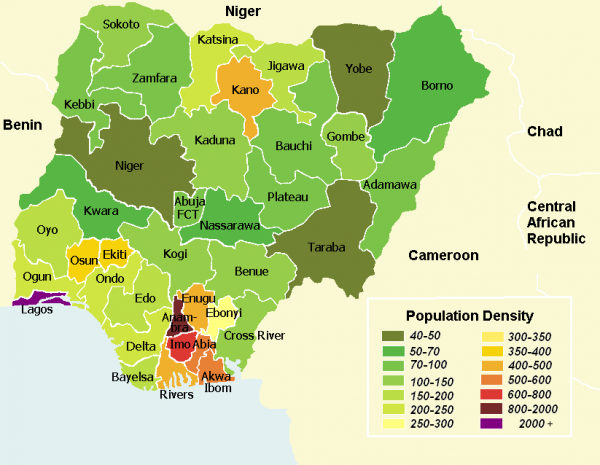 I found this interesting article on the BBC News website about three students in Nigeria who have created an online job search company. Only five years later, this company now is valued in the millions and employs over 100 people.
The article below contains some interesting insights into the Nigerian job market and the key to success for this company. In particular, they note the effect of the multiplier through job creation and how this has been used to benefit the wider economy. This is particularly pertinent given the severe unemployment problem that has affected this African economy. It has helped 35,000 people to find jobs in the past two years.
How three students created Nigeria’s online jobs giant BBC News, Jason Boswell (2/9/14)
Questions
- What are the main causes of the unemployment problem in Nigeria?
- The company itself employs hundreds of people, but indirect employment effects have also occurred. How has this happened?
- How important are entrepreneurs in African countries as a means of helping their development?
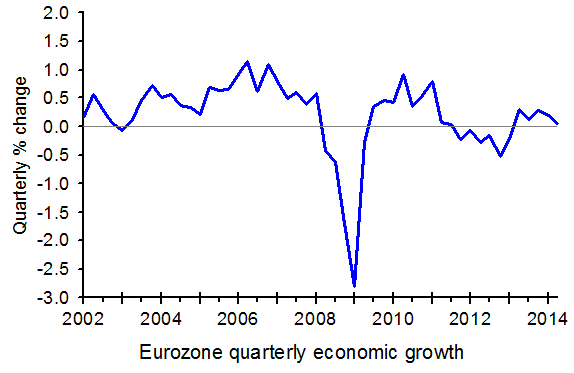
 The eurozone recorded 0.0% growth in the second quarter of 2014. While the UK and USA are now experiencing relatively buoyant economic growth, the eurozone as a whole is stagnating. Some of the 18 eurozone countries, it is true, are now growing, including Spain, Portugal, Ireland and the Netherlands. But the German and Italian economies contracted in the three months to the end of June, while France experienced zero growth.
This will put growing pressure on the ECB to introduce quantitative easing (QE) through the direct purchase of government bonds or other assets. Although this has been a key policy of many central banks, including the Bank of England, the Fed and the Bank of Japan, up to now the ECB has focused mainly on providing cheap funds to banks to encourage them to lend and keeping interest rates very low.
In June, the ECB did announce that it would explore the possibility of QE. It would also introduce €400 billion worth of targeted long-term lending to banks (targeted longer-term refinancing operations (TLTROs)), and would cease sterilising the extra liquidity injected through the Securities Markets Programme, which involved the purchase of existing bonds on the secondary market.
These plans and their implications are examined in the blog post, The ECB: tackling the threat of deflation.
But even if it does eventually introduce QE, this is unlikely before 2015. However, the first €200 billion of TLTROs will be introduced in September and the remaining €200 billion in December. The ECB hopes that these measures in the pipeline will give a sufficient stimulus to rekindle economic growth. But increasingly there are calls for something more dramatic to be done to prevent the eurozone as a whole slipping back into recession.
Articles
Eurozone economy grinds to halt even before Russia sanctions bite Reuters, Michelle Martin and Martin Santa (14/8/14)
ECB under pressure to boost growth, analysts say BBC News (14/8/14)
Eurozone growth at zero as Germany slumps, France stagnates Deutsche Welle (14/8/14)
Eurozone crisis: The grim economic reality BBC News, Gavin Hewitt (14/8/14)
Eurozone growth splutters to a halt as crisis enters new phase The Guardian, Larry Elliott (14/8/14)
Eurozone can learn from George Osborne and Bank of England stimulus The Guardian, Larry Elliott (14/8/14)
Broken Europe: economic growth grinds to a standstill The Telegraph, Szu Ping Chan (14/8/14)
One-in-three chance the ECB conducts quantitative easing next year – Reuters Poll Reuters, Sumanta Dey (13/8/14)
Eurozone’s Unravelling Recovery: What’s Going Wrong Across Troubled Currency Bloc International Business Times, Finbarr Bermingham (14/8/14)
France calls on ECB to act as eurozone growth grinds to a halt The Guardian, Larry Elliott (14/8/14)
That sinking feeling (again) The Economist (30/8/14)
Data
GDP stable in the euro area and up by 0.2% in the EU28 eurostat euroindicators (14/8/14)
Statistics Pocket Book ECB
European Economy: links to data sources Economics Network
Euro area economic and financial data ECB
Questions
- Explain how quantitative easing works.
- Why has the ECB been reluctant to introduce QE?
- What is meant by sterilisation? Why did the ECB sterilise the effects of the assets purchased under the Securities Markets Programme? Why did it cease doing this in June?
- How have events in Ukraine and political reactions to them influenced the eurozone economy?
- Should QE be ‘fast tracked’? Would there be any dangers in this?
- What is the ‘Funding for Lending’ scheme in the UK? Is the planned introduction of TLTROs similar to Funding for Lending?
 The expansion of the BRIC economies has both advantages and disadvantages for Western countries. Their consistently high growth rates have created a much wider market place for Western firms and a much needed additional source of consumer demand, especially in times of recession. Countries such as China have had double digit growth rates, with others like India experiencing growth rates of just under 10%. But are these impressive growth rates now beginning to fall?
For the last 2 years, the growth rate in the Indian economy has been sub-5%, with growth in the 2013-14 financial year at 4.7%. Though some sectors, including agriculture have experienced buoyant growth, it is other sectors that have been holding this economy back. Manufacturing contracted at an annualised rate of 1.4% over the quarter, while mining contracted by 0.4%. With a growth rate of just under 5%, one might think that this was good – after all many Western economies have only recently entered positive growth. However, the Indian economy has a rapidly growing population and it is estimated that 10 million additional jobs each year must be created. It is this figure that requires such a high growth rate – estimated at around 8%. Thus, the sub-5% growth recorded for 2 years is insufficient to sustain the required job creation.
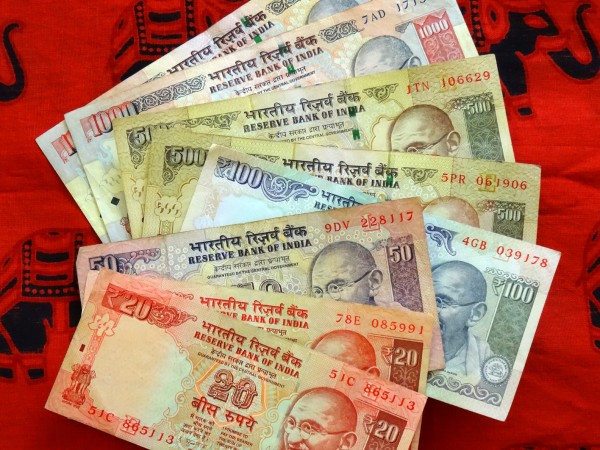
There are many factors that appear to be holding growth back. High inflation has been a problem for some years and the Indian currency has been relatively weak and volatile. Together, these issues have created an environment of uncertainty and if there’s one thing that investors don’t like, it’s uncertainty. This has therefore led to a lack of investment in the economy, which is a key component of aggregate demand and hence a key source of economic growth. Furthermore, interest rates rose last year, thereby pushing up the cost of borrowing and the rate of credit growth has also slowed. These factors collectively have led to lower foreign investment, domestic investment and spending, which have all contributed towards more subdued growth than in the past. Glenn Levine, a senior economist at Moody’s said:
India’s economy continues to grow well below potential as a combination of supply‐side constraints and the adverse effects of an underperforming government weigh on capital expenditure and hiring … It will be a while before the Indian economy is expanding above 6% again.
However, many economists remain optimistic about the prospects of Asia’s third-largest economy. Inflation appears to be under control and the currency has gained strength. Many believe that more investment supporting government policies will be the kick start the economy needs and this will in turn encourage firms to begin investment. It may be the new leader of this country, Narendra Modo, that will jump start the economy. The Prime Minister is expected to back policies to stimulate growth, who will direct more spending at infrastructure, simplify taxes and introduce policies to attract foreign investment. Adi Godrej, Chairman of the Godrej group said:
As soon as investors see the first signals of growth-supportive policies, you will see a definite turnaround on the ground.
The coming months will be crucial in determining how quickly the Indian economy is likely to see a return to near double digit growth. The new government has indeed promised policies to boost the economy, but the annual budget will confirm whether this promise is likely to be kept. Given the dependence of Indian jobs on a fast growth rate and the dependence of the Western world on the continued growth of the BRICs in creating a wider market for our exports, the fortunes of India are extremely important. The following articles consider this economy.
Indian economy grew at 4.7% in 2013-14 The Times of India (30/5/14)
India’s economic growth disappoints BBC News (30/5/14)
India’s GDP grows 4.7% in fiscal year, missing government forecast Wall Street Journal, Anant Vijay Kala (30/5/14)
India’s economy expands 4.7pct in fiscal year 2013/14 Reuters (30/5/14)
India’s economy still underwhelms CNN Money, Charles Riley, Alanna Petroff (30/5/14)
FY14 GDP growth at 4.7%; India sees worst slowdown in 25 years The Economic Times (30/5/14)
India growth below 5% adds pressure on Modi to spur investment Bloomberg, Unni Krishnan (30/5/14)
Jim Armitage: ‘Modinomics’ in India has helped growth, but not for all Independent, Jim Armitage (17/5/14)
Questions
- Using a diagram, explain how economic growth can be created through (a) demand-side measures and (b) supply-side measures.
- Why would higher interest rates reduce growth?
- Why does high inflation create uncertainty and what impact does this have on business investment?
- India has experienced a weak and volatile currency and this has contributed towards a lack of foreign investment and low growth. Using a diagram, explain why this could be the case.
- What sort of government policies would you recommend for the Indian economy if you had become the new Prime Minister and your primary objective was to boost economic growth?
- Why is the expansion of the BRIC economies, of which India is one, so important for Western economies?
 The latest preliminary GDP estimates for 2014 Q1 suggest that the economy’s output (real GDP) expanded by 0.8 per cent following on the back of a 0.7 per cent increase in 2013 Q4. Growth was observed in three of the four main industrial sectors: 0.9% in services, 0.8% in production and 0.3% in construction. In contrast, output decreased by 0.7% in agriculture. The total output of the economy is now just 0.6 per cent below its 2008 Q1 peak with the output of the service sector now 2.0 per cent higher.
Data on growth need to be set in the context of the inherent volatility of economies and in this case in the context of 2008/9 recession. Then, output fall by some 7.2 per cent. UK output peaked in 2008 Q1 (£392.786 billion at 2010 prices). There then followed 6 quarters during which output declined.
Output declined again in 2010 Q4 (-0.2% growth), in 2011 Q4 (-0.1% growth), in 2012 Q2 (-0.4%) and in 2012 Q4 (-0.2%). A double-dip recession was only narrowly avoided with growth recorded at zero on 2012 Q1. The latest ONS numbers show the economy grew by 0.8 per cent in 2013 Q2 (to £381.318 billion at 2010 prices), by 0.8 per cent in 2013 Q3 (to £384.533 billion at 2010 prices), by 0.7 per cent in 2013 Q4 (to £387.138 billion at 2010 prices) and by 0.8 per cent in 2014 Q1 (to £390.235 billion at 2010 prices). Compared with 2013 Q1, the output of the UK economy in 2014 Q1 is 3.1 per cent higher.
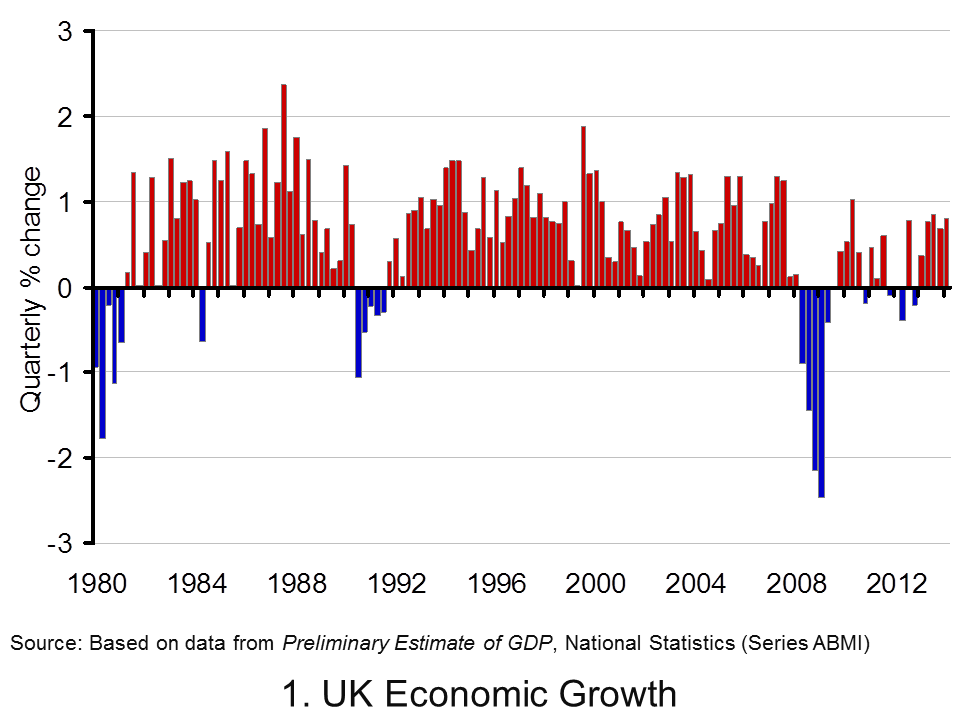 Chart 1 helps to put the recent growth numbers into an historical context. It shows the quarterly change in real GDP since the 1980s. We can see the 5-quarter recession that commenced in 1980 Q1 when output shrunk by 4.6 per cent, the 5-quarter recession that commenced in 1990 Q3 when output shrank by 2.4 per cent and the 6-quarter recession that commenced in 2008 Q2 when output shrank by 7.2 per cent. (Click here to download the chart to PowerPoint.)
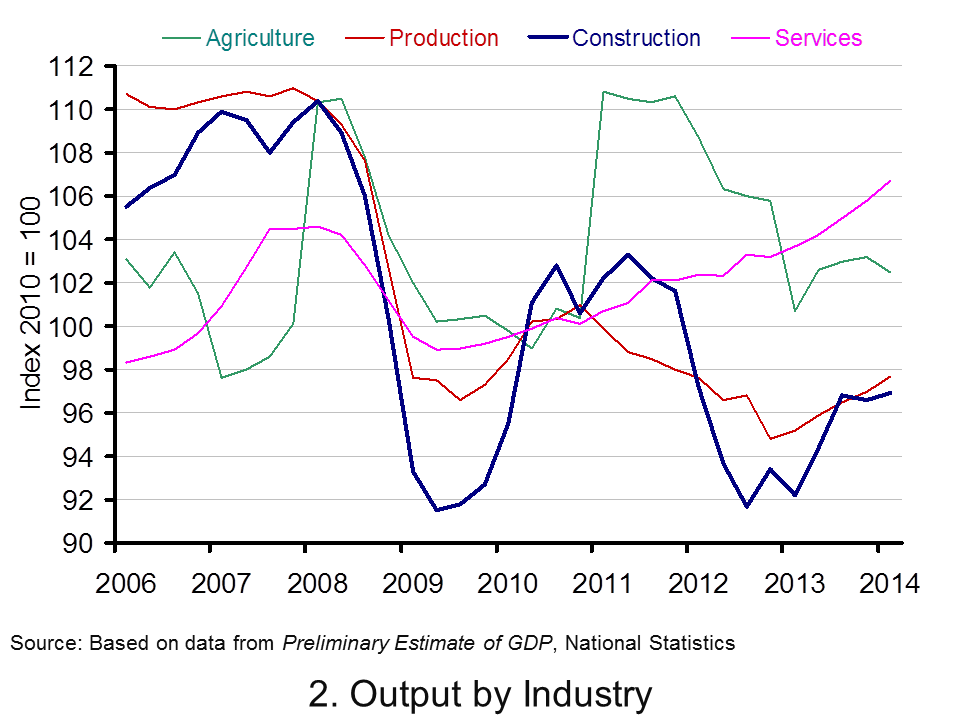 Chart 2 scratches a little below the surface by looking at output by the 4 principal industrial types. The interesting finding is that the output of the service sector has now risen above its 2008 Q1 peak. In 2014 Q1, service sector output was 2.0 per cent higher than 2008 Q1. The fact that total output remains 0.6 per cent lower can be explained by the lop-sided industrial recovery. Output in agriculture, forestry and fisheries remains 7.1 per cent lower, production (including manufacturing) 11.5 per cent lower and construction 12.2 per cent lower. (Click here to dowload the chart to Powerpoint.)
Data
Preliminary Estimate of GDP – Time Series Dataset Q1 2014 Office for National StatisticsGross Domestic Product Preliminary Estimate, Q1 2014 Office for National Statistics
Articles
UK GDP ‘close to pre-crisis level’ says NIESR BBC News (9/5/14)
UK ‘great recession’ almost over, says thinktank Guardian, Katie Allen (9/5/14)
UK economy tops its pre-crash high point, says NIESR Telegraph, Szu Ping Chan (9/5/14)
UK economy grew by 0.8% in first three months of 2014 Guardian, Katie Allen and Angela Monaghan (29/4/14)
Manufacturing is GDP star performer BBC News, Robert Peston (29/4/14).
Questions
- What is the difference between nominal and real GDP? Which of these helps to track changes in economic output?
- Looking at Chart 1 above, summarise the key patterns in real GDP since the 1980s.
- What is a recession? What is a double-dip recession?
- What are some of the problems with the traditional definition of a recession?
- Can a recession occur if nominal GDP is actually rising? Explain your answer.
- What factors lead to economic growth being so variable?
- What factors might explain the very different patterns seen since the late 2000s in the volume of output of the 4 main industrial sectors?
- Produce a short briefing paper exploring the prospects for economic growth in the UK over the next 12 to 18 months.
- Explain the arguments for and against using GDP as a measure of a country’s economic well-being.
- Analyse the role that the financial system might play in contributing to or alleviating the business cycle.
 The instability of the economy was clearly demonstrated by the events of the late 2000s. Economists have devoted considerable energies to understanding the determinants of the business cycle. Increasing attention is focused on the role that credit cycles play in contributing to or exacerbating cycles. Therefore, data on lending by banks is followed keenly by policymakers who wish to avoid the repeat of the pace of growth in credit seen in the period preceding the financial crisis. Interestingly, the latest data from the Bank of England show that lending by financial institutions to households (net of repayments) rose in July to its highest level since November 2009.