 Australia was one of the few economies that seemed to be somewhat insulated from the 2008/09 recession and credit crunch. However, with the UK now back in recession and global economic conditions worsening in much of Europe, Australia has now joined the list of countries that are experiencing economic conditions that are ‘weaker than forecast’.
Today’s world involves economies that are increasingly interdependent, hence the spread of the world economic slowdown. As such, with weak global demand, Australia has started to feel the effects, with demand for its goods and raw materials falling. This has led Australia’s central bank – the Reserve Bank of Australia – to cut its key interest rate (the ‘cash rate’) by more than expected. The rate had been at 4.25% and it was widely believed that a 0.25 percentage point cut would occur. However, the central bank cut the cash rate rate to 3.75% to counter the weakening conditions. The Reserve Bank said:
“This decision is based on information received over the past few months that suggests that economic conditions have been somewhat weaker than expected, while inflation has moderated …Growth in the world economy slowed in the second half of 2011, and is likely to continue at a below-trend pace this year.”
Banks’ interest rates have been falling in Australia for the past few months and this latest cut will do much to help financially squeezed households. Data show that Australian house sales have fallen, as have house prices, and retail sales have fared little better.
Lower interest rates are often a tool used to steer inflation and the Australian central bank may not have been as willing to cut rates had the inflation rate not come down in recent months. Keeping consumer prices under control remains a top priority for the central bank and so it will be interesting to see the impact that these rate cuts will have on the Australian economy.
Articles
Australia cenbank surprises with aggressive half point rate cut Reuters, Wayne Cole (1/5/12)
Australia cuts rates by than forecast to 3.75% BBC News (1/5/12)
Banks unlikely to pass on full rate cut The Australian, Wall Street Journal, Peter Trute (1/5/12)
Australia cuts rate to support economy Financial Times, Neil Hume (1/5/12)
Australia slashes interest rates by 0.5pc to boost economy The Telegraph (1/5/12)
Australia cuts interest rates as economy slows Guardian, Phillip Inman (1/5/12)
Banks must pass on rate cut: businesses Sydney Morning Herald, Ehssan Veiszadeh (1/5/12)
Bond prices rally after rate cut Sydney Morning Herald (1/5/12)
Surplus remains appropriate: Swan Sydney Morning Herald, Colin Brinsden (1/5/12)
Webcasts
 Reserve Bank of Australia Cuts Rates by 50 Basis Points to 3.75% CNBC video, Lauren Rosborough (1/5/12)
Further `Modest’ RBA Easing Possible, ANZ Says Bloomberg, Tony Morriss (1/5/12)
Australia’s central bank shifts focus to growth BBC News, Duncan Kennedy (1/5/12)
Questions
- Which factors will a central bank consider when setting interest rates?
- Explain the components of aggregate demand that will be affected by a lower rate of interest.
- Using diagrams to illustrate the process, explain both the interest-rate and the exchange-rate transmission mechanisms of the fall in interest rates.
- How are interest rates used to target inflation?
- How will lower rates of interest help the Australian economy recover from weakening global economic conditions?
- Why are Australia’s banks unlikely to pass on the full rate cut to consumers?
- Why did bond prices rise and the Australian dollar depreciate after the rate cut? Why does this suggest that a 0.5% cut was greater than anticpated by markets?
 Between December 2007 and March 2009, the Bank of England reduced Bank Rate on several occasions in order to stimulate the economy and combat recession. By March 2009, the rate stood at a record low of 0.5%. Each month the Monetary Policy Committee meets to decide on interest rates and since March 2009, the members’ decision has consistently been that Bank Rate needs to remain at 0.5%.
Although the UK economy has been making tentative steps towards recovery, it is still in a very vulnerable state. Last month, the Bank of England extended its programme of quantitative easing to a total £325bn stimulus. This, together with the decision to keep interest rates down and with the shock fall in manufacturing output contributing towards first quarter growth of just 0.1%, is a key indication that the UK economy is still struggling, even though the central bank thinks it unlikely that the UK will re-enter recession this year.
Monetary policy in the UK has been very much geared towards stimulating economic growth, despite interest rates typically being the main tool to keep inflation on target at 2%. The problem facing the central bank is that economic growth and inflation are in something of a conflict. Low interest rates to stimulate economic growth also create a higher inflation environment and that is the trade-off the economy has faced. Inflation has been well above its target for some months (a high of 5.2% in September 2011), and the low interest rate environment has done little to deflate the figure. After all, low interest rates are a monetary instrument that can be used to boost aggregate demand, which can then create demand-pull inflation. However, inflation is now slowly beginning to fall, but this downward trend could be reversed with the sky high oil prices we are recently experiencing. If inflation does begin to creep back up, the Monetary Policy Committee will once again face a decision: keep Bank Rate low and continue with quantitative easing to stimulate the economy or increase Bank Rate to counter the higher rate of inflation.
The data over recent months has been truly inconsistent. Some indicators suggest improvements in the economy and the financial environment, whereas others indicate an economic situation that is moving very quickly in the wrong direction. A key factor is that the direction the UK economy takes is very much dependent on the world economy and, in particular, on how events in the eurozone unfold. The following articles consider some of the latest economic developments.
UK economy grew 0.1% to avoid recession, says NIESR Guardian, Katie Allen (5/4/12)
UK interest rates held at 0.5% BBC News (5/4/12)
UK just about avoided recession in Q1, NIESR says Telegraph, Angela Monaghan (5/4/12)
Bank of England keeps interest rates on hold at 0.5pc Telegraph (5/4/12)
UK economy ‘weak but showing signs of improvement’ BBC News (3/4/12)
Bank of England holds on quantitative easing and interest rates Guardian, Katie Allen (5/4/12)
Faith on Tories on economy hits new low Financial Times, Helen Warrell (6/4/12)
Questions
- Which factors will the Monetary Policy Committee consider when setting interest rates?
- Using a diagram to help your answer, illustrate and explain the trade-off that the MPC faces when choosing to keep interest rates low or raise them.
- What is quantitative easing? How is it expected to boost economic growth in the UK?
- Which factors are likely to have contributed towards the low growth rate the UK economy experienced in the first quarter of 2012?
- Explain the trends that we have seen in UK inflation over the past year. What factors have caused the figure to increase to a high in September and then fall back down?
- What do you expect to happen to inflation over the next few months? To what extent is your answer dependent on the MPC’s interest rate decisions?
- Although the official figures suggest that the UK avoided a double-dip recession, do you agree with this assessment? Explain your answer.
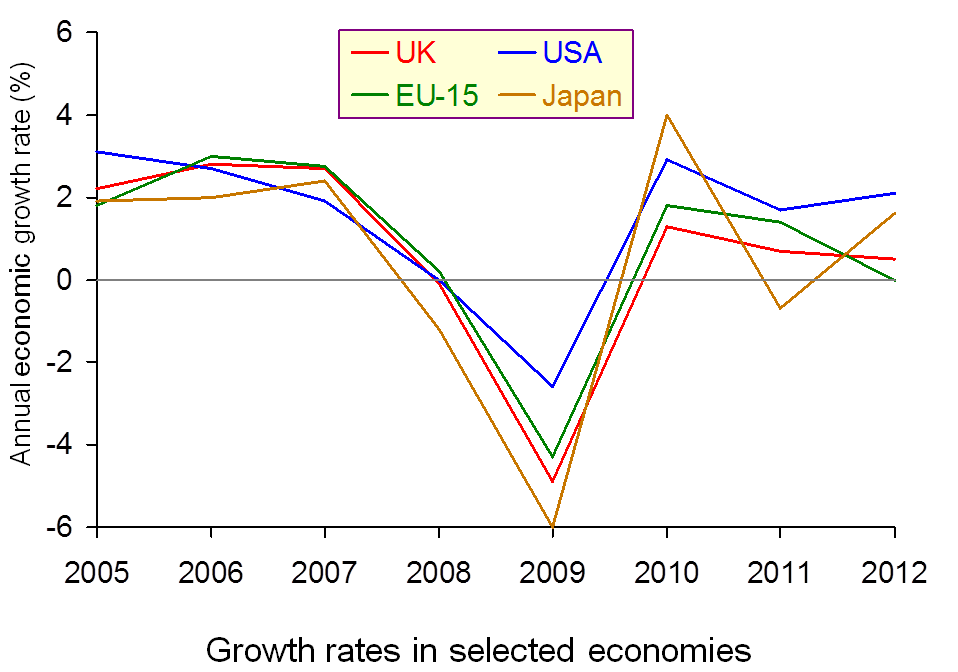 Here’s an excellent article (the first link below) for giving an overview of macroeconomic thinking and policy since the start of the financial crisis in 2007. It looks at how a Keynesian consensus emerged in 2008–9, culminating in policies of fiscal and monetary stimulus being adopted in most major economies.
It also looks at how this consensus broke down from 2010 with the subsequent problem of rising public-sector deficits and debt, and was replaced by a new, although less widespread, consensus of fiscal restraint.
The article is not just about economic theory and policy, but also about the process and politics of how consensus and ‘dissensus’ emerge. It looks at the spread of ideas as a process of ‘contagion’ and how dissent may reflect the view of different defined groups, such as political parties or schools of economic thought.
Consensus, Dissensus and Economic Ideas: The Rise and Fall of Keynesianism During the Economic Crisis, Henry Farrell (George Washington University) and John Quiggin (University of Queensland) (9/3/12)
Keynesianism in the Great Recession Out of the Crooked Timber, Henry Farrell (9/3/12)
Economics in the Crisis (see also) The Conscience of a Liberal, Paul Krugman (5/3/12)
Questions
- What were the features of the Keynesian consensus in 2008–9?
- To what extent can the consensus of that period be described as the result of ‘contagion’?
- Why did consensus break down in 2010?
- How do economic experts play a political role in economic crises?
- To what extent does a lack of consensus benefit politicians?
- Why may the appearance of a consensus be more important in driving policy than actual consensus?
 The rate of inflation in the UK is measured using the Consumer Prices Index (CPI). This is made up of a basket of goods and the ONS updates this ‘basket’ each year to ensure it is representative of what the average UK household buys. The basket contains 700 items, with 180,000 individual prices collected each month.
In recent years, items such as lip gloss have been added to the basket of goods and in the latest adjustment, the ONS has added tablet computers, amongst other things. This is a market that has seen enormous growth. It has been added to the basket as a means of giving a more accurate representation of the price changes faced by the average consumer. The ONS has made it clear that items are not added simply because they are new or removed simply because spending on them has fallen.
‘In each of these cases, the item has not been added because spending has increased or because the product is new on the market … It is purely as part of the rebalancing of the basket to improve its representation of overall price change.’
It is essential that these changes are made each year, as consumer buying habits do fluctuate considerably. One area in particular has been consumer responses to changes in technology. For example, developing and printing colour film has been removed as, with the development of digital cameras, this is no longer reflective of what a representative household spends its money on. Further to this, some items that have previously been used in calculating the RPI have now been added to the CPI, again to give a clearer picture of household spending in the UK. The following articles consider what’s in and what’s out.
Teenage fiction and iPads now in official UK shopping basket Guardian, Julia Kollewe (13/3/12)
Tablet computers added to UK inflation basket BBC News (13/3/12)
New items used to calculate inflation BBC News, Emma Simpson (23/3/12)
Tablet Computers Enter ‘Inflation Basket’ Sky News, Darren Morgan (ONS) (13/3/12)
Inflation basket of goods 2012: full list of what’s out and what’s in Guardian, Simon Rogers (13/3/12)
Tablet computers added to inflation basket of goods Telegraph (13/3/12)
How has the UK’s ‘inflation’ basket has changed? Metro, Ross McGuinness (27/3/12)
iPad and Galaxy added to inflation index Financial Times, Norma Cohen (13/3/12)
Questions
- What is the difference between the CPI and RPI? Which is usually higher? Explain your answer.
- How is the CPI calculated and hence how is inflation measured?
- What impact has technological progress had on the basket of goods that the representative household purchases? Do you think that technological progress make it more or less important for the basket of goods to be reviewed annually?
- Do you think products such as the iPad should be included in the CPI? Are they truly representative?
- In the second Guardian article, you can access a list of the products that are ‘in and out’. Is there anything on there that you think should be in or that should be out? Be sure to justify your answer!
 Unemployment figures for the UK have been going in the wrong direction for some time. With consumer expenditure, investment and hence aggregate demand remaining low, job creation has been severely lacking. However, 2 pieces of news have emerged in the last couple of days, which as David Cameron said was ‘a massive confidence boost for the UK economy’. Tesco and Nissan have both announced the creation of thousands of new jobs.
Over the next 2 years, Tesco has said that it will create 20,000 new jobs through store improvement and the opening of new stores. Whilst it is not clear how many will be full-time, part-time or apprenticeship placements, it still represents net job creation. This huge investment represents what many are calling a ‘fight-back’ from Tesco, who issued its first profit warning in 20 years, following weak Christmas trading. That announcement slashed their shares by over £5bn and is perhaps partly responsible for this planned investment.
Despite this good news, criticisms have emerged that the major supermarkets are simply inflating the job creation figures and that the actual number of new jobs will be significantly less than the 20,000 suggested. This follows allegations made towards Asda, who claimed to have created 30,000 jobs. However, evidence from records at Companies House suggests that new job creation by the company was closer to 7,000. Whatever the true figure, it still means new jobs, which can only help UK unemployment data.
In addition to this, Nissan has also announced that it will be creating 2,000 new jobs, as it begins production on a new model at its Sunderland factory. The jobs will be created as part of a £125m investment, including a £9.3m grant from the government. This is especially good news, given the area where many of these jobs will emerge. The North East is a region that has been hit particularly hard by the recession and the grant from the government has come from its regional growth fund. Nissan has said that even in hard economic times, it is possible to sell cars, as long as they are competitively priced. Neither of the plans discussed above will create jobs immediately, but perhaps the key is that it creates confidence, which is a rarity in the UK with the current economic situation. The following articles consider these job creation plans and their wider implications.
Tesco plans to create 20,000 UK jobs over 2 years BBC News (5/3/12)
Tesco to create 20,000 jobs in UK fight-back Telegraph, Jamie Dunkley (6/3/12)
Tesco’s UK boss defends ‘new jobs’ claims Sky News (5/3/12)
Tesco to freshen up with 20,000 new staff Financial Times, Andrea Felsted (5/3/12)
Now Tesco creates 20,000 jobs – with pay Independent (9/5/11)
Nissan to build new car in Sunderland BBC News (6/3/12)
Nissan pledges 2,000 new jobs at North East plant Sky News, Gerard Tubb (6/3/12)
Nissan Invitation compact car set to create 2,000 jobs Telegraph, Roland Gribben and David Millward (6/3/12)
Nissan to create 2,000 new jobs by building compact car in Sunderland Guardian, Dan Milmo(6/3/12)
Questions
- Explain the process by which net job creation should provide a boost to the economy.
- Will these new jobs have any impact on the government’s budget deficit?
- Why is there concern that the supermarkets are inflating the employment creation figures?
- What type of unemployment has been created by the recession? Why have certain areas, such as the North East been affected so badly by the recession and austerity measures?
- Which factors could have led to Tesco’s weaker trading figures towards then end of 2011? Why did this lead to a £5bn loss in the value of the group’s shares?
- Nissan has said that cars can be sold as long as they are competitively priced. To what extent do you think price is the main competitive weapon in the market for cars and in the supermarket industry?
 Australia was one of the few economies that seemed to be somewhat insulated from the 2008/09 recession and credit crunch. However, with the UK now back in recession and global economic conditions worsening in much of Europe, Australia has now joined the list of countries that are experiencing economic conditions that are ‘weaker than forecast’.