 This is the second of three blogs looking at high inflation and its implications. Here we look at changes in the housing market and its effects on households. Another way of analysing the financial importance of the housing and mortgage markets is through the balance sheets and associated flow accounts of the household sector.
We used the concept of balance sheets in our blog Bank failures and the importance of balance sheets. In the blog we referred to the balance-sheet effects from interest rate hikes on the financial well-being of financial institutions.
The analysis is analogous for households. Again, we can identify two general effects: rising borrowing and debt-servicing costs, and easing asset prices.
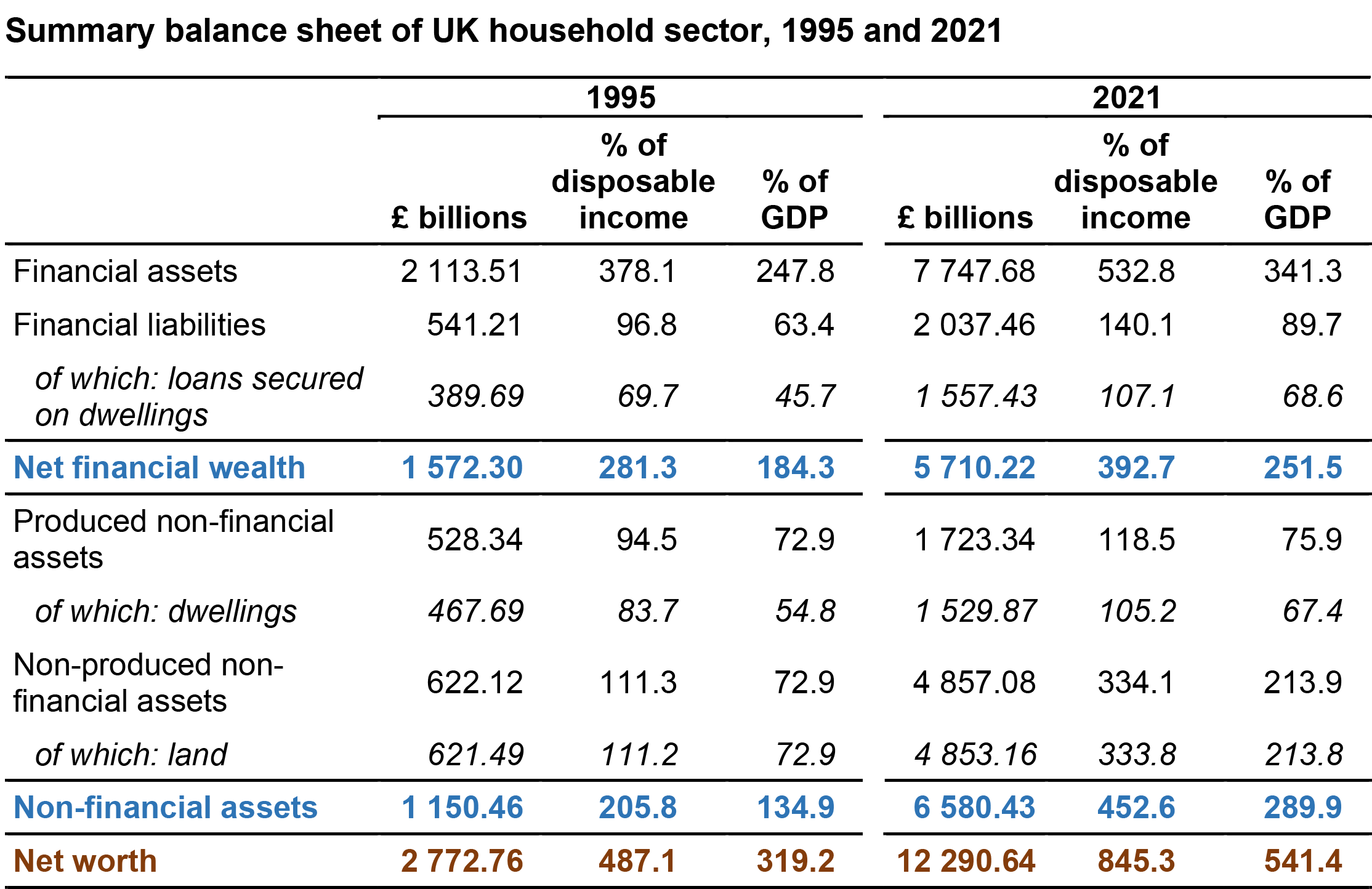
The following table shows the summary balance sheet of the UK household sector in 1995 and 2021.
Source: National balance sheet estimates for the UK: 1995 to 2021 (January 2023) and series RPHA, ONS
The total value of the sector’s net wealth (or ‘worth’) is the sum of its net financial wealth and its non-financial assets. The former is affected by the value of the stock of outstanding mortgages, which we can see from row 3 in the table (‘loans secured on dwellings’) has increased from £390 billion in 1995 to £1.56 trillion in 2021. This is equivalent to an increase from 70 to 107 per cent of the sector’s annual disposable income. This increase helps to understand the sensitivity of the sector’s financial position to interest rate increases and the sizeable cash flow effects. These effects then have implications for the sector’s spending.
 Housing is also an important asset on household balance sheets. The price of housing reflects both the value of dwellings and the land on which they sit, and these are recorded separately on the balance sheets. Their combined balance sheet value increased from £1.09 trillion (£467.69bn + £621.49bn) in 1995 to £6.38 trillion (£1529.87bn + £4853.16bn) in 2021 or from 128% of GDP to 281%.
The era of low inflation and low interest rates that had characterised the previous two decades or so had helped to boost house price growth and thus the value of non-financial assets on the balance sheets. In turn, this had helped to boost net worth, which increased from £2.78 trillion in 1995 to £12.29 trillion in 2021 or from 319% of GDP to 541%.
Higher interest rates and wealth
 The advent of higher interest rates was expected not only to impact on the debt servicing costs of households but the value of assets, including, in the context of this blog, housing. As Chart 3 in the previous blog helped to show, higher interest rates and higher mortgage repayments contributed to an easing of house price growth as housing demand eased. On the other hand, the impact on mortgaged landlords helped fuel the growth of rental prices as they passed on their increased mortgage repayment costs to tenants.
Higher interest rates not only affect the value of housing but financial assets such as corporate and government bonds whose prices are inversely related to interest rates. Research published by the Resolution Foundation in July 2023 estimates that these effects are likely to have contributed to a fall in the household wealth from early 2021 to early 2023 by as much as £2.1 trillion.
The important point here is that further downward pressure on asset prices is expected as they adjust to higher interest rates. This and the impact of higher debt servicing costs will therefore continue to impact adversely on general financial well-being with negative implications for the wider macroeconomic environment.
Articles
- The Mortgage Crunch
Resolution Foundation, Simon Pittaway (17/6/23)
- Peaked Interest?
Resolution Foundation, Molly Broome, Ian Mulheirn and Simon Pittaway (17/7/23)
- UK inflation to fall to lowest level since March 2022 but Bank of England still tipped to hike interest rates
City A.M., Jack Barnett (17/7/23)
- Mortgage payments set to jump by £500 for one million households
BBC News, Tom Espiner (13/7/23)
- Interest rates: Big rise less likely after inflation surprise
BBC News, Daniel Thomas, Faisal Islam & Dharshini David (19/7/23)
- Rising Mortgage Costs. What Can Be Done?
NIESR blog, Max Mosley and Adrian Pabst (17/7/23)
- UK interest rates forecast to rise less sharply after inflation falls to 7.9%
The Guardian, Richard Partington (19/7/23)
- Mortgage costs: More Scots falling behind on repayments
Herald Scotland, Kristy Dorsey (18/7/23)
Report
Data
Questions
- What possible indicators could be used to assess the affordability of residential house prices?
- What do you understand by the concept of the monetary policy transmission mechanism? How do the housing and mortgage markets relate to this concept?
- What factors might affect the proportion of people taking out fixed-rate mortgages rather than variable-rate mortgages?
- What is captured by the concept of net worth? Discuss how the housing and mortgage markets affect the household sector’s net worth.
- What are cash-flow effects? How do rising interest rates effect savers and borrowers?
- How might wealth effects from rising interest rates impact younger and older people differently?
- Discuss the ways by which house price changes could affect household consumption.
 This is the first of three blogs looking at inflation, at its effect on household budgets and at monetary policy to bring inflation back to the target rate. This first one takes an overview.
The housing and mortgage markets are vitally important to the financial well-being of many households. We have seen this vividly in recent times through the impact of rising inflation rates on interest rates and, in turn, on mortgage repayments. Some people on variable rate mortgages, or whose fixed rate deals are coming to the end of their term, have struggled to pay the new higher rates. In this blog we explore the reasons behind these events and the extent to which the financial well-being of UK households has been affected.
Chart 1 shows the path of inflation in the UK since 1997 when the Bank of England’s Monetary Policy Committee (MPC) was first charged with meeting an inflation rate target (click here for a PowerPoint). It captures the impact of the inflation shock that began to emerge in 2021 and saw the CPI inflation rate peak at 11.1 per cent in October 2022 – considerably above the Bank’s 2 per cent target.
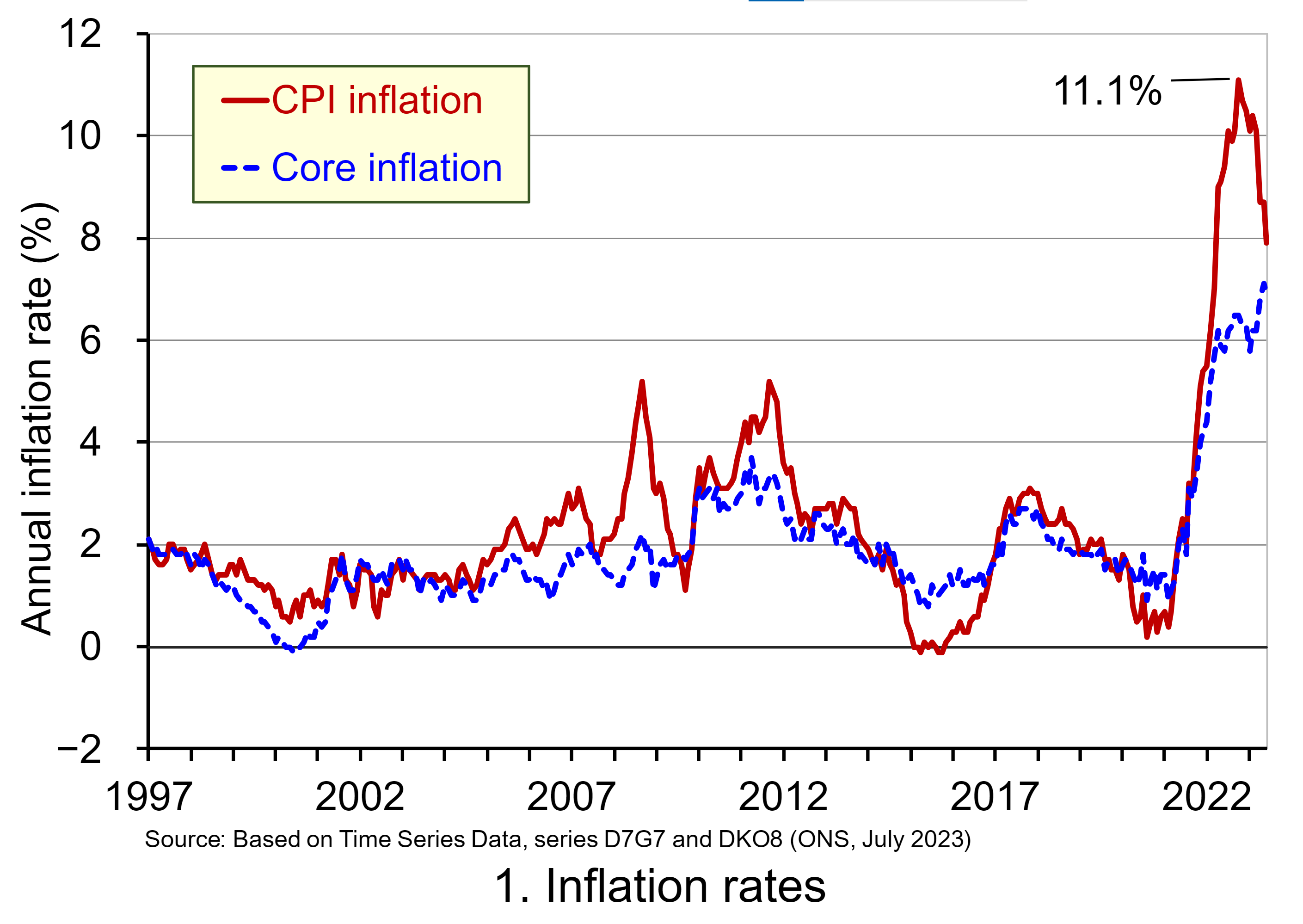 Despite easing somewhat, the CPI inflation rate is showing signs of persistence – meaning that it is taking time for it to return to target. One way of understanding this persistence is to look at a measure of inflation known as core inflation. This inflation rate measure excludes energy, food, alcoholic beverages and tobacco prices, all of which are notoriously volatile. Core inflation thus captures underlying inflationary pressures.
To address the inflationary pressures, the Bank of England began raising Bank Rate in December 2021 from a low of just 0.1 per cent. By June 2023 the Bank Rate had risen to 5 per cent with the prospect of further hikes. As the Bank Rate rises, the cost of borrowing from the Bank of England by commercial banks rises too. Therefore increases in the Bank Rate ripple through to other interest rates. However, the passthrough effect can be uneven affecting spreads between Bank Rate and other interest rates.
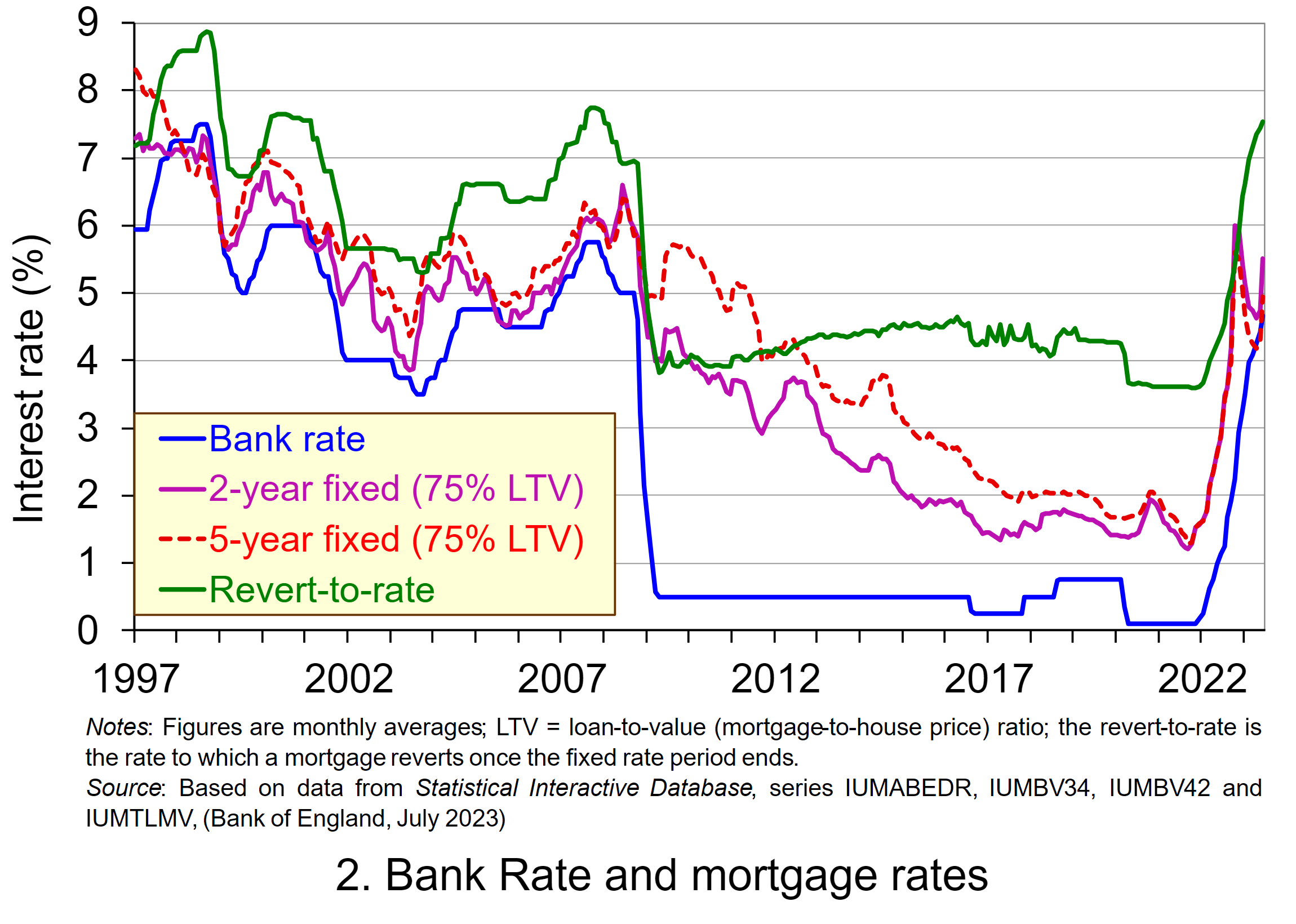 The increase in the Bank Rate is reflected in the increases in mortgage rates shown in Chart 2 (click here for a PowerPoint). As we have seen, this affects most immediately those with variable rate mortgages, and then those with fixed-rate mortgages as they come up for renewal. Analysis from the Resolution Foundation (2023) estimates that 4.2 million households saw their mortgage rates change between December 2021 and June 2023 – the equivalent of 56 per cent of mortgaged households.
The persistence of inflation means that mortgage rates may not have yet peaked and are likely to stay higher for longer than originally thought. With fixes normally between two to five years, the problem of higher rates for those renewing will continue. The Resolution Foundation projects that by the end of 2026, almost all households with a mortgage would have moved to a higher rate since December 2021. At this point, the typical annual repayment cost for mortgaged households is forecast to be £2000 per annum higher, leading to an increase in annual repayments for the UK household sector of £15.8 billion.
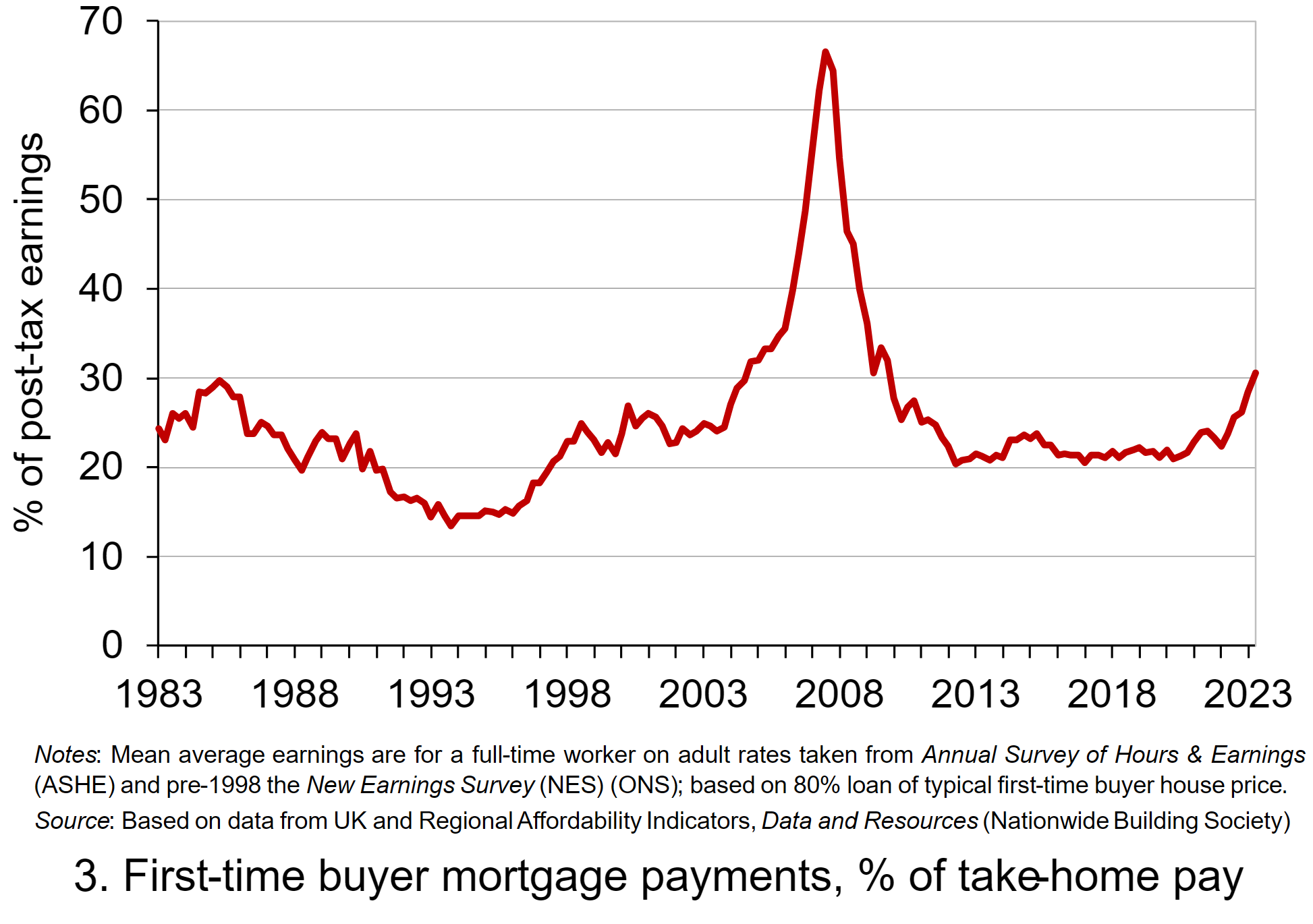 Chart 3 provides a visual picture of the typical annual repayment costs facing first-time buyers as a percentage of earnings after tax and national insurance (click here for a PowerPoint). The Nationwide Building Society figures are based on an 80% loan on the typical first-time buyer house price. It shows that repayment costs have been rising sharply on the back of rising interest rates and are now higher than at any time since the global financial crisis of 2007–8.
Articles
- UK inflation to fall to lowest level since March 2022 but Bank of England still tipped to hike interest rates
City A.M., Jack Barnett (17/7/23)
- UK inflation and interest rates high – how do other economies compare?
BBC News, Dharshini David (23/7/23)
- Mortgage payments set to jump by £500 for one million households
BBC News, Tom Espiner (13/7/23)
- Interest rates: Big rise less likely after inflation surprise
BBC News, Daniel Thomas, Faisal Islam & Dharshini David (19/7/23)
- Rising Mortgage Costs. What Can Be Done?
NIESR blog, Max Mosley and Adrian Pabst (17/7/23)
- UK interest rates forecast to rise less sharply after inflation falls to 7.9%
The Guardian, Richard Partington (19/7/23)
- Mortgage costs: More Scots falling behind on repayments
Herald Scotland, Kristy Dorsey (18/7/23)
- The Mortgage Crunch
Resolution Foundation, Simon Pittaway (17/6/23)
- Peaked Interest?
Resolution Foundation, Molly Broome, Ian Mulheirn and Simon Pittaway (17/7/23)
Data
Questions
- What possible indicators could be used to assess the affordability of residential house prices?
- What is captured by the rate of core inflation? Discuss the arguments for using this as the target inflation rate measure.
- What factors might affect the proportion of people taking out fixed-rate mortgages rather than variable-rate mortgages?
- Discuss the ways by which house price changes could impact on household consumption.
- Investigate the proportion of mortgages that are fixed rate and the typical length of the fixed rate term in two European countries, the USA and Japan. How does each differ from the UK?
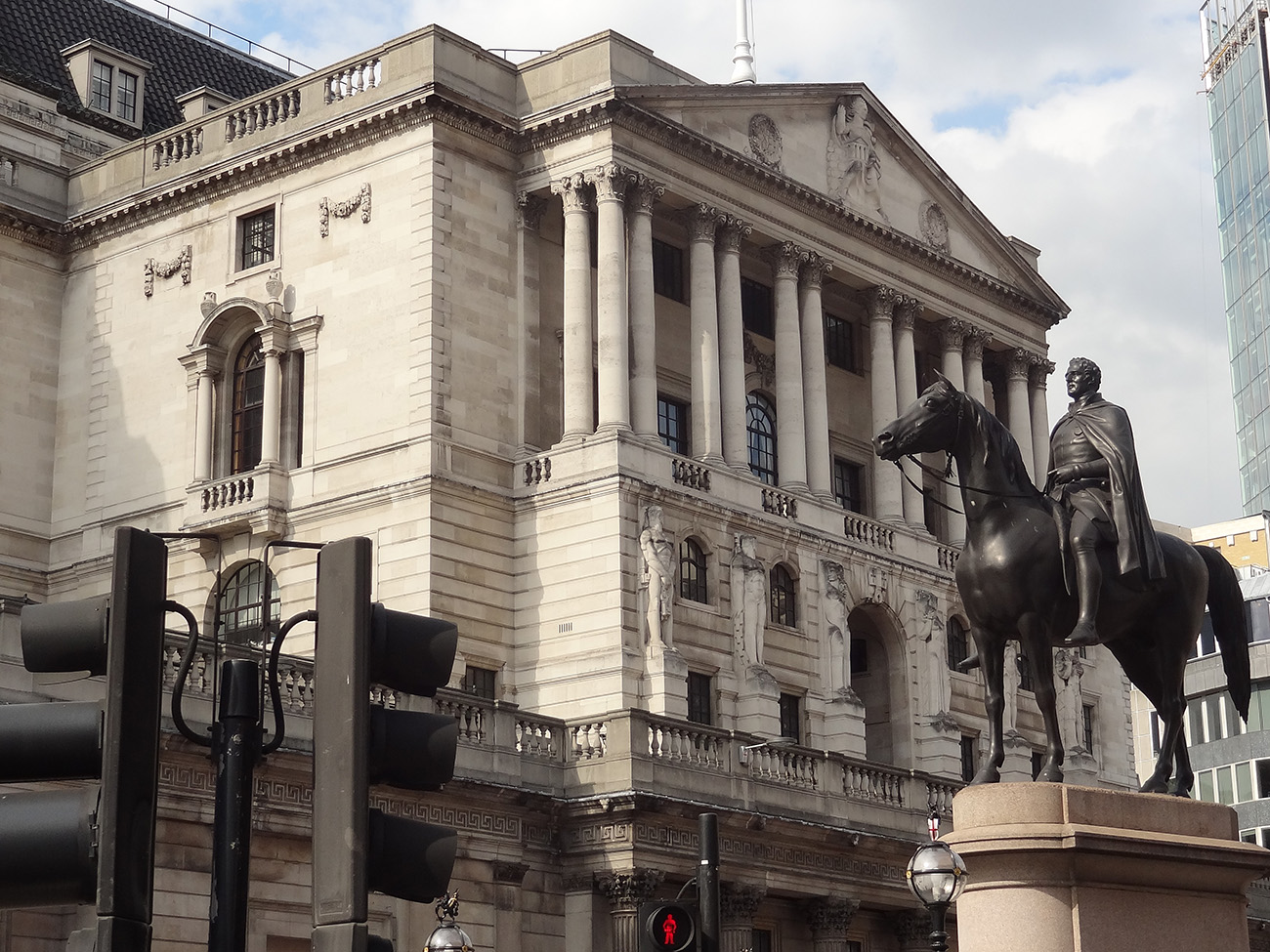 The mandates of central banks around the world are typically focused on controlling inflation. In many cases, this is accompanied by operational independence from government, but with the government setting an inflation target. The central bank then chooses the appropriate monetary policy to achieve the inflation target. This is argued to provide the conditions that can deliver lower and less variable inflation rates – at least over the longer term.
However, some economists argue that this has the potential to create the conditions for greater economic volatility and financial instability. The events surrounding the collapse of Silicon Valley Bank (SVB) – the largest since the global financial crisis – have helped to reignite these debates.
Inflation targeting central banks
The theoretical foundations for delegating monetary policy to central banks with mandates to meet an inflation rate target is often attributed to the paper of Fynn Kydland and Edward Prescott published in the Journal of Political Economy in 1977. It argues that if governments, rather than independent central banks, operate monetary policy, systemically-high inflation can become established if low-inflation announcements by governments lack credibility. Delegation of monetary to a central bank with an inflation rate target, however, can create the necessary conditions for credibility. This, in turn, gives the public confidence to maintain lower and more stable inflationary expectations than would otherwise be the case.
To mitigate the problem of a potential inflationary bias, it is argued that governments should delegate monetary policy to a conservative central banker: one that places less weight on output or employment stabilisation and more weight on inflation stabilisation than does society. However, as identified by Kenneth Rogoff in his paper published in the Quarterly Journal of Economics in 1985, this raises the spectre of greater volatility in output and employment when economies are buffeted by supply shocks.
Inflation–output stabilisation trade-off
The inflation–output stabilisation trade-off identified by Rogoff has particular relevance to the macroeconomic environment experienced by many countries in recent times. As economies began to open up after the pandemic, demand–supply imbalances saw the 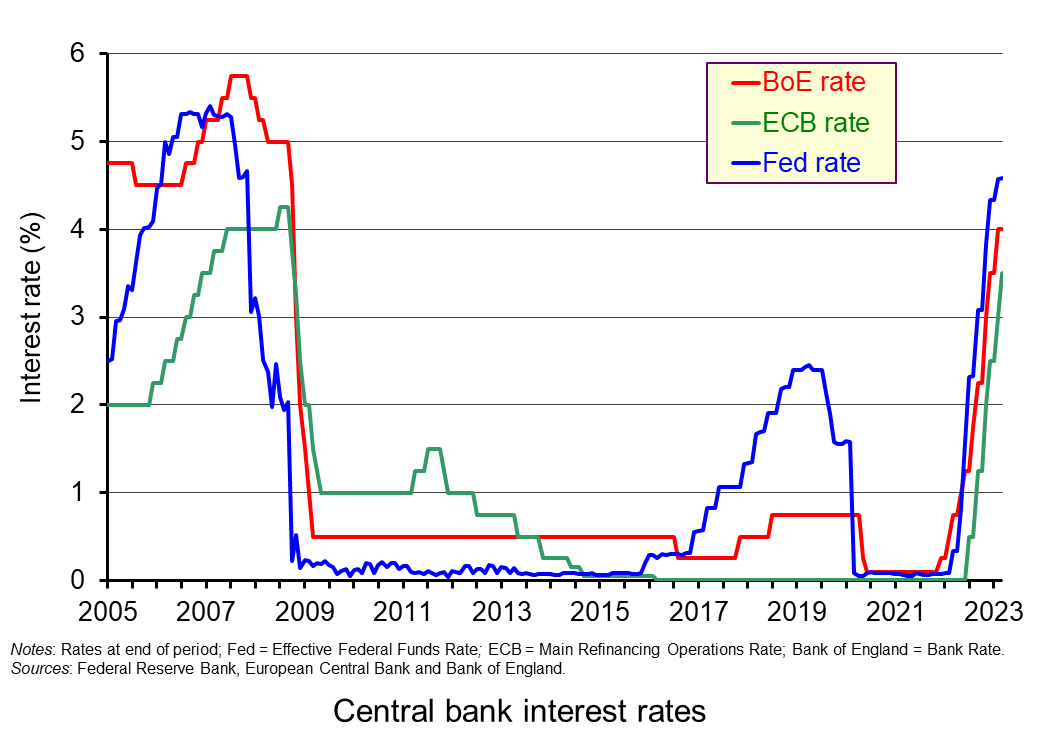 emergence of inflationary pressures. These pressures were then exacerbated by the Russian invasion of Ukraine, which drove up commodity prices.
Rather than pursuing a less contractionary policy in the face of these supply shocks so as to avoid recession, central banks stuck to their inflation mandates and hence raised interest rates significantly so as to bring inflation back to target as soon as possible. But this hampered economic recovery.
Inflation–financial stability trade-off
Yet the recent financial turmoil suggests a further inflation–stability trade-off: an inflation–financial stability trade-off. By raising interest rates, different sectors of the economy are liable to greater financial distress. This distress has contributed to the collapse of Silicon Valley Bank and Signature Bank, and led to a significant injection of funds by large US banks into First Republic. The fear is of a contagion within the financial sector, which then spills into other sectors of the economy.
The debate about central bank mandates and the weight attached to inflation stability relative to other objectives is therefore centre stage of macroeconomic policy debates.
Articles
- Inflation targeting and the 2 per cent goal
Financial Times, Editorial Board (16/12/22)
- Breaking the shackles of inflation targets
The Business Standard, Daniel Moss, Bloomberg (16/3/23)
- Evaluating Monetary Policy with Inflation Bands and Horizons
Federal Reserve Bank of San Francisco, letter, Troy Davig and Andrew Foerster (21/2/23)
- Need to rethink long-term inflation target: MPC member Ashima Goyal
The Economic Times (India) (15/3/23)
- Inflation Targeting Pros and Cons
Economicshelp, Tejvan Pettinger (16/11/17)
- Central banks walk tightrope in juggling mandates
Reuters, Mike Dolan (15/3/23)
- Silicon Valley Bank: why did it collapse and is this the start of a banking crisis?
The Guardian, Jonathan Barrett (13/3/23)
- Silicon Valley Bank: Regulators take over as failure raises fears
BBC News (11/3/23)
- HSBC swoops in to rescue UK arm of Silicon Valley Bank
BBC News, Michael Race (13/3/19)
- Silicon Valley Bank said it was too small to need regulation. Now it’s ‘too big to fail’
The Guardian, Rebecca Burns and Julia Rock (17/3/23)
- Multi-billion dollar rescue deal for First Republic Bank
BBC News, Natalie Sherman (16/3/19)
- Chancellor ‘welcomes’ decision to give Credit Suisse £44.5bn lifeline as shares bounce back
Sky News, Samuel Obsborne (16/3/23)
Questions
- Explain the argument that the delegation of monetary policy can help to keep the average rate of inflation lower.
- How might the monetary policy responses of central banks to an inflation shock create the possibility of an inflation–output stabilisation trade-off?
- What do you understand by a Taylor rule? Could this help to alleviate the inflation-output stabilisation trade-off?
- Some economists argue that there is less of a trade-off between inflation and output stability with demand-pull inflation because of a so-called ‘divine coincidence’ in monetary policy. Why might this be the case?
- What do you understand by the term ‘financial distress’? What metrics could be used to capture this for different sectors of the economy?
- Explain how financial contagion can spread both within and between different sectors of the economy.
 In two previous posts, one at the end of 2019 and one in July 2021, we looked at moves around the world to introduce a four-day working week, with no increase in hours on the days worked and no reduction in weekly pay. Firms would gain if increased worker energy and motivation resulted in a gain in output. They would also gain if fewer hours resulted in lower costs.
Workers would be likely to gain from less stress and burnout and a better work–life balance. What is more, firms’ and workers’ carbon footprint could be reduced as less time was spent at work and in commuting.
If the same output could be produced with fewer hours worked, this would represent an increase in labour productivity measured in output per hour.
The UK’s poor productivity record since 2008
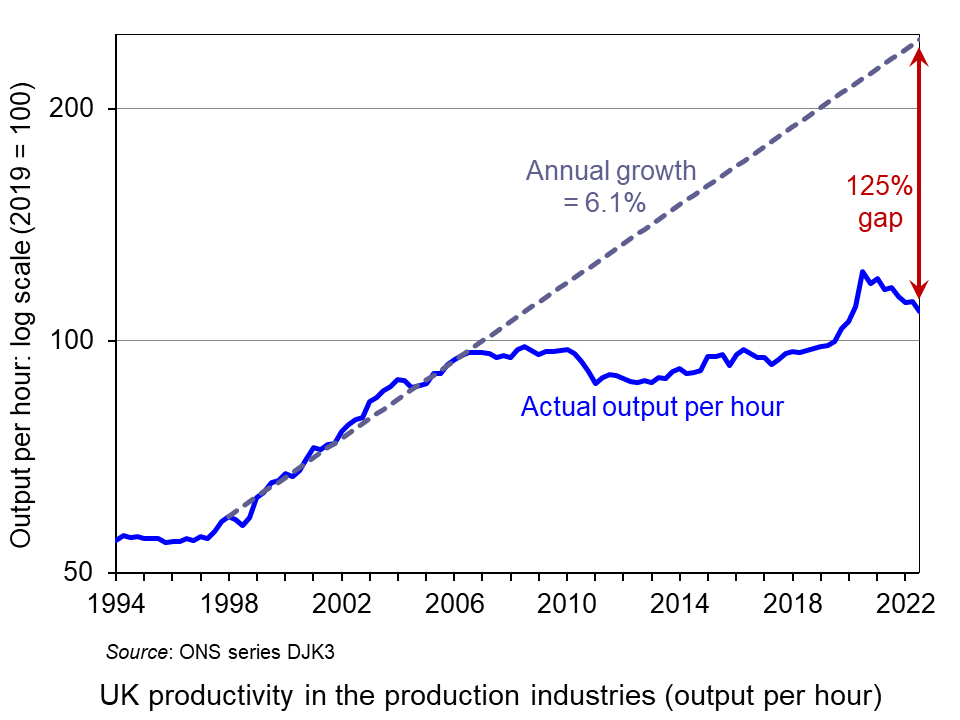 Since the financial crisis of 2007–8, the growth in UK productivity has been sluggish. This is illustrated in the chart, which looks at the production industries: i.e. it excludes services, where average productivity growth tends to be slower. (Click here for a PowerPoint of the chart.)
Prior to the crisis, from 1998 to 2007, UK productivity in the production industries grew at an annual rate of 6.1%. From 2007 to the start of the pandemic in 2020, the average annual productivity growth rate in these industries was a mere 0.5%.
It grew rapidly for a short time at the start of the pandemic, but this was because many businesses temporarily shut down or went to part-time working, and many of these temporary job cuts were low-wage/low productivity jobs. If you take services, the effect was even stronger as sectors such as hospitality, leisure and retail were particularly affected and labour productivity in these sectors tends to be low. As industries opened up and took on more workers, so average productivity fell back. In the four quarters to 2022 Q3 (the latest data available), productivity in the production industries fell by 6.8%.
If you project the average productivity growth rate from 1998 to 2007 of 6.1% forwards (see grey dashed line), then by 2022 Q3, output per hour in the production industries would have been 21/4 times (125%) higher than it actually was. This is a huge productivity gap.
 Productivity in the UK is lower than in many other competitor countries. According to the ONS, output per hour in the UK in 2021 was $59.14 in the UK. This compares with an average of $64.93 for the G7 countries, $66.75 in France, £68.30 in Germany, $74.84 in the USA, $84.46 in Norway and $128.21 in Ireland. It is lower, however, in Italy ($54.59), Canada ($53.97) and Japan ($47.28).
As we saw in the blog, The UK’s poor productivity record, low UK productivity is caused by a number of factors, not least the lack of investment in physical capital, both by private companies and in public infrastructure, and the lack of investment in training. Other factors include short-termist attitudes of both politicians and management and generally poor management practices. But one cause is the poor motivation of many workers and the feeling of being overworked. One solution to this is the four-day week.
Latest evidence on the four-day week
Results have just been released of a pilot programme involving 61 companies and non-profit organisations in the UK and nearly 3000 workers. They took part in a six-month trial of a four-day week, with no increase in hours on the days worked and no loss in pay for employees – in other words, 100% of the pay for 80% of the time. The trial was a success, with 91% of organisations planning to continue with the four-day week and a further 4% leaning towards doing so.
 The model adopted varied across companies, depending on what was seen as most suitable for them. Some gave everyone Friday off; others let staff choose which day to have off; others let staff work 80% of the hours on a flexible basis.
There was little difference in outcomes across different types of businesses. Compared with the same period last year, revenues rose by an average of 35%; sick days fell by two-thirds and 57% fewer staff left the firms. There were significant increases in well-being, with 39% saying they were less stressed, 40% that they were sleeping better; 75% that they had reduced levels of burnout and 54% that it was easier to achieve a good work–life balance. There were also positive environmental outcomes, with average commuting time falling by half an hour per week.
There is growing pressure around the world for employers to move to a four-day week and this pilot provides evidence that it significantly increases productivity and well-being.
Articles
- Results from world’s largest 4 day week trial bring good news for the future of work
4 Day Week Global, Charlotte Lockhart (21/2/23)
- Four-day week: ‘major breakthrough’ as most UK firms in trial extend changes
The Guardian, Heather Stewart (21/2/23)
- Senedd committee backs four-day working week trial in Wales
The Guardian, Steven Morris (24/1/23)
- ‘Major breakthrough’: Most firms say they’ll stick with a four-day working week after successful trial
Sky News, Alice Porter (21/2/23)
- Major four-day week trial shows most companies see massive staff mental health benefits and profit increase
Independent, Anna Wise (21/2/23)
- Four-day week: Which countries have embraced it and how’s it going so far?
euronews, Josephine Joly and Luke Hurst (23/2/23)
- Firms stick to four-day week after trial ends
BBC News, Simon Read, Lucy Hooker & Emma Simpson (21/2/23)
- The climate benefits of a four-day workweek
BBC Future Planet, Giada Ferraglioni and Sergio Colombo (21/2/23)
- Four-day working week: why UK businesses and workers will continue with new work pattern, plus pros and cons
National World, Rochelle Barrand (22/2/23)
- Most companies in UK four-day week trial to continue with flexible working
Financial Times, Daniel Thomas and Emma Jacobs (21/2/23)
- The pros and cons of a four-day working week
Financial Times, Editorial (13/2/23)
- Explaining the UK’s productivity slowdown: Views of leading economists
VoxEU, Ethan Ilzetzki (11/3/20)
- Why the promised fourth industrial revolution hasn’t happened yet
The Conversation, Richard Markoff and Ralf Seifert (27/2/23)
Questions
- What are the possible advantages of moving to a four-day week?
- What are the possible disadvantages of moving to a four-day week?
- What types of companies or organisations are (a) most likely, (b) least likely to gain from a four-day week?
- Why has the UK’s productivity growth been lower than that of many of its major competitors?
- Why, if you use a log scale on the vertical axis, is a constant rate of growth shown as a straight line? What would a constant rate of growth line look like if you used a normal arithmetical scale for the vertical axis?
- Find out what is meant by the ‘fourth industrial revolution’. Does this hold out the hope of significant productivity improvements in the near future? (See, for example, last link above.)
 Last year was far from the picture of economic stability that all governments would hope for. Instead, the overarching theme of 2022 was uncertainty, which overshadowed many economic predictions throughout the year. The Collins English Dictionary announced that their word of the year for 2022 is ‘permacrisis’, which is defined as ‘an extended period of instability and insecurity’.
For the UK, 2022 was an eventful year, seeing two changes in prime minister, economic stagnation, financial turmoil, rampant inflation and a cost of living crisis. However, the UK was not alone in its economic struggles. Many believe that it is a minor miracle that the world did not experience a systemic financial crisis in 2022.
Russia’s invasion of Ukraine has led to the biggest land war in Europe since 1945, the most serious risk of nuclear escalation since the Cuban missile crisis and the most far-reaching sanctions regime since the 1930s. Soaring food and energy costs have fuelled the highest rates of inflation since the 1980s and the biggest macroeconomic challenge in the modern era of central banking (with the possible exception of the financial crisis of 2007–8 and its aftermath). For decades we have lived with the assumptions that nuclear war was never going to happen, inflation will be kept low and rich countries will not experience an energy crisis. In 2022 all of these assumptions and more have been shaken.
With the combination of rising interest rates and a massive increase in geopolitical risk, the world economy did well to survive as robustly as it did. However, with public and private debt having risen to record levels during the now-bygone era of ultra-low interest rates and with recession risks high, the global financial system faces a huge stress test.
Government pledges
 Rishi Sunak, the UK Prime Minister, started 2023 by setting out five pledges: to halve inflation, boost economic growth, cut national debt as a percentage of GDP, and to address NHS waiting lists and the issue of immigrants arriving in small boats. Whilst most would agree that meeting these pledges is desirable, a reduction in inflation is forecast to happen anyway, given the monetary policy being pursued by the Bank of England and an easing of commodity prices; and public-sector debt as a percentage of GDP is forecast to fall from 2024/25.
Success in meeting the first four pledges will partly depend on the effects of the current industrial action by workers across the UK. How soon will the various disputes be settled and on what terms? What will be the implications for service levels and for inflation?
A weak global economy
 Success will also depend on the state of the global economy, which is currently very fragile. In fact, it is predicted that a third of the global economy will be hit by recession this year. The head of the IMF has warned that the world faces a ‘tougher’ year in 2023 than in the previous 12 months. Such comments suggest the IMF is likely soon to cut its economic forecasts for 2023 again. The IMF already cut its 2023 outlook for global economic growth in October, citing the continuing drag from the war in Ukraine, as well as inflationary pressures and interest rate rises by major central banks.
The World Bank has also described the global economy as being ‘on a razor’s edge’ and warns that it risks falling into recession this year. The organisation expects the world economy to grow by just 1.7% this year, which is a sharp fall from an estimated 2.9% in 2022 according to the Global Economic Prospects report (see link below). It has warned that if financial conditions tighten, then the world’s economy could easily fall into a recession. If this becomes a reality, then the current decade would become the first since the 1930s to include two global recessions. Growth forecasts have been lowered for 95% of advanced economies and for more than 70% of emerging market and developing economies compared with six months ago. Given the global outlook, it is no surprise that the UK economy is expected to face a prolonged recession with declining growth and increased unemployment.
The current state of the UK economy
Despite all the concerns, official figures show that, even though households have been squeezed by rising prices, UK real GDP unexpectedly grew in November, by 0.1%. This has been explained by a boost to bars and restaurants from the World Cup as people went out to watch the football and also by demand for services in the tech sector.
At first sight, the UK’s cost of living crisis might look fairly mild compared to other countries. Its inflation rate was 10.7% in November 2022, compared to 12.6% in Italy, 16% in Poland and over 20% in Hungary and Estonia. But UK inflation is still way above the Bank of England’s 2% target. The Bank went on to tighten monetary policy further, by increasing interest rates to 3.5% in December. Further rate rises are expected in 2023. In fact, the markets and the Bank both expect the main rate to reach 5.2% by the end of this year. With the consequent squeeze on real incomes, the Bank of England expects a recession in the UK this year – possibly lasting until mid-2024.
 The UK is also affected by global interest rates, which affect global growth. Global interest rates average 5%. A 1 percentage point increase would reduce global growth this year from 1.7% to 0.6%, with per capita output contracting by 0.3%, once changes in population are taken into account. This would then meet the technical definition of a global recession. This means that the Bank’s November economic forecast, which was based on a Bank Rate of 3%, may worsen due to an even larger contraction than previously expected. The resulting drop in spending and investment by people and businesses could then cause inflation to come down faster than the Bank had predicted when rates were at 3%.
There could be some positive news however, that may help bring down inflation in addition to rate rises. There has been some appreciation in the pound since the huge drop caused by the September mini-budget that had brought its value to a nearly 40-year low. This will help to reduce inflation by reducing the price of imports.
As far as workers are concerned, pay increases have been broadly contained, with 2022 being one of the worst years in decades for UK real wage growth. Limiting pay rises can have a deflationary effect because people have less to spend, but it also weighs on economic growth and productivity. Despite the impact on inflation, there is a lot of unrest across the UK, with strike action continuing to be at the forefront of the news. Strikes over pay and conditions continue in various sectors in 2023, including transport, health, education and the postal service. Strikes and industrial action have a negative effect on the wider economy. If wages are stagnating and the economy is not performing well, productivity will suffer as workers are less motivated and less investment in new equipment takes place.
Financial stresses
 The UK economy is also under threat of a prolonged recession due to the proportion of households that lack insulation against financial setbacks. This proportion is unusually large for a wealthy economy. A survey conducted prior to the pandemic, found that 3 million people in the UK would fall into poverty if they missed one pay cheque, with the country’s high housing costs being a key source of vulnerability. Another survey recently suggested that one-third of UK adults would struggle if their costs rose by just £20 a month.
The pandemic itself meant that over 4 million households have taken on additional debt, with many now falling behind on repaying it. This, combined with recent jumps in energy and food bills, could push many over the edge, especially if heating costs remain high when the present government cap on energy prices ends in April.
However, there could be some better news for households with the easing of COVID restrictions in China. This could have a positive impact on the UK economy if it helps ease supply-chain disruptions occurring since the height of the global pandemic. It could reduce inflationary pressure in the UK and other countries that trade with China by making it easier – and therefore less costly – for people to get hold of goods.
Articles
Reports
Questions
- Define the term ‘deflation’.
- Explain how an appreciation of the pound is good for inflation.
- Discuss the wider economic impacts of industrial strike action.
- Why is it important for the government to keep wages contained?