 The housing market is crucial in any economy, as it provides so many jobs in related industries. It is frequently a good signal of how buoyant the economy is. With recession in the UK, mortgage rationing continuing and many homeowners having to find 20% deposits to buy a house, many would expect the housing market to be showing signs of trouble.
And to some extent this is the case. Studies on house prices have clearly shown how unpredictable this market is and prices remain 0.7% below what they were a year ago. However, in August house prices increased, recording their biggest rise in two and a half years, at 1.3%. For many, this rise was a surprise, but came as a welcome relief following the declines in previous months. Despite this rise, analysts have suggested that this trend is unlikely to continue throughout the rest of the year, as the demand for houses remains weak. Robert Gardner, the Chief Economist at Nationwide said:
“Given the difficult economic backdrop, the extent of the rebound in August is a little surprising. However, we should never read too much into one month’s data, especially since monthly price changes have been impacted by a number of one-off factors this year, such as the ending of the stamp duty holiday for first time buyers’.
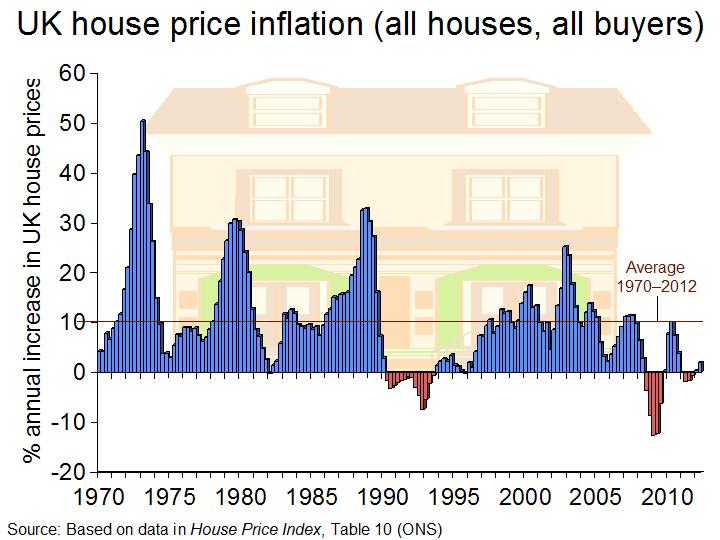 So, what is behind this upward trend? Nationwide’s Chief Economist says that it could be explained by a resilient labour market, where employment has risen in recent months, despite the recession. The labour market undoubtedly has a big effect on the housing market, as mortgages do take up so a large percentage of take-home pay.
However, another key factor that affects house prices is the availability of mortgages. The Bank of England and Treasury launched the Funding for Lending Scheme at the beginning of August in a bid to make mortgages cheaper and more easily available. However, analysts suggest that the scheme is yet to have an effect. Furthermore, until deposit requirements are eased, that first step on the property ladder will remain elusive for many people. Mortgage approvals did increase slightly in July, but still remain a major barrier for the housing market to really boom.
The following articles consider this ‘surprising’ rise in house prices and the factors behind it.
Articles
House prices in ‘surprising’ jump, Nationwide says BBC News (31/8/12)
UK house prices record surprise increase Financial Times, Tanya Powley (31/8/12)
Surprise house price rise in August not indicative of market, says Nationwide The Telegraph, Emma Wall (31/8/12)
House prices in surprise rebound Independent, Vicky Shaw (31/8/12)
House prices continue to hold The Economic Voice, Jeff Taylor (31/8/12)
Mortgage approvals still subdued, Bank of England says BBC News (30/8/12)
Banks are pulling back from property – expect prices to fall Money Week, Matthew Partridge (31/8/12)
UK house prices up, as London continues surge Share Cast, Michael Miller (29/8/12)
Data
Lending to Individuals Bank of England 2012
House Price Index Land Registry 2012
UK house prices (links) Economics Network
Questions
- Use a supply and demand diagram to analyse recent trends in the housing market.
- Why is the Bank of England’s lending scheme not having the expected impact on the housing market?
- To what extent do you think the state of the housing market depends on mortgage rationing? Which other factors are likely to affect the housing market?
- In the article from the Economic Voice, the author says that house prices holding as they are is a surprise, because of relatively high inflation and the fact that wages are not keeping pace. Explain the economic thinking behind this view.
- The Chief Economist at Nationwide has said that the future of the housing market depends heavily on what happens to the labour market. Why is this the case?
- Why have mortgages been rationed and minimum deposit requirements been increased?
- Why is the housing market so important for the economy?
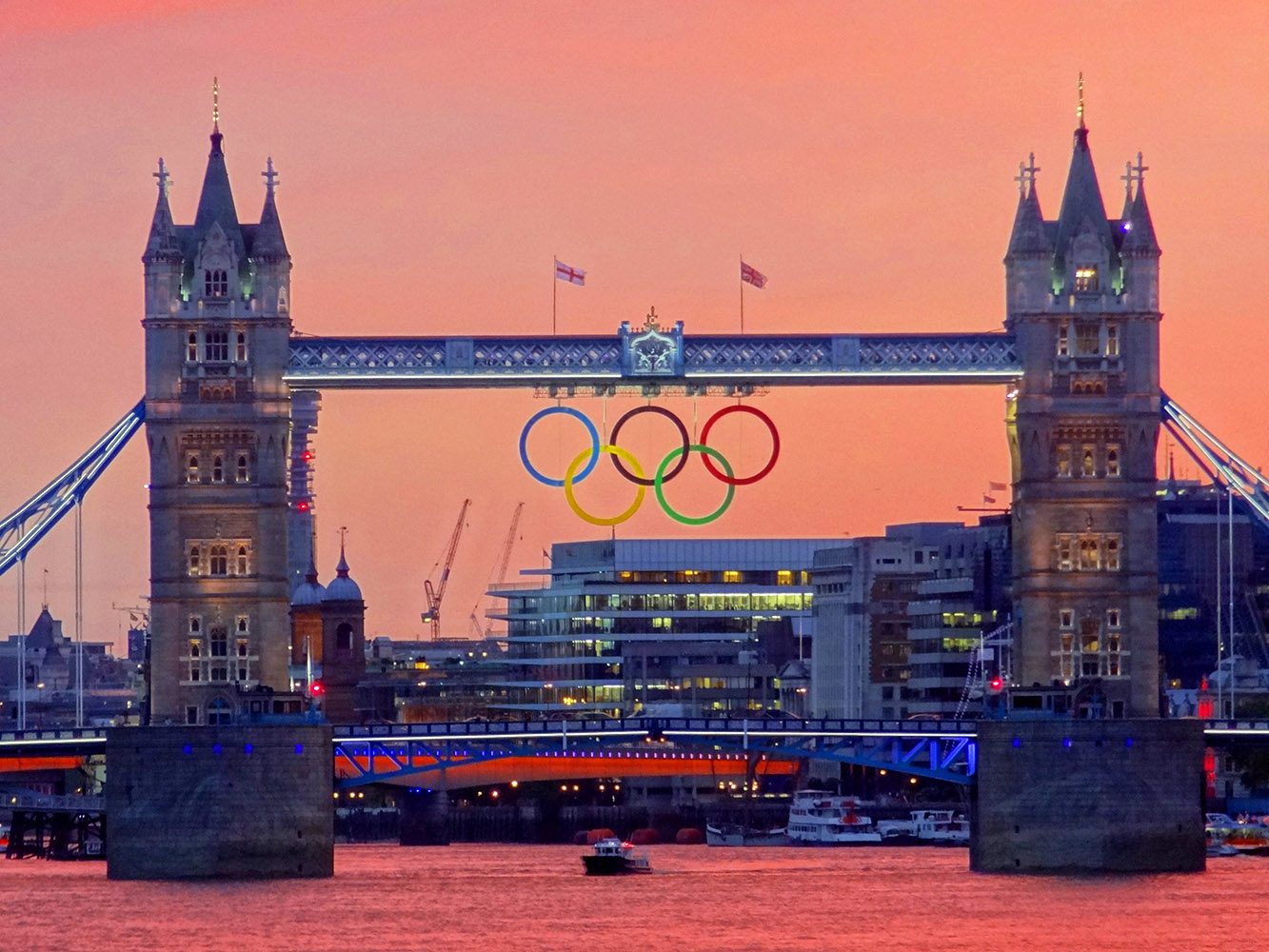
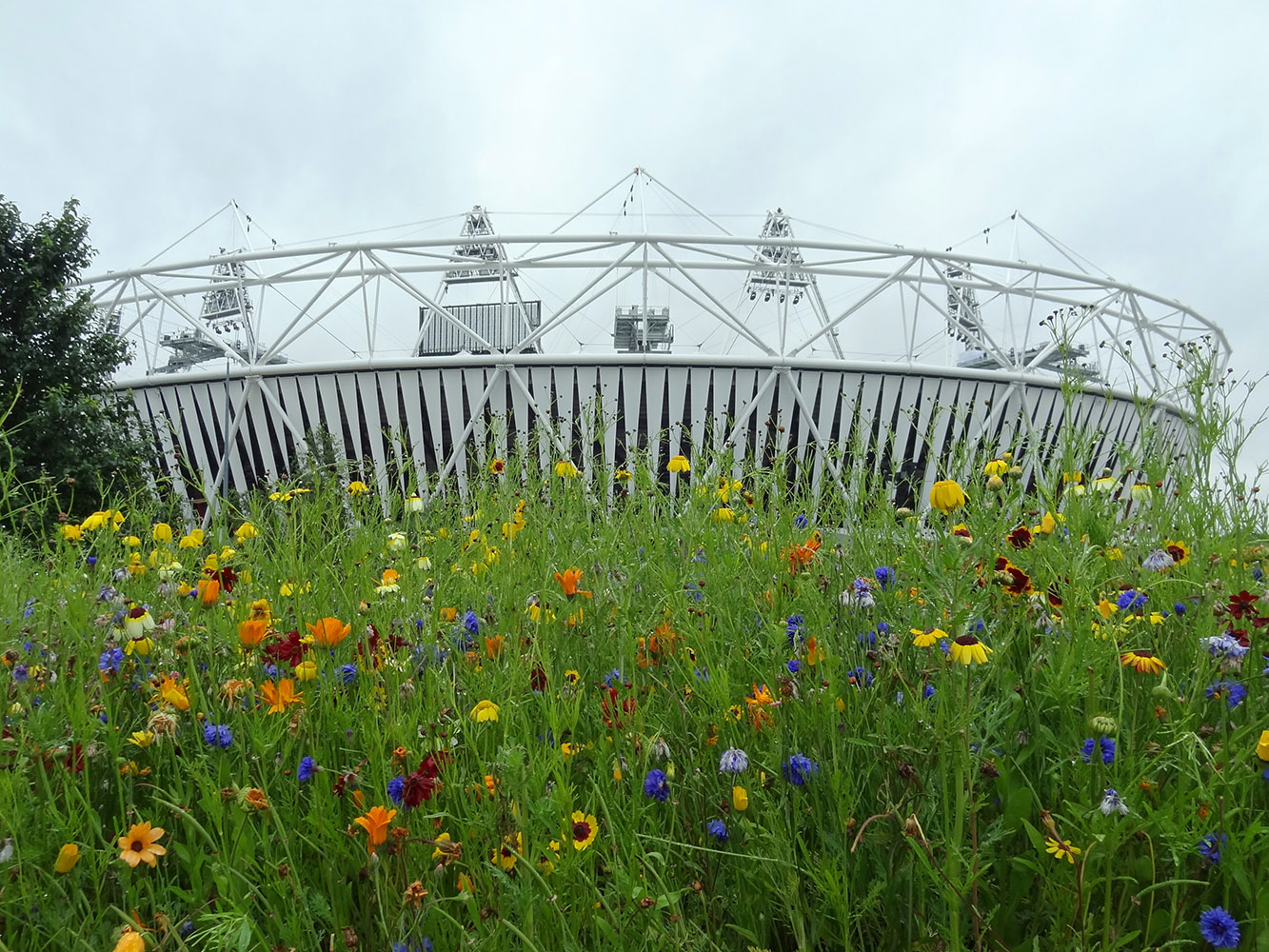
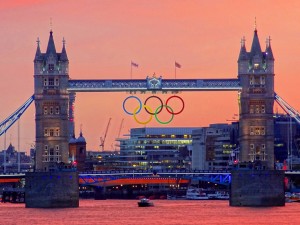 The 2012 London Olympics opened on 27 July. This has been the result of years of planning and investment in infrastructure since London won the bid in 2005.
It is estimated that hosting the Games will have cost over £9bn. It is therefore interesting to consider the long-run impact on a host city years after the last medal has been won. We might expect host cities to achieve increased growth due to the benefits from the improved infrastructure and the impact of increased publicity and exposure on trade, capital and population.
 This has recently been investigated in a paper published in the Economic Inquiry by Stephen Billings and James Holladay which looks at the impact hosting the Games has on GDP and trade (working paper available here). One difficulty with trying to identify the impact of hosting the Games, is that only certain cities will have a chance of being chosen as hosts and these may be cities that are more likely to experience future growth. If this is the case, it would appear that the future growth was due to hosting the Games when it would in fact have been likely to occur anyway. In order to control for this, the above paper compares the winners with losing finalists in the selection process for host cities. For example under this approach London would be compared with Singapore, Moscow, New York and Madrid. In addition, subsequent matching processes are also used to select appropriate cities for comparison.
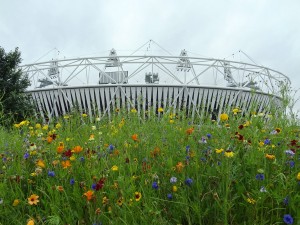 They find that larger cities in wealthier countries are more likely to be chosen to host the Games. However, once comparisons with other appropriate cities are made, overall, they find that hosting the Games has no effect on a cities population, growth or trade. One explanation provided is that the intense competition to host the Games means the potential gains are competed away via escalated promises in order to increase a cities chances of being selected. In addition, they note that there may well still be considerable specific benefits from the investments made to host the Games.
It is also clear that there are both positive and negative externalities from hosting the Games that, whilst difficult to measure, ideally should be taken into account. On the negative side, these include the extra hassle anybody travelling to work in London during the Games will face. On the other hand, on the positive side, it is hoped that part of the long-run legacy of the Games will be increased interest and participation in sport which would result in substantial health benefits.
David Cameron claims London 2012 will bring £13bn ‘gold for Britain’ The Guardian, Hélène Mulholland (05/07/12)
Olympic legacy: how the six Olympic boroughs compare for children The Guardian, Simon Rodgers (19/07/12)
London 2012: Olympics legacy hard to define BBC News, David Bond (13/07/12)
Questions
- Explain how intense competition to host the Games might result in benefits being competed away.
- Can you think of any other externalities resulting from the Olympic Games?
- Why are the impact of externalities difficult to measure?
- What other factors should be taken into account when assessing the costs and benefits of hosting the Games?
- Do you think the decision to bid to host the Games should be purely based on a cost-benefit analysis?
 World leaders have been meeting in Rio de Janeiro at a United Nations Conference on Sustainable Development. The conference, dubbed ‘Rio+20’, refers back to the first UN Conference on Environment and Development (UNCED) held in Rio 20 years ago in June 1992.
The 1992 conference adopted an Agenda 21. It was “comprehensive plan of action to be taken globally, nationally and locally by organizations of the United Nations System, Governments, and Major Groups in every area in which human impacts on the environment.”
The 2012 conference has looked at progress, or lack of it, on sustainability and what needs to be done. It has focused on two major themes: “how to build a green economy to achieve sustainable development and lift people out of poverty, including support for developing countries that will allow them to find a green path for development; and how to improve international coordination for sustainable development.” Issues examined have included decent jobs, energy, sustainable cities, food security and sustainable agriculture, water, oceans and disaster readiness.
But just what is meant by sustainable development? The conference defines sustainable development as that which meets the needs of the present without compromising the ability of future generations to meet their own needs. “Seen as the guiding principle for long-term global development, sustainable development consists of three pillars: economic development, social development and environmental protection.”
The articles below look at prospects for national and global sustainability. They also look at a new measure of national wealth, the Inclusive Wealth Index (IWI). This index has been developed under the auspices of the International Human Dimensions Programme on Global Environmental Change (IHDP) and published in its Inclusive Wealth Report 2012 (see report links below).
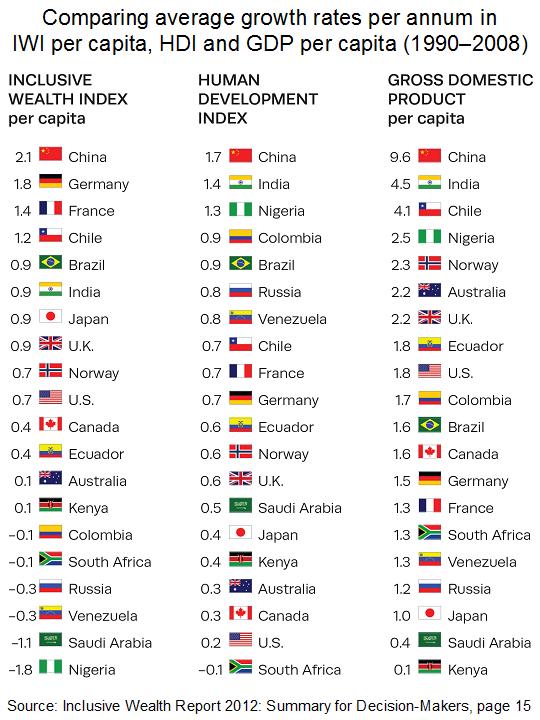 The IWR 2012 was developed on the notion that current economic production indicators such as gross domestic product (GDP) and the Human Development Index (HDI) are insufficient, as they fail to reflect the state of natural resources or ecological conditions, and focus exclusively on the short term, without indicating whether national policies are sustainable.
The IWR 2012 features an index that measures the wealth of nations by looking into a country’s capital assets, including manufactured, human and natural capital, and its corresponding values: the Inclusive Wealth Index (IWI). Results show changes in inclusive wealth from 1990 to 2008, and include a long-term comparison to GDP for an initial group of 20 countries worldwide, which represent 72% of the world GDP and 56% of the global population. (Click on chart for a larger version.)
So will growth in IWI per capita be a better measure of sustainable development than growth in GDP per capita? The articles also consider this issue.
Articles: summit
Rio+20 deal weakens on energy and water pledges BBC News, Richard Black (17/6/12)
Rio+20: Progress on Earth issues ‘too slow’ – UN chief BBC News, Richard Black (20/6/12)
Rio+20 Earth Summit Q&A The Telegraph, Louise Gray (16/5/12)
Rio+20 Earth Summit: campaigners decry final document Guardian, Jonathan Watts and Liz Ford (23/6/12)
A catastrophe if global warming falls off the international agenda Observer, Will Hutton (24/6/12)
Analysis: Rio +20 – Epic Fail The Bureau of Investigative Journalism Brendan Montague (22/6/12)
Articles: IWI
Accounting for natural wealth gains world traction Atlanta Business NewsKaty Daigle (17/6/12) (see alternatively)
New index shows lower growth for major economies Reuters, Nina Chestney (17/6/12)
A New Balance Sheet for Nations: UNU-IHDP and UNEP Launch Sustainability Index that Looks Beyond GDP EcoSeed (20/6/12)
World’s leading economies lag behind in natural capital Firstpost (18/6/12)
Beyond GDP: Experts preview ‘Inclusive Wealth’ index at Planet under Pressure conference EurekAlert, Terry Collins (28/3/12)
New sustainability index created that looks at more than gross domestic product bits of science (17/6/12)
 For Sustainability, Go Beyond Gross Domestic Product Scientific AmericanDavid Biello (17/6/12)
Report
Inclusive Wealth Report 2012: Overview IHDP
Inclusive Wealth Report 2012: Summary for Decision-makers IHDP
Inclusive Wealth Report 2012: full report IHDP
Questions
- What progress has been made towards sustainable development over the past 20 years?
- What are the limitations of conferences such as Rio+20 in trying to achieve global action?
- With the current challenges faced by the eurozone and the global economy more generally, is this a good time to be discussing long-term issues of sustainable development?
- Explain how IWI is derived and measured?
- Looking at the chart above, explain the very different positions of countries in the three columns.
- What are the strengths and weaknesses of using growth in IWI compared with using growth in GDP as measures of (a) economic development; (b) economic wellbeing?
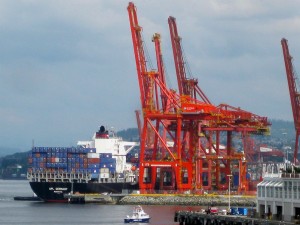 International economists have long advocated the advantages of free trade. By boosting competition, increasing choice and market size, trade has long been seen as an engine of growth and efficiency.
For many years, tariffs and other restrictive trade practices have been removed on trade between both developed and developing countries and many rounds of negotiations have taken place, with mixed results.
The World Trade Organisation (WTO) plays a key role in trade negotiations and has the main aim of liberalising trade. The organisation requires its members to operate according to a variety of rules, including the prohibition of quotas and the inability of countries to raise existing tariffs without negotiating with their trading partners.
If any country breaks a trade agreement, the WTO can impose sanctions. A current case that has been referred to the WTO for ‘consultation’ concerns Argentina. Argentina has imposed various import restrictions on trade, such as import licensing and a requirement for countries to balance its exports and imports.
A number of WTO members recently expressed their concerns about these restrictive trade practices. The EU trade commissioner Karel de Gucht said:
Argentina’s import restrictions violate international trade rules and must be removed. These measures are causing very real damage to EU companies – hurting jobs and our economy as a whole. … Argentina’s trade policy has become rooted in unfair trade practices.
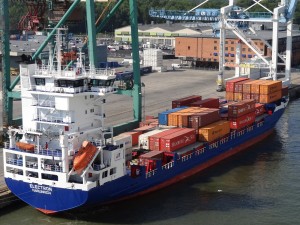 Argentina has said that it was expecting the move from the EU, but claims that its protectionist measures are there to support and re-industrialise the country. This case is unlikely to be resolved any time soon and while the ‘restrictive trade practices’ remain in place, EU companies trying to export to Argentina will find barriers, such as a requirement for all imports to receive pre-approval.
The effects of these restrictions have already been felt, with EU exports to Argentina down by 4% in April this year, compared with the same month last year. The following articles consider this issue.
EU takes Argentina trade fight to WTO France 24, (25/5/12)
EU files WTO suit over Argentina’s import restrictions Reuters, Sebastien Moffett and Tom Miles , (26/5/12)
EU escalates dispute with Argentina Financial Times, Peter Spiegel and Joshua Chaffin, (25/5/12)
EU refers Argentina’s import restrictions to the WTO BBC News (25/5/12)
EU steps up challenge to Argentina’s policies Wall Street Journal, Matthew Dalton (25/5/12)
Questions
- What are the rules governing the members of the WTO?
- What are the advantages of free trade?
- To what extent should emerging economies be allowed to impose protectionist measures to help support their economies?
- What action could the EU take in response to the ‘restrictive trade practices’ imposed by Argentina?
- What is import licensing?
- How will the import restrictions affect EU companies and the growth of the EU as a whole?
 Calls for a simplified tax and benefit system have been ongoing and many see the Coalition’s plans for a Universal Credit as a step in the right direction. However, a second suggestion set out in a report by lobbying groups is to introduce a single rate of income tax at 30%. The argument is that it will simplify the system, help lower income earners and boost growth.
As well as the introduction of a single rate of income tax, The 2020 Tax Commission’s Report also suggests an increase in the personal allowance to £10,000; scrapping National Insurance Contributions, stamp duty, inheritance tax and air passenger duty, as well as cutting fuel duty by 5p. For the typical tax payer, it may sound great – the difference between your gross and your net pay would narrow, but the wider consequences must be considered. Although a single rate of income tax would undoubtedly simplify the system, the impact on government finances must be considered. The commission predicts that overall borrowing would fall by £35bn after 15 years, but that the national deficit would increase by £49.1bn in the first year. Perhaps not an ideal solution given the current state of the national deficit!
The report does contain some radical change, but the idea of simplification is well-recognised as a necessary principle of any tax system. As the Chairman of the Commission, Allister Heath said:
It is time for Britain to make a vital choice between tweaking the status quo and letting our economy continue to be crippled by complex and punitive taxes, and drastically changing course with a radical but realistic plan for a tax system fit for the 21st century.
The 2020 Tax Commission has set out that plan and would ensure that income is taxed once at a single, much more reasonable rate. It could create the conditions to establish the UK as a global trading hub, generating renewed prosperity for all those who live and work here.
The current system is complex and many people end up paying an extremely high rate of tax, once everything has been paid. The Guardian article below gives a nice illustration. “If you earn income from shares, first corporation tax is taken out of the profits. Then you pay taxes on the dividends. Then because those profits drive up the share price you pay capital gains tax as well.” With a simpler and fairer tax system, the Commission argues that it will boost the competitiveness of the UK economy and help boost its struggling growth rate. How many, if any, of these proposals will be incorporated into the government’s plans is anybody’s guess, but it definitely presents an interesting solution and problem.
Report
The Single Income Tax The 2020 Tax Commission (May 2012)
Articles
Why it’s time for a single income tax Guardian, Matthew Elliott (21/5/12)
Business backs income tax rate of 30% Financial Times, Martin Sandbu (21/5/12)
Calls for single 30% income tax rate BBC News (21/5/12)
Single 30% tax rate ‘essential’ for growth Sky News (21/5/12)
Osborne urged to introduce 30pc income tax for all The Telegraph, Tim Ross (20/5/12)
Tax shake-up urged to empower consumers and kickstart growth Independent, Russell Lynch (21/5/12)
The Tax Reform Britain needs Wall Street Journal, Matthew Sinclair (20/5/12)
Questions
- What are the key principles of a tax system?
- Explain why simplicity is so important when reforming a tax system. How can it affect the incentive to work?
- Would a 30% single rate of income tax be equitable?
- If the reforms set out in the report were to go ahead, what do you think would be the impact on goods and services provided by the government, such as the NHS, education, roads?
- Using indifference analysis, illustrate the effect of a cut in the basic rate of income tax. How does it affect the decision to work more or less? You should consider the income and substitution effects in your answer.
- Why does the report argue that the reforms they suggest would help boost growth?
- How might the proposals affect government finances in both the short and long term?
 The housing market is crucial in any economy, as it provides so many jobs in related industries. It is frequently a good signal of how buoyant the economy is. With recession in the UK, mortgage rationing continuing and many homeowners having to find 20% deposits to buy a house, many would expect the housing market to be showing signs of trouble.