Many developing Asian countries have experienced rapid and yet relatively stable economic growth over a number of years. In other words, this has not been a short-term unsustainable boom associated with the expansionary phase of the business cycle – with aggregate demand expanding more rapidly than aggregate supply. Rather it is the result of a rapid growth in aggregate supply.
Over the period from 2000 to 2011, several Asian countries experienced average annual growth rates of over 4% and some, such as China and India, much more than that, as the following table shows. The table also shows forecasts for the period from 2012 to 2017. The high forecast growth rates are based on a continuing rapid growth in aggregate supply as the countries invest in infrastructure and adopt technologies, many of which have already been developed elsewhere.
But for aggregate supply to continue growing rapidly there must also be a stable growth in aggregate demand. With the recession in the developed world, some of the more open economies of Asia, such as South Korea, Taiwan, Malaysia and Singapore themselves suffered a slowdown or recession as demand for their exports fell. The Malaysian economy, for example, contracted by 1.5% in 2009.
Given the continuing macroeconomic problems in the developed world, many Asian countries are seeing the need to rebalance their economies away from a heavy reliance on exports. China, for example, is putting more emphasis on domestic-led demand growth. Others, such as Indonesia, have already embarked on this route. As The Economist article states:
Household consumption contributed half of the growth of just over 6% Indonesia enjoyed in the year to the third quarter (its eighth consecutive quarter of growth at that pace). Exports have fallen from about 35% of GDP ten years ago to less than a quarter in 2011. Developing Asia’s combined current-account surplus, which reflects its dependence on foreign demand, more than halved from 2008 to 2011 and is expected to fall further this year.
The continuing success story of many developing Asian economies thus lies in a balance of supply-side policies that foster continuing rapid investment and demand-side policies that create a stable monetary and fiscal environment. A crucial question here is whether they can emulate the ‘Great Moderation’ experienced by the Western economies from the mid-1990s to 2007, without creating the conditions for a crash in a few years time – a crash caused by excessive credit and an excessively deregulated financial system that was building up greater and greater systemic risk.
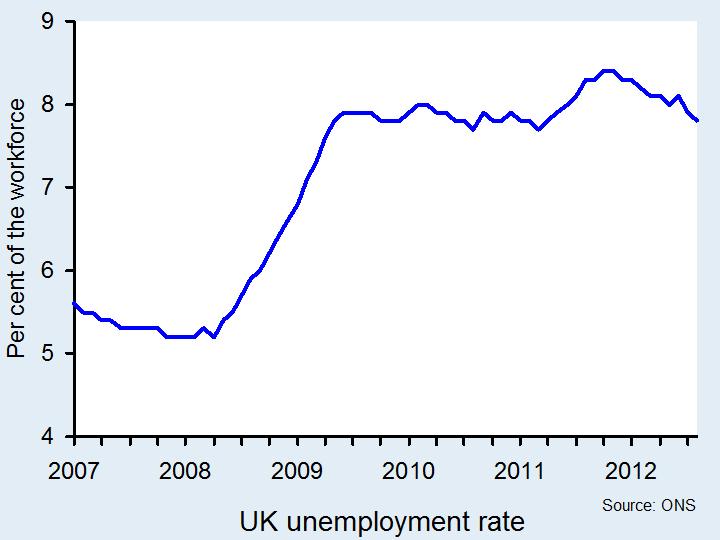
UK Unemployment figures for the July to September period have just been published. Perhaps surprisingly, the rate has fallen to 7.8% from 8.0% in the previous 3-month period. What is more, there have been similar 0.2 percentage-point falls in each of the two 3-month periods prior to that (see chart below).
This would normally suggest that the economy has been growing strongly and faster than the growth in potential output. But, despite positive economic growth in quarter 3 (see A positive turn of events?), the economy has been experiencing a prolonged period of low or negative growth.
So what is the explanation for the fall in unemployment? (For a PowerPoint of the chart, click here)
One reason is a greater flexibility in the labour market than in previous recessions. People are more willing to accept below inflation wage increases, or even nominal wage cuts, in return for greater job security. Others are prepared to reduce their hours.
The other reason is a fall in productivity (i.e. output per hour worked). One explanation is that people are not working so hard because, with a lack of demand, there is less pressure on them to be productive; a similar explanation is that firms are ‘hoarding’ labour in the hope that the market will pick up again.
Another explanation is that employment growth has often occurred in the low productivity industries, such as labour-intensive service industries; another is that when people leave their jobs they are replace by less productive workers on lower wages; another is that workers are making do with ageing equipment, whose productivity is falling, because firms cannot afford to invest in new equipment. An range of possible explanations is given on page 33 of the Bank of England’s November 2012 Inflation Report.
But with many predicting that growth will be negative again in 2012 quarter 4, the fall in unemployment may not continue. Britain may join many other countries in Europe and experience rising unemployment as well as falling output.
What possible explanation are there for the latest fall in unemployment?
What has been happening to employment, both full time and part time?
What are the different ways of measuring productivity? Why will they be affected differently by a fall in the average number of hours worked?
Why might it be in firms’ interests to maintain the level of their workforce despite falling sales?
Assume that there has been a fall in aggregate demand. Compare the resulting effect on consumption of (a) a fall in wages rates; (b) a rise in unemployment. How might the design of the benefit system affect the answer?
Trade is generally argued to be good for economic growth, as it allows countries to specialise in those goods in which they have a comparative advantage and thus produce and consume more of all goods in total. However, trade inevitably leads to winners and losers, especially as countries impose tariffs on imports in order to protect domestic industries. This has been the case in the banana industry.
Banana growers in the former European colonies have long been protected by EU tariffs, helping to prevent competition from their Latin American banana growers. But, now things could be about to change. In December 2009, most of the nations concerned reached an agreement in Geneva for tariffs imposed by the EU to be gradually reduced.
The European Union had imposed no duty on bananas from their former colonies, but had imposed tariffs on banana imports from other countries. This meant that those countries now benefiting from zero import duty could sell their bananas for a much lower price, therefore restricting the other nations (who did have to pay an import duty) from competing effectively.
With the World Trade Organisation in attendance, an agreement was signed that puts an end to this trade dispute dating back over 2 decades. The Director General of the WTO, Pascal Lamy said:
‘This is a truly historic moment … After so many twists and turns, these complicated and politically contentious disputes can finally be put to bed. It has taken so long that quite a few people who worked on the cases, both in the Secretariat and in member governments have retired long ago.’
This trade war has been ongoing for many years and this agreement represents a big step in the right direction. With a fairer playing field in this banana market, countries in Latin America will now be much more able to compete with other nations. As economists argue that trade is good, a reduction in protectionist measures should be seen as a good thing and will benefit the countries concerned. The following articles consider this trade resolution.
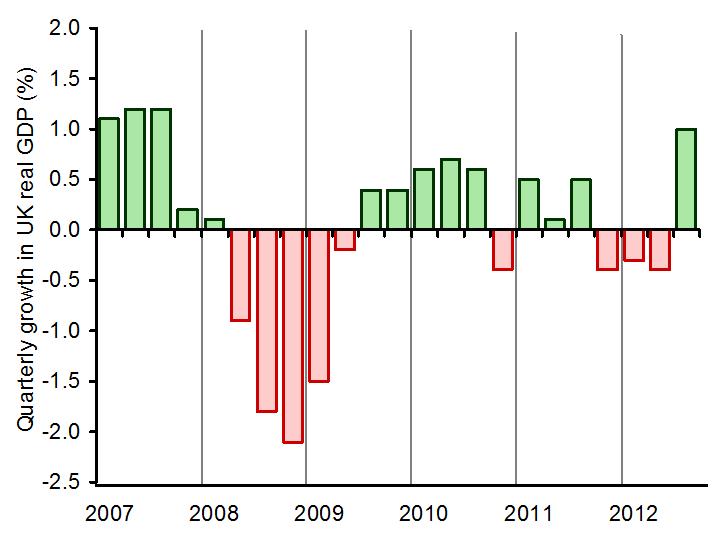
The story of the UK economy over the past few years has been one of bad news and worse news. With a double-dip recession having kept confidence low in the UK, positive news for the economy was seemingly a distant hope of government ministers. However, official statistics show that that in the 3 months from July to September, the UK economy emerged from recession, with growth of 1.0%.
This positive GDP figure (click here for a PowerPoint of the chart below) was undoubtedly helped by the London Olympics over the summer, which may have added as much as 0.2 percentage points to GDP, according to the ONS. Millions arriving in London and other venues, spending money on countless things. Yet, other factors have also contributed to this welcome growth. Stephanie Flanders said:
The positive ‘surprise’ in these figures is largely to be found in the service sector, which is estimated to have growth by 1.3% in the third quarter, after shrinking by 0.1% in the three months before.
Further to this, in Stephanie Flanders’ ‘Stephanomics’, she says that ‘it confirms that the last three months of this latest recession were brought to you by the Queen. Or at least, the extra Bank Holiday to celebrate her Jubilee.’ The Bank of England suggests that the Jubilee took 0.5 percentage points from official GDP statistics. So, the news so far is positive, but the economy is far from being back to its pre-recession size.
The 2008-2009 recession knocked 6.4% off the UK economy. Since then, the total growth (over the past 4 years) has reached only half of that – 3.2% and that includes the 1% figure just published. Thus, while we may be on ‘the right track’, there is still a long way to go. Economists differ in their interpretations of what this means for the overall recovery: some say that this is a sign of what’s to come; others argue that this recovery has been driven by one-off factors.
What is certain is that government policy over the next few months will be crucial in keeping the economy on the right growth path. The following articles consider the implications of this new economic data.
Which factors have contributed towards lower GDP data towards the beginning of this year?
Which factors have helped boost GDP in the 3 months from July to September?
Why is there disagreement about the likelihood of positive GDP figures continuing throughout the rest of the year?
Prior to the official release of the GDP figures, David Cameron hinted at positive news. Given that the market is so sensitive, what effect might this suggestion have had?
Given this positive figure, what implications does this have for the government’s quantitative easing programme?
If we translate this latest growth data onto an AD/AS diagram, how would you show what has recently happened?
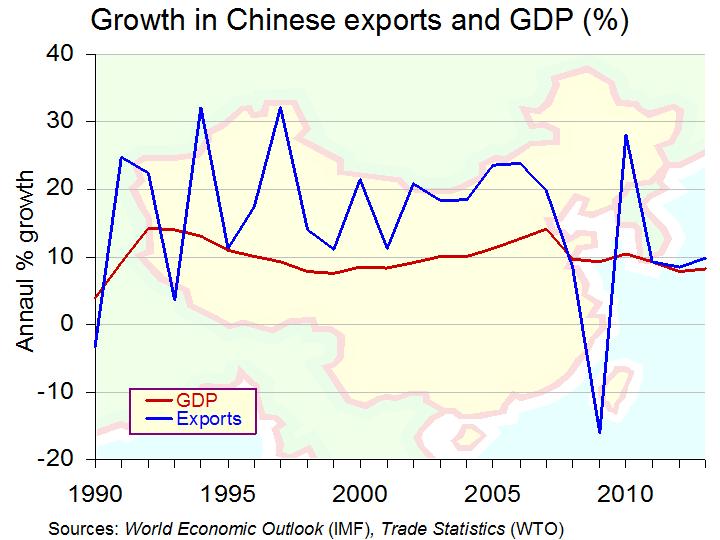
China has been one of the success stories of the past 20 years, with rapid growth in domestic and export demand. This has created the second largest economy in the world. From 1992 to 2007 annual GDP growth averaged 10.7% and annual export growth averaged 18.9% (see chart).
However, with the credit crunch and ensuing recession, growth rates in China have fallen somewhat. Annual GDP growth has averaged 9.6% and annual export growth has averaged 7.4%. Such growth rates may not seem bad, given that many Western economies have been struggling to achieve any growth, but they have been causing concern for this booming economy.
In its May Outlook, the World Bank forecast China’s growth for the year at 8.2%, but it has since been reduced to 7.8%. A key part of China’s success story has been its export market, but it has been this market that has caused concerns for the mainland economy. In August of this year, its year-on-year export growth was at only 2.7%, but exports last month grew by more than expected, at approximately 7.4%. China has had a consistent trade surplus and according to government figures, this has widened to $27.67 billion in September from $26.66 billion in the previous month.
Recovery in this market will be crucial for the continued success of the economy, as a means of alleviating the fears of a slowdown. This higher growth of exports may be a misleading indicator, perhaps influenced by seasonal factors and thus may not be a sign of what’s to come. Indeed, many analysts have said that they are not convinced that these healthier trade figures will remain. Alistair Thornton, from IHS Global Economics said:
“It’s safe to say we are overshooting the trend here and we expect (the data) to come back in line in the months ahead.”
Citigroup economist, Ding Shaung also confirmed these sentiments:
”The trade data is a positive sign for the Chinese economy … But it remains to be seen whether import and export growth can remain at these levels.”
Part of this pessimism is due to the uncertainty surrounding the growth prospects of its biggest two trading partners – the US and the European Union. Exports to the former have remained relatively high, but exports to the European Union have suffered, falling by over 5.6%. It is likely that weaknesses in the global economy have held back China’s growth prospects in both exports and national output. The Chinese government was aiming for growth of 7.6% in 2012. Not a bad rate you may say, but when compared with growth rates for 2011 (9.3%) and 2010 (10.4%), it does represent a significant fall. The future of the Chinese economy is crucial for the recovery of the world economy, in part as it represents a big demand for imports from other countries, such as the US and Europe. The following articles consider the trade and growth prospects of the world’s second largest economy.
Which factors have influenced Chinese exports and imports?
Why is China’s growth rate such an important variable for the UK and other Western economies?
Why has export growth in China fallen recently? Can you use the same explanation for its lower growth in national output?
Explain why analysts remain pessimistic about the sustainability of these improved trade figures.
Using a diagram, illustrate the effect that higher Chinese growth rates will have on GDP in a country such as the UK. Could there be a multiplier effect?
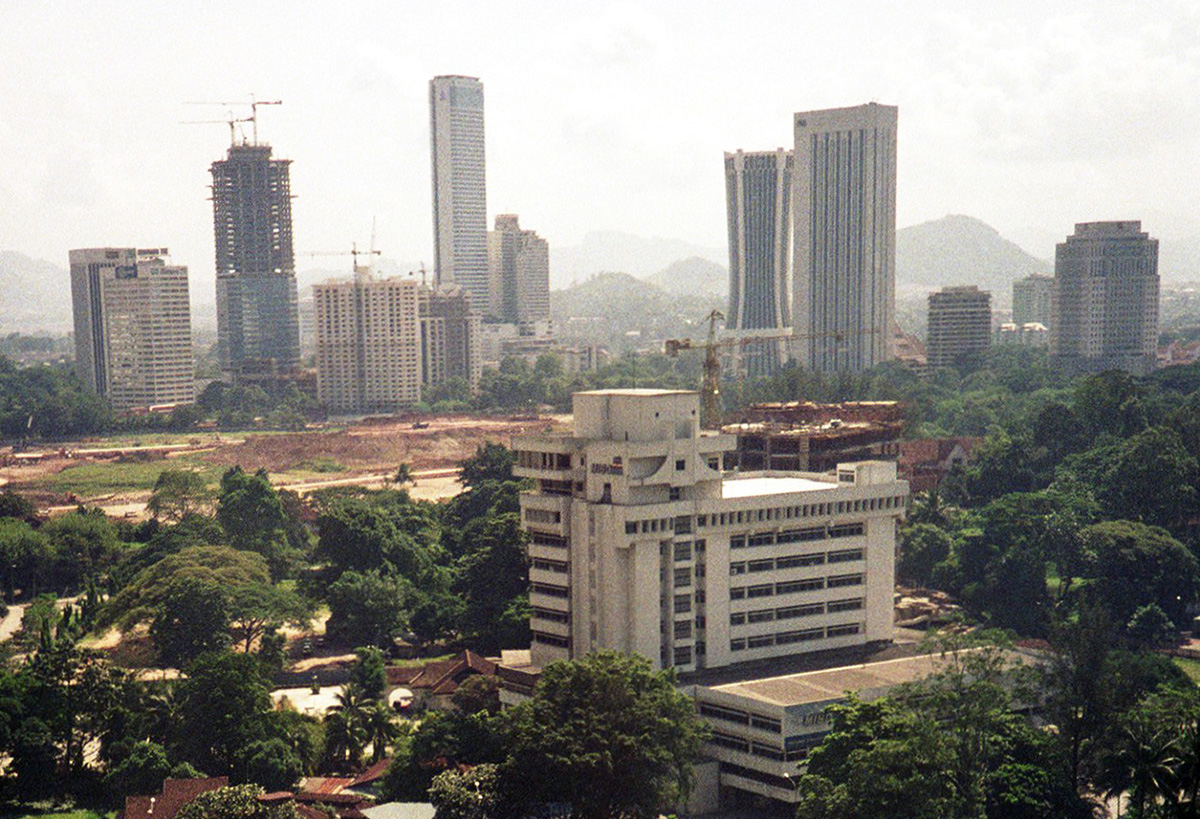 Many developing Asian countries have experienced rapid and yet relatively stable economic growth over a number of years. In other words, this has not been a short-term unsustainable boom associated with the expansionary phase of the business cycle – with aggregate demand expanding more rapidly than aggregate supply. Rather it is the result of a rapid growth in aggregate supply.