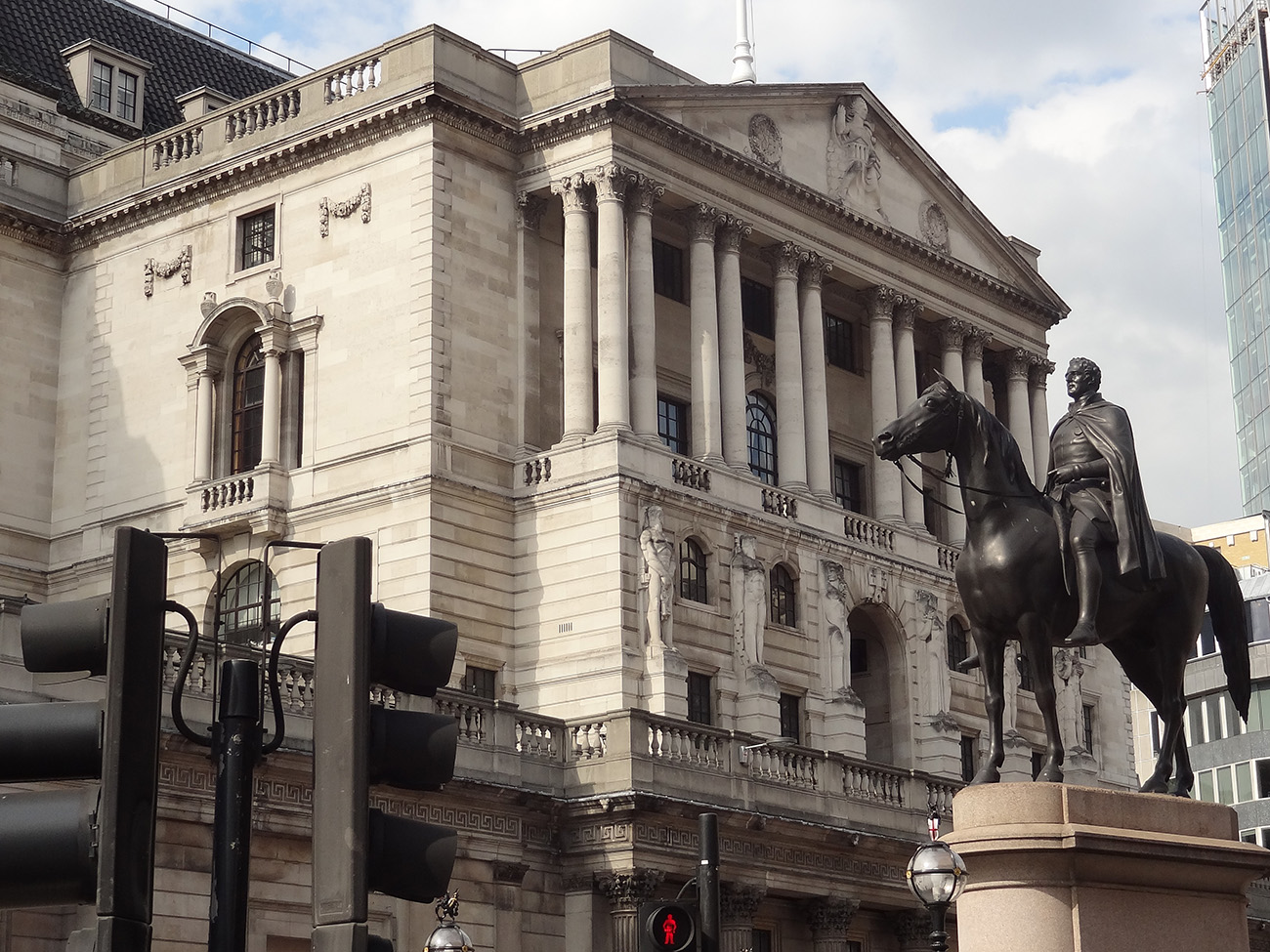
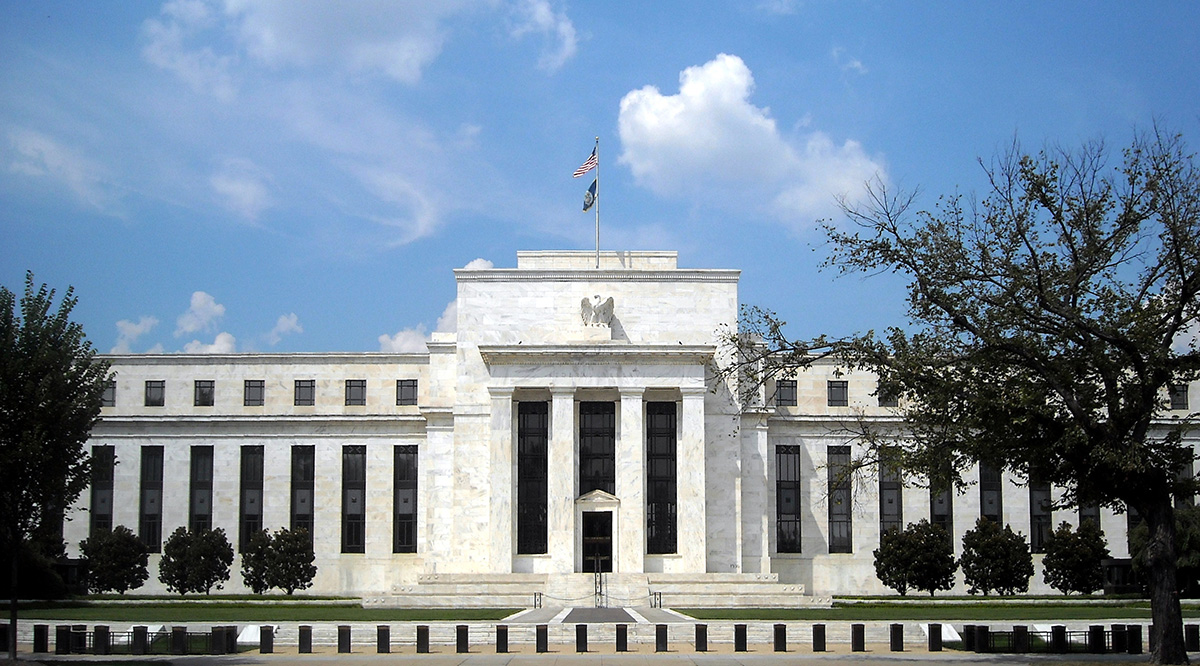
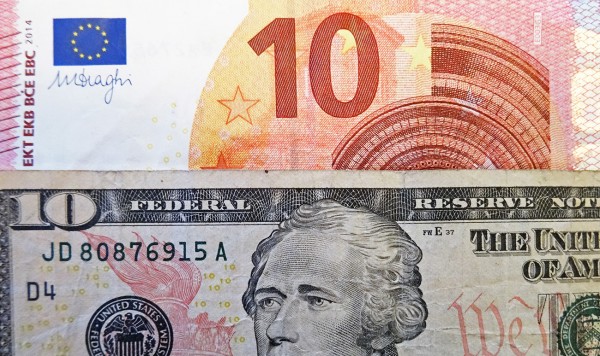
 The Federal Reserve chair, Janet Yellen, has been giving strong signals recently that the US central bank will probably raise interest rates at its December 16 meeting or, if not then, early in 2016. ‘Ongoing gains in the labor market’ she said, ‘coupled with my judgement that longer-term inflation expectations remain reasonably well anchored, serve to bolster my confidence in a return of inflation to 2%.’ This, as for many other central banks, is the target rate of inflation.
In anticipation of a rise in US interest rates, the dollar has been appreciating. Its (nominal) exchange rate index has risen by 24% since April 2014 (see chart below).
In the light of the sluggish eurozone economy, the ECB president, Mario Draghi, has been taking a very different stance. He has indicated that he stands ready to cut interest rates further and increase quantitative easing.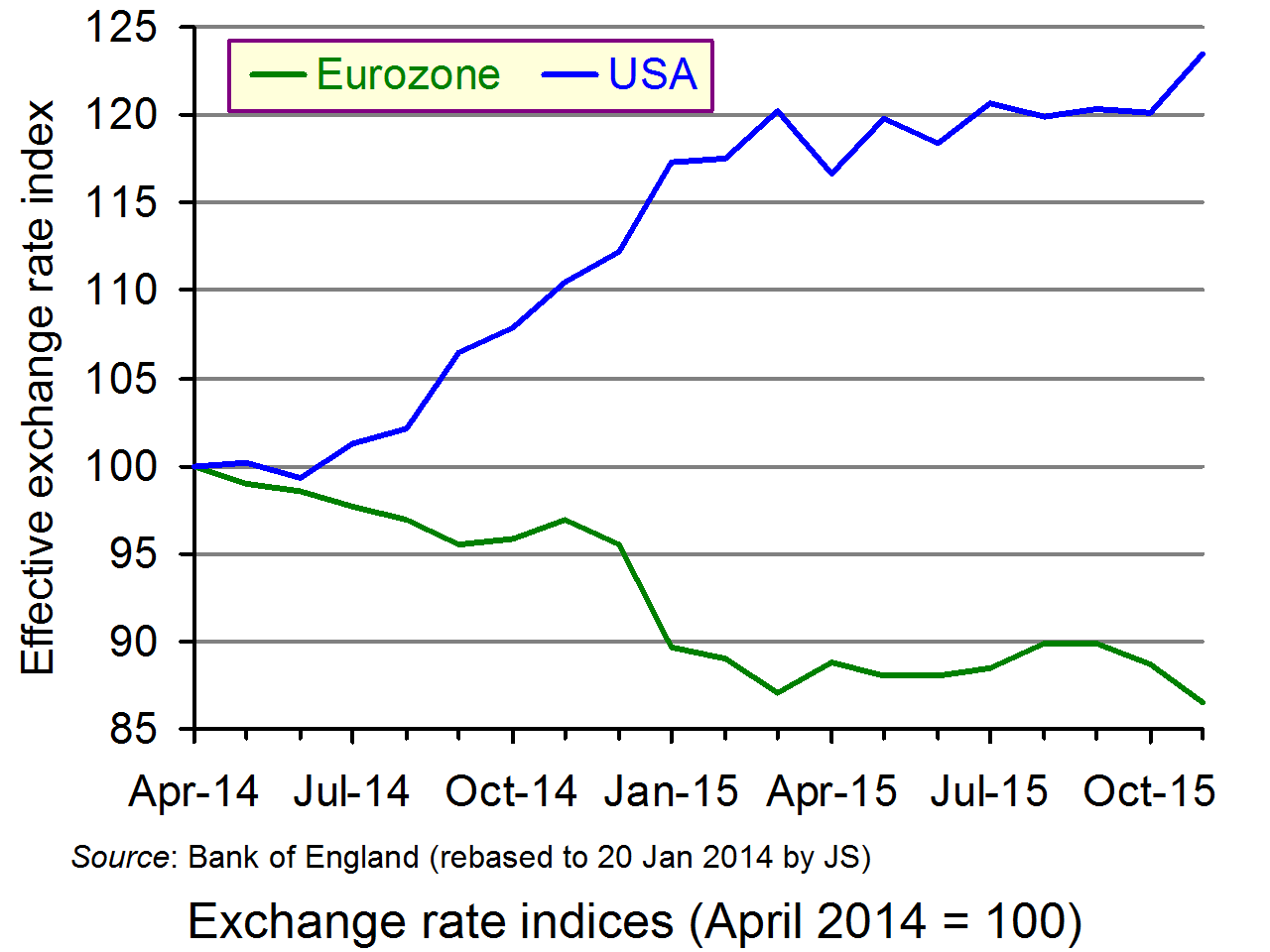 At the meeting on 3 December, the ECB did just that. It announced a further cut in the deposit rate, from –0.2 to –0.3 and an extension of the €60 billion per month QE programme from September 2016 to March 2017 (bringing the total by that time to €1.5 trillion – up from €1.1 trillion by September 2016).
Stock market investors had been expecting more, including an increase in the level of monthly asset purchases above €60 billion. Consequently stock markets fell. Both the German DAX and the French CAC 40 stock market indices fell by 3.6%. The euro also appreciated against the dollar by 2.7% on the day of the announcement. Nevertheless, since April 2014, the euro exchange rate index has fallen by 13%. Against the US dollar, the euro has depreciated by a massive 31%.
So what will be the consequences of the very different monetary policies being pursued by the Fed and the ECB? Are they simply the desirable responses to a lack of convergence of the economic performance of the US and eurozone economies? In other words, will they help to bring greater convergence between the two economies?
Or will the desirable effects of convergence be offset by other undesirable effects for the USA and the eurozone and also for the rest of the world?
|
|
| • |
Will huge amounts of dollar-denominated debt held by many emerging economies make it harder to service these debts with an appreciating dollar? |
| • |
How much will US exporters suffer from the dollar’s rise and what will the US authorities do about it? |
| • |
Will currency volatility lead to currency wars and, if so, what will be their economic effects? |
| • |
Will the time lags involved in the effects of the continuing programme of QE in the eurozone eventually lead to overheating? Already euro money supply is rising, on both narrow and broad measures. |
The following articles address these issues.
Articles
The Fed and the ECB: when monetary policy diverges The Guardian, Mohamed El-Erian (2/12/15)
European stocks slide after ECB dashes hopes of major QE expansion The Guardian, Heather Stewart and Graeme Wearden (3/12/15)
Mario Draghi riles Germany with QE overkill The Telegraph, Ambrose Evans-Pritchard (3/12/15)
How the eurozone missed its shot at a recovery The Telegraph, Peter Spence (3/12/15)
Yellen Signals Economy Nearly Ready for First Interest-Rate Hike Bloomberg, Christopher Condon (3/12/15)
Exchange rate data
Effective exchange rate indices Bank for International Settlements
Exchange rates Bank of England
Questions
- What would be the beneficial effects to the US and eurozone economies of their respective monetary policies?
- Explain the exchange rate movements that have taken place between the euro and the dollar over the past 19 months. How do these relate to the various parts of the balance of payments accounts of the two economies?
- Is it possible for the USA to halt the rise in the dollar while at the same time raising interest rates? Explain.
- Why are some members of the ECB (e.g. the German and Dutch) against expanding QE? Assess their arguments.
- What will be the impact of US and eurozone monetary policies on emerging economies?
- What will be the impact of US and eurozone monetary policies on the UK?
- Why did the euro appreciate after the Mario Draghi’s press statement on 3 December? What has happened to the dollar/euro exchange rate since and why?
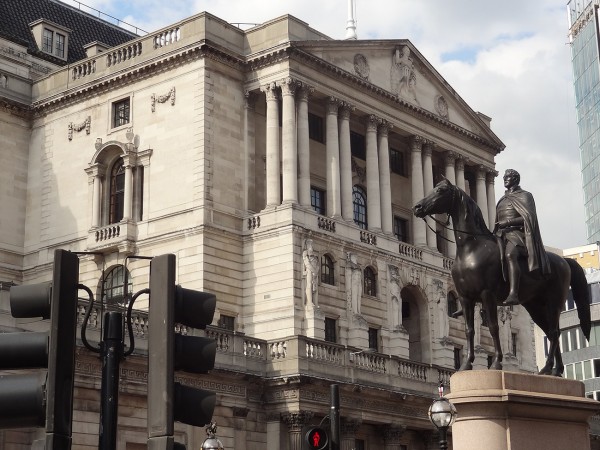 Following the recession of 2008/9, the UK has engaged in four rounds of quantitative easing (QE) – the process whereby the central bank increases the money supply by purchasing government bonds, and possibly other assets, on the open market from various institutions. The final round was announced in July 2012, bringing the total assets purchased to £375bn. As yet, however, there are no plans for quantitative tightening – the process of the Bank of England selling some of these assets, thereby reducing money supply.
The aim of QE has been to stimulate aggregate demand. Critics claim, however, that the effect on spending has been limited, since the money has not gone directly to consumers but rather to the institutions selling the assets, who have used much of the money to buy shares, bonds and other assets. Nevertheless, with banks having to strengthen their capital base following the financial crisis, QE has helped then to achieve this without having to make even bigger reductions in lending.
The Bank of England now reckons that the recovery is sufficiently established and there is, therefore, no need for further QE.
 This is also the judgement of the Federal Reserve about the US economy, which experienced annual growth of 3.5% in the third quarter of 2014. The IMF predicts that US growth will be around 3% for the next three years.
The Fed has had three rounds of QE since the financial crisis, but in October 2014 called an end to the process. Since the start of this year, it has been gradually reducing the amount it injects each month from $85bn to $15bn. The total bond purchases over the past five years have been some $3.6tn, bringing the Fed’s balance sheet to nearly $4.5tn.
 But as QE comes to an end in the USA, Japan is expanding its programme. On 31 October, the Bank of Japan announced that it would increase its asset purchases from ¥60-70tn per year to ¥80tn (£440bn). The Japanese government and central bank are determined to boost economic growth in Japan and escape the two decades of deflation and stagnation. The Tokyo stock market rose by some 8% in the week following the announcement and the yen fell by more than 5% against the dollar.
And the European Central Bank, which has not used full QE up to now, looks as if it is moving in that direction.  In October, it began a programme of buying asset-backed securities (ABSs) and covered bonds (CBs). These are both private-sector securities: ABSs are claims against non-financial companies in the eurozone and CBs are issued by eurozone banks and other financial institutions.
It now looks as if the ECB might take the final step of purchasing government bonds. This is probably what is implied by ECB President Mario Draghi’s statement after the 6 November meeting of the ECB that the ground was being prepared for “further measures to be implemented, if needed”.
But has QE been as successful as its proponents would claim? Is it the solution now to a languishing eurozone economy? The following articles look at these questions.
Fed calls time on QE in the US – charts and analysis The Guardian, Angela Monaghan (29/10/14)
Quantitative easing: giving cash to the public would have been more effective The Guardian, Larry Elliott (29/10/14)
End of QE is whimper not bang BBC News, Robert Peston (29/10/14)
Federal Reserve ends QE The Telegraph, Katherine Rushton (29/10/14)
Bank of Japan to inject 80 trillion yen into its economy The Guardian, Angela Monaghan and Graeme Wearden (31/10/14)
Every man for himself The Economist, Buttonwood column (8/11/14)
Why Japan Surprised the World with its Quantitative Easing Announcement Townhall, Nicholas Vardy (7/11/14)
Bank of Japan QE “Treat” Is a Massive Global Trick Money Morning, Shah Gilani (31/10/14)
ECB stimulus may lack desired scale, QE an option – sources Reuters, Paul Carrel and John O’Donnell (27/10/14)
ECB door remains open to quantitative easing despite doubts over impact Reuters, Eva Taylor and Paul Taylor (9/11/14)
ECB could pump €1tn into eurozone in fresh round of quantitative easing The Guardian,
Angela Monaghan and Phillip Inman (6/11/14)
Ben Bernanke: Quantitative easing will be difficult for the ECB CNBC, Jeff Cox (5/11/14)
Not All QE Is Created Equal as U.S. Outpunches ECB-BOJ Bloomberg, Simon Kennedy (6/11/14)
A QE proposal for Europe’s crisis The Economist, Yanis Varoufakis (7/11/14)
UK, Japan and 1% inflation BBC News, Linda Yueh (12/11/14)
 Greenspan Sees Turmoil Ahead As QE Market Boost Unwinds Bloomberg TV, Gillian Tett interviews Alan Greenspan (29/10/14)
Questions
- What is the transmission mechanism between central bank purchases of assets and aggregate demand?
- Under what circumstances might the effect of a given amount of QE on aggregate demand be relatively small?
- What dangers are associated with QE?
- What determines the likely effect on inflation of QE?
- What has been the effect of QE in developed countries on the economies of developing countries? Has this been desirable for the global economy?
- Have businesses benefited from QE? If so, how? If not, why not?
- What has been the effect of QE on the housing market (a) in the USA; (b) in the UK?
- Why has QE not been ‘proper’ money creation?
- What effect has QE had on credit creation? How and why has it differed between the USA and UK?
- Why did the announcement of further QE by the Bank of Japan lead to a depreciation of the yen? What effect is this depreciation likely to have?
 As we saw in the news item The difficult exit from cheap money, central banks around the world have been operating an extremely loose monetary policy since the beginning of 2009. Their interest rates have been close to zero and trillions of dollars of extra money has been injected into the world economy through various programmes of quantitative easing.
For the past few months the Federal Reserve has been purchasing bonds under its most recent programme dubbed QE3, and thereby increasing narrow money, by $85 billion per month. Since the start of its QE programme in 2009, it has pumped around $2.8 trillion of extra money into the US and world economies. This huge increase in money supply has boosted the demand for assets worldwide and world stock markets have risen. Much of the money has flowed into developing countries, such as India, and has acted as a boost to their economies.
 Once the US economy is growing strongly again, the aim is to taper off, and ultimately end or even reverse, the QE programme. It was expected that the Fed would decide to start this tapering off process at its meeting on 18 September – perhaps reducing bond purchases initially by some $10 billion. (Note that this would still be an increase in money supply, just a slightly smaller one.) Over the past few days, US bond prices have been falling (and yields increasing) in anticipation of such a move.
As it turned out, the Fed decided to delay tapering off. It will continue with its assets purchase programme of $85 billion per month for the time being. The reason given was that the US economy was still too fragile and needed the monthly injections of money to stay at the current level.
Normally it might be expected that the announcement of a more fragile recovery would cause the US stock market, and others worldwide, to fall. In fact the opposite occurred, with investors relieved that the extra money, which allows extra asset purchases, would continue at the same rate.
But this then raises the question of just what will be the effect when tapering off does actually occur. Will stock markets then go into a tailspin? Or will they merely stop rising so fast. That depends very much on the role of speculation.
Webcasts
Bernanke’s Own Words on Asset Purchases, Economy Bloomberg (18/9/13)
Bernanke: Fed to delay bond tapering PBS Newshour on YouTube (full speech plus questions) (18/9/13)
No tapering announced by Fed CNBC on Yahoo Finance (18/9/113)
The impact of US stimulus moves at home and abroad BBC News, Stephanie Flanders (18/9/13)
Is the upturn reaching Americans? BBC World, Stephanie Flanders (17/9/13)
Shares hit high as Federal Reserve maintains stimulus BBC News, Stephanie Flanders (18/9/13)
US Fed decision to delay tapering was a relief ET Now (India), Bimal Jalan (19/9/13)
Articles
Federal Reserve surprises markets by delaying QE tapering The Telegraph, Katherine Rushton (18/9/13)
Federal Reserve delays QE tapering: the full statement The Telegraph (18/9/13)
Q&A: What is tapering? BBC News (18/9/13)
Fed delay is no reason to celebrate The Guardian, Larry Elliott (19/9/13)
Federal Reserve tapering decision has baffled the markets The Guardian, Larry Elliott (19/9/13)
Taper tiger The Economist (21/9/13)
Everything You Need to Know About the Fed’s Decision Not to Taper QE3 The Atlantic, Matthew O’Brien (18/9/13)
Fed’s dovish turn leaves Wall Street economists mulling taper timing: poll Reuters, Chris Reese (18/9/13)
Good news and bad news from the Fed BBC News, Stephanie Flanders (19/9/13)
Is the Fed frightened of its shadow? BBC News, Robert Peston (19/9/13)
The Federal Reserve and Janet Yellen face a tough task with insufficient tools The Guardian, Mohamed A. El-Erian (14/10/13)
Questions
- Why might a slowing down in the increase in US money supply cause asset prices to fall, rather than merely to rise less quickly?
- Why has the US QE programme led to a rise in asset prices overseas?
- Distinguish between stabilising and destabilising speculation. Which type of speculation has been occurring as a result of the US QE programme?
- How has QE affected unemployment in the UK and USA? How is the participation rate and the flexibility of labour markets relevant to the answer?
- Explain the following two statements by Stephanie Flanders and Robert Peston respectively. “The market conditions argument has a circularity to it: talk of tapering leads to higher market rates, which in turn puts the taper itself on hold.” “The Fed simply hinting that less money would be created, means that there will be no reduction in the amount of money created (for now at least).”
- Why have US long-term interest rates, including mortgage rates, risen since May of this year?
- What impact have higher US long-term interest rates had on economies in the developing world? Explain.
 With many countries struggling to recover from the depression of the past few years, central banks are considering more and more doveish moves to kick-start lending. But with short-term interest rates in the USA, the UK and Japan close to zero, the scope for further cuts are limited. So what can central banks do?
The first thing that can be done is to adopt a higher inflation target or to accept inflation above target – at least for the time being. This could be accompanied by explicitly targeting GDP growth (real or nominal) or unemployment (see the blog from last December, Rethinking central bank targets).
 The second option is to increase quantitative easing. Although in a minority at the last MPC meeting, Mervyn King, the current Bank of England Governor, argued for a further £25 billion of asset purchases (bringing the total to £400bn) (see MPC minutes paragraph 39). It is highly likely that the MPC will agree to further QE at its next meeting in March. In Japan, the new governor of the Bank of Japan is expected to include asset purchases as part of the policy of monetary easing.
The third option is for the central bank to provide finance at below-market rates of interest directly to the banking sector specifically for lending: e.g. to small businesses or for house purchase. The Bank of England’s Funding for Lending Scheme is an example and the Bank is considering extending it to other financial institutions.
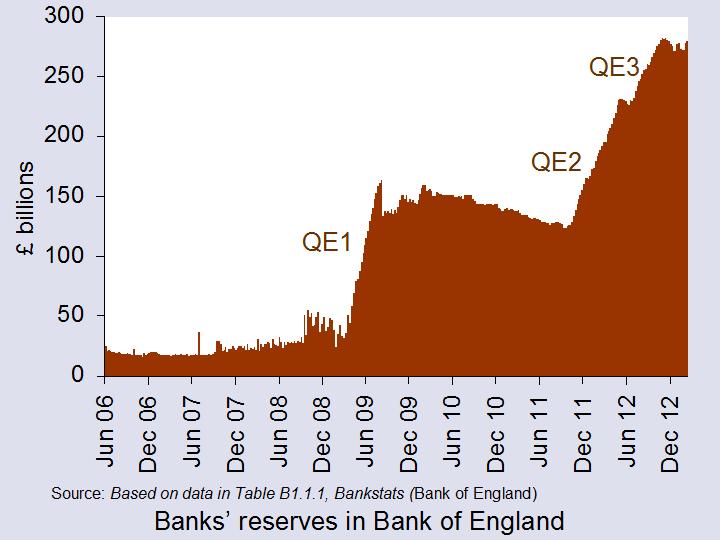 One other approach, mooted by the Bank of England’s Deputy Governor before the House of Commons Treasury Select Committee, is for negative interest rates paid on Banks’ reserves in the Bank of England. This would, in effect, be a fee levied on banks for keeping money on deposit. The idea would be to encourage banks to lend the money and not to keep excessive liquidity. As you can see from the chart, three rounds of quantitative easing have led to a huge increase in bank’s reserves at the Bank of England. (Click here for a PowerPoint of the chart.)
The following articles consider these various proposals and whether they will work to stimulate lending and thereby aggregate demand and economic recovery.
Central banks: Brave new words The Economist (23/2/13)
Phoney currency wars The Economist (16/2/13)
Analysis: Global central banks will keep taking it easy Reuters, Alan Wheatley (22/2/13)
Quantitative easing: the markets are struggling with a serious drug habi The Guardian, Larry Elliott (24/2/13)
Negative interest rates idea floated by Bank’s Paul Tucker BBC News (26/2/13)
Bank of England mulls negative interest rates Independent, Ben Chu (26/2/13)
BoE floats extending Funding for Lending to non-banks Mortgage Solutions, Adam Williams (26/2/13)
Funding for Lending Scheme failing to get banks lending Left Foot Forward, James Bloodworth (26/2/13)
Mortgage market boosted by lending schemes, says Redrow BBC News (26/2/13)
Widespread quantitative easing risks ‘QE wars’ and stagnation The Guardian, Nouriel Roubini (28/2/13)
Questions
- Consider each of the methods outlined above and their chances of success in stimulating aggregate demand.
- Go through each of the methods and consider the problems they are likely to create/have created.
- How important is it that monetary policy measures affect people’s expectations?
- What effects do the measures have on the distribution of income between borrowers and savers?
- What are annuities? How are these affected by policies of monetary easing?
- How has actual and anticipated Japanese monetary policy affected the exchange rate of the Japanese yen? How is this likely to affect the Japanese economy?
- Explain the sub-heading of the final article above, “When several major central banks pursue QE at the same time, it becomes a zero-sum game”. Do you agree?
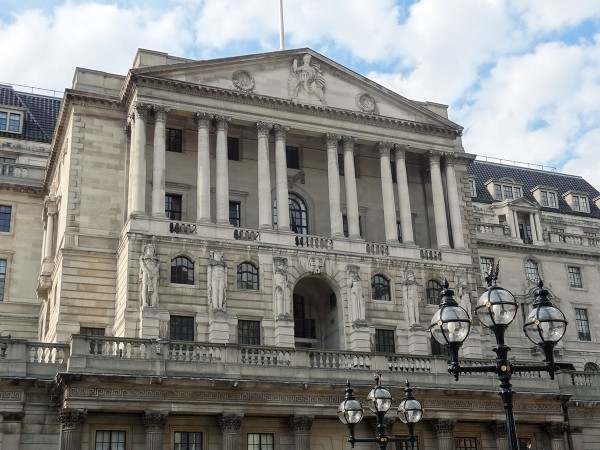 At present, the Bank of England has an inflation target of 2% CPI at a 24-month time horizon. Most, other central banks also have simple Inflation targets. But central bankers’ opinions seem to be changing.
Consider four facts.
1. Many central banks around the world have had record low interest rates for nearly four years, backed up in some cases by programmes of quantitative easing, officially in pursuit of an inflation target.
2. The world is mired in recession or sluggish growth, on which monetary policy seems to have had only a modest effect.
3. Inflation seems to be poorly related to aggregate demand, at least within an economy. Instead, inflation in recent years seems to be particularly affected by commodity prices.
4. Success in meeting an inflation target could mean failure in terms of an economy achieving an actual growth rate equal to its potential rate.
It’s not surprising that there have been calls for rethinking monetary policy targets.
 There have recently been two interesting developments: one is a speech by Mark Carney, Governor designate of the Bank of England; the other is a decision on targets by the Fed, reported at a press conference by Ben Bernanke, Chairman of the Federal Reserve.
Mark Carney proposes the possible replacement of an inflation target with a target for nominal GDP (NGDP). This could be, say, 5%. What is more, it should be an annual average over a number of years. Thus if the target is missed in one year, it can be made up in subsequent years. For example, if this year the actual rate of nominal GDP growth is 4%, then by achieving 6% next year, the economy would keep to the average 5% target. As Stephanie Flanders points out:
Moving to nominal GDP targets would send a signal that the Bank was determined to get back the nominal growth in the economy that has been lost, even if it is at the cost of pushing inflation above 2% for a sustained period of time.
In the USA, Ben Bernanke announced that the Fed would target unemployment by keeping interest rates at their current record lows until unemployment falls below a threshold of 6.5%.
Until recently, the Fed has been more flexible than most other central banks by considering not only inflation but also real GDP when setting interest rates. This has been close to following a Taylor rule, which involves targeting a weighted averaged of inflation and real GDP. However, in January 2012, the Fed announced that it would adopt a 2% long-run inflation target. So the move to targeting unemployment represents a rapid change in policy
So have simple inflation targets run their course? Should they be replaced by other targets or should targeting itself be abandoned? The following articles examine the issues.
Articles
UK
Mark Carney hints at need for radical action to boost ailing economies The Telegraph, Philip Aldrick (11/12/12)
George Osborne welcomes inflation target review The Telegraph, Philip Aldrick and James Kirkup (13/12/12)
Monetary policy: Straight talk The Economist, R.A. (12/12/12)
New Bank of England governor Mark Carney mulls end of inflation targets The Guardian, Larry Elliott (12/12/12/)
Carney’s trail of carnage Independent, Ben Chu (12/12/12)
Mark Carney suggests targeting economic output BBC News (12/12/12)
A new target for the Bank of England? BBC News, Stephanie Flanders (14/12/12)
Should the UK really ditch inflation target? Investment Week, Katie Holliday (14/12/12)
BoE economist Spencer Dale warns on Mark Carney’s ideas The Telegraph, Philip Aldrick (12/12/12)
USA
Ben Bernanke Outlines Fed Policy for 2013 IVN, Alex Gauthier (14/12/12)
Fed gives itself a new target BBC News, Stephanie Flanders (13/12/12)
Fed to Keep Easing, Sets Target for Rates CNBC, Jeff Cox (12/12/12)
Bernanke calls high unemployment rate ‘an enormous waste’ Los Angeles Times, Jim Puzzanghera (12/12/12)
Think the Fed has been too timid? Check out Britain and Japan. Washington Post, Brad Plumer (13/12/12)
Inflation Targeting is Dead, Long Live Inflation! The Market Oracle, Adrian Ash (14/12/12)
Speech and press conference
Guidance Bank of Canada, Mark Carney (11/12/12)
Transcript of Chairman Bernanke’s Press Conference Federal Reserve Bank, Ben Bernanke (12/12/12)
Questions
- Which of the following would meet an NGDP target of 5%: (a) 5% real growth and 0% inflation; (b) 5% real growth and 5% inflation; (c) 5% inflation and 0% growth?
- What are the main arguments in favour of an NGDP target?
- What factors would need to be taken into account in deciding the target rate of NGDP?
- What are the main arguments against an NGDP target?
- Is it possible to target two indicators with one policy instrument (interest rates)? Explain.
- Explain what is meant by Taylor rule?
- Is having an unemployment target a type of Taylor rule?
- Why may the rate of inflation (whether current or forecast) be a poor indicator of the state of the real economy?
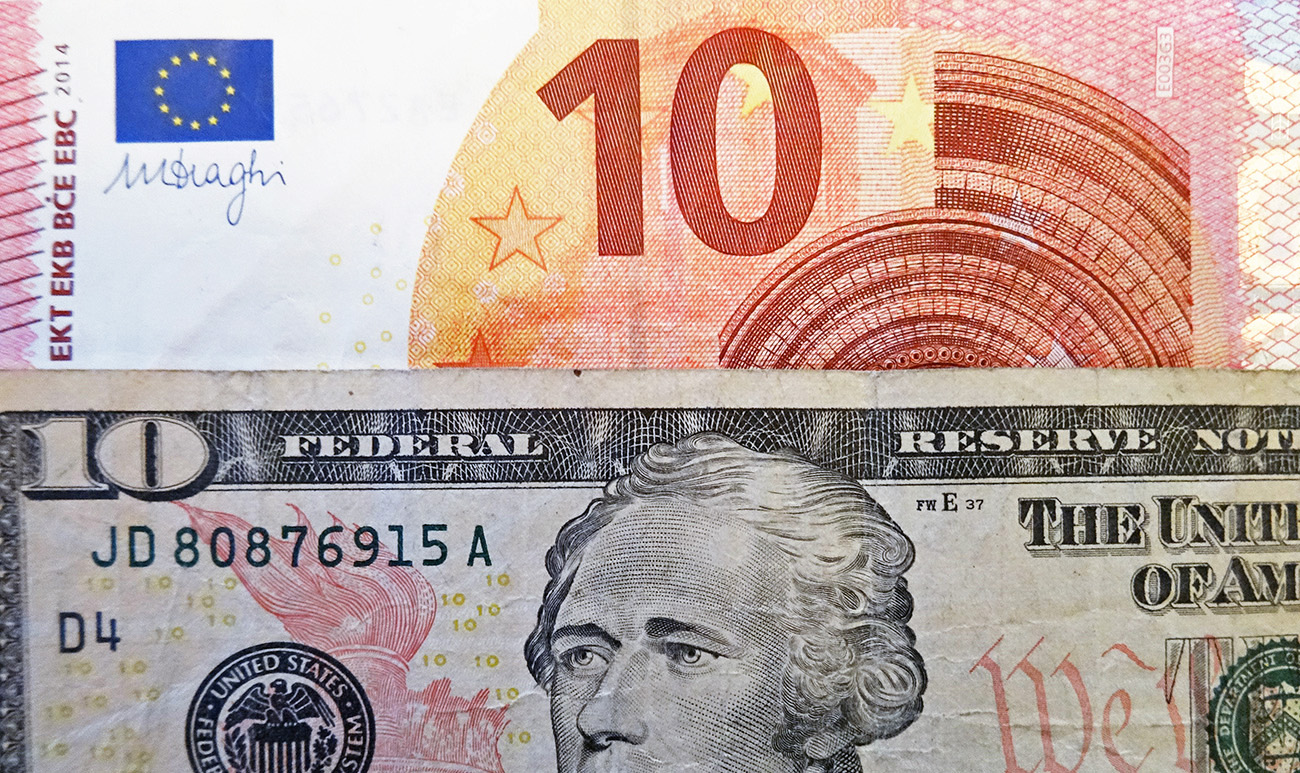 The Federal Reserve chair, Janet Yellen, has been giving strong signals recently that the US central bank will probably raise interest rates at its December 16 meeting or, if not then, early in 2016. ‘Ongoing gains in the labor market’ she said, ‘coupled with my judgement that longer-term inflation expectations remain reasonably well anchored, serve to bolster my confidence in a return of inflation to 2%.’ This, as for many other central banks, is the target rate of inflation.