 In the current environment of low inflation and rising unemployment, the Federal Reserve Bank, the USA’s central bank, has amended its monetary targets. The new measures were announced by the Fed chair, Jay Powell, in a speech for the annual Jackson Hole central bankers’ symposium (this year conducted online on August 27 and 28). The symposium was an opportunity for central bankers to reflect on their responses to the coronavirus pandemic and to consider what changes might need to be made to their monetary policy targets and instruments.
The Fed’s previous targets
Previously, like most other central banks, the Fed had a long-run inflation target of 2%. It did, however, also seek to ‘maximise employment’. In practice, this meant seeking to achieve a ‘normal’ rate of unemployment, which the Fed regards as ranging from 3.5 to 4.7% with a median value of 4.1%. The description of its objectives stated that:
In setting monetary policy, the Committee seeks to mitigate deviations of inflation from its longer-run goal and deviations of employment from the Committee’s assessments of its maximum level. These objectives are generally complementary. However, under circumstances in which the Committee judges that the objectives are not complementary, it follows a balanced approach in promoting them, taking into account the magnitude of the deviations and the potentially different time horizons over which employment and inflation are projected to return to levels judged consistent with its mandate.
The new targets
 Under the new system, the Fed has softened its inflation target. It will still be 2% over the longer term, but it will be regarded as an average, rather than a firm target. The Fed will be willing to see inflation above 2% for longer than previously before raising interest rates if this is felt necessary for the economy to recover and to achieve its long-run potential economic growth rate. Fed chair, Jay Powell, in a speech on 27 August said:
Following periods when inflation has been running below 2%, appropriate monetary policy will likely aim to achieve inflation moderately above 2 per cent for some time.
Additionally, the Fed has increased its emphasis on employment. Instead of focusing on deviations from normal employment, the Fed will now focus on the shortfall of employment from its normal level and not be concerned if employment temporarily exceeds its normal level. As Powell said:
Going forward, employment can run at or above real-time estimates of its maximum level without causing concern, unless accompanied by signs of unwanted increases in inflation or the emergence of other risks that could impede the attainment of our goals
 The Fed will also take account of the distribution of employment and pay more attention to achieving a strong labour market in low-income and disadvantaged communities. However, apart from the benefits to such communities from a generally strong labour market, it is not clear how the Fed could focus on disadvantaged communities through the instruments it has at its disposal – interest rate changes and quantitative easing.
Assessment
Modern monetary theorists (see blog MMT – a Magic Money Tree or Modern Monetary Theory?) will welcome the changes, arguing that they will allow more aggressive expansion and higher government borrowing at ultra-low interest rates.
The problem for the Fed is that it is attempting to achieve more aggressive goals without having any more than the two monetary instruments it currently has – lowering interest rates and increasing money supply through asset purchases (quantitative easing). Interest rates are already near rock bottom and further quantitative easing may continue to inflate asset prices (such as share and property prices) without sufficiently stimulating aggregate demand. Changing targets without changing the means of achieving them is likely to be unsuccessful.
It remains to be seen whether the Fed will move to funding government borrowing directly, which could allow for a huge stimulus through infrastructure spending, or whether it will merely stick to using asset purchases as a way for introducing new money into the system.
Articles
- In landmark shift, Fed rewrites approach to inflation, labor market
Reuters, Jonnelle Marte, Ann Saphir and Howard Schneider (27/8/20)
- 5 Key Takeaways From Powell’s Jackson Hole Fed Speech
Bloomberg, Mohamed A. El-Erian (28/8/20)
- Fed adopts new strategy to allow higher inflation and welcome strong labor markets
Market Watch, Greg Robb (27/8/20)
- Fed to tolerate higher inflation in policy shift
Financial Times, James Politi and Colby Smith (27/8/20)
- Fed inflation shift raises questions about past rate rises
Financial Times, James Politi and Colby Smith (28/8/20)
- Dollar slides as bond market signals rising inflation angst
Financial Times, Adam Samson and Colby Smith (28/8/20)
- Wall Street shares rise after Fed announces soft approach to inflation
The Guardian, Larry Elliott (27/8/20)
- How the Fed Is Bringing an Inflation Debate to a Boil
Bloomberg, Ben Holland, Enda Curran, Vivien Lou Chen and Kyoungwha Kim (27/8/20)
- The live now, pay later economy comes at a heavy cost for us all
The Guardian, Phillip Inman (29/8/20)
- The world’s central banks are starting to experiment. But what comes next?
The Guardian, Adam Tooze (9/9/20)
Speeches
Questions
- Find out how much asset purchases by the Fed, the Bank of England and the ECB have increased in the current rounds of quantitative easing.
- How do asset purchases affect narrow money, broad money and aggregate demand? Is there a fixed money multiplier effect between the narrow money increases and aggregate demand? Explain.
- Why did the dollar exchange rate fall following the announcement of the new measures by Jay Powell?
- The Governor of the Bank of England, Andrew Bailey, also gave a speech at the Jackson Hole symposium. How does the approach to money policy outlined by Bailey differ from that outlined by Jay Powell?
- What practical steps, if any, could a central bank take to improve the relative employment prospects of disadvantaged groups?
- Outline the arguments for and against central banks directly funding government expenditure through money creation.
- What longer-term problems are likely to arise from central banks pursuing ultra-low interest rates for an extended period of time?
 Share prices are determined by demand and supply. The same applies to stock market indices, such as the FTSE 100 and FTSE 250 in the UK and the Dow Jones Industrial Average and the S&P 500 in the USA. After all, the indices are the weighted average prices of the shares included in the index. Generally, when economies are performing well, or are expected to do so, share prices will rise. They are likely to fall in a recession or if a recession is anticipated. A main reason for this is that the dividends paid on shares will reflect the profitability of firms, which tends to rise in times of a buoyant economy.
When it first became clear that Covid-19 would become a pandemic and as countries began locking down, so stock markets plummeted. People anticipated that many businesses would fail and that the likely recession would cause profits of many other surviving firms to decline rapidly. People sold shares.
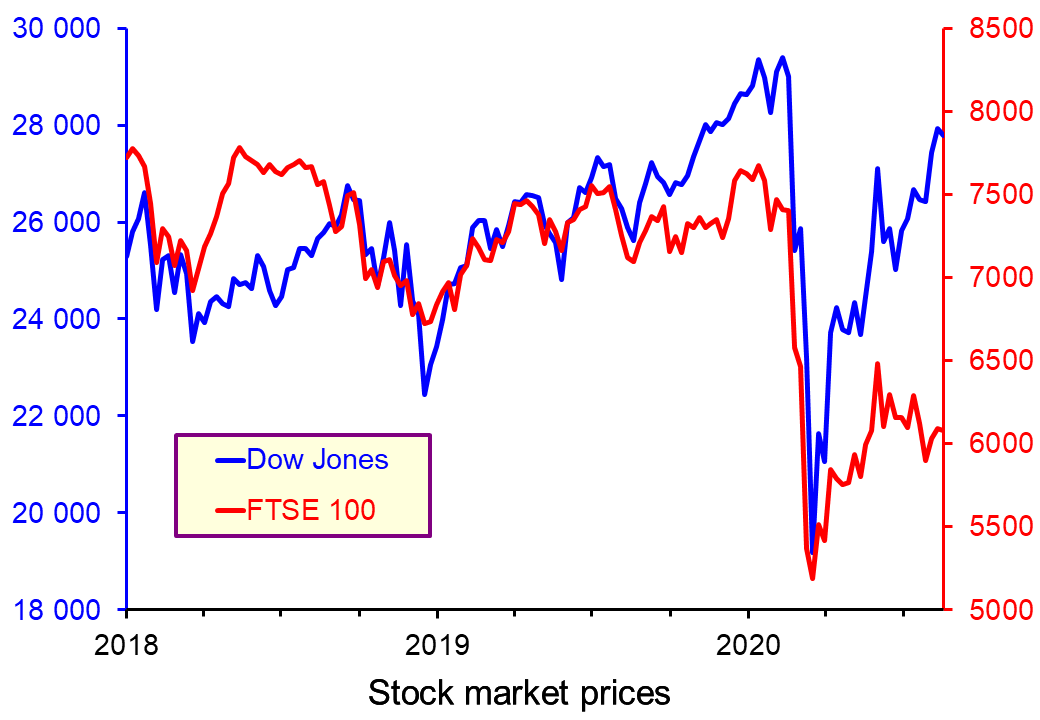 The first chart shows how the FTSE 100 fell from 7466 in early February 2020 to 5190 in late March, a fall of 30.5%. The Dow Jones fell by 34% over the same period. In both cases the fall was driven not only by the decline in the respective economy over the period, but by speculation that further declines were to come (click here for a PowerPoint of the chart).
But then stock markets started rising again, especially the Dow Jones, despite the fact that the recessions in the UK, the USA and other countries were gathering pace. In the second quarter of 2020, the Dow Jones rose by 23% and yet the US economy declined by 33% – the biggest quarterly decline on record. How could this be explained by supply and demand?
Quantitative easing
In order to boost aggregate demand and reduce the size of the recession, central banks around the world engaged in large-scale quantitative easing. 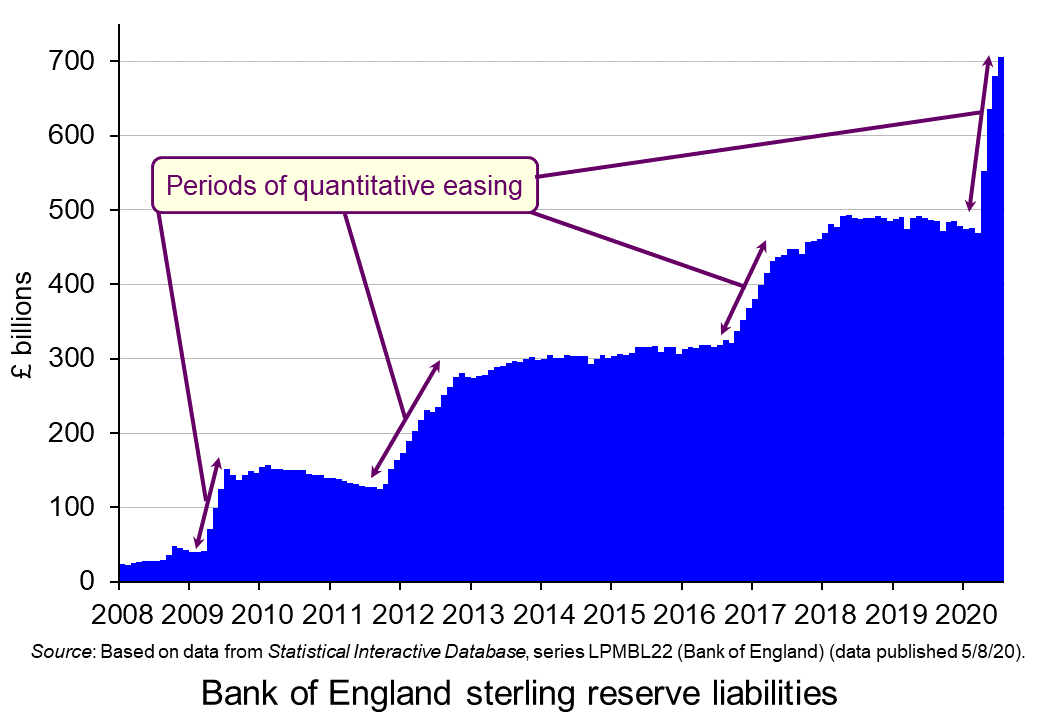 This involves central banks buying government bonds and possibly corporate bonds too with newly created money. The extra money is then used to purchase other assets, such as stocks and shares and property, or physical capital or goods and services. The second chart shows that quantitative easing by the Bank of England increased the Bank’s asset holding from April to July 2020 by 50%, from £469bn to £705bn (click here for a PowerPoint of the chart).
But given the general pessimism about the state of the global economy, employment and personal finances, there was little feed-through into consumption and investment. Instead, most of the extra money was used to buy assets. This gave a huge boost to stock markets. Stock market movements were thus out of line with movements in GDP.
Confidence
Stock market prices do not just reflect the current economic and financial situation, but also what people anticipate the situation to be in the future. 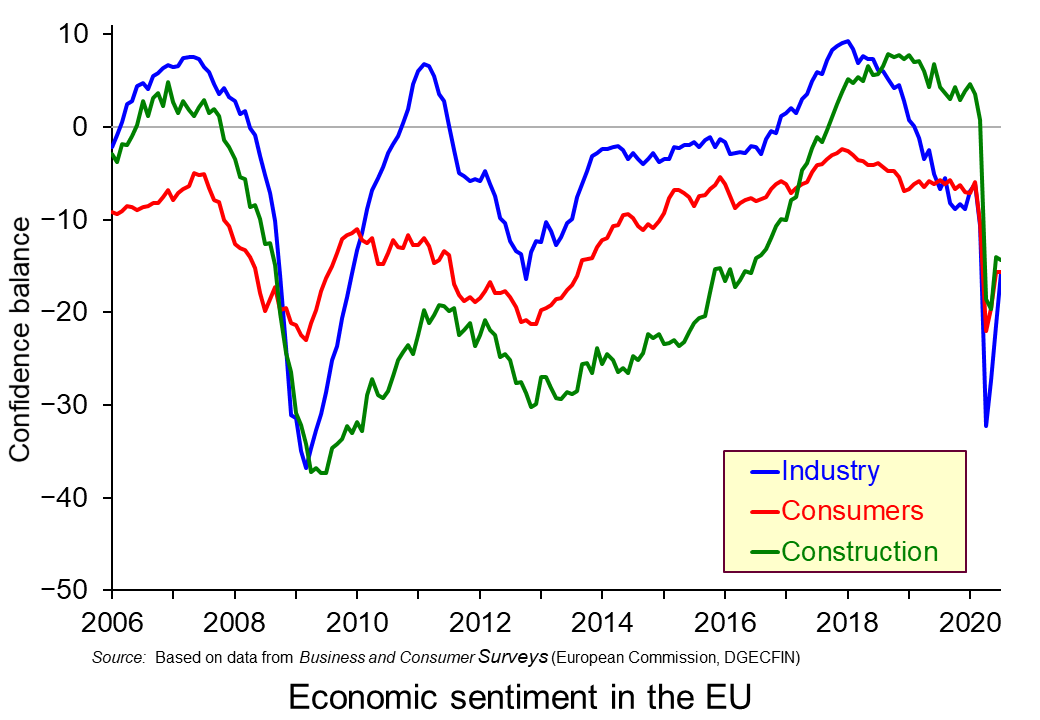 As infection and death rates from Covid-19 waned around Europe and in many other countries, so consumer and business confidence rose. This is illustrated in the third chart, which shows industrial, consumer and construction confidence indicators in the EU. As you can see, after falling sharply as the pandemic took hold in early 2020 and countries were locked down, confidence then rose (click here for a PowerPoint of the chart).
But, as infection rates have risen somewhat in many countries and continue to soar in the USA, Brazil, India and some other countries, this confidence may well start to fall again and this could impact on stock markets.
Speculation
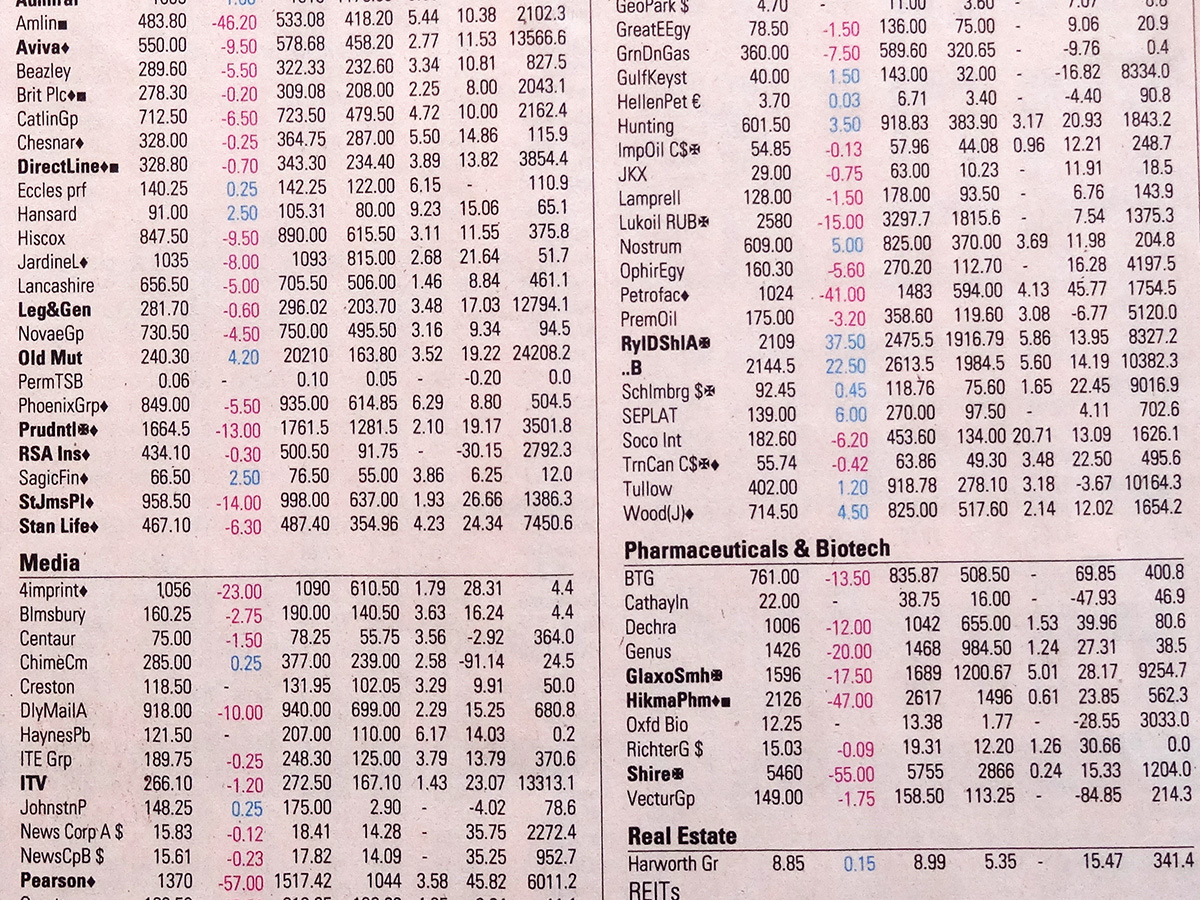 A final, but related, cause of recent stock market movements is speculation. If people see share prices falling and believe that they are likely to fall further, then they will sell shares and hold cash or safer assets instead. This will amplify the fall and encourage further speculation. If, however, they see share prices rising and believe that they will continue to do so, they are likely to want to buy shares, hoping to make a gain by buying them relatively cheaply. This will amplify the rise and, again, encourage further speculation.
If there is a second wave of the pandemic, then stock markets could well fall again, as they could if speculators think that share prices have overshot the levels that reflect the economic and financial situation. But then there may be even further quantitative easing.
There are many uncertainties, both with the pandemic and with governments’ policy responses. These make forecasting stock market movements very difficult. Large gains or large losses could await people speculating on what will happen to share prices.
Articles
Questions
- Illustrate the recent movements of stock markets using demand and supply diagrams. Explain your diagrams.
- What determines the price elasticity of demand for shares?
- Distinguish between stabilising and destabilising speculation. How are the concepts relevant to the recent history of stock market movements?
- Explain how quantitative easing works to increase (a) asset prices; (b) aggregate demand.
- What is the difference between quantitative easing as currently conducted by central banks and ‘helicopter money‘?
- Give some examples of companies whose share prices have risen strongly since March 2020. Explain why these particular shares have done so well.
 The LSE’s Centre for Economic Performance has just published a paper looking at the joint impact of Covid-19 and Brexit on the UK economy. Apart from the short-term shocks, both will have a long-term dampening effect on the UK economy. But they will largely affect different sectors.
Covid-19 has affected, and will continue to affect, direct consumer-facing industries, such as shops, the hospitality and leisure industries, public transport and personal services. Brexit will tend to hit those industries most directly involved in trade with Europe, the UK’s biggest trading partner. These industries include manufacturing, financial services, posts and telecommunications, mining and quarrying, and agriculture and fishing.
Despite the fact that largely different sectors will be hit by these two events, the total effect may be greater than from each individually. One of the main reasons for this is the dampening impact of Covid-19 on globalisation.  Travel restrictions are likely to remain tighter to more distant countries. And countries are likely to focus on trading within continents or regions rather than the whole world. For the UK, this, other things being equal, would mean an expansion of trade with the EU relative to the rest of the world. But, unless there is a comprehensive free-trade deal with the EU, the UK would not be set to take full advantage of this trend.
Another problem is that the effects of the Covid-19 pandemic have weakened the economy’s ability to cope with further shocks, such as those from Brexit. Depending on the nature (or absence) of a trade deal, Brexit will impose higher burdens on trading companies, including meeting divergent standards and higher administrative costs from greater form filling, inspections and customs delays.
Papers
Articles
Questions
- Referring to the LSE paper, give some examples of industries that are likely to be particularly hard hit by Brexit when the transition period ends? Explain why.
- Why have university finances been particularly badly affected by both Covid-19 and Brexit? Are there any other sectors that have suffered (or will suffer) badly from both events?
- Is there a scenario where globalisation in trade could start to grow again?
- Has Covid-19 affected countries’ comparative advantage in particular products traded with particular countries and, if so, how?
- The authors of the LSE report argue that ‘government policies to stimulate demand, support workers to remain in employment or find new employment, and to support businesses remain essential’. How realistic is it to expect the government to provide additional support to businesses and workers to deal with the shock of Brexit?
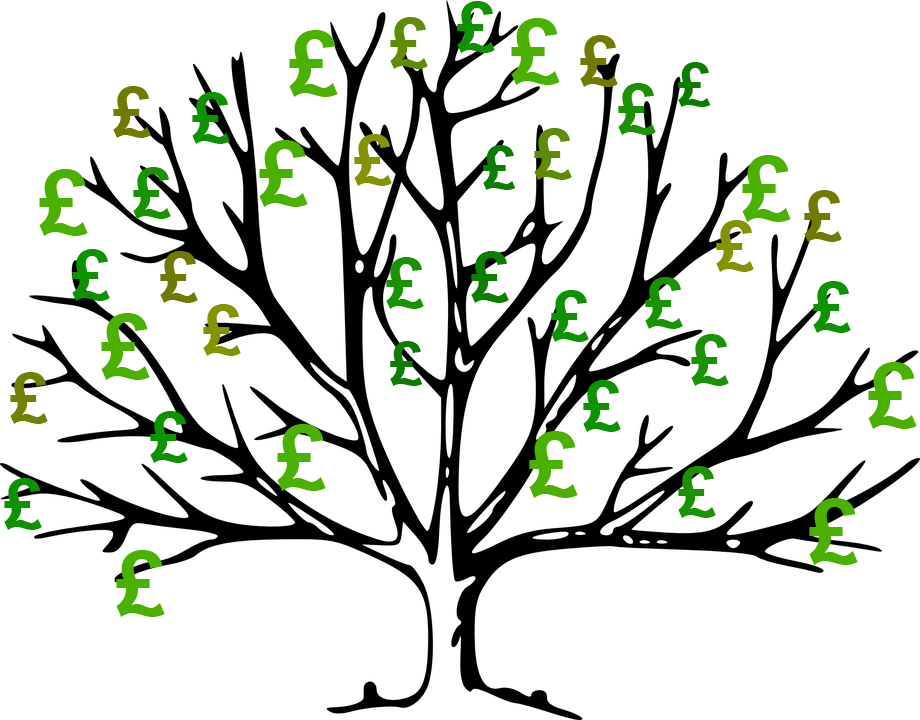 Is there a ‘magic money tree’? Is it desirable for central banks to create money to finance government deficits?
The standard thinking of conservative governments around the world is that creating money to finance deficits will be inflationary. Rather, governments should attempt to reduce deficits. This will reduce the problem of government expenditure crowding out private expenditure and reduce the burden placed on future generations of having to finance higher government debt.
If deficits rise because of government response to an emergency, such as supporting people and businesses during the Covid-19 pandemic, then, as soon as the problem begins to wane, governments should attempt to reduce the higher deficits by raising taxes or cutting government expenditure. This was the approach of many governments, including the Coalition and Conservative governments in the UK from 2010, as econommies began to recover from the 2007/8 financial crisis.
 ‘Modern Monetary Theory‘ challenges these arguments. Advocates of the theory support the use of higher deficits financed by monetary expansion if the money is spent on things that increase potential output as well as actual output. Examples include spending on R&D, education, infrastructure, health and housing.
Modern monetary theorists still accept that excess demand will lead to inflation. Governments should therefore avoid excessive deficits and central banks should avoid creating excessive amounts of money. But, they argue that inflation caused by excess demand has not been a problem for many years in most countries. Instead, we have a problem of too little investment and too little spending generally. There is plenty of scope, they maintain, for expanding demand. This, if carefully directed, can lead to productivity growth and an expansion of aggregate supply to match the rise in aggregate demand.
Government deficits, they argue, are not intrinsically bad. Government debt is someone else’s assets, whether in the form of government bonds, savings certificates, Treasury bills or other instruments. Provided the debt can be serviced at low interest rates, there is no problem for the government and the spending it generates can be managed to allow economies to function at near full capacity.
The following videos and articles look at modern monetary theory and assess its relevance. Not surprisingly, they differ in their support of the theory!
Videos
Articles
- Modern monetary theory: the rise of economists who say huge government debt is not a problem
The Conversation, John Whittaker (7/7/20)
- Modern Monetary Theory: How MMT is challenging the economic establishment
ABC News, Gareth Hutchens (20/7/20)
- What is Modern Monetary Theory and is it THE answer?
Sydney Morning Herald, Jessica Irvine (2/7/20)
- MMT: what is modern monetary theory and will it work?
MoneyWeek, Stuart Watkins (14/7/20)
- MMT: the magic money tree bears fruit
MoneyWeek, Stuart Watkins (17/7/20)
- Modern Monetary Theory is no Magic Money Tree
Adam Smith Institute, Matt Kilcoyne (20/5/20)
- “Modern Monetary Theory” Goes Mainstream
Forbes, Nathan Lewis (10/7/20)
- How Boris Johnson’s Conservatives have become Magic Money Tree huggers
The Scotsman, Bill Jamieson (16/7/20)
- Ignore the impacts of debt-fuelled stimulus at your peril
Livewire, David Rosenbloom (14/7/20)
- Modern Monetary Theory, explained
Vox.com, Dylan Matthews (16/4/19)
Questions
- Compare traditional Keynesian economics and modern monetary theory.
- Using the equation of exchange, MV = PY, what would a modern monetary theorist say about the effect of an expansion of M on the other variables?
- What is the role of fiscal policy in modern monetary theory?
- What evidence might suggest that money supply has been unduly restricted?
- When, according to modern monetary theory, is a rising government deficit (a) not a problem; (b) a problem?
- Is there any truth in the saying, ‘There’s no such thing as a magic money tree’?
- Provide a critique of modern monetary theory.
 Boris Johnson gave a speech on 30 June outlining his government’s approach to recovery from the sharpest recession on record. With the slogan ‘Build, build, build’, he said that infrastructure projects were the key to stimulating the economy. Infrastructure spending is a classic Keynesian response to recession as it stimulates aggregate demand allowing slack to be taken up, while also boosting aggregate supply, thereby allowing recovery in output while increasing potential national income.
A new ‘New deal’
He likened his approach to that of President Franklin D Roosevelt’s New Deal. This was a huge stimulus between 1933 and 1939 in an attempt to lift the US economy out of the Great Depression. There was a massive programme of government spending on construction projects, such as hospitals, schools, roads, bridges and dams, including the Hoover Dam and completing the 113-mile Overseas Highway connecting mainland Florida to the Florida Keys. Altogether, there were 34 599 projects, many large-scale. In addition, support was provided for people on low incomes, the unemployed, the elderly and farmers. Money supply was expanded, made possible by leaving the Gold Standard in 1934.
 There was some debate as to whether the New Deal could be classed as ‘Keynesian’. Officially, the administration was concerned to achieve a balanced budget. However, it had a separate ’emergency budget’, from which New Deal spending was financed. According to estimates by the Federal Reserve Bank of St Louis, the total extra spending amounted to nearly 40% of US GDP as it was in 1929.
By comparison with the New Deal, the proposals of the Johnson government are extremely modest. Mostly it amounts to bringing forward spending already committed. The total of £5 billion is just 0.2% of current UK GDP.
Focusing on jobs
A recent report published by the Resolution Foundation, titled ‘The Full Monty‘, argues that as the Job Retention Scheme, under which people have been furloughed on 80% pay, is withdrawn, so unemployment is set to rise dramatically. The claimant count has already risen from 1.2m to 2.8m between March and May with the furlough scheme in place.
 Policy should thus focus on job creation, especially in those sectors likely to experience the largest rise in unemployment. Such sectors include non-food retail, hospitality (pubs, restaurants, hotels, etc.), public transport, the arts, entertainment and leisure and a range of industries servicing these sectors. What is more, many of the people working in these sectors are young and low paid. Many will find it difficult to move to jobs elsewhere – partly because of a lack of qualifications and partly because of a lack of alternative jobs. The rising unemployment will raise inequality.
The Resolution Foundation report argues that policy should be focused specifically on job creation.
Policy makers should act now to minimise outflows from the hard-hit sectors – a wage subsidy scheme or a National Insurance cut in those sectors would reduce labour costs and discourage redundancies. Alongside this, the Government must pursue radical action to create jobs across the country, such as in social care and housing retrofitting, and ramp up support for the unemployed.
Dealing with hyteresis
The economy is set to recover somewhat as the lockdown is eased, but it is not expected to return to the situation before the pandemic. Many jobs will be lost permanently unless government support continues.
Even then, many firms will have closed and others will have reassessed how many workers they need to employ and whether less labour-intensive methods would be more profitable. They may take the opportunity to consider whether technology, such as AI, can replace labour; or they may prefer to employ cheap telecommuters from India or the Philippines rather than workers coming into the office.
Policies to stimulate recovery will need to take these hysteresis effects into account if unemployment is to fall back to pre-Covid rates.
Videos
Articles
- Coronavirus: Boris Johnson pledges ‘new deal’ to build post-virus
BBC News (30/6/20)
- Boris Johnson hails his economic plan as a new ‘New Deal.’ Try ‘small deal’ instead
MarketWatch, Pierre Briançon (30/6/20)
- Boris Johnson announces state-led post-coronavirus relaunch
Financial Times, George Parker, Jim Pickard and Chris Giles (30/6/20)
- How does Boris Johnson’s ‘new deal’ compare with Franklin D Roosevelt’s?
The Guardian, Richard Partington (30/6/20)
- Coronavirus: Ministers urged to stave off ‘second wave’ of unemployment with major job creation plan
PoliticsHome, Matt Honeycombe-Foster (29/6/20)
- Biggest job creation package in peacetime needed to deflect increase in UK unemployment, think tank reports
Independent, Alan Jones (29/6/20)
- UK needs ‘biggest-ever peacetime job creation plan’ to stop mass unemployment
The Guardian, Richard Partington (29/6/20)
- The International Labour Organization was founded after the Spanish flu – its past lights the path to a better future of work
The Conversation, Huw Thomas, Frederick Harry Pitts and Peter Turnbull (17/6/20)
- Seven charts on the coronavirus jobs market
BBC News, By Lora Jones and Daniele Palumbo (16/6/20)
- Covid, hysteresis, and the future of work
Vox, Richard Baldwin (29/5/20)
- The economy won’t snap back after Covid-19
Financial Times, Tim Harford (5/6/20)
- Addressing The Covid-19 Shock -Keeping People In Work And Businesses Afloat
Forbes, Linda Yueh (20/3/20)
- Cutting labour taxes brings back the jobs lost to COVID-19
Vox, Christian Bredemeier, Falko Juessen and Roland Winkler (28/6/20)
Report
Questions
- What are the arguments for and against substantial increased government expenditure on infrastructure projects?
- Should the UK government spend more or less on such projects than the amount already pledged? Justify your answer.
- What are the arguments for and against directing all extra government expenditure towards green projects?
- Look through the Resolution Foundation report and summarise the findings of each of its sections.
- What are the arguments for and against directing all extra government expenditure towards those sectors where there is the highest rate of job losses?
- What form could policies to protect employment take?
- How should the success of policies to generate employment be measured?
- What form does hysteresis play on the post-Covid-19 labour market? What four shocks mean that employment will not simply return to the pre-Covid situation?
