 Interest rates have been at record lows across the developed world since 2009. Interest rates were reduced to such levels in order to stimulate recovery from the financial crisis of 2007–8 and the resulting recession. The low interest rates were accompanied by extraordinary increases in money supply under various rounds of quantitative easing in the USA, UK, Japan and eventually the eurozone. But have such policies done harm?
This is the contention of Brian Sturgess in a new paper, published by the Centre for Policy Studies. He maintains that the policy has had a number of adverse effects:
|
|
| • |
There will be nothing left in the monetary policy armoury when the next downturn occurs other than even more QE, which will compound the following problems. |
| • |
It has had little effect in stimulating aggregate demand and economic growth. Instead the extra money has been used to repair balance sheets and support unprofitable businesses. |
| • |
It has inflated asset prices, especially shares and property, which has encouraged funds to flow to the secondary market rather than to funding new investment. |
| • |
The inflation of asset prices has benefited the already wealthy. |
| • |
By keeping interest rates down to virtually zero on savings accounts, it has punished small savers. |
| • |
By rewarding the rich and penalising small savers, it has contributed to greater inequality. |
| • |
By keeping interest rates down to borrowers, it has encouraged households to take on excessive amounts of debt, which will be hard to service if interest rates rise. |
| • |
It has lowered the price of risk, thereby encouraging more risky types of investment and the general misallocation of capital. |
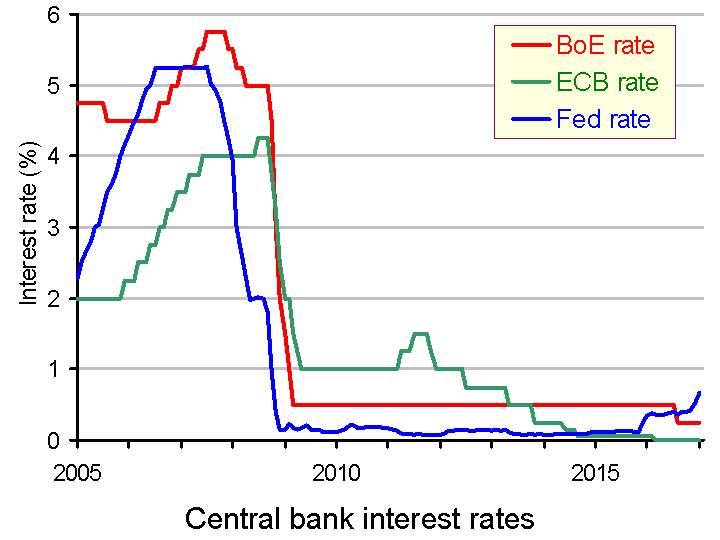 Sturgess argues that it is time to end the policy of low interest rates. Currently, in all the major developed economies, central bank rates are below the rate of inflation, making the real central bank interest rates negative.
He welcomes the two small increases by the Federal Reserve, but this should be followed by further rises, not just by the Fed, but by other central banks too. As Sturgess states in the paper (p.12):
In place of ever more extreme descents into the unknown, central banks should quickly renormalise monetary policy. That would involve ending QE and allowing interest rates to rise steadily so that interest rates can carry out their proper functions. Failure to do so will leave the global financial system vulnerable to potential shocks such as the failure of the euro, or the fiscal stresses in the US resulting from the unfinanced spending plans announced by Donald Trump in his presidential campaign.
Although Sturgess argues that the initial programmes of low interest rates and QE were a useful response to the financial crisis, he argues that they should have only been used as a short-term measure. However, if they were, and if interest rates had gone up within a few months, many argue that the global economy would rapidly have sunk back into recession. This has certainly been the position of central banks. Sturgess disagrees.
Articles
Damaging low interest rates and QE must end now, think thank warns The Telegraph, Julia Bradshaw (23/1/17)
QE has driven pension deficits up, think-tank argues Money Marketing, Justin Cash (23/1/17)
Hold: The ECB keeps interest rates and QE purchases steady as Mario Draghi defends loose policy from hawkish critics City A.M., Jasper Jolly (19/1/17)
Preparing for the Post-QE World Bloomberg, Jean-Michel Paul (12/10/16)
Paper
Stop Depending on the Kindness of Strangers: Low interest rates and the Global Economy Centre for Policy Studies, Brian Sturgess (23/1/17)
Questions
- Find out what the various rounds of quantitative easing have been in the USA, the UK, Japan and the eurozone.
- What are the arguments in favour of quantitative easing as it has been practised?
- How might interest rates close to zero result in the misallocation of capital?
- Sturgess claims that the existence of ‘spillover’ effects has had damaging effects on many emerging economies. What are these spillover effects and what damage have they done to such economies?
- How do low interest rates affect interest rate spreads?
- Have pensioners gained or lost from QE? Explain how the answer may vary between different pensioners.
- What is meant by a ‘natural’ or ‘neutral’ rate of interest (see section 3.2 in the paper)? Why, according to Janet Yellen (currently Federal Reserve Chair, writing in 2005), is this somewhere between 3.5% and 5.5% (in nominal terms)?
- What are the arguments for and against using created money to finance programmes of government infrastructure investment?
- Would helicopter money be more effective than QE via asset purchases in achieving faster economic growth? (See the blog posts: A flawed model of monetary policy and New UK monetary policy measures – somewhat short of the kitchen sink.)
- When QE comes to an end in various countries, what are the arguments for absorbing rather than selling the assets purchased by central banks? (See the Bloomberg article.)
 Many politicians throughout the world,
not just on the centre and left, are arguing for increased spending on infrastructure. This was one of the key proposals of Donald Trump during his election campaign. In his election manifesto he pledged to “Transform America’s crumbling infrastructure into a golden opportunity for accelerated economic growth and more rapid productivity gains”.
Increased spending on inffrastructure has both demand- and supply-side effects.
Unless matched by cuts elsewhere, such spending will increase aggregate demand and could have a high multiplier effect if most of the inputs are domestic. Also there could be accelerator effects as the projects may stimulate private investment.
On the supply side, well-targeted infrastructure spending can directly increase productivity and cut costs of logistics and communications.
The combination of the demand- and supply-side effects could increase both potential and actual output and reduce unemployment.
 So, if infrastructure projects can have such beneficial effects, why are politicians often so reluctant to give them the go-ahead?
Part of the problem is one of timing. The costs occur in the short run. These include demolition, construction and disruption. The direct benefits occur in the longer term, once the project is complete. And for complex projects this may be many years hence. It is true that demand-side benefits start to occur once construction has begun, but these benefits are widely dispersed and not easy to identify directly with the project.
Then there is the problem of externalities. The external costs of projects may include environmental costs and costs to local residents. This can lead to protests, public hearings and the need for detailed cost–benefit analysis. This can delay or even prevent projects from occurring.
The external benefits are to non-users of the project, such as a new bridge or bypass reducing congestion for users of existing routes. These make the private construction of many projects unprofitable, except with public subsidies or with public–private partnerships. So there does need to be a macroeconomic policy that favours publicly-funded infrastructure projects.
One type of investment that is less disruptive and can have shorter-term benefits is maintenance investment. Maintenance expenditure can avoid much more costly rebuilding expenditure later on. But this is often the first type of expenditure to be cut when public-sector budgets as squeezed, whether at the local or national level.
The problem of lack of infrastructure investment is very much a political problem. The politicians who give the go-ahead to such projects, such as high-speed rail, come in for criticisms from those bearing the short-run costs but they are gone from office once the benefits start to occur. They get the criticism but not the praise.
Articles
Are big infrastructure projects castles in the air or bridges to nowhere? The Economist, Buttonwood’s notebook (16/1/17)
Trump’s plans to rebuild America are misguided and harmful. This is how we should do it. The Washington Post, Lawrence H. Summers (17/1/17)
Questions
- Identify the types of externality from (a) a new high-speed rail line, (b) new hospitals.
- How is discounting relevant to decisions about public-sector projects?
- Why are governments often unwilling to undertake (a) new infrastructure projects, (b) maintenance projects?
- Is a programme of infrastructure investment necessarily a Keynesian policy?
- What accelerator effects would you expect from infrastructure investment?
- Explain the difference between the ‘spill-out’ and ‘pull-in’ effects of different types of public investments in a specific location. Is it possible for a project to have both effects?
- What answer would you give to the teacher who asked the following question of US Treasury Secretary, Larry Summers? “The paint is chipping off the walls of this school, not off the walls at McDonald’s or the movie theatre. So why should the kids believe this society thinks their education is the most important thing?”
- What is the ‘bridge to nowhere’ problem? Why does it occur and what are the solutions to it?
- Why is the ‘castles in the air’ element of private projects during a boom an example of the fallacy of composition?
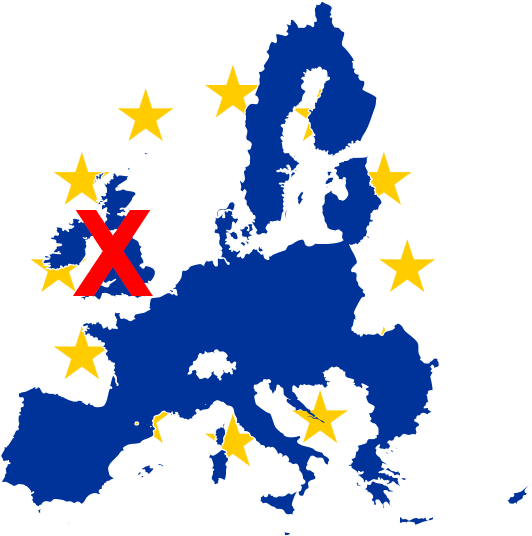 Theresa May has said that the UK will quit the EU single market and seek to negotiate new trade deals, both with the EU and with other countries. As she said, “What I am proposing cannot mean membership of the single market.” It would also mean leaving the customs union, which sets common external tariffs for goods imported into the EU.
The single market guarantees free movement of goods, services, labour and capital between EU members. There are no internal tariffs and common rules and regulations concerning products, production and trade. By leaving the single market, the UK will be able to restrict immigration from EU countries, as it is currently allowed to do from non-EU countries.
A customs union is a free trade area with common external tariffs and uniform methods of handling imports. There are also no, or only minimal, checks and other bureaucracies at borders between members. The EU customs union means that individual EU countries are not permitted to do separate trade deals with non-EU countries.
 Once the UK has left the EU, probably in around two years’ time, it will then be able to have different trade arrangements from the EU with countries outside the EU. Leaving the customs union would mean that the UK would face the EU’s common external tariff or around 5% on most goods, and 10% on cars.
Leaving the EU single market and customs union has been dubbed ‘hard Brexit’. Most businesses and many politicians had hoped that elements of the single market could be retained, such as tariff-free trade between the UK and the EU and free movement of capital. However, by leaving the single market, access to it will depend on the outcome of negotiations.
Negotiations will take place once Article 50 – the formal notice of leaving – has been invoked. The government has said that it will do this by the end of March this year. Then, under EU legislation, there will be up to two years of negotiations, at which point the UK will leave the EU.
The articles look at the nature of the EU single market and customs union and at the implications for the UK of leaving them.
Articles
Britain to leave EU market as May sets ‘hard Brexit’ course Reuters, Kylie MacLellan and William James (17/1/17)
Brexit: UK to leave single market, says Theresa May BBC News (17/1/17)
How Does U.K. Want to Trade With EU Post-Brexit?: QuickTake Q&A Bloomberg, Simon Kennedy (17/1/17)
Brexit at-a-glance: What we learned from Theresa May BBC News, Tom Moseley (17/1/17)
Theresa May unveils plan to quit EU single market under Brexit Financial Times, Henry Mance (17/1/17)
Doing Brexit the hard way The Economist (21/1/17)
Theresa May confirms it’ll be a hard Brexit – here’s what that means for trade The Conversation, Billy Melo Araujo (17/1/17)
How to read Theresa May’s Brexit speech The Conversation, Paul James Cardwell (17/1/17)
Theresa May’s hard Brexit hinges on a dated vision of global trade The Conversation, Martin Smith (17/1/17)
Brexit: What is the EU customs union and why should people care that the UK is leaving it? Independent, Ben Chapman (17/1/17)
Questions
- Explain the difference between a free-trade area, a customs union, a common market and a single market.
- What arrangement does Norway have with the EU?
- How would the UK’s future relationship with the EU differ from Norway’s?
- Distinguish between trade creation and trade diversion from joining a customs union. Who loses from trade diversion?
- Will leaving the EU mean that trade which was diverted can be reversed?
- What will determine the net benefits from new trade arrangements compared with the current situation of membership of the EU?
- What are the possible implications of hard Brexit for (a) inward investment and (b) companies currently in the UK of relocating to other parts of the EU? Why is the magnitude of such effects extremely hard to predict?
- Explain what is meant by ‘passporting rights’ for financial services firms. Why are they unlikely still to have such rights after Brexit?
- Discuss the argument put forward in The Conversation article that ‘Theresa May’s hard Brexit hinges on a dated vision of global trade’.
 Economic forecasting came in for much criticism at the time of the financial crisis and credit crunch. Few economists had predicted the crisis and its consequences. Even Queen Elizabeth II, on a visit to the London School of Economics in November 2008, asked why economists had got it so wrong. Similar criticisms have emerged since the Brexit vote, with economic forecasters being accused of being excessively pessimistic about the outcome.
The accuracy of economic forecasts was one of the topics discussed by Andy Haldane, Chief Economist at the Bank of England. Speaking at the Institute for Government in London, he compared economic forecasting to weather forecasting (see section from 15’20” in the webcast):
“Remember that? Michael Fish getting up: ‘There’s no hurricane coming but it will be very windy in Spain.’ Very similar to the sort of reports central banks – naming no names – issued pre-crisis, ‘There is no hurricane coming but it might be very windy in the sub-prime sector.” (18’40”)
The problem with the standard economic models which were used for forecasting is that they were essentially equilibrium models which work reasonably well in ‘normal’ times. But when there is a large shock to the economic system, they work much less well. First, the shocks themselves are hard to predict. For example, the sub-prime crisis in 2007/8 was not foreseen by most economists.
Then there is the effect of the shocks. Large shocks are much harder to model as they can trigger strong reactions by consumers and firms, and governments too. These reactions are often hugely affected by sentiment. Bouts of pessimism or even panic can grip markets, as happened in late 2008 with the collapse of Lehman Brothers. Markets can tumble way beyond what would be expected by a calm adjustment to a shock.
It can work the other way too. Economists generally predicted that the Brexit vote would lead to a fall in GDP. However, despite a large depreciation of sterling, consumer sentiment held up better than was expected and the economy kept growing.
 But is it fair to compare economic forecasting with weather forecasting? Weather forecasting is concerned with natural phenomena and only seeks to forecast with any accuracy a few days ahead. Economic forecasting, if used correctly, highlights the drivers of economic change, such as government policy or the Brexit vote, and their likely consequences, other things being equal. Given that economies are constantly being affected by economic shocks, including government or central bank actions, it is impossible to forecast the state of the macroeconomy with any accuracy.
This does not mean that forecasting is useless, as it can highlight the likely effects of policies and take into account the latest surveys of, say, consumer and business confidence. It can also give the most likely central forecast of the economy and the likely probabilities of variance from this central forecast. This is why many forecasts use ‘fan charts’: see, for example, Bank of England forecasts.
What economic forecasts cannot do is to predict the precise state of the economy in the future. However, they can be refined to take into account more realistic modelling, including the modelling of human behaviour, and more accurate data, including survey data. But, however refined they become, they can only ever give likely values for various economic variables or likely effects of policy measures.
Webcast
 Andy Haldane in Conversation Institute for Government (5/1/17)
Articles
‘Michael Fish’ Comments From Andy Haldane Pounced Upon By Brexit Supporters Huffington Post, Chris York (6/1/17)
Crash was economists’ ‘Michael Fish’ moment, says Andy Haldane BBC News (6/1/17)
The Bank’s ‘Michael Fish’ moment BBC News, Kamal Ahmed (6/1/17)
Bank of England’s Haldane admits crisis in economic forecasting Financial Times, Chris Giles (6/1/17)
Chief economist of Bank of England admits errors in Brexit forecasting BBC News, Phillip Inman (5/1/17)
Economists have completely failed us. They’re no better than Mystic Meg The Guardian, Simon Jenkins (6/1/17)
Five things economists can do to regain trust The Guardian, Katie Allen and Phillip Inman (6/1/17)
Andy Haldane: Bank of England has not changed view on negative impact of Brexit Independent, Ben Chu (5/1/17)
Big data could help economists avoid any more embarrassing Michael Fish moments Independent, Hamish McRae (7/1/17)
Questions
- In what ways does economic forecasting differ from weather forecasting?
- How might economic forecasting be improved?
- To what extent were the warnings of the Bank of England made before the Brexit vote justified? Did such warnings take into account actions that the Bank of England was likely to take?
- How is the UK economy likely to perform over the coming months? What assumptions are you making here?
- Brexit hasn’t happened yet. Why is it extremely difficult to forecast today what the effects of actually leaving the EU will be on the UK economy once it has happened?
- If economic forecasting is difficult and often inaccurate, should it be abandoned?
- The Bank of England is forecasting that inflation will rise in the coming months. Discuss reasons why this forecast is likely to prove correct and reasons why it may prove incorrect.
- How could economic forecasters take the possibility of a Trump victory into account when making forecasts six months ago of the state of the global economy a year or two ahead?
- How might the use of big data transform economic forecasting?
 Many or us make New Year’s resolutions: going on a diet, doing exercise, spending more time studying. But few people stick to them, even though they say they would like to. So how can people be motivated to keep to their resolutions? Well, the experiments of behavioural economists provide a number of insights into the problem. They also suggest various incentives that can be used to motivate people to stick to their plans.
Central to the problem is that people have ‘time inconsistency’. They put a higher weight on the benefits of things that are good for them in the future and less weight on these benefits when they have to act now. You might strongly believe that going to the gym is good for you and plan to go next Monday. But when Monday comes, you can’t face it.
Another part of the time inconsistency problem is the relatively high weighting given to short-term gratification – eating chocolates, watching TV, spending time on social media, staying in bed.  When thinking about whether you would like to do these things in, say, a couple of days’ time, you put a low weight on the pleasures. But thinking about doing them right now, you put a much higher weight on them. As the well-known saying goes, ‘Hard work often pays off after time, but laziness pays off now’.
So how can people be motivated to stick to their resolutions? Behavioural economists have studied various systems of incentives to see what works. Some of the findings are as follows:
|
|
| • |
People are generally loss averse. To get us to stick to New Year’s resolutions, we could devise a system of penalties for breaking them, such as paying 20p each time you swear! |
| • |
Given people’s time inconsistency, devising a system whereby you get treats after doing something you feel is good for you: e.g. watching TV for 30 minutes after you’ve done an hour’s revision. Rewards should follow effort, not precede them. |
| • |
Having simple clear goals. Thus rather than merely saying ‘I’ll eat less’, you devise a meal plan with menus that meet calorie and other dietary goals. Rather than saying, ‘I’ll exercise more’, you commit to going to the gym at specific times each week and doing a specific amount of each exercise. |
| • |
Ritualising. This is where you devise a regime that is feasible to stick to. For example, you could always write a shopping list to meet your dietary goals and then only buy what’s on that list; or you and your flatmates could have a rota for household chores. |
| • |
Social reinforcement. This is where people have a joint plan and help each other stick to it, such as going to the gym at specific times with a friend or group of friends, or joining a support group (e.g. to lose weight, or give up drinking or smoking). |
| • |
Avoiding temptation. For example, if you want to give up chocolate, don’t have any in the house. |
| • |
Using praise rather than criticism. People generally respond better to positive incentives than negative ones. |
Behavioural economists test these different incentive mechanisms to see what works best and then to see how they can be refined. The testing could be done experimentally, with volunteers being given different incentives and seeing how they respond. Alternatively, data could be collected on the effects of different incentive mechanisms that people have actually used, whether at home or at work.
 The advertising and marketing industry analyses consumer trends and how people respond to pricing, quality, display, packaging, advertising, etc. They want to understand human behaviour so that they can ‘direct’ it in their favour of their clients. Governments too are keen to find ways of encouraging people to do more of things that are good for them and less of things that are bad.
The UK government’s Behavioural Insights Team looks at ways people can be ‘nudged’ into changing their behaviour, see the blog A nudge in the right direction?
But back to New Year’s resolutions, have you made any? And, if so, have you thought about how you might stick to them? Have you thought about the incentives?
Podcast
Dan Ariely talks “Payoff” WUNC 91.5: North Carolina Public Radio, Dan Ariely talks to Frank Stasio (3/1/17)
Articles and blogs
50 New Year’s Resolution Ideas and how to Achieve Each of Them Lifehack, Ivan Dimitrijevic (31/12/16)
5 New Year’s Resolutions You Can Keep (With The Help Of Behavioral Science Research) Forbes, Carmen Nobel (3/1/17)
The science behind keeping your New Year’s resolutions BT, SNAP PA (30/12/15)
The Guardian view on New Year resolutions: fitter, happier, more productive The Guardian, Editorial (3/1/17)
The Behavioral Economics of Your New Year’s Resolutions The Daily Beast, Uri Gneezy (5/1/14)
The psychology of New Year’s resolution The Conversation, Mark Griffiths (1/1/16)
Apply Behavioral Economics for a Better New Year Wharton Blog Network, William Hartje (16/1/14)
The Kardashians Can Help Your New Year’s Resolutions Huffington Post, John Beeby (29/12/16)
Using economics to score with New Year resolutions The Hindu, Venky Vembu (4/1/17)
Be It Resolved The New York Times, John Tierney (5/1/12)
Goal-setting site
stickK ‘Set your goals and achieve them!’
Questions
- Explain what is meant by time inconsistent behaviour. Is this the same as giving future costs and benefits a lower weighting than present ones (and hence having to discount future costs and benefits)?
- Give some examples of ways in which your own behaviour exhibits time inconsistency. Would it be accurate to describe this as ‘present bias’?
- Would you describe not sticking to New Year’s resolutions as ‘irrational behaviour’?
- Have you made any New Year’s resolutions, or do you have any plans to achieve goals? Could you alter your own personal incentives and, if so, how, to make it more likely that you will stick to your resolutions/goals?
- Give some examples of ways in which the government could ‘nudge’ us to behave in ways that were more in our own individual interests or those of society or the environment?
- Do you think it’s desirable that the advertising industry should employ psychologists and behavioural economists to help it achieve its goals?