 Is too much expected of economists? When economic forecasts turn out to be wrong, as they often are, economists are criticised for having inaccurate or unrealistic models. But is this a fair criticism?
The following article by Richard Whittle from Manchester Metropolitan University looks at what economists can and cannot do. The article highlights two key problems for economic forecasting.
The first concerns human behaviour, which is influenced by a whole range of factors and can change very rapidly in response to changing circumstances. Moods of optimism or pessimism can quickly spread in response to a news item, such as measures announced by Donald Trump or latest data on growth or the housing market.
The second concerns the whole range of possible economic shocks. Such shocks, by their very nature, are hard to predict and can quickly make forecasts wrong. They could be a surprise election result, a surprise government policy change, a natural disaster, a war or a series of terrorist attacks. And these shocks, in turn, affect human behaviour. Consumption and investment may rise or fall as the events affect confidence and herd behaviour.
But is it a fair criticism of economics that it cannot foretell the future? Do economists, as the article says, throw up their hands and curse economics as a futile endeavour? Not surprisingly, the answer given is no! The author gives an analogy with medicine.
A doctor cannot definitely prevent illness, but can offer advice on prevention and hopefully offer a cure if you do get ill. This is the same for the work economists do.
Economists can offer advice on preventing crises or slowdowns but cannot definitively prevent them from happening. Economists can also offer robust advice on restoring growth, although when the advice is that the economy has grown too fast and should slow, it is often not welcomed by policy makers.
Helping understanding the various drivers in an economy and how humans are likely to respond to various incentives is a key part of what economists do. But making predictions with 100% certainty is asking too much of economists.
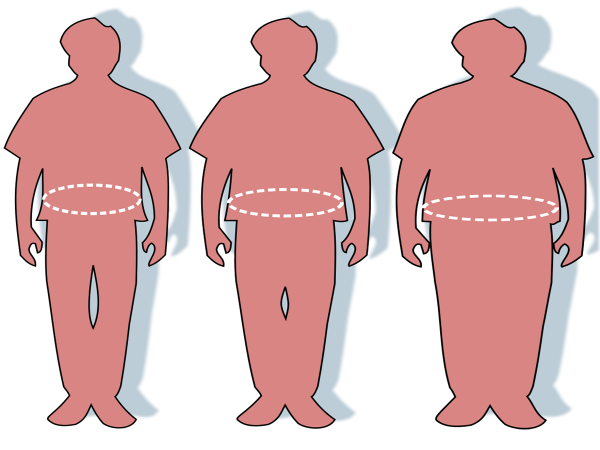 And just as medical professionals can predict that if you smoke, eat unhealthy food or take no exercise you are likely to be less healthy and die younger, but cannot say precisely when an individual will die, so too economists can predict that certain policy measures are likely to increase or decrease GDP or employment or inflation, but they cannot say precisely how much they will be affected.
As the article says, “the true value of the economist lies not in mystical fortune telling, but in achieving a better understanding of the nature of the economies in which we live and work.”
Article
How to be an economist in 2017 The Conversation, Richard Whittle (24/1/17)
Questions
- For what reasons has economics been ‘in crisis’? What is the solution to this crisis?
- Look at some macroeconomic forecasts for a country of your choice made two years ago for today (see, for example, forecasts made by the IMF, OECD or a central bank). How accurate were they? Explain any inaccuracies.
- To what extent is economic forecasting like weather forecasting?
- What is meant by cumulative causation? Give some examples. Why does cumulative causation make economic forecasting difficult?
- How is the increased usage of contactless card payments likely to affect spending patterns? Explain why.
- Why is it difficult to forecast the effects of Brexit?
- How can economic advisors help governments in designing policy?
- Why do people tend to overweight high probabilities and underweight low ones?
 In the light of the Brexit vote and the government’s position that the UK will leave the single market and customs union, there has been much discussion of the need for the UK to achieve trade deals. Indeed, a UK-US trade deal was one of the key issues on Theresa May’s agenda when she met Donald Trump just a week after his inauguration.
But what forms can a trade deal take? What does achieving one entail? What are likely to be the various effects on different industries – who will be the winners and losers? And what role does comparative advantage play? The articles below examine these questions.
Given that up until Brexit, the UK already has free trade with the rest of the EU, there is a lot to lose if barriers are erected when the UK leaves. In the meantime, it is vital to start negotiating new trade deals, a process that can be extremely difficult and time-consuming.
A far as new trade arrangements with the EU are concerned, these cannot be agreed until after the UK leaves the EU, in approximately two years’ time, although the government is keen that preliminary discussions take place as soon as Article 50 is triggered, which the government plans to do by the end of March.
Articles
Trade deals are difficult to negotiate and Britain lacks the skills for the job The Conversation, Nigel Driffield (27/1/17)
Why a U.S.-U.K. Trade Deal Could be Harder than it Sounds Newsweek, Josh Lowe (26/1/17)
UK-US trade deal will have ‘very small upsides’ for Britain, says former Bank of England economist Independent, Rob Merrick (26/1/17)
Trump says he wants a U.K. trade deal. Don’t hold your breath CNN Money, Alanna Petroff (23/1/16)
Reality Check: Can there be a quick UK-USA trade deal? BBC News, Jonty Bloom (16/1/17)
Questions
- What elements would be included in a UK-US trade deal?
- Explain the gains from trade that can result from exploiting comparative advantage.
- Explain the statement in the article that allowing trade to be determined by comparative advantage is ‘often politically unacceptable, as governments generally look to protect jobs and tax revenues, as well as to protect activities that fund innovation’.
- Why is it difficult to work out in advance the likely effects on trade of a trade deal?
- What would be the benefits and costs to the UK of allowing all countries’ imports into the UK tariff free?
- What are meant by ‘trade creation’ and ‘trade diversion’? What determines the extent to which a trade deal will result in trade creation or trade diversion?
 GDP is often used as a measure of wellbeing, even though it is really only a measure of the market value of a nation’s output or an indicator of economic activity. But although higher consumption can improve living standards, it is only one contributor to wellbeing, whether at individual or social level.
There are essentially four types of problems from using GDP as a measure of how society is doing.
The first is that it does not include (as negative figures) many external costs, such as pollution, stress and family breakdown related to work.
The second is that it includes things that are produced to counteract the adverse effects of increased production, such as security, antidepressants, therapy and clean-up activities.
The third is that it ignores things that are produced and do contribute to wellbeing and yet are not traded in the market. Examples include volunteer work, the ‘output’ of clubs and societies, work within the home, production from allotments and various activities taking place in the ‘underground economy’ to avoid taxation.
 The fourth is the sustainability of economic growth. If we deplete natural resources, the growth of today may be at the cost of the wellbeing of future generations.
Then there is the question of the distribution of the benefits of production. Although GDP figures can be adjusted for distribution, crude GDP growth figures are not. If a few wealthy get a lot richer and the majority do not, or even get poorer, a growth in GDP will not signify a growth in wellbeing of the majority.
Then there is the question of the diminishing marginal utility of income. If an extra pound to a rich person gives less additional wellbeing than an extra pound to a poor person, then any given growth rate accompanied by an increase in inequality will contribute less to wellbeing than the same growth rate accompanied by a decrease in inequality.
The first article below criticises the use of crude indicators, such as the growth in GDP or stock market prices to signify wellbeing. It also looks at some alternative indicators that can capture some of the contributions to wellbeing missed by GDP figures.
Articles
Want to know how society’s doing? Forget GDP – try these alternatives The Guardian, Mark Rice-Oxley (27/1/17)
The Increasingly Inadequate Measurement Of Productivity The Market Mogul, Chris Woods (20/1/17)
Why GDP fails as a measure of well-being CBS News, Mark Thoma (27/1/16)
Limitations of GDP as Welfare Indicator The Sceptical Economist, zielonygrzyb (31/7/12)
Questions
- Should GDP be abandoned as an indicator?
- How could GDP be refined to capture more of the factors affecting wellbeing?
- Go through each of the indicators discussed in the first article above and consider their suitability as an indicator of wellbeing.
- “Everywhere you look, there are better benchmarks than these tired old financial yardsticks.” Identify three such indicators not considered in the first article and discuss their suitability as measures of economic performance.
- How might the benefit you gain from free apps be captured?
- Consider the suitability of these alternatives to GDP.
 The government has launched its promised industrial strategy by publishing a Green Paper which details the measures the government plans to take. This represents a move away from a laissez-faire approach to business and a move towards greater intervention.
There are 10 elements or ‘pillars’ of the policy. These include investing in science and technology, skills training and infrastructure – energy, transport, digital and water. They also include support to businesses, developing local institutions and encouraging trade and inward investment.
The drivers of the policy are planned to be a mixture of financial support, government procurement, new structures or organisations and laws and regulations. Details will be fleshed out in the coming months as the policy is enacted.
Reactions to the announcement have been mixed. An industrial policy is generally seen as an important element for improving the supply side of the economy by improving productivity and encouraging capacity growth. However, much of the criticism of the policy is that it does not go far enough. The following articles assess the policy – both its design and likely success.
Articles
Theresa May’s long-awaited “industrial strategy” looks a bit thin The Economist (28/1/17)
Factbox: The 10 pillars of Britain’s Modern Industrial Strategy Reuters, William James (23/1/17)
Theresa May give details of action plan for British industry BBC News (23/1/17)
Industry plan is break with ‘laissez-faire’ approach of the past Sky News, Ian King (23/1/17)
Skills and infrastructure top priority in industrial strategy, say UK firms The Guardian, Graham Ruddick (21/1/17)
The Guardian view on industrial strategy: hot air but no liftoff The Guardian (23/1/17)
The industrial strategy acknowledges a fundamental truth about growth New Statesman, Michael Jacobs (23/1/17)
European bosses underwhelmed by UK industrial revival plan Reuters, Ludwig Burger (27/1/17)
Is the UK finally getting serious about industrial strategy? Economia, David Bailey (25/1/17)
Government policy documents
Building our Industrial Strategy: Our 10 pillars HM Government (23/1/17)
Building our Industrial Strategy: Green Paper HM Government (23/1/17)
Questions
- Distinguish between interventionist and market-orientated supply-side policy. In terms of this distinction, how would you categorise the UK government’s industrial strategy?
- How will the strategy address the UK’s productivity puzzle?
- Go through each of the 10 pillars and assess how they will help to address weaknesses in the UK economy.
- How can government ‘missions’ to address major social challenges help to drive innovation? (See New Statesman article above.)
- How may Brexit help or hinder the government’s industrial strategy?
- The Economist article describes the strategy as looking thin. Do you agree?
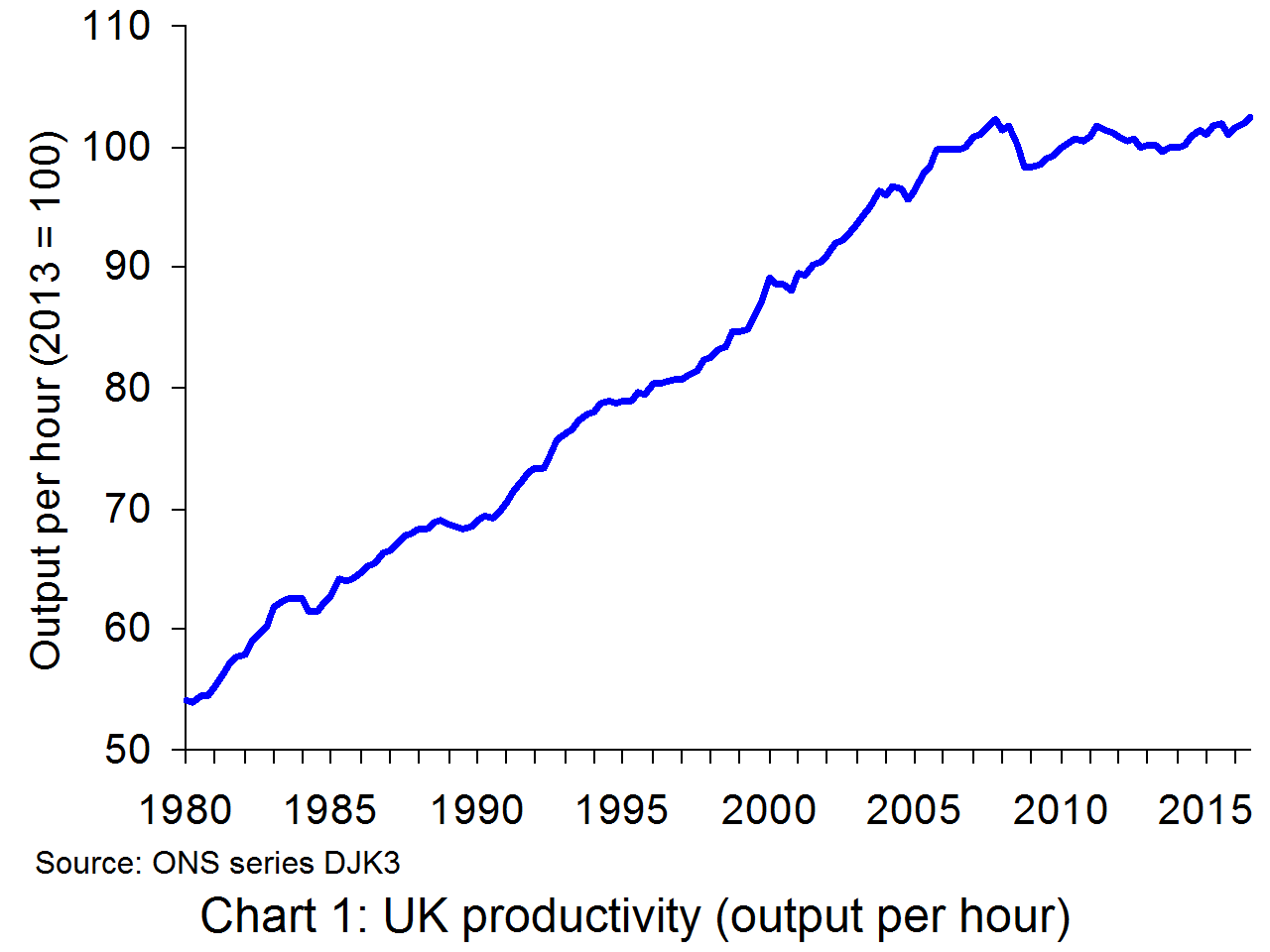 UK productivity growth remains well below levels recorded before the financial crisis, as Chart 1 illustrates. In fact, output per hour worked in 2016 Q3 was virtually the same as in 2007 Q4. What is more, as can be seen from Chart 2, UK productivity lags well behind its major competitors (except for Japan).
But why does UK productivity lag behind other countries 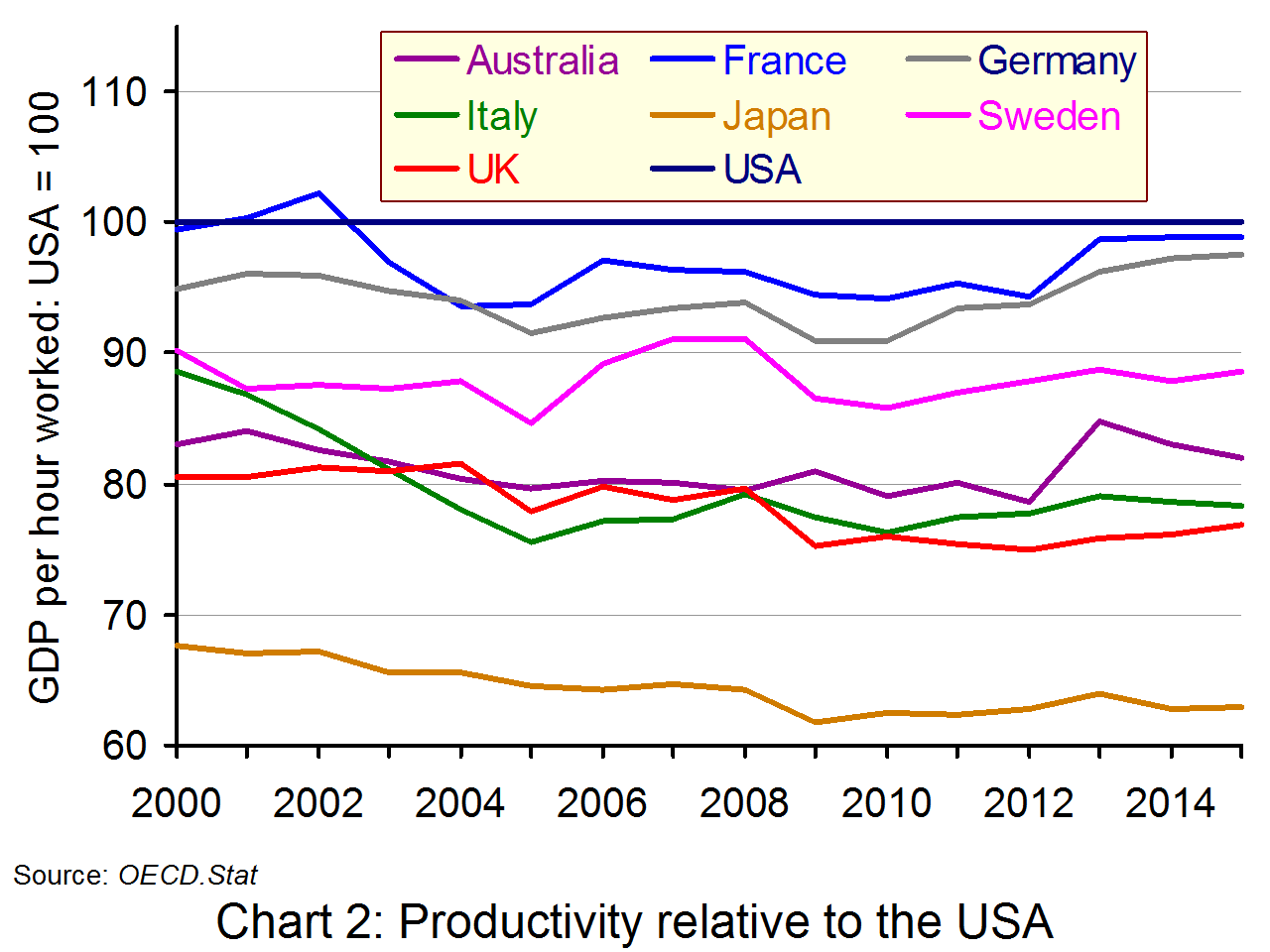 and why has it grown so slowly since the financial crisis? In its July 2015 analysis, the ONS addressed this ‘productivity puzzle’.
Among the many reasons suggested are low levels of investment, the impact of the financial crisis on bank’s willingness to lend to new businesses, higher numbers of people working beyond normal retirement age as a result of population and pensions changes, and firms’ ability to retain staff because of low pay growth. While these and other factors may be relevant, they do not provide a complete explanation for the weakness in productivity.
The lack of investment in technology and lack of infrastructure investment have been key reasons for the sluggish growth in productivity. Many companies are prepared to continue using relatively labour-intensive techniques because wage growth has been so low and this reduces the incentive to invest in labour-saving technology.
Another factor has been long hours and, for many office workers, being constantly connected to their work, checking and responding to emails and messages away from the office. The Telegraph article below reports Ann Francke, chief executive of the Chartered Management Institute, as saying:
“This is having a deleterious effect on the health of managers, which has a direct impact on productivity. UK workers already have the longest hours in Europe and yet we’re less productive.”
Another problem has been ultra low interest rates, which have reduced the burden of debt for poor performing companies and has allowed them to survive. It may also have prevented finance from being reallocated to more dynamic companies which would like to develop new products and processes.
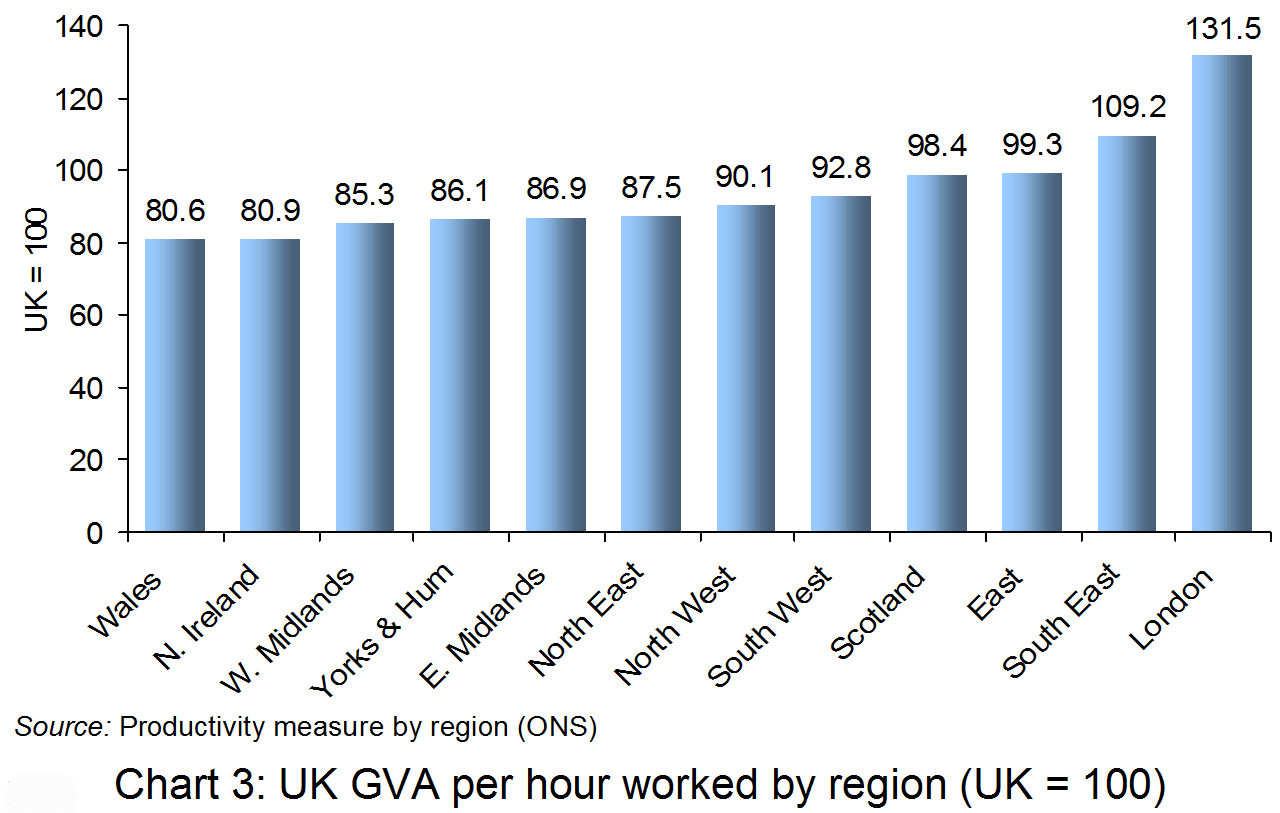
Another feature of UK productivity is the large differences between regions. This is illustrated in Chart 3. Productivity in London in 2015 (the latest full year for data) was 31.5% above the UK average, while that in Wales was 19.4% below.
This again reflects investment patterns and also the concentration of industries in particular locations. Thus London’s financial sector, a major part of London’s economy, has experienced relatively large increases in productivity and this has helped to push productivity growth in the capital well above other parts of the country.
Another factor, which again has a regional dimension, is the poor productivity performance of family-owned businesses, where ownership and management is passed down the generations within the family without bringing in external managerial expertise.
The government is very aware of the UK’s weak productivity performance. Its recently launched industrial policy is designed to address the problem. We look at that in a separate post.
Articles
UK productivity edges up but growth still flounders below pre-crisis levels The Telegraph, Julia Bradshaw (6/1/17)
Weak UK productivity spurs warnings of living standards squeeze The Guardian, Katie Allen (6/1/17)
Productivity gap yawns across the UK BBC News, Jonty Bloom (6/1/17)
The UK productivity puzzle Fund Strategy. John Redwood (26/1/17)
Productivity puzzle remains for economists despite UK growth in third quarter of 2016 City A.M., Jasper Jolly (6/1/17)
Portal site
Solve the Productivity Puzzle Unipart
Report
Productivity: no puzzle about it TUC (Feb 2015)
Data
Labour Productivity: Tables 1 to 10 and R1 ONS (6/1/17)
International comparisons of UK productivity (ICP) ONS (6/10/16)
Gross capital formation (% of GDP) The World Bank
Questions
- In measuring productivity, the ONS uses three indicators: output per worker, output per hour and output per job. Compare the relative usefulness of these three measures of productivity.
- How would you explain the marked difference in productivity between regions and cities within the UK?
- How do flexible labour markets impact on productivity?
- Why is investment as a percentage of GDP so low in the UK compared to that in most other developed countries (see)?
- Give some examples of industrial policy measures that could be adopted to increase productivity growth.
- Examine the extent to which very low interest rates and quantitative easing encourage productivity-enhancing investment.