 The Prudential Regulation Authority is the new UK authority in charge of banking regulation and is part of the Bank of England. In a report published on 20/6/13, the PRA found that UK banks had a capital shortfall of £27.1 billion (see Chart 1 below for details) if they were to meet the 7% common equity tier 1 (CET1) ratio: one of the capital adequacy ratios (CARs) specified under the Basel III rules (see Rebuilding UK banks: not easy to do and Chart 2 below).
CET1 includes bank reserves and ordinary share capital (‘equities’). To derive the CET1 ratio, CET1 is expressed as a percentage of risk-weighted assets. As Economics for Business (6th ed) page 467 states:
Risk-weighted assets are the total value of assets, where each type of asset is multiplied by a risk factor. …Cash and government bonds have a risk factor of zero and are thus not included. Inter-bank lending between the major banks has a risk factor of 0.2 and is thus included at only 20 per cent of its value; residential mortgages have a risk factor of 0.35; personal loans, credit-card debt and overdrafts have a risk factor of 1; loans to companies carry a risk factor of 0.2, 0.5, 1 or 1.5, depending on the credit rating of the company. Thus the greater the average risk factor of a bank’s assets, the greater will be the value of its risk weighted assets, and the lower will be its CAR.
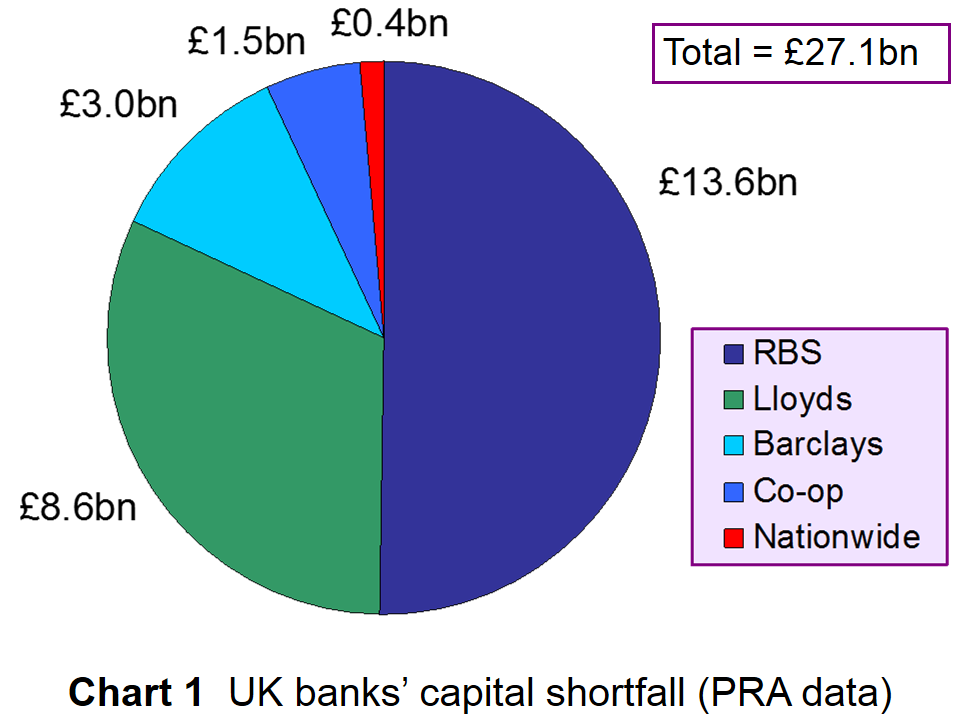 The data published by the PRA, based on end-2012 figures, show that the RBS group is responsible for around 50% of the capital shortfall, the Lloyds Banking Group around 32%, Barclays around 11%, the Co-operative around 5.5% and Nationwide the remaining 1.5%. HSBC, Santander and Standard Chartered met the 7% requirement. The PRA found that banks already were taking measures to raise £13.7bn, but this still leaves them requiring an additional £13.4 for current levels of lending.
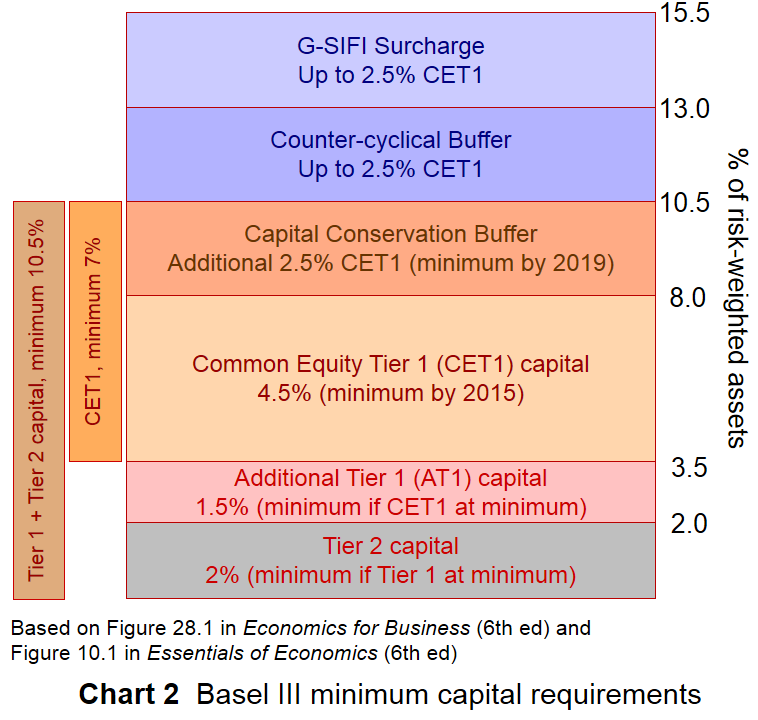 So what can the banks do? They must either raise additional capital (the numerator in the CAR) or reduce their risk-weighted assets (the denominator). Banks hope to be able to raise additional capital. For example, Lloyds is planning to sell government securities and US mortgage-backed securities and hopes to have a CET1 ratio of around 10% by the end of 2013. Generally, the banks aim to raise the required level of capital through income generation, the sale of assets and restructuring, rather than from issuing new shares.
What both the Bank of England and the government hope is that banks do not respond by reducing lending. While that might enable them to meet the 7% ratio, it would have an undesirable dampening effect on the economy – just at a time when it is hoped that the economy is starting to recover. As Robert Peston states:
I understand that both Barclays and Nationwide feel a bit miffed about being forced to hit this tough so-called leverage ratio at this juncture, because they are rare in that they have been supporting economic recovery by increasing their net lending.
They now feel they are being penalised for doing what the government wants. So I would expect there to be something of a spat between government and regulators about all this.
Articles
Factbox – Capital shortfalls for five UK banks, mutuals Standard Chartered News (20/6/13)
UK banks ordered to plug £27.1bn capital shortfall The Guardian, Jill Treanor (20/6/13)
Barclays, Co-op, Nationwide, RBS and Lloyds responsible for higher-than-expected capital shortfall of £27.1bn The Telegraph, Harry Wilson (20/6/13)
UK banks need to plug £27bn capital hole, says PRA BBC News (20/6/13)
Barclays and Nationwide forced to strengthen BBC News, Robert Peston (20/6/13)
Five Banks Must Raise $21 Billion in Fresh Capital: BOE Bloomberg, Ben Moshinsky (20/6/13)
Will Nationwide be forced to become a bank? BBC News, Robert Peston (4/7/13)
PRA news release and data
Prudential Regulation Authority (PRA) completes capital shortfall exercise with major UK banks and building societies Bank of England: Prudential Regulation Authority (20/6/13)
Questions
- Explain what are meant by the various Basel III capital adequacy requirements
- What are the banks which were identified as having a capital shortfall doing about it?
- Would it be desirable for banks to issue additional shares? Would this make the banks more secure?
- Would the raising of additional capital allow additional credit creation to take place? Explain.
- What other constraints are there on bank lending?
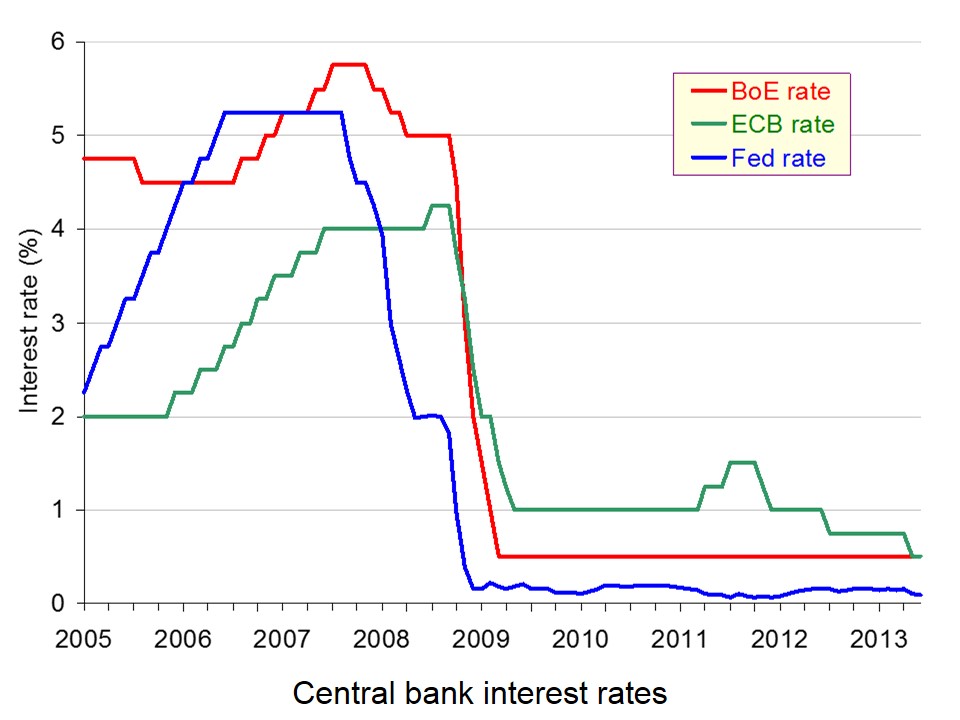 Since the beginning of 2009, central banks around the world have operated an extremely loose monetary policy. Their interest rates have been close to zero (click here for a PowerPoint of the chart) and more than $20 trillion of extra money has been injected into the world economy through various programmes of quantitative easing.
The most recent example of loose monetary policy has been in Japan, where substantial quantitative easing has been the first of Japan’s three arrows to revive the economy (the other two being fiscal policy and supply-side policy).
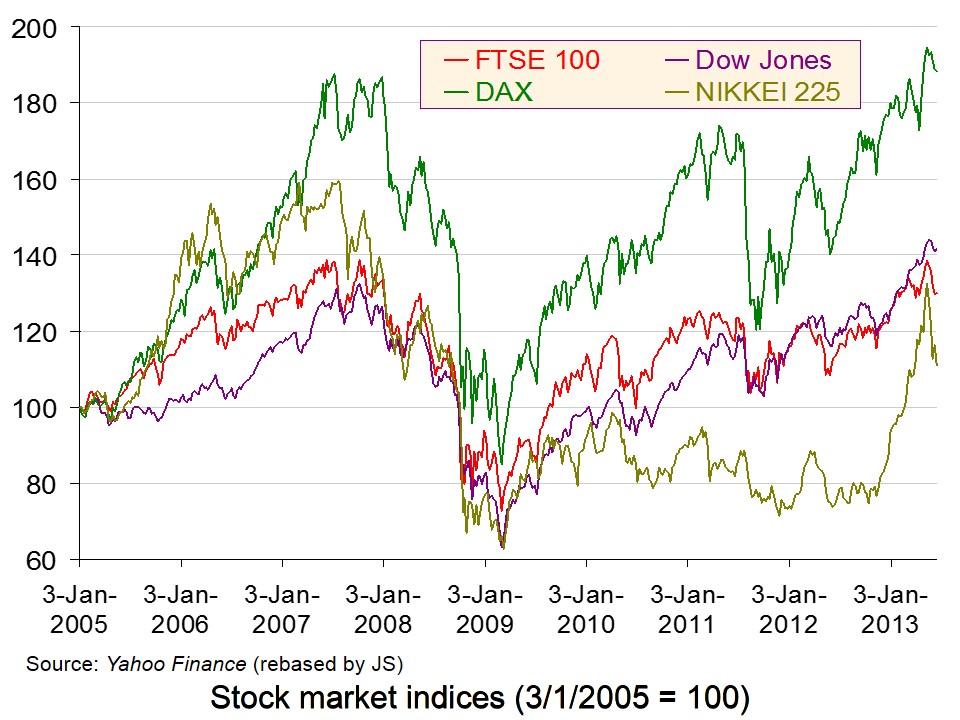 One consequence of a rise in money supply has been the purchase of a range of financial assets, including shares, bonds and commodities. As a result, despite the sluggish or negative growth in most developed countries, stock markets have soared (see chart). From March 2009 to May 2013, the FTSE 100 rose by 91% and both the USA’s Dow Jones Industrial average and Germany’s DAX rose by 129%. Japan’s NIKKEI 225, while changing little from 2009 to 2012, rose by 78% from November 2012 to May 2013 (click here for a PowerPoint of the chart).
The US economy has been showing stronger growth in recent months and, as a result, the Fed has indicated that it may soon have to begin tightening monetary policy. It is not doing so yet, nor are other central banks, but the concern that this may happen in the medium term has been enough to persuade many investors that stock markets are likely to fall as money eventually becomes tighter. Given the high degree of speculation on stock markets, this has led to a large-scale selling of shares as investors try to ‘get ahead of the curve’.
From mid-May to mid-June, the FTSE 100 fell by 6.2%, the Dow Jones by 2.6%, the DAX by 4.5% and the NIKKEI by 15%. In some developing countries, the falls have been steeper as the cheap money that entered their economies in search of higher returns has been leaving. The falls in their stock markets have been accompanied by falls in their exchange rates.
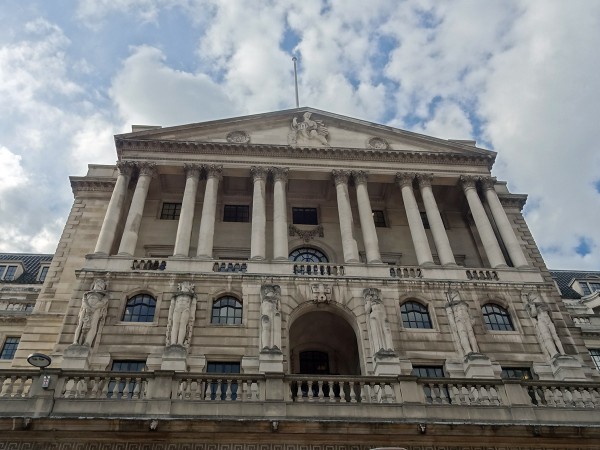 The core of the problem is that most of the extra money that was created by central banks has been used for asset purchase, rather than in financing extra consumer expenditure or capital investment. If money is tightened, it is possible that not only will stock and bond markets fall, but the fragile recovery may be stifled. In other words, tighter money and higher interest rates may indeed affect the real economy, even though loose monetary policy and record low interest rates had only a very modest effect on the real economy.
This poses a very difficult question for central banks. If even the possibility of monetary tightening some time in the future has spooked markets and may rebound on the real economy, does that compel central banks to maintain their loose policy? If it does, will this create an even bigger adjustment problem in the future? Or could there be a ‘soft landing’, whereby real growth absorbs the extra money and gradually eases the inflationary pressure on asset markets?
Articles
How the Fed bosses all BBC News, Robert Peston (12/6/13)
The great reversal? Is the era of cheap money ending? BBC News, Linda Yueh (12/6/13)
The Great Reversal: Part II (volatility and the real economy) BBC News, Linda Yueh (14/6/13)
The end of the affair The Economist (15/6/13)
Out of favour The Economist, Buttonwood (8/6/13)
The Federal Reserve: Clearer, but less cuddly The Economist (22/6/13)
Global financial markets anxious to avoid many pitfalls of ‘political risk’ The Guardian, Heather Stewart (13/6/13)
Dow Falls Below 15,000; Retailers Add to Slump New York Times, (12/6/13)
Global market sell-off over stimulus fears The Telegraph, Rachel Cooper (13/6/13)
Nikkei sinks over 800 points, falls into bear market Globe and Mail (Canada), Lisa Twaronite (13/6/13)
Global shares drop, dollar slumps as rout gathers pace Reuters, Marc Jones (13/6/13)
The G8, the bond bubble and emerging threats BBC News, Stephanie Flanders (17/6/13)
Global monetary policy and the Fed: vive la difference BBC News, Stephanie Flanders (20/6/13)
The Federal Reserve’s dysfunctional relationship with the markets The Guardian, Heidi Moore (19/6/13)
Global stock markets in steep falls after Fed comment BBC News (20/6/13)
Federal Reserve’s QE withdrawal could signal real trouble ahead The Guardian, Nils Pratley (20/6/13)
Central banks told to head for exit Financial Times, Claire Jones (23/6/13)
Stimulating growth threatens stability, central banks warn The Guardian (23/6/13)
BIS Press Release and Report
Making the most of borrowed time: repair and reform the only way to growth, says BIS in 83rd Annual Report BIS Press Release (23/6/13)
83rd BIS Annual Report 2012/2013 Bank for International Settlements (23/6/13)
Data
Yahoo! Finance: see links for FTSE 100, DAX, Dow Jones, NIKKEI 225
Link to central bank websites Bank for International Settlements
Statistical Interactive Database – Interest & exchange rates data Bank of England
Questions
- Why have stock markets soared in recent years despite the lack of economic growth?
- What is meant by ‘overshooting’? Has overshooting taken place in stock markets (a) up to mid-May this year; (b) since mid-May? How would you establish whether overshooting has taken place?
- What role is speculation currently playing in stock markets? Would you describe this speculation as destabilising?
- What has been the impact of quantitative easing on (a) bond prices; (b) bond yields?
- Argue the case for and against central banks continuing with the policy of quantitative easing for the time being.
- Find out how much the Indian rupee and the Brazilian real have fallen in recent weeks. Explain your findings.
 The UK electricity supply market is an oligopoly. Over 95% of the market is supplied by the ‘big six’: British Gas (Centrica), EDF Energy, E.ON, npower (RWE), Scottish Power (Iberdrola) and SSE. The big six also generate much of the electricity they supply; they are vertically integrated companies. Between them they generate nearly 80% of the country’s electricity. There are a further two large generators, Drax Power Limited and GDF Suez Energy UK, making the generation industry an oligopoly of eight key players.
Ofgem, the energy market regulator, has just published a report on the wholesale electricity market, arguing that it is insufficiently liquid. This, argues the report, acts as a barrier to entry to competitor suppliers. It thus proposes measures to increase liquidity and thereby increase effective competition. Liquidity, according to the report, is:
… the ability to quickly buy or sell a commodity without causing a significant change in its price and without incurring significant transaction costs. It is a key feature of a well-functioning market. A liquid market can also be thought of as a ‘deep’ market where there are a number of prices quoted at which firms are prepared to trade a product. This gives firms confidence that they can trade when needed and will not move the price substantially when they do so.
 A liquid wholesale electricity market ensures that electricity products are available to trade, and that their prices are robust. These products and price signals are important for electricity generators and suppliers, who need to trade to manage their risks. Liquidity in the wholesale electricity mark et therefore supports competition in generation and supply, which has benefits for consumers in terms of downward pressure on bills, better service and greater choice.
So how can liquidity be increased? Ofgem is proposing that the big six publish prices for two years ahead at which they are contracting to purchase electricity from generators in long-term contracts. These bilateral deals with generators are often with their own company’s generating arm. Publishing prices in this way will allow smaller suppliers to be able to seek out market opportunities. The generating companies will not be allowed to refuse to contract to supply smaller companies at the prices they are being forced to publish.
In addition, Ofgem is proposing that generators would have to sell 20% of output in the open market instead of through bilateral deals. As it is, however, some 30% of output is currently auctioned on the wholesale spot market (i.e. the market for immediate use).
But it is pricing transparency plus small suppliers being able to gain access to longer-term contracts that are the two key elements of the proposed reform.
Articles
UK utilities face having to disclose long-term deals Reuters, Karolin Schaps and Rosalba O’Brien (12/6/13)
Ofgem set to ‘break stranglehold’ in the energy market BBC News, John Moylan (12/6/13)
 Ofgem plan ‘to end energy stranglehold’ BBC Today Programme, John Moylan and Ian Marlee (12/6/13)
Ofgem outlines proposals to ‘break stranglehold’ of big six energy suppliers on electricity market The Telegraph (12/6/13)
Ofgem widens investigation into alleged rigging of gas and power markets The Guardian, Terry Macalister (6/6/13)
Ofgem moves to break stranglehold of ‘big six’ energy suppliers Financial Times, Guy Chazan (12/6/13)
Ofgem to crackdown on Big Six energy suppliers in bid to cut electricity prices Independent, Simon Read (12/6/13)
Reports and data
Opening up Electricity Market to Effective Competition Ofgem Press Release (12/6/13)
Wholesale power market liquidity: final proposals for a ‘Secure and Promote’ licence condition – Draft Impact Assessment Ofgem (12/6/13)
Electricity statistics Department of Energy & Climate Change
The Dirty Half Dozen Friends of the Earth (Oct 2011)
Questions
- What barriers to entry exist in (a) the wholesale and (b) the retail market for electricity?
- Distinguish between spot and forward markets. Why is competition in forward markets particularly important for small suppliers of electricity?
- How will ‘liquidity’ be increased by the measures Ofgem is proposing?
- To what extent does vertical integration in the energy industry benefit consumers of electricity?
- What is a price reporting agency (PRA)? What anti-competitive activities have been taking place in the short-term energy market and why may PRAs not be ‘fit for purpose’?
- Do you think that the measures Ofgem is proposing will ensure that the big generators trade fairly with small suppliers? Explain.
- What are the dangers in the proposals for the large generators?
 Since coming to office in December 2012, Shinzo Abe’s government has been determined to revive the Japanese economy. For the past 20 years, Japan’s growth has averaged only 0.8% per annum. This compares with 1.3% for Germany, 2.3% for the UK, 2.6% for the USA, 4.9% for South Korea and 10.4% for China.
Japanese real GDP per capita was only 14.5% higher in 2012 than 20 years earlier. This compares with figures for Germany, the UK, the USA, South Korea and China of 27%, 45%, 34%, 126% and 497% respectively.
So what has the Japanese government done to boost both short-term and long-term growth after years of stagnation? There are ‘three arrows’ to the policy, targeted at reviving and sustaining economic growth.
 The first arrow is monetary policy. The Bank of Japan has engaged in extensive quantitative easing through bond purchases in order to drive down the exchange rate (see A J-curve for Japan?), stimulate expenditure and increase the rate of inflation. A target inflation rate of 2% has been set by the Bank of Japan. Part of the problem for the Japanese economy over the years has been stagnant or falling prices. Japanese consumers have got used to waiting to spend in the hope of being able to buy at lower prices. Similarly, Japanese businesses have often delayed stock purchase. By committing to bond purchases of whatever amount is necessary to achieve the 2% inflation target, the central bank hopes to break this cycle and encourage people to buy now rather than later.
 The second arrow is fiscal policy. Despite having the highest debt to GDP ratio in the developed world, Japan is embarking on a large-scale programme of infrastructure investment and other public works. The package is worth over $100bn. The expansionary fiscal policy is accompanied by a longer-term plan for fiscal consolidation as economic growth picks up. In the short term, Japan should have no difficulty in financing the higher deficit, given that most of the borrowing is internal and denominated in yen.
 The third arrow is supply-side policy. On 5 June, Shinzo Abe unveiled a series of goals his government would like to achieve in order to boost capacity and productivity. These include increasing private-sector investment (both domestic and inward), infrastructure expenditure (both private and public), increasing farmland, encouraging more women to work by improving day-care facilities for children, and deregulation of both goods, capital and labour markets. The prime minister, however, did not give details of the measures that would be introduced to achieve these objectives. More details will be announced in mid-June.
The following videos and articles look at the three arrows of Abenomics and the effects they are having on confidence and attitudes as well as on expenditure, output and the exchange rate. They also look at the crucial third arrow: at whether supply-side reforms will be enough to achieve a sustained increase in economic growth.
Videos
Abenomics an uncertain future for most Financial Times on YouTube, Ben McLannahan (30/5/13)
Assessing Abenomics NHK World (3/6/13)
Adam Posen on Abenomics NHK World (30/5/13)
Japanese concerned over ‘Abenomics’ AlJazeera on YouTube (30/5/13)
Abenomics – the cure for deflation? BBC News, Rupert Wingfield-Hayes (10/5/13)
Japan PM’s economic speech ‘short on detail’ BBC News, Rupert Wingfield Hayes (5/6/13)
Pretty Positive on Abenomics Bloomberg, Jan Hatzius, Goldman Sachs (5/6/13)
Why Abenomics is Bonkers: Pro CNBC, Graeme Maxton, (27/5/13)
‘Abe’nomics Not About BOJ Printing Money Bloomberg, Derek Halpenny (31/5/13)
Abenomics Aims `Third Arrow’ at Business Rules Bloomberg, Willie Pesek (5/6/13)
Analysis on Abe’s Growth Plan NHK World (5/6/13)
Articles
Will three arrows find their target? On Line Opinion, Andrew Leigh (6/6/13)
Japan Fires ‘Third Arrow,’ but Will It Work? CNBC, Dhara Ranasinghe (5/6/13)
Japan’s ‘3 Arrows’ May Run Into German Wall CNBC, Michael Ivanovitch (19/5/13)
Japan’s recovery – the power of Abe’s three arrows Commonwealth Bank, Australia, Melanie Timbrell (31/5/13)
So Far, the Battery Charger Is Working in Japan The New York Times, Jeff Sommer (18/5/13)
Abenomics Could Light A Fire Under The Japan Trade Again Business Insider, Matthew Boesler (4/6/13)
Japan’s New Prime Minister Unveils The ‘Most Important’ Plank Of Abenomics Business Insider (5/6/13)
Japan PM pledges to boost incomes by 30% Channel NewsAsia (5/6/13)
Abe’s growth strategy disappoints economists, investors The Asahi Shimbun (6/6/13)
Abenomics Won’t Be ’Magic Bullet’ for Japan, Says Johnson of MIT Bloomberg, Cordell Eddings (5/6/13)
Too soon to call time on Abenomics BBC News, Stephanie Flanders (19/6/13)
Abenomics: The objectives and the risks BBC News, Puneet Pal Singh (19/7/13)
Data
World Economic Outlook Database IMF
Bank of Japan Statistics Bank of Japan
Economic Outlook Annex Tables OECD
Country statistical profile: Japan 2013 OECD
Questions
- Demonstrate on (a) an aggregate demand and supply diagram and (b) a Keynesian 45° line diagram the effects of the three arrows (assuming they are successful) in meeting their objectives.
- What will determine the effectiveness of the first two arrows in boosting short-term economic growth?
- Would you characterise the policies of the third arrow as interventionist or market-orientated, or as a mixture? Explain.
- What are the dangers in ‘Abenomics’?
- Find out what has been happening to Japanese bond rates. What are the implications of this for monetary policy?
- What are the ‘markets telling Abe’?
- In what ways will expectations influence the effectiveness of Abenomics?
 Here are a series of videos examining the case for and against austerity policy. Is such policy necessary to re-balance countries’ economies and retain or regain the confidence of investors? Or does such policy harm not just short-run growth but long-run growth too? Does it reduce investment and thereby aggregate supply?
These videos follow on from the news item Keynes versus the Classics: a new version of an old story. In the first video, Mark Blyth, author of Austerity: the History of a Dangerous Idea, argues that austerity policy has not worked and never can. George Osborne, by contrast, argues that although it has been a ‘hard road to recovery’, austerity policy is working.
International bodies take a more nuanced stand. The IMF, while supporting the objective of reducing the government deficit, argues that the pace of the cuts in the UK should be slowed until more robust growth returns. The OECD, in examining the global economy, is more supportive of countries maintaining the pace of deficit reduction, but argues that the ECB needs to take stronger monetary measures to boost bank lending in the eurozone.
With austerity having increasingly alarming effects on unemployment and social cohesion, especially within certain eurozone countries, such as Greece, Portugal and Spain, it is not surprising that there are growing demands for rethinking macroeconomic policy.
There is general agreement that more needs to be done to promote economic growth, and a growing consensus that an increase in infrastructure expenditure is desirable. But whether such expenditure should be financed by increased borrowing (with the extra deficit being reduced subsequently as a result of the extra growth), or whether it should be financed by reductions in expenditure elsewhere, is a continuing focus of debate.
Austerity: the History of a Dangerous Idea The Guardian, Mark Blyth (27/5/13) (see also)
IMF: UK austerity will be a ‘drag on growth’ BBC News. Hugh Pym (22/5/13)
George Osborne: ‘Hard road to recovery for UK economy’ BBC News (22/5/13)
Economy and austerity BBC News, Sajid Javid and Stephen Timms (1/5/13)
IMF’s Olivier Blanchard urges UK austerity rethink BBC News (16/4/13)
OECD ‘supportive of Osborne austerity plans’ BBC news (29/5/13)
Stimulus vs. austerity measures in EU CNN, Mohamed El-Erian (29/5/13)
‘No time to wobble’ on deficit reduction YouTube, Sir Roger Carr (CBI president) (16/5/13)
Deficit-Cutting: Not If, But When Wall Street Journal Live, David Wessel (8/5/13)
Questions
- What are the arguments for maintaining a policy of deficit reduction through tight fiscal policy?
- What are the three principles put forward by Mark Blyth for designing an appropriate macroeconomic policy?
- How does the fallacy of composition relate to the effects of all countries pursuing austerity policy simultaneously?
- Is the IMF for or against austerity? Explain.
- Assess the policies advocated by the OECD to stimulate economic growth in the eurozone.
 The Prudential Regulation Authority is the new UK authority in charge of banking regulation and is part of the Bank of England. In a report published on 20/6/13, the PRA found that UK banks had a capital shortfall of £27.1 billion (see Chart 1 below for details) if they were to meet the 7% common equity tier 1 (CET1) ratio: one of the capital adequacy ratios (CARs) specified under the Basel III rules (see Rebuilding UK banks: not easy to do and Chart 2 below).