 The ‘Classical’ Treasury view of the 1920s and 30s was that extra government spending or tax cuts were not the solution to depression and mass unemployment. Instead, it would crowd out private expenditure if the money supply were not allowed to rise as it would drive up interest rates. But if money supply were allowed to rise, this would be inflationary. The solution was to reduce budget deficits to increase confidence in public finances and to encourage private investment. Greater price and wage flexibility were the answer to markets not clearing.
Keynes countered these arguments by arguing that the economy could settle in a state of mass unemployment, with low confidence leading to lower consumer expenditure, lower investment, lower incomes and lower employment. The situation would be made worse, not better, by cuts in public expenditure or tax rises in an attempt to reduce the budget deficit. The solution was higher public expenditure to stimulate aggregate demand. This could be achieved by fiscal and monetary policies. Monetary policy alone could, however, be made ineffective by the liquidity trap. Extra money might simply be held rather than spent.
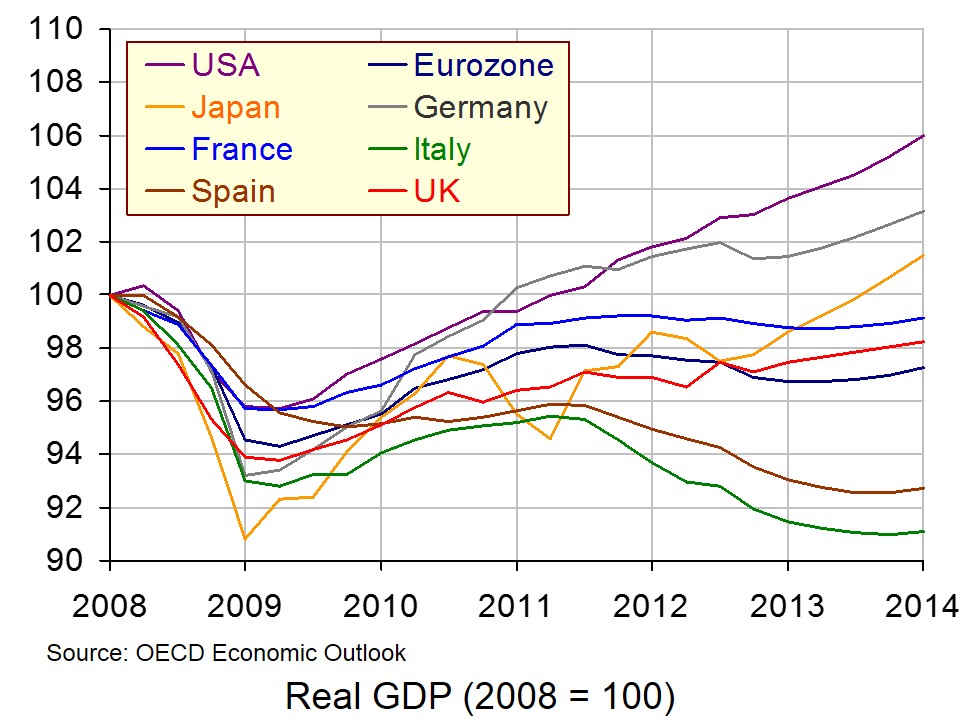 This old debate has been reborn since the financial crisis of 2007/8 and the subsequent deep recession and, more recently, the lack of recovery. (Click here for a PowerPoint of the chart.)
The articles below consider the current situation. Many economists, but certainly not all, take a Keynesian line that austerity policies to reduce public-sector deficits have been counter-productive. By dampening demand, such policies have reduced national income and slowed the recovery in both investment and consumer demand. This has at best slowed the rate of deficit reduction or at worst even increased the deficit, with lower GDP leading to a reduction in tax receipts and higher unemployment leading to higher government social security expenditure.
Although monetary policy has been very loose, measures such as record low interest rates and quantitative easing have been largely ineffective in stimulating demand. Economies are stuck in a liquidity trap, with banks preferring to build their reserves rather than to increase lending. This is the result partly of a lack of confidence and partly of pressure on them to meet Basel II and III requirements of reducing their leverage.
But despite the call from many economists to use fiscal policy and more radical monetary policy to stimulate demand, most governments have been pre-occupied with reducing their deficits and ultimately their debt. Their fear is that rising deficits undermine growth – a fear that was given weight by, amongst others, the work of Reinhart and Rogoff (see the blog posts Reinhart and Rogoff: debt and growth and It could be you and see also Light at the end of the tunnel – or an oncoming train?.
 But there is some movement by governments. The new Japanese government under Shinzo Abe is following an aggressive monetary policy to drive down the exchange rate and boost aggregate demand (see A J-curve for Japan?) and, more recently, the European Commission has agreed to slow the pace of austerity by giving the Netherlands, France, Spain, Poland, Portugal and Slovenia more time to bring their budget deficits below the 3% of GDP target.
Of course, whether or not expansionary fiscal and/or monetary policies should be used to tackle a lack of growth does not alter the argument that supply-side policies are also required in order to increase potential economic growth.
A Keynesian Victory, but Austerity Stands Firm The New York Times, Business Day, Eduardo Porter (21/5/13)
With Austerity Under Fire, Countries Seek a More Balanced Solution Knowledge@Wharton (22/5/13)
Keynes, Say’s Law and the Theory of the Business Cycle History of Economics Review 25.1-2, Steven Kates (1996)
Is Lord Keynes back in Brussels? The Conversation, Fabrizio Carmignani (31/5/13)
Keynes’s Biggest Mistake The New York Times, Business Day, Bruce Bartlett (7/5/13)
Keynes’s Not So Big Mistake The New York Times, The Conscience of a Liberal blog, Paul Krugman (7/5/13)
The Chutzpah Caucus The New York Times, The Conscience of a Liberal blog, Paul Krugman (5/5/13)
Keynes and Keynesianism The New York Times, Business Day, Bruce Bartlett (14/5/13)
Japan Is About To Prove Keynesian Economics Entirely Wrong Forbes, Tim Worstall (11/5/13)
The poverty of austerity exposed Aljazeera, Paul Rosenberg (24/5/13)
Britain is a lab rat for George Osborne’s austerity programme experiment The Guardian, Larry Elliott (26/5/13)
Eurozone retreats from austerity – but only as far as ‘austerity lite’ The Guardian, Larry Elliott (30/5/13)
Europe’s long night of uncertainty Daily Times (Pakistan), S P Seth (29/5/13)
Abenomics vs. bad economics The Japan Times Gregory Clark (29/5/13)
European countries to be allowed to ease austerity BBC News (29/5/13)
U.K. Should Restore Growth, Rebalance Economy IMF Survey (22/5/13)
Now everyone is a Keynesian again – except George Osborne The Observer, William Keegan (2/6/13)
Austerity Versus Growth (III): Fiscal Policy And Debt Sustainability Social Europe Journal, Stefan Collignon (30/5/13)
Questions
- Explain what is meant by Say’s Law and its implication for macroeconomic policy.
- Why have many governments, including the UK government, been reluctant to pursue expansionary fiscal policies?
- What is meant by the liquidity trap? What is the way out of this trap?
- In the first article above, Eduardo Porter argues that ‘moral views are getting in the way of reason’. What does he mean by this?
- Explain what are meant by the ‘paradox of thrift’ and the ‘fallacy of composition’. How are these two concepts relevant to the debate over austerity policies?
- What are the dangers in pursuing aggressive Keynesian policies?
- What are the dangers in not pursuing aggressive Keynesian policies?
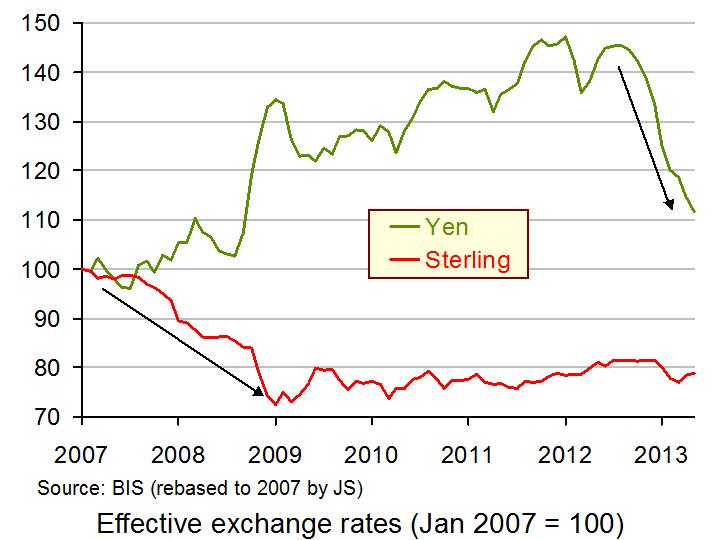
 The new Japanese government under Shinzo Abe, which took office on 26 December 2012, has been pursuing a policy of weakening the yen. Using a combination of low interest rates, quantitative easing, expansionary fiscal policy and a declared aim of depreciation, the government has succeeded in driving down the value of the yen.
Since mid-November last year, the yen has depreciated by 28% against the dollar, 30% against the euro and 21% against sterling. The effective exchange rate index has fallen by 22% (see first diagram below: click here for a PowerPoint of the diagram).
 But will this depreciation succeed in stimulating the Japanese economy and will it improve the balance of trade? The hope is that the falling yen will boost export sales by making them cheaper abroad, and will reduce the demand for imports by making them more expensive in Japan. The balance of trade will thereby improve and higher exports (an injection) and lower imports (a withdrawal) will stimulate aggregate demand and economic growth.
Traditionally Japan has run balance of trade surpluses, but since July 2012, it has been running monthly deficits – the longest run of deficits since 1980. But depreciation cannot be expected to turn this position around immediately. Indeed, theory suggests that the balance of trade is likely to deteriorate before it improves. This is known as the J-curve effect and is illustrated in the second diagram below. As page 768 of Economics, 8th edition states:
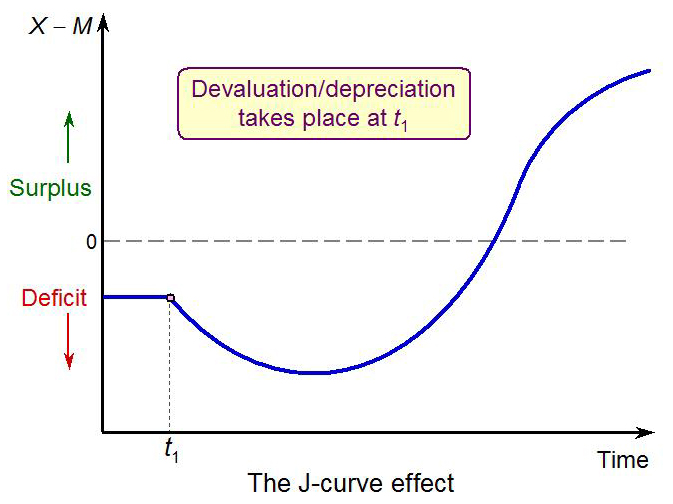 At first a devaluation or depreciation might make a current account deficit worse: the J-curve effect. The price elasticities of demand for imports and exports may be low in the short run (see Case Study 25.1 in MyEconLab). Directly after devaluation or depreciation, few extra exports may be sold, and more will have to be paid for imports that do not have immediate substitutes. There is thus an initial deterioration in the balance of trade before it eventually improves. In Figure 25.12 [the second diagram], devaluation takes place at time t1. As you can see, the diagram has a J shape.
Evidence suggests that the first part of the ‘J’ has been experienced in Japan: Japan’s balance of trade has deteriorated. But there is debate over whether the balance of trade will now start to improve. As the article by James Saft states:
But a look at the actual data shows Japanese companies, like British ones during a similar bout of currency weakness in 2008, appear to be more eager to use a newly competitive currency to pad profits through higher margins rather than higher export volumes. Thus far, Japanese exporters appear to be doing just that. Despite yen falls the price of Japanese exports in local currency has barely budged.
“Japanese companies have not actually cut the foreign currency prices of their exports. Just as with the UK exporters, the Japanese have chosen to hold foreign prices constant, maintain market share, and increase the yen value and thus the yen profit associated with yen depreciation,” UBS economist Paul Donovan writes in a note to clients.
 The extra profits earned by Japanese companies from export sales may be stockpiled or paid out in dividends rather than reinvested. And what investment does take place may be abroad rather than in Japan. The net effect may be very little stimulus to the Japanese economy.
As stated by Saft above, the UK had a similar experience in the period 2007–9, when sterling depreciated some 27% (see the second diagram). The balance of trade improved very little and UK companies generally priced goods to markets abroad rather than cutting overseas prices.
But times were different then. The world was plunging into recession. Now global markets are mildly growing or static. Nevertheless, there is a danger that the upward slope of the J-curve in Japan may be pretty flat.
Articles
Weak yen a boon for investors, not Japan Reuters, James Saft (14/5/13)
Japan’s Trade Data Suggest Even Lower Yen Needed Wall Street Journal, Nick Hastings (22/5/13)
2 Misunderstandings About Japanese Trade Seeking Alpha, Marc Chandler (22/5/13)
Japanese trade deficit widens Financial Times, Ben McLannahan (22/5/13)
Data
BIS effective exchange rate indices Bank for International Settlements
Japan’s balance of trade Trading Economics
UK Trade, March 2013 ONS
Questions
- Explain the J-curve effect.
- Why is there some doubt about whether the Japanese balance of trade will improve significantly?
- What will be the consequences for Japanese growth?
- If foreign currency prices of Japanese exports do not change, what will determine the amount that Japan exports?
- What other measures is the Japanese government taking to stimulate the economy? What will determine the size of the multiplier effects of these measures?
- Using data from the ONS plot the UK’s quarterly balance of trade figures from 2007 to the present day. Explain the pattern that emerges.
 The link below is to an article by Bill Gates, founder of Microsoft. He argues that per-capita GDP is a poor indicator of development, especially in Sub-Saharan Africa.
The problems with using GDP as an indicator of the level of development of a country are well known and several alternative measures are in common use. Perhaps the best known is the United Nations Development Programme’s Human Development Index (HDI), where countries are given an HDI of between 0 and 1. HDI is the average of three indices based on three sets of variables: (i) life expectancy at birth, (ii) education (a weighted average of (a) the mean years that a 25-year-old person or older has spent in school and (b) the number of years of schooling that a 5-year-old child is expected to have over their lifetime) and (iii) real gross national income (GNY) per capita, measured in US dollars at purchasing-power parity exchange rates (see Box 27.1 in Economics 8th edition for more details).
 But although indicators such as this capture more elements of development than simple per-capita GNP or GNY, there are still serious shortcomings. A major problem is the lack of and inaccuracy of statistics, especially when applied to the rural subsistence and informal urban sectors. The problem is recognised and some countries are trying to address the problem (see the second article below), but the problem is huge. As Gates says:
It is clear to me that we need to devote greater resources to getting basic GDP numbers right. … National statistics offices across Africa need more support so that they can obtain and report timelier and more accurate data. Donor governments and international organisations such as the World Bank need to do more to help African authorities produce a clearer picture of their economies. And African policymakers need to be more consistent about demanding better statistics and using them to inform decisions.
Another problem is how you convert data into internationally comparable forms. For example, how are inflation, exchange rates, income distribution, the quality of health provision and education, etc. taken into account?
How GDP understates economic growth The Guardian, Bill Gates (8/5/13)
States’ GDP computation report out soon, says Nigeria statistics bureau Premium Times (Nigeria), Bassey Udo (9/5/13)
Michael Porter Presents New Alternative to GDP: The Social Progress Index (SPI) Triple Pundit, Raz Godelnik (13/4/13)
Questions
- By accessing the Human Development Index site, identify which countries have a much higher ranking by HDP than by per capita gross national income. Explain why.
- Why is expressing GNY in purchasing-power parity (PPP) terms likely to increase the GNY figures for the poorest countries?
- Explain the following quote from the Gates article: ‘I have long believed that GDP understates growth even in rich countries, where its measurement is quite sophisticated, because it is very difficult to compare the value of baskets of goods across different time periods’.
- Why is GNY per capita, even when expressed in PPP terms, likely to understate the level of development in subsistence economies?
- Explain whether the rate of growth of GNY per capita is likely to understate or overstate the rate of economic development of sub-Saharan African countries?
- Why are the challenges of calculating GDP or GNY particularly acute in sub-Saharan Africa?
 The US dollar has been used as the international currency for the majority of international trade. Around 85% of foreign-exchange transactions are trades between US dollars and other currencies. As the first article below, from the Wall St Journal, states:
When a South Korean wine wholesaler wants to import Chilean cabernet, the Korean importer buys US dollars, not pesos, with which to pay the Chilean exporter. Indeed, the dollar is virtually the exclusive vehicle for foreign-exchange transactions between Chile and Korea, despite the fact that less than 20% of the merchandise trade of both countries is with the US.
… The dollar is the currency of denomination of half of all international debt securities. More than 60% of the foreign reserves of central banks and governments are in dollars.
But things are gradually changing as countries increasingly by-pass the dollar. Several countries have reached agreements with China to allow companies to exchange their currencies directly in so-called ‘currency swap‘ arrangements (see also). These include Japan, Australia, the UK, France/the eurozone, Argentina, Brazil, South Korea, Chile and Russia. But while these currency swap arrangements apply to current account transactions, there are still considerable controls of currency movements on China’s capital and financial accounts.
So what will be the implications for the USA and for China? What will be the impact on currency and bonds markets? The following articles explore the issues.
Why the Dollar’s Reign Is Near an End Wall Street Journal, Barry Eichengreen (1/3/11)
Beijing Continues Inexorable Push for Internationalisation of the Renminbi iNVEZZ, Alice Young (22/4/13)
RMB: Advance of the renminbi Emerging Markets, Elliot Wilson (4/5/13)
China’s new leaders to quicken yuan reform, but caution remains Reuters, Kevin Yao and Heng Xie (7/5/13)
Japan, China to launch direct yen-yuan trade on June 1 Reuters, Tetsushi Kajimoto (29/5/12)
China and Japan to start direct yen-yuan trade in June BBC News (29/5/12)
BOE Plans to Sign Yuan Currency Swap Deal With China Bloomberg, Fergal O’Brien & Svenja O’Donnell (22/2/13)
Bank of England, PBOC close to RMB/GBP swap agreement Emerging Markets (22/2/13)
China and Brazil sign $30bn currency swap agreement BBC News (27/3/13)
China, Brazil sign trade, currency deal before BRICS summit Reuters, Agnieszka Flak and Marina Lopes (26/3/13)
Direct trading to boost global use of yuan China Daily, Wei Tian (10/4/13)
Paris vies to be yuan hub China Daily, Li Xiang (19/4/13)
France plans currency swap line with China: paper Reuters (12/4/13)
Yuan Replaces the Dollar in China’s Dealings With France, Britain, Australia, as the War-Debt Continues to Destroy US Currency Al-Jazeerah (6/5/13)
China Takes Another Stab At The Dollar, Launches Currency Swap Line With France ZeroHedge, Tyler Durden (13/4/13)
Questions
- What are the ‘three pillars’ that have supported the dollar’s dominance?
- What is changing in the global economy to undermine this dominance?
- What will be the impact on the US government and US companies?
- What steps has China taken to ‘internationalise’ the renminbi (denominated in yuan)?
- Is the role of the euro likely to increase or decrease as an internationally held and used currency?
- What dangers are there for investors in holding all their wealth in dollar-denominated assets?
- Why may the increasing internationalisation of the euro and renminbi lead to less volatility between them and the dollar?
- How will the growing internationalisation of the euro and renminbi benefit eurozone and Chinese banks and internationally trading companies?
- What more does China need to do before the renminbi can be regarded as a truly global currency?
 An excellent learning exercise for students of economics is to take a journal article that uses data to model the economy and then try to replicate the authors’ results. You may well be given an assignment like this in future years of your degree.
One such exercise is used on the University of Massachusetts Amherst’s doctoral programme in economics. Thomas Herndon is a student on that degree and chose to examine a well-known and highly influential paper, Growth in a Time of Debt by Carmen Reinhart then of the University of Maryland and Kenneth Rogoff of Harvard University and former chief economist of the IMF. Professors Reinhart and Rogoff used new data on 44 countries spanning about 200 years.

A key finding of their paper, published in 2010 in the American Economic Review Papers and Proceedings, is that once a country’s government debt exceeds 90% of GDP, growth rates fall considerably: the median across countries by about 1% and the mean considerably more.
The paper has been hugely influential. It has been used to justify the austerity programmes being pursued in many countries, including the UK and the eurozone. Cutting the government deficit to GDP ratio, and ultimately the government debt to GDP ratio, has been seen as a way of achieving higher growth over the longer term, and justifies the adverse effect on short-term growth from the dampening of aggregate demand.
Well, this seemed an interesting paper for Thomas Herndon to examine, and he was keen to show just how Reinhart and Rogoff’s data led to their conclusions. But try as he might, he could not replicate their results. His initial reaction was to think he had made an error, but each time he checked he came back with the same conclusion: they must have made errors in their calculations.
His supervisor at Amherst, Professor Michael Ash, after Thomas had checked and checked again, realised that something was wrong. He encouraged Thomas to write to Reinhart and Rogoff to request sight of their dataset. They duly obliged and it was then that Thomas spotted various errors. These are explained in the articles below, but the overall effect was to alter the conclusion. Although high debt may undermine growth to some extent, the effect is much less than Reinhart and Rogoff concluded, and there are several exceptions to this rule.
On 15 April 2013, Thomas, along with his supervisor, Michael Ash and his colleague, Robert Pollin, published a response to the Reinhart and Rogoff paper. In the abstract to their paper, Does High Public Debt Consistently Stifle Economic Growth? A Critique of Reinhart and Rogoff they state that:
… coding errors, selective exclusion of available data, and unconventional weighting of summary statistics lead to serious errors that inaccurately represent the relationship between public debt and GDP growth among 20 advanced economies in the post-war period. They find that when properly calculated, the average real GDP growth rate for countries carrying a public-debt-to-GDP ratio of over 90 percent is actually 2.2 percent, not –0:1 percent as published in Reinhart and Rogoff. That is, contrary to RR, average GDP growth at public debt/GDP ratios over 90 percent is not dramatically different than when debt/GDP ratios are lower.
The authors also show how the relationship between public debt and GDP growth varies significantly by time period and country. Overall, the evidence we review contradicts Reinhart and Rogoff’s claim to have identified an important stylized fact, that public debt loads greater than 90 percent of GDP consistently reduce GDP growth.
So could this be you in the future? Will you take a famous paper and, by re-examining and reworking the data, find that its conclusions are wrong? Could you end up changing the world? Exciting stuff!
Podcasts
 Austerity: A Spreadsheet Error? BBC, More or Less, Tim Harford (20/4/13)
Austerity justification study ‘inaccurate’ BBC Today Programme, Robert Pollin (18/4/13)
Articles
UMass Student Exposes Serious Flaws in Harvard Economists’ Influential Study The Atlantic Wire, J.K. Trotter (18/4/13)
Shocking Paper Claims That Microsoft Excel Coding Error Is Behind The Reinhart-Rogoff Study On Debt Business Insider, Mike Konczal (16/4/13)
How a student took on eminent economists on debt issue – and won Economic Times of India (19/4/13)
Meet the 28-Year-Old Grad Student Who Just Shook the Global Austerity Movement New York Magazine, Kevin Roose (19/4/13)
An economist’s mea culpa: I relied on Reinhart and Rogoff Confessions of a Supply-Side Liberal blog, Miles Kimball (22/4/13)
The Rogoff-Reinhart data scandal reminds us economists aren’t gods The Guardian, Heidi Moore (18/4/13)
Reinhart, Rogoff… and Herndon: The student who caught out the profs BBC News Magazine, Ruth Alexander (20/4/13)
George Osborne’s case for austerity has just started to wobble The Guardian, Polly Toynbee (18/4/13)
The error that could subvert George Osborne’s austerity programme The Guardian, Charles Arthur and Phillip Inman (18/4/13)
The Excel depression Sydney Morning Herald, Paul Krugman (19/4/13)
Europe: Retreat from austerity BBC News, Gavin Hewitt (23/4/13)
Guest post by Thomas Herndon
The Grad Student Who Took Down Reinhart And Rogoff Explains Why They’re Fundamentally Wrong Business Insider, Thomas Herndon (22/4/13)
Papers
Growth in a Time of Debt NBER working paper, Carmen M. Reinhart and Kenneth S. Rogoff (January 2010)
Does High Public Debt Consistently Stifle Economic Growth? A Critique of Reinhart and Rogo�ff PERI Working Paper 322, Thomas Herndon, Michael Ash and Robert Pollin (April 2013)
Questions
- What were the particular errors made by Reinhart and Rogoff?
- How has their paper been used as a basis for the design of macroeconomic policy?
- What are the limitations of using even accurate time-series data as the basis for policy measures?
- How might the work of Herndon change the direction of future macroeconomic policy?
- In his guest post in Business Insider (see link above), Herndon wrote: ‘The implication for policy is that, under particular circumstances, public debt can play a key role in overcoming a recession.’ What might this role be?
- Why might we have to be cautious in drawing policy conclusions from Herndon’s work?
 But there is some movement by governments. The new Japanese government under Shinzo Abe is following an aggressive monetary policy to drive down the exchange rate and boost aggregate demand (see A J-curve for Japan?) and, more recently, the European Commission has agreed to slow the pace of austerity by giving the Netherlands, France, Spain, Poland, Portugal and Slovenia more time to bring their budget deficits below the 3% of GDP target.