 In December 2013, Uruguay passed a law permitting the growing, distribution and consumption of marijuana. The legislation comes into effect in April 2014. The state will regulate the industry to ensure good quality strains of the crop are grown and sold. It will also tax the industry.
Uruguay is the first country to legalise cannabis, but in July 2012, Colorado and Washington states in the USA passed laws permitting the sale and possession of small amounts of the drug for recreational use. (It was already legal to possess the drug for medical use.) The laws took effect a few months later. It is heavily taxed, however, especially in Washington, where it is taxed at a rate of 25% three times over: when it is sold to the processor; when the processor sells it to the retailer; and when the retailer sells it to the consumer. In Massachusetts, Nevada and Oregon, medical cannabis shops will be permitted to open this year. In the Netherlands, although the sale of cannabis is still illegal, ‘coffee shops’ are permitted to sell people up to 5 grams per day.
So should cannabis be legalised? People have very strong views on the subject and this can make a calm assessment of the issue more difficult. The economist’s approach to legalising cannabis involves seeking to identify and measure the costs and benefits of doing so. If the benefits exceed the costs, then it should be legalised; if not, it should remain illegal (or made illegal). The problem is that the size of the costs and benefits are not easy calculate as they involve estimates of things such as consumption levels, tax revenues, crime reduction, the effects on the consumption of other drugs, including legal drugs such as alcohol and tobacco.
Nevertheless, various estimates of these costs and benefits have been made and provide a basis for discussion.
Possible benefits of cannabis legalisation include: increased tax revenues for the government; reduction in crime, and hence reduction in law enforcement and prison costs; encouraging people with addiction problems to seek help, as they would not fear arrest; reduction in the price, benefiting users; regulating quality of the drug; reducing the consumption of alcohol and more dangerous drugs if these are substitutes for cannabis; moral arguments concerning freedom of individuals to choose their lifestyle.
Possible costs include: increased consumption of cannabis, with attendant health and social side effects; increased consumption of other drugs if they are complements, or if cannabis is an ‘entry level’ drug to harder drugs; moral objections to drug taking.
Clearly some of these costs and benefits are easier to measure than others. Moral arguments are almost impossible to assess quantitatively, even when various underlying moral standpoints are agreed.
The following articles look at recent events and at the arguments, both economic and non-economic.
Articles
As Uruguay moves to legalise cannabis, is the ‘war on drugs’ finished? Metro (20/1/14)
Regulating the sale of marijuana: Global perspective Journalist’s Resource, John Wihbey (17/1/14)
Next Step in Uruguay: Competitive, Quality Marijuana Independent European Daily Express (IEDE) (12/1/14)
U.S. support for legalization of marijuana at an all-time HIGH Mail Online, Anna Edwards (7/1/14)
14 Ways Marijuana Legalization Could Boost The Economy Huffington Post, Harry Bradford (7/11/12)
Colorado pot legalization: 30 questions (and answers) The Denver Post, John Ingold (13/12/12)
Economists Predict Marijuana Legalization Will Produce ‘Public-Health Benefits’ Forbes, Jacob Sullum (1/11/13)
Papers
Economics of Cannabis Legalization Hemp Today, Dale Gieringer (10/10/93)
Pros & Cons of Legalizing Marijuana About.com: US Liberal Politics, Deborah White
Would Marijuana Legalization Increase the Demand for Marijuana? About.com: Economics, Mike Moffatt
Time to Legalize Marijuana? – 500+ Economists Endorse Marijuana Legalization About.com: Economics, Mike Moffatt
A cost benefit analysis of cannabis legalisation Institute for Social and Economic Research, University of Essex
Licensing and regulation of the cannabis market in England and Wales: Towards a cost–benefit analysis Institute for Social and Economic Research, University of Essex, Mark Bryan, Emilia Del Bono and Stephen Pudney (9/13)
What Can We Learn from the Dutch Cannabis Coffeeshop Experience? Rand Drug Policy Research Center, Robert J. MacCoun (7/10)
Podcast
 Licensing and regulating the cannabis market in England and Wales Institute for Social and Economic Research, University of Essex, Stephen Pudney (15/9/13)
Questions
- If a country legalises cannabis, what is likely to happen to the price of cannabis? Use a demand and supply diagram to illustrate your argument, considering the effects on both demand and supply. How are the price elasticities of demand and supply relevant to your answer?
- What externalities are there from drug use?
- What externalities are there from making cannabis illegal?
- Distinguish between complementary and substitute goods for cannabis? How is the demand for these likely to be affected by legalising cannabis?
- Go through each of the benefits and costs of legalising cannabis and identify difficulties that might be experienced in quantifying these costs and benefits?
- If cannabis were legalised, how would you set about determining the optimum rate of tax on cannabis production, processing, distribution and sale?
- Consider the arguments for and against legalising cannabis from the perspective of (a) a free-market liberal and (b) a social democrat who sees government intervention as an important means of achieving various social goals.
 A remarkable event took place in Venezuela on Friday 8th November. Soldiers, on the orders of the president, temporarily occupied a chain of shops run by a leading electrical retailer called Dakar. The shops were forced to cut the prices of their electrical appliances and five managers were arrested and accused of ‘hiking up’ prices.
Unsurprisingly, news of these lower prices spread very quickly and long queues rapidly appeared outside the stores as people hoped to buy plasma televisions, fridges and washing machines at bargain prices. On Sunday 9th November, the president, Nicolas Maduro, gave a televised address in which he condemned the owners of the stores and announced that he was going to ask the National Assembly to grant him extra powers so that he could extend price controls to all consumer goods. He stated that he would next turn his attention to stores selling toys, cars, textiles and shoes.
The use of price controls in Venezuela is not new and dates back to 2003 when they were first introduced by the then president Hugo Chavez. Initially the regulations were imposed on various foods and basic goods. For example, by 2009 maximum prices had been set for cooking oil, white rice, sugar, coffee, flour, margarine, pasta and cheese. Businesses often complained that the maximum prices set by the government were below the costs of production. For example after a maximum price of 2.15 Bolivares was placed on a kilo of rice, producers argued that the cost of producing a kilo of rice was 4.41 Bolivares.
 The impact of the maximum prices in Venezuela appears to have been exactly what the theories in the economics textbooks would have predicted – shortages, long queues of people waiting outside shops and a flourishing black market. An article on the shortage of toilet rolls has been discussed in a previous article on this news site: Shortages in Venezuela- what’s the solution? However this has not stopped the Venezuelan government extending the scheme and increasing the number of products that have maximum prices imposed on them. In 2011 Hugo Chavez argued that the policy was required because:
The market has…become a perverse mechanism where big monopolies, the big trans-nationals and the bourgeoise dominate and ransack the people.
Economics textbooks often include some analysis of the impact of price ceilings on a competitive market. The effects on consumer surplus, producer surplus and deadweight welfare are usually discussed. However the potential administrative costs are rarely considered. The Venezuelan case helps to illustrate how in practise these costs could be quite significant.
For example, in April 2012 price controls in Venezuela were extended to a range of 19 products including fruit juice, toilet paper, nappies, soap, detergent, deodorant, toothpaste, baby food, floor polish, mineral water and razor blades. This caused a reduction in prices of between 4% and 25%. However this did not simply mean setting 19 different maximum prices because the goods were all sold in different quantities or different package sizes. For example a tube of toothpaste could be purchased in 4 different sizes – 50ml, 75ml, 100ml and 150 ml. Therefore officials had to set 4 different figures. Nappies were sold in 12 different package sizes ranging from10 nappies/packet to78 nappies/packet. Once again this meant that the administrators had to set 10 different maximum prices just for nappies. In total across the 19 products government officials had to set prices for 616 different individual items!! Companies were given just one month to adjust to the new legislation.
Whenever maximum prices are imposed on a competitive market both frustrated buyers and sellers have an incentive to evade them and trade illegally. Therefore the government established a number of organisations in an attempt to make sure the prices were enforced. One agency is called The National Superintendency of Fair Costs and Prices or Sundecop. Officials from this agency were sent out to 82 retail outlets in April 2012 to try to make sure that firms were sticking to the new regulated prices. They also printed and handed out leaflets to the public informing them of the changes. Another agency is called ‘The Institute for the Defense of People’s Access to Goods and Services’ or ‘Indepabis’. This organisation launched a new strategy in June 2012 in order to monitor compliance. This included the creation of a network called the Friends of Indepabis which would act as an information point for members of the public to report illegal pricing. A new complaints phone line was also introduced.
If president Maduro is granted the power to extend maximum prices to all consumer products, then one can only begin to imagine the extra administrative costs involved with implementing the policy.
Venezuelan president Maduro ‘to expand price controls’ BBC News (11/11/13)
Venezuela sends in troops to force electronics chain to charge ‘fair’ prices NBC News (13/11/13)
Venezuela appliances crackdown spurs uncertainty ABC news (13/11/13)
Venezuela’s government seizes electronic goods shops BBC News (9/11/13)
Venezuelan government sends TROOPS into electronics chain to force them to sell goods at a “fair price” DailyMirror (10/11/13)
Shocher: Price Controls Lead to Shortages in Venezuela Free Advice, Robert Murphy (2/10/13)
Venezuelan Government Action against Overpricing Welcomed by Citizens, Manipulated by Media venezuelanalysis (12/11/13).
Questions
- Explain why a maximum price imposed on a competitive market might generate a shortage. Draw a diagram to illustrate and explain your answer.
- Are there any circumstances when a maximum price would not cause a shortage in a competitive market?
- Analyse the impact of a maximum price on consumer surplus, producer surplus and deadweight welfare loss. Assume the market is competitive and clearly state any other assumptions you have made in your analysis. Comment on the impact of the price ceiling on economic efficiency.
- Illustrate and explain what would happen to consumer surplus and deadweight welfare loss if the available goods for sale were only purchased by the consumers with the lowest willingness to pay.
- Why might a maximum price lead to a flourishing black market?
- The former president, Hugo Chavez, argued that the price regulations were required because “big monopolies… ransack the people”. Using economic theory discuss this statement. Examine the impact of a maximum price on a pure monopoly.
 An excellent learning exercise for students of economics is to take a journal article that uses data to model the economy and then try to replicate the authors’ results. You may well be given an assignment like this in future years of your degree.
One such exercise is used on the University of Massachusetts Amherst’s doctoral programme in economics. Thomas Herndon is a student on that degree and chose to examine a well-known and highly influential paper, Growth in a Time of Debt by Carmen Reinhart then of the University of Maryland and Kenneth Rogoff of Harvard University and former chief economist of the IMF. Professors Reinhart and Rogoff used new data on 44 countries spanning about 200 years.

A key finding of their paper, published in 2010 in the American Economic Review Papers and Proceedings, is that once a country’s government debt exceeds 90% of GDP, growth rates fall considerably: the median across countries by about 1% and the mean considerably more.
The paper has been hugely influential. It has been used to justify the austerity programmes being pursued in many countries, including the UK and the eurozone. Cutting the government deficit to GDP ratio, and ultimately the government debt to GDP ratio, has been seen as a way of achieving higher growth over the longer term, and justifies the adverse effect on short-term growth from the dampening of aggregate demand.
Well, this seemed an interesting paper for Thomas Herndon to examine, and he was keen to show just how Reinhart and Rogoff’s data led to their conclusions. But try as he might, he could not replicate their results. His initial reaction was to think he had made an error, but each time he checked he came back with the same conclusion: they must have made errors in their calculations.
His supervisor at Amherst, Professor Michael Ash, after Thomas had checked and checked again, realised that something was wrong. He encouraged Thomas to write to Reinhart and Rogoff to request sight of their dataset. They duly obliged and it was then that Thomas spotted various errors. These are explained in the articles below, but the overall effect was to alter the conclusion. Although high debt may undermine growth to some extent, the effect is much less than Reinhart and Rogoff concluded, and there are several exceptions to this rule.
On 15 April 2013, Thomas, along with his supervisor, Michael Ash and his colleague, Robert Pollin, published a response to the Reinhart and Rogoff paper. In the abstract to their paper, Does High Public Debt Consistently Stifle Economic Growth? A Critique of Reinhart and Rogoff they state that:
… coding errors, selective exclusion of available data, and unconventional weighting of summary statistics lead to serious errors that inaccurately represent the relationship between public debt and GDP growth among 20 advanced economies in the post-war period. They find that when properly calculated, the average real GDP growth rate for countries carrying a public-debt-to-GDP ratio of over 90 percent is actually 2.2 percent, not –0:1 percent as published in Reinhart and Rogoff. That is, contrary to RR, average GDP growth at public debt/GDP ratios over 90 percent is not dramatically different than when debt/GDP ratios are lower.
The authors also show how the relationship between public debt and GDP growth varies significantly by time period and country. Overall, the evidence we review contradicts Reinhart and Rogoff’s claim to have identified an important stylized fact, that public debt loads greater than 90 percent of GDP consistently reduce GDP growth.
So could this be you in the future? Will you take a famous paper and, by re-examining and reworking the data, find that its conclusions are wrong? Could you end up changing the world? Exciting stuff!
Podcasts
Austerity: A Spreadsheet Error? BBC, More or Less, Tim Harford (20/4/13)
Austerity justification study ‘inaccurate’ BBC Today Programme, Robert Pollin (18/4/13)
Articles
UMass Student Exposes Serious Flaws in Harvard Economists’ Influential Study The Atlantic Wire, J.K. Trotter (18/4/13)
Shocking Paper Claims That Microsoft Excel Coding Error Is Behind The Reinhart-Rogoff Study On Debt Business Insider, Mike Konczal (16/4/13)
How a student took on eminent economists on debt issue – and won Economic Times of India (19/4/13)
Meet the 28-Year-Old Grad Student Who Just Shook the Global Austerity Movement New York Magazine, Kevin Roose (19/4/13)
An economist’s mea culpa: I relied on Reinhart and Rogoff Confessions of a Supply-Side Liberal blog, Miles Kimball (22/4/13)
The Rogoff-Reinhart data scandal reminds us economists aren’t gods The Guardian, Heidi Moore (18/4/13)
Reinhart, Rogoff… and Herndon: The student who caught out the profs BBC News Magazine, Ruth Alexander (20/4/13)
George Osborne’s case for austerity has just started to wobble The Guardian, Polly Toynbee (18/4/13)
The error that could subvert George Osborne’s austerity programme The Guardian, Charles Arthur and Phillip Inman (18/4/13)
The Excel depression Sydney Morning Herald, Paul Krugman (19/4/13)
Europe: Retreat from austerity BBC News, Gavin Hewitt (23/4/13)
Guest post by Thomas Herndon
The Grad Student Who Took Down Reinhart And Rogoff Explains Why They’re Fundamentally Wrong Business Insider, Thomas Herndon (22/4/13)
Papers
Growth in a Time of Debt NBER working paper, Carmen M. Reinhart and Kenneth S. Rogoff (January 2010)
Does High Public Debt Consistently Stifle Economic Growth? A Critique of Reinhart and Rogo�ff PERI Working Paper 322, Thomas Herndon, Michael Ash and Robert Pollin (April 2013)
Questions
- What were the particular errors made by Reinhart and Rogoff?
- How has their paper been used as a basis for the design of macroeconomic policy?
- What are the limitations of using even accurate time-series data as the basis for policy measures?
- How might the work of Herndon change the direction of future macroeconomic policy?
- In his guest post in Business Insider (see link above), Herndon wrote: ‘The implication for policy is that, under particular circumstances, public debt can play a key role in overcoming a recession.’ What might this role be?
- Why might we have to be cautious in drawing policy conclusions from Herndon’s work?
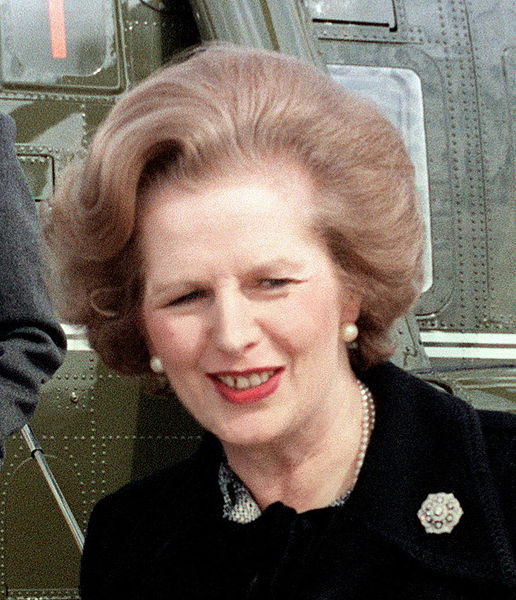 Much has been written on Margaret Thatcher following her death at the age of 87 on April 8. But getting a calm assessment of both her time in office and her legacy is not easy. And it’s clear why: she created both stronger loyalty and stronger opposition than any other UK Prime Minister.
As economists, however, we should try to be as dispassionate as possible in assessing the effects of policies. There is always a normative question of the relative desirability of different economic outcomes – and you will have your own views on the relative importance of objectives such as economic growth, greater equality and greater social cohesion – but to determine cause and effect, or at least correlation, requires a careful examination of the evidence. Also, drawing lessons for future policy requires a careful modelling of the economy and the effects of changing economic variables.
The following articles have been selected from the hundreds that have appeared in the press in the past few days. Whilst they cannot be claimed to be totally ‘objective’, taken together they give a good overview of her economic policies and her economic legacy.
You may well have been surprised by the amount of coverage of her death and at the fervour of her supporters and critics. But this bears witness to the huge effect she had on both the political scene and on the UK economy – for good or bad.
Articles
Margaret Thatcher’s timeline: From Grantham to the House of Lords, via Arthur Scargill and the Falklands War Independent (8/4/13)
Overhauls Are Still Felt, Debated Decades Later Wall Street Journal, Charles Forelle (9/4/13)
Margaret Thatcher’s Four Ages of Monetary Policy EconoMonitor, David Smith (10/4/13)
How Mrs Thatcher smashed the Keynesian consensus The Economist (9/4/13)
Margaret Thatcher: The economy now and then BBC News, Stephanie Flanders (10/4/13)
Did Margaret Thatcher transform Britain’s economy for better or worse? The Guardian, Larry Elliott (8/4/13)
A look back at Margaret Thatcher’s economic record Washington Post, Dylan Matthews (8/4/13)
Margaret Thatcher’s legacy for business and economics—the world weighs in Quartz, Gwynn Guilford (8/4/13)
Data
Economic Data freely available online The Economics Network, see especially sites 1, 2, 3, 6 and 9
Questions
- Summarise the macroeconomic policies followed by the Thatcher government from 1979 to 1990.
- Chart economic growth, unemployment and inflation over Margaret Thatcher’s time in office. How does the performance of each of these indicators compare with the period from 1990 to 2007 and from 2008 to the present day?
- What is meant by ‘monetarism’? Did the Thatcher government follow pure monetarist policies?
- What is meant by the ‘Big Bang’ as applied to the financial sector in 1986? Assess the long-term consequences of the Big Bang.
- What elements of ‘Thatcherism’ were retained by the Labour government from 1997 to 2010?
- To what extent can the current Coalition government be described as ‘Thatcherite’?
 Adverts are increasingly diverse, ranging from families using various products and promoting their qualities, to a gorilla drumming, a horse dancing and a monkey drinking tea! But, how important is advertising to a product’s brand. Does it have a positive effect on sales and profitability?
The key role of advertising is to sell more products and many firms spend a huge amount on advertising campaigns. Indeed, over £16bn was spent on advertising in 2012. Given that the economy is still vulnerable and many firms have seen their sales and profits decline, this is a huge amount. Procter & Gamble spent over £200 million, British Sky Broadcasting spent £145 million and Tesco spent £114 million in 2011.
 Advertising increases consumer awareness of the product and its features, but also actively aims to persuade people to purchase the product. By differentiating the product through adverts a company aims to shift the demand curve to the right and also make it more inelastic, by persuading customers that there are no (or few) close substitutes.
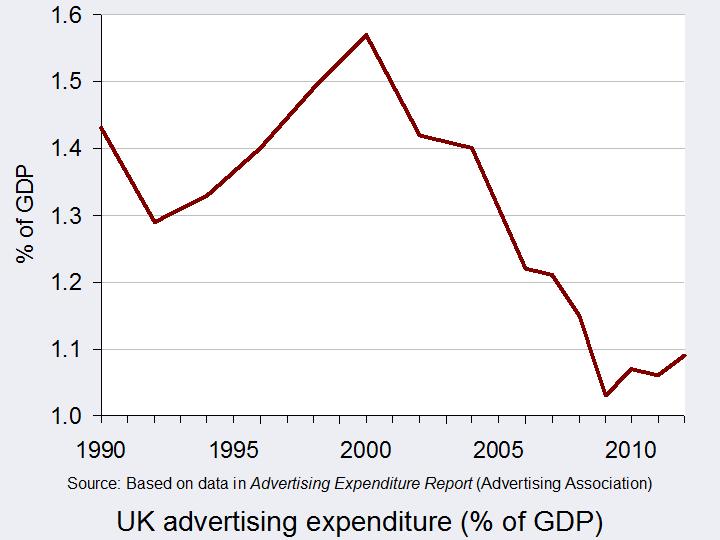 Since the start of the economic downturn in 2008, advertising expenditure has fallen, as companies have seen a decline in their budgets. From a high of £18.61 billion in 2004, the Advertising Association found that it fell to £14.20 billion in 2009 at constant 2008 prices. In the last few years, advertising expenditure has remained at around £14.5 billion. But, is cutting back on advertising a sensible strategy during a recession? Of course budgets are tight for both firms and consumers, but many suggest that media-savvy firms would actually benefit from maintaining their advertising. By doing so firms could take advantage of weaker competitors by increasing their market share and establishing their brand image in the long run.
 It’s also important to consider another link between economic growth and advertising. Research suggests that advertising can be an important factor for economic growth. A three-year study undertaken by the Advertising Association and Deloitte, commencing in January 2013 suggests that for every £1 spent on advertising in the UK, £6 is generated for the wider economy. Based on these predictions, the estimated £16bn that was spent on ad campaigns in 2011 added over £100 billion to the UK’s GDP.
 So, perhaps encouraging more advertising is the answer to the UK’s economic dilemma. This is certainly the opinion of Matt Barwell, the consumer marketing and innovation director of Diageo Western Europe, who said:
People fundamentally believe in advertising but a lot of the conversation focuses on negative elements. People rarely get the opportunity to talk about the positive role advertising plays in terms of wealth creation, exports and the social benefits that it provides. These are all things that many of us take for granted.
If private firms can therefore be encouraged to boost their marketing campaigns, jobs may be created, demand for products will rise and with the help of the multiplier, the economy may strengthen. Advertising has both pros and cons and opinions differ on what makes a good advert. But, whatever your opinion of the role of advertising, it is certainly an important aspect of any economy. The following articles take a view of advertising.
Articles
Could we advertise ourselves out of recession? Marketing Week, Lucy Tesseras (31/1/13)
Advertising in times of recession: A question of value The Open University, Tom Farrell (13/3/09)
Recession spending on advertising and R&D Penn State, Smeal College of Business
Nothing to shout about The Economist (30/7/09)
UK’s payday lenders face restrictions on advertising Reuters (6/3/13)
Value claims improve advertising effectiveness in recessionary times Com Score, Diane Wilson (17/9/13)
Advertising in a bad economy About Advertising, Apryl Duncan
Advertising worth £100bn to UK economy The Telegraph, Graham Ruddick (31/1/13)
Can advertising be the motor that gets the struggling UK economy out of first gear? More about advertising (26/2/13)
Adverts ‘worth £100bn to UK’ Independent, Giddeon Spanier (30/1/13)
Report
Advertising Pays – How advertising fuels the UK economy Advertising Association & Deloitte (30/1/13)
Advertising Pays – How advertising fuels the UK economy: Accompanying video presentation Advertising Association & Deloitte: on YouTube (30/1/13)
Questions
- What is the role of advertising?
- Using a demand and supply diagram, illustrate and explain the role of advertising.
- During a recession, why would you expect advertising expenditure to fall? What impact would you expect this to have in your diagram from question 1?
- How might firms that sustain their advertising expenditure during a downturn benefit?
- Explain the link between advertising and the economy.
- Why could a higher level of advertising boost economic growth?
- Are there any negative externalities from advertising?
 In December 2013, Uruguay passed a law permitting the growing, distribution and consumption of marijuana. The legislation comes into effect in April 2014. The state will regulate the industry to ensure good quality strains of the crop are grown and sold. It will also tax the industry.