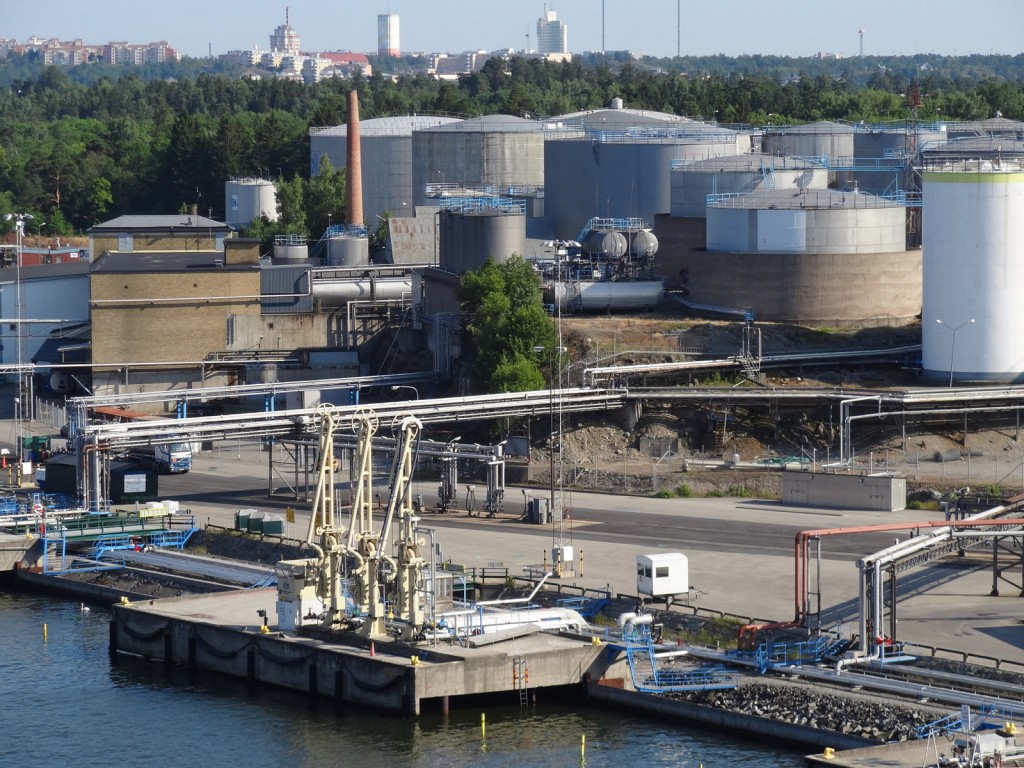
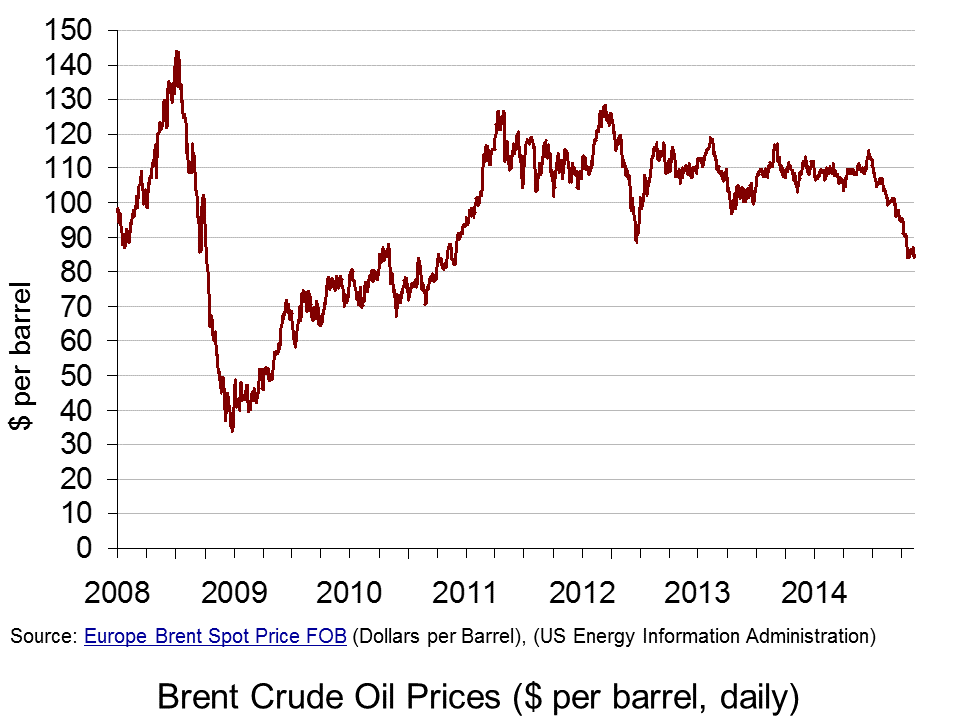
 Over the past three months oil prices have been falling. From the beginning of September to the end of November Brent Crude has fallen by 30.8%: from $101.2 to a four-year low of $70.0 per barrel (see chart below: click here for a PowerPoint). The fall in price has been the result of changes in demand and supply.
As the eurozone, Japan, South America and other parts of the world have struggled to recover, so the demand for oil has been depressed. But supply has continued to expand as the USA and Canada have increased shale oil production through fracking. 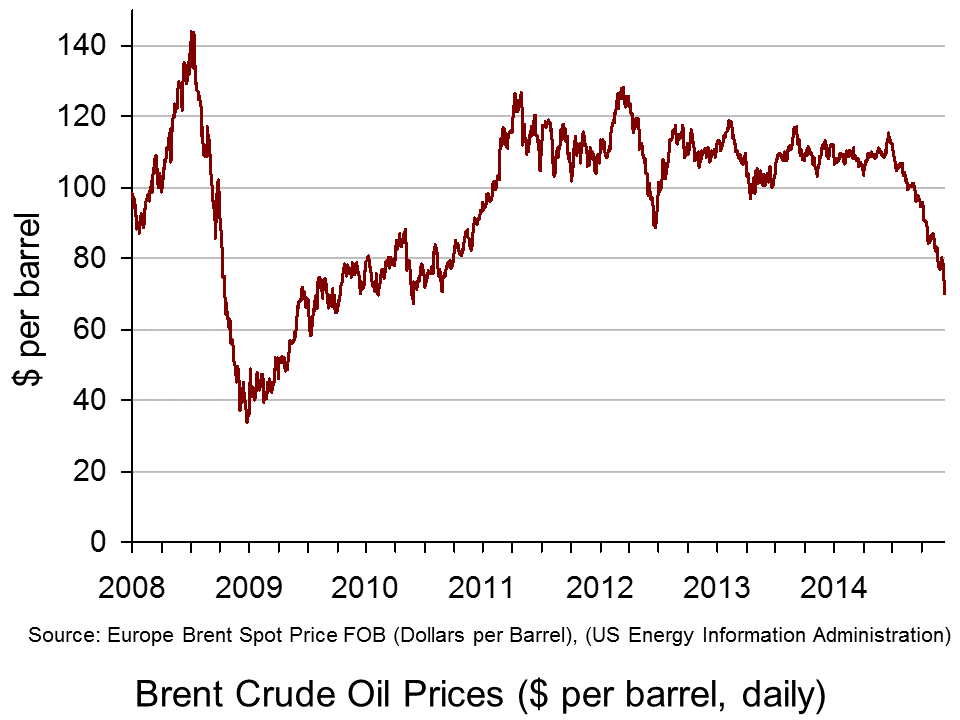 As far as OPEC is concerned, rather than cutting production, it decided at a meeting on 27 November to maintain the current target of 30 million barrels a day.
The videos and articles linked below look at these demand and supply factors and what is likely to happen to oil prices over the coming months.
They also look at the winners and losers. Although falling prices are likely in general to benefit oil importing countries and harm oil exporting ones, it is not as simple as that. The lower prices could help boost recovery and that could help to halt the oil price fall and be of benefit to the oil exporting countries. But if prices stay low for long enough, this could lower inflation and even cause deflation (in the sense of falling prices) in many countries. This, in turn, could dampen demand (see the blog post, Deflation danger). This is a particular problem in Japan and the eurozone. Major oil importing developing countries, such as China and India, however, should see a boost to growth from the lower oil prices.
Some oil exporting countries will be harder hit than others. Russia, in particular, has been badly affected, especially as it is also suffering from the economic sanctions imposed by Western governments in response to the situation in Ukraine. The rouble has fallen by some 32% this year against the US dollar and nearly 23% in the past three months alone.
Then there are the environmental effects. Cheaper oil puts less pressure on companies and governments to invest in renewable sources of energy. And then there are the direct effects on the environment of fracking itself – something increasingly being debated in the UK as well as in the USA and Canada.
Videos
 Oil price at four-year low as Opec meets BBC News, Mark Lobel (27/11/14)
Opec losing control of oil prices due to US fracking BBC News, Nigel Cassidy (4/12/13)
How the price of oil is set – video explainer The Telegraph, Oliver Duggan (28/11/14)
How Oil’s Price Plunge Impacts Wall Street Bloomberg TV, Richard Mallinson (28/11/14)
Oil Prices Plummet: The Impact on Russia’s Economy Bloomberg TV, Martin Lindstrom (28/11/14)
Articles
Oil prices plunge after Opec meeting BBC News (28/11/14)
Crude oil prices extend losses Financial Times, Dave Shellock (28/11/14)
Oil price plunges after Opec split keeps output steady The Guardian, Terry Macalister and Graeme Wearden (27/11/14)
Falling oil prices: Who are the winners and losers? BBC News, Tim Bowler (17/10/14)Hooray for cheap oil BBC News, Robert Peston (1/12/14)
Russian Recession Risk at Record as Oil Price Saps Economy Bloomberg, Andre Tartar and Anna Andrianova (28/11/14)
Rouble falls as oil price hits five-year low BBC News (1/12/14)
Data
Brent Spot Price US Energy Information Administration (select daily, weekly, monthly or annual: can be downloaded to Excel)
Spot exchange rate of Russian rouble against the dollar Bank of England
Questions
- Use a diagram to illustrate the effects of changes in the demand and supply of oil on oil prices.
- How does the price elasticity of demand and supply of oil affect the magnitude of these price changes?
- Explain whether (a) the demand for and (b) the supply of oil are likely to be relatively elastic or relatively inelastic? How are these elasticities likely to change over time?
- Distinguish between the spot price and forward prices of oil? If the three-month forward price is below the spot price, what are the implications of this?
- Analyse who gains and who loses from the recent price falls.
- What are the effects of a falling rouble on the Russian economy?
- What are likely to be the effects of further falls in oil prices on the eurozone economy?
 Since coming to office two years ago, Shinzo Abe’s government has been determined to revive the Japanese economy. The policy has involved ‘three arrows‘: expansionary fiscal policy, expansionary monetary policy and supply-side reforms. But figures just out show that the Japanese economy is back in recession. The economy shrank by 0.4% in quarter 3, having shrunk by 1.9% in quarter 2.
This has come as a huge disappointment for Mr Abe, who has staked his political reputation on escaping from deflation and achieving sustained economic growth. In response, he has called a general election to put a revised economic plan to the electorate.
The main cause of the reversal into recession has been an increase in the sales tax on all goods, which has dampened spending. The tax rise, planned by the previous government, was to help reduce the deficit and start tackling the huge public-sector debt, which, at over 230% of GDP, is by far the highest in the developed world. Another rise in sales tax is due in October 2015 – from 8% to 10%. Mr Abe hopes to cancel the rise and it is this that he may put to the electorate.
So what is the outlook for Japan? Will quarter 4 show economic growth, or will pessimism have set in? Will the Bank of Japan introduce even more quantitative easing, or will it wait for the latest increase in QE to take effect (see the blog post, All eased out: at least for the USA and UK)?
The following articles look at the implications of the latest news, both for Japan and globally, and at the options for the government and central bank.
Articles
Japanese economy falls into surprise recession Independent, Maria Tadeo (17/11/14)
Japan’s economy makes surprise fall into recession BBC News (17/11/14)
Coming to a crunch: Time is running out for Abenomics The Economist (20/11/14)
Japan’s economy: Delay the second consumption tax hike The Economist (17/11/14)
Defying Expectations, Japan’s Economy Falls Into Recession New York Times, Jonathan Soble (16/11/14)
Japan shocks as economy slips into recession CNBC, Li Anne Wong (17/11/14)
Japan Unexpectedly Enters Recession as Abe Weighs Tax: Economy Bloomberg, Keiko Ujikane and Toru Fujioka (17/11/14)
The world should be wary: Japan’s economic woes are contagious The Guardian, Larry Elliott (17/11/14)
Why is Japan heading to the polls? BBC News (18/11/14)
Previous news items on this site
A new economic road for Japan? (January 2013)
A J-curve for Japan? (May 2013)
Japan’s three arrows (June 2013)
Abenomics – one year on (December 2013)
Japan’s recovery (January 2014)
Japan’s CPI: An Update (May 2014)
All eased out: at least for the USA and UK (November 2014)
Data
Quarterly Estimates of GDP Japanese Cabinet Office
Japan and the IMF IMF Country Reports
Economic Outlook Annex Tables OECD
Questions
- Give details of the Japanese government’s three arrows.
- Discuss the pros and cons of the rise in the sales tax. Is it possible for the rise in the sales tax to increase the size of the public-sector deficit?
- What have been the effects of Japanese government policies on (a) prices of goods and services; (b) living standards; (c) asset prices?
- Who have been the gainers and losers of the policies?
- How is the Japanese situation likely to effect the value of the yen? How is this, in turn, likely to affect its trading partners? Could this set off a chain reaction?
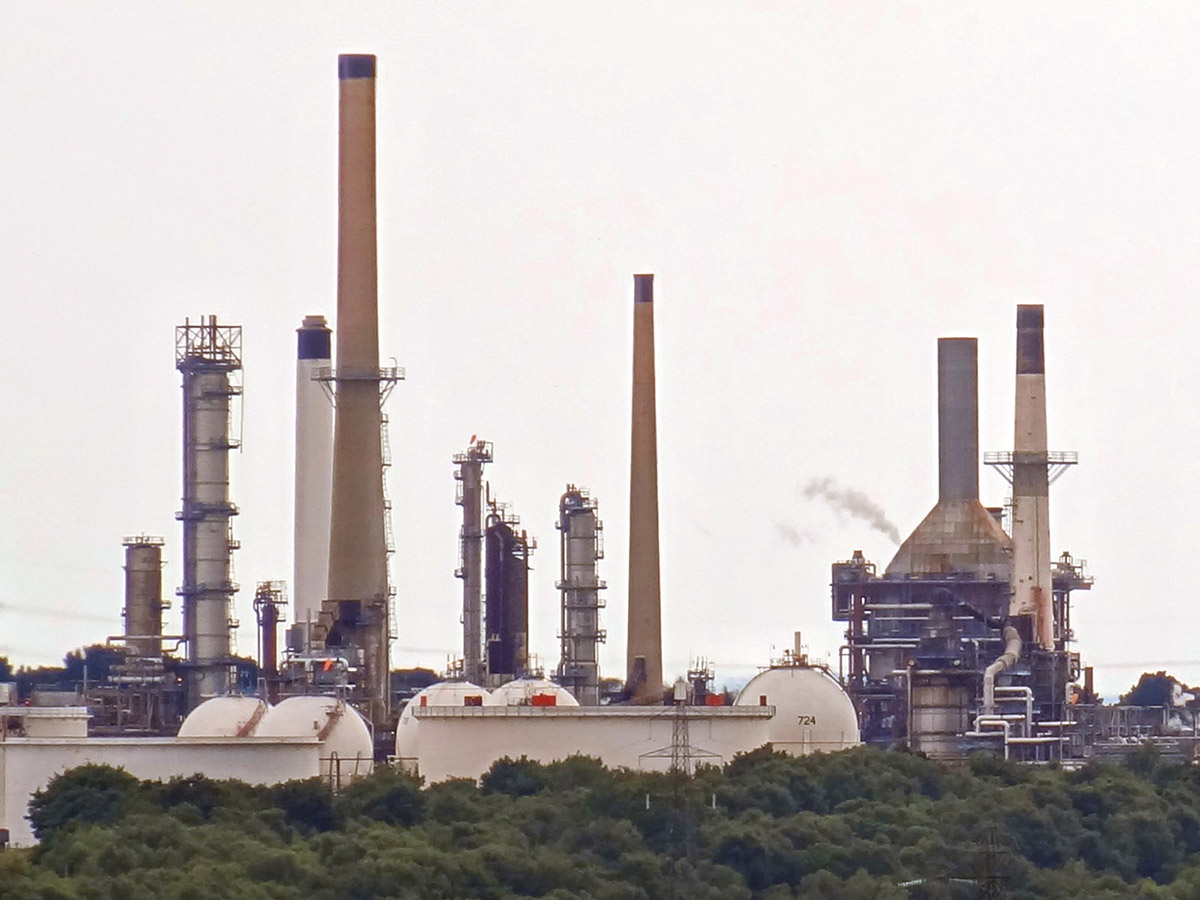 A big expenditure for many households is petrol. The price of petrol is affected by various factors, but the key determinant is what happens in the oil market. When oil prices rise, this pushes up the price of petrol at the pumps. But, when they fall, do petrol prices also fall? That is the question the government is asking.
The price of oil is a key cost of production for companies providing petrol and so when oil prices rise, it shifts the supply curve up to the left and hence prices begin to increase. We also see supply issues developing with political turmoil, fears of war and disruption and they have a similar effect. As such, it is unsurprising that petrol prices rise with concern of supply and rising costs. But, what happens when the opposite occurs? Oil prices have fallen significantly: by a quarter. Yet, prices at the pump have fallen by around 6%. This has caused anger amongst customers and the government is now urging petrol retailers to pass their cost savings from a lower price of oil onto customers. Danny Alexander, Chief Secretary to the Treasury said:
“I believe it’s called the rocket-and-feather effect. The public have a suspicion that when the price of oil rises, pump prices go up like a rocket. But when the price of oil falls, pump prices drift down like a feather … This has been investigated before and no conclusive evidence was found. But even if there were a suspicion it could be true this time it would be an outrage.”
However, critics suggest that tax policy is partly to blame as 63% of the cost of petrol is in the form taxation through fuel duty and VAT. Therefore even if oil prices do fall, the bulk of the price we pay at the pumps is made up of tax revenue for the government. Professor Stephen Glaister, director of the RAC Foundation said:
“It’s a simple story. Before tax we have just about the cheapest petrol and diesel in Europe. After tax we have just about the most expensive … It’s right to keep the pressure on fuel retailers but if drivers want to know what’s behind the high pump prices of recent years all they have to do is follow the trail back to the Treasury … if ministers are serious about reducing fuel prices further then they should cut duty further.”
 (Click here for a PowerPoint of the chart.)
However, even taking out the fuel duty and VAT, Arthur Renshaw, an analyst at Experian has said that the actual price of petrol has fallen by 21% since last year. Still, a much bigger decrease than we have seen at the pumps. One further reason for this may be the fact that dollars is the currency in which oil is traded. The pound has been relatively weak, falling by almost 7% over the past few months and hence even though the price of oil has fallen, the effect on UK consumers has been less pronounced.
The big supermarkets have responded to government calls to cut petrol prices, but how much of this cut was influenced by the government and how much was influenced by the actions of the other supermarkets is another story. A typical oligopoly, where interdependence is key, price wars are a constant feature, so even if one supermarket cut petrol prices, this would force others to respond in kind. If such price wars continue, further price cuts may emerge. Furthermore, with oil production still at such high levels, this market may continue to put downward pressure on petrol prices. Certainly good news for consumers – we now just have to wait to see how long it lasts, with key oil producing countries, such as Russia taking a big hit. The following articles consider this story.
Articles
Supermarkets cut fuel prices again The Telegraph, Nick Collins (6/11/14)
Petrol retailers urged to cut prices in line with falling oil costs The Guardian, Terry Macalister (6/11/14)
Supermarkets cut petrol prices after chancellor’s criticism Financial Times, Michael Kavanagh (6/11/14)
Governent ‘watching petrol firms’ Mail Online (6/11/14)
Our horrendous tax rates are the real reason why petrol is still so expensive The Telegraph, Allister Heath (6/11/14)
Osborne ‘expects’ fuel price drop after fall in oil price BBC News (6/11/14)
Danny Alexander tells fuel suppliers to pass on oil price cuts to drivers The Telegraph, Peter Dominiczak (5/11/14)
Further UK fuel cuts expected as pound strengthens The Scotsman, Alastair Dalton (6/11/14)
Data
Spot oil prices Energy Information Administration
Weekly European Brent Spot Price Energy Information Administration (Note: you can also select daily, monthly or annual.)
Annual Statistical Bulletin OPEC
Questions
- Using a supply and demand diagram, illustrate the impact that a fall in the price of oil should have on the price of petrol.
- What is the impact of a tax on petrol?
- Why is petrol a market that is so heavily taxed? You should think about the incidence of taxation in your answer.
- Why does the strength of the pound have an impact on petrol prices in the UK and how much of the oil price is passed onto customers at the pumps?
- Does the structure of the supermarket industry help customers when it comes to the price of petrol? Explain your answer.
- Militant action in some key oil producing countries has caused fears of oil disruption. Why is that oil prices don’t reflect these very big concerns?
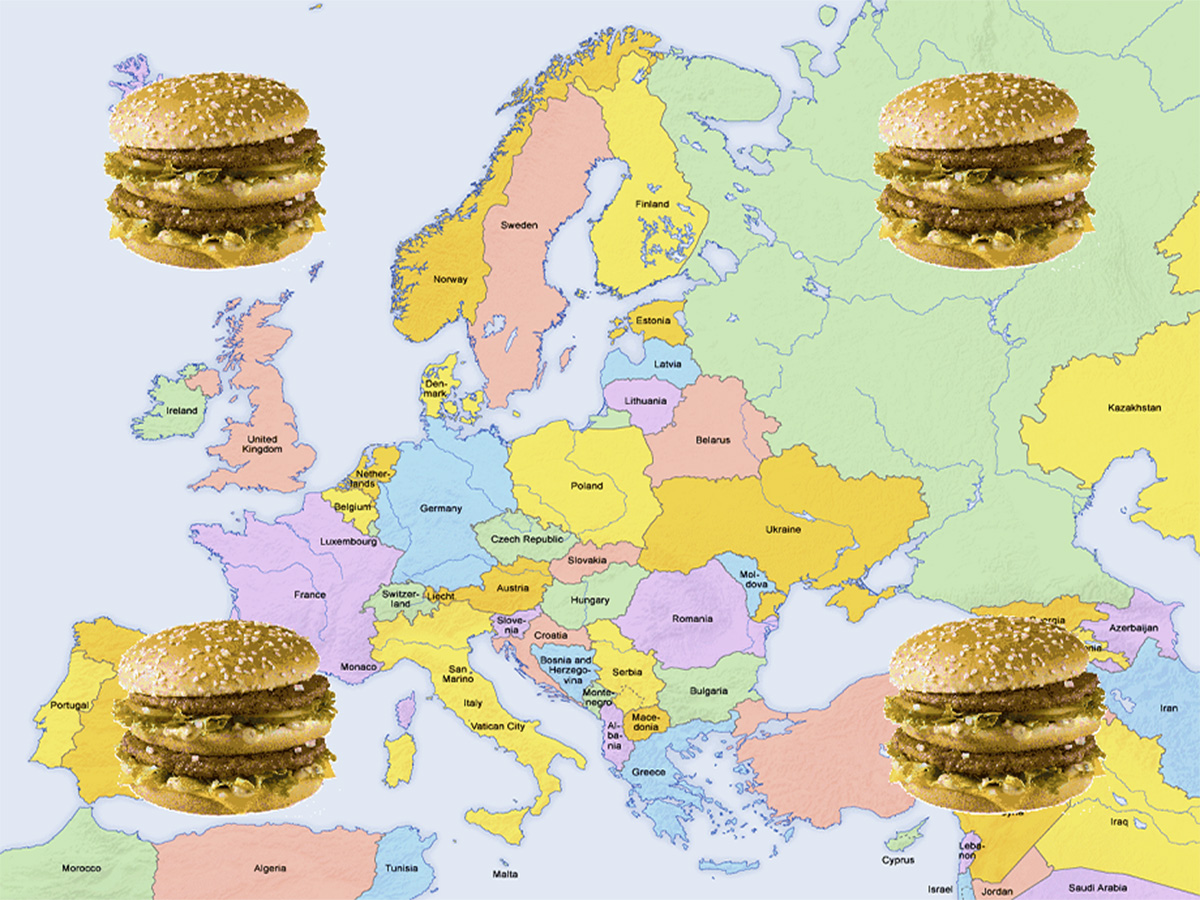
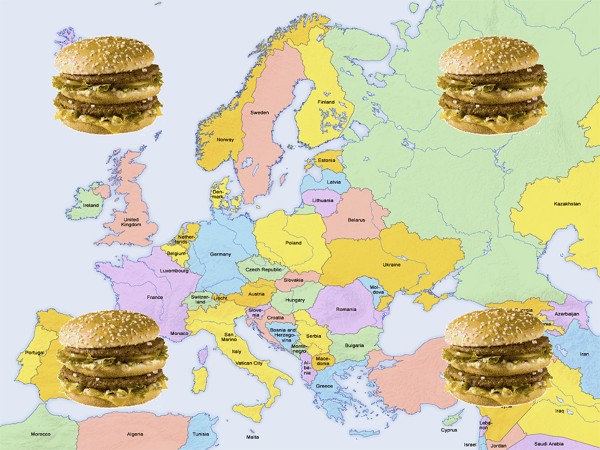 At least once a year The Economist publishes its ‘hamburger standard’ exchange rates for currencies. It is a light-hearted attempt to see if currencies are exchanging at their purchasing-power parity rates. The test is the price at which a ‘Big Mac’ McDonald’s hamburger sells in different countries!
According to this simplified version of the purchasing-power parity theory, exchange rates should adjust so that a Big Mac costs the same in dollars everywhere (see Economics 8th edition Box 25.4).
These Big Mac exchange rates can be used to compare various prices and incomes between countries. The article linked below from The Guardian compares minimum wages between European countries in Big Mac terms.
There are 25 countries across Europe which have minimum wages. A clear pattern of minimum wage rates can be seen: although actual exchange rates understate the purchasing power of incomes in poorer European countries compared to richer ones, minimum wages, even in purchasing-power standard terms, are still higher in the richer countries.
Luxembourg’s minimum wage buys you just about three Big Macs in an hour, while most of northern Europe (and France) between 2–2.5 Big Macs. Moving south, the minimum wage nets about one Big Mac an hour. As we progress east, it begins to cost more than an hour of work on the minimum wage in order to afford a Big Mac.
Of course, there are other factors determining the dollar price of a Big Mac other than the failure of exchange rates to reflect purchasing-power parities. Nevertheless, using the Big Mac index in this way does give a useful preliminary snap shot of differences in what minimum wages can buy in different countries.
Articles
Comparing the minimum wage across Europe using the price of a Big Mac The Guardian datablog, Alberto Nardelli (25/9/14)
Minimum wage statistics Eurostat (Sept/14)
Data
Earnings Database Eurostat
Questions
- What is meant by ‘purchasing-power parity exchange rates’?
- Why may actual exchange rates not accurately reflect the purchasing power of currencies within countries?
- Using the link to Eurostat article above, compare Big Mac minimum wages with (a) actual minimum wages and (b) minimum wages expressed in purchasing-power standard terms.
- Using the links to the Eurostat article and Eurostat data, describe how the proportion of employees earning minimum wages varies across European countries. What factors determine this proportion?
- Using the same links, describe how the monthly minimum wage as a proportion of average monthly earnings varies across European countries. Explain these differences.
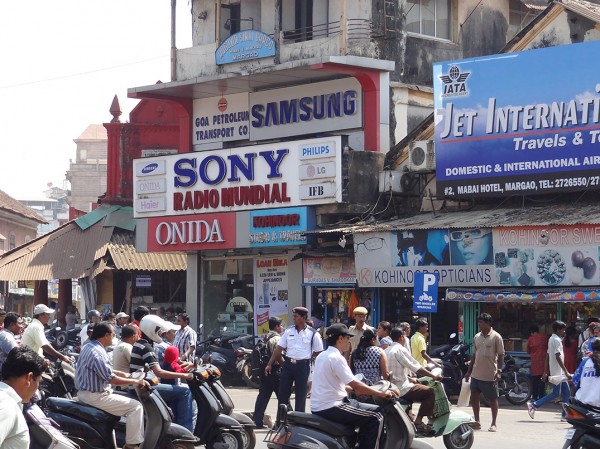 The expansion of the BRIC economies has both advantages and disadvantages for Western countries. Their consistently high growth rates have created a much wider market place for Western firms and a much needed additional source of consumer demand, especially in times of recession. Countries such as China have had double digit growth rates, with others like India experiencing growth rates of just under 10%. But are these impressive growth rates now beginning to fall?
For the last 2 years, the growth rate in the Indian economy has been sub-5%, with growth in the 2013-14 financial year at 4.7%. Though some sectors, including agriculture have experienced buoyant growth, it is other sectors that have been holding this economy back. Manufacturing contracted at an annualised rate of 1.4% over the quarter, while mining contracted by 0.4%. With a growth rate of just under 5%, one might think that this was good – after all many Western economies have only recently entered positive growth. However, the Indian economy has a rapidly growing population and it is estimated that 10 million additional jobs each year must be created. It is this figure that requires such a high growth rate – estimated at around 8%. Thus, the sub-5% growth recorded for 2 years is insufficient to sustain the required job creation.
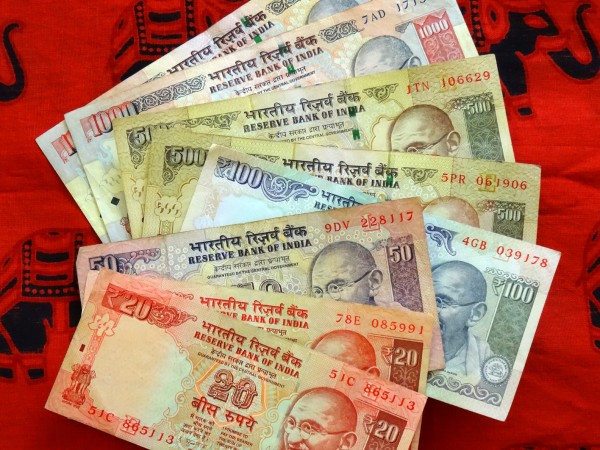
There are many factors that appear to be holding growth back. High inflation has been a problem for some years and the Indian currency has been relatively weak and volatile. Together, these issues have created an environment of uncertainty and if there’s one thing that investors don’t like, it’s uncertainty. This has therefore led to a lack of investment in the economy, which is a key component of aggregate demand and hence a key source of economic growth. Furthermore, interest rates rose last year, thereby pushing up the cost of borrowing and the rate of credit growth has also slowed. These factors collectively have led to lower foreign investment, domestic investment and spending, which have all contributed towards more subdued growth than in the past. Glenn Levine, a senior economist at Moody’s said:
India’s economy continues to grow well below potential as a combination of supply‐side constraints and the adverse effects of an underperforming government weigh on capital expenditure and hiring … It will be a while before the Indian economy is expanding above 6% again.
However, many economists remain optimistic about the prospects of Asia’s third-largest economy. Inflation appears to be under control and the currency has gained strength. Many believe that more investment supporting government policies will be the kick start the economy needs and this will in turn encourage firms to begin investment. It may be the new leader of this country, Narendra Modo, that will jump start the economy. The Prime Minister is expected to back policies to stimulate growth, who will direct more spending at infrastructure, simplify taxes and introduce policies to attract foreign investment. Adi Godrej, Chairman of the Godrej group said:
As soon as investors see the first signals of growth-supportive policies, you will see a definite turnaround on the ground.
The coming months will be crucial in determining how quickly the Indian economy is likely to see a return to near double digit growth. The new government has indeed promised policies to boost the economy, but the annual budget will confirm whether this promise is likely to be kept. Given the dependence of Indian jobs on a fast growth rate and the dependence of the Western world on the continued growth of the BRICs in creating a wider market for our exports, the fortunes of India are extremely important. The following articles consider this economy.
Indian economy grew at 4.7% in 2013-14 The Times of India (30/5/14)
India’s economic growth disappoints BBC News (30/5/14)
India’s GDP grows 4.7% in fiscal year, missing government forecast Wall Street Journal, Anant Vijay Kala (30/5/14)
India’s economy expands 4.7pct in fiscal year 2013/14 Reuters (30/5/14)
India’s economy still underwhelms CNN Money, Charles Riley, Alanna Petroff (30/5/14)
FY14 GDP growth at 4.7%; India sees worst slowdown in 25 years The Economic Times (30/5/14)
India growth below 5% adds pressure on Modi to spur investment Bloomberg, Unni Krishnan (30/5/14)
Jim Armitage: ‘Modinomics’ in India has helped growth, but not for all Independent, Jim Armitage (17/5/14)
Questions
- Using a diagram, explain how economic growth can be created through (a) demand-side measures and (b) supply-side measures.
- Why would higher interest rates reduce growth?
- Why does high inflation create uncertainty and what impact does this have on business investment?
- India has experienced a weak and volatile currency and this has contributed towards a lack of foreign investment and low growth. Using a diagram, explain why this could be the case.
- What sort of government policies would you recommend for the Indian economy if you had become the new Prime Minister and your primary objective was to boost economic growth?
- Why is the expansion of the BRIC economies, of which India is one, so important for Western economies?
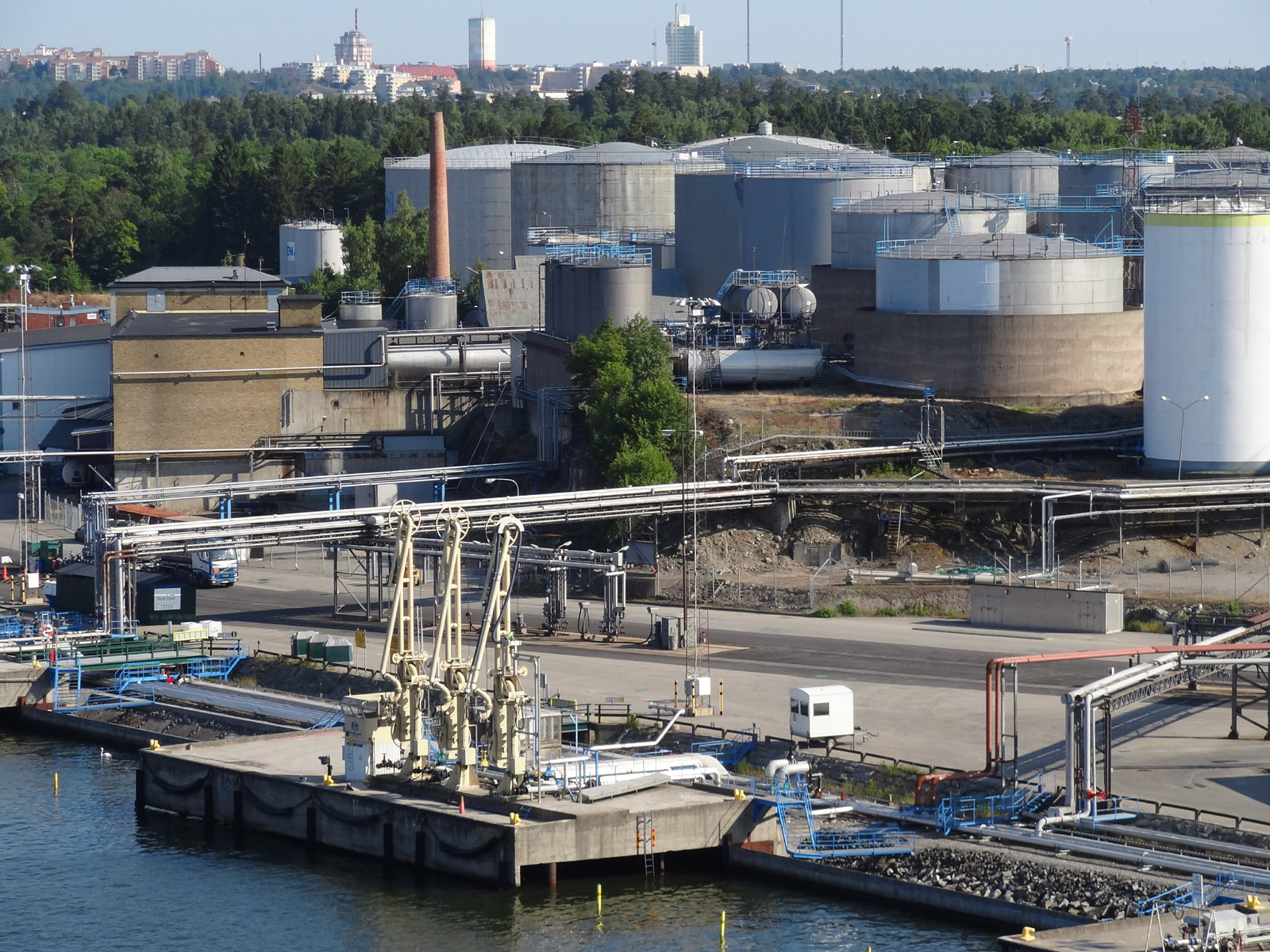 Over the past three months oil prices have been falling. From the beginning of September to the end of November Brent Crude has fallen by 30.8%: from $101.2 to a four-year low of $70.0 per barrel (see chart below: click here for a PowerPoint). The fall in price has been the result of changes in demand and supply.
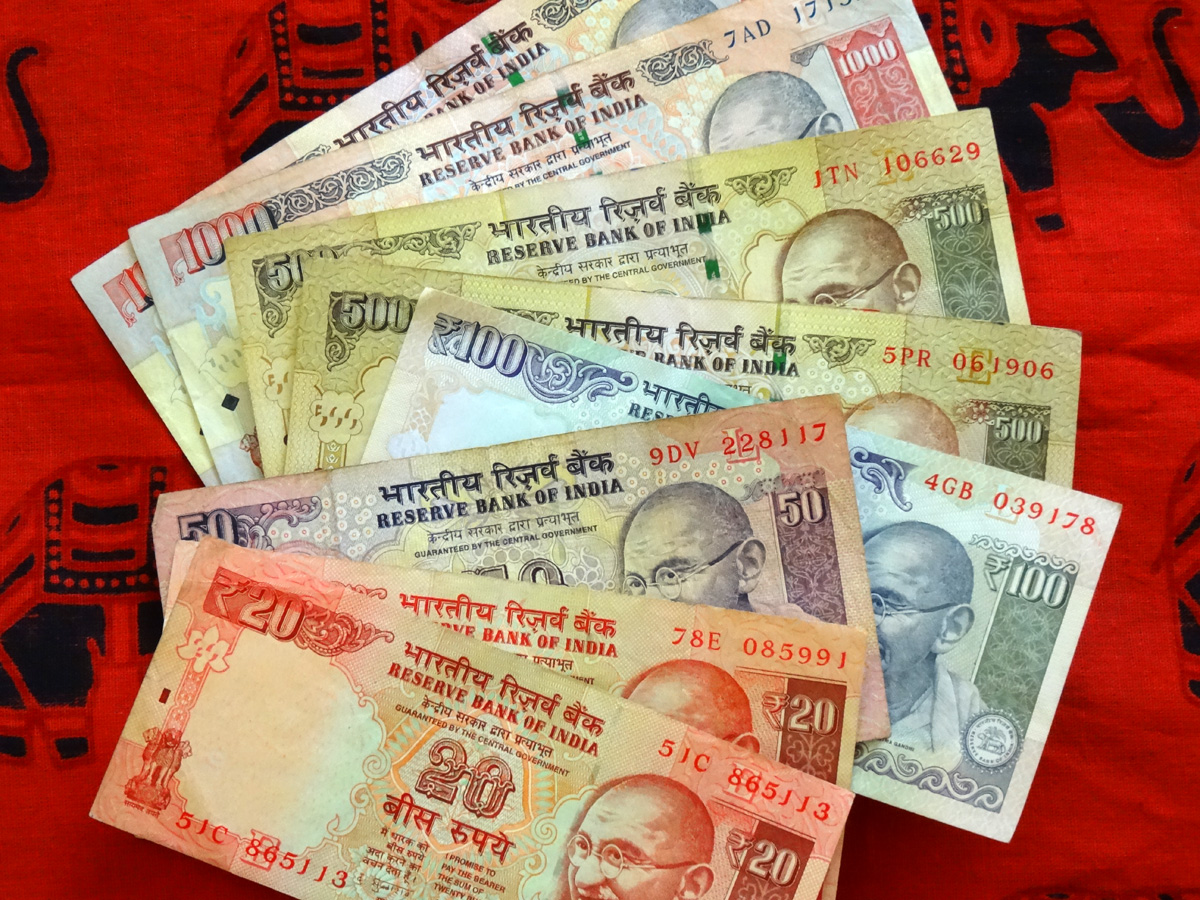
  Major oil importing developing countries, such as China and India, however, should see a boost to growth from the lower oil prices.