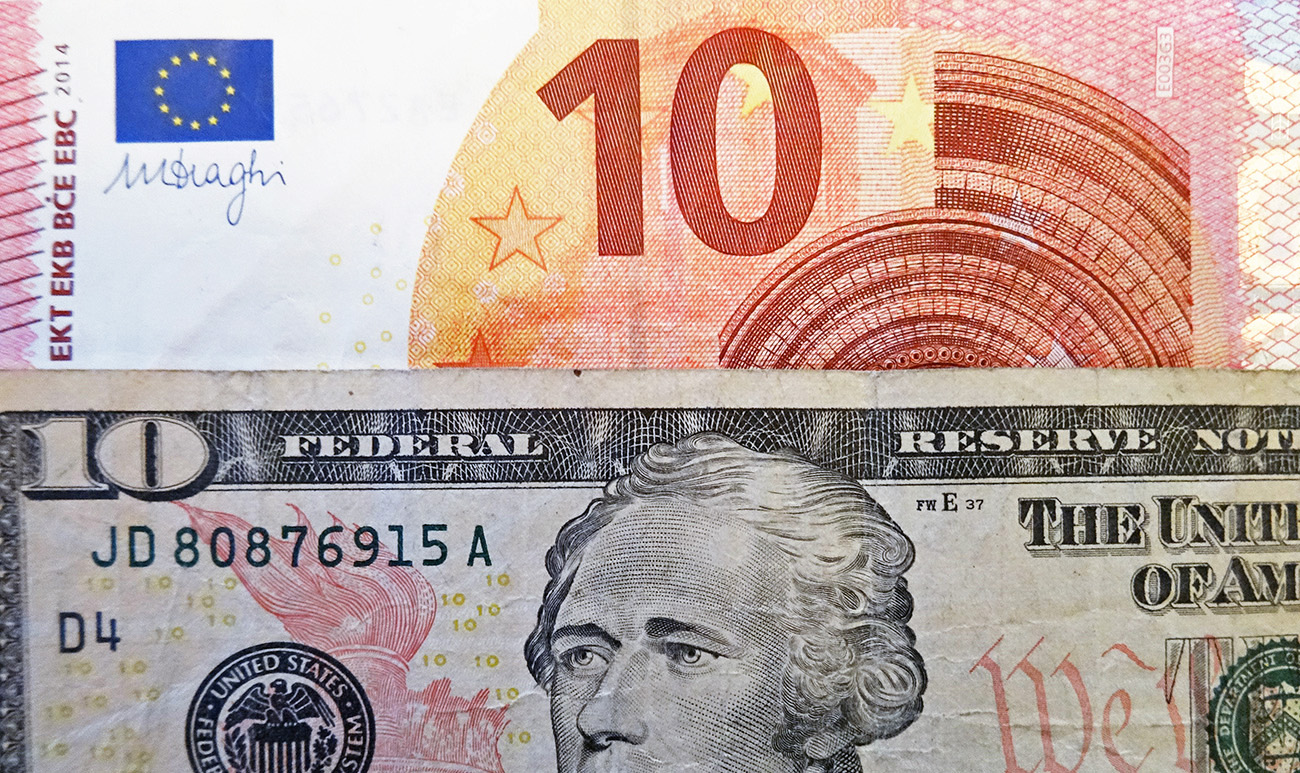
 The perceived wisdom is that nominal interest rates have a lower zero bound. The Swedish central bank (the Ricksbank) has effectively been charging financial institutions to deposit money at the central bank since 2009. On 29 January 2016 the Central Bank of Japan also introduced a negative interest rate on deposits. The -0.1 per cent rate currently applies to a portion of the reserves held by financial institutions at the central bank. The move is another attempt to pump energy into a struggling economy.
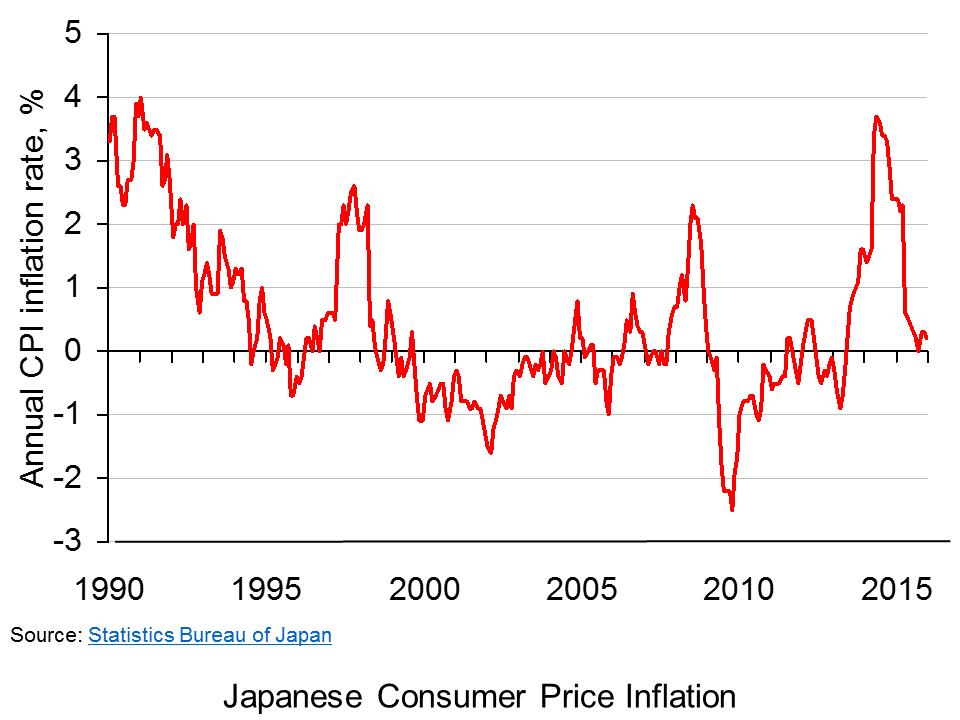 As the chart shows, since the mid 1990s there have been protracted periods of Japanese price deflation. In January 2013 Japan introduced a 2 per cent CPI inflation target. This was accompanied by a massive expansion of its quantitative easing programme, principally through purchases of government bonds from investors. Following the monetary loosening, buoyed too by a loosening of fiscal policy, the rate of inflation rose. It reached 3.7 per cent in May 2014.
However, through 2015 the rate of inflation began to fall sharply, partly the result of falling commodity prices, especially oil. Now there appears to be an increasing fear at the Bank of Japan that deflation may be set to return. The introduction of a negative deposit rate is intended to prevent deflation. In particular by affecting expectations of inflation. The hope is to prevent a deflationary mindset becoming re-established.
 The further loosening of monetary policy through a negative interest rate follows on the heels of an acceleration of quantitative easing last October. Back then, the Bank of Japan said that it would conduct Open Market Operations so that the monetary base would increase annually be ¥80 trillion. This was reaffirmed in its 29 January announcement. For an economy that has experienced four recessionary contractions since 2008 and with provisional estimates suggesting that it contracted by 0.4 per cent in the final quarter of 2015, it remains to be seen whether further monetary loosening might yet be called for.
Data
Consumer Price Index Statistics Bureau of Japan
Articles
Bank of Japan adopts negative interest rate policy CNBC, Nyshka Chandran (29/1/16)
Japan adopts negative interest rate in surprise move BBC News (29/1/16)
Bank of Japan shocks markets by adopting negative interest rates Guardian, Justin McCurry (29/1/16)
Japan stuns markets by slashing interests rates into negative territory Telegraph, Mehreen Khan (29/1/16)
Japan introduces negative interest rate to boost economy The Herald, (29/1/16)
Questions
- What does a negative interest rate on deposits mean for depositors?
- What effect is the Bank of Japan hoping that a negative deposit rate will have on the Japanese economy? How would such effects be expected to occur?
- What effect might the Bank of Japan’s actions be expected to have on the structure of interest rates in the economy?
- How might the negative interest rate effect how people wish to hold their wealth?
- What are the dangers of deflation? Why is the Bank of Japan keen to avoid expectations of deflation becoming re-established?
- To what extent are national policy-makers able to exert pressure over the rate of inflation?
 In our recent blog constructing growth without production: The UK growth paradox we saw that the provisional estimate of economic growth in the UK in the final quarter of 2015 was 0.5 per cent. This was buoyed by service sector growth of 0.7 per cent. Meanwhile, construction sector output was estimated to have fallen by 0.1 per cent and production in the production industries by 0.2 per cent. The ONS Index of Production released on 11 February suggests the decline in production activity in the final quarter might have been has much as 0.5 per cent further pointing to unbalanced industrial growth.
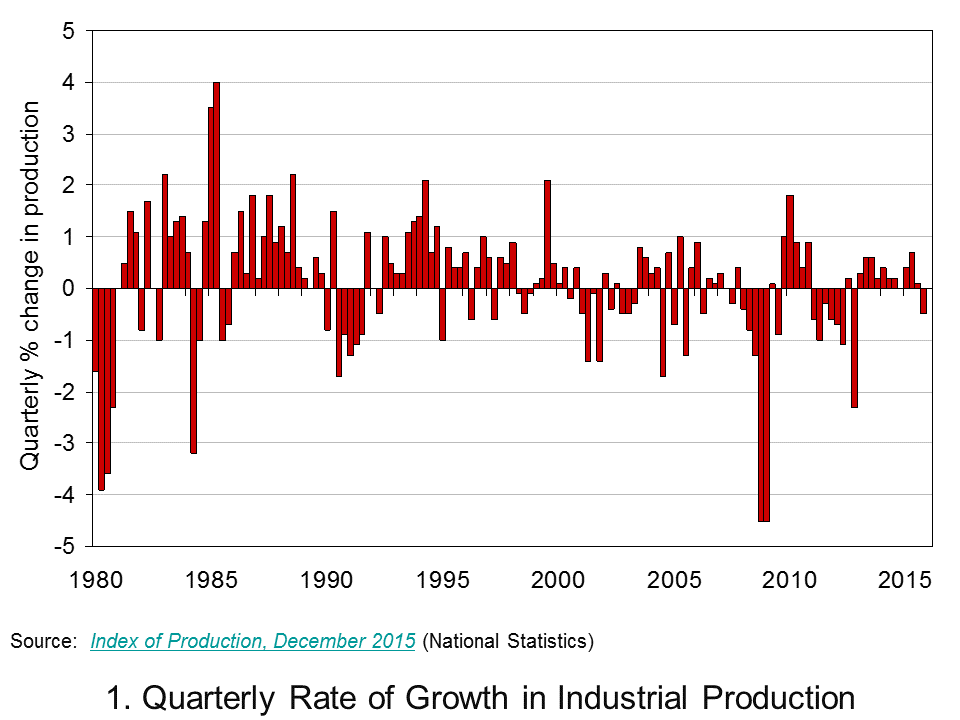 The production industries today account for about 15 per cent of UK output which is small in comparison to the roughly 79 per cent from service-sector industries. Chart 1 shows the quarterly rate of growth in UK industrial production since the 1980s. (Click here for a PowerPoint of the chart). Over this period the average quarterly rate of growth in industrial output has been a mere 0.1 per cent compared with 0.5 per cent for total economic output and 0.7 per cent for the service sector. As a result, the importance of the production industries as a driver of economic output has declined.
Across 2015 industrial production rose by 1 per cent while the total output of the economy grew by 2.2 per cent. Industrial output comprises four main components. Of these, output from mining and quarrying grew in 2015 by 6.6 per cent, water, sewerage and waste management by 3.1 per cent, electricity, gas, steam and air conditioning by 0.3 per cent, while manufacturing output contracted by 0.2 per cent.
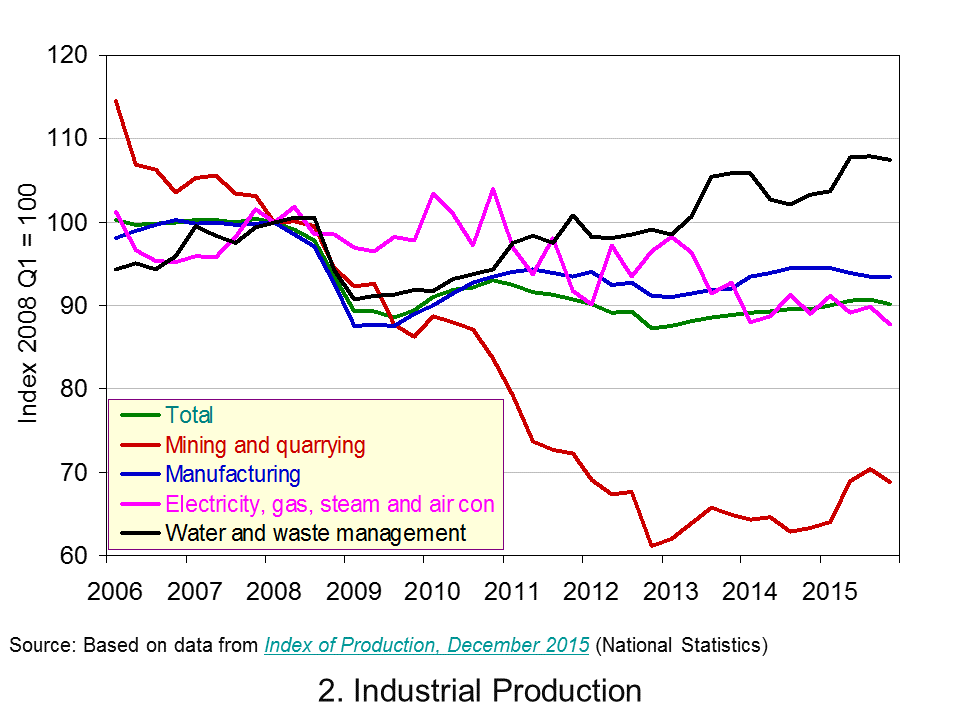 Chart 2 shows the path of industrial output since 2006. (Click here for a PowerPoint of the chart). In particular, it allows us to analyse the effect of the financial crisis and the global economic downturn. Whereas the total output of the economy surpassed its 2008 Q1 peak in 2013 Q2, driven by the service sector, total industrial output in 2015 Q4 remains 9.9 per cent below its 2008 Q1 level. Among its component parts, output in mining and quarrying is 31 per cent lower, electricity, gas, steam and air conditioning output is 12.2 per cent lower and manufacturing 6.5 per cent lower. Only the output of water, sewerage and waste management is greater – some 7.4 per cent higher.
The data point to the industrial composition of UK remaining heavily skewed towards the service sector and, hence, to service-sector industries driving economic growth. A key talking point is the extent to which this matters. On one hand we might point to the deindustrialisation captured by the data. This has had profound implications for certain regions of the United Kingdom and in particular for living standards in certain communities. Industrial change poses challenges for the UK labour force and for policymakers trying to affect the skills of workers needed in a changing economy. It has had a profound impact on the country’s balance of trade in goods: we consistently run a balance of trade deficit in goods. On the other hand we might argue that the UK does services well. We might be said to have a comparative advantage in this area. Whatever, your view point the latest industrial production data show the fragility of UK industrial output.
Data
Index of Production Dataset December 2015 Office for National StatisticsIndex of Production, December 2015 Office for National Statistics
Articles
UK industrial production shrank in 2015 Guardian, Phillip Inman (10/2/16)
December UK industrial output falls sharply BBC News, (10/2/16)
Manufacturing output fall dents UK growth hope Sky News, (10/2/16)
Industrial production’s worst monthly fall since 2012 Belfast Trelegraph, Holly Williams (11/2/16)
GDP growth picks up to 0.5% but only the services sector comes to the party Independent, Ben Chu (29/1/16)
Questions
- What is meant by industrial production? How does it differ from the economy’s total output?
- Would you expect the index of production to be less or more volatile than total output? Explain your answer.
- What factors might explain the volatility of industrial production?
- Do the different rates of growth across the industrial sectors of the UK matter?
- Discuss the economic issues that might arise as the industrial composition of a country changes.
- Why is the distinction between nominal and real important when analysing economic growth?
 In the blog the service sector continues to drive the UK business cycle written in October 2014 we observed how UK growth was being driven by the service sector while other industrial sectors struggled. The contrasting performance across UK industry appears now to be even more marked. The latest GDP numbers from the Office for National Statistics contained in Gross Domestic Product: Preliminary Estimate, Quarter 4 (Oct to Dec) 2015 show the economy’s output expanded by 0.5 per cent in the fourth quarter. Yet the construction sector is in recession following contractions of 1.9 per cent (Q3) and 0.1 per cent (Q4). Here we update our earlier blog to evidence the UK’s growth paradox.
Preliminary estimates suggest that the UK economy expanded by 0.5 per cent in the final quarter of 2015 following on from growth of of 0.4 per cent in the third quarter. 2015 as a whole saw output grow by 2.2 per cent, down from 2.9 per cent in 2014 and a little below the average over the past 60 years of around 2.6 per cent.
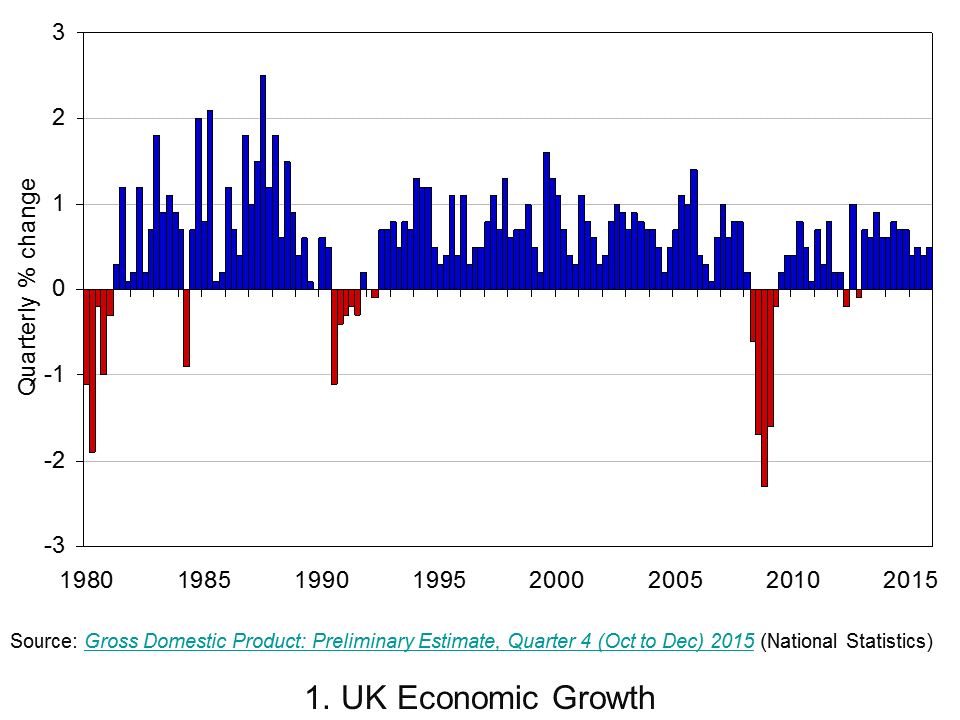 Chart 1 shows quarterly economic growth since 1980s (Click here for a PowerPoint of the chart). It illustrates nicely the inherent volatility of economies – one of the threshold concepts in economics.The average quarterly rate of growth since 1980 has been 0.5 per cent so on the face of it, a quarterly growth number of 0.5 per cent might seem to paint a picture of sustainable growth. Yet, the industrial make up of growth is far from balanced.
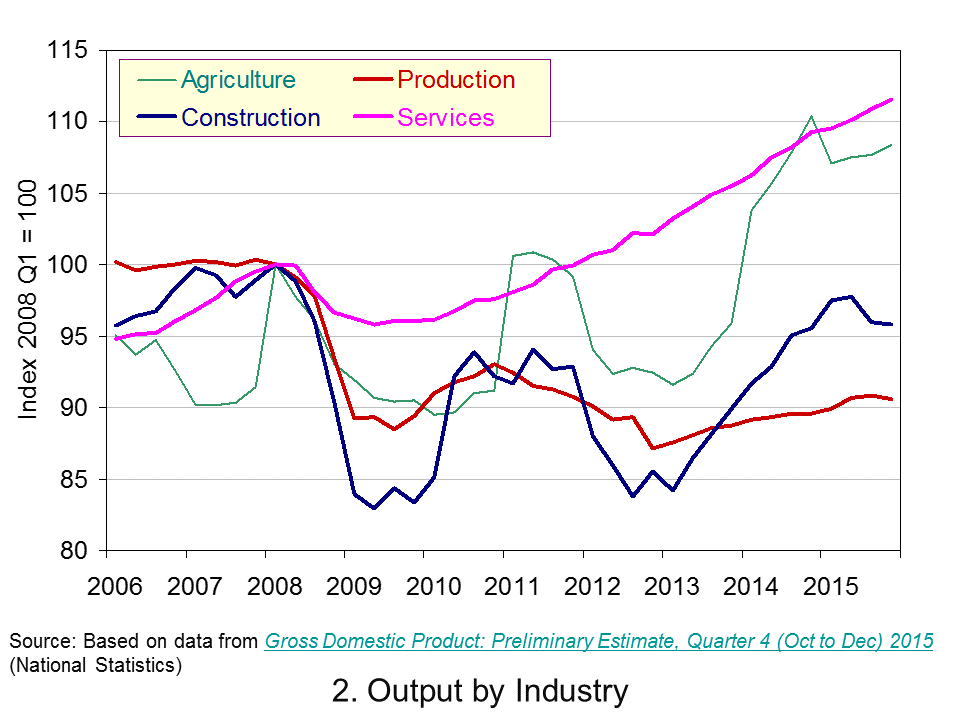 Consider now Chart 2 (Click here for a PowerPoint of the chart). It allows us to analyse more recent events by tracking how industrial output has evolved since 2006. It suggests an unbalanced recovery following the financial crisis. In 2015 Q4 the economy’s total output was 6.6 per cent higher than in 2008 Q1 with service-sector output 11.6 per cent higher. However, a very different picture emerges for the other principal industrial types.
The economy’s total output surpassed its 2008 Q1 peak in 2013 Q2, but output across the production industries in 2015 Q4 remains 9.4 per cent lower than in 2008 Q1 (and 6.4 per cent lower specifically within manufacturing) and 4.2 per cent lower in the construction sector. However, output in the agricultural sector has rebounded and is now 8.4 per cent higher than in 2008 Q1.
The growth data continue to show the British economy struggling to rebalance its industrial composition. With output in construction in 2015 Q4 2 per cent lower than it was in Q2 and manufacturing output 0.4 per cent lower, UK growth remains stubbornly dependent on the service sector.
Data
Preliminary Estimate of GDP – Time Series Dataset Quarter 4 (Oct to Dec) 2015 Office for National StatisticsGross Domestic Product: Preliminary Estimate, Quarter 4 (Oct to Dec) 2015 Office for National Statistics
Economy tracker: GDP BBC News
Articles
UK economic growth slows in 2015: what the economists are saying Guardian, Katie Allen (28/1/16)
UK economy grows 0.5% in fourth quarter BBC News, (28/1/16)
Bumpy times ahead’ for UK even as fourth quarter growth accelerates Telegraph, Szu Ping Chan (28/1/16)
UK economic growth rises to 0.5% in fourth quarter The Scotsman, Roger Baird (28/1/16)
GDP growth picks up to 0.5% but only the services sector comes to the party Independent, Ben Chu (29/1/16)
Questions
- What is the difference between nominal and real GDP? Which of these helps to track changes in economic output?
- Looking at Chart 1 above, summarise the key patterns in real GDP since the 1980s.
- What is a recession?
- What are some of the problems with the traditional definition of a recession?
- Can a recession occur if nominal GDP is actually rising? Explain your answer.
- What factors lead to economic growth being so variable?
- What factors might explain the very different patterns seen since the late 2000s in the volume of output of the four main industrial sectors?
- What different interpretations could there be of a ‘rebalancing’ of the UK economy?
- What other data might we look at to analyse whether the UK economy is ‘rebalancing’?.
- Do the different rates of growth across the industrial sectors of the UK matter?
- Produce a short briefing paper exploring the prospects for economic growth in the UK over the next 12 to 18 months.
- What is the difference between GVA and GDP?
- Explain the arguments for and against using GDP as a measure of a country’s economic well-being.
 The Chinese economy was, for some time, the beacon of the world economy, posting strong growth and giving a much needed boost to demand in other countries. However, the weakening Chinese economy is now causing serious concerns around the world and not least in China itself.
China’s stock market on Monday 11th January closed down 5.3%, with the Hong Kong Index down by 2.8%. These falls suggest a continuing downward trajectory this week, following the 10% decline on Chinese markets last week. Today, further falls were caused, at least in part, by uncertainty over the direction of the Chinese currency, the yuan. Volatility in the currency is expected to continue with ongoing depreciation pressures and adding to this is continuing concerns about deflation.
The barrage of bad news on key economic indicators may well mean significant intervention by Chinese authorities to try to avoid its slowest growth in 25 years. However, there are also concerns about China’s ability to manage its economic policy, given recent events. IG’s Angus Nicholson said:
“Global markets are still in the grips of China fears, and it is uncertain whether the Chinese government can do enough to reassure global investors.”
Similar sentiments were echoed by Paul Mackel, head of emerging markets FX research at HSBC:
“Different signals about foreign exchange policy have wrong-footed market participants and we are wary in believing that an immediate calmness will soon emerge.”
Perhaps key to turning this downward trend on its head, will be the Chinese consumers. With a traditionally larger saving ratio than  many Western economies, it may be that this ‘cushion’ will give growth a boost, through the contribution of consumer spending. As we know, aggregate demand comprises consumption, investment, government spending and net exports (AD = C + I + G + X – M). Consumer spending (C) increased from 50.2% in 2014 to 58.4% in 2015, according to HIS Global Insight. A similar increase for 2016 would certainly be welcome.
As oil prices continue to fall and concerns remain over China’s weak economic data, we may well soon begin to see just how interdependent the world has become. Many economists suggest that we are now closer to the start of the next recession than we are to the end of the last one and this latest turmoil on Chinese stock markets may do little to allay the fears that the world economy may once again be heading for a crash. The following articles consider the Chinese turmoil.
Free lunch: China’s weakest link Financial Times, Martin Sandbu (11/01/16)
China’s stocks start the week with sharp losses BBC News (11/01/16)
China shares fall 5% to hit-three-month low The Guardian (11/01/16)
China’s resilient shoppers face fresh test from market headwinds Bloomberg (11/01/16)
China shares head lower again on price data Sky News (11/01/16)
U.S., European shares slip as China, oil woes continue Reuters, Lewis Krauskopf (11/01/16)
U.S. stocks drop as oil tumbles again Wall Street Journal (11/01/16)
China escalates emergency stock market intervention The Telegraph, Mehreen Kahn (05/01/16)
Questions
- How are prices and values determined on the stock market?
- Share prices in China have been falling significantly since the start of 2016. Has it been caused by demand or supply-side factors? Use a demand and supply diagram to illustrate this.
- Why has the volatility of the Chinese currency added further downward pressure to Chinese stock markets?
- With the expected increase in consumer spending in China, how will this affect AD? Use a diagram to explain your answer and using this, outline what we might expect to happen to economic growth and unemployment in China.
- Why are there serious concerns about the weak level of inflation in China? Surely low prices are good for exports.
- Should the world economy be concerned if China’s economy does continue to slow?
- To what extent are oil prices an important factor in determining the future trajectory of the world economy?
 The Federal Reserve chair, Janet Yellen, has been giving strong signals recently that the US central bank will probably raise interest rates at its December 16 meeting or, if not then, early in 2016. ‘Ongoing gains in the labor market’ she said, ‘coupled with my judgement that longer-term inflation expectations remain reasonably well anchored, serve to bolster my confidence in a return of inflation to 2%.’ This, as for many other central banks, is the target rate of inflation.
In anticipation of a rise in US interest rates, the dollar has been appreciating. Its (nominal) exchange rate index has risen by 24% since April 2014 (see chart below).
In the light of the sluggish eurozone economy, the ECB president, Mario Draghi, has been taking a very different stance. He has indicated that he stands ready to cut interest rates further and increase quantitative easing.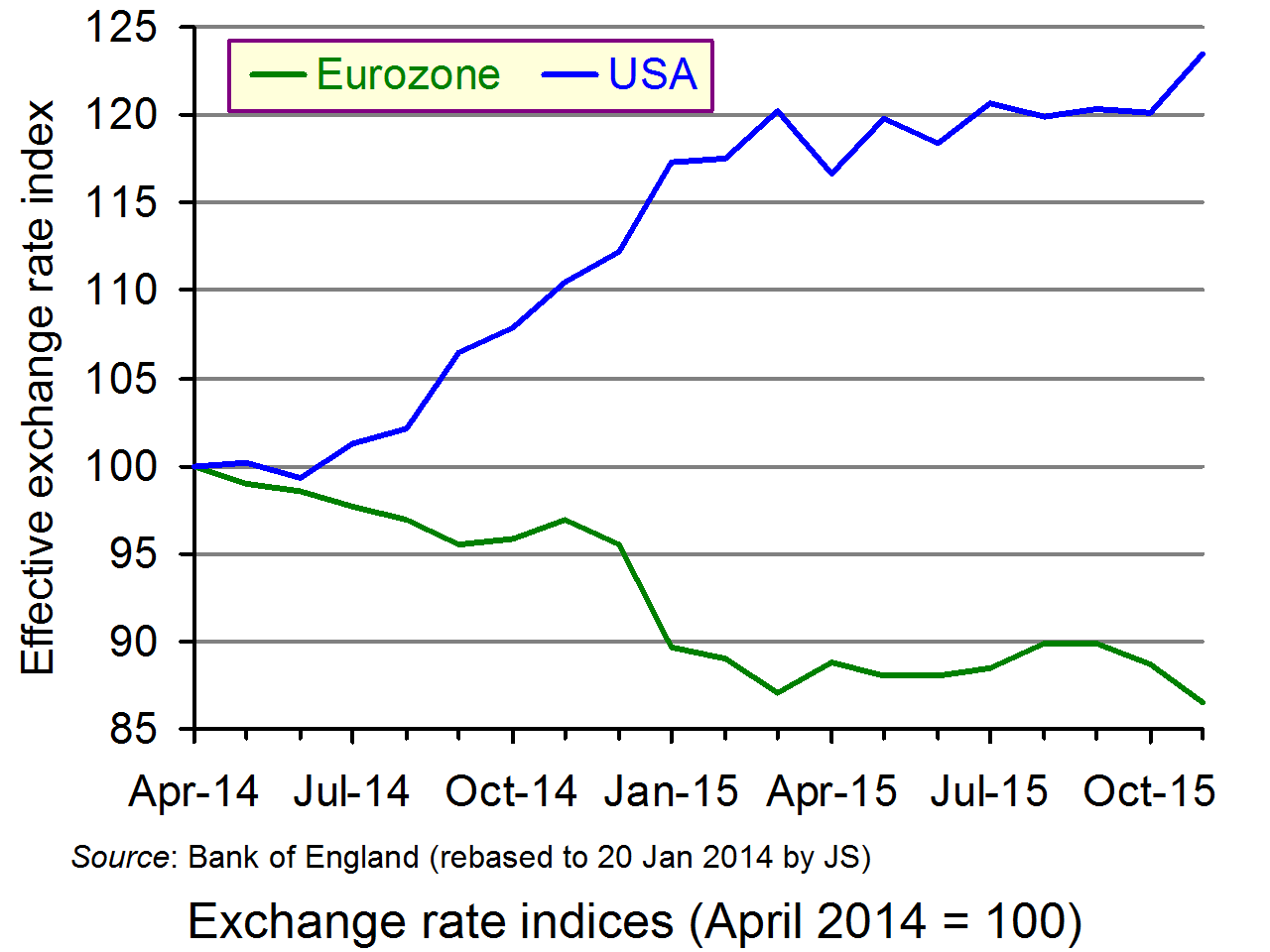 At the meeting on 3 December, the ECB did just that. It announced a further cut in the deposit rate, from –0.2 to –0.3 and an extension of the €60 billion per month QE programme from September 2016 to March 2017 (bringing the total by that time to €1.5 trillion – up from €1.1 trillion by September 2016).
Stock market investors had been expecting more, including an increase in the level of monthly asset purchases above €60 billion. Consequently stock markets fell. Both the German DAX and the French CAC 40 stock market indices fell by 3.6%. The euro also appreciated against the dollar by 2.7% on the day of the announcement. Nevertheless, since April 2014, the euro exchange rate index has fallen by 13%. Against the US dollar, the euro has depreciated by a massive 31%.
So what will be the consequences of the very different monetary policies being pursued by the Fed and the ECB? Are they simply the desirable responses to a lack of convergence of the economic performance of the US and eurozone economies? In other words, will they help to bring greater convergence between the two economies?
Or will the desirable effects of convergence be offset by other undesirable effects for the USA and the eurozone and also for the rest of the world?
|
|
| • |
Will huge amounts of dollar-denominated debt held by many emerging economies make it harder to service these debts with an appreciating dollar? |
| • |
How much will US exporters suffer from the dollar’s rise and what will the US authorities do about it? |
| • |
Will currency volatility lead to currency wars and, if so, what will be their economic effects? |
| • |
Will the time lags involved in the effects of the continuing programme of QE in the eurozone eventually lead to overheating? Already euro money supply is rising, on both narrow and broad measures. |
The following articles address these issues.
Articles
The Fed and the ECB: when monetary policy diverges The Guardian, Mohamed El-Erian (2/12/15)
European stocks slide after ECB dashes hopes of major QE expansion The Guardian, Heather Stewart and Graeme Wearden (3/12/15)
Mario Draghi riles Germany with QE overkill The Telegraph, Ambrose Evans-Pritchard (3/12/15)
How the eurozone missed its shot at a recovery The Telegraph, Peter Spence (3/12/15)
Yellen Signals Economy Nearly Ready for First Interest-Rate Hike Bloomberg, Christopher Condon (3/12/15)
Exchange rate data
Effective exchange rate indices Bank for International Settlements
Exchange rates Bank of England
Questions
- What would be the beneficial effects to the US and eurozone economies of their respective monetary policies?
- Explain the exchange rate movements that have taken place between the euro and the dollar over the past 19 months. How do these relate to the various parts of the balance of payments accounts of the two economies?
- Is it possible for the USA to halt the rise in the dollar while at the same time raising interest rates? Explain.
- Why are some members of the ECB (e.g. the German and Dutch) against expanding QE? Assess their arguments.
- What will be the impact of US and eurozone monetary policies on emerging economies?
- What will be the impact of US and eurozone monetary policies on the UK?
- Why did the euro appreciate after the Mario Draghi’s press statement on 3 December? What has happened to the dollar/euro exchange rate since and why?
 The perceived wisdom is that nominal interest rates have a lower zero bound. The Swedish central bank (the Ricksbank) has effectively been charging financial institutions to deposit money at the central bank since 2009. On 29 January 2016 the Central Bank of Japan also introduced a negative interest rate on deposits. The -0.1 per cent rate currently applies to a portion of the reserves held by financial institutions at the central bank. The move is another attempt to pump energy into a struggling economy.
 The further loosening of monetary policy through a negative interest rate follows on the heels of an acceleration of quantitative easing last October. Back then, the Bank of Japan said that it would conduct Open Market Operations so that the monetary base would increase annually be ¥80 trillion. This was reaffirmed in its 29 January announcement. For an economy that has experienced four recessionary contractions since 2008 and with provisional estimates suggesting that it contracted by 0.4 per cent in the final quarter of 2015, it remains to be seen whether further monetary loosening might yet be called for.