 The UK economy faces a growing problem of energy supplies as energy demand continues to rise and as old power stations come to the end of their lives. In fact some 10% of the UK’s electricity generation capacity will be shut down this month.
Energy prices have risen substantially over the past few years and are set to rise further. Partly this is the result of rising global gas prices.
In 2012, the response to soaring gas prices was to cut gas’s share of generation from 39.9% per cent to 27.5%. Coal’s share of generation increased from 29.5% to 39.3%, its highest share since 1996 (see The Department of Energy and Climate Change’s Energy trends section 5: electricity). But with old coal-fired power stations closing down and with the need to produce a greater proportion of energy from renewables, this trend cannot continue.
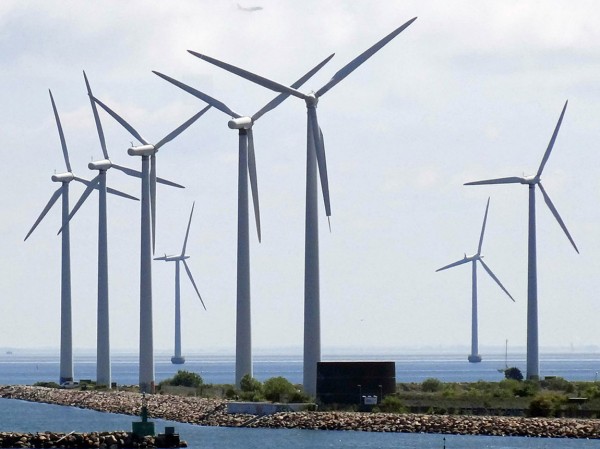 But new renewable sources, such as wind and solar, take a time to construct. New nuclear takes much longer (see the News Item, Going nuclear). And electricity from these low-carbon sources, after taking construction costs into account, is much more expensive to produce than electricity from coal-fired power stations.
So how will the change in balance between demand and supply affect prices and the security of supply in the coming years. Will we all have to get used to paying much more for electricity? Do we increasingly run the risk of the lights going out? The following video explores these issues.
Webcast
UK may face power shortages as 10% of energy supply is shut down BBC News, Joe Lynam (4/4/13)
Data
Electricity Statistics Department of Energy & Climate Change
Quarterly energy prices Department of Energy & Climate Change
Questions
- What factors have led to a rise in electricity prices over the past few years? Distinguish between demand-side and supply-side factors and illustrate your arguments with a diagram.
- Are there likely to be power cuts in the coming years as a result of demand exceeding supply?
- What determines the price elasticity of demand for electricity?
- What measures can governments adopt to influence the demand for electricity? Will these affect the position and/or slope of the demand curve?
- Why have electricity prices fallen in the USA? Could the UK experience falling electricity prices for similar reasons in a few years’ time?
- In what ways could the government take into account the externalities from power generation and consumption in its policies towards the energy sector?
 In the blog No accounting for trade, the rise in the UK’s balance of trade deficit was discussed. Many factors have contributed to this weakening position and no one market is to blame. But, by analysing one product and thinking about the factors that have caused its export volumes to decline, we can begin to create a picture not just of the UK economy (or more particularly Scotland!), but of the wider global economy.
Scotch whisky may not have been the drink of choice for many British adults, but look outside Great Britain and the volume consumed is quite staggering. For example, French consumers drink more Scotch whisky in one month than they drink cognac in one year. The volume of Scotch whisky exported from our shores was £4.23 billion for 2011, accounting for 90% of all sales and making its way into 200 markets. However, one problem with this product is that it is highly susceptible to the business cycle. Add to this the time required to produce the perfect Scotch (in particular the fact that it must be left to mature) and we have a market where forecasting is a nightmare.
Producers typically look to forecast demand some 10 years ahead and so getting it right is not always easy, especially when the global economy declines following a financial crisis! So what has been the impact on exports of this luxurious drink? In the past few years, it has been as key growth market for UK exports rising by 190% in value over the past decade. But in 2012 the volume of Scotch whisky exports fell by 5% to 1.19 billion bottles. What explains the decline in sales?
The biggest importer of Scotch whisky is France and its volumes were down by 25%. Part of this decline is undoubtedly the economic situation. When incomes decline, demand for normal goods also falls. Many would suggest Scotch whisky is a luxury and thus we would expect to see a relatively large decline following any given fall in income. However, another factor adding to this decline in 2012 is the increased whisky tax imposed by the French government. Rising by 15% in 2012, commentators suggest that this caused imports of Scotch whisky to rise in 2011 to avoid this tax, thus imports in 2012 took a dive. Spain is another key export market and its economic troubles are clearly a crucial factor in explaining their 20% drop in volume of Scotch whisky imported.
But, it’s not all bad news: sales to Western Europe may be down, but Eastern Europe and other growth countries/continents, such as the BRICs and Africa have developed a taste for this iconic product. Latvia and Estonia’s value of Scotch whisky imports were up by 48% and 28% respectively, as Russian demand rises and China, still growing, is another key market. Gavin Hewitt, chief executive of the Scotch Whisky Association said:
A combination of successful trade negotations, excellent marketing by producers, growing demand from mature markets, particularly the USA, and the growing middle class in emerging economies helped exports hit a record £4.3bn last year.
Furthermore, while the volume of exports worldwide did fall, the value of these exports rose to £4.27 billion, a growth of 1%. This suggests that although we are exporting fewer bottles, the bottles that we are exporting are more expensive ones. Clearly some people have not felt the impact of the recession. For Scotland and the wider UK, these declining figures are concerning, but given the cyclical nature of the demand, as the world economy slowly begins to recover, sales are likely to follow suit. Gavin Hewitt continued his comments above, saying:
We are contributing massively to the Government’s wish for an export-led recovery. There is confidence in the future of the industry, illustrated by the £2bn capital investment that Scotch whisky producers have committed over the next three to four years.
The following articles consider the rise and fall of this drink and its role as a key export market across the world.
 Scottish whisky industry puts export hope in new market BBC News (2/4/13)
Scotch whisky sales on the slide The Guardian, Simon Neville (2/4/13)
Growth stalls for Scotch whisky exports BBC News (2/4/13)
Scotch whisky accounts for 25pc of UK’s food and drink exports The Telegraph, Auslan Cramb (2/4/13)
Whisky sales fall but value of exports hits new high Herald Scotland (3/4/13)
Scotch whisky exports rise to record value The Telegraph, Auslan Cramb (2/4/13)
Scotch whisky exports hit by falling demand in France The Grocer, Vince Bamford (2/4/13)
New markets save Scotch from impact of austerity Independent, Tom Bawden (2/4/13)
Scotch exports hit by falling demand Financial Times, Hannah Kichler (2/4/13)
Questions
- Which is the better measure of an industry’s performance: the value or the volume of goods sold?
- Why would you expect volumes of Scotch sold to decline during an economic downturn?
- When a higher tax was imposed on Scotch whisky in France, why did volumes fall? Use a demand and supply diagram to illustrate the impact of the tax.
- What type of figure would you expect Scotch whisky to have for income elasticity of demand? Does it vary for different people?
- Why is forecasting demand for Scotch so difficult? What techniques might be used?
- Why does demand for Scotch whisky remain high and even rising in many emerging markets?
- Is the market for Scotch whisky exports a good indication of the interdependence of countries across the world?
 VAT was introduced on the 1st of April 1973, as part of the conditions for the UK entering the Common Market. Designed by a French tax expert, Maurice Lauré, it was initially envisaged as a straightforward replacement for purchase tax, which would be applied to most goods and services.
Forty years on, VAT is increasingly complex, with numerous exemptions, many anomalies in its scope, and increasingly expensive challenges to its imposition. How did we get to this point? And is it time for VAT to undergo a mid-life makeover?
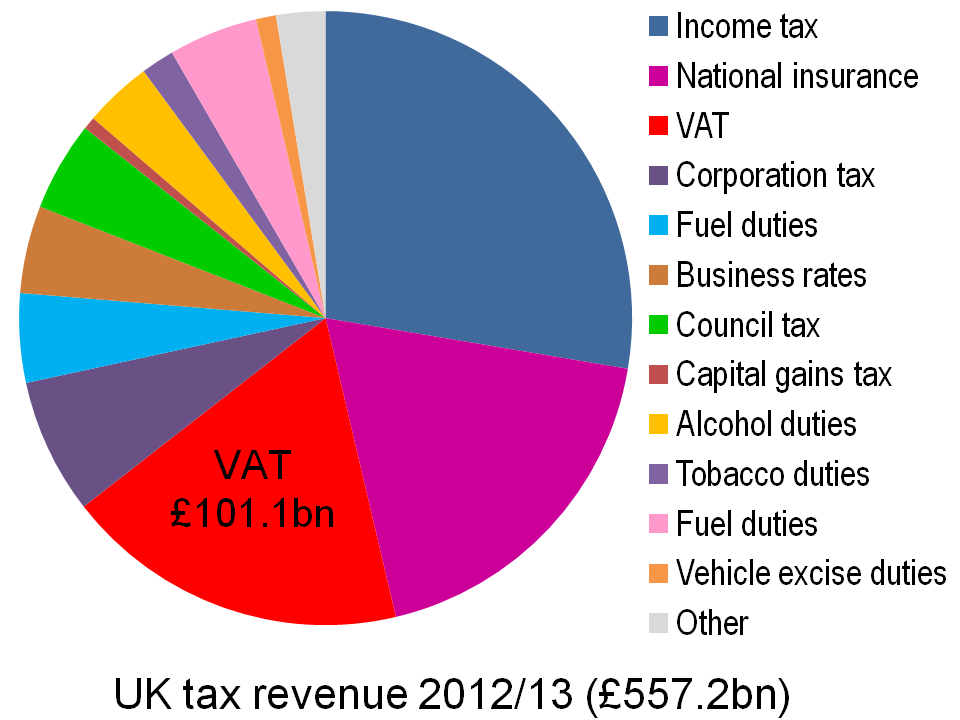
All governments have to raise taxes – to redistribute income and to fund public spending. They have a number of mechanisms they can use, but essentially they have to tax incomes (direct taxes), spending (indirect taxes) or a mix of both. The main indirect tax in the UK is VAT, which now raises over £100bn a year, compared with £1.5bn in its first year (see above chart: click here for a PowerPoint version). Initially envisaged as a simple, cross-Europe purchase tax, the current system is complex and at times appears to have been formulated ‘on the hoof’, never a good way to build a tax system.
In the 2012 Budget, the Chancellor decided to apply the standard rate of income tax to hot takeaway pasties; previously they had been zero-rated. However, he had sharply underestimated the ability of the industry to lobby against the tax, working closely with the tabloid press. Perhaps more importantly, he also missed the complex nature of the good; when is a hot pasty just cooling down? And what is hot? The government backtracked and now 20% VAT is only charged on pasties that are deliberately kept hot. You might think that this change of heart avoided introducing an anomaly, but consider how you might feel if you sell takeaway baked potatoes, which are subject to VAT.
Apart from the complexity of the system, VAT is unpopular with some commentators who feel that it falls too heavily on low-income households. Although many foodstuffs are zero-rated and housing is exempt, VAT is charged at 20% on clothing and many necessities such as cleaning materials. Gas and electricity are subject to a reduced rate of 5% and both alcohol and cigarettes have additonal excise duties imposed and yet are disproportionally consumed by the poor. When the standard rate of VAT was temporarily dropped to 15% in 2010, but then permanently raised to 20% in 2011, many felt that this was a shift in the tax burden to the poor.
So complex, irrational and prone to changes following political lobbying or expensive legal cases, VAT does seem to be stumbling into its forties under something of a cloud. However, it remains the case that it raises a large proportion of UK tax revenues at relatively low direct cost and provides the Chancellor with a reasonably effective fiscal policy tool. Even if a government wanted to put in place an alternative, it is likely that the associated political risks would be too high for it to do so. We might hope for some rationalisation of the current system, but there is little doubt that we will be raising a glass to VAT’s 50th birthday in 2023.
The links below include some articles on VAT’s 40th birthday and some more general articles on VAT.
Articles
VAT is 40 years old- and now has middle-age spread The Guardian, Juliette Garside (31/1/13)
Is VAT suffering a mid-life crisis at 40? BBC News, Colin Corder (31/3/13)
VAT at 40, not simple, not popular, but central to government revenue-raising The Chartered Institute of Taxation (28/3/13)
Happy birthday VAT, here’s how not to pay you The Telegraph, Rosie Murray-West (31/3/13)
Poorest spend higher proportion of VAT than richest BBC News (31/10/11)
A Value- Added Tax offers much to love- and hate New York Times, Gregory Mankiw (1/5/10)
EC Standard VAT Declaration European Commission Roadmap (2012)
Data and information
VAT pages HMRC
Public sector finance statistics HM Treasury (follow link to latest Public finances databank (Excel file) and go to Worksheet C2)
Latest European Union EU VAT rates VATLive
Questions
- Explain why VAT might be deemed regressive. Can you formulate an argument that it falls more heavily on the rich than the poor?
- Why is VAT administratively cheap? Other than generating tax revenues, can you think of any advantages of the tax?
- Newspapers and books are zero-rated in the UK, while e-books and news apps are standard rated at 20%. Can you identify some other anomalies in the UK VAT system? Is there an argument that a better approach would be to charge a lower rate on all goods and services?
- Who pays VAT, consumers or producers? Illustrate your answer with a diagram, or two.
- A business has to register for VAT once it has a turnover of £77,000 pa. Does this system give rise to any perverse incentives?
- Countries across the European Union have varying VAT rates, applied to very different ranges of products. Explain why this might hinder the workings of a single European market.
- Imagine you were running a brand new economy; would you use a value-added tax to raise revenues? What are the alternatives open to governments?
 House prices have long been an obsession with the UK media and much of the public; when they rise, homeowners feel rich, when they fall, consumer confidence dives. Following the financial crisis and subsequent recession, there has been a great deal of attention focused on the overall health of the housing market.
But the UK faces a particular problem of a sharp and growing divide in regional house prices. First time buyers in London face having to find high deposits and even then, many are unable to access mortgages. Meanwhile those in the regions can access more affordable housing, but may be reluctant to enter the market when prices are stagnant. What are the implications of this divide for the housing market and for the broader economy?
The housing market demonstrates characteristics which are typical of those for goods that are both consumable and involve capital growth; when prices rise housing is seen as a good ‘investment’ and demand increases, this in turn leads to higher prices. Conversely when values drop, demand falls and the market slumps. Markets like this are described as being prone to price bubbles.
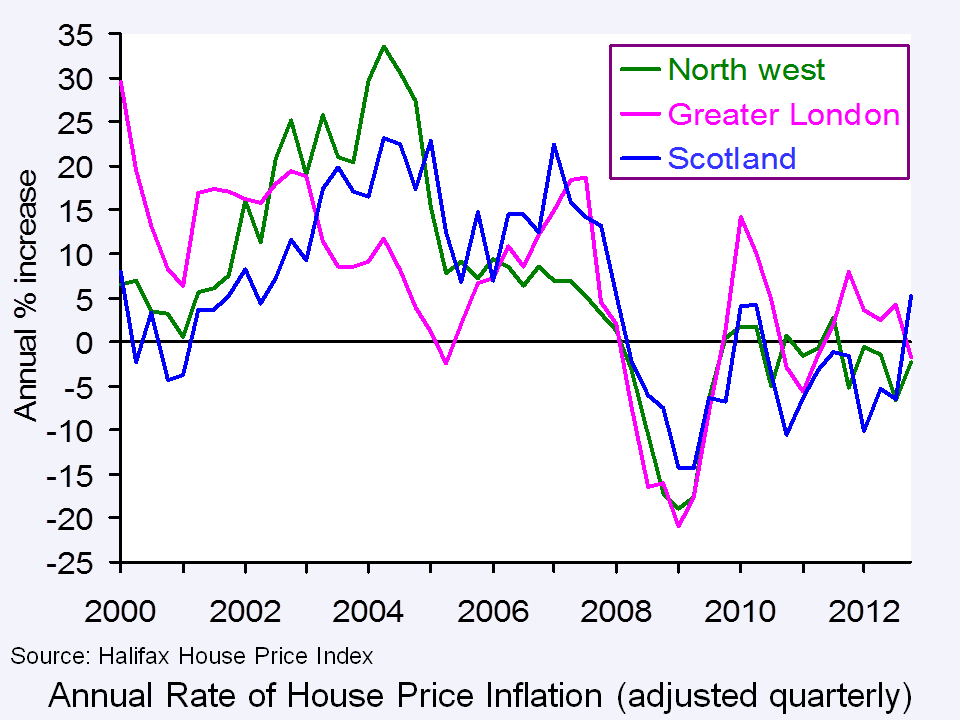 Looking at UK house prices as a whole can, however, mask large variations across the economy; variations which can cause problems for jobseekers, for employers and for the government. Recently one of the UK’s largest mortgage lenders predicted continuing regional variance in house prices. Halifax’s figures looked at the price of housing across a number of UK towns and showed that changes seen during 2012 ranged from a 14.8 per cent rise to an 18.4 per cent fall. The biggest rise seen during the year was in Southend on Sea, in Essex, while the greatest fall was in Craigavon, in Northern Ireland. Of the ten towns with the biggest rises, eight were found in London or the south east, with Durham being the only northern town showing growth. Of the ten towns that the Halifax identified with the biggest falls, four are in Scotland, three are in the north west, one is in the north of England and one is in Northern Ireland.
Martin Ellis, housing economist at the Halifax, said:
We expect continuing broad stability in house prices nationally in 2013. The generalised north/south divide in house price performance seen during 2012 is likely to continue next year. House prices are expected to be strongest in London and the south east as this part of the country performs best in economic terms.
These disparities present a particular problem in a recession. While London and the south east show signs of economic growth, with relatively low unemployment and high levels of inward investment, many regions outside London see house prices falling further as unemployment grows. There are some exceptions – the arrival of the BBC in Salford has resulted in a sharp increase in prices there – but, in general, confidence is low outside the south east.
The articles below consider regional differences in the housing market.
Articles
House prices creep up over 2012 The Guardian, Patrick Collinson (29/1/13)
Which regions of the UK will show the biggest house price rises in the next 5 years? This is Money, Rachel Rickard Straus (17/1/13)
Figures reveal scale of regional house price divide Inside Housing, Tom Lloyd (2/1/13)
Property market gets a budget boost, so are things looking up? This is Money, Simon Lambert (21/3/13)
Help to Buy scheme could drive up house prices, says OBR The Guardian, Josephine Moulds and Jennifer Rankin (26/3/13)
London house prices outstrip 2007 peak with a 2.8% increase The Guardian, Hilary Osborne (28/3/13)
Housing market in southeast is worth £2tn Financial Times, James Pickford and Ed Hammond (1/2/13)
House prices show annual increase Evening Standard (28/3/13)
House price data
Links to house price data The Economics Network
Regional Historical House Price Data Halifax House Price Index (Lloyds Banking Group)
Questions
- Thinking about the market for owner-occupied housing, what are the factors that will determine demand? How might these explain variations in demand across different regions of the UK?
- How does the supply of housing vary across the UK?
- What would you predict about regional variations in rents?
- What is the impact of high house prices in London on first time buyers? Does this matter?
- What are the implications for the labour market of sharp variations in house prices across regions?
- Why might the Chancellor want to put in place policies to boost the housing market?
- Who gains from high house prices? Who loses? You might want to think about this in term of the life-cycle.
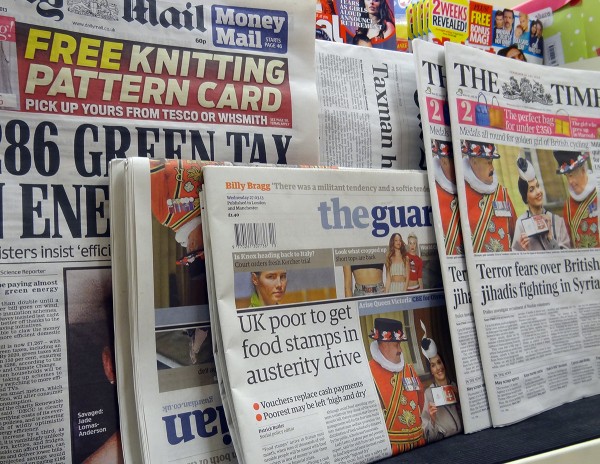 Technology and the Internet have both good and bad sides, whether it’s for businesses or consumers. Many opportunities have been created, such as access to global markets, cheaper and easier transport and communication and better sources of supply. But with this opportunity comes threats, especially for businesses. We’ve seen the emergence of new online-based companies and in some cases these have contributed to the demise of other firms. In this News Item we look at the impact on the newspaper industry.
Media is one industry that has been significantly affected by technological developments. Newspaper readership has been in decline for many years and this is even the case for the most widely read UK paper – The Daily Telegraph. However, according to Seamus Dooley, Irish secretary of the National Union of Journalists, it’s not the end of the industry:
It is an industry in crisis, but I don’t accept it is an industry in terminal decline.
More and more information has become freely available online and just as we would expect in any other sector, the newspaper industry has had to respond. To keep their readers, newspapers across the world provide thousands of articles on all topics on their websites. But if news can be accessed freely, why bother purchasing a newspaper? This is the problem facing the Daily Telegraph, the Independent, the Daily Mail etc – the number of newspapers sold has declined and thus so have revenues and profits.
 One option is to charge consumers for reading the news by introducing a subscription to the online articles. The Financial Times already charges a fee to view articles online beyond a certain number and The Telegraph is soon to follow suit. Back in 2010, The Times and Sunday Times launched their new websites, which charged readers for viewing articles. The model being adopted by The Telegraph is a little different, as a certain number of articles can be viewed for free before a price must be paid. International readers are already charged to view online material, but these new charges will apply to UK readers. With so much competition facing newspapers, the number of readers for The Telegraph will undoubtedly decline, but with newspaper readership falling, revenues must come from somewhere. Tony Gallagher has said:
We want to develop a closer rapport with our digital audience in the UK, and we intend to unveil a number of compelling digital products for our loyal subscribers in the months ahead.
Differentiating the product is going to be essential for any newspaper that begins charging, as with so much information available online for free, they have to ensure they keep their readers. Establishing loyalty will be crucial. The following articles consider this change.
Telegraph extends paywall to UK readers BBC News (26/3/13)
The Telegraph: subscribe to Britain’s finest journalism The Telegraph (26/3/13)
Telegraph to put up metered paywall Guardian, Roy Greenslade (26/3/13)
The sun joins Telegraph in charging website users The Guardian, Lisa O’Carroll and Roy Greenslade (26/3/13)
Oh how Times are charging Sloman News Site March 2010
Telegraph introduces UK paywall Marketing Week, Lara O’Reilly (26/3/13)
Washington Post announces porous paywall Journalism.co.uk, Sarah Marshall (19/3/13)
Washington Post latest newspaper to put faith in paywalls The Guardian, Dominic Rushe (19/3/13)
Ireland’s newspapers suffer hard times Financial Times, Jamie Smythe (24/3/13)
Washington Post to start charging for website Wall Street Journal, Keach Hagey (18/3/13)
Questions
- Where would you put newspapers on the product life cycle? Explain your answer.
- How would you assess the effect of the development of technology and the internet for newspapers?
- Have readers of newspapers benefited from the internet?
- How might estimates of elasticity have been used to make the decision to charge to view online articles?
- Which consumers will be affected most by this new strategy?
- How might companies that don’t charge for online access benefit from this new strategy?
- Would you continue to read articles from The Times, the Financial Times, The Telegraph, etc. linked from this site if you had to pay to access them? If so, why? If not, why not?
- How much would you be prepared to pay to access online articles? How are the concepts of utility and consumer surplus relevant here?
- What effect will the paywall have on The Telegraph’s revenues and profits? Use a diagram to illustrate your answer.
 The UK economy faces a growing problem of energy supplies as energy demand continues to rise and as old power stations come to the end of their lives. In fact some 10% of the UK’s electricity generation capacity will be shut down this month.
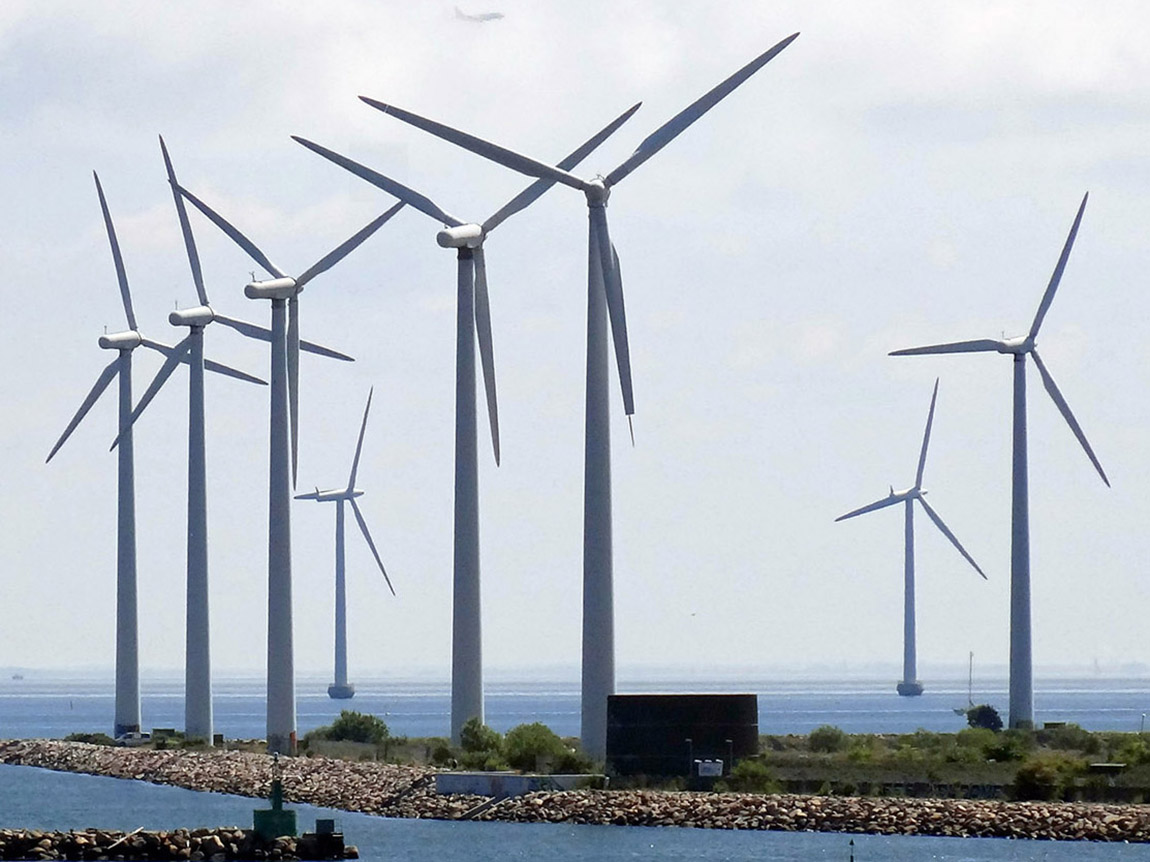 But new renewable sources, such as wind and solar, take a time to construct. New nuclear takes much longer (see the News Item, Going nuclear). And electricity from these low-carbon sources, after taking construction costs into account, is much more expensive to produce than electricity from coal-fired power stations.