 For all households, energy is considered an essential item. As electricity and gas prices rise and fall, many of us don’t think twice about turning on the lights, cooking a meal or turning on the heating. We may complain about the cost and want prices brought down, but we still pay the bills. But, is there anything that can be done about high energy prices? And if there is, should anything be done?
The worlds of politics and economics are closely linked and Ed Miliband’s announcement of his party’s plans to impose a 20-month freeze on energy prices if elected in 2015 showed this relationship to be as strong as ever. The price freeze would certainly help average households reduce their cost of living by around £120 and estimates suggest businesses would save £1800 over this 20 month period. The energy companies have come in for a lot of criticism, in particular relating to their control of the industry. The sector is dominated by six big companies – your typical oligopoly, and this makes it very difficult for new firms to enter. Thus competition is restricted. But is a price freeze a good policy?
 Part of the prices we pay go towards investment in cleaner and more environmentally friendly sources of energy. Critics suggest that any price freeze would deprive the energy sector of much needed investment, meaning our energy bills will be higher in the future. Furthermore, some argue this price freeze suggests that Labour is abandoning its environmental policy. Energy shortages have been a concern, especially with the cold weather the UK experienced a few years ago. This issue may reappear with price freezes. As Angela Knight, from Energy UK, suggests:
Freezing the bill may be superficially attractive, but it will also freeze the money to build and renew power stations, freeze the jobs and livelihoods of the 600,000-plus people dependent on the energy industry and make the prospect of energy shortages a reality, pushing up the prices for everyone.
There is a further concern and that is that large energy companies will be driven from the UK. This thought was echoed by many companies, in particular the British Gas owner Centrica, commenting that:
If prices were to be controlled against a background of rising costs it would simply not be economically viable for Centrica to continue to operate and far less to meet the sizeable investment challenge that the industry is facing…The impact of such a policy would be damaging for the country’s long-term prosperity and for our customers.
Share prices naturally fluctuate with global events and a political announcement such as this was inevitably going to cause an effect. But, perhaps the effect was not expected to be as big as the one we saw. 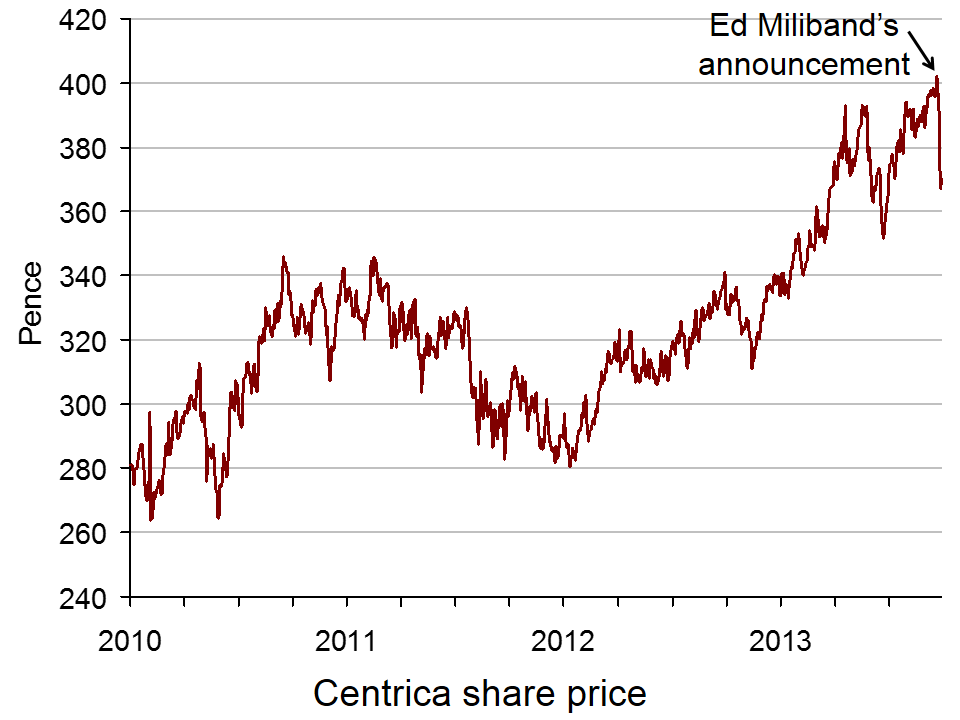 Share prices for Centrica and SSE fell following the announcement – perhaps no great shock – but then they continued to fall. The market value tumbled by 5% and share prices kept falling. This has led to Ed Miliband being accused of ‘economic vandalism’ by a major shareholder of Centrica, which is hardly surprising, given the estimated cost of such a price freeze would be £4.5 billion.
The economic implications of such a move are significant. The announcement itself has caused massive changes in the FTSE and if such a move were to go ahead if Labour were elected in 2015, there would be serious consequences. While families would benefit, at least in the short term, there would inevitably be serious implications for businesses, the environmental policy of the government, especially relating to investment and the overall state of the economy. The following articles consider the aftermath of Ed Miliband’s announcement.
Miliband stands firm in battle over fuel bills plan The Guardian, Patrick Wintour and Terry Macalister (25/9/13)
Michael Fallon calls Miliband’s energy prices pledge ‘dangerous’ Financial Times, Elizabeth Rigby and Jim Pickard (26/9/13)
Britain’s labour treads narrow path between populism and prudence Reuters (26/9/12)
Ed Miliband’s radical reforms will make the energy market work for the many Independent (26/9/13)
Has Labour fallen out of love with Business? BBC News (26/9/13)
Top Centrica shareholder Neil Woodford accuses Labour leader Ed Miliband of economic vandalism The Telegraph, Kamal Ahmed (25/9/13)
Centrica and SSE slide after Labour price freeze pledge The Guardian (26/9/13)
Ed Miliband’s energy price freeze pledge is a timely but risky move The Guardian, Rowena Mason (24/9/13)
Questions
- Why are energy prices such a controversial topic?
- How are energy prices currently determined? Use a diagram to illustrate your answer. By adapting this diagram, illustrate the effect of a price control being imposed. How could it create an energy shortage? What impact would this have after the 20-month price freeze
- Why would there be adverse effects on energy companies if prices were frozen and costs increased? Use a diagram to illustrate the problem and use your answer to explain why energy companies might leave the UK.
- How would frozen energy prices help households and businesses?
- Why were share prices in Centrica and SSE adversely affected?
- Is there an argument for regulating other markets with price controls?
- Why is there such little competition in the energy sector?
 Despite the prolonged stagnation in the UK, unemployment has not soared. In fact, over the past two years the ILO unemployment rate (see here for a definition) has fallen slightly – from 8.6% in October 2011 to around 8.0% today. What is more, the claimant count rate is considerably lower than the ILO rate – at around 4.4%.
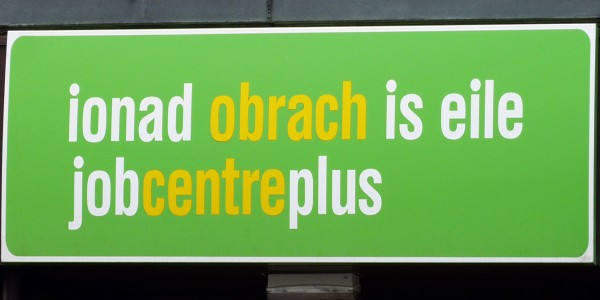
Part of the reason for the relatively good unemployment figures is the rise in ‘zero-hours contracts’. These allow employers to cut the hours that people work without laying them off. The Office for National Statistics estimates that last year (2012) 250,000 people, or 0.84% of the workforce, were on such contracts.
But just what is meant by ‘zero-hours contracts’? According to the ONS:
People on zero-hours contracts are classified as being in employment regardless of the number of hours they actually worked during the survey reference week. This includes anyone who was not required to work any hours during the reference week whilst remaining on their current contract of employment. The continued existence of the contract of employment is the key determinant of their employment status in these situations.
If people are working less than they would like to, this is classified as underemployment, but such people do not appear in the unemployment statistics. Such contracts thus mask the true extent of surplus labour in the economy.
The Chartered Institute of Personnel and Development (CIPD) puts the figure much higher than the ONS. In the Summer 2013 issue of its Labour Market Outlook, it estimates that one million workers are on zero-hours contracts.
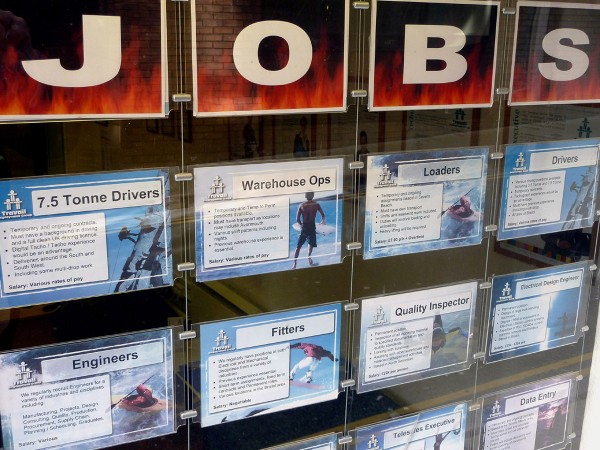 Many employers use such contracts, including many voluntary-sector and public-sector organisations, including the NHS, local councils and Buckingham Palace. They are also used by many small and medium-sized enterprises and many well-known large companies, such as Sports Direct, Amazon, JD Wetherspoon and Cineworld. It gives them the flexibility to adjust the hours they employ people. It allows them to keep people in employment when demand is low. It also makes them more willing to take on staff when demand rises, as it removes the fear of being over-staffed if demand then falls back.
But many workers dislike such contracts, which give them fewer employment rights and fewer hours than they would like to work. It also makes it difficult to budget when future income is uncertain. It also make credit and mortgages harder to obtain, as people have no guaranteed income. Another complaint is that companies may use the threat of lower hours as a tool to bully staff and get away with poorer working conditions.
In May of this year, the Business Secretary, Vince Cable, announced that he was setting up a review of zero hours contracts.
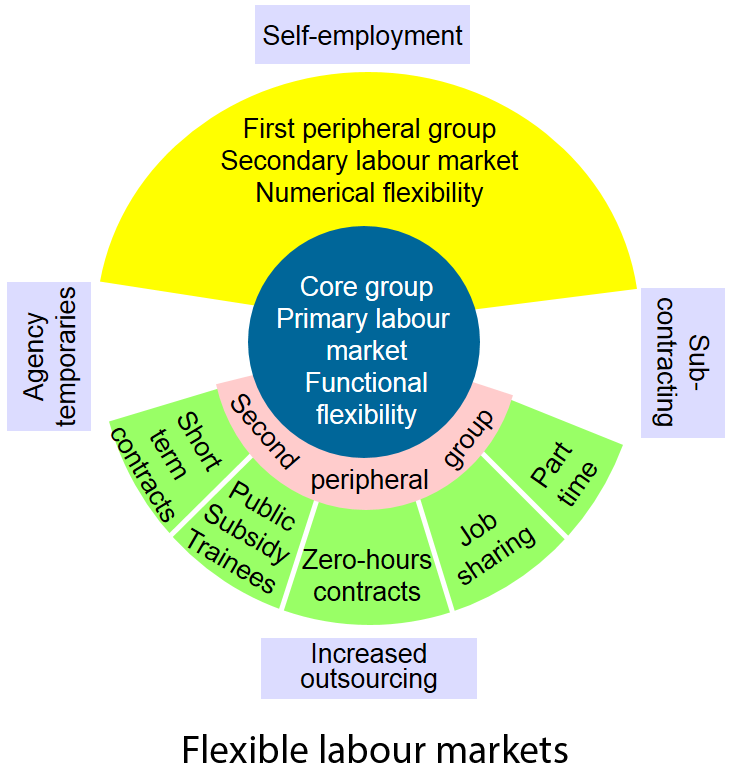
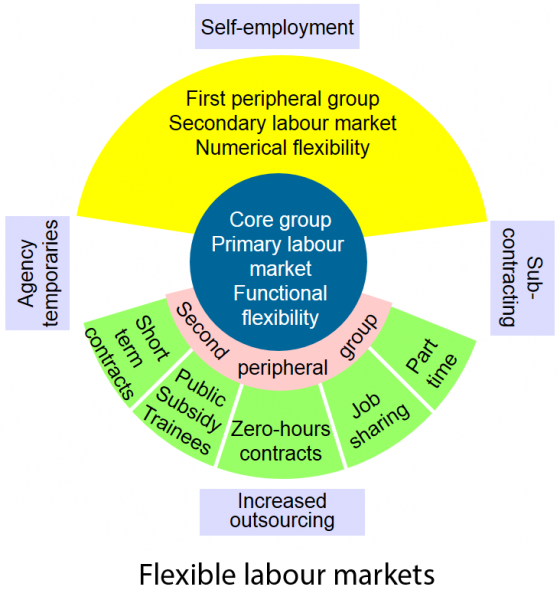 Note that zero hours are not the only form of flexible working. Other examples include: ‘self-employed’ workers, contracted separately for each job they do for a company; people paid largely or wholly on commission; on-call working; part-time working, where the hours are specified in advance, but where these are periodically re-negotiated; overtime; people producing a product or service for a company (perhaps at home), where the company varies the amount paid per unit according to market conditions.
The following videos and articles look at the issue in some detail: at the extent of the practice and at its benefits to employers and its costs (and some benefits) to workers. Both The Guardian and the BBC have an extensive range of articles on the topic.
Webcasts
 Do zero hours contracts create real jobs? BBC Newsnight, Allegra Stratton (14/8/12)
Record number of ‘Zero Hours Contracts’ ITV News on YouTube, Laura Kuenssberg (2/5/13)
Britons rally against ‘Zero Hour’ contracts Al Jazeera on YouTube (4/8/13)
Anger at Amazon working conditions Channel 4 News (1/8/13)
Government to include Amazon in its zero hours probe Channel 4 News (2/8/13)
Councils using zero hours contracts BBC London, Warren Nettleford (31/7/13)
Podcasts
The real economy: Labour market BBC Today Programme, Evan Davis (24/8/11)
Zero hour contracts ‘just the norm’ BBC Today Programme, Rochelle Monte and Peter Cheese (5/8/13)
Articles
Zero-hours contracts: One million British workers could be affected Independent, Nigel Morris (5/8/13)
Zero hours contracts “spreading like wildfire”, official stats show Union News, Pete Murray (1/8/13)
Zero-hours contracts: what are they? The Guardian, Phillip Inman (30/7/13)
Buckingham Palace uses zero-hours contracts for summer staff The Guardian, Simon Neville, Matthew Taylor and Phillip Inman (30/7/13)
Nick Clegg: business department will investigate zero-hours contracts The Guardian,
Patrick Wintour, Simon Neville, Matthew Taylor and Phillip Inman (31/7/13)
Zero-hours contracts are not unavoidable The Guardian, Phillip Inman (1/8/13)
ONS admits it underestimated number of zero-hours contracts The Guardian, Simon Neville (1/8/13)
Zero-hours contract workers – the new reserve army of labour? The Guardian, Philip Inman (4/8/13)
Zero-hours contracts cover more than 1m UK workers The Guardian, Simon Goodley and Phillip Inman (5/8/13)
Zero-hours contracts use by councils needs to be moderated The Guardian, Vidhya Alakeson (5/8/13)
If zero-hours contracts are driving this ‘recovery’, it’s a lousy kind of recover The Guardian, Deborah Orr (9/8/13)
ONS increases its estimate of workers on zero hours contracts Financial Times, John Aglionby (1/8/13)
Zero Hours Herald Scotland, Ian Bell and Scott Dickson (4/8/13)
Sports Direct protests planned over zero hours contracts Channel 4 News (3/8/13)
Cable warns of exploitation of zero-hours contracts BBC News (5/8/13)
Q&A: What are zero-hours contracts? BBC News (5/8/13)
Record number of 16-24s on zero hours contracts at work BBC Newsbeat, Jim Reed (15/5/13)
Figures show 18-24s most likely on zero-hours contract BBC Newsbeat, Jim Reed and Amelia Butterly (5/8/13)
Andy Burnham calls for ban on zero hours contracts BBC News (28/4/13)
Zero-hours contracts: What is it like living on one? BBC News, Sean Clare (5/8/13)
Small Talk: Zero-hours contracts? Key for growth Independent, David Prosser (5/8/13)
Zero Hour Contracts Manchester based law firm, Emma Cross (30/7/13)
Data
People and proportion in employment on a zero-hour contract ONS (31/7/13)
Estimating Zero-Hour Contracts from the Labour Force Survey ONS (26/7/13)
One million workers on zero hours contracts, finds CIPD study CIPD, Michelle Stevens (5/8/13)
Labour Market Outlook CIPD
Questions
- Distinguish between open unemployment, disguised unemployment and underemployment?
- Distinguish between functional, numerical and financial flexibility? Which type or types of flexibility do zero-hours contracts give the firm?
- Identify the various benefits to employers of zero-hours contracts?
- What are the costs and benefits to workers of such contracts?
- Identify what forms of flexible contracts are used for staff in your university or educational establishment. Do they benefit (a) staff; (b) students?
- Are zero-hours contracts fair?
- In what ways do zero-hours contracts transfer risks from employers to employees?
- If a company introduces a system of zero-hours contracts, is this in accordance with the marginal productivity theory of profit maximisation from employment?
- From the perspective of the employer, how do the benefits of zero-hours contracts compare with other forms of flexible working?
- Consider the arguments for and against (a) banning and (b) regulating zero-hours contracts.
 At a cost of €1 trillion to EU states, tax evasion is undoubtedly an area in need of attention. With government finances in deficit across the world, part of the gap could be plugged by preventing tax revenues from going unpaid. Well-known companies and individuals have been accused of tax evasion (and avoidance), but part of the problem is the existence of countries that make such activities possible.
Tax havens not only offer favourable tax rates, but also have in place regulations that prevent the effective exchange of information. That is, they are able to keep the identity and income information of depositors a private affair and are not required to share that information with other governments. This means that other tax authorities are unable to demand the tax revenue from income earned, when it is held in some of these countries. This can deprive the government’s coffers of substantial amounts of money.
In 2000, the OECD produced a report naming so-called ‘uncooperative tax havens’, including Monaco, Andorra, Liechtenstein and Liberia. Since then, all nations on this list have pledged their cooperation and been removed and in a recent step, Andorra has announced a proposal to implement its first ever income tax. This move is partly in response to pressures from EU governments to tackle tax evasion. Furthermore, talks between the finance ministers of tax havens, such as Switzerland and Liechtenstein have been agreed with the aim of improving the flow of bank account information and thus combating tax evasion. The Council of the European Union said:
The decision represents an important step in the EU’s efforts to clamp down on tax evasion and tax fraud”
Countries, such as Switzerland (a non-EU member) are likely to find requests for information difficult to ignore, if they want to have access to EU financial markets. However, any concessions on information provision will come at a significant cost for a country that has long regarded its banking secrecy as an ‘honourable policy.
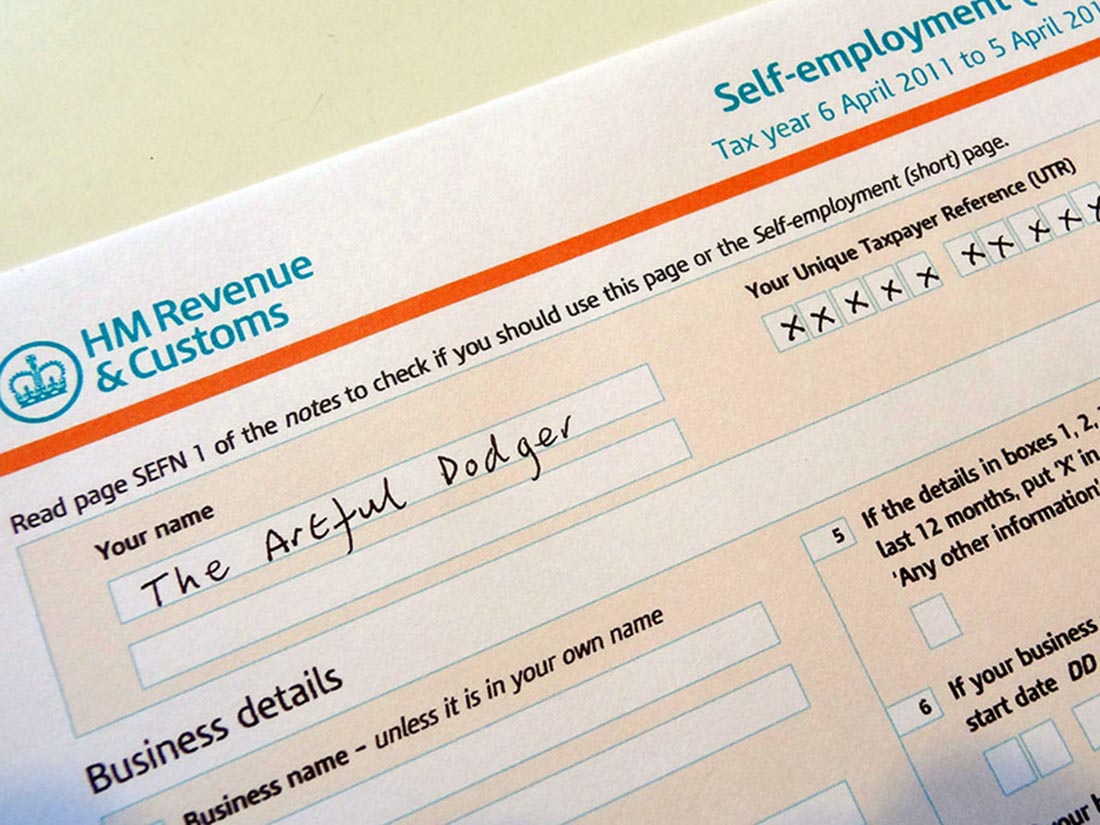 Reforming policy on tax havens is essential, not only to help tackle tax evasion and thus government deficits, but also to generate investment into countries that don’t offer such favourable tax rates. Investors naturally want to invest in those countries with low tax rates and as such, could it be that countries like the UK suffer from a loss of investment and that the only way to encourage it is to offer similarly low tax rates? International agreement is certainly needed to tackle the worldwide issue of tax evasion and at the moment, it seems as though pressure is building on secretive countries. The following articles consider this controversial issue.
Clock ticks on Swiss banking secrecy BBC News, Imogen Foulkes (21/5/13)
Andorra bows to EU pressure to introduce income tax The Telegraph, Fiona Govan (2/6/13)
Andorra to introduce income tax for first time BBC News (2/6/13)
Andorra to introduce income tax for the first time Economy Watch (3/6/13)
Swiss have no choice but to bow to US ultimatum – Ackermann Reuters, Katharina Bart> (3/6/13)
Austria out front as EU zeroes in on tax evasion The Budapest Times (29/5/13)
EU to start talks with non-EU countries on tax evasion BBC News (14/5/13)
Questions
- What is tax evasion?
- Using game theory, explain why an international agreement on tax evasion might be needed?
- When an income tax is imposed in Andorra, what will be the impact on government revenues?
- How might the labour supply incentive change once an income tax is imposed?
- How do tax havens affect investment in other countries?
- Is there an argument that countries such as the UK should cut its tax rates to encourage investment?
 Imagine if none of the clubs in the English Premier League (EPL) or English Football League (EFL) had junior or youth teams. Instead envisage a situation where all of the talented young footballers in the country go to college or university to develop their skills. Then once a year there is a big televised event where each of the clubs in the EPL and EFL take it in turns to choose which young college/university players they would like to recruit.
Strange as it sounds to football fans in Europe this is exactly what happens in American Football in the USA. It is called the NFL draft and this year’s event took place over three days between 25th and 27th April at Radio City Music Hall in New York. There was greater interest in Britain than usual in this year’s event because of the involvement of 24 year old Menelik Watson who was born and raised in Manchester. Although originally a basketball player, coaches spotted his potential to play American football in the NFL and two years ago he obtained a place at Florida State University.
The NFL draft has seven rounds. Each of the 32 teams has the right to choose one player in each round. An important design issue for any draft system is how to determine the running order in which the teams make their choices. Obviously all 32 teams would like to get the first chance at recruiting the most talented of all the college players. The NFL’s solution to this allocation problem is an interesting one. The team with the worst playing record from the previous season gets the first choice in each round. In the 2012-13 season this happened to be the Kansas City Chiefs who played 16 games and only won 2 of them. The second choice in each round goes to the team with the 2nd worst playing record from the previous season and so on. The final choice in each round goes to the previous year’s Super Bowl champions who in the 2012–13 were the Baltimore Ravens. Another interesting characteristic of the system is the ability of teams to trade draft choices. For example in 2013 the Oakland Raiders traded their choice in the first round (which was the 3rd choice overall) with the Miami Dolphins for their choices in both the first and second round (12th and 42nd choice overall).
What is the rationale for having a draft system? It was first introduced in February 1936 and many commentators have argued that it has been a key factor which has helped to maintain competitive balance in sport. The man behind the idea, Bert Bell of the Philadelphia Eagles, argued that without this type of system the sport would be dominated by the 4 richest teams. He stated that:
Every year, the rich get richer and the poor get poorer. Four teams control the championship. Because they are successful, they keep attracting the best college players in the open market, which makes them more successful.
Some evidence for the success of the scheme is that in the last 15 years the Super Bowl has been won by 10 different teams. However in 1934, just before the scheme was proposed, there was another major issue for team owners. The Brooklyn Dodgers and the Philadelphia Eagles had become involved in a bidding war for a very talented young player called Stan Kostka. Brooklyn won the battle but had to pay him a salary of $5,000 – the same amount that was paid to the star player in the league. Some people have argued that the real purpose of the draft scheme was to limit the pay of young players by effectively reducing any competitive bidding for their services. Once drafted, a player is expected to join the team who selected him. There may be some protracted negotiations over his final salary and bonuses but the only option open to him if an agreement breaks down is to re-enter the draft the following year. This effectively gives the teams monopsony power which may enable them to restrict players pay to below that of their marginal revenue product. For example although Andrew Luck, the first choice draft pick in 2012, reportedly earns just over $20million from his 4 year contract with the Indianapolis Colts some commentators have argued that his true market value is over $100 million.
The good news for Menelik Watson was that he was finally drafted by the Oakland Raiders and was the 42nd overall player chosen in the draft process. This is the highest choice ever made by a team in the NFL for a player born and brought up in Britain. The final outcome for the league as a whole can be seen on the NFL website.
NFL Draft 2013: Your essential comprehensive guide BBC Sport Simon Clancy (25/4/13)
NFL Draft 2013: Menelik Watson goes to Oakland Raiders BBC Sport, (26/4/13)
NFL Draft makes Menelik Watson Oakland Raiders’ second British player The Guardian, Paulo Bandini (27/4/13)
NFL Draft: Manchester’s Menelik Watson looking to start with Oakland Raiders right away Sky Sport, Paul Higham (28/4/13)
Manchester’s Watson lands dream NFL job after being drafted by the Oakland Raiders Daily Mail, Matthew Sherry (27/4/13)
Abolish the NFL Draft Sports on Earth, Patrick Hruby (25/4/13) .
Questions
- Explain why the marginal revenue product for sports stars is so much higher than it is for people in most other jobs.
- Draw a diagram to illustrate how the wage rate for players would be determined if the labour market was perfectly competitive.
- Assuming that the marginal revenue product for sports stars was in fact lower than that of most people in other jobs, draw a diagram to illustrate why they would still tend to be paid so much more.
- What is monopsony? Explain how the draft system could give the teams in the NFL monopsony power.
- Draw a diagram to illustrate the impact of monopsony on wages and employment in the labour market for NFL players.
- Can you think of any perverse incentives that the draft system could create for the performance of teams towards the end of the regular season.
 The English Premier League (EPL) has negotiated a record TV deal which will generate £5.5 billion of revenue over the next 3 years – beginning in the season 2013–14. This represents a 70% increase on the previous deal. Controversy has arisen over some initial proposals put forward by the EPL as to how the money will be spent. The owners of the clubs in the Championship of the English Football League (EFL) are particularly concerned about the size of the proposed payments to the three teams relegated from the EPL.
Some 30 years ago the money generated from the sale of television rights was equally shared between all the teams in the then four divisions of the English Football League (EFL). In 1992 the top division of the English Football League broke away and formed the English Premier League (EPL). This newly formed EPL negotiated a separate television deal and kept the majority of the money. However, some payments were and still are made to the teams in the EFL and to organisations such as the League Managers Association and Professional Footballers Association. For example in 2011-–12 the EPL donated £189.4 million of the £1.2 billion generated from that year’s TV deal.
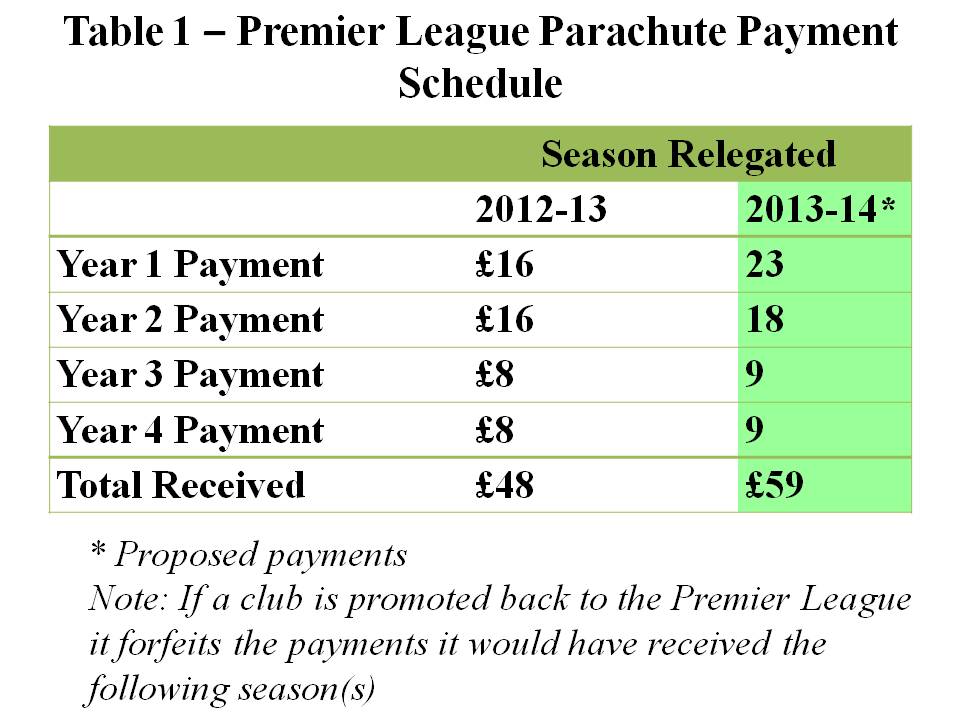
The majority of the money donated by the EPL is spent in two main ways. First, some money is redistributed to all the teams in the EFL: i.e. The Championship, League 1 and League 2. These are known as ‘solidarity payments’ and in 2011–12 the EPL spent £49.8 million on this scheme. Each club in the Championship received £2.3 million. It has been proposed that the amount paid into this scheme should be increased by 5% in the season 2013–14. Second, a relatively large amount of money is paid over a four-year period to the three teams relegated each season from the EPL into the Championship. These are known as ‘parachute payments’ and in the season 2011–12 the EPL spent £90.9 million on this scheme. The rationale for having parachute payments is to help the relegated teams adjust their wage bills to the much lower revenue streams that come from playing in the Championship. Proposed changes to the scheme are outlined in Table 1.
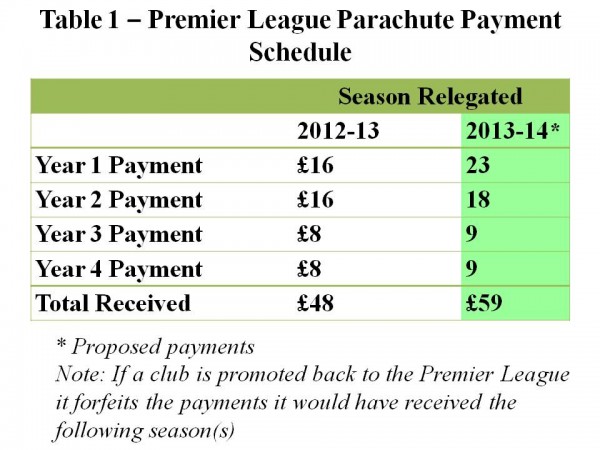 The chairmen of the football league clubs met on the 20th March 2013 and a number of them expressed concerns about the relatively large increase in the parachute payments compared to the solidarity payments. They were particularly concerned that the changes to the funding would damage the competitive balance of the Championship.
Competitive balance refers to how the most talented players are distributed amongst the teams in a league. For example, are the majority of the most talented footballers playing for just a couple of the teams? In this case the league is competitively imbalanced and the teams with the best players will tend to win far more games than the other teams. The outcome of the league will be very predictable. If the most talented players were more evenly spread across all the teams in the league, then it would be more competitively balanced. Matches and the outcome of the league would become more unpredictable.
Does the level of competitive balance matter? Some sports economists have argued that it may have a significant impact on the success of the league. This is because fans may value the unpredictability of the results. It follows that closer and more unpredictable results will generate higher match-day attendances and increase the revenues of the clubs.
This is an interesting argument and is the opposite of what economic theory would predict for most markets. For example, the standard prediction would be that as firms outperform their rivals, they generate more revenue and profit. If they manage to drive all their rivals out of business, they would become a pure monopoly and make large abnormal profits. However in professional team sports the outcome may differ significantly. If the unpredictability of the league is highly valued by fans, then teams will generate more revenue when they have strong and evenly matched rivals.
It has been reported that further discussions about the distribution of the money will take place this month with the owners of the championship clubs arguing that there should be smaller increases in parachute payments and much larger increases in solidarity payments. Representatives of the EPL have argued that the parachute payments do not distort competition and make the championship predictable. They point out that at present only one of the top six teams in the championship (Hull) receives parachute payments, while only one of the teams promoted from the Championship in the season 2012–13 (West Ham) received these payments.
Articles
Premier League warned over rich and poor split in wake of TV deal The Guardian, Owen Gibson (19/3/13)
Championship clubs angered by Premier League parachute boost Daily Mail, Charles Sale (6/2/13)
Football league is to lessen the advantage of parachute payments The Guardian, Owen Gibson (20/3/13)
Championship clubs warn Premier League over hike in parachute payments for relegated teams The Independent, Majid Mohamed (20/3/13)
Increased parachute payments could lead to a salary cap in the Championship The Post, A. Stockhausen (21/3/13)
Scudamore:Parachute payment system fair Eurosport, Andy Eckardt (22/3/13)
Parachute payments more than a softened landing The Daisy Cutter, Richard Brook (21/3/13)
Questions
- What factors will influence the size of the attendance at a football match?
- To what extent do you think that the money generated from the sale of television rights should be equally shared between all the clubs in the English Premier League and the English Football League
- Can you think of any ways of measuring the competitive balance of a football league?
- Explain why a very competitively imbalanced league may reduce the revenue for all the clubs in that league?.
- In traditional economic theory it is assumed that firms aim to maximise their profits. What do you think is the objective of a typical football club in the English Premier League?
 Part of the prices we pay go towards investment in cleaner and more environmentally friendly sources of energy. Critics suggest that any price freeze would deprive the energy sector of much needed investment, meaning our energy bills will be higher in the future. Furthermore, some argue this price freeze suggests that Labour is abandoning its environmental policy. Energy shortages have been a concern, especially with the cold weather the UK experienced a few years ago. This issue may reappear with price freezes. As Angela Knight, from Energy UK, suggests: