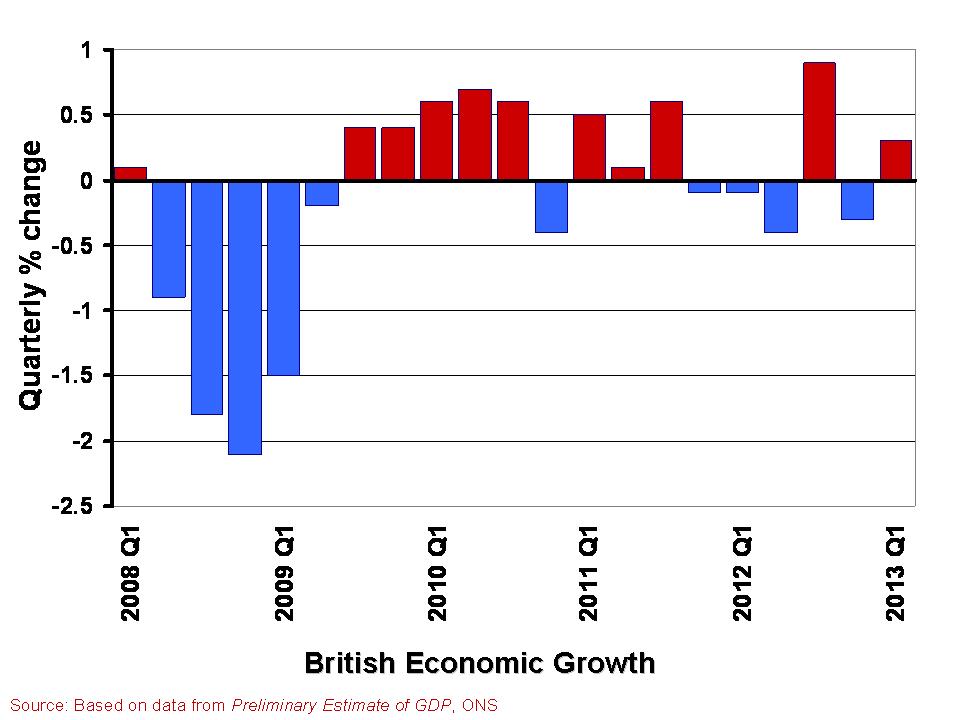
 In The global economy we note the mixed picture contained within the latest British growth numbers. With the first estimate of growth for Q1 of 2013 pointing to an increase in real GDP of 0.3 per cent, the UK economy appears to have missed the ignominy of a triple dip recession. However, the overall economy remains fragile with different sectors of the economy performing quite differently.
A patchy picture is perhaps the fairest assessment. This helps to explain the quite different perceptions amongst economists, business people, journalists and the wider public about the current state of the economy. Here we consider in a little more detail the growth numbers for the UK from the latest preliminary GDP estimates. (Click here for a PowerPoint of the chart).
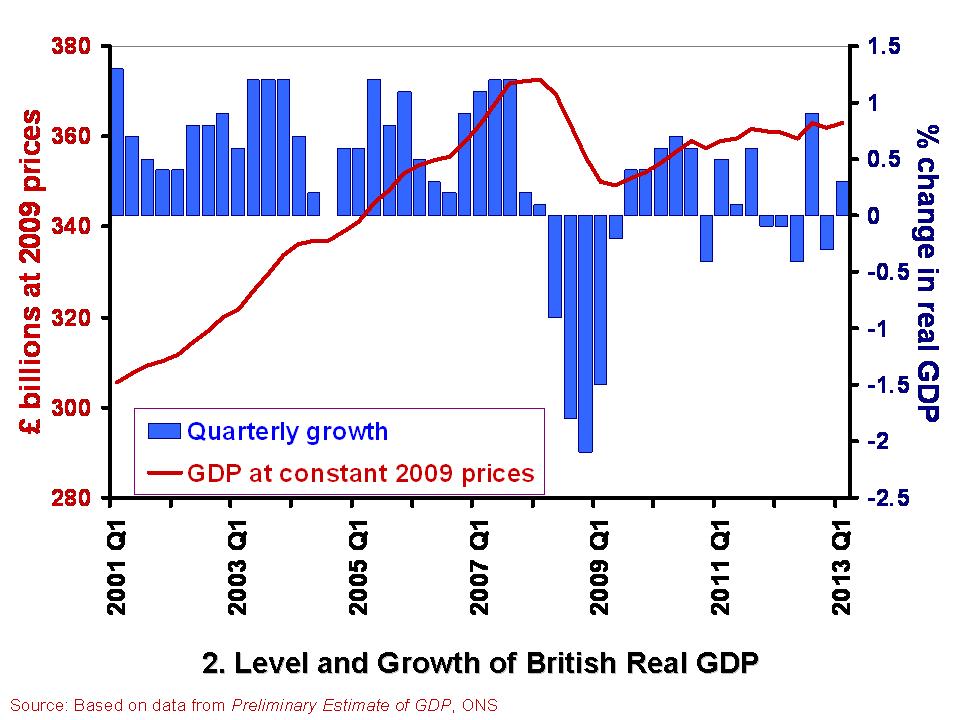 The British economy is thought to have grown by 0.3 per cent in the first quarter of 2013. This follows a contraction of 0.3 per cent in the final quarter of 2012. Compared with the first quarter of 2012, the output of the British economy was 0.6 per cent higher. However, as Chart 2 helps to show, the British economy has some way to go before it returns to the levels seen prior to the financial crisis. Real GDP peaked in the first quarter of 2008 when GDP at 2009 prices was estimated at £372.7 billion. In the first quarter of 2013, GDP at constant 2009 prices is estimated at £362.9 billion. This means that the economy is still 2.6 per cent smaller than its 2008-peak. Click here for a PowerPoint of the chart.
The patchy nature of British growth is illustrated nicely by the contrasting rates of growth across the different industrial sectors in the first quarter of the year. While service sector output rose by 0.6 per cent, output across the production industries rose by only 0.2 per cent and agricultural output declined by 3.7 per cent. Within the production industries, mining and quarrying output rose by 3.2 per cent, but manufacturing output shrunk by 0.3 per cent and construction output shrunk by 2.5 per cent.
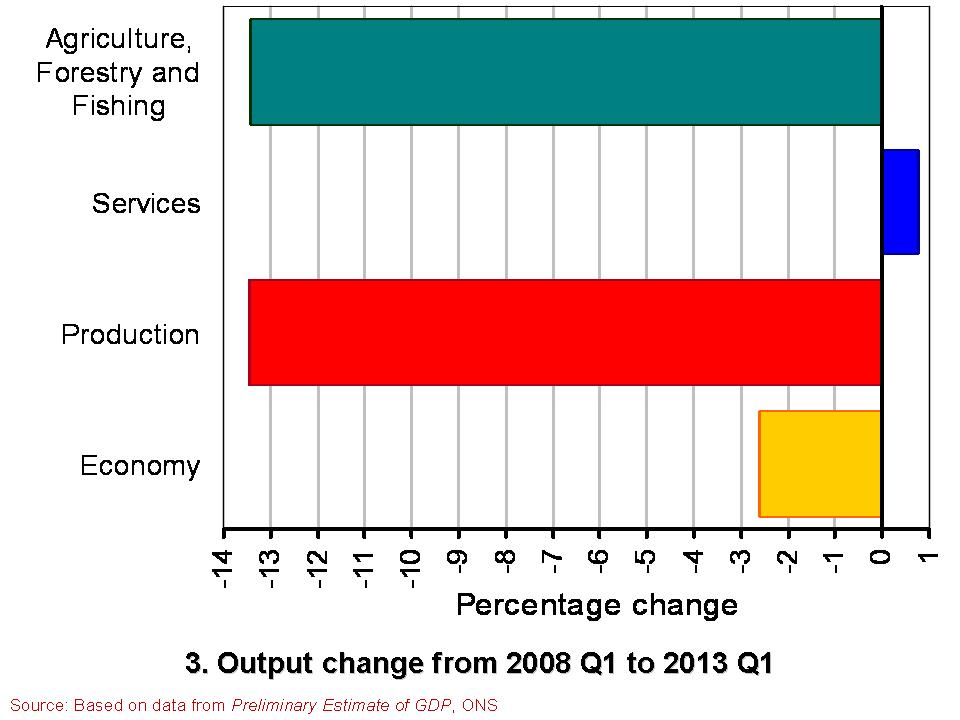 Chart 3 compares the output of agriculture, the production industries and the service sector between the first quarter of 2008 and the first quarter of 2013. (Click here for a PowerPoint of the Chart). It shows the dramatically different experience of the service sector compared with agriculture and the production industries. While output in the service sector is now 0.8 per cent higher, output across agriculture and the production industries is almost 13.5 per cent lower. Within the production industries, output in mining and quarrying is 38 per cent lower, in the construction sector 19 per cent lower and 10 per cent lower in manufacturing. It is perhaps not surprising then that we get such different messages about the state of the economy. The devil really is in the detail.
Data
Preliminary Estimate of GDP – Time Series Dataset Q1 2013 Office for National Statistics
Statistical Bulletin: Gross Domestic Product Preliminary Estimate Q1 2013 Office for National Statistics
Articles
UK avoids triple-dip recession with better-than-expected 0.3% GDP growth Guardian, Heather Stewart (25/4/13)
UK economy shows 0.3% growth Financial Times, Claire Jones (25/4/13)
UK avoids triple-dip recession with 0.3pc GDP growth Telegraph, Szu Ping Chan (25/4/13)
Osborne claims UK economy is ‘healing’ Financial Times, George Parker and Claire Jones (25/4/13)
UK narrowly escapes triple-dip recession as GDP figures show 0.3% growth in first three months of year Independent, Ben Chu (25/4/13)
UK economy avoids triple-dip recession BBC News (25/4/13)
Questions
- What is the difference between nominal and real GDP? Which of these helps to track changes in economic output?
- How would we identify a recession in either of the first two charts?
- What is a double-dip recession? What is a triple-dip recession?
- The UK economy in Q1 2013 was 2.6 per cent smaller than in Q1 2008. What factors do you think help explain why after 5 years UK real GDP is still lower?
- Why if output in the production and agricultural sectors is 13.5 per cent lower in Q1 2013 compared to Q1 2008 is the economy’s total output only 2.6 per cent lower?
- Economic growth rates fluctuate quite significantly. Can economic theory help to explain why this is the case?
 The latest growth data for the UK is somewhat difficult to interpret. It’s positive, but not that positive. The Conservatives say it shows that the economy is moving in the right direction. Labour suggests it is evidence that the Coalition’s policies are not working. With a return to positive growth, the UK has avoided the triple dip recession and here we take a closer look at the economic performance of other key nations.
In the final quarter of 2012, the US economy grew at 0.4%, but in the 3 months to March 2013, economic growth in America picked up to 2.5%. Consumer spending significantly increased, growing at an annualized rate of 3.2%, according to the Commerce Department. This figure helped boost the growth rate of the US economy, as consumer spending accounts for around two thirds of economic activity.
 However, the growth figure was lower than expected, in part due to lower government spending. Furthermore, there are suggestions that the positive consumer spending figures are merely a positive blip and spending will fall as the US economy moves through 2013.
If this does prove to be the case in the USA, it will do little to further boost UK economic growth, which was recorded at 0.3% for the first 3 months of 2013. The Chancellor has said that the growth figures are encouraging and are evidence that the government’s policies are working.
Today’s figures are an encouraging sign the economy is healing … Despite a tough economic backdrop, we are making progress. We all know there are no easy answers to problems built up over many years, and I can’t promise the road ahead will always be smooth, but by continuing to confront our problems head on, Britain is recovering and we are building an economy fit for the future.
While the USA and UK have recorded positive growth, expectations of growth throughout Europe remain uncertain. Spain has revised its forecasts downwards for 2013, expecting the economy to shrink by over 1%. Even after 2013, growth is expected to remain very weak, forecast to be 0.5% in 2014 and 0.9% in 2015. To make matters worse, Spain’s unemployment continues to move in the wrong direction, with data for the first 3 months of 2013, recording an unemployment rate of 27.2% – the highest on record.
However, it’s not just Spanish unemployment that is on the rise. Figures for March show that in France, 3.2 million people were out of work, a 1.2 % rise compared to February. In the UK, 2.56 million people were recorded as unemployed, representing just under 8% of the working population. The German economy continues to outperform its European partners, but eurozone growth continues to look weak for the rest of 2013.
Despite much bad news in Europe, growth in other parts of the world remains buoyant. South Korea has recorded economic growth that is at its highest level in 2 years. Economic growth was just under 1%, but construction and investment both increased, perhaps a sign of an economy starting its recovery.
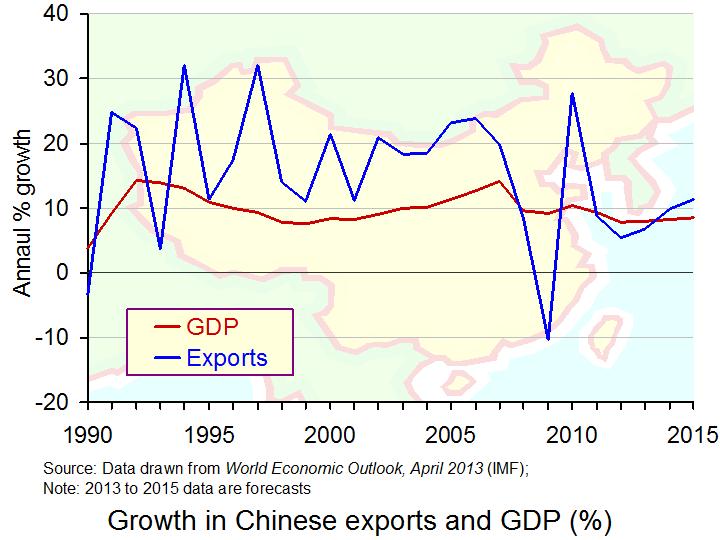 The Chinese economy has seemed relatively unaffected by the economic downturn, yet its economic growth has slowed. Averaging over 10% per annum for the last decade, the growth for January – March 2013 was only 7.7%. This is a decline on the previous 3 months and is lower than expected. If the Chinese economy does begin to slow (relatively speaking), this could present the global economic recovery with an unwelcome obstacle.
Many Western economies are reliant on exports to boost their growth figures and with such high demand in China, this is a key export market for many countries. If the Chinese economy continues to slow, consumer spending may even fall and this could mean a reduction in Chinese imports: that is, a reduction in other countries’ exports to China. However, for China’s competitors, the news is better, as with China’s move from a low to middle-income country, other countries will now see an opportunity to grasp a competitive advantage in the production of cheaper products. David Rees from Capital Economics said:
Trade data show that Chinese imports of commodities, and industrial metals in particular, have been falling in recent months … That is bad news for those emerging markets in Latin America, the Middle East, and Africa that predominately export commodities to China. It is not all bad news … To the extent that China’s structural slowdown reflects its transition from low to middle-income status, opportunities will present themselves for other EMs as China moves up the value chain. We are particularly upbeat on the manufacturing-based economies of South East Asia, along with Mexico, Poland, and Turkey.
News is better in Japan, where growth forecasts have been raised to 2.9% over the same period and the economy is expected to grow by 1.5% throughout both 2013 and 2014. Furthermore, suggestions that inflation may also reach 0.7% have boosted confidence. This might be the end of Japan’s troubles with deflation.
So, we have something of a mixed picture across the world, although the IMF predicts a global rate of growth of 3.5% for 2013, which would be an improvement on 2012 figures. The following articles consider the global situation.
Spain slashes economic growth forecast Sky News (26/4/13)
UK avoids triple-dip recession with better than expected 0.3% GDP growth The Guardian, Heather Stewart (26/4/13)
US economy grows 2.5% on buoyant consumer spending BBC News (26/4/13)
Poor French and Spanish jobs data but UK economy returns to growth – as it happened The Guardian, Graeme Wearden and Nick Fletcher (25/4/13)
UK economy avoids tiple-dip recession with 0.3pc GDP growth The Telegraph, Szu Ping Chan (25/4/13)
South Korea economic growth hits two year high BBC News (25/4/13)
S. Korea economy grows at the fastest pace in two years Bloomberg, Eunkyung Seo (25/4/13)
Spain revises down its economic forecast BBC News (26/4/13)
US economy sees broad growth Financial Times, Robin Harding (25/4/13)
Germany’s private sector shrinks as Eurozone decline continues – as it happened The Guardian, Graeme Wearden and Nick Fletcher (23/4/13)
China economic growth lower than forecast BBC News (15/4/13)
China’s slowing economy: what you need to know Bloomberg Business Week, Dexter Roberts (25/4/13)
Modest Growth Pickup in 2013, Projects IMF International Monetary Fund (23/1/13)
Questions
- How is economic growth measured?
- What is meant by a triple-dip recession?
- What has caused the small increase in growth in the UK? Do you think this signifies the start of the economic recovery?
- In the USA, what has caused the growth rate to reach 2.5% and why is it lower than expected?
- Why are growth rates in countries across the world relevant for UK forecasts of economic growth?
- Which factors have allowed the Chinese economy to achieve average growth rates above 10% for the past decade?
- Using an AD/AS diagram, illustrate the desired impact of the Coalition’s policies to boost economic growth.
- With unemployment rising in countries like Spain and France, how might Eurozone growth be affected in the coming months?
- Japanese growth is looking positive and inflation is expected to reach about 0.7%. Why is it that Japan has suffered from deflation for so many years and why is this a problem?
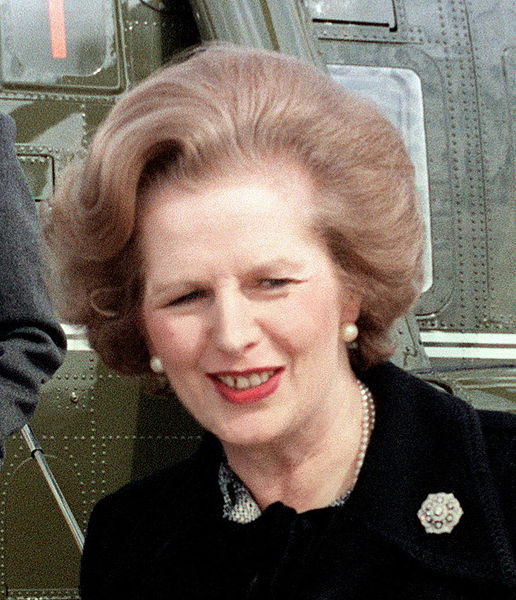 Much has been written on Margaret Thatcher following her death at the age of 87 on April 8. But getting a calm assessment of both her time in office and her legacy is not easy. And it’s clear why: she created both stronger loyalty and stronger opposition than any other UK Prime Minister.
As economists, however, we should try to be as dispassionate as possible in assessing the effects of policies. There is always a normative question of the relative desirability of different economic outcomes – and you will have your own views on the relative importance of objectives such as economic growth, greater equality and greater social cohesion – but to determine cause and effect, or at least correlation, requires a careful examination of the evidence. Also, drawing lessons for future policy requires a careful modelling of the economy and the effects of changing economic variables.
The following articles have been selected from the hundreds that have appeared in the press in the past few days. Whilst they cannot be claimed to be totally ‘objective’, taken together they give a good overview of her economic policies and her economic legacy.
You may well have been surprised by the amount of coverage of her death and at the fervour of her supporters and critics. But this bears witness to the huge effect she had on both the political scene and on the UK economy – for good or bad.
Articles
Margaret Thatcher’s timeline: From Grantham to the House of Lords, via Arthur Scargill and the Falklands War Independent (8/4/13)
Overhauls Are Still Felt, Debated Decades Later Wall Street Journal, Charles Forelle (9/4/13)
Margaret Thatcher’s Four Ages of Monetary Policy EconoMonitor, David Smith (10/4/13)
How Mrs Thatcher smashed the Keynesian consensus The Economist (9/4/13)
Margaret Thatcher: The economy now and then BBC News, Stephanie Flanders (10/4/13)
Did Margaret Thatcher transform Britain’s economy for better or worse? The Guardian, Larry Elliott (8/4/13)
A look back at Margaret Thatcher’s economic record Washington Post, Dylan Matthews (8/4/13)
Margaret Thatcher’s legacy for business and economics—the world weighs in Quartz, Gwynn Guilford (8/4/13)
Data
Economic Data freely available online The Economics Network, see especially sites 1, 2, 3, 6 and 9
Questions
- Summarise the macroeconomic policies followed by the Thatcher government from 1979 to 1990.
- Chart economic growth, unemployment and inflation over Margaret Thatcher’s time in office. How does the performance of each of these indicators compare with the period from 1990 to 2007 and from 2008 to the present day?
- What is meant by ‘monetarism’? Did the Thatcher government follow pure monetarist policies?
- What is meant by the ‘Big Bang’ as applied to the financial sector in 1986? Assess the long-term consequences of the Big Bang.
- What elements of ‘Thatcherism’ were retained by the Labour government from 1997 to 2010?
- To what extent can the current Coalition government be described as ‘Thatcherite’?
 VAT was introduced on the 1st of April 1973, as part of the conditions for the UK entering the Common Market. Designed by a French tax expert, Maurice Lauré, it was initially envisaged as a straightforward replacement for purchase tax, which would be applied to most goods and services.
Forty years on, VAT is increasingly complex, with numerous exemptions, many anomalies in its scope, and increasingly expensive challenges to its imposition. How did we get to this point? And is it time for VAT to undergo a mid-life makeover?
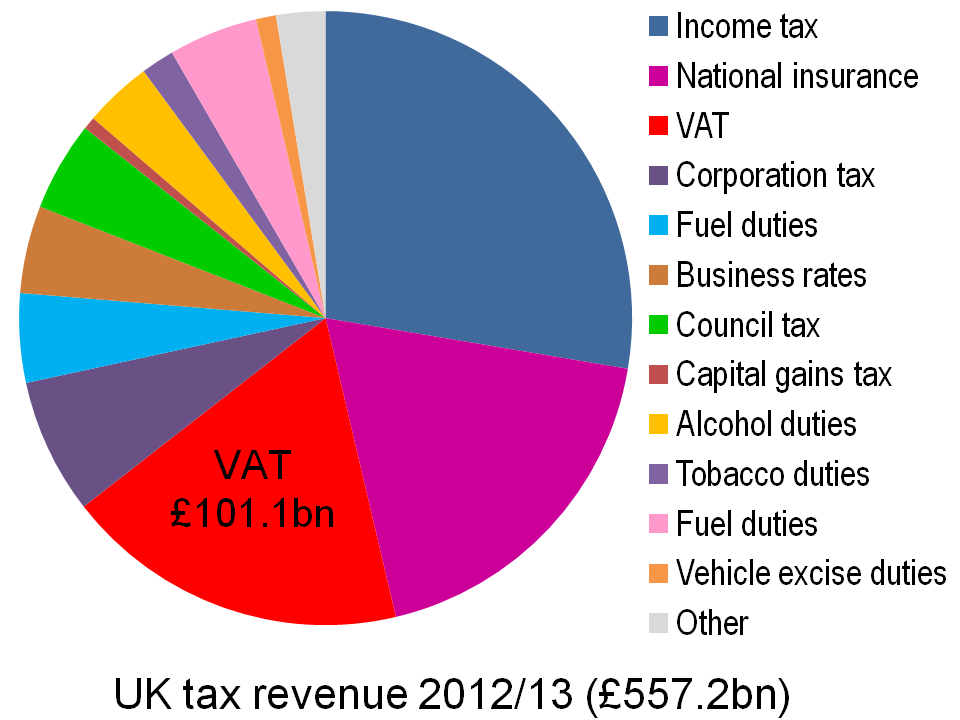
All governments have to raise taxes – to redistribute income and to fund public spending. They have a number of mechanisms they can use, but essentially they have to tax incomes (direct taxes), spending (indirect taxes) or a mix of both. The main indirect tax in the UK is VAT, which now raises over £100bn a year, compared with £1.5bn in its first year (see above chart: click here for a PowerPoint version). Initially envisaged as a simple, cross-Europe purchase tax, the current system is complex and at times appears to have been formulated ‘on the hoof’, never a good way to build a tax system.
In the 2012 Budget, the Chancellor decided to apply the standard rate of income tax to hot takeaway pasties; previously they had been zero-rated. However, he had sharply underestimated the ability of the industry to lobby against the tax, working closely with the tabloid press. Perhaps more importantly, he also missed the complex nature of the good; when is a hot pasty just cooling down? And what is hot? The government backtracked and now 20% VAT is only charged on pasties that are deliberately kept hot. You might think that this change of heart avoided introducing an anomaly, but consider how you might feel if you sell takeaway baked potatoes, which are subject to VAT.
Apart from the complexity of the system, VAT is unpopular with some commentators who feel that it falls too heavily on low-income households. Although many foodstuffs are zero-rated and housing is exempt, VAT is charged at 20% on clothing and many necessities such as cleaning materials. Gas and electricity are subject to a reduced rate of 5% and both alcohol and cigarettes have additonal excise duties imposed and yet are disproportionally consumed by the poor. When the standard rate of VAT was temporarily dropped to 15% in 2010, but then permanently raised to 20% in 2011, many felt that this was a shift in the tax burden to the poor.
So complex, irrational and prone to changes following political lobbying or expensive legal cases, VAT does seem to be stumbling into its forties under something of a cloud. However, it remains the case that it raises a large proportion of UK tax revenues at relatively low direct cost and provides the Chancellor with a reasonably effective fiscal policy tool. Even if a government wanted to put in place an alternative, it is likely that the associated political risks would be too high for it to do so. We might hope for some rationalisation of the current system, but there is little doubt that we will be raising a glass to VAT’s 50th birthday in 2023.
The links below include some articles on VAT’s 40th birthday and some more general articles on VAT.
Articles
VAT is 40 years old- and now has middle-age spread The Guardian, Juliette Garside (31/1/13)
Is VAT suffering a mid-life crisis at 40? BBC News, Colin Corder (31/3/13)
VAT at 40, not simple, not popular, but central to government revenue-raising The Chartered Institute of Taxation (28/3/13)
Happy birthday VAT, here’s how not to pay you The Telegraph, Rosie Murray-West (31/3/13)
Poorest spend higher proportion of VAT than richest BBC News (31/10/11)
A Value- Added Tax offers much to love- and hate New York Times, Gregory Mankiw (1/5/10)
EC Standard VAT Declaration European Commission Roadmap (2012)
Data and information
VAT pages HMRC
Public sector finance statistics HM Treasury (follow link to latest Public finances databank (Excel file) and go to Worksheet C2)
Latest European Union EU VAT rates VATLive
Questions
- Explain why VAT might be deemed regressive. Can you formulate an argument that it falls more heavily on the rich than the poor?
- Why is VAT administratively cheap? Other than generating tax revenues, can you think of any advantages of the tax?
- Newspapers and books are zero-rated in the UK, while e-books and news apps are standard rated at 20%. Can you identify some other anomalies in the UK VAT system? Is there an argument that a better approach would be to charge a lower rate on all goods and services?
- Who pays VAT, consumers or producers? Illustrate your answer with a diagram, or two.
- A business has to register for VAT once it has a turnover of £77,000 pa. Does this system give rise to any perverse incentives?
- Countries across the European Union have varying VAT rates, applied to very different ranges of products. Explain why this might hinder the workings of a single European market.
- Imagine you were running a brand new economy; would you use a value-added tax to raise revenues? What are the alternatives open to governments?
 The UK economy is suffering from a lack of aggregate demand. Low spending in real terms is preventing the economy from growing. A simple solution would seem to be to stimulate aggregate demand through fiscal policy, backed up by even looser monetary policy. But this is easier said than done and could result in undesirable consequences in the medium term.
If increased borrowing were to be used to fund increased government expenditure and/or cuts in taxes, would any resulting growth be sufficient in the medium term to reduce the public-sector deficit below the initial level through automatic fiscal stabilisers? And would the growth be sustainable? The answer to this second question depends on what happens to the supply side of the economy. Would there be an increase in aggregate supply to match the increase in aggregate demand?
 This second question has led many economists to argue that we need to see a rebalancing of the economy. What is needed is an increase in investment and exports, rather than an increase in just consumer expenditure funded by private borrowing and government current expenditure funded by public borrowing.
But how will exports and investment be stimulated? As far as exports are concerned, it was hoped that the depreciation of the pound since 2008 would give UK exporters a competitive advantage. Also domestic producers would gain a competitive advantage in the UK from imports becoming more expensive. But the current account deficit has actually deteriorated. According to the EU’s AMECO database, in 2008 the current account deficit was 1% of GDP; in 2012 it was 3.7%. It would seem that UK producers are not taking sufficient advantage of the pound’s depreciation, whether for exports or import substitutes.
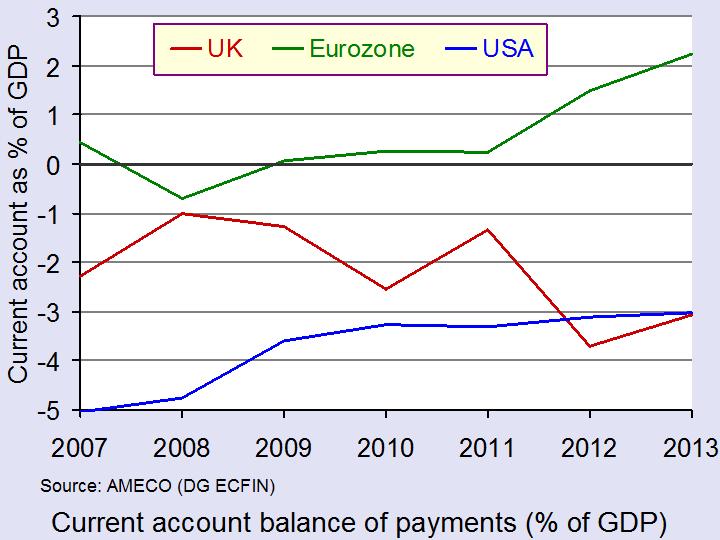 As far as investment is concerned, there are two major problems. The first is the ability to invest. This depends on financing and things such as available land and planning regulations. The second is the confidence to invest. With not little or no growth in consumer demand, there is little opportunity for the accelerator to work. And with forecasts of sluggish growth and austerity measures continuing for some years, there is little confidence in a resurgence in consumer demand in the future. (Click here for a PowerPoint of the above chart. Note that the 2013 plots are based on AMECO forecasts.)
So hope of a rebalancing is faint at the current time. Hence the arguments for an increase in government capital expenditure that we looked at in the last blog post (The political dynamite of calm economic reflection). The problem and the options for government are considered in the following articles.
Articles
Budget 2013: Chancellor’s rebalancing act BBC News, Stephanie Flanders (11/3/13)
Why George Osborne is failing to rebalance the economy The Guardian, Larry Elliott (17/3/13)
Economy fails to ‘rebalance’ Financial Times, Sarah O’Connor (27/2/13)
Analysis – Long haul ahead for Britain’s struggling economy Reuters, William Schomberg (3/3/13)
Can banks be forced to lend more? BBC News, Robert Peston (12/3/13)
Budget 2013: What the commentators are saying BBC News (13/3/13)
Data
UK Trade, January 2013 (ONS) (12/3/13)
Business investment, Q4 2012 ONS (27/2/13)
Questions
- Draw a diagram to illustrate the effects of a successful policy to increase both aggregate demand and aggregate supply. What will determine the effect on the output gap?
- For what reasons has the UK’s current account deteriorated over the past few years while those of the USA and the eurozone have not?
- Using ONS data, find out what has happened to the UK’s balance of trade in (a) goods and (b) services over the past few years and explain your findings.
- Why are firms reluctant to invest at the moment? What policy measures could the government adopt to increase investment?
- With interest rates so low, why don’t consumers borrow and spend more, thereby aiding the recovery?