 Youth unemployment has been one of the main headlines for some months, with data showing a record number of young people out of work.
As part of the government’s £1bn Youth Contract that aims to help young people back into work and help those unable to find employment, Nick Clegg has announced wage subsidies to firms hiring 18-24 year olds will be paid earlier.
Some of the costs of unemployment are obvious. For the individual who is unemployed, it means a lack of income and hence inability to buy goods and services. This then has wider implications for the economy. If people are unable to purchase goods and services, this contributes to a lower level of aggregate demand, which in times of recession, is hardly ideal.
Unemployment also means an inefficient use of resources, meaning the economy is operating below full capacity. Fewer people in work also implies lower tax revenues for the government, at the same time as higher unemployment benefit payments, contributing towards a growing budget deficit. This point is of particular concern, when it is young workers claiming benefits, as it could mean a life of dependency.
 There are also some longer-term consequences, in particular for those who have been out of work for some time. They lose their skills, making it harder to find a job and this can pose costs to employers and further costs to the government through re-training. As such, government initiatives to tackle youth unemployment have never been more important.
The wage subsidies that were announced back in November will now be paid when young people have been out of work for six months, instead of nine. This initiative aims to help reduce youth unemployment in areas where it is at its worst. Twenty local authorities have been identified as priorities for the government and will benefit from this scheme. As Nick Clegg said to CBI summit:
“Three months can make all the difference. When you feel like your banging your head against a brick wall, when you live in an area where opportunities are already few and far between, another 12 weeks of rejection letters, of being cut off, of sitting at home waiting, worrying, that can seriously knock the stuffing out of you, making it extremely difficult to pick yourself up …
So jobcentres will be able to make use of the subsidy before people are referred to the Work Programme, capitalising on their links with local employers, and they’ll also intensify support, so more training, more regular coaching, spending more time with young people to knock a CV into shape or prep ahead of an interview.”
There are critics of the scheme, who argue that it is too little, too late and that it will simply displace older workers, thereby creating worse unemployment for another group. Until the economy begins to grow and confidence returns to the markets, unemployment is likely to remain a frequent headline. The following articles consider the wage subsidy and the state of unemployment in the UK.
Wage subsidy could mean more jobs Independent Online, Business Report, Pierre Heistein (14/6/12)
Wage subsidies scheme moved forward The Press Association (27/6/12)
Wage subsidy plan for young workers brought forward BBC News (27/6/12)
Wage subsidies scheme moved forward Independent, Alan Jones (27/6/12)
Nick Clegg announces extra help for jobless in 20 troublespots Guardian, Juliette Jowit (27/6/12)
Young people’s prospects have ‘nose-dived’ says report BBC News, Judith Burns (25/6/12)
Economic gap between young and old significantly worse since 2008 – study Guardian, James Ball and Helene Mulholland (25/6/12)
Questions
- Why is unemployment such a big concern for the UK economy? What is so important about youth unemployment?
- Which factors have contributed towards such high youth unemployment?
- How will the wage subsidy encourage firms to take on more young people? Think about how a rational firm behaves when choosing between 2 workers.
- Why does the wage subsidy cause concern for organisations supporting the employment of older workers?
- To what extent do you agree with the Guardian article that says that young people have borne the brunt of the recession and subsequent government cuts?
- What other things have been undertaken in a bid to reduce unemployment and stimulate the economy?
- Think about the costs of unemployment. Categorise them into costs to (a) the individual, (b) friends and family, (c) the government and (d) the economy.
 If one person saves more, then it will increase that person’s consumption possibilities in the future. If, however, everyone saves more, and hence spends less, then businesses will earn less and are likely to respond by producing less if the decline in aggregate demand continues. Hence if a country saves more, people could be worse off. That’s the paradox of thrift.
There is considerable debate around the world at the moment about the desirability of austerity policies. The debate has become more intense with the worsening economic outlook in many European countries and with the election in France of François Hollande who rejects many of the austerity measures of his predecessor, Nicolas Sarkozy.
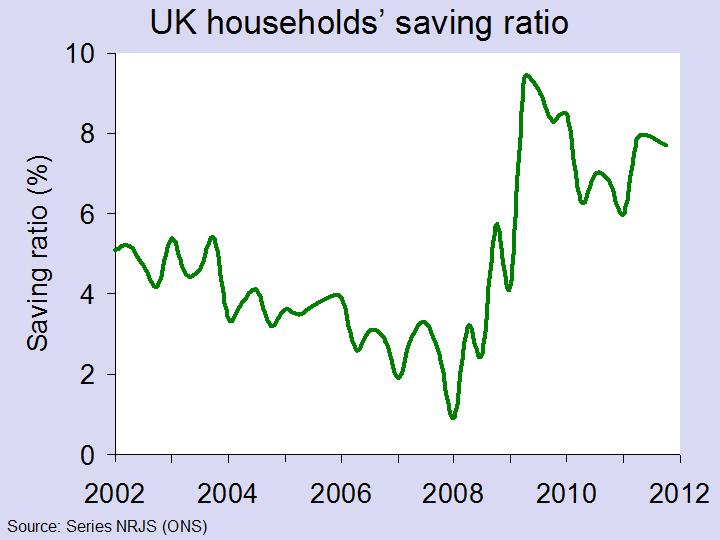 But can further stimulus be given to aggregate demand without causing a further worsening of countries’ public-sector debt positions and causing a fall in confidence in financial markets? And how would that impact on investment?
And in the meantime, as the economic outlook darkens, people are trying to save more, despite low interest rates. The paradox of thrift seems to be getting more acute. (Click here for a PowerPoint of the chart.)
Articles
How National Belt-Tightening Goes Awry New York Times, Robert J. Shiller (19/5/12)
Japan disease is spreading: High risk and low returns Firstpost (India), Vivek Kaul (17/5/12)
The Solution can not be More Debt Huffington Post, Jill Shaw Ruddock (29/5/12)
Crediting debt Breaking Views, Edward Hadas (30/5/12)
Green investments can overcome the paradox of thrift New Statesman, Dimitri Zenghelis (7/6/12)
Austerity has never worked Guardian, Ha-Joon Chang (4/6/12)
The False Choice Between Austerity And Growth Forbes (24/5/12)
It’s not a case of austerity v stimulus for Europe Guardian, Paul Haydon (1/6/12)
Data
UK households’ saving ratio: series NRJS ONS
Household saving rates for OECD countries StatExtracts: OECD
Questions
- Why may we be experiencing a paradox of thrift at the current time?
- What are the arguments for the use of fiscal and monetary policies to expand aggregate demand at the current time?
- What are the arguments against the use of fiscal and monetary policies to expand aggregate demand at the current time?
- Can economic growth be stimulated by a redistribution of aggregate demand and, if so, in what way?
- Can green investment overcome the paradox of thrift?
- To what extent are demand-side and supply-side policies (a) complementary; (b) contradictory? Or, to put the question another way, to what extent may policies to encourage growth in the long term damage growth in the short term and vice versa?
 With tight incomes, the first things that families tend to cut back on are the more luxury items. Extensions to houses are delayed, interior refurbishments are put off and the old car that was going to be traded in becomes something you can live with for another few years.
Car sales have been adversely affected during the recession, but data for May 2012 show a positive turn. Manufacturers have said that car sales are up by 7.9% compared with May last year. According to the Society of Motor Manufacturers and Traders (SMTT), much of the increased demand has come from private sales, where the increase has been over 14%.
This data may not be the answer to the economic troubles, but it is perhaps an indication that confidence is beginning to return. However, should things go from bad to worse in the eurozone, it isn’t hard to see data for the coming months showing the opposite trend. One other key piece of information to take from this data is the growth in the sales of lower-emissions vehicles. Sales of these were up 31.8% in May 2012 compared to the same time last year. Jonathan Visscher from SMMT said:
‘The green sector is growing fast…Every car manufacturer is going to have a hybrid model on its lists by the end of this year, even Ferrari.’
The continuing upward trend in car sales is by no means guaranteed to continue, especially with things like the expected rise in fuel duty later this year and the ongoing crisis in the eurozone, with Spanish banks potentially looking for help via a bail-out in the not too distant future. The following articles consider the acceleration in car sales.
UK sees biggest annual rise in car sales for nearly 2 years Reuters (8/6/12)
New car sales accelerate ahead Press Association (8/6/12)
UK new car sales accelerated in May, say manufacturers BBC News (8/6/12)
New car sales accelerate ahead Independent, Peter Woodman (8/6/12)
Car registrations accelerate in May Financial Times, John Reed (8/6/12)
Questions
- How would you define a luxury good? What is the relationship with income?
- How could an increase in car sales benefit the economy? How could the multiplier effect have an impact?
- Which factors have contributed towards the growth in low-emissions cars?
- Sales of low-emissions cars have significantly increased. However, why is this increase
- What are some of the key things that can help to bring a recession to an end? Into which general category would you place this increase in car sales?
- Fuel duty is expected to rise later this year. How might this affect the number of new car registrations? What does your answer tell you about the cross elasticity of demand?
 Countries differ considerably in terms of the number of hours people work.
Despite the criticisms levelled at Greece, with some claiming that Greek workers are ‘lazy’, according to 2010 figures, the average worker in Greece worked 2109 hours per year – more than in any other European country. The average German worker worked 1419 hours and the average Dutch worker only 1377.
Internationally, amongst developed countries, Korea has the highest number of working hours per worker at 2193 per year. In the USA, the figure is 1778 hours and in the UK it’s 1647. (Click on chart below for a larger version.)
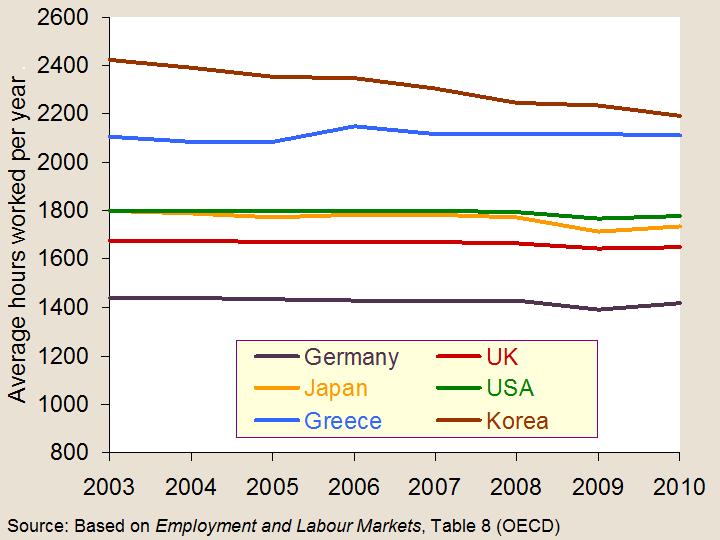 But working long hours does not mean working more productively. Generally the countries in which people work longer hours have lower output per hour.
The following podcast and articles look at the relationship between hours worked and productivity and consider which way the causality lies. They also look at related issues such as the proportion of part-time working and the length of annual paid holidays.
Podcast
 Hardest Working Nations (also at) More or Less: BBC Radio 4, Tim Harford talks to Jon Messenger from the ILO (18/5/12)
Articles
Who works the longest hours? BBC News Magazine, Wesley Stephenson (23/5/12)
Are Greeks the hardest workers in Europe? BBC News Magazine, Charlotte McDonald (26/2/12)
Book
Working Time around the World ILO, Sangheon Lee, Deirdre McCann and Jon C. Messenger (Routledge, 2007)
Data
International Comparisons of Productivity – 2010 – Final Estimates: Statistical Bulletin ONS (6/3/12)
International Comparisons of Productivity – 2010 – Final Estimates: Data ONS (6/3/12)
Productivity Statistics OECD
Table 8: Average annual working time: Hours per worker Employment and Labour Markets, OECD
Questions
- Which countries tend to work the longest hours?
- Would cutting working hours, either through legislation or by agreement with companies, allow more people to be employed? Explain why it might be more complicated than this.
- What is the relationship between labour productivity per hour and the average number of hours worked per worker? Do people work longer hours because they are less productive or are they less productive because they work longer hours?
- Why factors determine labour productivity?
- Why may average hours worked be deceptive in terms of assessing how hard people are working?
- Why do US workers work more hours per year on average than UK workers?
 In the third and final part of this blog, we look at the G8 summit at Camp David on 18 and 19 May 2012. Ways of averting the deepening global economic crisis were top of the agenda.
In terms of the global economy, the leaders agreed on three main things. The first was that they supported Greece remaining in the euro. According to the communiqué:
We agree on the importance of a strong and cohesive eurozone for global stability and recovery, and we affirm our interest in Greece remaining in the eurozone while respecting its commitments. We all have an interest in the success of specific measures to strengthen the resilience of the eurozone and growth in Europe
The second was a commitment to ‘fiscal responsibility’ and the clawing down of public-sector deficits.
We commit to fiscal responsibility and, in this context, we support sound and sustainable fiscal consolidation policies that take into account countries’ evolving economic conditions and underpin confidence and economic recovery.
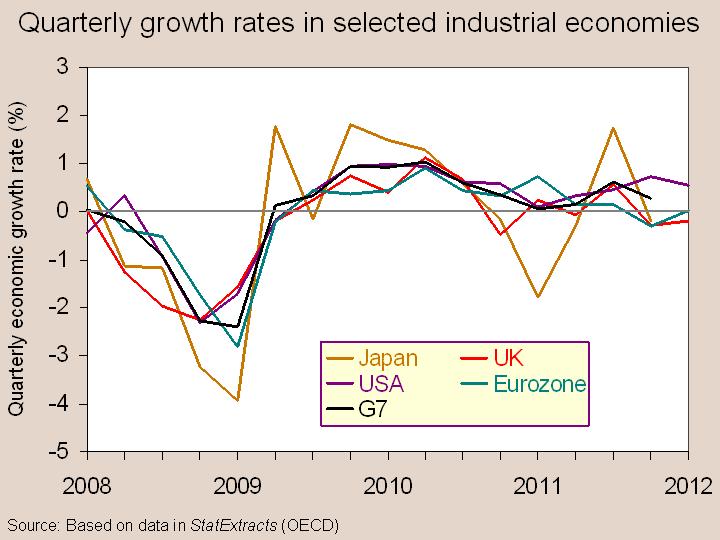 The third was commitment to boosting economic growth. (Click on chart for a larger image.) On the supply side this would be through measures to stimulate productivity. On the demand side this would be through policies to stimulate investment.
(For a PowerPoint of the chart, click on the following link: Quarterly Growth.)
To raise productivity and growth potential in our economies, we support structural reforms, and investments in education and in modern infrastructure, as appropriate. Investment initiatives can be financed using a range of mechanisms, including leveraging the private sector. Sound financial measures, to which we are committed, should build stronger systems over time while not choking off near-term credit growth. We commit to promote investment to underpin demand, including support for small businesses and public-private partnerships.
But the communiqué was short on details. How will fiscal consolidation be achieved? Does this mean a continuation of austerity measures? And if so, what will be the impact on aggregate demand? Or if fiscal consolidation is slowed down, what will be the impact on financial markets?
If a growth in investment is central to the policy, what will be the precise mechanisms to encourage it? Will they be enough to combat the deflationary effect on demand of the fiscal measures?
And how will productivity increases be achieved? What supply-side measures will be introduced? And will productivity increases be encouraged or discouraged by continuing austerity measures?
Lots of questions – questions raised by the articles below.
Articles
Capitalism at a crossroads Independent (19/5/12)
Barack Obama warns eurozone to focus on jobs and growth The Telegraph (20/5/12)
G8 Summit: World leaders push for Greece to stay in the eurozone The Telegraph, Angela Monaghan (19/5/12)
Obama sees ’emerging consensus’ on crisis Sydney Morning Herald, Ben Feller and Jim Kuhnhenn (20/5/12)
G8 leaders tout economic growth, fiscal responsibility CNN (20/5/12)
G8 focuses on Eurozone Gulf News (20/5/12)
G8 leaders back Greece amid tensions France 24 (20/5/12)
G8 splits over stimulus versus austerity Financial TimesRichard McGregor and Kiran Stacey (19/5/12)
Cameron is consigning the UK to stagnation Financial Times, Martin Wolf (17/5/12)
Time to end ‘Camerkozy’ economics Financial Times, Ed Miliband (18/5/12)
Obama: Eurozone ‘must focus on jobs and growth’ BBC News (20/5/12)
World leaders back Greece, vow to combat financial turmoil Reuters, Jeff Mason and Laura MacInnis (19/5/12)
Germany isolated over euro crisis plan at G8 meeting in Camp David Guardian, Patrick Wintour (19/5/12)
G8 leaders end summit with pledge to keep Greece in eurozone Guardian, Ewen MacAskill (19/5/12)
G8 summit ends with few tangible results Xinhua, Sun Hao (20/5/12)
Final communiqué
Camp David DeclarationG8 (19/5/12)
Questions
- To what extent are economic growth and fiscal consolidation (a) compatible; (b) incompatible objectives? How might a Keynesian and a new classical economist respond to these questions?
- What supply-side measures could be introduced by the EU?
- Why might dangers of protectionism increase in the coming months?
- What would be the impact of a Greek default and exit from the eurozone on other eurozone economies?
- What monetary policy changes could be introduced by the eurozone governments and the ECB in order to ease the sovereign debt crisis of countries such as Grecce, Spain, Portugal, Italy and Ireland?
 There are also some longer-term consequences, in particular for those who have been out of work for some time. They lose their skills, making it harder to find a job and this can pose costs to employers and further costs to the government through re-training. As such, government initiatives to tackle youth unemployment have never been more important.