 In the second part of this blog, we look at an interview with the Guardian given by Robert Chote, Chair of the UK’s Office of Budget Responsibility. Like Mervyn King’s, that we looked at in Part 1, Robert Chote’s predictions are also gloomy.
In particular, he argues that if Greece leaves the euro, the effects on the UK economy could be significant, not just in the short term, but in the long term too.
The concern is that you end up with an outcome in the eurozone that creates the same sort of structural difficulties in the financial system and in the economy that we saw in the past recession, and that that has consequences both for hitting economic activity in the economy, but also its underlying potential. And it’s the latter which has particular difficulties for the fiscal position, because it means not just that the economy weakens and then strengthens again – ie, it goes into a hole and comes out – but that you go down and you never quite get back up to where you started. And that has more lingering, long-term consequences for the public finances.
The interview looked not just at the effects of the current crisis in the eurozone on the eurozone, British and world economies, but also at a number of other issues, including: the reliability of forecasts and those of the OBR in particular; relations between the OBR and the Treasury; allowing the OBR to cost opposition policies; the economic effect of cutting the 50p top rate of income tax; the sustainability of public-sector pensions; and tax increases or spending cuts in the long term.
In Part 3 we look at attempts by the G8 countries to find a solution to the mounting crisis.
Articles
Robert Chote interview: ‘I would not say in the past there’s been rigging’ Guardian, Andrew Sparrow (18/5/12)
UK ‘may never fully recover’ if Greece exits euro Guardian, Andrew Sparrow, Helena Smith and Larry Elliott (18/5/12)
British economy may ‘never quite recover’ from a severe Euro collapse The Telegraph, Rowena Mason (18/5/12)
OBR report
Economic and fiscal outlook Office for Budget Responsibility (March 2012)
Questions
- Why is it very difficult to forecast the effects of a Greek withdrawal from the euro?
- Why may Greek withdrawal have an effect on long-term potential output in the UK and the rest of Europe?
- Why are economic forecasts in general so unreliable? Does this mean that we should abandon economic forecasting?
- Why are public finances “likely to come under pressure over the longer term”?
- Why might the cut in the top rate of income tax from 50% to 45% have little impact on economic growth? Distinguish between income and substitution effects of the tax cut.
 This has been a week of gloomy prognostications. On Wednesday 16 May, the Bank of England published its quarterly Inflation Report – and it makes worrying reading.
The forecast of UK economic growth for 2012 has been reduced from 1.2% in the previous report to 0.8%. But the rate of inflation is forecast to remain above the 2% target well into next year. However, at the two-year horizon, inflation is now forecast to be 1.6% – below the target, thus giving the MPC scope for further quantitative easing.
In the introduction to the report, the Governor, Mervyn King, writes:
Over the past year or so, two factors have hampered the recovery and rebalancing by more than expected. First, higher-than-expected world commodity and energy prices have squeezed real take-home pay, dampening consumption growth. Second, credit conditions, far from easing, have in some cases become tighter. The direct and indirect exposures of UK banks to the euro-area periphery have affected funding costs as the challenges of tackling the indebtedness and lack of competitiveness in those countries have intensified.
And at the news conference launching the report, he said:
We have been through a big global financial crisis, the biggest downturn in world output since the 1930s, the biggest banking crisis in this country’s history, the biggest fiscal deficit in our peace time history and our biggest trading partner – the euro area – is tearing itself apart without any obvious solution.
The idea that we could reasonably hope to sail serenely through this with growth close to the long run average and inflation at 2% strikes me as wholly unrealistic. We’re bound to be buffeted by this and affected by it.
 The following articles look at the Bank of England’s predictions and at the challenges facing the UK economy as the crisis in the eurozone deepens and as inflation in the UK remains stubbornly above target. They also look at the issue of the extent to which capacity has been lost as a result of the continuing weakness of the UK economy. As The Economist article states:
Business surveys suggest only a small proportion of firms are operating below capacity. That finding looks odd given the economy’s output is still 4% below its level at the start of 2008, and is much farther below the level it would have reached if GDP growth had continued at its long-term rate. The picture painted by surveys could be right if a chunk of the economy’s potential has been written off for good. But Sir Mervyn King, the bank’s governor, doubts this. There is “no obvious reason” why the economy could not rejoin its pre-crisis path, though it might take a decade or two to get there, he said on May 16th.
We look in more detail at the question of lost capacity in Part 2.
Articles
 Bank of England cuts growth forecasts: Sir Mervyn King’s speech in full The Telegraph (16/5/12)
Bank of England sees inflation up and growth falling Independent, Ben Chu (17/5/12)
Hard going The Economist (19/5/12)
Bank of England optimism dented again Financial Times, Chris Giles (16/5/12)
Eurozone is ‘tearing itself apart’, says Mervyn King. True, but the UK’s problems are as intractable as ever The Telegraph, Philip Aldrick (16/5/12)
Inflation Report
Inflation Report: portal page Bank of England
Inflation Report: May 2012 Bank of England (16/5/12)
Additional Data
Statistical annex to European Economy. Spring 2012 European Commission, Economic and Financial AffairsAnnual macro-economic database European Commission, Economic and Financial Affairs (11/5/12) (see particularly section 6.5)
Forecasts for the UK economy HM Treasury
Questions
- What explanations are given for the rate of CPI inflation remaining persistently above the 2% target?
- Why have the prospects for economic growth worsened since the publication of the February Inflation Report?
- How might it be possible to have a narrowing (negative) output gap and yet a stagnant economy?
- Why may capacity have been lost since the financial crisis of 2008?
- Why has M4 declined despite the programme of quantitative easing? (See M4 in record fall despite QE.)
- What scope is there for monetary policy in achieving faster economic growth without pushing inflation above the 2% target?
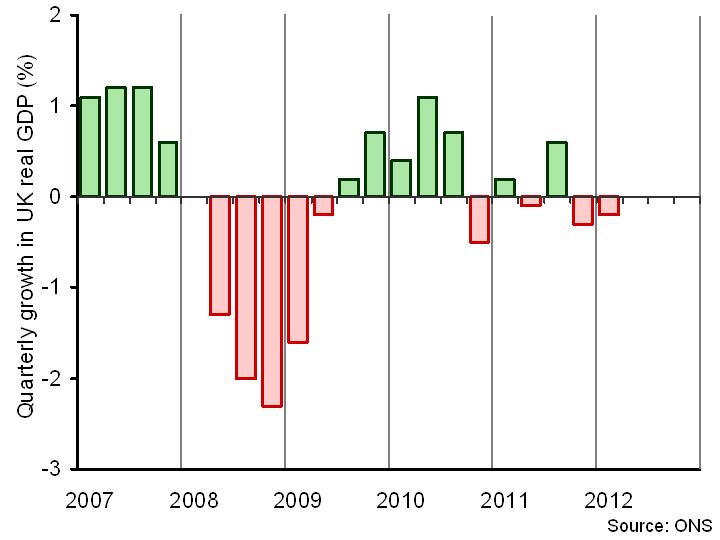 The UK is officially back in recession: or to be more accurate, a double-dip recession.
The generally accepted definition of a recession is two or more quarters of negative growth in real GDP. According to figures released by the Office for National Statistics, the UK economy shrank by 0.2% in quarter 1, 2012, having shrunk by 0.3% in quarter 4, 2011.
(Click on the following link for a PowerPoint of the above chart: Double dip 2)
As you can see from the chart (click chart for a larger version), these declines are tiny compared with the recession of 2008/9. Nevertheless, with the eurozone economy slowing (Britain’s largest export market), and with cuts to government expenditure set to bite harder in the coming months, there are worries that there may be more quarters of negative growth to come.
So what are the causes of this double-dip recession? Are they largely external, in terms of flagging export markets; or are they internal? Is the new recession the direct result of the tight fiscal policy pursued by the Coalition government?
And what is to be done? Is there no option but to continue with the present policy – the government’s line? Or should the austerity measures be reined in? After all, as we saw in the last blog post (Economic stimulus, ‘oui’; austerity, ‘non’), the mood in many European countries is turning against austerity.
The following articles explore the causes and policy implications of the latest piece of bad news on the UK economy.
Articles
Double-dip recession a terrible blow for George Osborne Guardian, Larry Elliott (25/4/12)
Double-dip recession figures mark another bad day for George Osborne Guardian, Larry Elliott (25/4/12)
UK double-dip recession: what the economists say Guardian (25/4/12)
Feared double dip recession becomes reality as British economy contracts again in first quarter of 2012 Daily Record (25/4/12)
Britain in double-dip recession as growth falls 0.2pc The Telegraph, Angela Monaghan and Szu Ping Chan (25/4/12)
Did the eurozone crisis cause the double-dip recession? Guardian, Polly Curtis (25/4/12)
UK’s double-dip recession Financial Times, Chris Giles (25/4/12)
UK is in ‘double dip’ recession FT Adviser, Rebecca Clancy and John Kenchington (25/4/12)
Flanders explains GDP figure BBC News, Stephanie Flanders (25/4/12)
No recovery for UK: No let up for ONS BBC News, Stephanie Flanders (25/4/12)
Double-dip recession: There’s always fantasy island BBC News, Paul Mason (25/4/12)
UK double-dip recession to drag on into summer, economists warn The Telegraph, Philip Aldrick (26/4/12)
George Osborne can stop the rot, but only by spending as he slashes The Telegraph, Jeremy Warner (25/4/12)
Double dip has arrived – and Osborne is running out of escape routes Independent, Ben Chu (26/4/12)
Britain’s bosses tell the ONS: it’s bad, but not a recession Independent, Tom Bawden, Lucy Tobin , Gideon Spanier (26/4/12)
The Chancellor received plenty of warning Independent, David Blanchflower (26/5/12)
Data
Gross Domestic Product: Preliminary Estimate, Q1 2012 ONS (25/4/12)
Preliminary Estimate of GDP Time Series Dataset 2012 Q ONS (25/4/12)
World Economic Outlook Database IMF (17/4/12)
Business and Consumer Surveys (for all individual EU countries and for the EU as a whole) European Commission: Economic and Financial Affairs
Consumer Confidence Nationwide Building Society
Questions
- Assess the current state of the UK economy and its likely course over the coming few months.
- Why may looking at the business surveys provide a truer picture of the state of the UK economy than the official measure of GDP?
- Why has the UK economy gone back into recession?
- Compare the policy approaches of the Coalition government with those of the Labour opposition.
- How important is it for the UK to retain its AAA credit rating?
 Between December 2007 and March 2009, the Bank of England reduced Bank Rate on several occasions in order to stimulate the economy and combat recession. By March 2009, the rate stood at a record low of 0.5%. Each month the Monetary Policy Committee meets to decide on interest rates and since March 2009, the members’ decision has consistently been that Bank Rate needs to remain at 0.5%.
Although the UK economy has been making tentative steps towards recovery, it is still in a very vulnerable state. Last month, the Bank of England extended its programme of quantitative easing to a total £325bn stimulus. This, together with the decision to keep interest rates down and with the shock fall in manufacturing output contributing towards first quarter growth of just 0.1%, is a key indication that the UK economy is still struggling, even though the central bank thinks it unlikely that the UK will re-enter recession this year.
Monetary policy in the UK has been very much geared towards stimulating economic growth, despite interest rates typically being the main tool to keep inflation on target at 2%. The problem facing the central bank is that economic growth and inflation are in something of a conflict. Low interest rates to stimulate economic growth also create a higher inflation environment and that is the trade-off the economy has faced. Inflation has been well above its target for some months (a high of 5.2% in September 2011), and the low interest rate environment has done little to deflate the figure. After all, low interest rates are a monetary instrument that can be used to boost aggregate demand, which can then create demand-pull inflation. However, inflation is now slowly beginning to fall, but this downward trend could be reversed with the sky high oil prices we are recently experiencing. If inflation does begin to creep back up, the Monetary Policy Committee will once again face a decision: keep Bank Rate low and continue with quantitative easing to stimulate the economy or increase Bank Rate to counter the higher rate of inflation.
The data over recent months has been truly inconsistent. Some indicators suggest improvements in the economy and the financial environment, whereas others indicate an economic situation that is moving very quickly in the wrong direction. A key factor is that the direction the UK economy takes is very much dependent on the world economy and, in particular, on how events in the eurozone unfold. The following articles consider some of the latest economic developments.
UK economy grew 0.1% to avoid recession, says NIESR Guardian, Katie Allen (5/4/12)
UK interest rates held at 0.5% BBC News (5/4/12)
UK just about avoided recession in Q1, NIESR says Telegraph, Angela Monaghan (5/4/12)
Bank of England keeps interest rates on hold at 0.5pc Telegraph (5/4/12)
UK economy ‘weak but showing signs of improvement’ BBC News (3/4/12)
Bank of England holds on quantitative easing and interest rates Guardian, Katie Allen (5/4/12)
Faith on Tories on economy hits new low Financial Times, Helen Warrell (6/4/12)
Questions
- Which factors will the Monetary Policy Committee consider when setting interest rates?
- Using a diagram to help your answer, illustrate and explain the trade-off that the MPC faces when choosing to keep interest rates low or raise them.
- What is quantitative easing? How is it expected to boost economic growth in the UK?
- Which factors are likely to have contributed towards the low growth rate the UK economy experienced in the first quarter of 2012?
- Explain the trends that we have seen in UK inflation over the past year. What factors have caused the figure to increase to a high in September and then fall back down?
- What do you expect to happen to inflation over the next few months? To what extent is your answer dependent on the MPC’s interest rate decisions?
- Although the official figures suggest that the UK avoided a double-dip recession, do you agree with this assessment? Explain your answer.
 International trade brings various benefits to an economy. One is that it can stimulate economic growth – something the UK government would very much like to achieve in current circumstances.
As one of the components of aggregate demand, net exports is a key variable that can create jobs and growth in an economy, and it is this variable that is being directly targeted in a trade agreement between the UK and South Korea. Growth in developing countries is far outstripping that in the West and through this trade deal, the UK is hoping to benefit from some of this growth – to the tune of about £500m per year.
South Korea already trades a huge amount with the UK – we are its second largest European trade partner after Germany. The Free Trade Area that has been agreed will put British firms in a stronger position when negotiating contracts, especially in relation to sporting events, such as the Asian Games in 2014, the World Student Games in 2015 and the Pyeongchang Winter Olympics in 2018. Nick Clegg, who announced the agreement said:
‘The best of British design, innovation and services will have even greater opportunity to show their strength in South Korea. UK and Korean companies will be able to form alliances on multi-billion pound projects across the world.’
Some of the benefits of this agreement may be seen relatively soon, as the South Korea National Pension Service has announced plans to set up a base in London, which would create a much need injection of investment into the stagnant economy. This latest trade deal is very much a part of the Coalition’s strategy of creating stronger ties and trade links to the fast growing emerging markets. The size of these potential benefits and the speed with which they emerge can only be estimated, but if they do materialise they will undoubtedly have positive effects on economic growth. The following articles consider these ‘economic opportunities in the UK’.
Nick Clegg hails Korean trade deal as £2bn opportunity for Britain Telegraph, Anna White (25/3/12)
South Korea trade deal ‘may bring £500m to UK economy’ BBC News (26/3/12)
South Korea’s $320bn pension fund to set up London base Guardian (26/3/12)
S Korea pension fund to set up London office Financial Times, Elizabeth Rigby (25/3/12)
Nick Clegg boosts British business in South Korea The Economic Voice, Jeff Taylor (26/3/12)
Questions
- What are the benefits and costs of trade? To whom do they accrue?
- The articles talk about a free trade area. What are the characteristics of such an agreement?
- What other types of trade agreement are there? In each case, find examples of that type of agreement.
- Why is trade seen as an engine of growth? Think about aggregate demand and how this can explain a boost to national income.
- If the South Korea National Pension Service does create a base in London, explain how the multiplier effect might create additional benefits to the UK.
 In the second part of this blog, we look at an interview with the Guardian given by Robert Chote, Chair of the UK’s Office of Budget Responsibility. Like Mervyn King’s, that we looked at in Part 1, Robert Chote’s predictions are also gloomy.