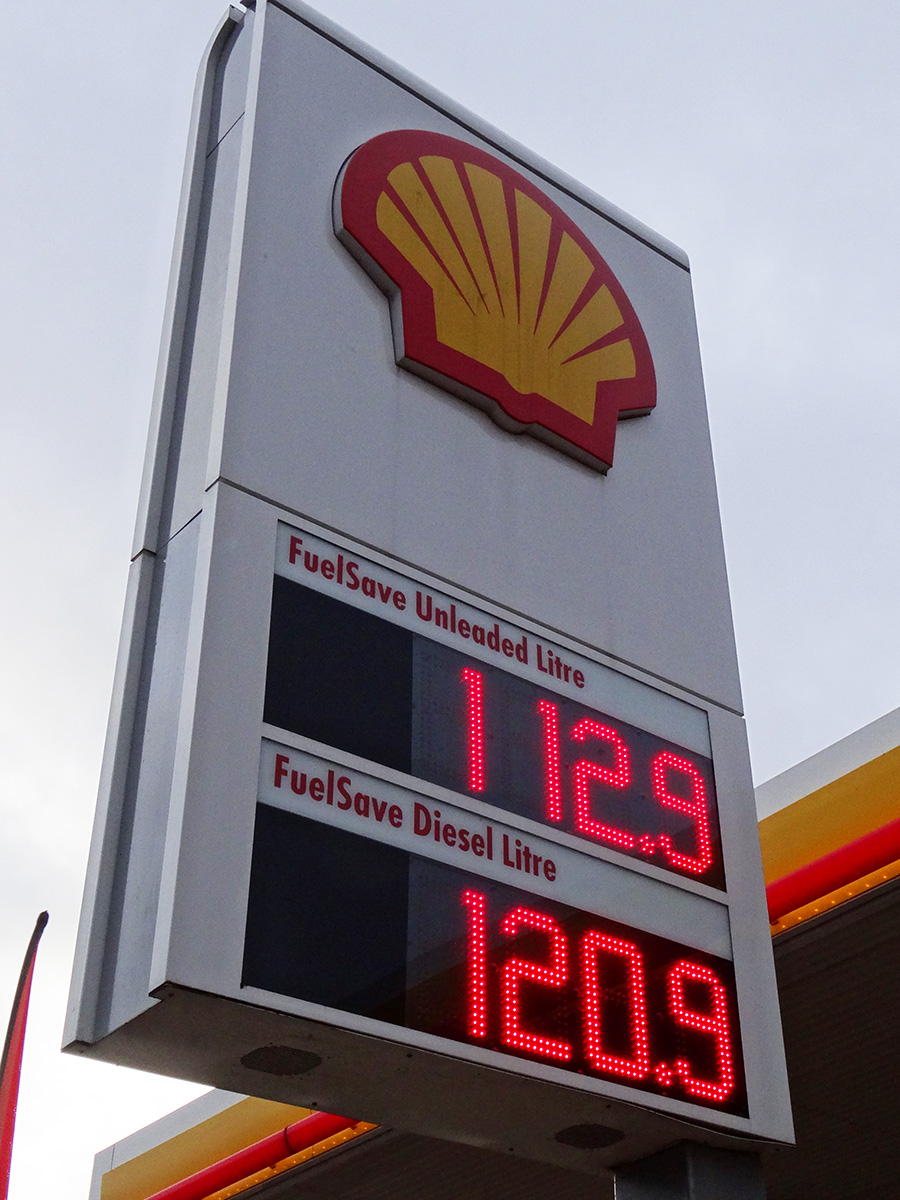
 Oil prices have been plummeting in recent months. Indeed, many commentators are saying that this is the major economics news story of 2014. In June 2014 Brent crude was around $112 per barrel. By December the price has fallen to around $60 – a fall of 46%. But what are the implications for fuel prices?
Just because the crude oil price has fallen by 46%, this does not mean that prices at the pump should do the same. Oil is priced in dollars and the pound has depreciated against the dollar by just over 7% since June, from around £1 = $1.69 to around £1 = $1.57. Thus in sterling terms, crude oil has fallen by only 42%.
More significantly, the cost of crude is a relatively small percentage of the price of a litre of petrol. At a price of 132p per litre (the July average price), crude accounted for around 27% of the price, or around 36p per litre. At a price of 114p per litre, the price in late December, crude accounts for around 19% of the price, or around 21.5p per litre. The largest element of price is fuel duty, which is charged at a flat rate of 57.95p per litre. In addition there is VAT at 20% of the pre-VAT price (or 16.67% of the retail price). Finally there are the refining, distribution and retail costs and margins, but these together account for only around 16p per litre.
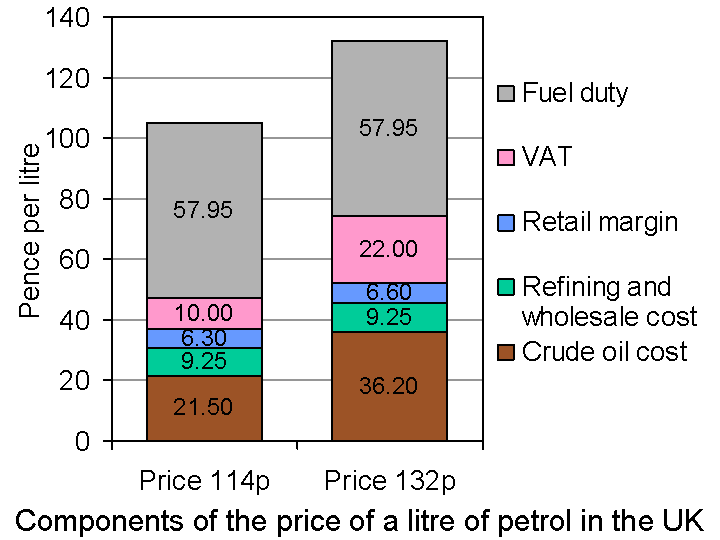 What this means is that the 46% cut in oil prices has led to a cut in petrol prices of only around 14%. If petrol prices were to reach £1 per litre, as some commentators have forecast, crude oil prices would have to fall to under $40 per barrel.
Although petrol and diesel prices have fallen by a smaller percentage than oil prices, this still represents a significant cut in motoring and transport costs. It also represents a significant cut in costs for the petrochemical industry and other industries using large amounts of oil.
For oil-importing countries this is good news as the fall in the oil price represents an increase in real incomes. For oil importing countries, and especially those such as Russia and some OPEC countries where oil constitutes a large proportion of their exports, it is bad news. We explore these effects in Part 2.
Videos
 UK petrol prices hit four-year low BBC News, John Moyland (10/12/14)
Petrol prices plunge ahead of Christmas holidays Belfast Telegraph (19/12/14)
Petrol price plummet – could fuel drop to below a pound a litre in the New Year? Channel 5 News on YouTube (17/12/14)
Articles
UK motorists benefit from petrol price drop Financial Times, Michael Kavanagh (23/12/14)
Petrol to drop to £1 a litre, says Goldman Sachs The Telegraph, Szu Ping Chan (9/12/14)
Oil prices: How low will they go in 2015? International Business Times, Shane Croucher (22/12/14)
Plummeting oil price may lead to petrol falling below £1 a litre RAC news (17/12/14)
Pump Prices: Cheap Petrol Comes With A Warning Sky News (19/12/14)
Data and information
Fuel prices in Europe Drive Alive (20/12/14)
Weekly road fuel prices Department of Energy & Climate Change (23/12/14)
Prices at the pump – why are they falling and will this continue? ONS (18/12/14)
Fuel Prices Explained RAC
UKPIA Statistical Review 2014 United Kingdom Petroleum Industry Association
Questions
- Why does the price of petrol fluctuate less in percentage terms than the price of crude oil?
- What factors will affect whether UK petrol prices fall to £1 per litre?
- If crude oil prices fell by 20%, in which of these two cases would there be a bigger percentage fall in petrol prices: (a) petrol price currently 140p; (b) petrol price currently 110p? Explain.
- Distinguish between a specific tax and an ad valorem tax. Which of these is (a) fuel duty; (b) VAT? Illustrate your answer with a supply and demand diagram.
- What determines the price elasticity of demand for petrol and diesel? Is the long-run elasticity likely to be higher or lower than the short-run elasticity? Explain.
- Distinguish between demand-pull and cost-push inflation. Given that oil price changes are correlated to inflation, would you characterise recent falls in inflation as reductions in demand-pull or cost-push pressures, or both: (a) in a specific oil-importing country; (b) globally?
 Figures for employment and unemployment give an incomplete picture of the state of the labour market. Just because a person is employed, that does not mean that they are working the number of hours they would like.
Some people would like to work more hours, either by working more hours in their current job, or by switching to an alternative job with more hours or by taking on an additional part-time job. Such people are classed as ‘underemployed’. On average, underemployed workers wanted to work an additional 11.3 hours per week in 2014 Q2. Underemployment is a measure of slack in the labour market, but it is not picked up in the unemployment statistics.
Other people would like to work fewer hours (at the same hourly rate), but feel they have no choice – usually because their employer demands that they work long hours. Some, however, would like to change to another job with fewer hours even if it involved less pay. People willing to sacrifice pay in order to work fewer hours are classed as ‘overemployed’.
Statistics released by the Office for National Statistics show that, in April to June 2014, 9.9%, or 3.0 million, workers in the UK were underemployed; and 9.7%, or 2.9 million, were overemployed.
The figures for underemployment vary between different groups:
|
|
| • |
11.0% of female workers |
8.9% of male workers |
| • |
19.6% of 16-24 year olds |
9.9% of all workers |
| • |
21.1% of people in elementary occupations (e.g. cleaners, shop assistants and security guards) |
5.4% of people in professional occupations (e.g. doctors, teachers and accountants) |
| • |
11.5% of people in the North East of England (in 2013) |
9.2% of people in the East of England (in 2013) |
| • |
22.1% of part-time workers |
5.4% of full-time workers |
As far as the overemployed are concerned, professional people and older people are more likely want shorter hours
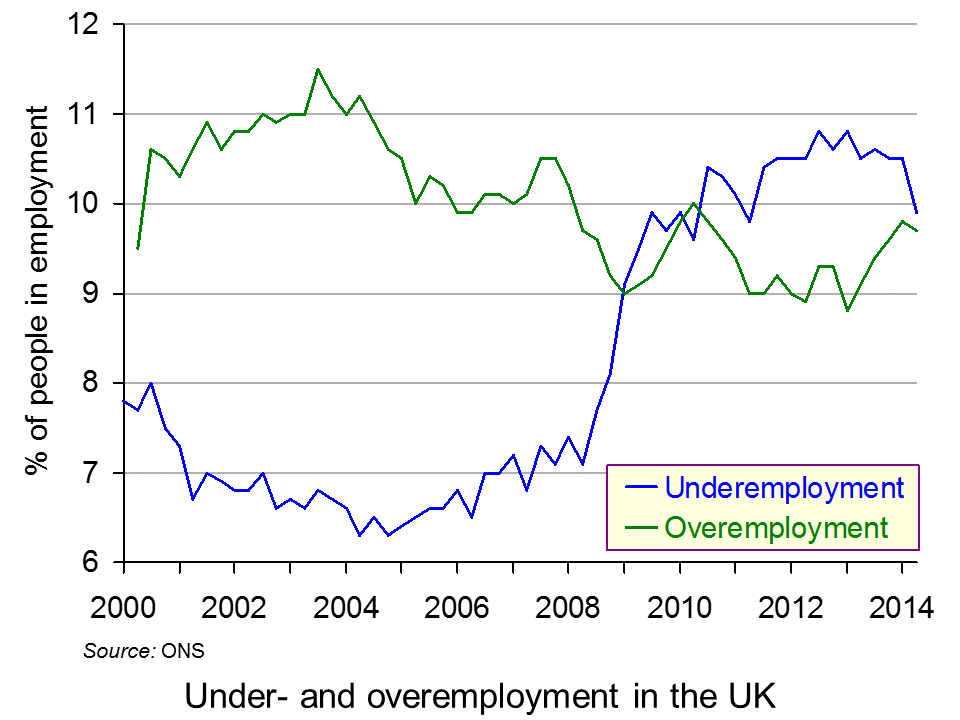 The ONS data also show how under- and overemployment have changed over time: see chart (click here for a PowerPoint). Before the financial crisis and recession, overemployment exceeded underemployment. After the crisis, the position reversed: underemployment rose from 6.8% in 2007 to a peak of 10.8% in mid-2012; while overemployment fell from 10.5% in 2007 to a trough of 8.8% in early 2013.
More recently, as the economy has grown more strongly, underemployment has fallen back to 9.9% (in 2014 Q2) and overemployment has risen to 9.7%, virtually closing the gap between the two.
The fact that there is still significant underemployment suggests that there is still considerable slack in the labour market and that this may be acting as a brake on wage increases. On the other hand, the large numbers of people who consider themselves overemployed, especially among the professions and older workers, suggests that many people feel that they have not got the right work–life balance and many may be suffering consequent high levels of stress.
Articles
Rise in number of UK workers who want to cut back hours, ONS says The Guardian, Phillip Inman (25/11/14)
Data reveal slack and stretch in UK workforce Financial Times, Sarah O’Connor (25/11/14)
Will you graduate into underemployment? The Guardian, Jade Grassby (30/9/14)
Three million people would take pay cut to work shorter hours: Number who say they feel overworked rises by 10 per cent in one year Mail Online, Louise Eccles (26/11/14)
ONS: Rate of under-employment in Scotland lower than UK average Daily Record, Scott McCulloch (25/11/14)
ONS Release
Underemployment and Overemployment in the UK, 2014 ONS (25/11/14)
Questions
- Distinguish between unemployment (labour force survey (LFS) measure), unemployment (claimant count measure), underemployment (UK measure), underemployment (Eurostat measure) and disguised unemployment.
- Why is underemployment much higher amongst part-time workers than full-time workers?
- How do (a) underemployment and (b) overemployment vary according to the type of occupation? What explanations are there for the differences?
- Is the percentage of underemployment a good indicator of the degree of slack in the economy? Explain.
- How is the rise in zero hours contracts likely to have affected underemployment?
- How could the problem of overemployment be tackled? Would it be a good idea to pass a law setting a maximum number of hours per week that people can be required to do in a job?
- Would flexible working rights be a good idea?
 The articles linked below look at the dangers of deflation and policies of central banks to counter it.
Deflation in economics has three meanings. The first is falling prices: i.e. negative inflation. The second, more traditional meaning, is a fall in real aggregate demand, resulting in lower output, higher unemployment and lower inflation – and quite possibly an actual fall in the price level. These first two definitions describe what is generally seen as an undesirable situation. The third is a slowing down in the growth of real aggregate demand, perhaps as a result of a deliberate act of fiscal and/or monetary policy. This third meaning could describe a desirable situation, where unsustainable growth is reduced and inflation is reduced from an above-target level.
Here we focus on the first definition. The first two articles look at the dangers of a fall in the price level. The chart below shows falling inflation, although not actually deflation, in China, France, Germany and the UK (click here for a PowerPoint). Several European countries, however, are experiencing actual deflation. These include: Greece, Spain, Hungary, Poland and Sweden. Inflation in the eurozone for 2014 is expected to be a mere 0.5%.
The most obvious danger of deflation (or expected deflation) is that people will delay spending on durable goods, such as cars, furniture and equipment, hoping to buy the items cheaper later. 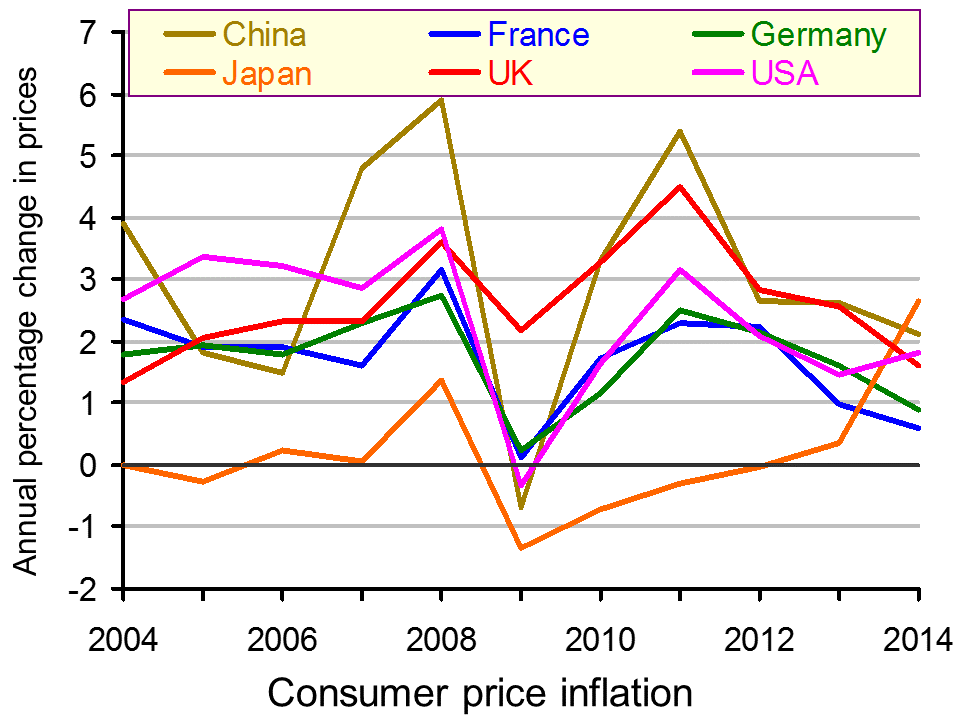 The result could be a fall in aggregate demand and a fall in output and employment.
For retailers, this is all spelling Christmas doom. Already the runup to the most crucial time of the year for shops is being characterised by a game of chicken. Shoppers are wondering how long they can leave their festive buying in the hope of late bargains.
Interest rates may be low, but for people with debts, this is being offset by the fact that inflation is no longer reducing the real value of that debt. For people with credit card debt, personal loans and most mortgages, the interest rate they pay is significantly above the rate of inflation. In other words, the real interest rate on their debt is still significantly positive. This may well discourage people from borrowing and spending, further dampening aggregate demand. And, with a Bank Rate of just 0.5%, there is virtually no scope for lowering the official interest rate further.
At least in the UK, economic growth is now positive – for the time being at any rate. The danger is becoming more serious, however, in many eurozone countries, which are already back in recession or close to being so. The ECB, despite its tentative steps to ease credit conditions, it moving closer to the day when it announces full-blown quantitative easing and buys sovereign bonds of eurozone countries. The Bank of Japan has already announced that it is stepping up it QE programme – a vital ingredient in getting Abenomics back on track and pulling Japan out of its latest recession.
In the USA, by contrast, there is little danger of deflation, as the US economy continues to grow strongly. The downside of this, has been a large rise in consumer debt (but not mortgages) – the ingredients of a possible future bubble and even a new financial crisis.
Forget what central bankers say: deflation is the real monster The Observer, Katie Allen (23/11/14)
Why Deflation Is Such A Big Worry For Europe NPR, Jim Zarroli (31/10/14)
Exclusive: China ready to cut rates again on fears of deflation – sources Reuters, Kevin Yao (23/11/14)
Central Banks in New Push to Prime Pump Wall Street Journal Jon Hilsenrath, Brian Blackstone and Lingling Wei (21/11/14)
Are Central Banks Panicking? Seeking Alpha, Leo Kolivakis (21/11/14)
Questions
- What are (a) the desirable and (b) the undesirable consequences of deflation? Does the answer depend on how deflation is defined?
- What is meant by a ‘deflationary gap’? In what sense is ‘deflationary’ being used in this term?
- Why have oil prices been falling? How desirable are these falls for the global economy?
- Is there an optimal rate of inflation? If so, how would this rate be determined?
- The chart shows that inflation in Japan is likely to have risen in 2014. This in large part is the result to a rise in the sales tax earlier this year. If there is no further rise in the sales tax, which there will probably not be if Mr Abe’s party wins the recently called election, what is likely to be the effect of the 2014 tax rise on inflation in 2015?
- If the Bank Rate is below the rate of inflation, why are people facing a positive real rate of interest? Does this apply equally to borrowers and savers?
- In what sense is there a cultural revolution at the Bank of England?
 Lloyds Banking Group has announced that it plans to reduce its labour force by 9000. Some of this reduction may be achieved by not replacing staff that leave, but some may have to be achieved through redundancies.
The reasons given for the reduction in jobs are technological change and changes in customer practice. More banking services are available online and customers are making more use of these services and less use of branch banking. Also, the increasingly widespread availability of cash machines (ATMs) means that fewer people withdraw cash from branches.
And it’s not just outside branches that technological change is impacting on bank jobs. Much of the work previously done by humans is now done by software programs.
One result is that many bank branches have closed. Lloyds says that the latest planned changes will see 150 fewer branches – 6.7% of its network of 2250.
What’s happening in banking is happening much more widely across modern economies. Online shopping is reducing the need for physical shops. Computers in offices are reducing the need, in many cases, for office staff. More sophisticated machines, often controlled by increasingly sophisticated computers, are replacing jobs in manufacturing.
So is this bad news for employees? It is if you are in one of those industries cutting employment. But new jobs are being created as the economy expands. So if you have a good set of skills and are willing to retrain and possibly move home, it might be relatively easy to find a new, albeit different, job.
As far as total unemployment is concerned, more rapid changes in technology create a rise in frictional and structural unemployment. This can be minimised, however, or even reduced, if there is greater labour mobility. This can be achieved by better training, education and the development of transferable skills in a more adaptive labour force, where people see changing jobs as a ‘normal’ part of a career.
Webcasts
Lloyds Bank cuts 9,000 jobs – but what of the tech future? Channel 4 News, Symeon Brown (28/10/14)
Lloyds Bank confirms 9,000 job losses and branch closures BBC News, Kamal Ahmed (28/10/14)
Article
Lloyds job cuts show the technology axe still swings for white collar workers The Guardian, Phillip Inman (28/10/14)
Reports
Unleashing Aspiration: The Final Report of the Panel on Fair Access to the Professions Cabinet Office (July 2009)
Fair access to professional careers: a progress report Cabinet Office (30/5/12)
Questions
- Is a reduction in banking jobs inevitable? Explain.
- What could banks do to reduce the hardship to employees from a reduction in employment?
- What other industries are likely to see significant job losses resulting from technological progress?
- Distinguish between demand-deficient, real-wage, structural and frictional unemployment. Which of these are an example, or examples, of equilibrium unemployment?
- What policies could the government pursue to reduce (a) frictional unemployment; (b) structural unemployment?
- What types of industry are likely to see an increase in employment and in what areas of these industries?
 Europe’s largest economy is Germany and the prospects and growth figures of this country are crucial to the growth of the Eurozone as a whole. The EU is a key trading partner for the UK and hence the growth data of Germany and in turn of the Eurozone is also essential in creating buoyant economic conditions within our borders. The bad news is that the economic growth forecast for Germany has been cut by the German government.
The German government had previously estimated that the growth rate for this year would be 1.8%, but the estimate has now been revised down to 1.2% and next year’s growth rate has also been revised downwards from 2% to 1.3%. Clearly the expectation is that low growth is set to continue.
Whenever there are changes in macroeconomic variables, a key question is always about the cause of such change, for example is inflation caused by demand-pull or cost-push factors. The German government has been quick to state that the lower growth rates are not due to internal factors, but have been affected by external factors, in particular the state of the global economy. As such, there are no plans to make significant changes to domestic policy, as the domestic economy remains in a strong position. The economy Minister said:
“The German economy finds itself in difficult external waters … Domestic economic forces remain intact, with the robust labour market forming the foundation … As soon as the international environment improves, the competitiveness of German companies will bear fruit and the German economy will return to a path of solid growth … [for this reason there is] no reason to abandon or change our economic or fiscal policy.”
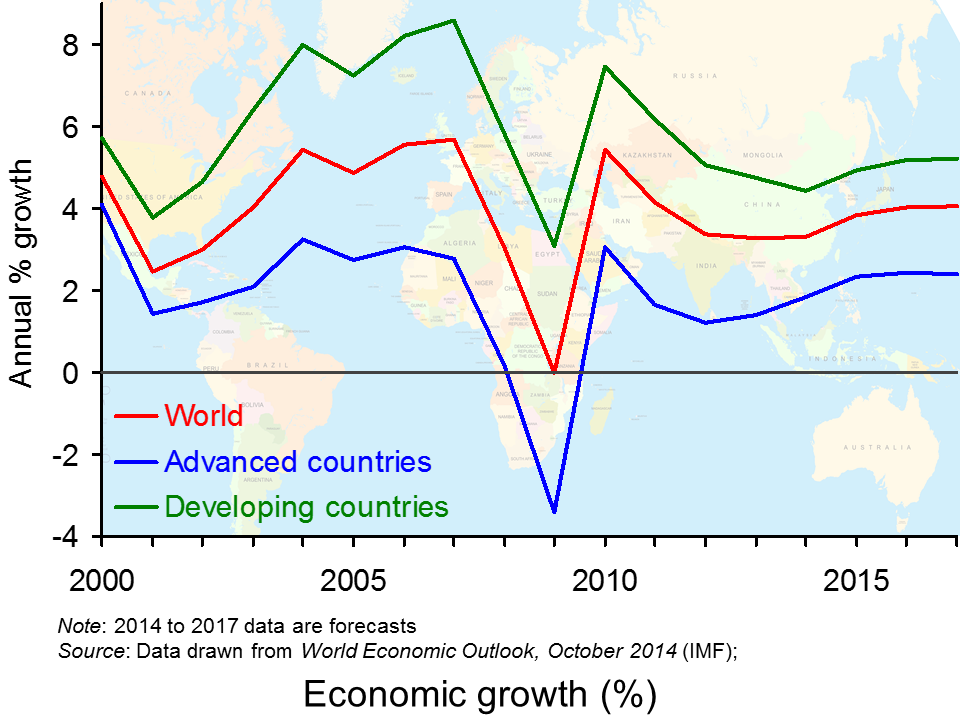 The global picture remains relatively weak and while some economies, including the UK, have seen growth pick up and unemployment fall, there are concerns that the economic recovery is beginning to slow. With an increasingly interdependent world, the slowing down of one economy can have a significant impact on the growth rate of others. If country A begins to slow, demand for imports will fall and this means a fall in the demand for exports of country B. For countries that are dependent on exports, such as Germany and China, a fall in the demand for exports can mean a big decline in aggregate demand and in August, Germany saw a 5.8% drop in exports.
Adding to the gloom is data on inflation, suggesting that some other key economies have seen falls in the rate of inflation, including China. The possibility of a triple-dip recession for the Eurozone has now been suggested and with its largest economy beginning to struggle, this suggestion may become more real. The following articles consider the macroeconomic picture.
Articles
Germany cuts growth forecasts amid recession fears, as Ireland unveils budget The Guardian, Graeme Wearden (14/10/14)
As cracks in its economy widen, is Germany’s miracle about to fade? The Observer, Philip Oltermann (19/10/14)
Why the German economy is in a rut The Economist (21/10/14)
Germany’s flagging economy: Build some bridges and roads, Mrs Merkel The Economist (18/10/14)
Germany cuts 2014 growth forecast from 1.8% to 1.2% BBC News (14/10/14)
IMF to cut growth forecast for Germany – der Spiegel Reuters (5/10/14)
Fears of triple-dip eurozone recession, as Germany cuts growth forecast The Guardian, Phillip Inman (15/10/14)
Germany slashes its economic forecasts Financial Times, Stefan Wagstyl (14/10/14)
Merkel vows austerity even as growth projection cut Bloomberg, Brian Parkin, Rainer Buergin and Patrick Donahue (14/10/14)
Is Europe’s economic motor finally stalling? BBC News, Damien McGuinness (17/10/14)
Why Germany won’t fight deflation BBC News, Robert Peston (16/10/14)
Data
World Economic Outlook Database IMF (15/10/14)
World Economic Outlook IMF (October 2014)
Questions
- How do we measure economic growth and is it a good indicator of the state of an economy?
- What are the key external factors identified by the Germany government as the reasons behind the decline in economic growth?
- Angela Merkel has said that austerity measures will continue to balance the budget. Is this a sensible strategy given the revised growth figures?
- Why is low inflation in other economies further bad news for those countries that have seen a decline or a slowdown in their growth figures?
- Why is interdependence between nations both a good and a bad thing?
- Using AS and AD analysis, illustrate the reasons behind the decline German growth. Based on your analysis, what might be expected to happen to some of the other key macroeconomic variables in Germany and in other Eurozone economies?
 Oil prices have been plummeting in recent months. Indeed, many commentators are saying that this is the major economics news story of 2014. In June 2014 Brent crude was around $112 per barrel. By December the price has fallen to around $60 – a fall of 46%. But what are the implications for fuel prices?