 As the old year gives way to the new, papers have been full of economic forecasts for the coming year. This year is no exception. The authors of the articles below give their predictions of what is to come for the global economy and, for the most part, their forecasts are relatively optimistic – but not entirely so. Despite a sunny outlook, there are various dark clouds on the horizon.
Most forecasters predict a higher rate of global economic growth in 2014 than in 2013 – and higher still in 2015. The IMF, in its October forecasts, predicted global growth of 3.6% in 2014 (up from 2.9% in 2013) and 4.0% in 2015.
Some countries will do much better than others, however. The USA, the UK, Germany and certain developing countries are forecast to grow more strongly. The eurozone as a whole, however, is likely to see little in the way of growth, as countries such as Greece, Spain, Portugal and Italy continue with austerity policies in an attempt to reduce their debt. 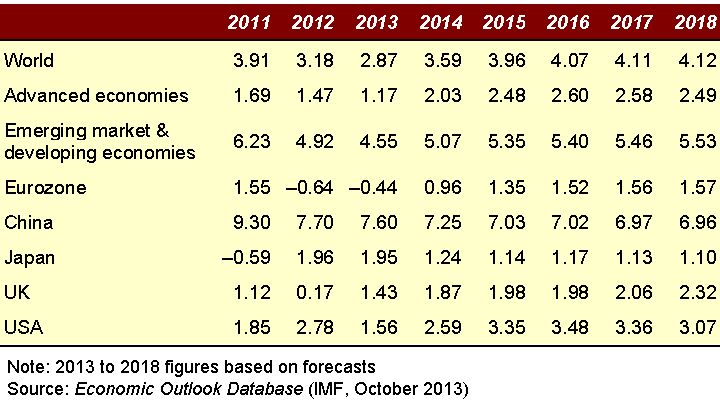 Chinese growth has slowed, as the government seeks to rebalance the economy away from exports and investment in manufacturing towards consumption, and services in particular. It is still forecast to be 7.3% in 2014, however – well above the global average. Japanese growth has picked up in response to the three arrows of fiscal, monetary and supply-side policy. But this could well fade somewhat as the stimulus slows. The table shows IMF growth forecasts for selected countries and groups of countries to 2018.
Much will depend on what happens to monetary policy around the world. How quickly will monetary stimulus taper in the USA and in Japan? Will the ECB introduce more aggressively expansionary monetary policy? When will the Bank of England start raising interest rates?
Growth within countries is generally favouring those on higher incomes, with the gap between rich and poor set to continue widening over the coming years. The pay of top earners has continued to rise considerably faster than prices, while increasingly flexible labour markets and squeezed welfare budgets have seen a fall in living standards of many on low incomes. According to a Which? survey (reported in the Independent article below), in the UK:
Only three in ten expect their family’s situation to improve in the new year, while 60% said they are already dreading the arrival of their winter energy bill. The Which? survey also found that 13 million people could afford to pay for Christmas only by borrowing, with more than four in ten using credit cards, loans or overdrafts to fund their festive spending. A third of people (34%) also dipped into their savings, taking an average of £450 from their accounts.
If recovery is based on borrowing, with real incomes falling, or rising only very slowly, household debt levels are likely to increase. This has been stoked in the UK by the ‘Help to Buy‘ scheme, which has encouraged people to take on more debt and has fuelled the current house price boom. This could prove damaging in the long term, as any decline in confidence could lead to a fall in consumer expenditure once more as people seek to reduce their debts.
 And what of the global banking system? Is it now sufficiently robust to weather a new crisis. Is borrowing growing too rapidly? Is bank lending becoming more reckless again? Are banks still too big to fail? Is China’s banking system sufficiently robust? These are questions considered in the articles below and, in particular, in the New York Times article by Gordon Brown, the former Prime Minister and Chancellor of the Exchequer.
Articles
Global economy: hopes and fears for 2014The Observer, Heather Stewart and Larry Elliott (29/12/13)
Looking ahead to 2014 BBC News, Linda Yueh (20/12/13)
Low hopes for a happy new financial year in 2014 Independent, Paul Gallagher (29/12/13)
Brisk UK economic growth seen in 2014 fuelled by spending – Reuters poll Reuters, Andy Bruce (12/12/13)
GLobal Economy: 2014 promises faster growth, but no leap forward Reuters, Andy Bruce (29/12/13)
My 2014 Economic Briefing Huffington Post, Tony Dolphin (27/12/13)
Three UK Economy Stories that will Dominate in 2014 International Business Times, Shane Croucher (27/12/13)
Who You Calling a BRIC? Bloomberg, Jim O’Neill (12/11/13)
Hope and Hurdles in 2014 Project Syndicate, Pingfan Hong (27/12/13)
On top of the world again The Economist (18/11/13)
Digging deeper The Economist (31/10/13)
BCC Economic Forecast: growth is gathering momentum, but recovery is not secure British Chambers of Commerce (12/13)
Eight predictions for 2014 Market Watch, David Marsh (30/12/13)
Stumbling Toward the Next Crash New York Times, Gordon Brown (18/12/13)
Central banks must show leadership to rejuvenate global economy The Guardian, Larry Elliott (1/1/14)
Global economy set to grow faster in 2014, with less risk of sudden shocks The Guardian, Nouriel Roubini (31/12/13)
A dismal new year for the global economy The Guardian, Joseph Stiglitz (8/1/14)
Forecasts and reports
World Economic Outlook (WEO) IMF (October 2013)
Economic Outlook OECD (November 2013)
Output, prices and jobs The Economist
Bank of England Inflation Report: Overview Bank of England (November 2013)
Questions
- What reasons are there to be cheerful about the global economic prospects for 2014 and 2015?
- Who will gain the most from economic growth in the UK and why?
- Why is the eurozone likely to grow so slowly, if at all?
- Are we stumbling towards another banking crisis, and if so, which can be done about it?
- Why has unemployment fallen in the UK despite falling living standards for most people?
- What is meant by ‘hysteresis’ in the context of unemployment? Is there a problem of hysteresis at the current time and, if so, what can be done about it?
- Explain whether the MINT economies are likely to be a major source of global economic growth in the coming year?
- Why is it so difficult to forecast the rate of economic growth over the next 12 months, let alone over a longer time period?
 It is one year since the election of Shinzo Abe in Japan. He immediately embarked on a radical economic policy to stimulate the Japanese economy, which had suffered from years of stagnation. There have been three parts (or three arrows) to his policy: fiscal policy and monetary policy to stimulate aggregate demand and supply-side policy to increase productivity.
As the previous post explains:
 “The first arrow is monetary policy. The Bank of Japan has engaged in extensive quantitative easing through bond purchases in order to drive down the exchange rate (see A J-curve for Japan?), stimulate expenditure and increase the rate of inflation. A target inflation rate of 2% has been set by the Bank of Japan. Part of the problem for the Japanese economy over the years has been stagnant or falling prices. Japanese consumers have got used to waiting to spend in the hope of being able to buy at lower prices. Similarly, Japanese businesses have often delayed stock purchase. By committing to bond purchases of whatever amount is necessary to achieve the 2% inflation target, the central bank hopes to break this cycle and encourage people to buy now rather than later.
 The second arrow is fiscal policy. Despite having the highest debt to GDP ratio in the developed world, Japan is embarking on a large-scale programme of infrastructure investment and other public works. The package is worth over $100bn. The expansionary fiscal policy is accompanied by a longer-term plan for fiscal consolidation as economic growth picks up. In the short term, Japan should have no difficulty in financing the higher deficit, given that most of the borrowing is internal and denominated in yen.
 The third arrow is supply-side policy. On 5 June, Shinzo Abe unveiled a series of goals his government would like to achieve in order to boost capacity and productivity. These include increasing private-sector investment (both domestic and inward), infrastructure expenditure (both private and public), increasing farmland, encouraging more women to work by improving day-care facilities for children, and deregulation of both goods, capital and labour markets. The prime minister, however, did not give details of the measures that would be introduced to achieve these objectives. More details will be announced in mid-June.”
In the webcast and article below, Linda Yueh, the BBC’s Chief Business Correspondent, considers how effective the policies are proving and the challenges that remain.
Webcast
 Has Abenomics fixed Japan’s economic fortunes? BBC News, Linda Yueh (16/12/13)
Articles
Why Abenomics holds lessons for the West BBC News, Linda Yueh (13/12/13)
Japanese business confidence hits six-year high, Tankan survey shows The Guardian (16/12/13)
Data
World Economic Outlook Database IMF (Oct 2013)
Bank of Japan Statistics Bank of Japan
Economic Outlook Annex Tables OECD
Country statistical profile: Japan 2013 OECD (15/11/13)
Questions
- Demonstrate on (a) an aggregate demand and supply diagram and (b) a Keynesian 45° line diagram the effects of the three arrows (assuming they are successful) in meeting their objectives.
- Why has Japan found it so hard to achieve economic growth over the past 20 years?
- How has the Japanese economy performed over the past 12 months?
- What lessons can be learnt by the UK and eurozone countries from Japan’s three arrows?
- Why is the second arrow problematic, given the size of Japan’s general government debt? Does the proportion of Japanese debt owed overseas affect the argument?
- In what ways do the three arrows (a) support each other; (b) conflict with each other?
- Why is the structure of the labour market in Japan acting as a break on economic growth? What policies are being, or could be, pursued to tackle these structural problems?
 ‘Deflation could be replacing debt as the main problem – and there’s nothing to suggest the ECB is up to the job.’ So begins the linked article below by Barry Eichengreen, Professor of Economics and Political Science at the University of California, Berkeley.
The good news in this is that worries about debt in eurozone countries are gradually receding. Indeed, this week Ireland officially ended its reliance on a bailout (of €67.5 billion) from the EU and IMF and regained financial sovereignty (see also).
The bad news is that this does not mark the end of austerity. Indeed, many eurozone countries could get stuck in a deflationary trap, with austerity policies continuing to depress aggregate demand. Eurozone inflation is less than 1% and falling.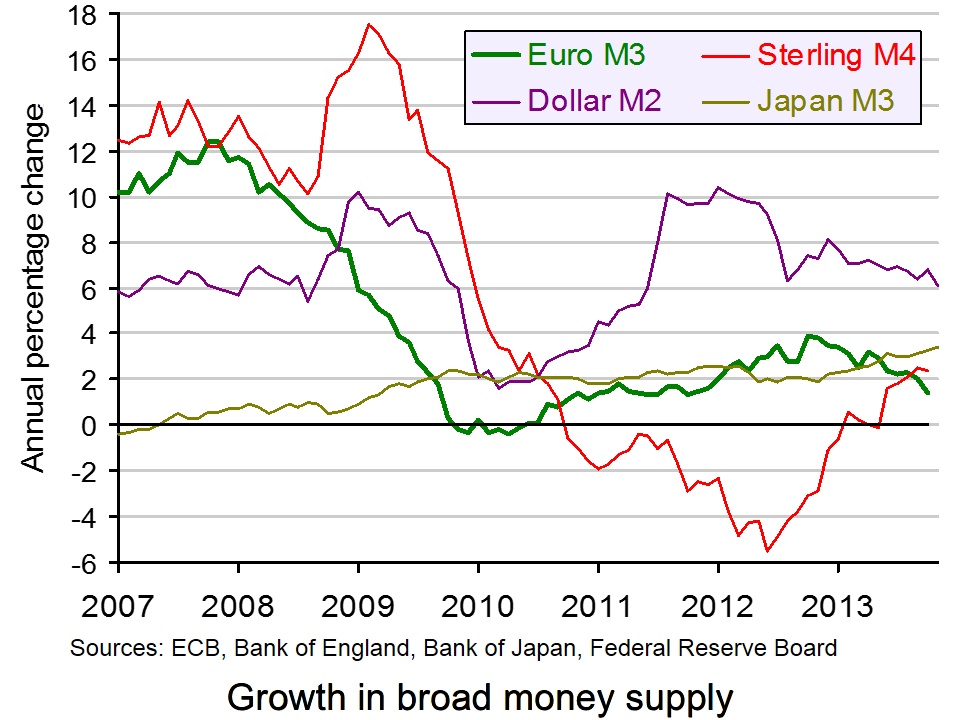 Broad money supply growth is now below that of the US dollar, the yen and sterling (see chart: click here for a PowerPoint).
The ECB has been far more cautious than central banks in other countries in acting to prevent recession and deflation. Unlike the USA, Japan and the UK, which have all engaged in extensive quantitative easing, the ECB had been reluctant to do so for fear of upsetting German opinion and taking the pressure off southern European countries to reform.
But as Eichengreen points out, the dangers of inaction could be much greater. What is more, quantitative easing is not the only option. The ECB could copy the UK approach of ‘funding for lending’ – not for housing, but for business.
Europe’s economic crisis could be mutating again The Guardian, Barry Eichengreen (10/12/13)
Questions
- What problems are created by falling prices?
- What effect would deflation have on debt and the difficulties in repaying that debt?
- What measures have already been adopted by the ECB to stimulate the eurozone economy? (Search previous articles on this site.)
- Why have such measures proved inadequate?
- What alternative policies are open to the ECB?
- What are the arguments for the ECB being given a higher inflation target (such as 3 or 4%)?
- What are the arguments for and against relaxing fiscal austerity in the eurozone at the current time?
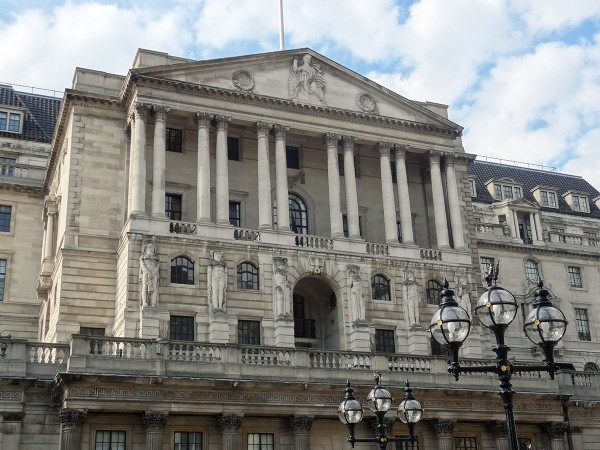 The Consumer Prices index (CPI) measures the rate of inflation and in October, this rate fell to 2.2%, bringing inflation to its lowest level since September 2012. For many, this drop in inflation came as a surprise, but it brings the rate much closer to the Bank of England’s target and thus reduces the pressure on changing interest rates.
The CPI is calculated by calculating the weighted average price of a basket of goods and comparing how this price level changes from one month to the next. Between September and October prices across a range of markets fell, thus bringing inflation to its lowest level in many months. Transport prices fell by their largest amount since mid-2009, in part driven by fuel price cuts at the big supermarkets and this was also accompanied by falls in education costs and food. The Mail Online article linked below gives a breakdown of the sectors where the largest price falls have taken place. One thing that has not yet been included in the data is the impact of the price rises by the energy companies. The impact of his will obviously be to raise energy costs and hence we can expect to see an impact on the CPI in the coming months, once the price rises take effect.
 With inflation coming back on target, pressures on the Bank of England to raise interest rates have been reduced. When inflation was above the target rate, there were concerns that the Bank of England would need to raise interest rates to cut aggregate demand and thus bring inflation down.
However, the adverse effect of this would be a potential decline in growth. With inflation falling to 2.2%, this pressure has been removed and hence interest rates can continue to remain at the record low, with the objective of stimulating the economy. Chris Williamson from Markit said:
The easing in the rate of inflation and underlying price pressures will provide greater scope for monetary policy to be kept looser for longer and thereby helping ensure a sustainable upturn in the economy … Lower inflation reduces the risk of the Bank of England having to hike rates earlier than it may otherwise prefer to, allowing policy to focus on stimulating growth rather than warding off rising inflationary pressures.
The lower rate of inflation also has good news for consumers and businesses. Wages remain flat and thus the reduction in the CPI is crucial for consumers, as it improves their purchasing power. As for businesses, a low inflation environment creates more certainty, as inflation tends to be more stable. Businesses are more able to invest with confidence, again benefiting the economy. Any further falls in the CPI would bring inflation back to its target level of 2% and then undoubtedly concerns will turn back to the spectre of deflation, though with the recent announcements in energy price rises, perhaps we’re getting a little ahead of ourselves! Though we only need to look to countries such as Spain and Sweden where prices are falling to realise that it is certainly a possibility. The following articles consider the data and the impact.
UK inflation falls in October: what the economists say The Guardian, Katie Allen (12/11/13)
British inflation hits 13-month low, easing pressure on central bank Reuters, David Milliken and William Schomberg (12/11/13)
UK inflation falls to 2.2% in October BBC News (1211/13)
UK inflation falls to 13-month low: reaction The Telegraph (12/11/13)
Fall in inflation to 2.2% welcome by government The Guardian, Katie Allen (12/11/13)
Inflation falls to lowest level for a year as supermarket petrol price war helps ease the squeeze on family finances Mail Online, Matt Chorley (12/11/13)
Inflation falls to its lowest level for more than a year as consumers benefit from petrol pump price war Independent, John-Paul Ford Rojas (12/11/13)
UK inflation slows to 2.2%, lowest level in a year Bloomberg, Scott Hamilton and Jennifer Ryan (12/11/13)
Are we facing deflation? Let’s not get carried away The Telegraph, Jeremy Warner (12/11/13)
Questions
- How is the CPI calculated?
- Use an AD/AS diagram to illustrate how prices have been brought back down. Is the reduction in inflation due to demand-side or supply-side factors?
- What are the benefits of low inflation?
- The Telegraph article mentions the possibility of deflation. What is deflation and why does it cause such concern?
- Explain why a fall in the rate of inflation eases pressure on the Bank of England.
- How does the rate of inflation affect the cost of living?
- Is a target rate of inflation a good idea?
 First the good news. Employment is rising and unemployment is falling. Both claimant count rates and Labour Force Survey rates are down. Compared with a year ago, employment is up 279,092 to 29,869,489; LFS unemployment is down from 7.87% to 7.69%; and the claimant count rate is down from 4.7% to 4.0%.
Now the bad news. Even though more people are in employment, real wages have fallen. In other words, nominal wages have risen less fast than prices. Since 2009, real wages have fallen by 7.6% and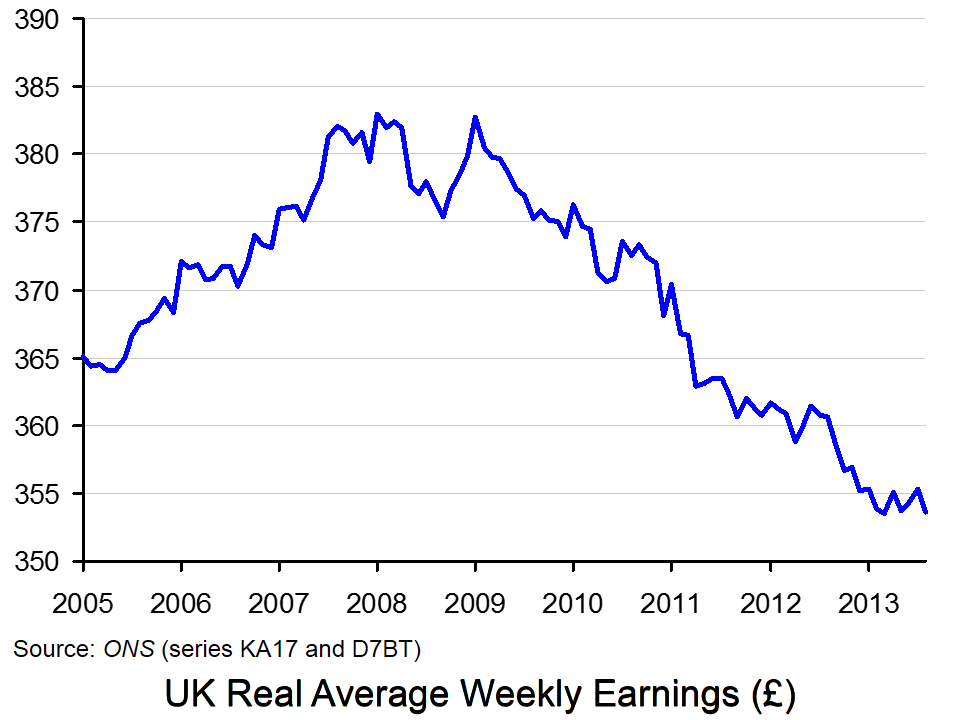 have continued to fall throughout this period. The first chart illustrates this. It shows average weekly wage rates in 2005 prices. (Click here for a PowerPoint of the chart.)
The fall in real wages is an average for the whole country. Many people, especially those on low incomes, have seen their real wages fall much faster than the average. For many there is a real ‘cost of living’ crisis.
But why have real wages fallen despite the rise in employment? The answer is that output per hour worked has declined. This is illustrated in the second chart, which compares UK output per worker with that of other G7 countries. UK productivity has fallen both absolutely and relative to other G7 countries, most of which have had higher rates of investment.
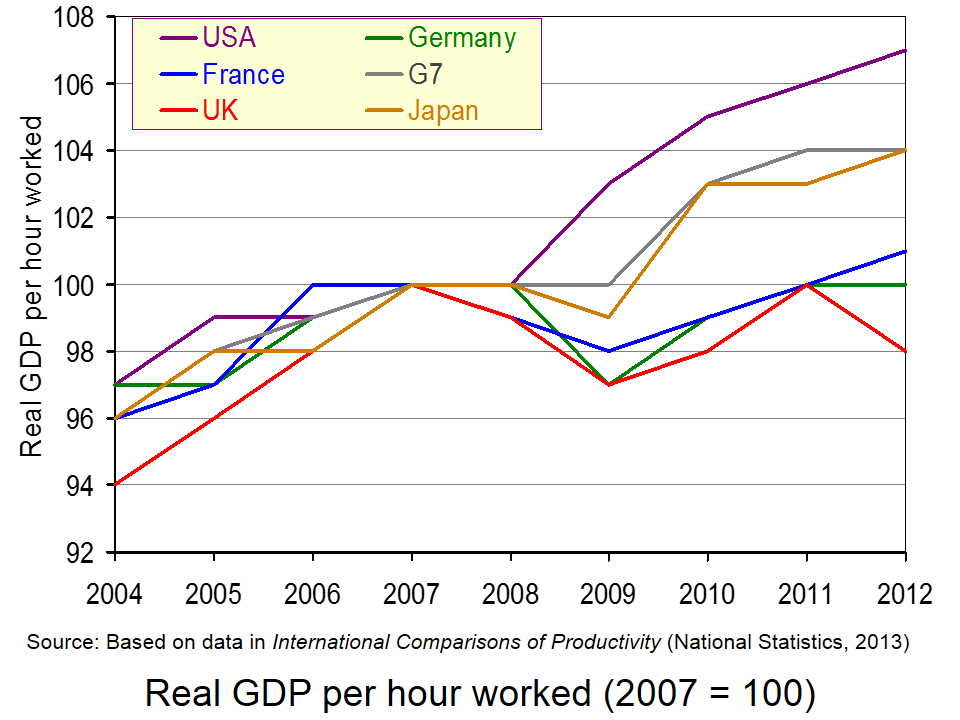 The falling productivity in the UK requires more people to be employed to produce the same level of output. Part of what seems to be happening is that many employers have been prepared to keep workers on in return for lower real wages, even if demand from their customers is falling. And many workers have been prepared to accept real wage cuts in return for keeping their jobs.
Another part of the explanation is that the jobs that have been created have been largely in low-skilled, low-wage sectors of the economy, such as retailing and other parts of the service sector.
But falling productivity is only part of the reason for falling real wages. The other part is rising prices. A number of factors have contributed to this. These include a depreciation of the exchange rate back in 2008, the effects of which took some time to filter through into higher prices in the shops; a large rise in various commodity prices; and a rise in VAT and various other administered prices.
So what is the answer to falling real wages? The articles below consider the problem and some of the possible policy alternatives.
Articles
Inflation, unemployment and UK ‘misery’ BBC News, Linda Yueh (16/10/13)
Employment is growing, but so are the wage slaves The Guardian, Larry Elliott (16/10/13)
Living standards – going down and, er, up BBC News, Nick Robinson (26/7/13)
Revealed: The cost of living is rising faster in the UK than anywhere in Europe, with soaring food and energy bills blamed Mail Online, Matt Chorley (16/10/13)
Cutting prices to raise living standards is just a waste of energy The Telegraph, Roger Bootle (6/10/13)
Downturn sees average real wages collapse to a record low Independent, Ben Chu (17/10/13)
Why living standards and public finances matter Financial Times, Gavin Kelly (29/9/13)
Social Mobility Tsar Alan Milburn Calls on Government to Boost Wages to End UK Child Poverty International Business Times, Ian Silvera (17/10/13)
Do incorrect employment growth figures explain low UK productivity? The Guardian, Katie Allen (23/10/13)
Data
Unemployment data ONS
Average Weekly Earnings dataset ONS
Consumer Prices Index ONS
International Comparison of Productivity ONS
Questions
- How are real wages measured?
- Why have real wage rates fallen in the UK since 2009?
- What factors should be included when measuring living standards?
- Why has employment risen and unemployment fallen over the past two years?
- What factors could lead to a rise in real wages in the future?
- What government policies could be adopted to raise real wages?
- Assess these policies in terms of their likely short-term success and long-term sustainability.