 As we saw in the blog post last month, Eurozone becalmed the doldrums, the eurozone economy is stagnant and there is a growing danger that it could sink into a deflationary spiral. Last month, several new measures were announced by the ECB, including a negative interest rate on money deposited in the ECB by banks in the eurozone. This month, the ECB has gone further including, for the first time, a form of quantitative easing.
So what has been announced, and will it help to kick-start the eurozone economy? The measures were summarised by Mario Draghi, President of the ECB, at a press conference as follows:
The Governing Council decided today to lower the interest rate on the main refinancing operations of the Eurosystem by 10 basis points to 0.05% and the rate on the marginal lending facility by 10 basis points to 0.30%. The rate on the deposit facility was lowered by 10 basis points to –0.20%. In addition, the Governing Council decided to start purchasing non-financial private sector assets.
The Eurosystem will purchase a broad portfolio of simple and transparent asset-backed securities (ABSs) with underlying assets consisting of claims against the euro area non-financial private sector under an ABS purchase programme (ABSPP). This reflects the role of the ABS market in facilitating new credit flows to the economy and follows the intensification of preparatory work on this matter, as decided by the Governing Council in June. In parallel, the Eurosystem will also purchase a broad portfolio of euro-denominated covered bonds issued by MFIs domiciled in the euro area under a new covered bond purchase programme (CBPP3). Interventions under these programmes will start in October 2014.
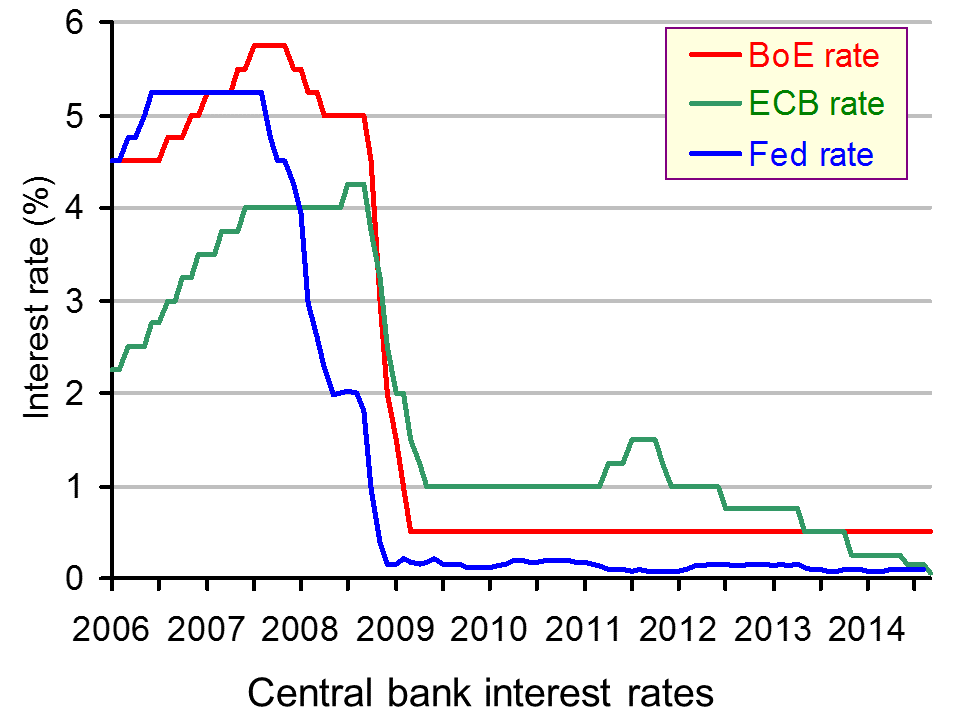
To summarise: the ECB has cut interest rates, with the main rate cut to virtually zero (i.e. 0.05%). This represents a floor to interest rates, as, according to Mario Draghi, there is now no scope for further cuts. (Click here for a PowerPoint of the chart.)
In addition, the ECB will begin the outright purchase of private-sector securities. This is a form of quantitative easing as it will involve the purchase of assets with newly created money. In the past, the ECB has simply offered loans to banks, with assets owned by banks used as collateral. This form of quantitative easing has been dubbed ‘QE light’, as it does not involve the purchase of government bonds, something the German government in particular has resisted. The ECB recognises that it would be a sensitive matter to buy government bonds of countries, such as Greece, Spain and Cyprus, which have been criticised for excessive borrowing.
Nevertheless, if it involves the creation of new money, purchasing private-sector assets is indeed a form of QE. As Mario Draghi said in response to a question on this matter:
QE is an outright purchase of assets. To give an example: rather than accepting these assets as collateral for lending, the ECB would outright purchase these assets. That’s QE. It would inject money into the system. Now, QE can be private-sector asset-based, or also sovereign-sector, public-sector asset-based, or both. The components of today’s measures are predominantly oriented to credit easing. However, it’s quite clear that we would buy outright ABS only if there is a guarantee.
So with appropriate guarantees in place about the soundness of these securitised assets, the ECB will purchase them outright.
But will these measures be enough? Time will tell, but there are now several measures in the pipeline, which could see a large stimulus to bank lending. The main question is whether banks will indeed take the opportunity to lend or merely hoard the extra reserves. And that depends in large part on the demand for credit from businesses and consumers. Boosting that is difficult when the economic climate is pessimistic.
Articles
Draghi’s ECB surprise puts off bigger quantitative easing for now Reuters, John O’Donnell (5/9/14)
ECB President Mario Draghi pulls stimulus lever at last, but still no quantitative easing for eurozone Independent, Ben Chu (5/9/14)
ECB cuts rates and launches stimulus programme BBC News (4/9/14)
Draghi Push for ECB Easing Intensifies Focus on ABS Plan Bloomberg, Stefan Riecher and Jeff Black (4/9/14)
 Draghi Sees Almost $1 Trillion Stimulus as QE Fight Waits Bloomberg, Simon Kennedy (5/9/14)
Draghi’s Case For ECB Quantitative Easing Forbes, Jon Hartley (8/9/14)
ECB’s last roll of the dice BBC News, Robert Peston (4/9/14)
Draghi’s eurozone steroids BBC News, Robert Peston (2/10/14)
Draghinomics – Abenomics, European-style The Guardian, Nouriel Roubini (1/9/14)
ECB Press Release
Introductory statement to the press conference (with Q&A) European Central Bank, Mario Draghi, President of the ECB (4/9/14)
Webcast of the press conference 4 September 2014 European Central Bank, Mario Draghi, President of the ECB (4/9/14)
Questions
- Summarise the ECB’s monetary policy measures that will be coming into effect over the coming months.
- How does the QE announced by Mario Draghi differ from the QE that has been used by the Bank of England?
- Would it be a realistic option for the ECB to reduce its main rate below zero, just as it did with the deposit facility rate?
- What is meant by ‘securitisation’. Explain how asset-backed securities (ABSs) and covered bonds are forms of securitised assets.
- Why will the purchase of mortgage-backed securities not necessarily give a boost to the housing market?
- How does the effectiveness of any QE programme depend on what happens to the velocity of circulation of created money?
- What determines this velocity of circulation?
- Why are ‘animal spirits’ so important in determining the effectiveness of monetary policy?
- Are there any moral hazards in the ECB actions? If so what are they?
 Each month the accountancy firm BDO publishes its Business Trends Indices. These indices “are ‘polls of polls’ that pull together the results of all the main UK business surveys”. The latest report shows that the January 2013 Optimism Index was its lowest since the report began 21 years ago.
The Optimism Index predicts business performance two quarters ahead. In January 2013 it was 88.9. The way the index is constructed, a reading of 95 or more suggests that firms are optimistic about business performance. Clearly, they were pessimistic.
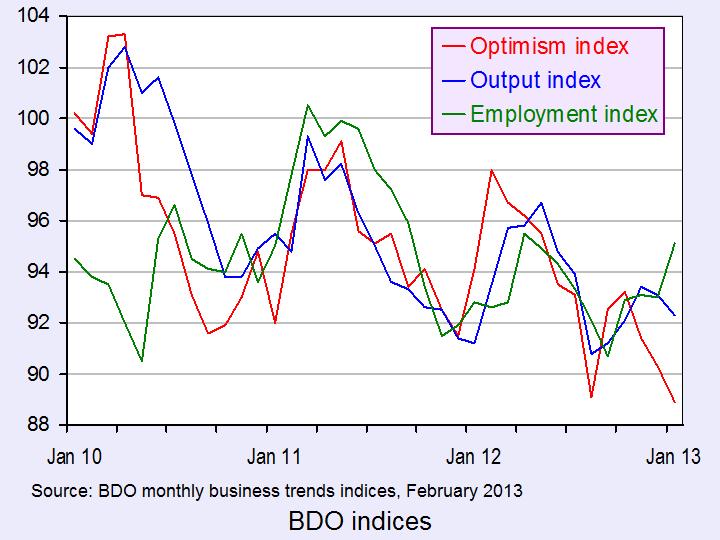 Although there was an increase in hiring intentions, firms were still predicting a fall in output. The indices for optimism, employment and output are shown in the chart. (Click here for a PowerPoint.)
As Peter Hemington, Partner, BDO LLP, commented:
In spite of a strengthening Labour Market, business confidence continues to weaken, and improved hiring intentions are not translating into growth plans. It seems the damaging effects on businesses of five years’ zigzagging economic growth, has left them wary of making concrete plans for expansion and resigned to the ‘new normal’ of economic stagnation.
To end this cycle, it is imperative that the Government implements plans to expedite growth. Without growth incentives, we will continue to see UK businesses reluctant to invest and expand, which poses a grave threat to the UK’s economic recovery.
The following articles comment on the gloomy mood of business and on its implications for output and investment. They also look at the implications for government policy.
Articles
Confidence slumps despite optimism from manufacturers Insider News (11/2/13)
Fears of a triple-dip recession return as survey puts business confidence at a 21-year low This is Money (11/2/13)
Pressure grows on ministers for growth strategy Yorkshire Post (11/2/13)
Triple-dip jitters as business confidence hits 21-yr low Management Today, Michael Northcott (11/2/13)
Report and data
Business Trends: Business confidence hits 21-year low signalling economic contraction BDO Press Release (11/2/13)
BDO Monthly Business Trends Indices, February 2013 – Full Report BDO (11/2/13)
Business and Consumer Surveys European Commission: Economic and Financial Affairs
Questions
- What reasons are given by the report for a decline in business optimism?
- Explain how an accelerator/multiplier interaction could compound the recession or help to cause a bounce back from recession.
- How does business sentiment in one country affect business sentiment in others?
- In the absence of a change in its fiscal stance, what policies could the government adopt to increase business confidence?
- Why might firms’ hiring intentions increase even though they are predicting a fall in output?
This autumn has been one of the mildest on record. Whilst this may be very nice for most of us, certain industries have been suffering. For example, gas and electricity consumption is down as people delay turning on their heating. One sector particularly badly hit has been clothing. Sales of winter clothes are substantially down and many retailers are longing for colder weather to boost their sales.
Of course, this is not helped by consumer incomes. With inflation at around 5% and average (pre-tax) weekly earnings currently rising by less than 2%, real incomes are falling. In fact over the year, even nominal disposable incomes are down 2.1%, given the rise in national insurance and income tax. And the problem of falling incomes is compounded by worries over the future state of the economy – whether it will go back into recession, with further falls in real income and rises in unemployment.
It’s no wonder that retailers are longing for some cold weather and for their customers to return from the seaside or their garden barbecues to the shopping malls. Look out for the ‘sales’ signs: they’re beginning to spring up as desperate retailers seek to attract wary customers.
Webcast
Retailers slash prices in Christmas build-up BBC News, Tim Muffett (25/11/11)
Articles
Winter woes: warm weather means shoppers aren’t buying as much Guardian, Zoe Wood (21/11/11)
Shoppers urged to be savvy as Christmas sales last for weeks The Telegraph, Victoria Ward (21/11/11)
Data
Earnings tables: Labour Market Statistics ONS (November 2011)
Personal Income and Wealth ONS
Price Indices and Inflation ONS
Personal Inflation Calculator (PIC) ONS
Questions
- Identify the determinants of demand for winter clothing.
- How responsive is demand likely to be to these determinants (a) over a period of a few weeks; (b) over a period of a few months?
- What factors should a retailer take into account when deciding whether to make pre-Christmas discounts?
- Assume that you are employed but are afraid of losing your job in a few months’ time. How would this affect your consumption of (a) seasonal goods; (b) durable goods; (c) day-to-day goods?
- What longer-term strategies could retailers adopt if they predict tough trading conditions over the next two or three years?
With all the concerns recently about Greek and Italian debt and about the whole future of the eurozone, you would be forgiven for thinking that the problems of the UK economy had gone away. This couldn’t be further from the truth. Problems are mounting and pessimism is growing.
First there is the problem of a contracting eurozone economy. This will directly impact on the UK as almost half of UK exports go to eurozone countries. Second there is the impact of the government expenditure cuts, most of which have still not taken effect yet. Third there is the fact that, with the combination of inflation over 5% and nominal pay typically rising by no more than 2%, real take-home pay is falling and hence too is the volume of consumer expenditure. Fourth, there is the increasingly pessimistic mood of consumers and business. The more pessimistic people become about the prospects for their jobs and incomes, the more people will rein in their spending; the more pessimistic businesses become, the more they will cut back on investment and economise on stock holding.
Forecasts for the UK economy have become considerably bleaker over the past few weeks. These include forecasts by the National Institute for Economic and Social Research (NIESR), the accountancy network BDO, Ernst & Young’s ITEM Club and the CBI in its SME Trends Survey and November Economic Forecast. The Treasury’s latest Forecasts for the UK Economy, which brings together forecasts by 29 different organisations, also shows a marked increase in pessimism from September to October.
So is it now time for the government to change course to prevent the economy slipping back into recession? Do we need a Plan B? Certainly, it’s something we’ve considered before on this news site (see Time for a Plan B?). The latest call has come from a group of 100 leading academic economists who have written to the Observer. In their letter they spell out what such a plan should contain. You’ll find a link to the letter below and to other articles considering the proposals.
The letter
We economists have a Plan B that will work, Mr Osborne Observer letters (29/10/11)
Articles
Plan B: the ideas designed to restart a stalled UK economy Observer, Daniel Boffey and Heather Stewart (29/10/11)
Plan B could have been even more aggressive, but it would definitely work Observer, Will Hutton (29/10/11)
The economy: we need Plan B and we need it now Observer editorial (30/10/11)
If tomorrow’s growth figures disappoint, Plan B will be a step closer, whatever David Cameron says The Telegraph, Daniel Knowles (31/10/11)
Plan B to escape the mess we are in Compass, John Weeks (7/11/11)
The report
Plan B; a good economy for a good society Compass, Edited by Howard Reed and Neal Lawson (31/10/11)
Questions
- What are the main proposals in Compass’s Plan B?
- How practical are these proposals?
- Without a Plan B, what is likely to happen to the UK economy over (a) the coming 12 months; (b) the next 3 years?
- Why might sticking to Plan A worsen the public-sector deficit – at least in the short term?
- What are the main arguments for sticking to Plan A and not easing up on deficit reduction?
- Find out what proportion of the UK’s debt is owed to non-UK residents? (See data published by the UK’s Debt Management Office (DMO).) How does this proportion and the average length of UK debt affect the arguments about the sustainability of this level of debt and the ease of servicing it?
- If you had to devise a Plan B, what would it look like and why? To what extent would it differ from Compass’s Plan B and from George Osborne’s “Plan A”?
The government is sticking to its deficit reduction plan. But with worries about a lack of economic recovery, or even a double dip recession, some economists are calling for a Plan B. They back up their arguments by referring to the lack of consumer confidence, falling real incomes and rising commodity prices. Without a slowing down in cuts and tax rises, the lack of aggregate demand, they claim, will prevent a recovery.
The government maintains that sticking to the cuts and tax rises helps maintain international confidence and thereby helps to keep interest rates low. Also, it argues, if the economy does slow down, then automatic stabilisers will come into play. Finally, even though fiscal policy is tight, monetary policy is relatively loose, with historically low interest rates.
But will there be enough confidence to sustain a recovery? Economists are clearly divided. But at least the IMF seems to think so. In its latest assessment of the UK economy, although it has cut the growth forecast for 2011 from 2% to 1.5%, that is still a positive figure and thus represents a recovery, albeit a rather fragile one.
Articles
Coalition’s spending plans simply don’t add up Observer letters, 52 economists (5/6/11)
Is George Osborne losing his grip on Britain’s economic recovery? Guardian, Heather Stewart and Daniel Boffey (4/6/11)
George Osborne plan isn’t working, say top UK economists Guardian, Heather Stewart and Daniel Boffey (4/6/11)
How are the Coalition fixing the economy? The Telegraph, Tim Montgomerie (28/5/11)
Cameron’s new cuts narrative The Spectator, Fraser Nelson (27/5/11)
The changing narrative of Chancellor George Orborne Channel 4 News, Faisal Islam (17/5/11)
The UK could be leading with a new economic approach, instead we follow Guardian, Will Hutton (4/6/11)
The coalition’s strategy is courting disaster Observer, (5/6/11)
Government faces fresh calls for a Plan B BBC News (5/6/11)
‘Serious debate’ needed on economy BBC Today Programme, Stephanie Flanders (6/6/11)
IMF cuts UK growth forecast for 2011 BBC News, John Lipsky (Deputy Director of the IMF) (6/6/11)
IMF says hope for best, plan for worst BBC News, Stephanie Flanders (6/6/11)
IMF set out a ‘Plan B’ for George Osborne BBC News, Paul Mason (6/6/11)
How to rebalance our economy Independent, Sean O’Grady (6/6/11)
IMF maps out a Plan B for the UK economy The Telegraph, Jeremy Warner (6/6/11)
A long and hard road lies ahead for the British economy Financial Times, Martin Wolf (6/6/11)
IMF Report
United Kingdom – 2011 Article IV Consultation Concluding Statement of the Mission (6/6/11)
Forecasts
OECD Economic Outlook 89 Annex Tables (June 2011): see especially Annex Table 1
Output, prices and jobs The Economist
Questions
- Explain what is likely to happen to each of the components of aggregate demand.
- Is monetary policy loose enough? How could it be made looser, given that Bank rate is at the historically low level of 0.5% and could barely go any lower?
- What are automatic fiscal stablisers and how are they likely to affect aggregate demand if growth falters? What impact would this have on the public-sector deficit?
- What is meant by the ‘inventory cycle’? How did this impact on growth in 2010 and the first part of 2011?
- What is likely to happen to inflation in the coming months and why? How is this likely to impact on economic growth?
- Referring to the economists’ letter (the first link above), what do you think they mean by “a green new deal and a focus on targeted industrial policy” and how would this affect economic growth?
 As we saw in the blog post last month, Eurozone becalmed the doldrums, the eurozone economy is stagnant and there is a growing danger that it could sink into a deflationary spiral. Last month, several new measures were announced by the ECB, including a negative interest rate on money deposited in the ECB by banks in the eurozone. This month, the ECB has gone further including, for the first time, a form of quantitative easing.