 The latest data in the Quarterly National Accounts show that UK households in 2015 spent £1.152 trillion, the equivalent of 62 per cent of the country’s Gross Domestic Product (GDP). In real terms, household spending rose by 2.8 per cent in 2015 in excess of the 2.3 per cent growth observed in GDP. In the final quarter of 2015 real household spending rose by 0.6 per – the same rate of growth as that recorded for the UK economy. This was the tenth consecutive quarter of positive consumption growth and the twelfth of economic growth.
It is the consistent growth seen over the recent past in real household spending that marks it out from the other components of aggregate demand. Consequently, household spending remains the bedrock of UK growth.
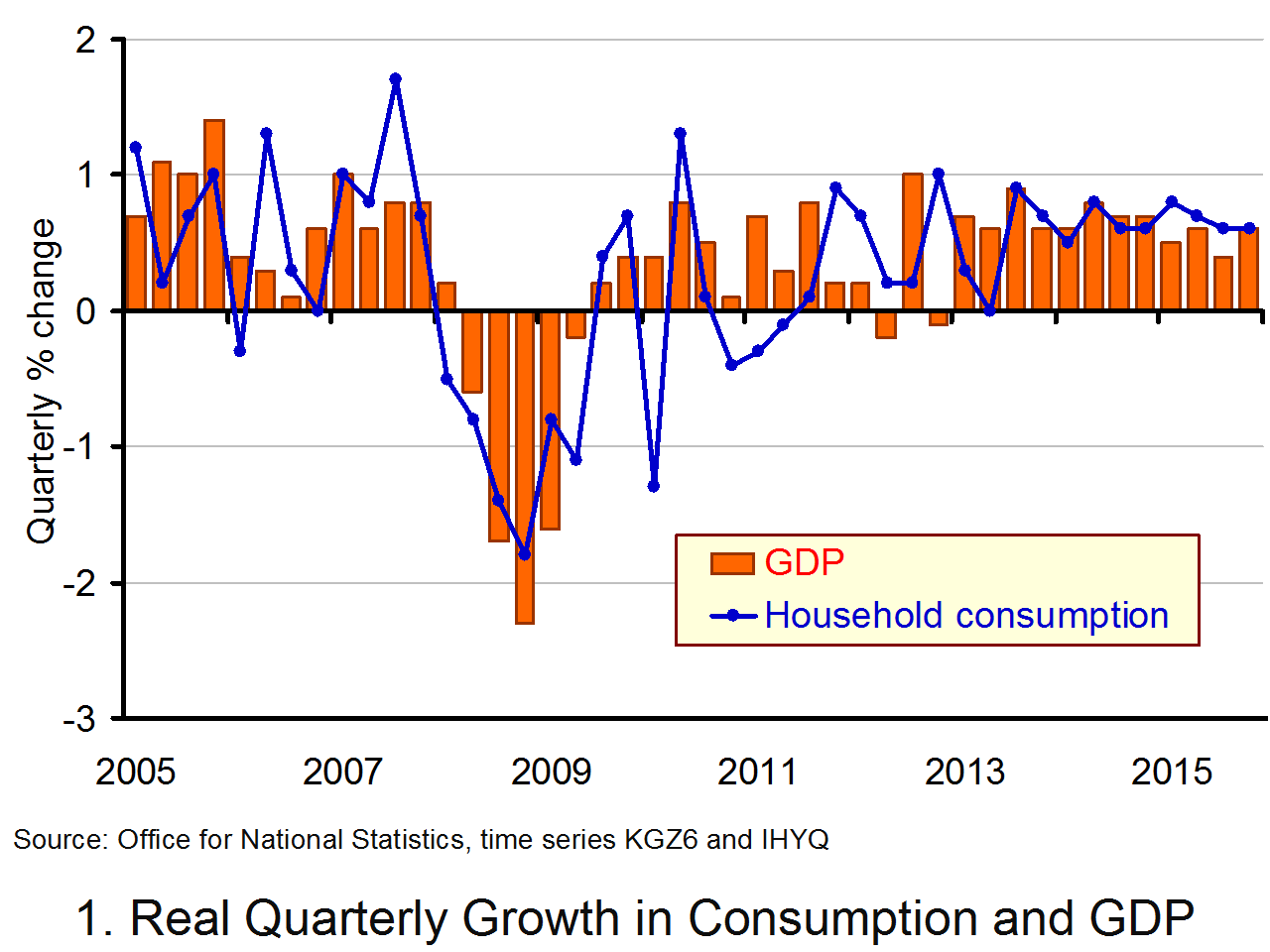 Chart 1 helps to evidence the close relationship between consumption and economic growth. It picks out nicely the stark turnaround both in economic growth and consumer spending following the financial crisis. Over the period from 2008 Q1 to 2011 Q2, real consumer spending typically fell by 0.4 per cent each quarter. This weakness in consumption was mirrored by economic growth. Real GDP contracted over this period by an average of 0.2 per cent each quarter. (Click here to download a PowerPoint of the chart.)
Since 2011 Q3 real consumption growth has averaged 0.6 per cent per quarter – the rate at which consumption grew in 2015 Q4 – while, real GDP growth has averaged 0.5 per cent per quarter. Over this same period the real disposable income (post-tax income) of the combined household and NPISH (non-profit institutions serving households), has typically grown by 0.4 per cent per quarter. (NPISHs are charities and voluntary organisations.)
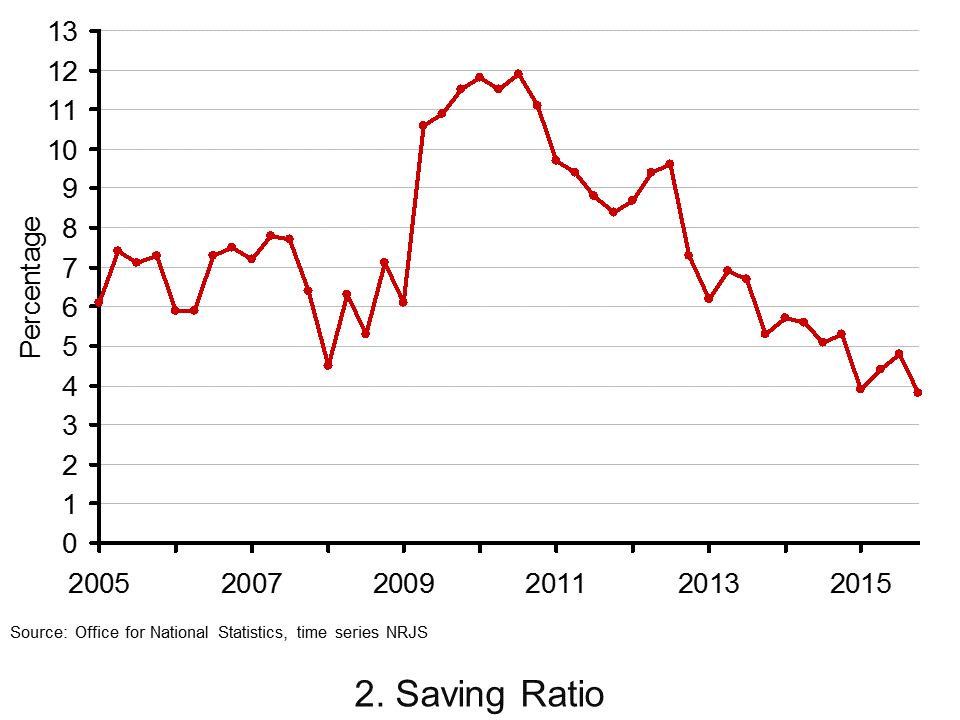 The strength of consumption relative to income is evidenced by the decline in the saving ratio as can be observed in Chart 2. The ratio captures the percentage of disposable income that households (and NPISHs) choose to save. In 2010 Q3 the proportion of income saved hit 11.9 per cent having been as low as 4.5 per cent in 2008 Q1. By 2015 Q4 the saving ratio had fallen to 3.8 per cent, the lowest value since the series began in 1963 Q1. (Click here to download a PowerPoint.)
The historic low in the saving ratio in the final quarter of 2015 reflects the strength of consumption alongside a sharp fall in real disposable income of 0.6 per cent in the quarter. However, the bigger picture shows a marked downward trend in the saving ratio over the period from 2012.
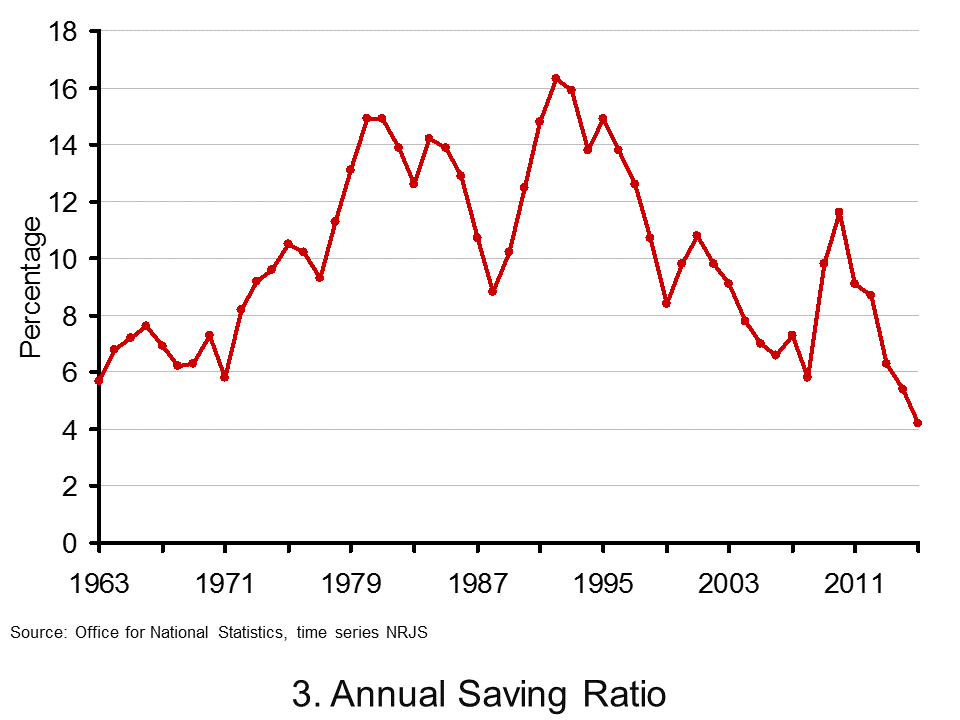 When seen in a more historic context the latest numbers taken on even greater significance. Chart 3 shows the annual saving ratio since 1963. From it we can see that the 2015 value of 4.2 was the first year when the ratio fell below 5 per cent. With 2014 being the previous historic low, there must be some concern that UK consumption growth is not being underpinned by income growth. (Click here to download a PowerPoint.)
 Of course, consumption theory places great emphasis on expected future income in determining current spending. To some extent it may be argued that households were liquidity-constrained following the financial crisis. They were unable to borrow to support spending and, as time moved on, to borrow against the expectation of stronger income growth in the future. This would have depressed consumption growth. But, there may also have been a self-imposed liquidity constraint as the financial crisis unfolded. Heightened uncertainty may have led households to be more prudent and divert resources to saving. Such precautionary saving would tend to boost the saving ratio and so may be a factor in the sharp rise we observed in the ratio.
 The easing of credit constraints as we headed through the early 2010s allied with stronger economic growth may help to explain the strength of the recovery in consumption growth. However, it is the extent and, in particular, the duration of this strong consumption growth that is fuelling a debate over its sustainability. The current uncertainty around future income growth and the need for households to be mindful of the indebtedness built up prior to the financial crisis point to households needing to retain a degree of caution. Consequently, the debates around the financial well-being of households and the need to rebalance the UK economy away from consumer spending are likely to be further intensified by the latest consumption and saving data.
Data
All data related to Quarterly National Accounts: Quarter 4 (Oct to Dec) 2015 Office for National Statistics
Office for National Statistics Office for National Statistics
Articles
Britons raid savings to fund spending as economists warn recovery ‘built on sand’ Telegraph, Szu Ping Chan (31/3/16)
UK Growth Higher But Deficit Hits New Record Sky News, (31/3/16)
Britain is a nation that has forgotten how to save Telegraph, Jeremy Warner (31/3/16)
A vulnerable economy: the true cost of Britain’s current account deficit Guardian, Larry Elliott (31/3/16)
U.K. Manufacturing ‘In the Doldrums’ Leaves Growth Lopsided Bloomberg, Emma Charlton (1/4/16)
Pound drops as UK manufacturing languishes in the doldrums Telegraph, Szu Ping Chan (1/4/16)
Questions
- Why is the distinction between nominal and real growth an important one when looking at many macroeconomic variables.
- Examine the argument that the historic low saving ratio in the UK is a cause for concern.
- What factors might we expect to impact on the saving ratio?
- To what extent do you think the current growth in consumer spending is sustainable?
- How important are expectations in determining consumer behaviour?
- Explain what you understand by consumption smoothing.
- Why would we would typically expect consumption growth to be less variable than that in disposable income?
- Why might consumption sometimes be observed to be less sensitive or more sensitive to income changes?
- What factors might cause households to be liquidity constrained?
- What is precautionary saving? What might affect its perceived importance among households?
 In many cases, we simply leave the market to do what it does best – equate demand with supply and from this we get an equilibrium price and the optimal quantity. But, what happens if either the price or quantity is ‘incorrect’? What happens if the market fails to deliver an efficient outcome? In this case, we look to governments to intervene and ‘correct’ the market and such intervention can take place on the demand and/or supply-side. One area where it is generally felt that government intervention is needed is drugs and the trafficking of them across borders.
There are many ways in which governments have tried to tackle the problem of drug usage. The issue is that drugs are bad for individuals, for the community, society and the economy. Too much is produced and consumed and hence we have a classic case of market failure and this justifies government intervention.
But, how should governments intervene? With a substance such as drugs, we have an inelastic demand with resepect to price – any increase in price leads to only a small decrease in quantity. So any policy implemented by governments that attempts to change the market price will have limited effect in restricting demand. With globalisation, drugs can be moved more easily across borders and hence global co-operation is needed to restrict the flow. The article below considers the area of drugs and drug trafficking and looks at some of the policy options open to government.
Narconomics: The business of drug trafficking Houston Chronicle (16/3/16)
Questions
- Why does the market fail in the case of drug trafficking?
- Draw the demand curve you would expect for drugs and use this to explain why an increase in price will have limited effect on demand.
- Is there an argument for making drugs legal as a means of raising tax revenue?
- If better educational programmes are introduced about the perils of drug usage, how would this affect the market? Use a demand and supply diagram to help explain your answer.
- Why does globalisation make the solutions to drug trafficking more difficult to implement?
- Could drug usage and drug trafficking and hence the need to invest more money in tackling the problem actually boost an economy’s rate of growth? If so, does this mean that we should encourage drug usage?
 It doesn’t seem long ago that we were looking at the prospects of Brazil for hosting the Football World Cup. Now, we turn to the same economy, but this time for the Olympics. It is often the case that hosting big global sporting events can give a boost to the host nation, but is Brazil prepared for it? Did the World Cup bring the expected economic boosts? Some argue that the Olympics is just what Brazil needs, but others suggest it will only worsen the economic situation in the world’s seventh largest economy.
Brazil’s economic performance in the past year was not good. In fact, it was one of the worst performing nations of any major economy, with GDP falling by 3%. This is a very different country from the one that was awarded this biggest of sporting events. Despite these difficult times, Brazil’s government maintains that the country is ready and that the games will be ‘spectacular’.
Key to hosting a sporting event such as the Olympics is the infrastructure investment and as a key component of aggregate demand, this should be a stimulant for growth and job creation. However, with the economy still struggling, many are concerned that the infrastructure won’t be in place in time.
Other benefits from this should be the boost to growth driven by athletes and spectators coming from around the globe, buying tickets, memorabilia, accommodation, food and other items that tourists tend to buy. A multiplier effect should be seen and according to research has the potential to create significant benefits for the whole economy and not just the local regions where events take place. You can look at similar analysis in blogs written about Tokyo: 2020 Tokyo Olympics and London: The London Olympics legacy: a cost–benefit analysis and Does hosting the Olympics Games increase economic growth?
But, is this really likely to happen, especially given the somewhat lacklustre boost that the Brazil World Cup gave to the economy? The following articles consider this.
Rio 2016: Can Games bounce back from Brazil economic woes? BBC News, Bill Wilson (11/03/16)
Does hosting the Olympics actually pay off? It’s the economy, Binyamin Applebaum (5/08/14)
Rio Olympics no help to Brazil economy based on World Cup Bloomberg, Raymond Colitt (16/01/15)
The economic impact of Brazil’s 2014 World Cup and 2016 Olympics Saxo Group, Trading Floor, Sverrir Sverrisson (27/08/12)
Special Interview: Cost–benefit analysis of hosting the World Cup, Olympics Al Arabiya, Ricardo Guerra (3/7/14)
Questions
- How might you carry out a cost–benefit analysis to decide whether to host a big sporting event?
- Are there any externalities that might result from hosting the Olympics? How easy is it to estimate their monetary value? Should this be taken into account by a country when making a decision?
- Why might there be a boost to aggregate demand prior to the Olympics?
- Why might there be a multiplier effect when a nation hosts the Olympics or another sporting event?
- Might there be benefits to Brazil’s neighbours from its hosting the Olympics?
 There is a lot of pessimism around about the state of the global economy and the prospects for more sustained growth. Stock markets have been turbulent; oil and other commodity prices have fallen; inflation has been below central bank targets in most countries; and growth has declined in many countries, most worryingly in China.
The latest worry, expressed by finance ministers at the G20 conference in Shanghai, is that UK exit from the EU could have a negative impact on economic growth, not just for the UK, but for the global economy generally.
But is this pessimism justified? In an interesting article in the Independent, Hamish McRae argues that there are five signs that the world economy is not doomed yet! These are:
|
|
| • |
There are more monetary and fiscal measures that can still be taken to boost aggregate demand. |
| • |
Despite some slowing of economic growth, there is no sign of a global recession in the offing. |
|
|
| • |
US and UK growth are relatively buoyant, with consumer demand ‘driving the economy forward’. |
| • |
Deflation worries are too great, especially when lower prices are caused by lower commodity prices. These lower costs should act to stimulate demand as consumers have more real purchasing power. |
| • |
Inflation may start to edge upwards over the coming months and this will help to increase confidence as it will be taken as a sign that demand is recovering. |
So, according to McRae, there are five things we should look for to check on whether the global economy is recovering. He itemises these at the end of the article. But are these the only things we should look for?
Five signs that the world economy is not doomed yet Independent, Hamish McRae (27/2/15)
Questions
- What reasons are there to think that the world will grow more strongly in 2016 than in 2015?
- What reasons are there to think that the world will grow less strongly in 2016 than in 2015?
- Distinguish between leading and lagging indicators of economic growth.
- Do you agree with McRae’s choice of five indicators of whether the world economy is likely to grow more strongly?
- What indicators would you add to his list?
- Give some examples of ‘economic shocks’ that could upset predictions of economic growth rates. Explain their effect.
 Deflation is currently a concern in the UK and across Europe. However, relative to Japan, the deflation concern is small. In Japan, deflation has been problematic for more than two decades and this has had significant implications for the Japanese economy.
‘Abenomics’ has been in practice in Japan, as the Prime Minister, Shinzo Abe, has been trying to reflate the economy. Growth has been improving and the deflation concern appeared to be under control. However, GDP data now shows that the economy is once again declining and so with aggregate demand falling, this pushes down average prices across the economy and so the deflation risk re-emerges. This article from BBC News and another from The Guardian look at the economic policy known as ‘Abenomics’ and how the Japanese economy is faring.
Articles
Off target: Is it the end of ‘Abenomics’ in Japan? BBC News, Rupert Wingfield-Hayes (15/2/16)
Japan’s economy shrinks again as Abenomics is blown off course The Guardian, Justin McCurry (15/2/16)
Previous blogs
Japan’s deflation fears grow (update) (27/2/16)
Riding the Japanese roller coaster (15/2/16)
Japan’s interesting monetary stance as deflation fears grow (14/2/16)
Japan’s arrows missing their target (17/11/14)
Japan’s recovery (3/2/14)
Abenomics – one year on (16/12/13)
Japan’s three arrows (6/6/13)
Questions
- What are the key features of Japan’s ‘Abenomics’?
- Why is deflation such a concern? Surely falling prices are good for consumers and hence the economy.
- How has Japan been trying to reflate its economy and why has this failed?
- The yen is getting stronger, but how will this affect the Japanese economy? Use a demand and supply diagram to illustrate what has caused the value of the yen to fall and an aggregate demand and supply diagram to show the impact.
- Negative interest rates have been implemented in Japan. What does this mean for savers and borrowers and the economy?
- How do you think Japan’s stance on immigration and structural change is affecting its macroeconomy?
 The latest data in the Quarterly National Accounts show that UK households in 2015 spent £1.152 trillion, the equivalent of 62 per cent of the country’s Gross Domestic Product (GDP). In real terms, household spending rose by 2.8 per cent in 2015 in excess of the 2.3 per cent growth observed in GDP. In the final quarter of 2015 real household spending rose by 0.6 per – the same rate of growth as that recorded for the UK economy. This was the tenth consecutive quarter of positive consumption growth and the twelfth of economic growth.