 A recession is typically characterised by high unemployment, low or negative growth and low inflation, due to a lack of aggregate demand. However, since 2009, inflation levels in the UK have only added to the pressures facing the government and the Bank of England. Not only had there been a problem of lack of demand, but the inflation target was no longer being met.
Inflation had increased to above 5% – a figure we had not been accustomed to for many years. With interest rates at record lows with the aim of boosting aggregate demand, demand-pull inflation only added to cost-push pressures. However, data released by the ONS shows that inflation, as measured by the CPI, has now fallen back to its 2% target. Having been at 2.1% in November 2013, the figure for December 2013 fell by 0.1 percentage points.
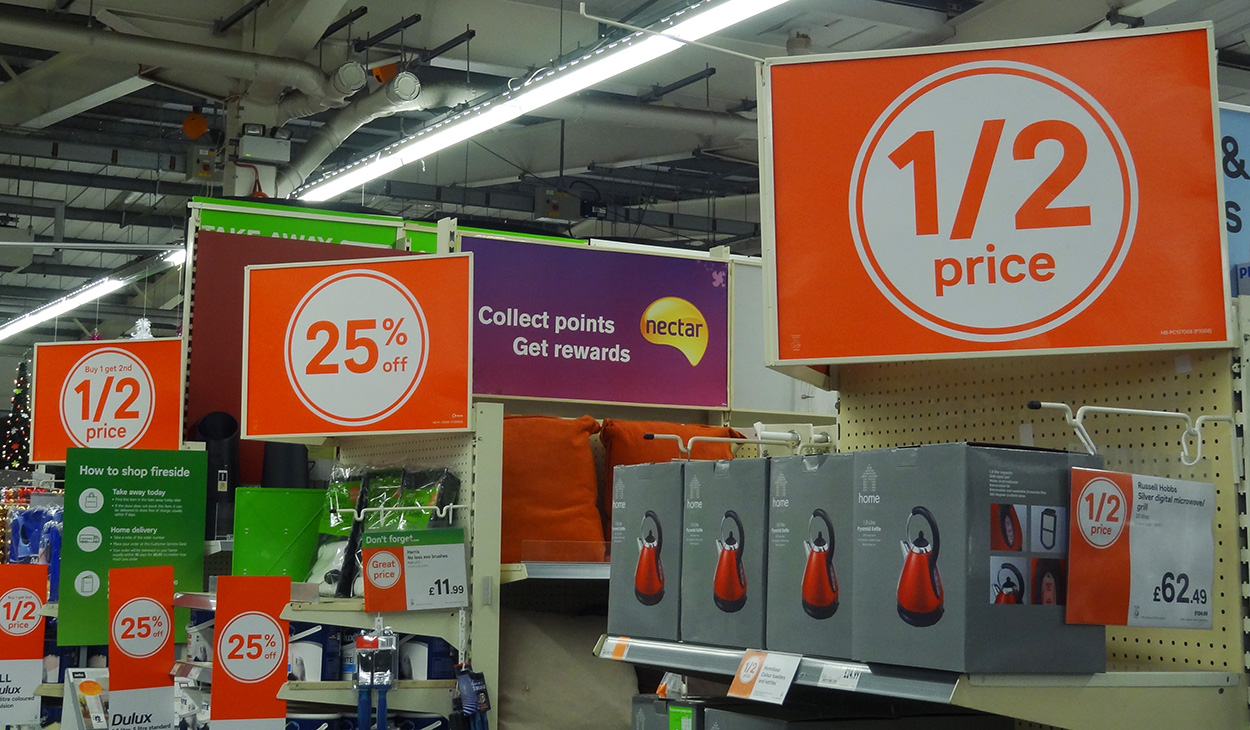
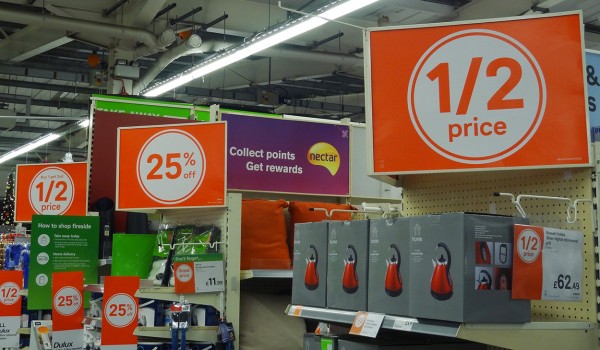 The data for December include some of the energy price rises from the big six, but do not include the full extent of price decreases and discounting initiated by retailers in the lead up to Christmas. The key factors that have helped to keep prices down include some of the discounting throughout December and falling food prices, in particular bananas, grapes and meat.
With inflation back on target, pressures have been removed from the Bank of England to push up interest rates. Mark Carney has said that interest rates will remain at 0.5% until unemployment falls to 7%. 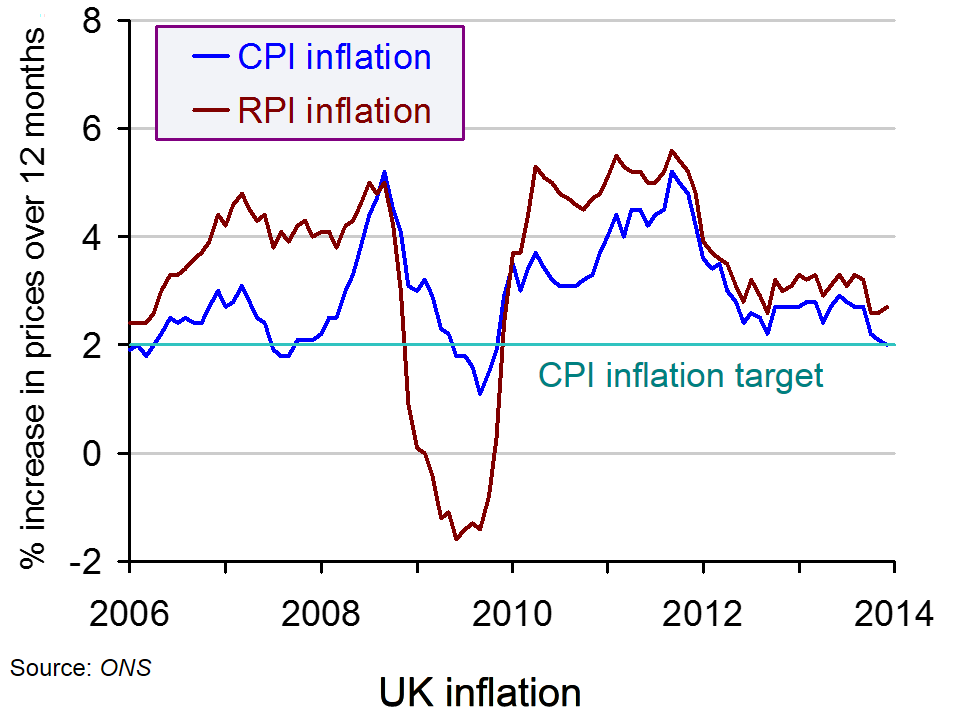 With unemployment fast approaching this target, there has been speculation that interest rates would rise, but with inflation falling back on target, these pressures have been reduced. (Click here for a PowerPoint of the chart.) Referring to this, Jeremy Cook, the chief economist at World First said:
The lack of inflation will help stay their hand especially if the pace of job creation seen in the second half of last year also shows.
These thoughts were echoed by Rob Wood, the chief UK economist at Berenberg Bank:
Inflation is the BoE’s ‘get out of jail free’ card for this year … The lack of inflation pressure gives them room to delay a first hike until next year.
Many economists now believe that the CPI rate of inflation is likely to remain at or below the target, in particular if productivity growth improves. This belief is further enhanced by the fact that tax rates are stable, the pound is relatively strong and the previous upward pressure on commodity prices from China is now declining. Some economists believe that CPI inflation could fall to 1.5% this year and the Treasury has said that it is ‘another sign that the Government’s long-term economic plan is working’. The following articles consider this latest macroeconomic data.
UK inflation falls to Bank of England’s 2pc target in December The Telegraph, Szu Ping Chan (14/1/14)
UK inflation falls to 2% target rate in December BBC News (14/1/14)
Carney’s lucky streak continues as UK inflation slows to 2% Financial Times, Claire Jones (14/1/14)
UK inflation fall gives Bank of England a lift Wall Street Journal, Richard Barley(14/1/14)
Inflation falls to Bank of England target Reuters, William Schomberg and Ana Nicolaci da Costa (14/1/14)
Inflation hits Bank of England’s target of 2% in December Independent, John Paul Ford Rojas (14/1/14)
Questions
- What is the relationship between interest rates and aggregate demand?
- Which factors have led to the reduction in the rate of inflation?
- Why have the latest data on inflation rates reduced the pressure on the Bank of England to increase interest rates?
- Why do stable tax rates, a strong pound and reduced pressure from China on commodity prices suggest that the CPI measures of inflation is likely to remain at similarly low levels?
- Why has the RPI increased while the CPI has fallen?
 As the old year gives way to the new, papers have been full of economic forecasts for the coming year. This year is no exception. The authors of the articles below give their predictions of what is to come for the global economy and, for the most part, their forecasts are relatively optimistic – but not entirely so. Despite a sunny outlook, there are various dark clouds on the horizon.
Most forecasters predict a higher rate of global economic growth in 2014 than in 2013 – and higher still in 2015. The IMF, in its October forecasts, predicted global growth of 3.6% in 2014 (up from 2.9% in 2013) and 4.0% in 2015.
Some countries will do much better than others, however. The USA, the UK, Germany and certain developing countries are forecast to grow more strongly. The eurozone as a whole, however, is likely to see little in the way of growth, as countries such as Greece, Spain, Portugal and Italy continue with austerity policies in an attempt to reduce their debt. 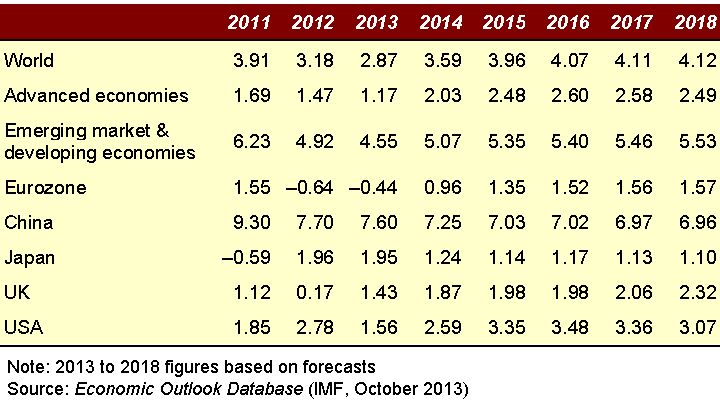 Chinese growth has slowed, as the government seeks to rebalance the economy away from exports and investment in manufacturing towards consumption, and services in particular. It is still forecast to be 7.3% in 2014, however – well above the global average. Japanese growth has picked up in response to the three arrows of fiscal, monetary and supply-side policy. But this could well fade somewhat as the stimulus slows. The table shows IMF growth forecasts for selected countries and groups of countries to 2018.
Much will depend on what happens to monetary policy around the world. How quickly will monetary stimulus taper in the USA and in Japan? Will the ECB introduce more aggressively expansionary monetary policy? When will the Bank of England start raising interest rates?
Growth within countries is generally favouring those on higher incomes, with the gap between rich and poor set to continue widening over the coming years. The pay of top earners has continued to rise considerably faster than prices, while increasingly flexible labour markets and squeezed welfare budgets have seen a fall in living standards of many on low incomes. According to a Which? survey (reported in the Independent article below), in the UK:
Only three in ten expect their family’s situation to improve in the new year, while 60% said they are already dreading the arrival of their winter energy bill. The Which? survey also found that 13 million people could afford to pay for Christmas only by borrowing, with more than four in ten using credit cards, loans or overdrafts to fund their festive spending. A third of people (34%) also dipped into their savings, taking an average of £450 from their accounts.
If recovery is based on borrowing, with real incomes falling, or rising only very slowly, household debt levels are likely to increase. This has been stoked in the UK by the ‘Help to Buy‘ scheme, which has encouraged people to take on more debt and has fuelled the current house price boom. This could prove damaging in the long term, as any decline in confidence could lead to a fall in consumer expenditure once more as people seek to reduce their debts.
 And what of the global banking system? Is it now sufficiently robust to weather a new crisis. Is borrowing growing too rapidly? Is bank lending becoming more reckless again? Are banks still too big to fail? Is China’s banking system sufficiently robust? These are questions considered in the articles below and, in particular, in the New York Times article by Gordon Brown, the former Prime Minister and Chancellor of the Exchequer.
Articles
Global economy: hopes and fears for 2014The Observer, Heather Stewart and Larry Elliott (29/12/13)
Looking ahead to 2014 BBC News, Linda Yueh (20/12/13)
Low hopes for a happy new financial year in 2014 Independent, Paul Gallagher (29/12/13)
Brisk UK economic growth seen in 2014 fuelled by spending – Reuters poll Reuters, Andy Bruce (12/12/13)
GLobal Economy: 2014 promises faster growth, but no leap forward Reuters, Andy Bruce (29/12/13)
My 2014 Economic Briefing Huffington Post, Tony Dolphin (27/12/13)
Three UK Economy Stories that will Dominate in 2014 International Business Times, Shane Croucher (27/12/13)
Who You Calling a BRIC? Bloomberg, Jim O’Neill (12/11/13)
Hope and Hurdles in 2014 Project Syndicate, Pingfan Hong (27/12/13)
On top of the world again The Economist (18/11/13)
Digging deeper The Economist (31/10/13)
BCC Economic Forecast: growth is gathering momentum, but recovery is not secure British Chambers of Commerce (12/13)
Eight predictions for 2014 Market Watch, David Marsh (30/12/13)
Stumbling Toward the Next Crash New York Times, Gordon Brown (18/12/13)
Central banks must show leadership to rejuvenate global economy The Guardian, Larry Elliott (1/1/14)
Global economy set to grow faster in 2014, with less risk of sudden shocks The Guardian, Nouriel Roubini (31/12/13)
A dismal new year for the global economy The Guardian, Joseph Stiglitz (8/1/14)
Forecasts and reports
World Economic Outlook (WEO) IMF (October 2013)
Economic Outlook OECD (November 2013)
Output, prices and jobs The Economist
Bank of England Inflation Report: Overview Bank of England (November 2013)
Questions
- What reasons are there to be cheerful about the global economic prospects for 2014 and 2015?
- Who will gain the most from economic growth in the UK and why?
- Why is the eurozone likely to grow so slowly, if at all?
- Are we stumbling towards another banking crisis, and if so, which can be done about it?
- Why has unemployment fallen in the UK despite falling living standards for most people?
- What is meant by ‘hysteresis’ in the context of unemployment? Is there a problem of hysteresis at the current time and, if so, what can be done about it?
- Explain whether the MINT economies are likely to be a major source of global economic growth in the coming year?
- Why is it so difficult to forecast the rate of economic growth over the next 12 months, let alone over a longer time period?
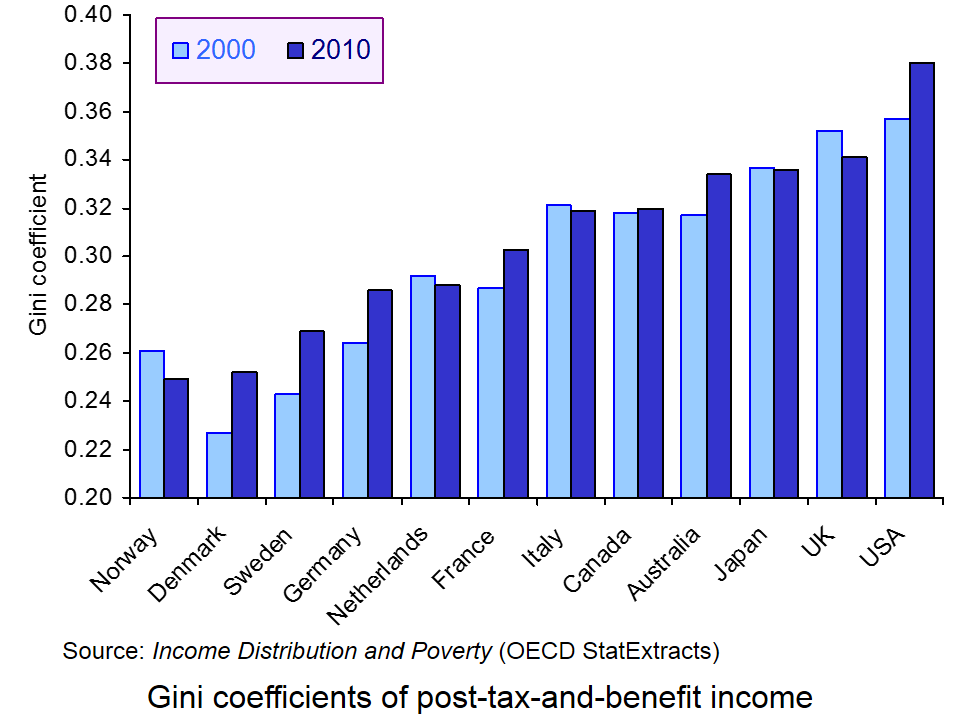 Growing inequality of income and wealth is a common pattern throughout the world. In the boom years up to 2008, the rich got a lot richer, but at least those on low incomes generally saw modest rises in their incomes. Since 2008, however, the continually widening gap between rich and poor has seen the poor and many on middle incomes getting absolutely poorer.
The problem is particularly acute in the USA. Indeed, in his 2012 State of the Union address, President Obama said that it was the ‘defining issue of our time.’
No challenge is more urgent. No debate is more important. We can either settle for a country where a shrinking number of people do really well, while a growing number of Americans barely get by. Or we can restore an economy where everyone gets a fair shot, everyone does their fair share, and everyone plays by the same set of rules.
The good news for the poor in the USA is that at last their incomes have stopped falling, thanks to stronger economic growth. But their share of the growth in GDP is tiny. As The Economist article states:
The main message is a grim one. Most of the growth is going to an extraordinarily small share of the population: 95% of the gains from the recovery have gone to the richest 1% of people, whose share of overall income is once again close to its highest level in a century. The most unequal country in the rich world is thus becoming even more so.
Apart from the ethical question of whether it is desirable for a society, already highly unequal, to become even more so, there is the question of whether this growth in inequality threatens economic recovery. Joseph Stiglitz argues that the rich have a low marginal propensity to consume and that this is threatening recovery.
Then there is the question of investment. Because most Americans have not seen any significant rise in incomes, it is easy for them to believe that the country cannot afford to invest more. And certainly it is difficult to persuade people that higher taxes are warranted to fund education, infrastructure or research.
The following articles consider the problem and its implications and look at various policy alternatives.
Articles and videos
Inequality: Growing apart The Economist (21/9/13)
What is income inequality, anyway? CNN, John D. Sutter (29/10/13)
Inequality is literally killing America Press TV (22/11/13)
It’s Economic Inequality Stupid – What to Do About the Biggest Crisis Facing America Huffington Post, Robert Creamer (14/11/13)
US Inequality Now Literally Off the Chart Truthout, Salvatore Babones (8/6/13)
Inequality moves to the front line of US politics Financial Times, Richard McGregor (20/11/13)
 Is wealth inequality slowing growth? BBC News, Linda Yueh (21/11/13)
American Inequality in Six Charts The New Yorker, John Cassidy (18/11/13)
Income Inequality ‘Profoundly Corrosive’ Wall Street Journal, Larry Summers (19/11/13)
21 Charts On US Inequality That Everyone Should See Business Insider, Gus Lubin (12/11/13)
Data, information and reports
Income inequality in the United States Wikipedia
Inequality Data & Statistics Inequality.org
Income Main United States Census Bureau
World of Work Report 2013: Snapshot of the United States ILO
World of Work Report 2013 ILO
StatExtracts OECD (Search for Gini)
Questions
- How may income inequality be measured?
- Comment on the Gini coefficients in the above link to the StatExtracts site.
- Why has inequality grown in the USA?
- The Swiss have just voted in a referendum to reject a proposal to limit executive pay to 12 times that of the lowest paid worker in the same company. What are the arguments for and against the proposal?
- What features of an unequal society tend to perpetuate or even deepen that inequality over time?
- What features of a well functioning market economy would help to reduce income inequality?
- Are higher marginal tax rates and higher welfare payments the best way of reducing inequality? What other policy options are there?
- Compare the views of Paul Krugman and Joseph Stiglitz on the effects of growing inequality on economic growth. How significant is the difference in the marginal propensity to consume of the rich and the poor in explaining the relatively low rate of US economic growth?
 HS2 has been a controversial topic for some time now. Between the disruption it would cause to countless neighbourhoods and the protests that have emerged and the debate about the cost effectiveness of the project, it’s been in the news a fair amount. The transport network in the UK needs improving, not only for businesses located here, but also to encourage more investment into the country. HS2 is one of the solutions offered.
The latest estimate for the cost of HS2 is over £40 billion. However, many suggest that the benefits HS2 will bring do not cover the full costs. Furthermore, as noted above, other concerns include the disruption that it will bring to countless households who will be living along the proposed routes. Cost benefit analysis have been carried out to determine the viability of the project, but they are invariably difficult to do. As they involve determining all of the private and social costs and benefits and putting a monetary estimate onto them, there will inevitably be factors that are over-looked, under-estimated or over-estimated. The suggestions here are that the costs have been under-estimated and the benefits over-estimated.
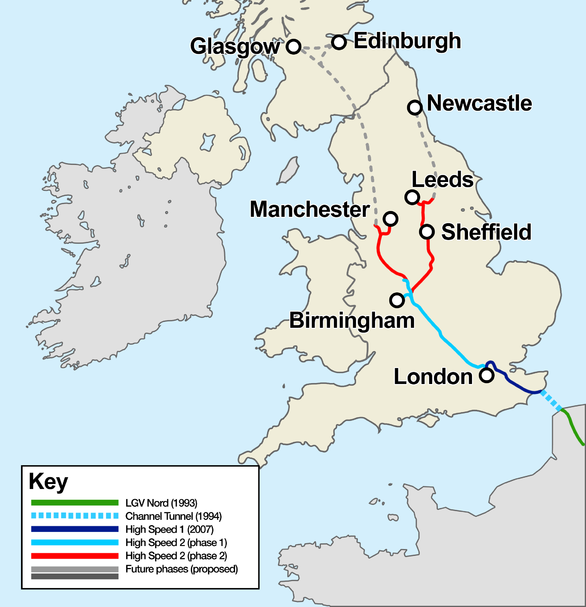 In September, KPMG produced a report that estimated the overall benefit to the UK economy would be a boost to growth of 0.8%, which would benefit many businesses and communities. The British Chambers of Commerce said:
Business communities in dozens of cities and towns, from many parts of the UK, remain strongly supportive of HS2.
The railway network is also approaching full capacity and this is one of the reasons why HS2 has been proposed. A government source said:
We need to do something because our railways are nearly full, but the alternative to HS2 is a patch and mend job that would cause 14 years of gridlock, hellish journeys and rail replacement buses … The three main routes to the north would be crippled and the economy would be damaged.
However, this report has faced criticism, in particular because it ignored a variety of supply-side constraints and because they argue it would be more effective to simply update the existing network. 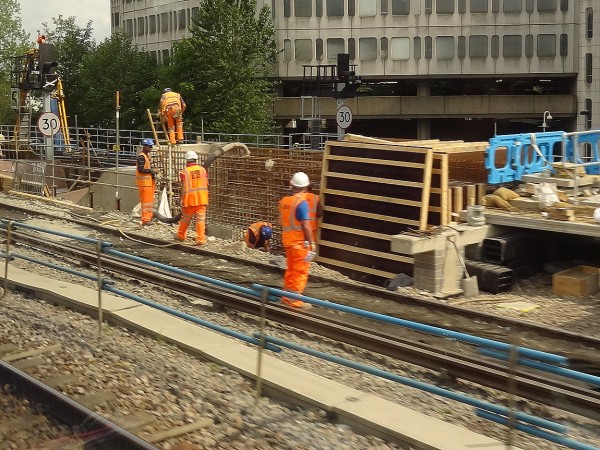 However, a new government-commissioned report has suggested that this alternative to HS2 would involve 14 years of weekend route closures and much longer journey times. However, those in favour of updating existing routes have said that this new report commissioned by the government is ‘a complete fabrication’. Hilary Wharf of the HS2 Action Alliance commented:
This government-funded report is a complete fabrication. The main alternative to HS2 involves longer trains and reduced first-class capacity to provide more standard class seats…No work is required at Euston to deliver the necessary capacity increase. Work is only required at three locations on the WCML [West Coast Main Line], and this is comparable to the work being carried out on the route at present.
The debate regarding HS2 will continue for the time being and it is just another area that is fuelling the political playing field. Whatever is done, the rail network certainly requires investment, whether it is through HS2 or upgrades to the existing routes. The following reports and articles consider the latest developments and controversy regarding HS2.
Reports
HS2 Cost and Risk model Report: A report to Government by HS2 ltd HS2 Ltd March 2012
High Speed 2 (HS2) Limited: HS2 Regional Economic Impacts KPMG September 2013
Draft Environmental Statement: Phase One: Engine for Growth HS2 May 2013
Updated Economic Case for HS2 HS2 August 2012
Articles
HS2 alternative ‘would mean years of rail disruption’ BBC News (28/10/13)
Alternative to HS2 would see Britain suffer 14 years of rail misery, says Coalition Independent, Nigel Morris (28/10/13)
HS2 alternatives could require 14 years of weekend rail closures The Guardian, Rajeev Syal (28/10/13)
Passengers ‘face 14 years of chaos if HS2 is derailed’: ‘Unattractive’ package of closures would be needed to expand capacity if Labour withdraws support Mail Online, Jason Groves (28/10/13)
HS2: Labour to examine cheaper rival plan The Telegraph, Tim Ross and Andrew Gilligan (27/10/13)
Britain’s railways have become mere outposts of other nations’ empires The Guardian, John Harris (28/10/13)
’Years of delays’ if government backs down on HS2 rail project Financial Times, Kiran Stacey and Brian Gloom (28/10/13)
Questions
- What is a cost-benefit analysis? Explain the steps that are involved in any cost-benefit analysis.
- Conduct a cost-benefit analysis for HS2. Ensure that you differentiate between costs and benefits and between private and social concepts.
- How can we measure the costs and benefits of HS2?
- Explain how HS2 is expected to boost economic growth. Use the AD/AS model to illustrate this.
- To what extent is there likely to be a multiplier effect from HS2? Is it likely to benefit the whole economy or just those areas where the route lies?
- Conduct a cost-benefit analysis for the alternative suggestion. Which do you think is likely to be more feasible? Explain your answer.
- How will improvements to the rail network or the investment of HS2 benefit businesses in the UK economy?
 The latest preliminary GDP estimates for 2013 Q3 suggest that the economy’s output (real GDP) expanded by 0.8 per cent following on the back of a 0.7 per cent increase in Q2. Growth was observed across the main industrial sectors with the important service sector growing by 0.7 per cent. While the output of the service sector is now 0.5 per cent higher than its 2008 Q1 peak, the total output of the economy remains 2.6 per cent below its 2008 Q1 peak.
The volatility of growth underpins the idea of business cycles and on occasions results in recessions. Today’s release needs to be set in the context of this volatility and in the context of 2008/9 recession which saw output fall by 7.2 per cent. UK output peaked in 2008 Q1 (£392.786 billion at 2010 prices). There then followed 6 quarters during which output declined.
Output declined again in 2010 Q4 (–0.2% growth) and again in 2011 Q4 (–0.1% growth). The estimates of real GDP for 2011 Q4 and 2012 Q1 are identical at £376.462 billion (at 2010 prices). Previous revisions have seen the 2012 Q1 growth number revised up so that a further recession resulting in a double-dip recession no longer appears in the figures.
While output is now portrayed as (very) flat in 2012 Q1, it did fall again in 2012 Q2 (–0.5 per cent growth) and in 2012 Q4 (–0.3 per cent growth). Moving forward in time, the latest ONS numbers show an economy that grew by 0.4 per cent in 2013 Q1 (to £377.301 billion at 2010 prices), by 0.7 per cent in 2013 Q2 (to £379.780 billion at 2010 prices) and by 0.8 per cent in 2013 Q3 billion (to £382.818 billion at 2010 prices). Compared with 2012 Q3, the output of the UK economy in 2013 Q2 is 1.5 per cent higher.
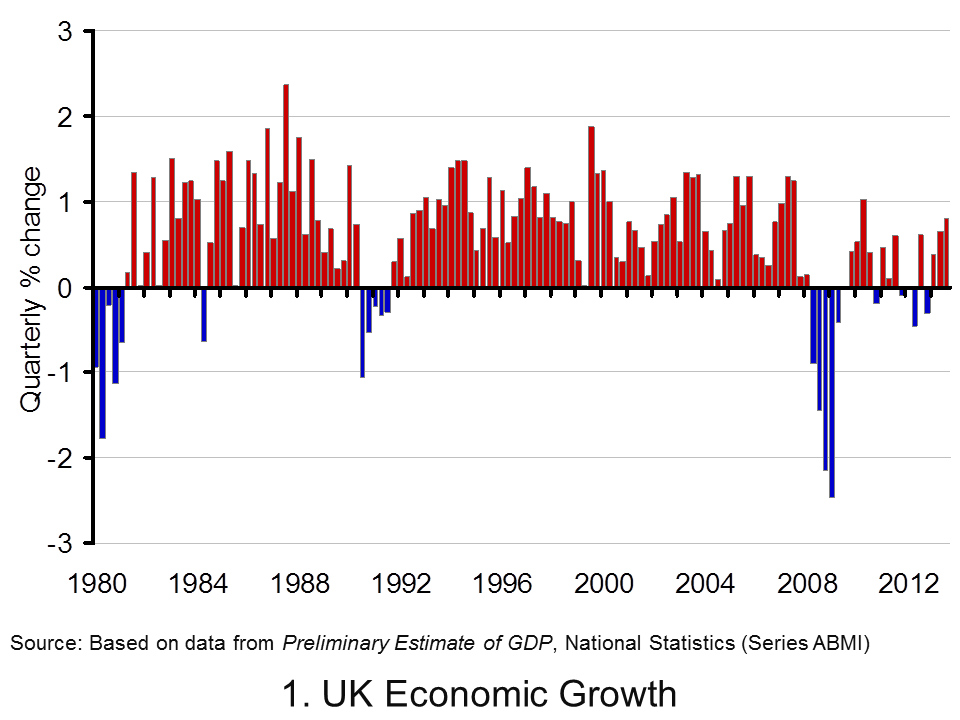 Chart 1 helps to put the recent growth numbers into an historical context. It shows the quarterly change in real GDP since the 1980s. From it, we can see the 5-quarter recession that commenced in 1980 Q1 when output shrunk by 4.6 per cent, the 5-quarter recession that commenced in 1990 Q3 when output shrank by 2.4 per cent and the 6-quarter recession that commenced in 2008 Q2 when output shrank by 7.2 per cent. (Click here to download a PowerPoint of the chart.)
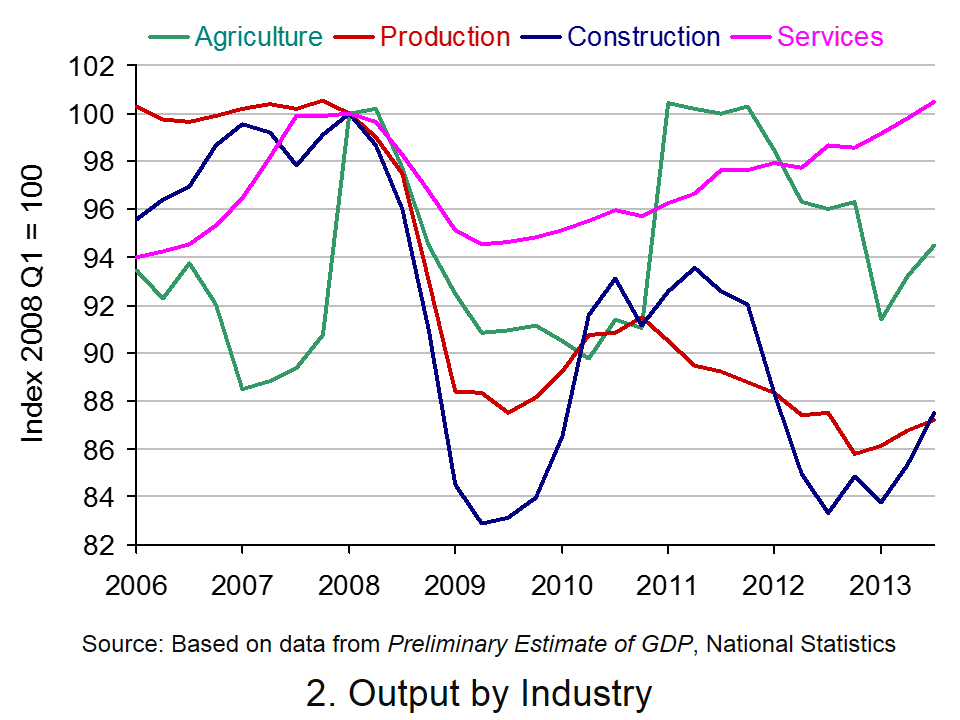 Chart 2 scratches a little below the surface by looking at output by the four principal industrial types. The interesting finding is that the output of the service sector has now risen above its 2008 Q1 peak. In 2013 Q3 output is 0.5 per cent larger. By contrast, the other three sectors remain smaller than in 2008 Q1. Agriculture, forestry and fisheries is 5.9 per cent smaller, construction 14.3 per cent smaller and production (including manufacturing) is 14.6 per cent smaller. (Click here to download a PowerPoint of the chart.)
With today’s release, quarterly growth now averages –0.11 per cent since 2008 Q2. If we take the series back to the mid 1950s when it began, the average quarterly rate of growth is 0.64 per cent which is equivalent to an annual rate of increase of 2.57 per cent. While today’s news is encouraging it remains important to keep it in perspective and to ensure that growth is sustainable and built on firm foundations.
Data
Preliminary Estimate of GDP – Time Series Dataset Q3 2013 Office for National StatisticsGross Domestic Product Preliminary Estimate, Q3 2013 Office for National Statistics
New Articles
UK economy grows by 0.8% – the fastest pace in three years Guardian, Larry Elliott (25/10/13)
UK economy grew by 0.8% in third quarter Independent, Nick Renaud-Komiya (25/10/13)
UK GDP: fastest growth for three years BBC News (25/10/13)
UK economy grows by 0.8pc in third quarter Telegraph, Szu Ping Chu (25/10/13)
UK Economy: GDP Growth Accelerates To 0.8% Sky News (25/10/13)
Previous Articles
GDP grows 0.7% as UK economy shows steady recovery Guardian, Phillip Inman (26/9/13)
Hopes of economic recovery take double blow as GDP remains at 0.7% Independent, Russell Lynch (26/9/13)
UK economic growth confirmed at 0.7% BBC News (26/9/13)
IMF cuts global growth outlook but raises UK forecast BBC News (9/10/13)
Good news as IMF upgrades UK’s growth forecast Independent, Ben Chu (8/10/13)
Economy: IMF Makes UK Growth Forecast U-Turn Sky News (8/10/13)
Questions
- What is the difference between nominal and real GDP? Which of these helps to track changes in economic output?
- Looking at Chart 1 above, summarise the key patterns in real GDP since the 1980s.
- What is a recession? What is a double-dip recession?
- What are some of the problems with the traditional definition of a recession?
- Explain the arguments for and against the proposition that the UK has recently experienced a double-dip recession.
- Can a recession occur if nominal GDP is actually rising? Explain your answer.
- What factors might result in economic growth being so variable?
- What factors might explain the very different patterns seen since the late 2000s in the volume of output of the 4 main industrial sectors?
- Produce a short briefing paper exploring the prospects for economic growth in the UK over the next 12 to 18 months.
 A recession is typically characterised by high unemployment, low or negative growth and low inflation, due to a lack of aggregate demand. However, since 2009, inflation levels in the UK have only added to the pressures facing the government and the Bank of England. Not only had there been a problem of lack of demand, but the inflation target was no longer being met.
 The data for December include some of the energy price rises from the big six, but do not include the full extent of price decreases and discounting initiated by retailers in the lead up to Christmas. The key factors that have helped to keep prices down include some of the discounting throughout December and falling food prices, in particular bananas, grapes and meat.