 In two recent speeches, the Governor of the Bank of England, Mark Carney, and the Bank’s Chief Economist, Andy Haldane, have reflected on the growing inequality in the UK and other countries. They have also answered criticisms that monetary policy has exacerbated the problem. As, Andy Haldane puts it:
It is clear monetary policy has played a material role in lifting all boats since the financial crisis broke. …[But] even if monetary policy has lifted all boats, and could plausibly do so again if needed, that does not mean it has done so equally. In particular, concerns have been expressed about the potential distributional effects of monetary policy.
Jan Vlieghe [member of the Monetary Policy Committee] has recently looked at how monetary policy may have affected the fortunes of, among others, savers, pension funds and pensioners. The empirical evidence does not suggest these cohorts have been disadvantaged to any significant degree by the monetary policy stance. For most members in each cohort, the boost to their asset portfolios and the improved wages and profits due to a stronger economy more than offset the direct loss of income from lower rates [of interest on savings accounts].
Andy Haldane’s speech focused largely on regional inequality. He argued that productivity has grown much more rapidly in the more prosperous regions, such as London and the South East. This has resulted in rising inequality in wages between different parts of the UK. Policies that focus on raising productivity in the less prosperous regions could play a major role in reducing income inequality.
Mark Carney’s speech echoed a lot of what Andy Haldane was saying. He argued that expansionary monetary policy has, according to Bank of England modelling, “raised the level of GDP by around 8% relative to trend and lowered unemployment by 4 percentage points at their peak”. And the benefits have been felt by virtually everyone. Even savers have generally gained:
That’s in part because, to a large extent, the thrifty saver and the rich asset holder are often one and the same. Just 2% of households have deposit holdings in excess of £5000, few other financial assets and don’t own a home.
But some people still gained more from monetary policy than others – enough to contribute to widening inequality.
Losers from the lost decade
 Mark Carney looked beyond monetary policy and argued that the UK has experienced a ‘lost decade’, where real incomes today are little higher than 10 years ago – the first time this has happened for 150 years. This stalling of average real incomes has been accompanied by widening inequality between various groups, where a few have got a lot richer, especially the top 1%, and many have got poorer. Although the Gini coefficient has remained relatively constant in recent years, there has been a widening gap between the generations.
For both income and wealth, some of the most significant shifts have happened across generations. A typical millennial earned £8000 less during their twenties than their predecessors. Since 2007, those over 60 have seen their incomes rise at five times the rate of the population as a whole. Moreover, rising real house prices between the mid-1990s and the late 2000s have created a growing disparity between older home owners and younger renters.
This pattern has been repeated around the developed world and has led to disillusionment with globalisation and a rise in populism. 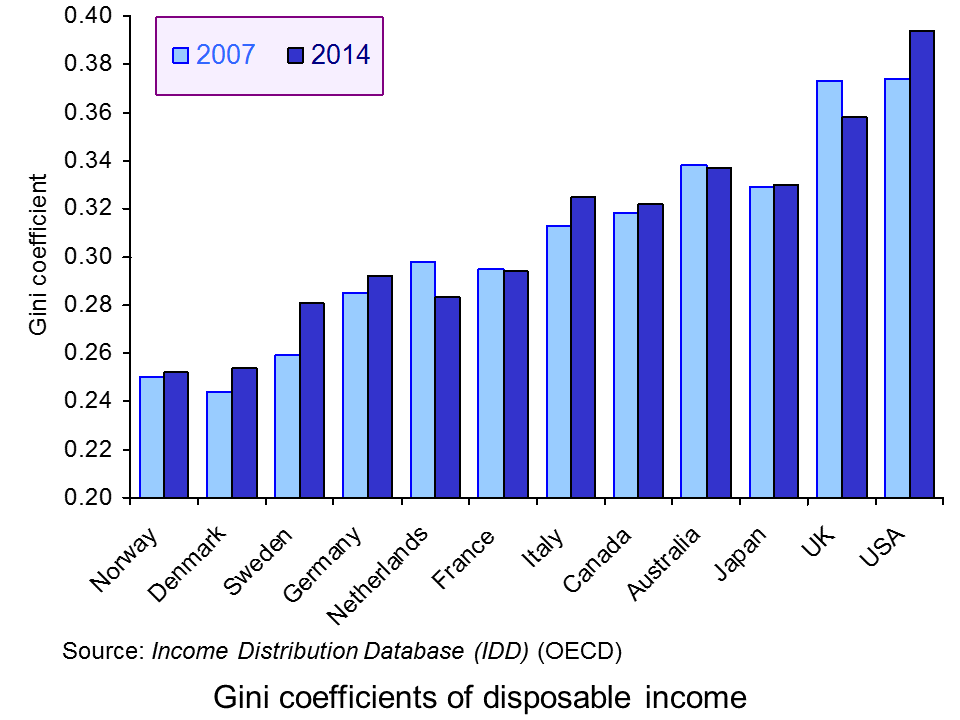 Globalisation has been “associated with low wages, insecure employment, stateless corporations and striking inequalities”. (Click here for a PowerPoint of the chart.)
And populism has been reflected in the crisis in Greece, the Brexit vote, Donald Trump’s election, the rise of the National Front in France, the No vote in the Italian referendum on reforming the constitution and the rise in anti-establishment parties and sentiment generally. Mainstream parties are beginning to realise that concerns over globalisation, inequality and a sense of disempowerment must be addressed.
Solutions to inequality
As far as solutions are concerned, central must be a rise in general productivity that increases potential real income.
Boosting the determinants of long-run prosperity is the job of government’s structural, or supply-side policies. These government policies influence the economy’s investment in education and skills; its capacity for research and development; the quality of its core institutions, such as the rule of law; the effectiveness of its regulatory environment; the flexibility of its labour market; the intensity of competition; and its openness to trade and investment.
But will this supply-side approach be enough to bring both greater prosperity and greater equality? Will an openness to trade be accepted by populist politicians who blame globalisation and the unequal gains from international trade for the plight of the poor? Carney recognises the problem and argues that:
For the societies of free-trading, networked countries to prosper, they must first re-distribute some of the gains from trade and technology, and then re-skill and reconnect all of their citizens. By doing so, they can put individuals back in control.
For free trade to benefit all requires some redistribution. There are limits, of course, because of fiscal constraints at the macro level and the need to maintain incentives at the micro level. Fostering dependency on the state is no way to increase human agency, even though a safety net is needed to cushion shocks and smooth adjustment.
Redistribution and fairness also means turning back the tide of stateless corporations.
… Because technology and trade are constantly evolving and can lead to rapid shifts in production, the commitment to reskilling all workers must be continual.
In a job market subject to frequent, radical changes, people’s prospects depend on direct and creative engagement with global markets. Lifelong learning, ever-greening skills and cooperative training will become more important than ever.
But whether these prescriptions will be accepted by people across the developed world who feel that the capitalist system has failed them and who look to more radical solutions, whether from the left or the right, remains to be seen. And whether they will be adopted by governments is another question!
Webcast
 Roscoe Lecture Bank of England on YouTube, Mark Carney (5/12/16)
Speeches
One Car, Two Car, Red Car, Blue Car Bank of England, Andrew Haldane (2/12/16)
The Spectre of Monetarism: Roscoe Lecture, Liverpool John Moores University Bank of England, Mark Carney (5/12/16)
Articles: Andrew Haldane speech
Bank of England chief economist says monetary stimulus stopped ‘left behind’ from drowning Independent, Ben Chu (2/12/16)
BoE’s Andrew Haldane warns of regional growth inequality BBC News (2/12/16)
‘Regions would have faced contraction’ without rate cuts and money printing Belfast Telegraph (2/12/16)
Bank of England chief: UK can be transformed if it copies progress on Teesside Gazette Live, Mike Hughes (2/12/16)
Articles: Mark Carney speech
Governor’s ‘dynamite’ warning on wages and globalisation Sky News, Ed Conway (6/12/16)
Mark Carney warns Britain is suffering first lost decade since 1860 as people across Europe lose trust in globalisation The Telegraph, Szu Ping Chan and Peter Foster (5/12/16)
Mark Carney: we must tackle isolation and detachment caused by globalisation The Guardian, Katie Allen (6/12/16)
Bank of England’s Carney warns of strains from globalization Reuters, William Schomberg and David Milliken (6/12/16)
CARNEY: Britain is in ‘the first lost decade since the 1860s’ Business Insider UK, Oscar Williams-Grut (7/12/16)
Carney warns about popular disillusion with capitalism BBC News (5/12/16)
Some fresh ideas to tackle social insecurity Guardian letters (7/12/16)
Report
Monitoring poverty and social exclusion 2016 (MPSE) Joseph Rowntree Foundation, Adam Tinson, Carla Ayrton, Karen Barker, Theo Barry Born, Hannah Aldridge and Peter Kenway (7/12/16)
Data
OECD Income Distribution Database (IDD): Gini, poverty, income, Methods and Concepts OECD
The effects of taxes and benefits on household income Statistical bulletins ONS
Questions
- Has monetary policy aggravated the problem of inequality? Explain.
- Comment on Charts 11a and 11b on page 19 of the Haldane speech.
- Does the process of globalisation help to reduce inequality or does it make it worse?
- If countries specialise in the production of goods in which they have a comparative advantage, does this encourage them to use more or less of relatively cheap factors of production? How does this impact on factor prices? How does this affect income distribution?
- How might smaller-scale firms “by-pass big corporates and engage in a form of artisanal globalisation; a revolution that could bring cottage industry full circle”?
- Why has regional inequality increased in the UK?
- What types of supply-side policy would help to reduce inequality?
- Explain the following statement from Mark Carney’s speech: “For free trade to benefit all requires some redistribution. There are limits, of course, because of fiscal constraints at the macro level and the need to maintain incentives at the micro level”.
- Mark Carney stated that “redistribution and fairness also means turning back the tide of stateless corporations”. How might this be done?
 An article in the February 2015 issue of the Economic Journal, ‘Intergenerational Wealth Mobility in England, 1858–2012: Surnames and Social Mobility’ by Gregory Clark and Neil Cummins, looks at the persistence of wealth within British families across the generations. The article shows, ‘using rare surnames to track families, that wealth is much more persistent than standard one-generation estimates would suggest. There is still a significant correlation between the wealth of families five generations apart’.
It concludes that down the generations the main determinant of wealth is inheritance, despite all efforts to improve social mobility. The intergenerational elasticity of wealth inheritance is found to be 0.70–0.75 throughout the years 1858–2012. In other words, people’s wealth on average will be between 70% and 75% of that of their parents. Thus a large proportion of each person’s wealth depends on the wealth of their parents and a relatively small amount depends on other factors. As Clark and Cummins conclude:
The implications of this model are that wealth will be surprisingly persistent in families across multiple generations. This is what allows rich rare surnames to still remain rich on average even four generations later. It also implies that wealth differences between racial, religious and ethnic groups will also be highly persistent across generations.
So it is just inherited wealth in terms of money or property that gets passed from generation to generation? Or are their other factors, such as education, social class and social contacts, that cause  people’s wealth to depend heavily on that of their parents? Clark and Cummins consider this question.
What is the latent variable that underlies the inheritance of wealth? Evidence in other work we have done on the inheritance of education status in England suggests that families can be conceived of as having an underlying social competence, which is highly persistent across generations. This social competence generates their outcomes on all dimensions of social status but with random components on each one. In this case, social mobility between generations measured on any single aspect of status will be much greater than mobility on a more general ranking of families’ overall social status, that averages earnings, wealth, occupation, education, health and longevity.
So does this mean that attempts to create greater social mobility and greater equality are futile? The authors maintain that although it is difficult to achieve greater social mobility, income and wealth can nevertheless be redistributed through the tax and benefits system.
News articles
Inheritance: how Britain’s wealthy still keep it in the family The Observer, Jamie Doward (1/2/15)
How the rich stay rich: social status is more inheritable than height ZME Science (25/11/14)
This is the proof that the 1% have been running the show for 800 years Quartz (23/11/14)
Journal article
Intergenerational Wealth Mobility in England, 1858–2012: Surnames and Social Mobility The Economic Journal, Gregory Clark and Neil Cummins (February 2015) (To read this article you will need to log in via Shibboleth using your university username and password.)
Questions
- What would be the implication of an intergenerational wealth elasticity (a) of 1; (b) of 0; (c) >1; (d) <0?
- For what reasons might there be a high intergenerational wealth elasticity?
- What is the likely relationship between the intergenerational distribution of wealth and the intergenerational distribution of income?
- What difficulties are there is using rare surnames as a means of establishing the intergenerational distribution of wealth?
- Discuss the advantages and disadvantages of (a) a much higher rate of inheritance tax (in the UK it’s currently 40% on the value of a person’s estate above £325,000 when they die); (b) capping the amount that can be left to any individual from an estate, with anything above this taxed at 100%; (c) capping the total amount that can be left (other than to charity), with the rest taxed at 100%.
- What measures could be adopted to increase social mobility?
- What problems would arise from using the tax and benefit system to reduce inequality? (In 2012/13 the gini coefficient of original income was 0.52 and that of both gross income (i.e. income after benefits but before tax) and post-tax-and-benefit income in the UK was 0.37: see Table 27 of The Effects of Taxes and Benefits on Household Income, 2012/13.)

The World Economic Forum has been holding its annual meeting in the up-market Swiss ski resort of Davos. Many of the world’s richest and most powerful people attend these meetings, including political leaders, business leaders and representatives of various interest groups.
This year, one of the major topics has been the growth in inequality across the globe and how to reverse it. According to a report by Oxfam, Wealth: Having it all and wanting more:
The richest 1 per cent have seen their share of global wealth increase from 44 per cent in 2009 to 48 per cent in 2014 and at this rate will be more than 50 per cent in 2016. Members of this global elite had an average wealth of $2.7m per adult in 2014.
Of the remaining 52 per cent of global wealth, almost all (46 per cent) is owned by the rest of the richest fifth of the world’s population. The other 80 per cent share just 5.5 per cent and had an average wealth of $3851 per adult – that’s 1/700th of the average wealth of the 1 per cent.
Currently, the richest 85 people in the world have the same amount of wealth as the poorest 50% of the world’s population. It might seem odd that those with the wealth are talking about the problem of inequality.  Indeed, some of those 85 richest people were at the conference: a conference that boasts extremely luxurious conditions. What is more, many delegates flew into the conference in private jets (at least 850 jets) to discuss not just poverty but also climate change!
Yet if the problem of global inequality is to be tackled, much of the power to do so lies in the hands of these rich and powerful people. They are largely the ones who will have to implement policies that will help to raise living standards of the poor.
But why should they want to? Part of the reason is a genuine concern to address the issues of increasingly divided societies. But part is the growing evidence that greater inequality reduces economic growth by reducing the development of skills of the lower income groups and reducing social mobility. We discussed this topic in the blog, Inequality and economic growth.
So what policies could be adopted to tackle the problem. Oxfam identifies a seven-point plan:
|
|
| • |
Clamp down on tax dodging by corporations and rich individuals; |
| • |
Invest in universal, free public services such as health and education; |
| • |
Share the tax burden fairly, shifting taxation from labour and consumption towards capital and wealth; |
| • |
Introduce minimum wages and move towards a living wage for all workers; |
| • |
Ensure adequate safety-nets for the poorest, including a minimum income guarantee; |
| • |
Introduce equal pay legislation and promote economic policies to give women a fair deal; |
| • |
Agree a global goal to tackle inequality. |
But how realistic are these policies? Is it really in the interests of governments to reduce inequality? Indeed, some of the policies that have been adopted since 2008, such as bailing out the banks and quantitative easing, have had the effect of worsening inequality. QE drives up asset prices, particularly bond, share and property prices. This has provided a windfall to the rich: the more of such assets you own, the greater the absolute gain.
The following videos and articles look at the problem of growing inequality and how realistic it is to expect leaders to do anything significant about it.
Videos and podcasts
Income inequality is ‘brake on growth’, Oxfam chief warns Davos France 24, Winnie Byanyima (22/1/15)
Davos dilemma: Can the 1% cure income inequality? Yahoo Finance, Lizzie O’Leary and Shawna Ohm (21/1/15)
Richest 1% ‘Will Own Half The World’s Wealth By 2016’ ITN on YouTube, Sarah Kerr (19/1/15)
The Price of Inequality BBC Radio 4, Robert Peston (3/2/15 and 10/2/15)
Articles
Richest 1% will own more than all the rest by 2016 Oxfam blogs, Jon Slater (19/1/15)
Global tax system can cut inequality The Scotsman, Jamie Livingstone (23/1/15)
A new framework for a new age Financial Times, Tony Elumelu (23/1/15)
The global elite in Davos must give the world a pay rise New Statesman, Frances O’Grady (22/1/15)
New Oxfam report says half of global wealth held by the 1% The Guardian, Larry Elliott and Ed Pilkington (19/1/15)
Davos is starting to get it – inequality is the root cause of stagnation The Guardian, Larry Elliott (25/1/15)
Inequality isn’t inevitable, it’s engineered. That’s how the 1% have taken over The Guardian, Suzanne Moore (19/1/15)
Why extreme inequality hurts the rich BBC News, Robert Peston (19/1/15)
Eurozone stimulus ‘reinforces inequality’, warns Soros BBC News, Joe Miller (22/1/15)
Hot topic for the 1 percent at Davos: Inequality CNBC, Lawrence Delevingne (21/1/15)
Global inequality: The wrong yardstick The Economist (24/1/15)
A Richer World (a compendium of articles) BBC News (27/1/15)
Data
OECD Income Distribution Database: Gini, poverty, income, Methods and Concepts OECD
The effects of taxes and benefits on household income ONS
Questions
- Why has inequality increased in most countries in recent years?
- For what reasons might it be difficult to measure the distribution of wealth?
- Which gives a better indication of differences in living standards: the distribution of wealth or the distribution of income?
- Discuss the benefits and costs of using the tax system to redistribute (a) income and (b) wealth from rich to poor
- Go through each of the seven policies advocated by Oxfam and consider how practical they are and what possible objections to them might be raised by political leaders.
- Why is tax avoidance/tax evasion by multinational companies difficult to tackle?
- Does universal access to education provide the key to reducing income inequality within and between countries?
 What is the relationship between the degree of inequality in a country and the rate of economic growth? The traditional answer is that there is a trade off between the two. Increasing the rewards to those who are more productive or who invest encourages a growth in productivity and capital investment, which, in turn, leads to faster economic growth. Redistribution from the rich to the poor, by contrast, is argued to reduce incentives by reducing the rewards from harder work, education, training and investment. Risk taking, it is claimed, is discouraged.
Recent evidence from the OECD and the IMF, however, suggests that when income inequality rises, economic growth falls. Inequality has grown massively in many countries, with average incomes at the top of the distribution seeing particular gains, while many at the bottom have experienced actual declines in real incomes or, at best, little or no growth. 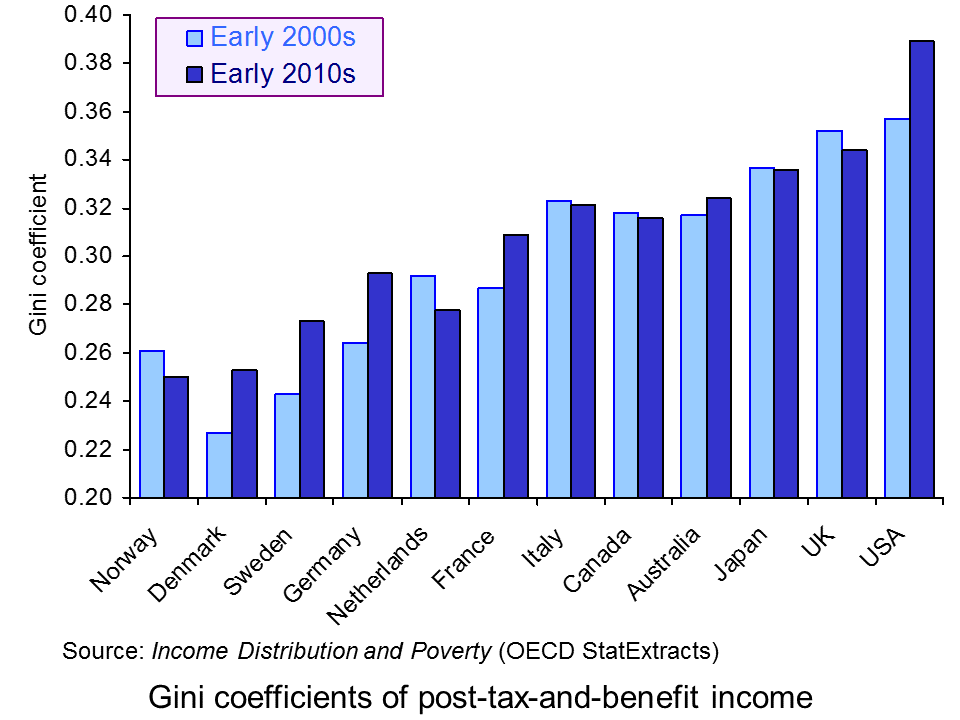 This growth in inequality can be seen in a rise in countries’ Gini coefficients. The OECD average Gini coefficient rose from 0.29 in the mid-1980s to 0.32 in 2011/12. This, claims the OECD, has led to a loss in economic growth of around 0.35 percentage points per year.
But why should a rise in inequality lead to lower economic growth? According to the OECD, the main reason is that inequality reduces the development of skills of the lower income groups and reduces social mobility.
By hindering human capital accumulation, income inequality undermines education opportunities for disadvantaged individuals, lowering social mobility and hampering skills development.
The lower educational attainment applies both to the length and quality of education: people from poorer backgrounds on average leave school or college earlier and with lower qualifications.
But if greater inequality generally results in lower economic growth, will a redistribution from rich to poor necessarily result in faster economic growth? According to the OECD:
Anti-poverty programmes will not be enough. Not only cash transfers but also increasing access to public services, such as high-quality education, training and healthcare, constitute long-term social investment to create greater equality of opportunities in the long run.
Thus redistribution policies need to be well designed and implemented and focus on raising incomes of the poor through increased opportunities to increase their productivity. Simple transfers from rich to poor via the tax and benefits system may, in fact, undermine economic growth. According to the IMF:
That equality seems to drive higher and more sustainable growth does not in itself support efforts to redistribute. In particular, inequality may impede growth at least in part because it calls forth efforts to redistribute that themselves undercut growth. In such a situation, even if inequality is bad for growth, taxes and transfers may be precisely the wrong remedy.
Articles
Inequality ‘significantly’ curbs economic growth – OECD BBC News (9/12/14)
Is inequality the enemy of growth? BBC News, Robert Peston (6/10/14)
Income inequality damages growth, OECD warns Financial Times, Chris Giles (8/10/14)
OECD finds increasing inequality lowers growth Deutsche Welle, Jasper Sky (10/12/14)
Revealed: how the wealth gap holds back economic growth The Guardian, Larry Elliott (9/12/14)
Inequality Seriously Damages Growth, IMF Seminar Hears IMF Survey Magazine (12/4/14)
Warning! Inequality May Be Hazardous to Your Growth iMFdirect, Andrew G. Berg and Jonathan D. Ostry (8/4/11)
Economic growth more likely when wealth distributed to poor instead of rich The Guardian, Stephen Koukoulas (4/6/15)
So much for trickle down: only bold reforms will tackle inequality The Guardian, Larry Elliott (21/6/15)
Videos
Record inequality between rich and poor OECD on YouTube (5/12/11)
The Price of Inequality The News School on YouTube, Joseph Stiglitz (5/10/12)
Reports and papers
FOCUS on Inequality and Growth OECD, Directorate for Employment, Labour and Social Affairs (December 2014)
Trends in Income Inequality and its Impact on Economic Growth OECD Social, Employment and Migration Working Papers, Federico Cingano (9/12/14)
An Overview of Growing Income Inequalities in OECD Countries: Main Findings OCED (2011)
Redistribution, Inequality, and Growth IMF Staff Discussion Note, Jonathan D. Ostry, Andrew Berg, and Charalambos G. Tsangarides (February 2014)
Measure to Measure Finance and Development, IMF, Jonathan D. Ostry and Andrew G. Berg (Vol. 51, No. 3, September 2014)
Data
OECD Income Distribution Database: Gini, poverty, income, Methods and Concepts OECD
The effects of taxes and benefits on household income ONS
Questions
- Explain what are meant by a Lorenz curve and a Gini coefficient? What is the relationship between the two?
- The Gini coefficient is one way of measuring inequality. What other methods are there? How suitable are they?
- Assume that the government raises taxes to finance higher benefits to the poor. Identify the income and substitution effects of the tax increases and whether the effects are to encourage or discourage work (or investment).
- Distinguish between (a) progressive, (b) regressive and (c) proportional taxes?
- How will the balance of income and substitution effects vary in each of the following cases: (a) a cut in the tax-free allowance; (b) a rise in the basic rate of income tax; (c) a rise in the top rate of income tax? How does the relative size of the two effects depend, in each case, on a person’s current income?
- Identify policy measures that would increase both equality and economic growth.
- Would a shift from direct to indirect taxes tend to increase or decrease inequality? Explain.
- By examining Tables 3, 26 and 27 in The Effects of Taxes and Benefits on Household Income, 2012/13, (a) explain the difference between original income, gross income, disposable income and post-tax income; (b) explain the differences between the Gini coefficients for each of these four categories of income in the UK.
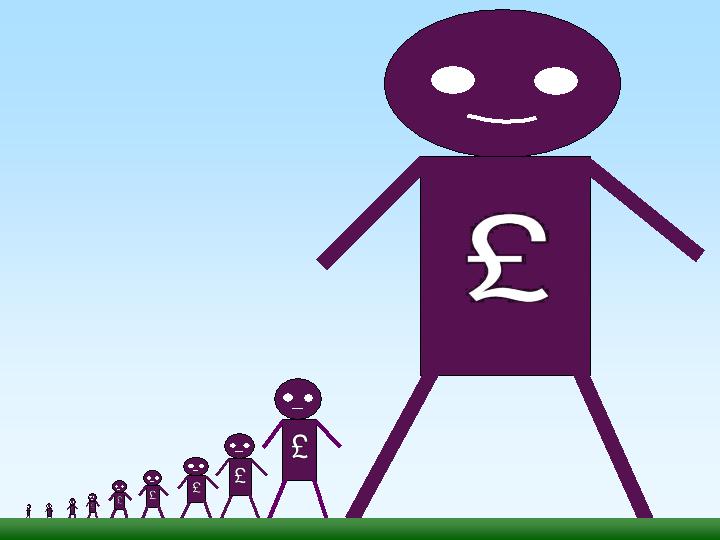 In his 1971 book, Income Distribution, Jan Pen, a Dutch economist, gave a graphic illustration of inequality in the UK. He described a parade of people marching by. They represent the whole population and the parade takes exactly one hour to pass by. The height of each person represents his or her income. People of average height are the people with average incomes – the observer is of average height. The parade starts with the people on the lowest incomes (the dwarfs), and finishes with those on the highest incomes (the giants).
Because income distribution is unequal, there are many tiny people. Indeed, for the first few minutes of the parade, the marchers are so small they can barely be seen. Even after half an hour, when people on median income pass by, they are barely waist high to the observer.
The height is growing with tantalising slowness, and forty-five minutes have gone by before we see people of our own size arriving. To be somewhat more exact: about twelve minutes before the end the average income recipients pass by.
In the final minutes, giants march past and then in the final seconds:
the scene is dominated by colossal figures: people like tower flats. Most of them prove to be businessmen, managers of large firms and holders of many directorships and also film stars and a few members of the Royal Family.
The rear of the parade is brought up by a few participants who are measured in miles. Indeed they are figures whose height we cannot even estimate: their heads disappear into the clouds and probably they themselves do not even know how tall they are.
Pen’s description could be applied to most countries – some with even more dwarfs and even fewer but taller giants. Generally, over the 43 years since the book was published, countries have become less equal: the giants have become taller and the dwarfs have become smaller.
The 2011 Economist article, linked below, uses changes in Gini coefficients to illustrate the rise in income inequality. A Gini coefficient shows the area between the Lorenz curve and the 45° line. The figure will be between 0 and 1 (or 0% and 100%). a figure of 0 shows total equality; a figure of 1 shows a situation of total inequality, where one person earns all the nation’s income. The higher the figure, the greater the inequality.
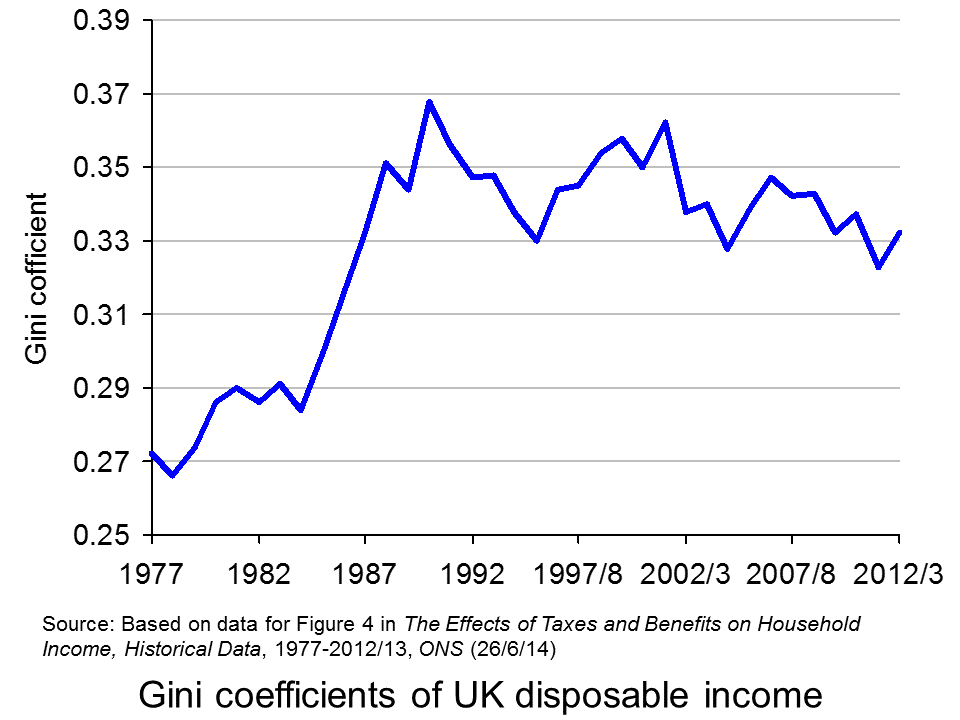 The chart opposite shows changes in the Gini coefficient in the UK (see Table 27 in the ONS link below for an Excel file of the chart). As this chart and the blog post Rich and poor in the UK show, inequality rose rapidly during the years of the 1979–91 Thatcher government, and especially in the years 1982–90. This was associated with cuts in the top rate of income tax and business deregulation. It fell in the recession of the early 1990s as the rich were affected more than the poor, but rose with the recovery of the mid- to late 1990s. It fell again in the early 2000s as tax credits helped the poor. It fell again following the financial crisis as, once more, the rich were affected proportionately more than the poor.
The most up-to-date international data for OECD countries can be found on the OECD’s StatExtracts site (see chart opposite: click here for a PowerPoint). The most unequal developed county is the USA, with a Gini coefficient of 0.389 in 2012 (see The end of the American dream?), and US inequality is rising. Today, the top 1% of the US population earns some 24% of national income. This compares with just 9% of national income in 1976.
Many developing countries are even less equal. Turkey has a Gini coefficient of 0.412 and Mexico of 0.482. The figure for South Africa is over 0.6.
When it comes to wealth, distribution is even less equal. The infographic, linked below, illustrates the position today in the USA. It divides the country into 100 equal-sized groups and shows that the top 1% of the population has over 40% of the nation’s wealth, whereas the bottom 80% has only 7%.
So is this inequality of income and wealth desirable? Differences in wages and salaries provide an incentive for people to work harder or more effectively and to gain better qualifications. The possibility of increased wealth provides an incentive for people to invest.
But are the extreme differences in wealth and income found in many countries today necessary to incentivise people to work, train and invest? Could sufficient incentives exist in more equal societies? Are inequalities in part, or even largely, the result of market imperfections and especially of economic power, where those with power and influence are able to use it to increase their own incomes and wealth?
Could it even be the case that excessive inequality actually reduces growth? Are the huge giants that exist today accumulating too much financial wealth and creating too little productive potential? Are they spending too little and thus dampening aggregate demand? These arguments are considered in some of the articles below. Perhaps, by paying a living wage to the ‘tiny’ people on low incomes, productivity could be improved and demand could be stimulated.
Infographic
Wealth Inequality in America YouTube, Politizane (20/11/12)
Articles
The rise and rise of the cognitive elite The Economist (20/1/11)
Inequality in America: Gini in the bottle The Economist (26/11/13)
Pen’s Parade: do you realize we’re mostly dwarves? LVTFan’s Blog (21/2/11)
Here Are The Most Unequal Countries In The World Business Insider, Andy Kiersz (8/11/14)
Inequality in the World Dollars & Sense, Arthur MacEwan (Nov/Dec 14)
Britain is scared to face the real issue – it’s all about inequality The Observer, Will Hutton (19/1/14)
The tame inequality debate FundWeb, Daniel Ben-Ami (Nov 14)
Is inequality the enemy of growth? BBC News, Robert Peston (6/10/14)
Data
GINI index World Bank data
List of countries by income equality Wikipedia
The Effects of Taxes and Benefits on Household Income, 2012/13 ONS (see table 27)
Income Distribution and Poverty: Gini (disposale income) OECD StatExtract
Questions
- Distinguish between income and wealth. Is each one a stock or a flow?
- Explain how (a) a Lorenz curve and (b) a Gini coefficient are derived.
- What other means are there of measuring inequality of income and wealth other than using Gini coefficients (and giants and dwarfs!)?
- Why has inequality been rising in many countries over the years?
- How do (a) periods of rapid economic growth and (b) recessions affect income distribution?
- Define ‘efficiency wages’. How might an increase in wages to people on low incomes result in increased productivity?
- What is the relationship between the degree of inequality and household debt? What implications might this have for long-term economic growth and future financial crises? Is inequality the ‘enemy of growth’?