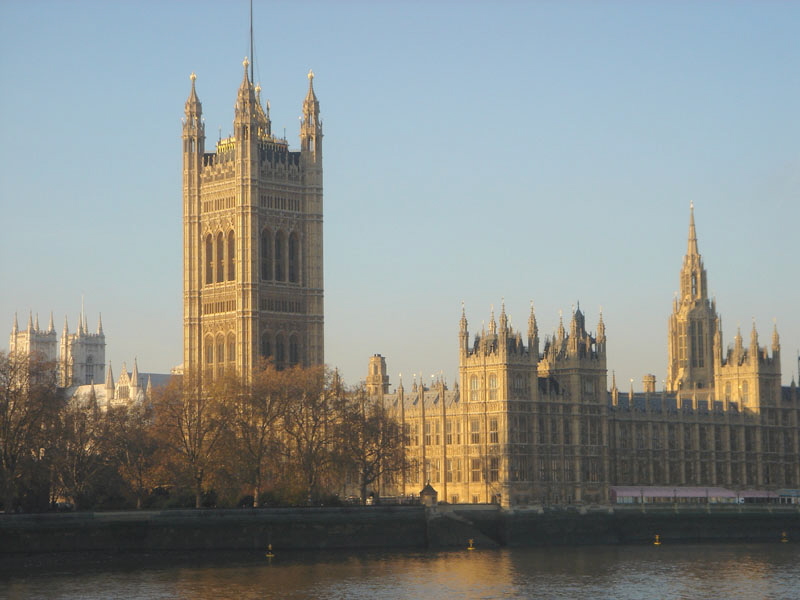
 There has been considerable discussion recently about whether the government should introduce a property tax on high value properties. The government, finding it difficult to reduce the public-sector deficit and yet determined to do so, is looking for additional measures to reduce government expenditure or raise tax revenue.
But would it favour a mansion tax as a means of raising additional revenue?
The imposition of such a tax is favoured by both Liberal Democrats and the Labour Party. It is strongly opposed, however, by Conservatives. But just what would such a tax look like and what are the arguments for and against it?
One alternative would be to impose a one-off tax on property valued over a certain amount, such as £2 million. Alternatively it could be levied only for as long as the government is seeking to make substantial inroads into the deficit.
Another would be to add one or more bands to council tax. At present, council tax in England is levied in 8 bands according to the value of a person’s property. The highest band is for property valued over £320,000 in 1991 prices, with the amount of tax due for each band varying from local authority to local authority. (Average UK house prices in 2012 are 135% higher than in 1991.) In Scotland the bands are lower with the top band being for property valued over £212,000 in 1991 prices. In Wales, there is an additional band for property valued over £424,000, but properties are valued in 2003 prices, not 1991 prices.
With low top bands for council tax, people in mansions end up paying the same as people in much more modest property. It would be relatively easy to add additional bands, with the top band applying only to property worth, say, over £1 million or more.
 The arguments in favour of a mansion tax are that it is progressive, relatively easy to collect, hard to evade and with minimal disincentive effects. The arguments against are that it would make the tax system ‘too progressive’, would not necessarily be related to an individual’s ability to pay and could have substantial disincentive effects.
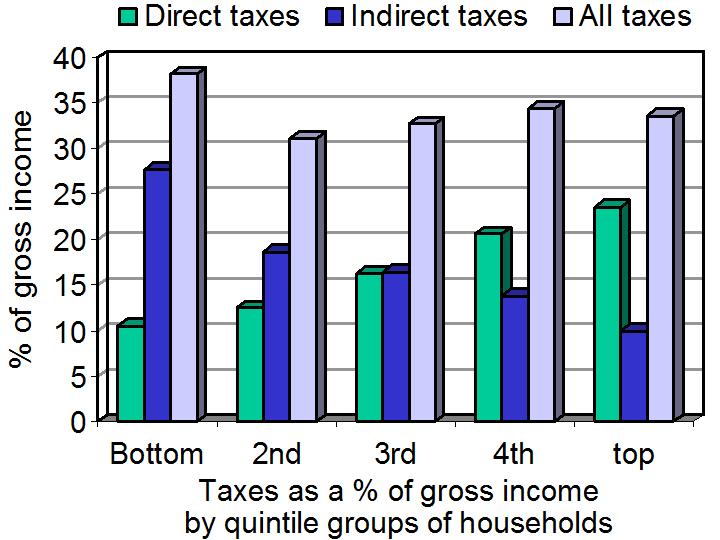
The progressiveness of the UK tax system is illustrated in the chart, which looks at the proportion of income paid in direct, indirect and all taxes by quintile groups of households – that is, households grouped into five equal sized groups ranked from lowest to highest gross income. (Click here for a PowerPoint of the chart.)
The following articles look at the debate as it has raged over the past few weeks. Try to unpick the genuine arguments from the political rhetoric!
Articles
Clegg Says U.K. Could Apply Mansion Tax ‘in Five Seconds’ Bloomberg, Robert Hutton (25/9/12)
Two thirds back mansion tax on £1m homes Metro, Tariq Tahir (8/10/12)
Mansion tax would ‘tackle inequality’ This is Tamworth (27/9/12)
Council tax: the easy way to make mansion-dwellers pay Guardian, Simon Jenkins (25/9/12)
 Rich must pay fair share in tax BBC Andrew Marr Show, Nick Clegg (23/9/12)
We will get mansion tax on £2 million homes through next budget, promise Lib Dems The Telegraph, Rowena Mason (25/9/12)
Trying to tax the wealthy not worth the price The Scotsman, George Kerevan (31/8/12)
Tax on wealth is true to Tory principles Financial Times, Janan Ganesh (24/9/12)
How would Clegg’s emergency wealth tax work? Guardian, Hilary Osborne (29/8/12)
Labour considers mansion tax on wealthy Financial Times, George Parke (5/9/12)
Conservative conference: Cameron rules out ‘mansion tax’ BBC News (7/10/12)
Don’t make wealth tax a habit Financial Times, Howard Davies (29/8/12)
George Osborne blocks mansion tax, but insists wealthy will pay more The Telegraph, Robert Winnett (8/10/12)
Why George Osborne had to kill the mansion tax The Spectator, Matthew Sinclair (7/10/12)
David Cameron rules out mansion tax and plans further welfare cuts Guardian, Hélène Mulholland (7/10/12)
Viewpoint: Would a wealth tax work? BBC News, Mike Walker (29/8/12)
For all the claims made about wealth taxes, it’s not correct to say the rich are paying their fair share Independent, Jonathan Portes (2/10/12)
Data
House price data links Economics Network
The Effects of Taxes and Benefits on Household Income, 2010/2011 ONS (26/6/12) (see especially Tables 2 and 3 and Table 26 for historical data)
Questions
- Explain the distinction between direct and indirect taxes, and between progressive and regressive taxes. For what reasons do the poor pay a higher proportion of their income in indirect taxes than the rich?
- What forms can a tax on wealth take?
- How progressive are taxes in the UK (see the ONS site in the Data section above)?
- Assess the arguments in favour of a mansion tax.
- Assess the arguments against a mansion tax.
- What type of wealth tax would be hardest to evade?
- What are the likely income and substitution effects of a wealth tax?
 According to the Sunday Times Rich List, the combined wealth of Britain’s 1000 richest people grew by nearly 4.7% last year to £414 billion (after growing by 18% in 2010).
This is in stark contrast to average households, who saw their real incomes decline by 1.9% in 2011. As the Guardian article below says:
The Rich Listers are not merely the 1%, but the 0.01%, and this fanfared celebration of their assets feels like a celebration of things that nobody feels like celebrating: bankers’ bonuses, complex corporate tax-avoidance structures, the stifling grip of aristocratic family wealth.
So why are the rich getting richer and what are the implications for society and the economy? Watch and read the following webcasts and articles and then see if you can answer the questions below.
Webcasts
Rich List shows how super-wealthy have dodged recession (or) Channel 4 News (29/4/12)
Sunday Times Rich List: Wealthy getting richer BBC News, Ben Thompson (29/4/12)
Articles
Britain’s richest see fortunes rise to record high Reuters, Tim Castle (29/4/12)
Sunday Times Rich List shows rich recover wealth twice as fast Myfinances.co.uk, Ben Salisbury (29/4/12)
Sunday Times Rich List suggests UK’s wealthiest defy recession BBC News (28/4/12)
Sunday Times Rich List 2012: Wealth of richest grows to record levels The Telegraph, Patrick Sawer (28/4/12)
The Not-So-Rich-Any-More List Guardian, Oliver Burkeman and Patrick Kingsley (27/4/12)
Sunday Times Rich List ITV News (29/4/12)
Data
Distribution of Personal Wealth HMRC
The effects of taxes and benefits on household income ONS (19/5/11)
Household Quarterly Release 2011 Q4 – Real household actual income and expenditure per head ONS
Questions
- Distinguish between stocks and flows. Which of the following are stocks and which are flows: income, wealth, savings, saving, expenditure, possessions?
- If the combined wealth of the 1000 wealthiest people increased in 2011, does this imply that their incomes rose? Explain.
- Why have the super rich got richer, while average incomes in the country have fallen?
- What are the costs and benefits to society (other than the super rich) of the super rich becoming richer?
- Distinguish between the income and substitution effects of an increase in income of the wealthy. Which is likely to be larger and why?
 What will be the effect of raising tax allowances – the threshold at which people start paying income tax? The Coalition government in the UK has a policy of raising the threshold to £10,000 by 2015/16. As a step on this road, the present plan is to raise the threshold from £7475 in 2011/12 to £8105 in 2012/13. The Liberal Democrats, however, are urging the Chancellor to raise allowances more quickly.
The government maintains that raising the personal allowance is progressive – that it will give relatively more help to the poor. New research by the Institute for Fiscal Studies, however, casts doubt on this claim. The IFS demonstrates that the benefits will be unevenly distributed, with the greatest benefits going to middle-income families where more than one person works but where no-one earns the higher tax rate. The poorest people – those earning below the threshold – will gain nothing at all.
Read the following articles and the IFS report and establish just who would benefit by a rise in the tax threshold and whether or not the move could be described at ‘progressive’.
Articles
Tax move ‘benefits better-off’ Independent, Joe Churcher (9/3/12)
Raising tax threshold would benefit rich more than poor, says IFS MyFinances.co.uk (11/3/12)
Rise in income tax threshold would help the rich Financial Times, Vanessa Houlder (9/3/12)
Budget 2012: raising the personal tax allowance threshold isn’t fair Guardian blog, Heather Stewart (9/3/12)
IFS report
A £10,000 personal allowance: who would benefit, and would it boost the economy? IFS, James Browne (March 2012)
Questions
- Define the term ‘progressive tax’.
- For what reasons might raising the personal tax allowance (a) be progressive; (b) not be progressive?
- How does eliminating child benefit for any families where either parent earns the higher tax rate affect the progressiveness of raising income tax thresholds?
- What additional measures could be taken to ensure that raising tax thresholds was progressive across the whole income range and for all households?
 Child Benefit is a universal benefit, which means it is awarded on the basis of having a certain contingency (a child!) and not on the basis of a contributions record or an income test. It is for this latter reason that the equity and efficiency of child benefit has come into question.
Is it really equitable or a good use of money for a family earning £200,000 per year to receive child benefit of £20.30 per week for the first child and £13.40 each week for every subsequent child? Do these families really need the money, or would it be better spent on education, healthcare etc? This question became even more pertinent with the growing budget deficit facing the UK and the Coalition’s policy of cutting the deficit and hence cutting government expenditure.
Child benefit was one of the benefits targeted by the Coalition. It would be removed from higher rate tax payers. Those earning more than £44,000 would no longer be eligible to receive it. For some this seems like a good policy – the benefit is being targeted at those who need it most – it is becoming more vertically efficient. However, for others this presents a problem, not least because it looks at individual income and not family income. If there is a 2 parent household, with each parent earning, say, £40,000 then total household income is £80,000. Yet, this family is still eligible to receive child benefit, as neither of their incomes exceed £44,000. However, a 2 parent household, where one person works and earns £45,000 and the other only works part time and earns £5,000 would not receive child benefit, despite their total household income being only £50,000. This policy, unsurprisingly, faced criticisms of inequity and that middle income households would be the ones who saw their income squeezed and were made significantly worse off.
Amid these criticisms, David Cameron has admitted that there is an issue with the threshold and those facing the cliff edge of becoming a higher rate tax payer and losing the benefit. The Chancellor is unlikely to be in favour of any significant changes that will reduce the projected £2.5bn savings the policy will make. Although the policy still looks set to go ahead, following the Coalition’s defeat in the House of Lords concerning cuts to welfare and Cameron’s desire to retain the loyalty of Conservative supporters, we may still see some revisions to the initial proposal. The following articles consider this highly charged issue.
Webcasts
Child benefit cut will go ahead, says Osborne BBC News (13/1/12)
George Osborne: child benefit plans will go ahead The Telegraph, Robert Winnett (9/5/11)
Child benefit cut to hit 1.5 million families, says IFS BBC News (13/1/12)
Articles
Osborne sticks to child benefit cut The Press Association (13/1/12)
Middle-class parents could keep their child benefit after all Independent, Andrew Grice (13/1/12)
Welfare payment cap poses ‘real risks to children’s rights’ Guardian, Randeep Ramesh (11/1/12)
Universal child benefit has had its day Mail Online, Janice Atkinson-Small (13/1/12)
Questions
- What is the difference between a benefit such as income support and child benefit?
- Define the terms horizontal and vertical efficiency and horizontal and vertical equity.
- To what extent does child benefit (as a universal benefit) conform with your definitions above? Would the new means tested child benefit meet the objectives of horizontal and vertical efficiency and horizontal and vertical equity any better?
- Why are middle-income families and women likely to be the most affected by the proposed changes to child benefit?
- Why is there a growing pressure on the Coalition government to rethink the proposal?
- If child benefit is removed from higher rate tax payers, should other benefits be changed to compensate some families for their losses?
Divided we stand is the title of a new report by the Organisation for Economic Co-operation and Development (OECD). Its sub-title is “Why inequality keeps rising”. The report shows how the gulf between rich and poor has widened in most countries, both developed and developing. As the introduction states:
In the three decades prior to the recent economic downturn, wage gaps widened and household income inequality increased in a large majority of OECD countries. This occurred even when countries were going through a period of sustained economic and employment growth.
The report analyses the major underlying forces behind these developments. Its conclusion is that inequality looks set to continue widening, especially with the worldwide economic slowdown and rise in unemployment. However, the report says that “there is nothing inevitable about growing inequalities. Globalisation and technological changes offer opportunities but also raise challenges that can be tackled with effective and well-targeted policies.”
So just what is the extent of inequality? How has it changed over time? And what can be done to reduce inequality? The webcast produced by the OECD to accompany the report looks at the problem, and the report and articles look at what can be done about it.
Webcast
Record inequality between rich and poor OECD (5/12/11)
Articles
Governments need will to fix growing inequality Times Colonist (Canada), Paul Willcocks (8/12/11)
Capitalism defies the laws of gravity Sydney Morning Herald, (7/12/11)
UK pay gap rises faster than any rich nation – OECD The Telegraph, (5/12/11)
The Income Inequality Boom: It’s Real and It’s Everywhere The Atlantic, Derek Thompson (6/12/11)
Income inequality growing faster in UK than any other rich country, says OECD Guardian, Randeep Ramesh (5/12/11)
OECD inequality report: how do different countries compare? Guardian datablog (5/12/11)
Inequality in Britain: faring badly in an unfair world Guardian (5/12/11)
OECD calls time on trickle-down theory Financial Times, Nicholas Timmins (5/12/11)
Wage inequality ‘getting worse’ in leading economies BBC News, Adam Fleming (5/12/11)
OECD Report and Documents
Governments must tackle record gap between rich and poor, says OECD OECD Press Release (5/12/11)
Divided we Stand: Why Inequality Keeps Rising – Introduction by Angel Gurría, OECD Secretary-General, at Press Conference OECD (5/12/11)
Divided we Stand: Why Inequality Keeps Rising – 4-Page Summary of Report (5/12/11)
An Overview of Growing Income Inequalities in OECD Countries: Main Findings OECD (5/12/11)
Questions
- Why may inequality be seen as a ‘bad thing’ for society as a whole and not just the poor?
- Does it matter for the poor if rich people’s incomes grow at a greater rate than those of the poor so long as the incomes of the poor do indeed grow?
- Explain what is meant by the Gini coefficient. What has happened to the Gini coefficient over the past few years across the world?
- Are there any common explanatory features in the economies of those countries where income inequality is growing rapidly? Similarly, are there any common explanatory features in the economies of those countries where income inequality is not growing, or growing only very slowly?
- What are the causes of rising inequality?
- Identify policies that can be adopted to tackle growing inequality.
- What problems arise from policies to reduce inequality by (a) reducing inequalities in disposable income; (b) providing more free services to all, such as healthcare and education? How might these problems be mitigated?
 There has been considerable discussion recently about whether the government should introduce a property tax on high value properties. The government, finding it difficult to reduce the public-sector deficit and yet determined to do so, is looking for additional measures to reduce government expenditure or raise tax revenue.