 George Osborne in his recent Autumn Statement, once again stressed that ‘the government is committed to strong, sustainable and balanced growth’. But while he plans to reduce government debt as a percentage of GDP, consumer debt is rising, both absolutely and as a percentage of household disposable income. The rise in household borrowing, and the resulting rise in consumer expenditure, has been the main factor driving economic growth. It has not been exports nor, until recently, investment, as the Chancellor had hoped. Indeed, investment in new housing is falling.
The Office for Budget Responsibility in its latest Economic and Fiscal Outlook forecasts that gross household debt will reach 163 per cent of household disposable income by 2021, up from 146% at the end of 2015.
Consumer gross debt includes both secured debt and unsecured debt. Secured debt is essentially debt secured on property (i.e. mortgages), while unsecured debt is largely in the form of credit card debt, overdrafts and personal loans.
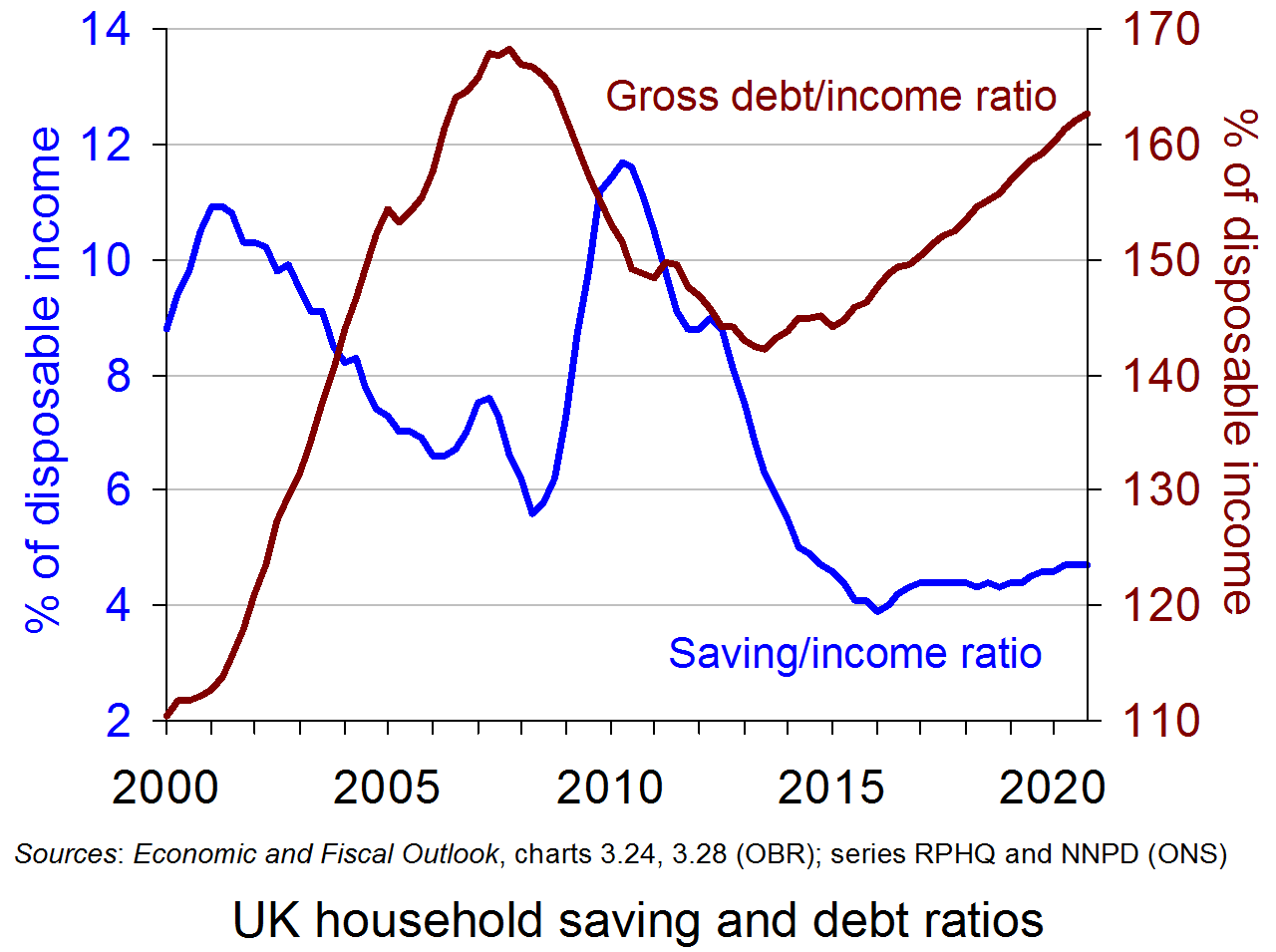 The chart shows that from 2008 to 2013, gross debt fell as a percentage of personal disposable income. Following the financial crisis, banks were more cautious about lending as they sought to increase their capital and liquidity ratios. And consumers were more cautious about borrowing as the uncertainty made many people keen to reduce their debts. This decline in credit reversed the massive growth in household debt from 2000 to 2008: one of the contributing factors to the financial crisis. (Click here for a PowerPoint of the chart.)
But since late 2013, household debt – both secured and unsecured – has been rising. In absolute (nominal) terms, individuals’ debt is now £1.43 trillion, slightly above the previous high in 2008. And as the chart shows, the OBR forecasts that it will continue rising. This makes consumers more vulnerable to adverse economic shocks, such as a downturn in emerging markets, another crisis in the eurozone or financial crises in other parts of the world.
 And as consumer debt has been rising, the personal saving ratio (the ratio of saving to personal disposable incomes) has been falling and is now lower than before the financial crisis.
The rise in consumer borrowing has been of some concern to the Bank of England. Andy Haldane, the Bank’s Chief Economist, appearing before the Treasury Select Committee, warned that consumer credit, and in particular personal loans, had been ‘picking up at a rate of knots. That ultimately might be an issue that the Financial Policy Committee might want to look at fairly carefully.’
Articles
The UK economy may be growing, but in a highly unbalanced way The Guardian, Phillip Inman (27/11/15)
UK growth hit by biggest drag from net trade on record The Telegraph, Szu Ping Chan (27/11/15)
Surge in consumer lending could prompt Bank of England intervention The Guardian, Patrick Collinson and Jill Treanor (30/11/15)
Consumer spending rise troubles Bank of England The Guardian, Heather Stewart (24/11/15)
Between Debt and the Devil by Adair Turner review – should the government start printing money? The Guardian, Tom Clark (25/11/15)
Lending rises as Bank of England ponders new curbs Financial Times, Ferdinando Giugliano (30/11/15)
Carney indicates BoE’s willingness to rein in credit Financial TImes, Chris Giles (5/11/15)
FCA sounds alarm at rising credit card debt Financial Times, Emma Dunkley (3/11/15)
Interest rates will stay low for longer – but household debt is a worry, says BoE The Telegraph, Szu Ping Chan (24/11/15)
Seven years after the crisis, Britain is still addicted to the drug of debt Independent, James Moore (1/12/15)
Vince Cable: Former Business Secretary warns that ‘severe economic storms’ are on the way Independent, Ben Chu (14/11/15)
The risks stalking the UK economy BBC News, Kamal Ahmed (1/12/15)
OBR publications
Economic and fiscal outlook Office for Budget Responsibility (25/11/15)
Economic and fiscal outlook charts and tables (Excel file) Office for Budget Responsibility (25/11/15)
Questions
- Does it matter if economic growth is driven by a rise in consumer demand, in turn driven by a risen in consumer credit?
- Is there an inflation risk from growth being driven by a rise in consumer credit?
- What is the precise relationship between the household saving ratio and the household debt ratio? (Which of these ratios is a stock and which is a flow?)
- What might cause a fall in consumer borrowing? Would this be a good thing?
- Why did consumer borrowing fall following the financial crisis of 2007–8?
- What could the Bank of England’s Financial Policy Committee do to curb consumer borrowing?
- If banks were forced to hold more reserves, how could aggregate demand be maintained? Would ‘helicopter money’ be a good idea?
- What are ‘countercyclical buffers for banks’? What are the arguments for raising them at the current time?
 The Paris Climate Change Conference (COP21) is under way. At the opening on November 30, 150 Heads of State gathered in Paris, most of whom addressed the conference. With representatives from 195 countries and observers from a range of organisations, the conference is set to last until 11 December. Optimism is relatively high that a legally binding and universal agreement will be reached, with the aim of keeping global warming below 2°C – what is generally regarded as a ‘safe’ limit.
But although it is hoped that a successor to the Kyoto Protocol of 1997 will be put in place, there are many problems in getting so many countries to agree. They may all wish to reduce global warming, but there is disagreement on how it should be achieved and how the burden should be shared between countries.
 There are several difficult economic issues in the negotiations. The first is the size and impact of the external costs of emissions. When a country burns fossil fuels, the benefits are almost entirely confined to residents of that county. However, the environmental costs are largely external to that country and only a relatively small fraction is borne by that country and hardly at all by the polluters themselves, unless there is a carbon tax or other form or penalty in place. The problem is that the atmosphere is a common resource and without collective action – national or international – it will be overused.
The second problem is one of distribution. Politicians may agree in principle that a solution is necessary which is equitable between nations, but there is considerable disagreement on what is meant by ‘equitable’ in this context. As the third Guardian article below puts it:
The most important hurdle could be over whether industrialised countries like the US, UK and Japan, which have contributed the most to the historical build-up of emissions, should be obliged to cut more than developing countries. India, on behalf of many poor countries, will argue that there must be “differentiation” between rich and poor; but the US wants targets that are applicable to all. A collision is inevitable.
A third problem is that of uncertainty. Although there is general agreement among scientists that human action is contributing to global warming, there is less agreement on the precise magnitude of the causal relationships. There is also uncertainty over the likely effects of specific emissions reductions. This uncertainty can then be used by governments which are unwilling to commit too much to emissions reductions.
 A fourth difficulty arises from the intertemporal distribution of costs and benefits of emissions reductions. The costs are born immediately action is taken. Carbon taxes or charges, or subsidies to renewables, or caps on emissions, all involve higher energy prices and/or higher taxes. The flows of benefits (or lower costs), however, of reduced emissions are not likely to be fully experienced for a very long time. But governments, whether democratic or dictatorships, tend to have a relatively short time horizon, governed by the electoral cycle or the likelihood of staying in power. True, governments may not be solely concerned with power and many politicians may have genuine desires to tackle climate change, but their political survival is still likely to be a major determinant of their actions.
Of course, if there is strong public opinion in favour of action to reduce emissions, governments are likely to respond to this. Indeed, all the expressions of public support for action ahead of the conference from all around the world, do give some hope for a strong agreement at the Paris conference. Nevertheless, there is still widespread scepticism in many countries over the relationship between human action and climate change, and many argue that the costs of policies to tackle climate change exceed the benefits.
Game theory can shed some insights into the difficulties ahead for the negotiators. The global optimum may be for a strong agreement, binding on all countries. The Nash equilibrium, however, may be a situation where countries push for their own interests at the expense of others, with the final agreement being much more minimalistic.
There do, however, seem to be more reasons to be cheerful at this summit that at previous ones. But negotiations are likely to be hard and protracted over the coming days.
Videos and webcasts
 Paris Climate Conference: The Big Picture Wall Street Journal on YouTube, Jason Bellini (30/11/15)
Why is the Paris UN climate summit important? PwC, Leo Johnson (14/10/15)
Paris climate change summit 2015: ‘the near impossible task’ Channel 4 News on YouTube, Tom Clarke (30/11/15)
COP21: Rallies mark start of Paris climate summit BBC News, David Shukman (29/11/15)
With climate at ‘breaking point’, leaders urge breakthrough in Paris Reuters, Bruce Wallace and Alister Doyle (1/12/15)
COP21: Paris conference could be climate turning point, says Obama BBC News (30/11/15)
Leaders meet to reach new agreement on climate change BBC News, David Shukman (30/11/15)
Poll: Growing Doubts Over Climate Change Causes Sky News, Thomas Moore (30/11/15)
Paris climate protesters banned but 10,000 shoes remain The Guardian (29/11/15)
Articles
COP-21 climate deal in Paris spells end of the fossil era The Telegraph, Ambrose Evans-Pritchard (29/11/15)
Is there an economic case for tackling climate change? BBC News, Andrew Walker (28/11/15)
World Leaders in Paris Vow to Overcome Divisions on Climate Change Wall Street Journal, William Horobin and William Mauldin (30/11/15)
Experts discuss how to build a carbon-free energy industry The Guardian, Tim Smedley (25/11/15)
Africa could lead world on green energy, says IEA head The Guardian, Anna Leach (11/11/15)
Climate change talks: five reasons to be cheerful or fearful The Guardian, John Vidal (30/11/15)
The Paris climate change summit, explained in 4 charts The Washington Post, Philip Bump (30/11/15)
Why This Goal To Curb Climate Change ‘Is Not Ideal’ Huffington Post, Jacqueline Howard (30/11/15)
Paris climate change talks: What the different groups attending expect from these crucial meetings Independent, Tom Bawden (29/11/15)
UN Climate Change Conference: World Leaders Call For Price On CO2 Emissions Despite Uphill Battle At Paris Summit International Business Times, Maria Gallucci (30/11/15)
World Bank, six nations call for a price on carbon SBS (Australia) (1/12/15)
Uruguay makes dramatic shift to nearly 95% electricity from clean energy The Guardian, Jonathan Watts (3/12/15)
Questions
- Why is COP21 considered to be so significant?
- For what reasons is there hope for a binding agreement to limit global warming to 2°C?
- What would be the effect on global warming of the commitments made by more than 180 countries prior to the conference?
- What market failings contribute towards the problem of global warming?
- Why, if all countries want to achieve a binding agreement at the Paris conference, is it likely to be so difficult to achieve?
- Explain what is meant by a ‘Nash equilibrium’ and how the concept is relevant to international negotiations.
- Why is China investing heavily in solar power?
- Could Africa lead the world in green energy?
- Is a ‘cap and trade’ (tradable permits) system (a) an effective means of reducing emissions; (b) an efficient system?
- What is the best way of financing investment in renewable energy?
- How does the structure/order of the Paris conference differ from previous COPs? Is such a structure more likely to achieve substantial results?
 The demand for oil is growing and yet the price of oil, at around $46 per barrel over the past few weeks, remains at less than half that of the period from 2011 to mid 2014. The reason is that supply has been much larger than demand. The result has been a large production surplus and a growth in oil stocks. Supply did fall somewhat in October, which reduced the surplus in 2015 Q3 below than of the record level in Q2 – but the surplus was still the second highest on record.
What is more, the modest growth in demand is forecast to slow in 2016. Supply, however, is expected to decrease through the first three quarters of 2016, before rising again at the end of 2016. The result will be a modest rise in price into 2016, to around $56 per barrel, compared with an average of just over $54 per barrel so far for 2015 (click here for a PowerPoint of the chart below).
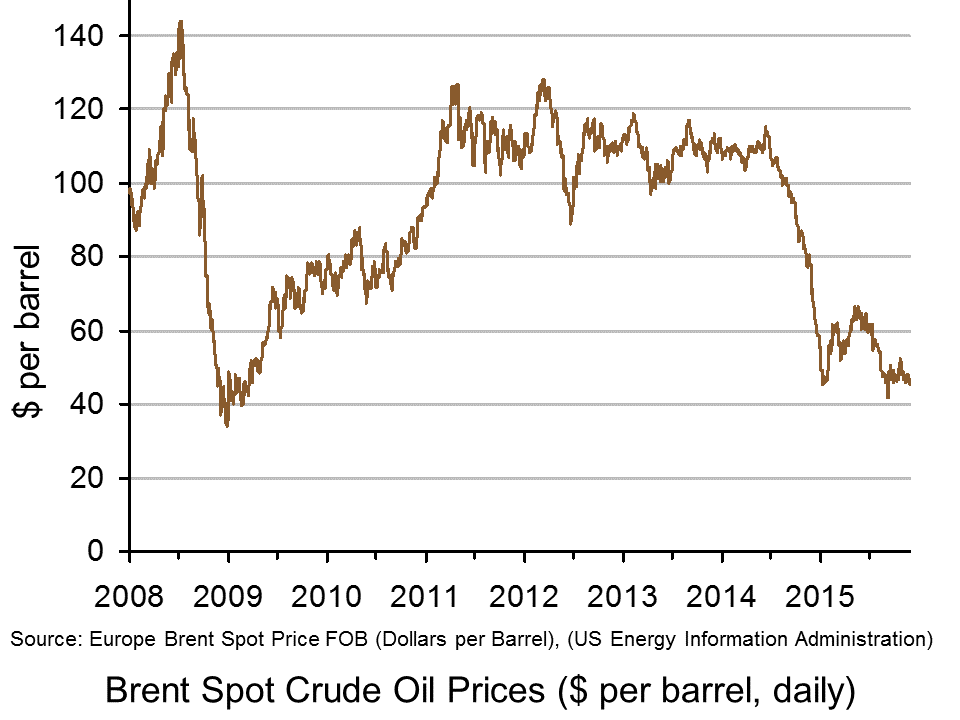 But why does supply remain so high, given such low prices? As we saw in the post The oil industry and low oil prices, it is partly the result of increases in supply from large-scale investment in new sources of oil over the past few years, such as the fracking of shale deposits, and partly the increased output by OPEC designed to keep prices low and make new investment in shale oil unprofitable.
So why then doesn’t supply drop off rapidly? As we saw in the post, A crude indicator of the economy (Part 2), even though shale oil producers in the USA need a price of around $70 or more to make investment in new sources profitable, the marginal cost of extracting oil from existing sources is only around $10 to £20 per barrel. 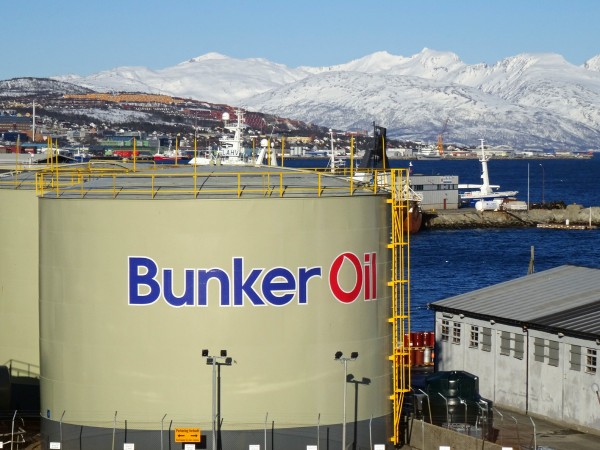 This means that shale oil production will continue until the end of the life of the wells. Given that wells typically have a life of at least three years, it could take some time for the low prices to have a significant effect on supply. According to the US Energy Information Administration’s forecasts, US crude oil production will drop next year by only just over 5%, from an average of 9.3 million barrels per day in 2015 to 8.8 million barrels per day in 2016.
In the meantime, we can expect low oil prices to continue for some time. Whilst this is bad news for oil exporters, it is good news for oil importing countries, as the lower costs will help aid recovery.
Webcasts
IEA says oil glut could worsen through 2016 Euronews (13/11/15)
IEA Says Record 3 Billion-Barrel Oil Stocks May Deepen Rout BloombergBusiness, Grant Smith (13/11/15)
Articles
IEA Offers No Hope For An Oil-Price Recovery Forbes, Art Berman (13/11/15)
Oil glut to swamp demand until 2020 Financial Times, Anjli Raval (10/11/15)
Record oil glut stands at 3bn barrels BBC News (13/11/15)
Global oil glut highest in a decade as inventories soar The Telegraph, Mehreen Khan (12/11/15)
The Oil Glut Was Created In Q1 2015; Q3 OECD Inventory Movements Are Actually Quite Normal Seeking Alpha (13/11/15)
Record oil glut stands at 3 billion barrels Arab News (14/11/15)
OPEC Update 2015: No End To Oil Glut, Low Prices, As Members Prepare For Tense Meeting International Business Times, Jess McHugh (12/11/15)
Surviving The Oil Glut Investing.com, Phil Flynn (11/11/15)
Reports and data
Oil Market Report International Energy Agency (IEA) (13/11/15)
Short-term Energy Outlook US Energy Information Administration (EIA) (10/11/15)
Brent Crude Prices US Energy Information Administration (EIA)
Questions
- Using demand and supply diagrams, demonstrate (a) what has been happening to oil prices in 2015 and (b) what is likely to happen to them in 2016.
- How are the price elasticities of demand and supply relevant in explaining the magnitude of oil price movements?
- What are oil prices likely to be in five years’ time?
- Using aggregate demand and supply analysis, demonstrate the effect of lower oil prices on a national economy.
- Why might the downward effect on inflation from lower oil prices act as a stimulus to the economy? Is this consistent with deflation being seen as requiring a stimulus from central banks, such as lower interest rates or quantitative easing?
- Do you agree with the statement that “Saudi Arabia is acting directly against the interests of half the cartel and is running OPEC over a cliff”?
- If the oil price is around $70 per barrel in a couple of years’ time, would it be worth oil companies investing in shale oil wells at that point? Explain why or why not.
- Distinguish between short-run and long-run shut down points. Why is the short-run shut down price likely to be lower than the long-run one?
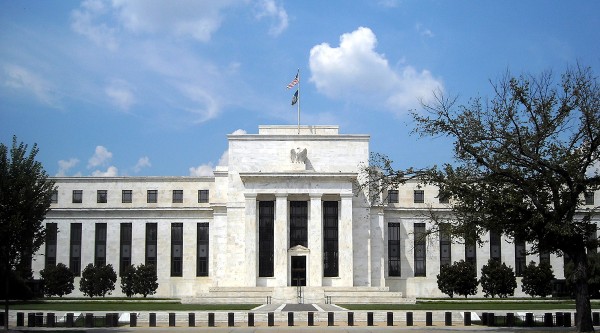 It is now some seven years since the financial crisis and nearly seven years since interest rates in the USA, the eurozone, the UK and elsewhere have been close to zero. But have these record low interest rates and the bouts of quantitative easing that have accompanied them resulted in higher or lower investment than would otherwise have been the case? There has been a big argument about that recently.
According to conventional economic theory, investment is inversely related to the rate of interest: the lower the rate of interest, the higher the level of investment. In other words, the demand-for-investment curve is downward sloping with respect to the rate of interest. It is true that in recent years investment has been low, but that, according to traditional theory, is the result of a leftward shift in demand thanks to low confidence, not to quantitative easing and low interest rates.
In a recent article, however, Michael Spence (of New York University and a 2001 Nobel Laureate) and Kevin Warsh (of Stanford University and a former Fed governor) challenge this conventional wisdom.  According to them, QE and the accompanying low interest rates led to a rise in asset prices, including shares and property, rather than to investment in the real economy. The reasons, they argue, are that investors have seen good short-term returns on financial assets but much greater uncertainty over investment in physical capital. Returns to investment in physical capital tend to be much longer term; and in the post-financial crisis era, the long term is much less certain, especially if the Fed and other central banks start to raise interest rates again.
“We believe that QE has redirected capital from the real domestic economy to financial assets at home and abroad. In this environment, it is hard to criticize companies that choose ‘shareholder friendly’ share buybacks over investment in a new factory. But public policy shouldn’t bias investments to paper assets over investments in the real economy.”
This analysis has been challenged by several eminent economists, including Larry Summers, Harvard Economics professor and former Treasury Secretary. He criticises them for confusing correlation (low investment coinciding with low interest rates) with causation. As Summers states:
“This is a little like discovering a positive correlation between oncologists and cancer and asserting that this proves oncologists cause cancer. One would expect in a weak recovery that investment would be weak and monetary policy easy. Correlation does not prove causation. …If, as Spence and Warsh assert, QE has raised stock prices, this should tilt the balance toward real investment.”
 Not surprisingly Spence and Warsh have an answer to this criticism. They maintain that their critique is less of low interest rates but rather of the form that QE has taken, which has directed new money into the purchase of financial assets. This then has driven further asset purchases, much of it by companies, despite high price/earnings ratios (i.e. high share prices relative to dividends). As they say:
“Economic theory might have something to learn from recent empirical data, and from promising new thinking in behavioral economics.”
Study the arguments of both sides and try to assess their validity, both theoretically and in the light of evidence.
Articles
The Fed Has Hurt Business Investment The Wall Street Journal, Michael Spence and Kevin Warsh (26/10/15) [Note: if you can’t see the full article, try clearing cookies (Ctrl+Shift+Delete)]
I just read the ‘most confused’ critique of the Fed this yea Washington Past, Lawrence H. Summers (28/10/15)
A Little Humility, Please, Mr. Summers The Wall Street Journal, Michael Spence and Kevin Warsh (4/11/15) [Note: if you can’t see the full article, try clearing cookies (Ctrl+Shift+Delete)]
Do ultra-low interest rates really damage growth? The Economist (12/11/15)
It’s the Zero Bound Yield Curve, Stupid! Janus Capital, William H Gross (3/11/15)
Is QE Bad for Business Investment? No Way! RealTime Economic Issues Watch, Joseph E. Gagnon (28/10/15)
Department of “Huh!?!?”: QE Has Retarded Business Investment!? Washington Center for Equitable Growth, Brad DeLong (27/10/15)
LARRY SUMMERS: The Wall Street Journal published the ‘single most confused analysis’ of the Fed I’ve read this year Business Insider, Myles Udland (29/10/15)
The Fed’s Loose Money, Financial Markets and Business Investment SBE Council, Raymond J. Keating (29/10/15)
How the QE trillions missed their mark AFR Weekend, Maximilian Walsh (4/11/15)
Financial Markets In The Era Of Bubble Finance – Irreversibly Broken And Dysfunctional David Stockman’s Contra Corner, Doug Noland (8/11/15)
Questions
- Go through the arguments of Spence and Warsh and explain them.
- Explain what are meant by the ‘yield curve’ and ‘zero bound yield curve’.
- What criticisms of their arguments are made by Summers and others?
- Apart from the effects of QE, why else have long-term interest rates been low?
- In the light of the arguments on both sides, how effective do you feel that QE has been?
- How could QE have been made more effective?
- What is likely to happen to financial markets over the coming months? What effect is this likely to have on the real economy?
 First the IMF in its World Economic Outlook, then the European Commission in its Economic Forecasts (see also) and now the OECD in its Economic Outlook (see also) – all three organisations in the latest issues of their 6-monthly publications are predicting slower global economic growth than they did 6 months previously. This applies both to the current year and to 2016. The OECD’s forecast for global growth this year is now 2.9%, down from the 3.7% it was forecasting a year ago. Its latest growth forecast for 2016 is 3.3%, down from the 3.9% it was forecasting a year ago.
Various reasons are given for the gloomier outlook. These include: a dramatic slowdown in global trade growth; slowing economic growth in China and fears over structural weaknesses in China; falling commodity prices (linked to slowing demand but also as a result of increased supply); austerity policies as governments attempt to deal with the hangover of debt from the financial crisis of 2007/8; low investment leading to low rates of productivity growth despite technological progress; and general fears about low growth leading to low spending as people become more cautious about their future incomes.
 The slowdown in trade growth (forecast to be just 2% in 2015) is perhaps the most worrying for future global growth. As Angel Gurría, OECD Secretary-General, states in his remarks at the launch of the latest OECD Economic Outlook:
‘Global trade, which was already growing slowly over the past few years, appears to have stagnated and even declined since late 2014, with the weakness centering increasingly on emerging markets, particularly China. This is deeply concerning as robust trade and global growth go hand in hand. In 2015 global trade is expected to grow by a disappointing 2%. Over the past five decades there have been only five other years in which trade growth has been 2% or less, all of which coincided with a marked downturn of global growth.’
So what policies should governments pursue to stimulate economic growth? According to Angel Gurría:
‘Short-term demand needs to be supported and structural reforms to be pursued with greater ambition than is currently the case. Three specific actions are key:
|
|
| • |
First, we need to resist and turn back rising protectionism. Trade strengthens competition and investment and revs up the “diffusion machine” – the spread of new technologies throughout the economy – which will ultimately lift productivity. |
| • |
Second, we need to step up structural reform efforts, which have weakened in recent years. And here, I mean the whole range of structural reforms – education, innovation, competition, labour and product market regulation, R&D, taxes, etc. |
| • |
Third, there is scope to adjust public spending towards investment. If done collectively by all countries, if the sector and projects chosen have high multipliers, and if combined with serious structural reforms, stronger public investment can give a boost to growth and employment and not increase the relative debt burden.’ |
 On this third point, the OECD Economic Outlook argues that ‘the rationale for such investments is that they could help to push economies onto a higher growth path than might otherwise be the case, at a time when private investment growth remains modest.’
‘Collective action to increase public investment can be expected to boost the initial domestic multiplier effects from the stimulus, since private investment and exports in each economy will benefit from stronger demand in other economies. …the multiplier effects from an investment-led stimulus are likely to be a little larger than from other forms of fiscal stimulus, since the former also has small, but positive, supply-side effects.
In other words, the OECD is calling for a relaxation of austerity policies, with public investment being used to provide a stimulus to growth. The higher growth will then lead to increased potential output, as well as actual output, and an increase in tax revenues.
These policy recommendations are very much in line with those of the IMF.
Videos and Webcasts
OECD warns of global trade slowdown, trims growth outlook again Reuters (9/11/15)
OECD returns to revisionism with growth downgrade Euronews, Robert Hackwill (9/11/15)
OECD: Weak China Import Growth Leads Trade Slowdown Bloomberg, Catherine L Mann, OECD Chief Economist (9/11/15)
OECD Economic Outlook: Moving forward in difficult times OECD PowerPoint presentation, Catherine L Mann, OECD Chief Economist (9/11/15)
Press Conference OECD, Angel Gurría and Álvaro Pereira (9/11/15)
Articles
OECD cuts world growth forecast Financial Times, Ferdinando Giugliano (9/11/15)
OECD rings alarm bell over threat of global growth recession thanks to China slowdown Independent, Ben Chu (10/11/15)
OECD cuts global growth forecasts amid ‘deep concern’ over slowdown BBC News (9/11/15)
OECD fears slowdown in global trade amid China woes The Guardian, Katie Allen (9/11/15)
The global economy is slowing down. But is it recession – or protectionism? The Observer, Heather Stewart and Fergus Ryan (14/11/15)
Global growth is struggling, but it is not all bad news The Telegraph, Andrew Sentance (13/11/15)
OECD Publications
Economic Outlook Annex Tables OCED (9/11/15)
Press Release: Emerging market slowdown and drop in trade clouding global outlook OCED (9/11/15)
Data handout for press OECD (9/11/15)
OECD Economic Outlook, Chapter 3: Lifting Investment for Higher Sustainable Growth OCED (9/11/15)
OECD Economic Outlook: Full Report OECD (9/11/15)
Questions
- Is a slowdown in international trade a cause of slower economic growth or simply an indicator of slower economic growth? Examine the causal connections between trade and growth.
- How worried should we be about disappointing growth in the global economy?
- What determines the size of the multiplier effects of an increase in public investment?
- Why are the multiplier effects of an increase in public-sector investment likely to be larger in the USA and Japan than in the UK, the eurozone and Canada?
- How can monetary policy be supportive of fiscal policy to stimulate economic growth?
- Under what circumstances would public-sector investment (a) stimulate and (b) crowd out private-sector investment?
- How would a Keynesian economist respond to the recommendations of the OECD?
- How would a neoclassical/neoliberal economist respond to the recommendations?
- Are the OECD’s recommendations in line with the Japanese government’s ‘three arrows‘?
- What structural reforms are recommended by the OECD? Are these ‘market orientated’ or ‘interventionist’ reforms, or both? Explain.
 George Osborne in his recent Autumn Statement, once again stressed that ‘the government is committed to strong, sustainable and balanced growth’. But while he plans to reduce government debt as a percentage of GDP, consumer debt is rising, both absolutely and as a percentage of household disposable income. The rise in household borrowing, and the resulting rise in consumer expenditure, has been the main factor driving economic growth. It has not been exports nor, until recently, investment, as the Chancellor had hoped. Indeed, investment in new housing is falling.