 One type of market failing is the asymmetric information between producers and consumers. Advertising, branding and marketing can either help to reduce consumers’ limited information or play on ignorance to mislead consumers.
Misleading consumers is what the pharmaceutical company Reckitt Benckiser is accused of doing with its Nurofen brand of painkillers. There are very few types of painkiller – the most common three being paracetamol, ibuprofen and aspirin. These are sold cheaply in chemists as unbranded ‘generic products’. Or you can buy much more expensive branded versions of the same drugs. Many people believe that the branded versions are more effective as they are cleverly marketed.
Reckitt Benckiser has been found guilty by the Australian federal court of deceiving consumers. The company produces various varieties of Nurofen, each claiming to target a particular type of pain. But Nurofen Back Pain, Nurofen Period Pain, Nurofen Migraine Pain and Nurofen Tension Headache are in fact identical! And in many outlets, they were sold at different prices – a form of price discrimination reflecting the strength of demand by consumers for a particular type of pain relief.
 And now the UK Advertising Standards Authority is investigating the company over whether its adverts for Nurofen Express are misleading by stating that the product ‘gives you faster headache relief than standard paracetamol or ibuprofen’. Also it is investigating the company’s claim that its products directly target muscles in the head. Both Nurofen Migraine Pain and Nurofen Tension Headache claim on the front of the box to provide ‘targeted rapid relief’.
The company adopts similar practices in its combined pain-killer and decongestant drugs for relieving cold symptoms. For example, its Nurofen Cold and Flu Relief, Nurofen Day and Night Cold and Flu, Nurofen Sinus and Blocked Nose and Nurofen Sinus Pain Relief all contain the same quantities of ibuprofen and the decongestant phenylephrine hydrochloride, but each claims to do something different.
So there are various issues here. The first is whether excessive profits are made by charging a price typically 3 to 4 times greater than the identical generic version of the drug; the second is whether the company deliberately misleads consumers by claiming that a particular version of the drug targets a particular type of pain; the third is whether ‘faster acting’ versions are significantly different; the fourth is whether price discrimination is being practised.
Articles
Nurofen maker Reckitt Benckiser suffers advertising headaches Financial Times, Robert Cookson and Scheherazade Daneshkhu (15/12/15)
Nurofen Express advertising claims probed by UK watchdog BBC News (15/12/15)
ASA probing ‘misleading’ painkiller claims in advert by drug firm behind Nurofen The Telegraph, Tom Morgan and agency (15/12/15)
The great painkiller con: Top drug brands accused of huge mark-ups and misleading claims Mail Online, Sean Poulter and John Naish (16/12/15)
Nurofen Under Investigation By UK Watchdog Over Claims Advert ‘Misled’ Customers Huffington Post, Natasha Hinde (15/12/15)
Australian Competition & Consumer Comission media release
Court finds Nurofen made misleading Specific Pain claims ACCC (14/12/15)
Questions
- Is price discrimination always against the consumer’s interests?
- What form of price discrimination is being practised in the case of Nurofen?
- How, do you think, does Reckitt Benckiser decide the prices it charges retailers for its pain killers and how, do you think, do retailers determine the price they charge consumers for them?
- Is it a reasonable assumption that branded products in most cases are better than own-brand or generic versions? How is behavioural theory relevant here?
- If Reckitt Benckiser were banned from using the word ‘targets’ when referring to one of its product’s effect on particular type of pain, could the company instead use the words ‘suitable for’ relieving a particular type of pain and thereby avoid misleading consumers?
- What is the best way of improving consumer knowledge about particular types of over-the-counter drugs and their effects on the body?
- Comment on the following statement by Dr Aomesh Bhatt, the company’s medical affairs director: ‘The Nurofen specific-pain range was launched with an intention to help consumers navigate their pain relief options, particularly within the grocery environment where there is no healthcare professional to assist decision making.’
 After two weeks of negotiations between the 195 countries attending the COP21 climate change conference in Paris, a deal has been reached on tackling climate change. Although the deal still has to be ratified by countries, this is a major step forward in limiting global warming. Before it can formally come into force, it must have been ratified by at least 55 countries, accounting for at least 55% of global greenhouse gas emissions.
The deal goes much further than previous agreements and includes the following:
- A limit on the increase in global temperatures to ‘well below’ 2°C above pre-industrial levels and efforts pursued to limit it to 1.5°C.
- A recognition that the pledges already made ahead of the conference by 186 countries and incorporated into the agreement are insufficient and will only limit global temperature rise to 2.7°C at best.
- Countries to update their emissions reductions commitments every five years – the first being in 2020. Such revised commitments should then be legally binding.
- A global ‘stocktake’ in 2023, and every five years thereafter, to monitor countries’ progress in meeting their commitments and to encourage them to make deeper cuts in emissions to reach the 1.5°C goal. This requires a process of measurement and verification of countries’ emissions.
- To reach a peak in greenhouse gas emissions as soon as possible and then to begin reducing them and to achieve a balance between sources and sinks of greenhouse gases (i.e. zero net emissions) in the second half of this century.
- Developed countries to provide the poorest developing countries with $100bn per year by 2020 to help them reduce emissions. This was agreed in Copenhagen, but will now be continued from 2020 to 2025, and by 2025 a new goal above $100bn per year will be agreed.
- The development of market mechanisms that would award tradable credits for green projects and emissions reductions.
- A recognition that the ‘loss and damage’ associated with climate-related disasters can be serious for many vulnerable developing countries (such as low-lying island states) and that this may require compensation. However, there is no legal liability on developed countries to provide such compensation.
Perhaps the major achievement at the conference was a universal recognition that the problem of global warming is serious and that action needs to be taken. Mutual self interest was the driving force in reaching the agreement, and although it is less binding on countries than many would have liked, it does mark a significant step forward in tackling climate change.
But why did the conference not go further? Why, if there was general agreement that global warming should be tackled and that global temperature rise should ideally be capped at 1.5°C, was there not a binding agreement on each country to apply this cap?
There are two reasons.
First, it is very difficult to predict the exact relationship, including its timing, between emissions and global temperature rise. Even if you could make limits to emissions binding, you could not make global temperature rise binding.
 Second, even if there is general agreement about how much emissions should be reduced, there is no general agreement on the distribution of these reductions. Many countries want to do less themselves and others to do more. More specifically, poor countries want rich countries to do all the cutting while many continue to build more coal-fired power stations to provide the electricity to power economic development. The rich countries want the developing countries, especially the larger ones, such as China, India and Brazil to reduce their emissions, or at least the growth in their emissions.
Then there is the difference between what countries vaguely pledge at a global conference and what they actually do domestically. Many developed countries are keen to take advantage of currently cheap fossil fuels to power economic growth. They are also still investing in alternative sources of fossil fuels, such as through fracking.
 As we said in the previous blog, game theory can shed some useful insights into the nature and outcome of climate negotiations. ‘The global optimum may be for a strong agreement, binding on all countries. The Nash equilibrium, however, may be a situation where countries push for their own interests at the expense of others, with the final agreement being much more minimalistic.’
‘Minimalistic’ may be too strong a description of the outcomes of the Paris conference. But they could have been stronger. Nevertheless, judged by the outcomes of previous climate conferences, the deal could still be described as ‘historic’.
Videos
 With landmark climate accord, world marks turn from fossil fuels Reuters (13/12/15)
COP21 climate change summit reaches deal in Paris BBC News (13/12/15)
COP21: Paris climate deal is ‘best chance to save planet’ BBC News (13/12/15)
COP21: Climate change deal’s winners and losers BBC News, Matt McGrath (13/12/15)
The Five Key Decisions Made in the UN Climate Deal in Paris Bloomberg, video: Nathaniel Bullard; article: Ewa Krukowska and Alex Morales (12/12/15)
The key factors in getting a deal in Paris BBC News on YouTube, Tom Burke (13/12/15)
Articles
COP21 agreement: All you need to know about Paris climate change deal Hindustan Times, Chetan Chauhan (13/12/15)
COP21: Paris agreement formally adopted Financial Times, Pilita Clark and Michael Stothard (12/12/15)
Let’s hail the Paris climate change agreement and get to work Financial Times, Jeffrey Sachs (12/12/15)
COP21: Public-private collaboration key to climate targets Financial Times, Nicholas Stern (13/12/15)
Paris climate change agreement: the deal at a glance The Telegraph, Emily Gosden (12/12/15)
Climate Accord Is a Healing Step, if Not a Cure New York Times, Justin Gillis (12/12/15)
Paris Agreement Ushers in End of the Fossil Fuel Era Slate, Eric Holthaus (12/12/15)
Paris Agreement: the reaction Business Green, James Murray and Jessica Shankleman (12/12/15)
World’s First Global Deal to Combat Climate Change Adopted in Paris Scientific American, David Biello (12/12/15)
COP21: Paris climate deal ‘our best chance to save the planet’, says Obama Independent, Tom Bawden (13/12/15)
Grand promises of Paris climate deal undermined by squalid retrenchments The Guardian, George Monbiot (12/12/15)
Paris Agreement on climate change: the good, the bad, and the ugly The Conversation, Henrik Selin and Adil Najam (14/12/15)
COP21: James Hansen, the father of climate change awareness, claims Paris agreement is a ‘fraud’ Independent, Caroline Mortimer (14/12/15)
Paris climate agreement: More hot air won’t save us from oblivion Sydney Morning Herald, Peter Hartcher (15/12/15)
Draft Agreement
Adoption of the Paris Agreement United Nations Framework Convention on Climate Change (12/12/15)
Questions
- Could the market ever lead to a reduction in greenhouse gas emissions? Explain.
- What are the main strengths and weaknesses of the Paris agreement?
- Is it in rich countries’ interests to help poorer countries to achieve reductions in greenhouse gas emissions?
- How might countries reduce the production of fossil fuels? Are they likely to want to do this? Explain.
- Is a ‘cap and trade’ (tradable permits) system (a) an effective means of reducing emissions; (b) an efficient system?
- What is the best way of financing investment in renewable energy?
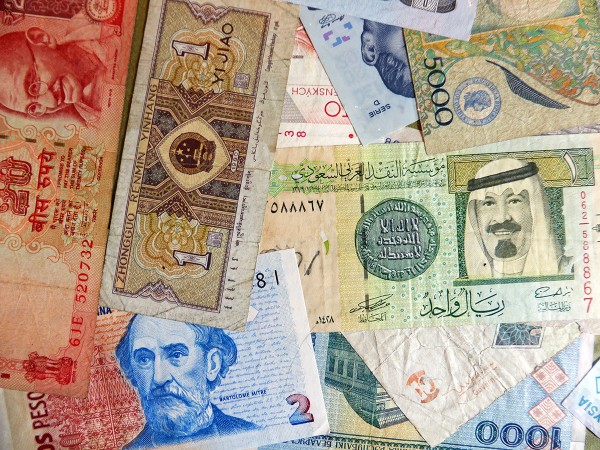 As we saw in the blog post Down down deeper and down, or a new Status Quo?, for many countries there is now a negative rate of interest on bank deposits in the central bank. In other words, banks are being charged to keep liquidity in central banks. Indeed, in some countries the central bank even provides liquidity to banks at negative rates. In other words, banks are paid to borrow!
But, by definition, holding cash (in a safe or under the mattress) pays a zero interest rate. So why would people save in a bank at negative interest rates if they could get a zero rate simply by holding cash? And why would banks not borrow money from the central bank, if borrowing rates are negative, hold it as cash and earn the interest from the central bank?
 These questions are addressed in the article below from The Economist. It argues that to swap reserves for cash is costly to banks and that this cost is likely to exceed the interest they have to pay. In other words, there is not a zero bound to central bank interest rates, either for deposits or for the provision of liquidity; and this reflects rational behaviour.
But does the same apply to individuals? Would it not be rational for banks to charge customers to deposit money (a negative interest rate)? Indeed, there is already a form of negative interest rate on many current accounts; i.e. the monthly or annual charge to keep the account open. But would it also make sense for banks to offer negative interest rates on loans? In other words, would it ever make sense for banks to pay people to borrow?
Read the folowing article and then try answering the questions.
Article
Bankers v mattresses The Economist (28/11.15)
Central bank repo rates/base rates
Central banks – summary of current interest rates global-rates.com
Worldwide Central Bank Rates CentralBankRates
Questions
- What is a central bank’s ‘repo rate’. Is it the same as (a) its overnight lending rate; (b) its discount rate?
- Why are the Swedish and Swiss central banks charging negative interest rates when lending money to banks?
- What effect are such negative rates likely to have on (a) banks’ cash holdings; (b) banks’ lending to customers?
- Why are many central banks (including the ECB) charging banks to deposit money with them? Why do banks continue to make such deposits when interest rates are negative?
- Would banks ever lend to customers at negative rates of interest? Explain why or why not.
- Would banks ever offer negative rates of interest on savings accounts? Explain why or why not.
- How do expectations about exchange rate movements affect banks willingness to hold deposits with the central bank?
- What are the arguments for and against abolishing cash altogether?
 Are emerging markets about to experience a credit crunch? Slowing growth in China and other emerging market economies (EMEs) does not bode well. Nor does the prospect of rising interest rates in the USA and the resulting increase in the costs of servicing the high levels of dollar-denominated debt in many such countries.
According to the Bank for International Settlements (BIS) (see also), the stock of dollar-denominated debt in emerging market economies has doubled since 2009 and this makes them vulnerable to tighter US monetary policy.
Weaker financial market conditions combined with an increased sensitivity to US rates may heighten the risk of negative spillovers to EMEs when US policy is normalised. …
Despite low interest rates, rising debt levels have pushed debt service ratios for households and firms above their long-run averages, particularly since 2013, signalling increased risks of financial crises in EMEs.
But there is another perspective. Many emerging economies are pursuing looser monetary policy and this, combined with tighter US monetary policy, is causing their exchange rates against the dollar to depreciate, thereby increasing their export competitiveness. At the same time, more rapid growth in the USA and some EU countries, should also help to stimulate demand for their exports.
Also, in recent years there has been a large growth in trade between emerging economies – so-called ‘South–South trade’. Exports from developing countries to other developing countries has grown from 38% of developing countries’ exports in 1995 to over 52% in 2015. With technological catch-up taking place in many of these economies and with lower labour and land costs, their prospects look bright for economic growth over the longer term.
These two different perspectives are taken in the following two articles from the Telegraph. The first looks at the BIS’s analysis of growing debt and the possibility of a credit crunch. The second, while acknowledging the current weakness of many emerging economies, looks at the prospects for improving growth over the coming years.
Articles
‘Uneasy’ market calm masks debt timebomb, BIS warns The Telegraph, Szu Ping Chan (6/12/15)
Why emerging markets will rise from gloom to boom The Telegraph, Liam Halligan (5/12/15)
Questions
- How does an improving US economy impact on emerging market economies?
- Will the impact of US monetary policy on exchange rates be adverse or advantageous for emerging market economies?
- What forms does dollar-denominated debt take in emerging economies?
- Why has south–south trade grown in recent years? Is it consistent with the law of comparative advantage?
- Why is growth likely to be higher in emerging economies than in developed economies in the coming years?
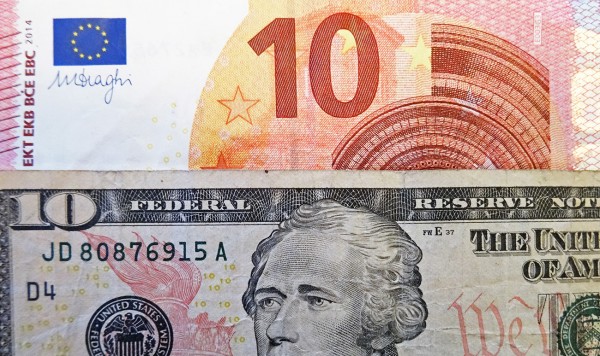 The Federal Reserve chair, Janet Yellen, has been giving strong signals recently that the US central bank will probably raise interest rates at its December 16 meeting or, if not then, early in 2016. ‘Ongoing gains in the labor market’ she said, ‘coupled with my judgement that longer-term inflation expectations remain reasonably well anchored, serve to bolster my confidence in a return of inflation to 2%.’ This, as for many other central banks, is the target rate of inflation.
In anticipation of a rise in US interest rates, the dollar has been appreciating. Its (nominal) exchange rate index has risen by 24% since April 2014 (see chart below).
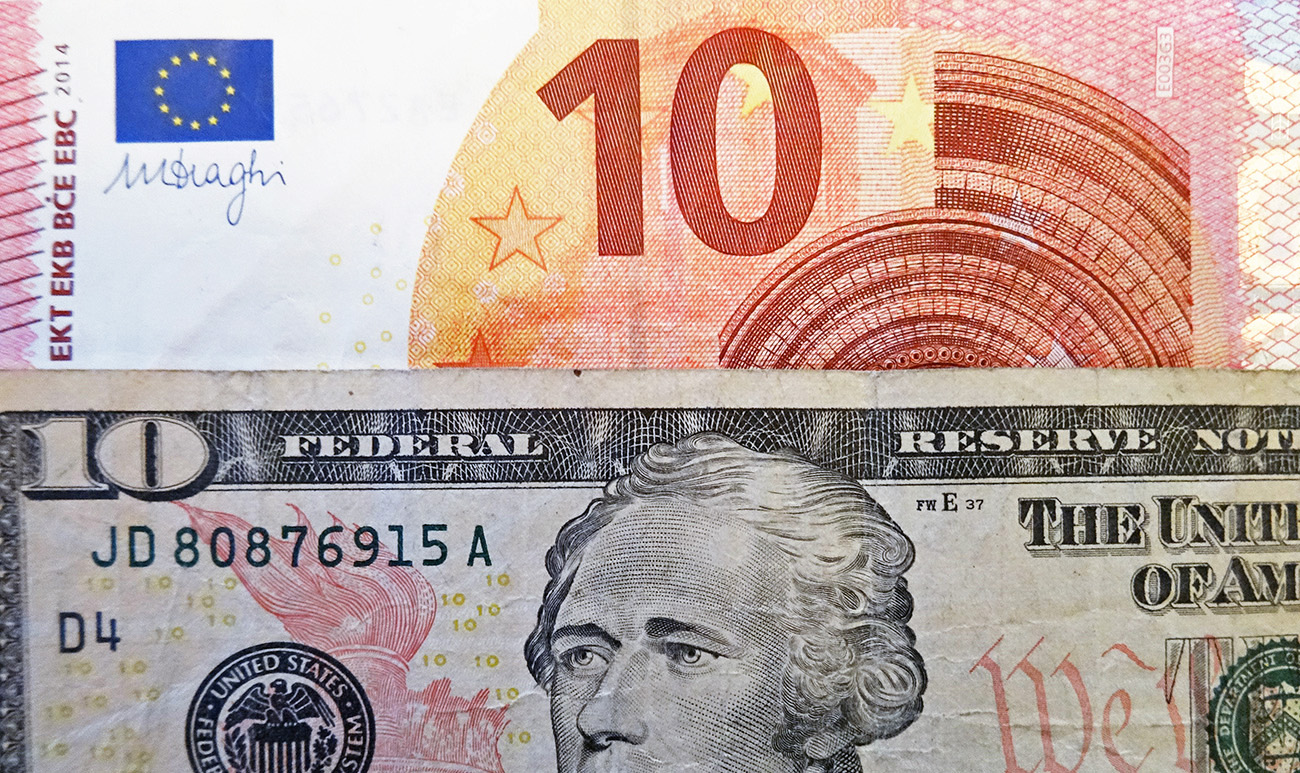
In the light of the sluggish eurozone economy, the ECB president, Mario Draghi, has been taking a very different stance. He has indicated that he stands ready to cut interest rates further and increase quantitative easing.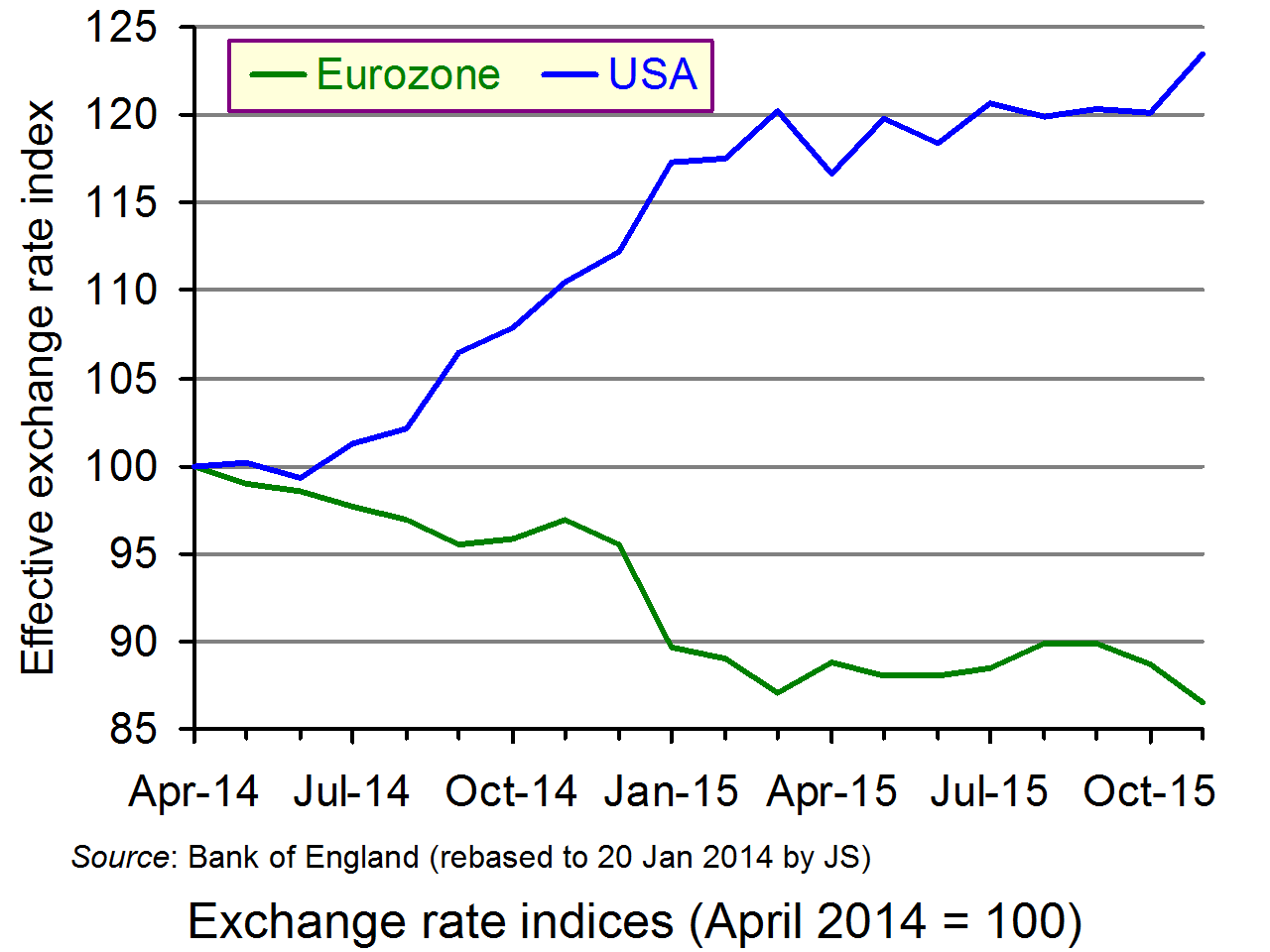 At the meeting on 3 December, the ECB did just that. It announced a further cut in the deposit rate, from –0.2 to –0.3 and an extension of the €60 billion per month QE programme from September 2016 to March 2017 (bringing the total by that time to €1.5 trillion – up from €1.1 trillion by September 2016).
Stock market investors had been expecting more, including an increase in the level of monthly asset purchases above €60 billion. Consequently stock markets fell. Both the German DAX and the French CAC 40 stock market indices fell by 3.6%. The euro also appreciated against the dollar by 2.7% on the day of the announcement. Nevertheless, since April 2014, the euro exchange rate index has fallen by 13%. Against the US dollar, the euro has depreciated by a massive 31%.
So what will be the consequences of the very different monetary policies being pursued by the Fed and the ECB? Are they simply the desirable responses to a lack of convergence of the economic performance of the US and eurozone economies? In other words, will they help to bring greater convergence between the two economies?
Or will the desirable effects of convergence be offset by other undesirable effects for the USA and the eurozone and also for the rest of the world?
|
|
| • |
Will huge amounts of dollar-denominated debt held by many emerging economies make it harder to service these debts with an appreciating dollar? |
| • |
How much will US exporters suffer from the dollar’s rise and what will the US authorities do about it? |
| • |
Will currency volatility lead to currency wars and, if so, what will be their economic effects? |
| • |
Will the time lags involved in the effects of the continuing programme of QE in the eurozone eventually lead to overheating? Already euro money supply is rising, on both narrow and broad measures. |
The following articles address these issues.
Articles
The Fed and the ECB: when monetary policy diverges The Guardian, Mohamed El-Erian (2/12/15)
European stocks slide after ECB dashes hopes of major QE expansion The Guardian, Heather Stewart and Graeme Wearden (3/12/15)
Mario Draghi riles Germany with QE overkill The Telegraph, Ambrose Evans-Pritchard (3/12/15)
How the eurozone missed its shot at a recovery The Telegraph, Peter Spence (3/12/15)
Yellen Signals Economy Nearly Ready for First Interest-Rate Hike Bloomberg, Christopher Condon (3/12/15)
Exchange rate data
Effective exchange rate indices Bank for International Settlements
Exchange rates Bank of England
Questions
- What would be the beneficial effects to the US and eurozone economies of their respective monetary policies?
- Explain the exchange rate movements that have taken place between the euro and the dollar over the past 19 months. How do these relate to the various parts of the balance of payments accounts of the two economies?
- Is it possible for the USA to halt the rise in the dollar while at the same time raising interest rates? Explain.
- Why are some members of the ECB (e.g. the German and Dutch) against expanding QE? Assess their arguments.
- What will be the impact of US and eurozone monetary policies on emerging economies?
- What will be the impact of US and eurozone monetary policies on the UK?
- Why did the euro appreciate after the Mario Draghi’s press statement on 3 December? What has happened to the dollar/euro exchange rate since and why?
 And now the UK Advertising Standards Authority is investigating the company over whether its adverts for Nurofen Express are misleading by stating that the product ‘gives you faster headache relief than standard paracetamol or ibuprofen’. Also it is investigating the company’s claim that its products directly target muscles in the head. Both Nurofen Migraine Pain and Nurofen Tension Headache claim on the front of the box to provide ‘targeted rapid relief’.