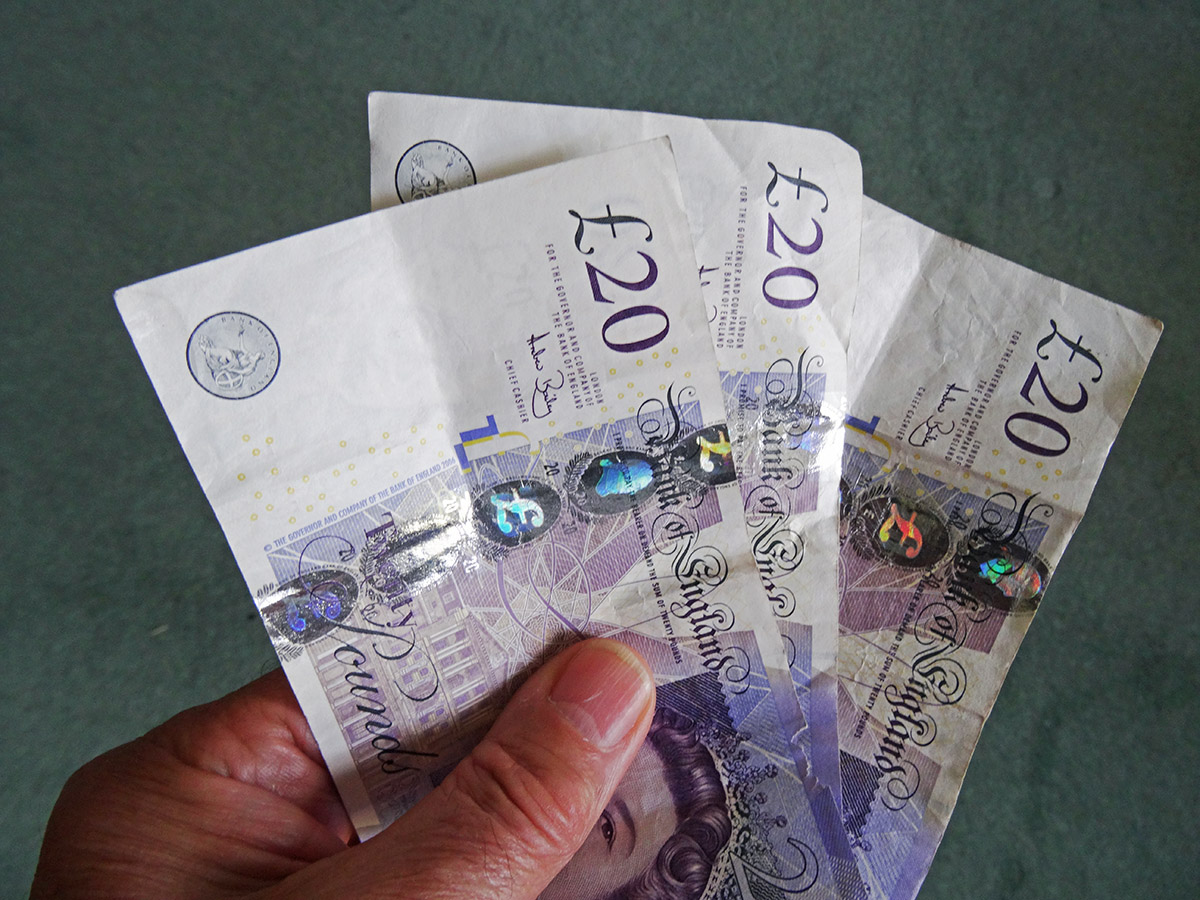
 What will production look like in 20 years time? Will familiar jobs in both manufacturing and the services be taken over by robots? And if so, which ones? What will be the effect on wages and on unemployment? Will most people be better off, or will just a few gain while others get by with minimum-wage jobs or no jobs at all?
The BBC has been running a series looking at new uses for robots and whether they will take people’s jobs? This complements three reports: one by Boston Consulting one by Deloitte and an earlier one by Deloitte and Michael Osborne and Carl Frey from Oxford University’s Martin School. As Jane Wakefield, the BBC’s technology reporter states:
Boston Consulting Group predicts that by 2025, up to a quarter of jobs will be replaced by either smart software or robots, while a study from Oxford University has suggested that 35% of existing UK jobs are at risk of automation in the next 20 years.
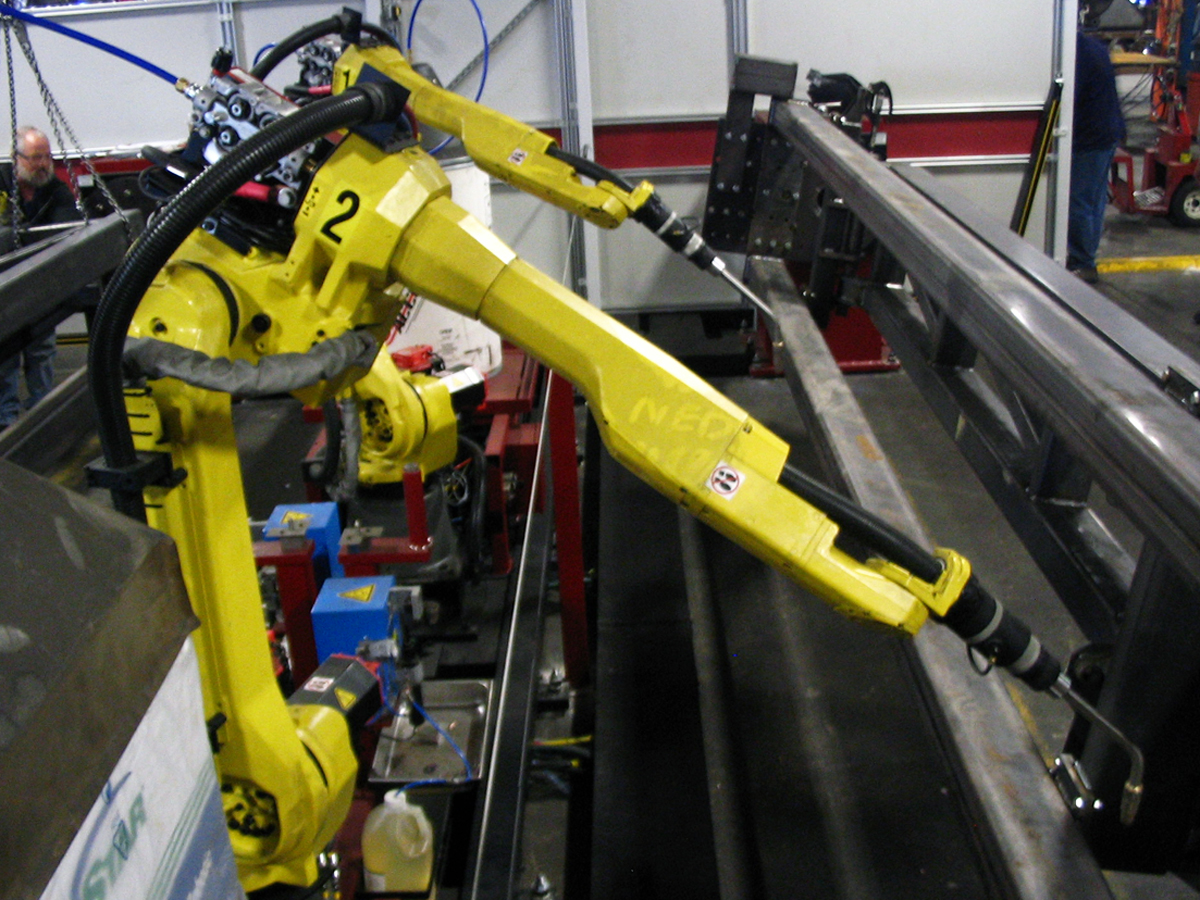
Jobs at threat from machines include factory work, office work, work in the leisure sector, work in medicine, law, education and other professions, train drivers and even taxi and lorry drivers. At present, in many of these jobs machines work alongside humans. For example, robots on production lines are common, and robots help doctors perform surgery and provide other back-up services in medicine.
A robot may not yet have a good bedside manner but it is pretty good at wading through huge reams of data to find possible treatments for diseases.
Even if robots don’t take over all jobs in these fields, they are likely to replace an increasing proportion of many of these jobs, leaving humans to concentrate on the areas that require judgement, creativity, human empathy and finesse.
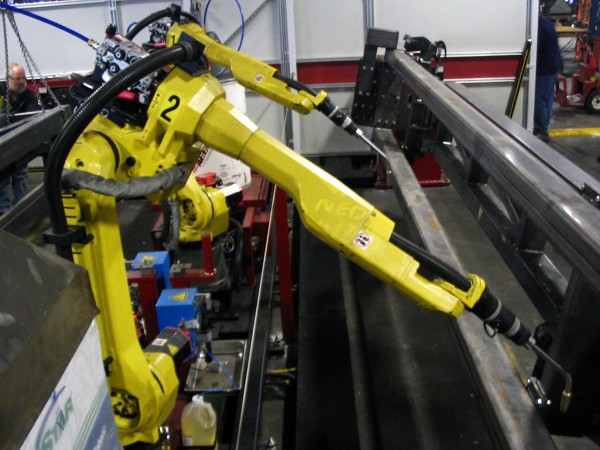 These developments raise a number of questions. If robots have a higher marginal revenue product/marginal cost ratio than humans, will employers choose to replace humans by robots, wholly or in part? How are investment costs factored into the decision? And what about industrial relations? Will employers risk disputes with employees? Will they simply be concerned with maximising profit or will they take wider social concerns into account?
Then there is the question of what new jobs would be created for those who lose their jobs to machines. According to the earlier Deloitte study, which focused on London, over 80% of companies in London say that over the next 10 years they will be most likely to take on people with skills in ‘digital know-how’, ‘management’ and ‘creativity’.
 But even if new jobs are created through the extra spending power generated by the extra production – and this has been the pattern since the start of the industrial revolution some 250 years ago – will these new jobs be open largely to those with high levels of transferable skills? Will the result be an ever widening of the income gap between rich and poor? Or will there be plenty of new jobs throughout the economy in a wide variety of areas where humans are valued for the special qualities they bring? As the authors of the later Deloitte paper state:
The dominant trend is of contracting employment in agriculture and manufacturing being more than offset by rapid growth in the caring, creative, technology and business services sectors.
The issues of job replacement and job creation, and of the effects on income distribution and the balance between work and leisure, are considered in the following videos and articles, and in the three reports.
Videos
 What is artificial intelligence? BBC News, Valery Eremenko (13/9/15)
What jobs will robots take over? BBC News, David Botti (15/8/14)
Could a robot do your job? BBC News, Rory Cellan-Jones (14/9/15)
Intelligent machines: The robots that work alongside humans BBC News, Rory Cellan-Jones (14/9/15)
Intelligent machines: Will you be replaced by a robot? BBC News, John Maguire (14/9/15)
Will our emotions change the way adverts work? BBC News, Dan Simmons (24/7/15)
Could A Robot Do My Job? BBC Panorama, Rohan Silva (14/9/15)
Articles
Technology has created more jobs in the last 144 years than it has destroyed, Deloitte study finds Independent, Doug Bolton (18/8/15)
Technology has created more jobs than it has destroyed, says 140 years of data The Guardian, Katie Allen (18/8/15)
Will a robot take your job? BBC News (11/9/15)
Intelligent Machines: The jobs robots will steal first BBC News, Jane Wakefield (14/9/15)
Robots Could Take 35 Per Cent Of UK Jobs In The Next 20 Years Says New Study Huffington Post, Thomas Tamblyn (14/9/15)
The new white-collar fear: will robots take your job? The Telegraph, Rohan Silva (12/9/15)
Does technology destroy jobs? Data from 140 years says no Catch news, Sourjya Bhowmick (11/9/15)
Reports
Takeoff in Robotics Will Power the Next Productivity Surge in Manufacturing Boston Consulting Group (10/2/15)
Agiletown: the relentless march of technology and London’s response Deloitte (November 2014)
Technology and people: The great job-creating machine Deloitte, Ian Stewart, Debapratim De and Alex Cole (August 2015)
Questions
- Which are the fastest growing and fastest declining occupations? To what extent can these changes be explained by changes in technology?
- What type of unemployment is caused by rapid technological change?
- Why, if automation replaces jobs, have jobs increased over the past 250 years?
- In what occupations is artificial intelligence (AI) most likely to replace humans?
- To what extent are robots and humans complementary rather than substitute inputs into production?
- “Our analysis of more recent employment data also reveals a clear pattern to the way in which technology has affected work.” What is this pattern? Explain.
- Why might AI make work more interesting for workers?
- Using a diagram, show how an increase in workers’ marginal productivity from working alongside robots can result in an increase in employment. Is this necessarily the case? Explain.
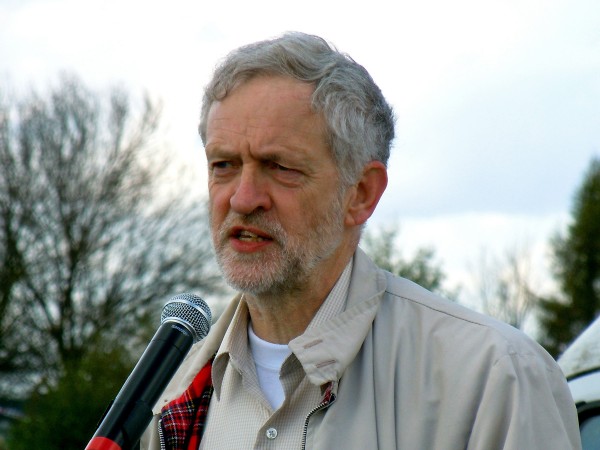 Jeremy Corbyn, the newly elected leader of the Labour Party, is proposing a number of radical economic policies. One that has attracted considerable attention is for a new form of QE, which has been dubbed ‘people’s quantitative easing’.
This would involve newly created money by the Bank of England being directly used to fund spending on large-scale housing, energy, transport and digital projects. Rather than the new money being used to purchase assets, as has been the case up to now, with the effect filtering only indirectly into aggregate demand and even more indirectly into aggregate supply, under the proposed scheme, both aggregate demand and aggregate supply would be directly boosted.
Although ‘conventional’ QE has worked to some extent, the effects have been uneven. Asset holders and those with large debts, such as mortgages, have made large gains from higher asset prices and lower interest rates. By contrast, savers in bank and building society accounts have seen the income from their savings decline dramatically. What is more, the indirect nature of the effects has meant time lags and uncertainty over the magnitude of the effects.
But despite the obvious attractiveness of the proposals, they have attracted considerable criticism. Some of these are from a political perspective, with commentators from the right arguing against an expansion of the state. Other criticisms focus on the operation and magnitude of the proposals
 One is that it would change the relationship between the Bank of England and the government. If the Bank of England created money to fund government projects, that would reduce or even eliminate the independence of the Bank. Independence has generally been seen as desirable to prevent manipulation of the central bank by the government for short-term political gain. Those in favour of people’s QE argue that the money would be directed into a National Investment Bank, which would then make the investment allocation decisions. The central bank would still be independent in deciding the amount of QE.
This leads to the second criticism and that is about whether further QE is necessary at the current time. Critics argue that while QE of whatever type was justified when the economy was in recession and struggling to recover, now would be the wrong time for further stimulus. Indeed, it could be highly inflationary. The economy is currently expanding. If banks respond by increasing credit, the velocity of circulation of narrow money could rise and broad money supply grow, providing enough money to underpin a growing economy.
Many advocates of people’s QE accept this second point and see it as a contingency plan in case the economy fails to recover and further monetary stimulus is deemed necessary. If further QE is not felt necessary by the Bank of England, then the National Investment Bank could fund investment through conventional borrowing.
The following articles examine people’s QE and look at its merits and dangers. Given the proposal’s political context, several of the articles approach the issue from a very specific political perspective. Try to separate the economic analysis in the articles from their political bias.
Jeremy Corbyn’s proposal
The Economy in 2020 Jeremy Corbyn (22/7/15)
Articles
People’s quantitative easing — no magic Financial Times, Chris Giles (13/8/15)
How Green Infrastructure Quantitative Easing would work Tax Research UK, Richard Murphy (12/3/15)
What is QE for the people? Money Week, Simon Wilson (22/8/15)
QE or not QE? A slippery slope to breaking the Bank EconomicsUK.com, David Smith (23/8/15)
We don’t need “People’s QE”, basic economic literacy is enough Red Box, Jonathan Portes (13/8/15)
Is Jeremy Corbyn’s policy of ‘quantitative easing for people’ feasible? The Guardian, Larry Elliott (14/8/15)
Corbynomics: Quantitative Easing for People (PQE) Huffington Post, Adnan Al-Daini (7/9/15)
Corbyn’s “People’s QE” could actually be a decent idea FT Alphaville, Matthew C. Klein (6/8/15)
Jeremy Corbyn’s ‘People’s QE’ would force Britain into three-year battle with the EU The Telegraph, Peter Spence (15/8/15)
Would Corbyn’s ‘QE for people’ float or sink Britain? BBC News, Robert Peston (12/8/15)
Strategic Quantitative Easing – public money for public benefit New Economics Foundation blog, Josh Ryan-Collins (12/8/15)
People’s QE and Corbyn’s QE Mainly Macro blog, Simon Wren-Lewis
You can print money, so long as it’s not for the people The Guardian, Zoe Williams (4/10/15)
Questions
- What is meant by ‘helicopter money’? How does it differ from quantitative easing as practised up to now?
- Is people’s QE the same as helicopter money?
- Can people’s QE take place alongside an independent Bank of England?
- What is meant by the velocity of circulation of money? What happened to the velocity of circulation following the financial crisis?
- How does conventional QE feed through into aggregate demand?
- Under what circumstances would people’s QE be inflationary?
 The UK’s balance on trade continues to be sharply in deficit. At the same time, both manufacturing and overall production are still well below their pre-crisis levels. What is more, with a sterling exchange rate that has appreciated substantially over recent months, UK exports are at an increasing price disadvantage. The hoped-for re-balancing of the economy from debt-financed consumption to investment and exports has not occurred. Investment in the UK remains low relative to that in other major economies (see).
But other developments in the global economy are working in the UK’s favour.
Manufacturing globally is becoming more capital intensive, which reduces the comparative advantage of developing countries with low labour costs.
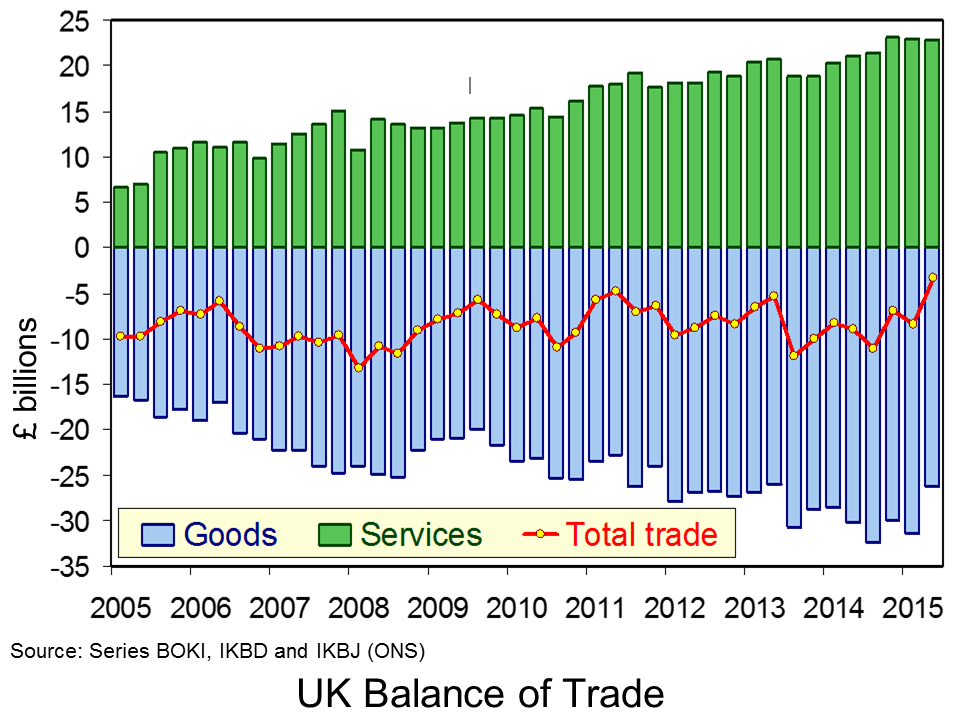 At the same time, the dividing line between manufacturing and services is becoming more blurred. Manufacturers in developing countries may still produce parts, such as chips or engines, but the design, marketing and sales of the products may take place in developed countries, such as the UK. Indeed, as products become more sophisticated, an increasing amount of value added may occur in developed countries.
The UK may be particularly well-placed in this regard. It can provide many high-end services in IT, business support and financial services to international manufacturers. It may have a comparative advantage in idea-intensive production.
 Finally with a higher exchange rate, the UK’s terms of trade have been improving. The downside is that it makes UK exports more expensive in foreign currency terms, but it also makes commodity prices cheaper, which have already fallen in dollar terms, and also the prices of imported component parts. This helps offset the effect of the appreciation of the exchange rate on exports.
The following article by Jeremy Warner considers whether, despite its poor performance in traditional manufacturing, the UK might have hit an economic ‘sweet spot’ in its trade position.
Article
Unbalanced but lucky, Britain hits an economic sweet spot The Telegraph, Jeremy Warner (8/9/15)
Data
UK Trade (Excel file) ONS (9/9/15)
(See, for example, Worksheet 1. You can search for longer series using Google advanced search, putting www.ons.gov.uk in the ‘site or domaine’ box and searching for a particular series, using the series identifier found at the top of each column in the Excel file, such as BOKI for balance on trade in goods.)
Exchange rate data Bank of England Statistical Interactive Database
Questions
- Explain the difference between the balance on trade, the balance on trade in goods and the balance of payments on current account.
- Why has the UK not experienced a re-balancing of the economy as hope for by the Chancellor of the Exchequer, amongst others?
- What is meant by the ‘terms of trade’?
- What would cause an ‘improvement’ in the terms of trade?
- Are the UK’s terms of trade likely to move in the UK’s favour in the coming months? Explain.
- What current factors are mitigating against a recovery of UK manufacturing exports?
- Is de-industrialisation necessarily a ‘bad thing’?
- Does the development of new capital-intensive technologies in manufacturing mean that the UK could become a net exporter of manufactures? Explain why or why not.
 The mood has changed in international markets. Investors are becoming more pessimistic about recovery in the world economy and of the likely direction of share prices. Concern has centred on the Chinese economy. Forecasts are for slower Chinese growth (but still around 5 to 7 per cent) and worries centre on the impact of this on the demand for other countries’ exports.
The Chinese stock market has been undergoing turmoil over the past few weeks, and this has added to jitters on other stock markets around the world. Between the 5th and 24th of August, the FTSE 100 fell by 12.6%, from 6752 to 5898; the German DAX fell by 17.1% from 11,636 to 9648 and the US DOW Jones by 10.7% from 17,546 to 15,666. Although markets have recovered somewhat since, they are very volatile and well below their peaks earlier this year.
But are investors right to be worried? Will a ‘contagion’ spread from China to the rest of the world, and especially to its major suppliers of raw materials, such as Australia, and manufactured exports, such as the USA and Germany? Will other south-east Asian countries continue to slow? Will worries lead to continued falls in stock markets as pessimism becomes more entrenched? Will this then impact on the real economy and lead then to even further falls in share prices and further falls in aggregate demand?

Or will the mood of pessimism evaporate as the Chinese economy continues to grow, albeit at a slightly slower rate? Indeed, will the Chinese authorities introduce further stimulus measures (see the News items What a devalued yuan means to the rest of the world and The Shanghai Stock Exchange: a burst bubble?), such as significant quantitative easing (QE)? Has the current slowing in China been caused, at least in part, by a lack of expansion of the monetary base – an issue that the Chinese central bank may well address?
Will other central banks, such as the Fed and the Bank of England, delay interest rate rises? Will the huge QE programme by the ECB, which is scheduled to continue at €60 billion until at least September 2016, give a significant boost to recovery in Europe and beyond?
The following articles explore these questions.
Articles
The Guardian view on China’s meltdown: the end of a flawed globalisation The Guardian, Editorial (1/9/15)
Central banks can do nothing more to insulate us from the Asian winter The Guardian, Business leader (6/9/15)
Where are Asia’s economies heading BBC News, Karishma Vaswani (4/9/15)
How China’s cash injections add up to quantitative squeezing The Economist (7/9/14)
Nouriel Roubini dismisses China scare as false alarm, stuns with optimism The Telegraph, Ambrose Evans-Pritchard (4/9/15)
Markets Are Too Pessimistic About Chinese Growth Bloomberg, Nouriel Roubini (4/9/15)
Data
World Economic Outlook databases IMF: see, for example, data on China, including GDP growth forecasts.
Market Data Yahoo: see, for example, FTSE 100 data.
Questions
- How do open-market operations work? Why may QE be described as an extreme form of open-market operations?
- Examine whether or not the Chinese authorities have been engaging in monetary expansion or monetary tightening.
- Is an expansion of the monetary base necessary for there to be a growth in broad money?
- Why might the process of globalisation over the past 20 or so years be described a ‘flawed’?
- Why have Chinese stock markets been so volatile in recent weeks? How seriously should investors elsewhere take the large falls in share prices on the Chinese markets?
- Would it be fair to describe the Chinese economy as ‘unstable, unbalanced, uncoordinated and unsustainable’?
- What is the outlook over the next couple of years for Asian economies? Explain.
- For what reasons might stock markets have overshot in a downward direction?
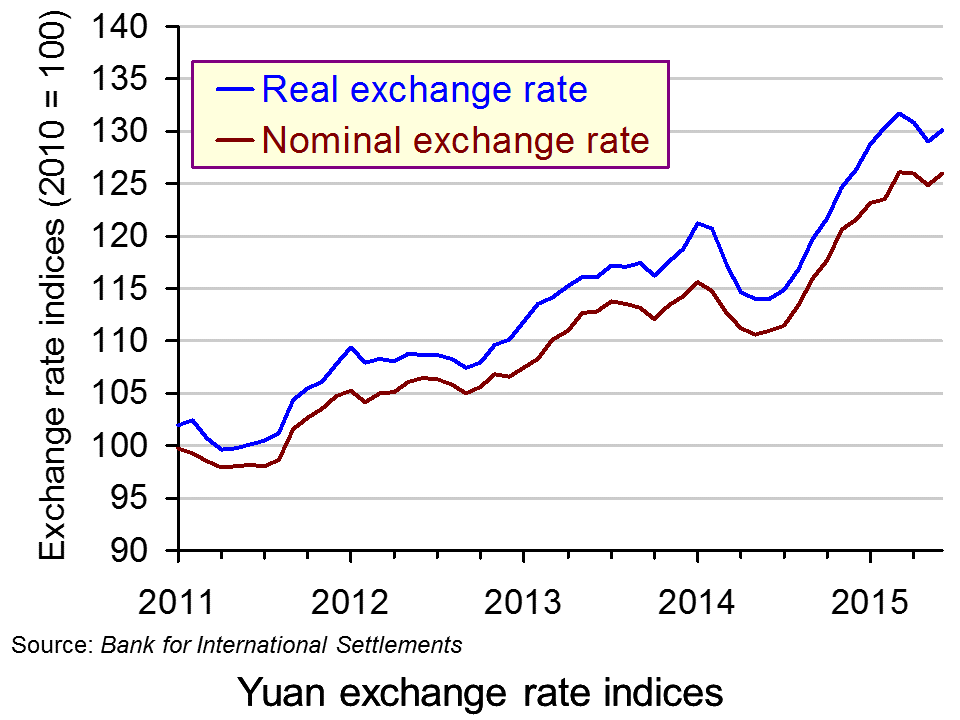
 On August 11th, China devalued its currency, the yuan, by 1.9%. The next day it devalued it by a further 1.6% and on the next day by a further 1.1%. Even though the total devaluation was relatively small, especially given a much bigger revaluation over the previous three years (see chart below), traders in world markets greeted the news with considerable pessimism. Stock markets around the world fell. For example, the US Dow Jones was down by 1.1%, the FTSE 100 was down by 2.5% and the German DAX by 5.8%.
There are three major concerns of investors about the devaluation. The first is that a weaker yuan will make other countries’ exports more expensive in China, thereby making it harder to export to China. At the same time Chinese imports into the rest of the world will be cheaper, thereby making it harder for domestic producers to compete with Chinese imports.
 The second is that cheaper Chinese imports will put downward pressure on prices at a time when inflation rates in the major economies are already below target rates. The fear of deflation has not gone away and this further deflationary twist will intensify such fears and possibly dampen demand.
The third is that the devaluation is taken as a sign that the Chinese authorities are worried about a slowing Chinese economy and are using the devaluation to boost Chinese exports. The rapidly expanding Chinese economy has been one of the major motors of the global economy in recent years and hence a slowing Chinese economy is cause for serious concern at a time when the global economy is still only very slowly recovering from the shock of the financial crisis of 2007–8
But just how worried should the rest of the world be about the falling yuan? And will it continue to fall, or could this be seen as a ‘one-off’ correction? What effect will it have on the macroeconomic policies of the USA, the eurozone and other major countries/regions? The following articles analyse Chinese policy towards its currency and the implications for the rest of the world.
China weakens yuan for a third straight day on Thursday CNBC, Nyshka Chandran (13/8/15)
Markets reel as investors fear worst of Chinese slowdown is yet to come The Telegraph, Peter Spence (12/8/15)
China cannot risk the global chaos of currency devaluation The Telegraph, Ambrose Evans-Pritchard (12/8/15)
Beware a China crisis that could crash down on us all The Telegraph, Liam Halligan (15/8/15)
The curious case of China’s currency The Economist, Buttonwood’s notebook (11/8/15)
China’s yuan currency falls for a second day BBC News (12/8/15)
China slowdown forces devaluation BBC News, Robert Peston (11/8/15)
What the yuan devaluation means around the world BBC News, Lerato Mbele, Daniel Gallas and Yogita Limaye (12/8/15)
China allows yuan currency to drop for third day BBC News, various reporters (13/8/15)
The Guardian view on global currencies: it’s the economy, stupid The Guardian, Editorial (14/8/15)
China’s currency gambit and Labour’s debate about quantitative easing: old and new ways to cope with economic crisis The Guardian, Paul Mason (16/8/15)
Questions
- By what percentages have the nominal and real yuan exchange rate indices appreciated since the beginning of 2011? Use data from the Bank for International Settlements.
- Explain the difference between nominal and real exchange rate indices.
- Compare the changes in the yuan exchange rate indices with that of the yuan/dollar exchange rate (see Bank of England Interactive Database). Explain the difference.
- How is the yuan exchange rate with other currencies determined?
- How have the Chinese authorities engineered a devaluation of the yuan? To what extent could it be described as a ‘depreciation’ rather than a ‘devaluation’?
- Why have world stock markets reacted so negatively to the devaluation?
- Why, in global terms, is the devaluation described as deflationary?
- How much should the rest of the world be worried by the devaluation of the yuan?
- Explain the statement by Robert Peston that ‘Beijing has done the monetary tightening that arguably the US economy needs’.
- Comment on the following statement by Stephen King of HSBC (see the second Telegraph article below): ‘The world economy is sailing across the ocean without any lifeboats to use in case of emergency.’
 What will production look like in 20 years time? Will familiar jobs in both manufacturing and the services be taken over by robots? And if so, which ones? What will be the effect on wages and on unemployment? Will most people be better off, or will just a few gain while others get by with minimum-wage jobs or no jobs at all?
 These developments raise a number of questions. If robots have a higher marginal revenue product/marginal cost ratio than humans, will employers choose to replace humans by robots, wholly or in part? How are investment costs factored into the decision? And what about industrial relations? Will employers risk disputes with employees? Will they simply be concerned with maximising profit or will they take wider social concerns into account?