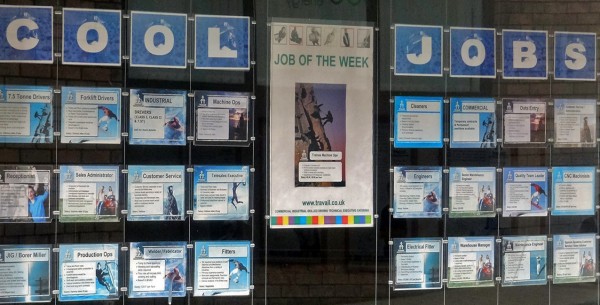
 In a post last August we looked at the rising number of workers employed on ‘zero-hours’ contracts. These are contracts where there are no guaranteed minimum hours. Such contracts give employers the flexibility to employ workers as much or as little as suits the business. Sometimes it benefits workers, who might be given the flexibility to request the hours that suit them, but usually workers simply have to take the hours on offer.
Latest figures published by the Office for National Statistics show that zero-hours contracts are on the increase. In 2014 quarter 4, 697,000 workers were recorded as being on zero-hours contracts. 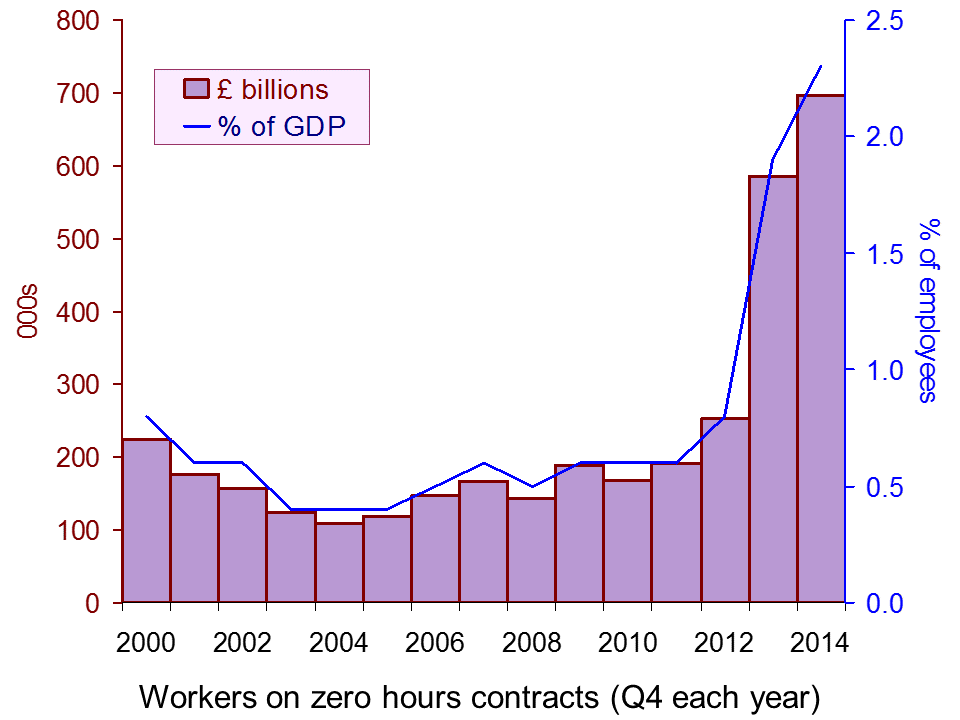 This represents 2.3% of people in employment. Ten years ago (2004, Q4) the figures were 108,000 or 0.4%: see chart. (Click here for a PowerPoint of the chart.)
Around one third of the 697,000 people on zero-hours contracts wanted more work if they could get it and most wanted it in their current job rather than having to move jobs. These people wanting more work can be classed as underemployed. They also include those not on a zero-hours contract who would like to work more if they could.
According to the ONS:
‘People on zero-hours contracts are more likely to be women, in full-time education or in young or older age groups when compared with other people in employment. On average, someone on a zero-hours contract usually works 25 hours a week.’ (See section 4 of the report for more details.)
As we saw in the earlier post, many public- and private-sector employers use such contracts, including many small and medium-sized enterprises and many well-known large companies, such as Sports Direct, Amazon, JD Wetherspoon and Cineworld. It gives them the flexibility to adjust the hours they employ people. It allows them to keep people in employment when demand is low. It also makes them more willing to take on staff when demand rises, as it removes the fear of being over-staffed if demand then falls back.
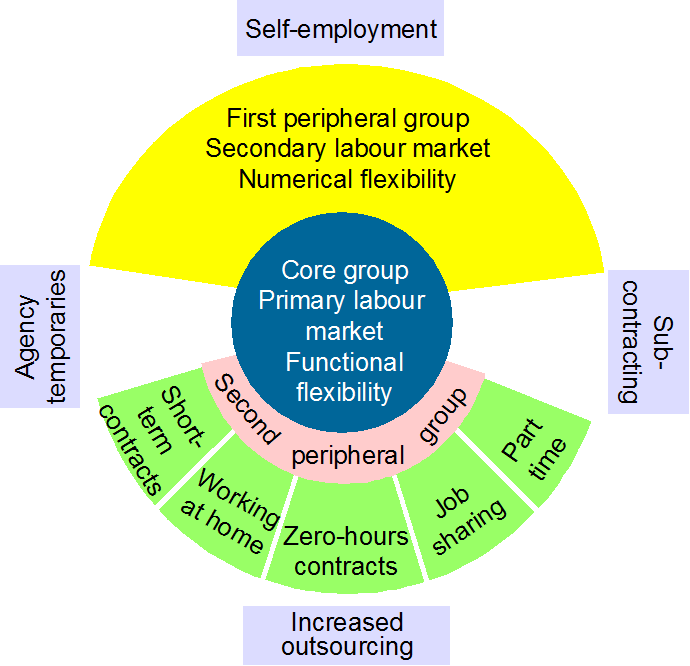 As we also saw, zero-hours contracts are not the only form of flexible working. Other examples include: ‘self-employed’ workers, contracted separately for each job they do for a company; people paid largely or wholly on commission; on-call working; part-time working, where the hours are specified in advance, but where these are periodically re-negotiated; overtime; people producing a product or service for a company (perhaps at home), where the company varies the amount paid per unit according to market conditions.
The extent of zero-hours contracts varies dramatically from one sector of the economy to another. Only 0.6% of workers in the Information, Finance and Professional sectors were on zero-hours contracts in 2014 Q4, whereas 10% in the Accommodation and Food sectors were.
The flexibility that such contracts give employers may make them more willing to keep on workers when demand is low – they can reduce workers’ hours rather than laying them off. It also may make them more willing to take on workers (or increase their hours) when demand is expanding, not having to worry about being over staffed later on.
However, many workers on such contracts find it hard to budget when their hours are not guaranteed and can vary significantly from week to week.
Articles
lmost 700,000 people in UK have zero-hours contract as main job The Guardian, Phillip Inman (25/2/15)
UK firms use 1.8m zero-hours contracts, says ONS BBC News (25/1/15)
Zero-hours contracts jump in UK Financial Times, Emily Cadman (25/2/15)
Zero-hours contracts ‘disturbingly’ hit 1.8 million in 2014 International Business Times, Ian Silvera (25/2/15)
Zero-hours contracts a reality for almost 700,000 UK workers, ONS figures show Independent, Antonia Molloy (25/1/15)
Data
Contracts with No Guaranteed Hours, Zero Hour Contracts, 2014 ONS Release (25/1/15)
Supplementary LFS data on zero hours contracts – October to December 2014 ONS dataset (25/2/15)
Analysis of Employee Contracts that do not Guarantee a Minimum Number of Hours ONS Report (25/1/15)
Questions
- Distinguish between open unemployment, disguised unemployment and underemployment?
- Distinguish between functional, numerical and financial flexibility? Which type or types of flexibility do zero-hours contracts give the firm?
- In a ‘flexible’ labour market, what forms can that flexibility take?
- Why does the Accommodation and Food sector have a relatively high proportion of people employed on zero-hours contracts?
- What are the benefits and costs to employers of using zero-hours contracts?
- If a company introduces a system of zero-hours contracts, is this in accordance with the marginal productivity theory of profit maximisation from employment?
- What are the benefits and costs to employees of working on zero-hours contracts?
- Why has the use of zero-hours contracts risen so rapidly?
- Using the ONS data, find out how the use of zero-hours contracts varies by occupation and explain why.
- Identify what forms of flexible contracts are used for staff in your university or educational establishment. Do they benefit (a) staff; (b) students?
- Consider the arguments for and against (a) banning and (b) regulating zero-hours contracts.
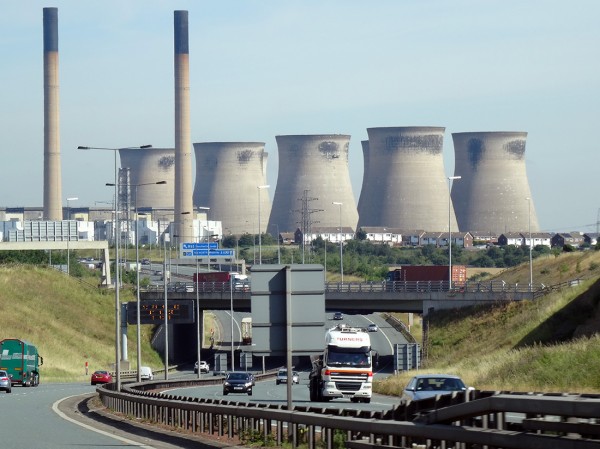 Over 90% of UK households buy their gas and electricity from one of the ‘big six’ energy suppliers – British Gas (Centrica), EDF, E.ON, npower (RWE), Scottish Power (Iberdrola) and SSE. The big six are currently being investigated by the Competition and Markets Authority (CMA) for possible breach of a dominant market position.
An updated ‘issues statement‘ summarises the investigation group’s initial thinking based on the evidence it has received. In paragraph 16 it states:
Comparing all available domestic tariffs – including those offered by the independent suppliers – we calculate that, over the period Quarter 1 2012 to Quarter 2 2014, over 95% of the dual fuel customers of the Six Large Energy Firms could have saved by switching tariff and/or supplier and that the average saving available to these customers was between £158 and £234 a year (depending on the supplier).
 Between 40% and 50% of customers have been with a supplier for more than 10 years. The companies are thus accused of exploiting these ‘loyalty’ customers, many of whom are too busy or ill-informed to switch to an alternative supplier. According to the uSwitch article below:
This is a particular issue for the most vulnerable of customers, including the elderly, who view switching as ‘impossible’.
But the elderly were not the only consumers losing out; the CMA found that those customers most likely to be on expensive standard tariffs were less educated, or on lower incomes, or single parents, and did not necessarily have access to the Internet.
And the problem of penalising ‘loyalty’ customers who do not shop around applies in other industries, most notably banking. People who regularly switch savings accounts can get higher interest rates, often for a temporary ‘introductory’ period. Similarly, people who regularly transfer credit card debt from one card to another can take advantage of low interest rate, or even zero interest rate, deals for an introductory period.
Returning to the energy industry. Is the problem one of oligopoly? Do the big six have too much market power and, if so, what can be done about it? Should they be split up? Should regulation be tightened? Should new entrants be encouraged and, if so, what specific measures can be taken? The following articles explore the issues and possible policies.
Articles
British energy customers missed out on savings Reuters, Nina Chestney (18/2/15)
U.K. Energy Customers Could Save by Shopping Around: CMA BloombergBusiness, Aoife White (18/2/15)
Big six energy firms overcharging customers by up to £234 a year The Guardian, Sean Farrell (18/1/15)
Big six energy firms may lose quarter of customers by 2020, analysts warn The Guardian, Terry Macalister (1/10/14)
UK watchdog says big energy groups do not enjoy unfair advantage Financial Times, Michael Kavanagh (18/2/15)
CMA energy market investigation update: millions are punished for being loyal uSwitch, Lauren Vasquez (19/2/15)
Gas and electricity bills – the key questions Channel 4 News (18/2/15)
Energy customers miss big savings, says CMA inquiry BBC News, John Moylan (18/2/15)
Big Six energy companies overcharging loyal customers by up to £234 a year says watchdog Independent, Simon Read (18/2/15)
Consumer groups demand change after ‘Big Six’ accused of penalising customers out of hundreds of pounds Independent, Simon Read (19/2/15)
Energy companies’ loyalty problem lights the way forward The Conversation, Bridget Woodman (19/2/15)
CMA press releases and reports
Energy market investigation – updated issues statement Competition and Markets Authority (18/2/15)
Energy market investigation Competition and Markets Authority (23/2/15)
Energy Market Investigation: Updated Issues Statement Competition and Markets Authority (18/2/15)
Questions
- What barriers to entry exist in the electricity and gas supply markets?
- Explain how the big six are practising price discrimination. What form does it take and how are the markets separated?
- Find out what tariffs are offered by each of the big six. When you have done so, reflect on how easy it was to find out the information and why so few customers switch.
- How could more people be encouraged to ‘shop around’ and switch energy suppliers?
- Explain the five theories of harm identified by the CMA. Would a rise in market share of the smaller energy suppliers adequately combat each of the five types of harm?
- In what ways may UK energy regulation be ‘a barrier to pro-competitive innovation and change’?
- What are the arguments for and against breaking up the big six?
- What are the arguments for and against electricity and gas price control?
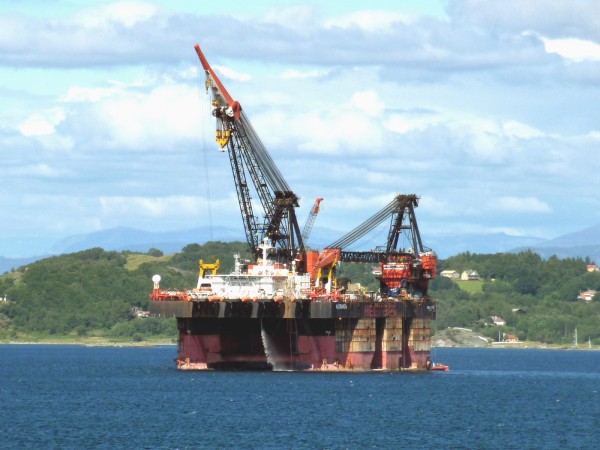 The recent low price of oil has been partly the result of faltering global demand but mainly the result of increased supply from shale oil deposits. The increased supply of shale oil has not been offset by a reduction in OPEC production. Quite the opposite: OPEC has declared that it will not cut back production even if the price of oil were to fall to $30 per barrel.
We looked at the implications for the global economy in the post, A crude indicator of the economy (Part 2). We also looked at the likely effect on oil prices over the longer term and considered what the long-run supply curve might look like. Here we examine the long-run effect on prices in more detail. In particular, we look at the arguments of two well-known commentators, Jim O’Neill and Anatole Kaletsky, both of whom have articles on the Project Syndicate site. They disagree about what will happen to oil prices and to energy markets more generally in 2015 and beyond.
Jim O’Neill argues that with shale oil production becoming unprofitable at the low prices of late 2014/early 2015, the oil price will rise. He argues that a good indicator of the long-term equilibrium price of oil is the five-year forward price, which is much less subject to speculation and is more reflective of the fundamentals of demand and supply. The five-year forward price is around $80 per barrel – a level to which O’Neill thinks oil prices are heading.
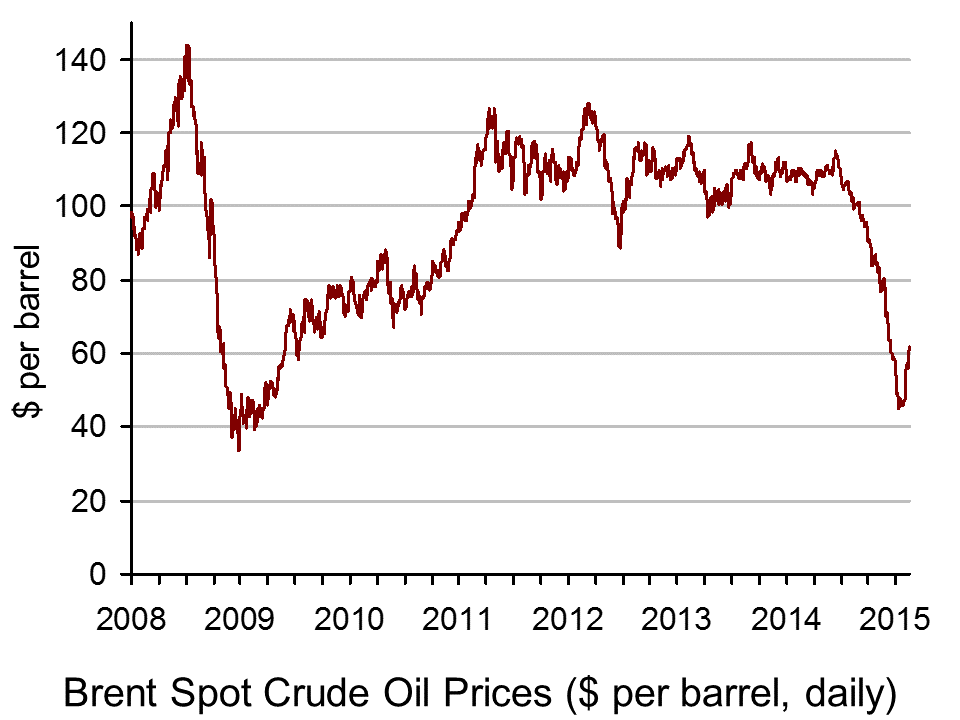 Anatole Kaletsky disagrees. He sees $50 per barrel as a more likely long-term equilibrium price. He argues that new sources of oil have made the oil market much more competitive. The OPEC cartel no longer has the market power it had from the mid 1970s to the mid 1980s and from the mid 2000s, when surging Chinese demand temporarily created a global oil shortage and strengthened OPEC’s control of prices. Instead, the current situation is more like the period from 1986 to 2004 when North Sea and Alaskan oil development undermined OPEC’s power and made the oil market much more competitive.
Kaletsky argues that in a competitive market, price will equal the marginal cost of the highest cost producer necessary to balance demand and supply. The highest cost producers in this case are the shale oil producers in the USA. As he says:
Under this competitive logic, the marginal cost of US shale oil would become a ceiling for global oil prices, whereas the costs of relatively remote and marginal conventional oilfields in OPEC and Russia would set a floor. As it happens, estimates of shale-oil production costs are mostly around $50, while marginal conventional oilfields generally break even at around $20. Thus, the trading range in the brave new world of competitive oil should be roughly $20 to $50.
So who is right? Well, we will know in twelve months or more! But, in the meantime, try to use economic analysis to judge the arguments by answering the questions below.
The Price of Oil in 2015 Project Syndicate, Jim O’Neill (7/1/15)
A New Ceiling for Oil Prices Project Syndicate, Anatole Kaletsky (14/1/15)
Questions
- For what reasons might the five-year forward price of oil be (a) a good indicator and (b) a poor indicator of the long-term price of oil?
- Under O’Neill’s analysis, what would the long-term supply curve of oil look like?
- Are shale oil producers price takers? Explain.
- Draw a diagram showing the marginal and average cost curves of a swing shale oil producer. Put values on the vertical axis to demonstrate Kaletsky’s arguments. Also put average and marginal revenue on the diagram and show the amount of profit at the maximum-profit point.
- Why are shale oil producers likely to have much higher long-run average costs than short-run variable costs? How does this affect Kaletsky’s arguments?
- Under Kaletsky’s analysis, what would the long-term supply curve of oil look like?
- Criticise Kaletsky’s arguments from O’Neill’s point of view.
- Criticise O’Neill’s arguments from Kaletsky’s point of view.
- Will OPEC’s policy of not cutting back production help to restore its position of market power?
- Why might the fall in the oil price below $50 in early 2015 represent ‘overshooting’? Why does overshooting often occur in volatile markets?
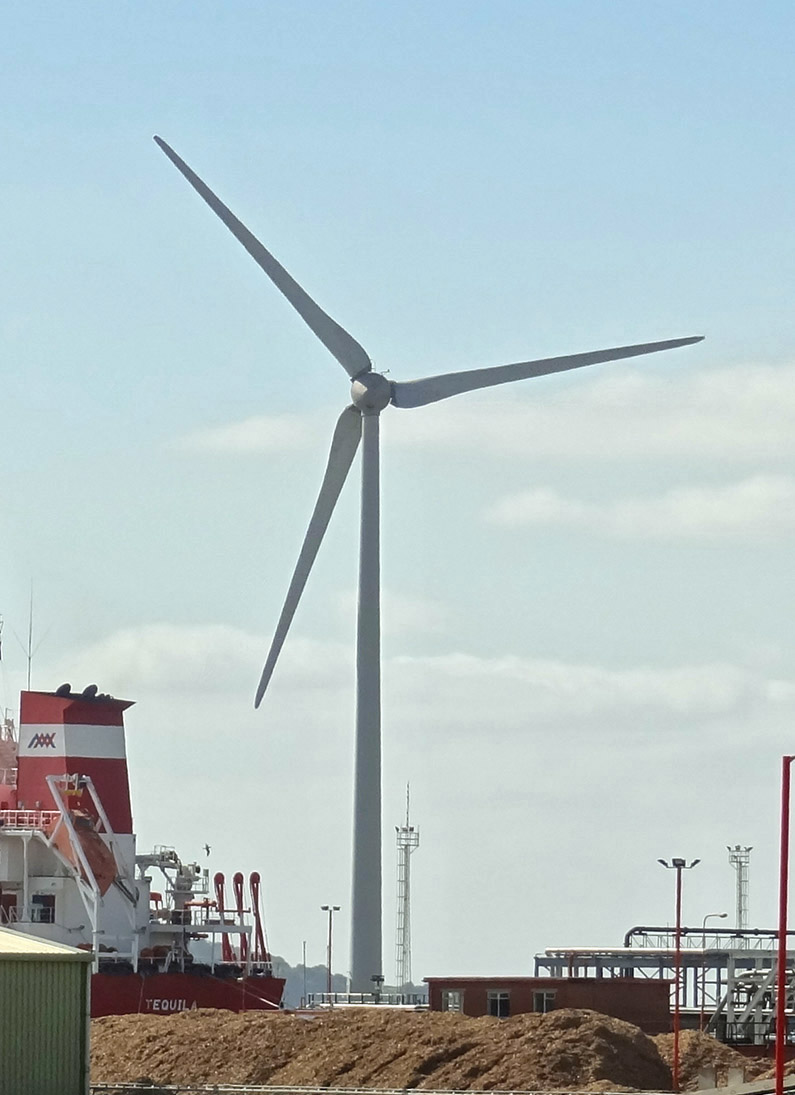
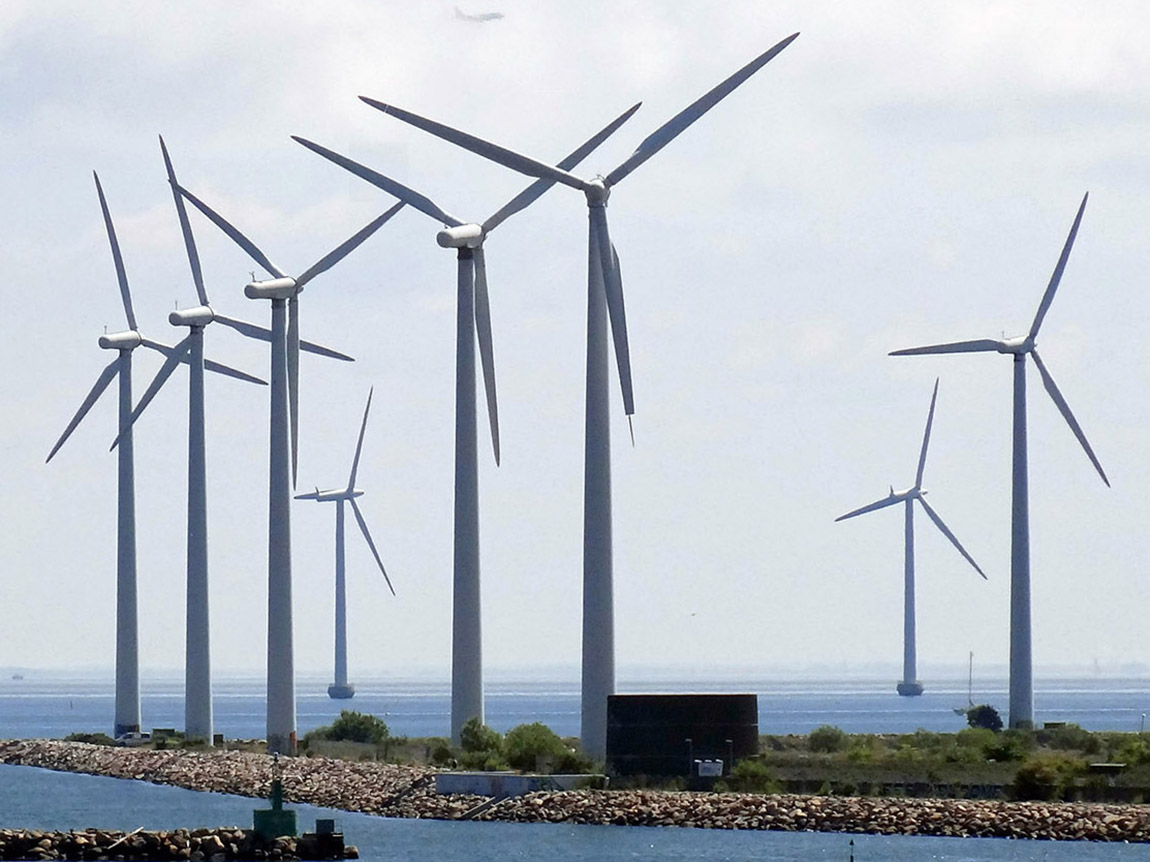
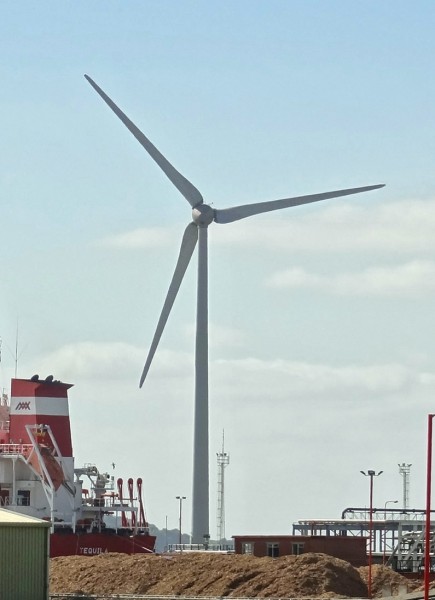 When an industry produces positive externalities, there is an argument for granting subsidies. To achieve the socially efficient output in an otherwise competitive market, the marginal subsidy should be equal to the marginal externality. This is the main argument for subsidising wind power. It helps in the switch to renewable energy away from fossil fuels. There is also the secondary argument that subsidies help encourage the development of technologies that would be too uncertain to fund at market rates.
If subsidies are to be granted, it is important that they are carefully designed. Not only does their rate need to reflect the size of the positive externalities, but also they should not entail any perverse incentive effects. But this is the claim about subsidies given to wind turbines: that they create an undesirable side effect.
Small-scale operators are encouraged to build small turbines by offering them a higher subsidy per kilowatt generated (through higher ‘feed-in’ tariffs). But according to a report by the Institute for Public Policy Research (IPPR), this is encouraging builders and operators of large turbines to ‘derate’ them. This involves operating them below capacity in order to get the higher tariff. As the IPPR overview states:
The scheme is designed to support small-scale providers, but the practice of under-reporting or ‘derating’ turbines’ generating capacity to earn a higher subsidy is costing the taxpayer dearly and undermining the competitiveness of Britain’s clean energy sector.
The loophole sees developers installing ‘derated’ turbines – that is, turbines which are ‘capped’ so that they generate less energy. Turbines are derated in this way so that developers and investors are able to qualify for the more generous subsidy offered to lower-capacity turbines, generating 100–500kW. 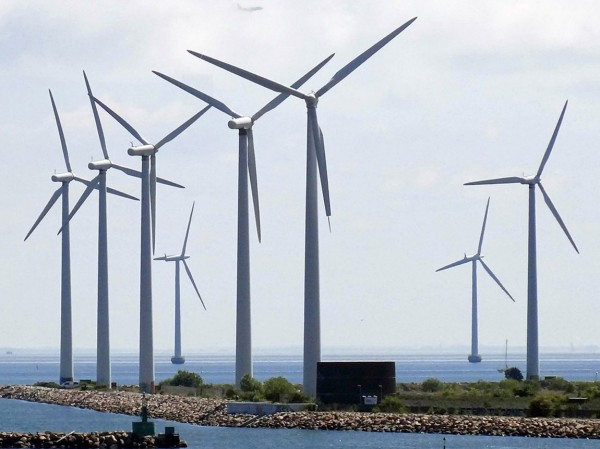 By installing derated turbines, developers are making larger profits off a feature of the scheme that was designed to support small-scale projects. Currently, the rating of a turbine is declared by the manufacturer and installer, resulting in a lack of external scrutiny of the system.
The subsidies are funded by consumers through higher electricity prices. As much as £400 million could be paid in excess subsidies. The lack of scrutiny means that operators could be receiving as much as £100 000 per year per turbine in excess subsidies.
However, as the articles below make clear, the facts are disputed by the wind industry body, RenewableUK. Nevertheless, the report is likely to stimulate debate and hopefully a closing of the loophole.
Video
 Turbine power: the cost of wind power to taxpayers Channel 4 News, Tom Clarke (10/2/15)
Articles
Wind subsidy loophole boosts spread of bigger turbines Financial Times, Pilita Clark (10/2/15)
Call to Close Wind Power ‘Loophole’ Herald Scotland, Emily Beament (10/2/15)
Wind farm developers hit back at ‘excessive subsidy’ claims Business Green, Will Nichols (10/2/15)
The £400million feed-in frenzy: Green energy firms accused of making wind turbines LESS efficient so they appear weak enough to win small business fund Mail Online, Ben Spencer (10/2/15)
Wind power subsidy ‘loophole’ identified by new report Engineering Technology Magazine, Jonathan Wilson (11/2/15)
Report
Feed-in Frenzy Institute for Public Policy Research, Joss Garman and Charles Ogilvie (February 2015)
Questions
- Draw a diagram to demonstrate the optimum marginal rate of a subsidy and the effect of the subsidy on output.
- Who should pay for subsidies: consumers, the government (i.e. taxpayers generally), electricity companies through taxes on profits made from electricity generation using fossil fuels, some other source? Explain your thinking.
- What is the argument for giving a higher subsidy to operators of small wind turbines?
- If wind power is to be subsidised, is it better to subsidise each unit of output of electricity, or the construction of wind turbines or both? Explain.
- What could Ofgem do (or the government require Ofgem to do) to improve the regulation of the wind turbine industry?
 Yanis Varoufakis, the new Greek finance minister, is also an economist and an expert in game theory and co-author of Game Theory: a critical text. He is now putting theory into practice.
He wishes to renegotiate the terms of Greece’s debt repayments. He argues not that some of the debt should be written off, but that the terms of the repayment are far too tough.
Greece’s problem, he argues, was wrongly seen as one of a lack of liquidity and hence the Troika (of the EU, the ECB and the IMF) provided a large amount of loans to enable Greece to keep servicing its debts. These loans were conditional on Greece following austerity policies of higher taxes and reduced government expenditure. But this just compounded the problem as seen by Yanis Varoufakis. With a shrinking economy, it has been even more difficult to repay the loans granted by the Troika.
The problem, he argues, is essentially one of insolvency. The solution is to renegotiate the terms of the debt to make it possible to pay. This means reducing the size of the budget surplus that Greece is required to achieve. The Troika is currently demanding a surplus equal to 3% of GDP in 2015 and 4.5% of GDP in 2016.
 The Syriza government is also seeking to link repayments to economic growth, by the issue of growth-linked bonds, whose interest rate depends on the rate of economic growth, with a zero rate if there is no growth in real GDP. He is also seeking emergency humanitarian aid
At the centre of the negotiations is a high stake game. On the one hand, Germany and other countries do not want to reduce Greece’s debts or soften their terms. The fear is that this could unleash demands from other highly indebted countries in the eurozone, such as Spain, Portugal and Ireland. Already, Podemos, Spain’s anti-austerity party is rapidly gaining support in Spain. On the other hand, the new Greek government cannot back down in its fundamental demands for easing the terms of its debt repayments.
And the threats on both sides are powerful. The Troika could demand that the original terms are met. If they are not, and Greece defaults, there could be capital flight from Greece (even more than now) and Greece could be forced from the euro. The Greeks would suffer from further falls in income, which would now be denominated in a weak drachma, high inflation and financial chaos. But that could unleash a wave of speculation against other weaker eurozone members and cause a break-up of the currency union. 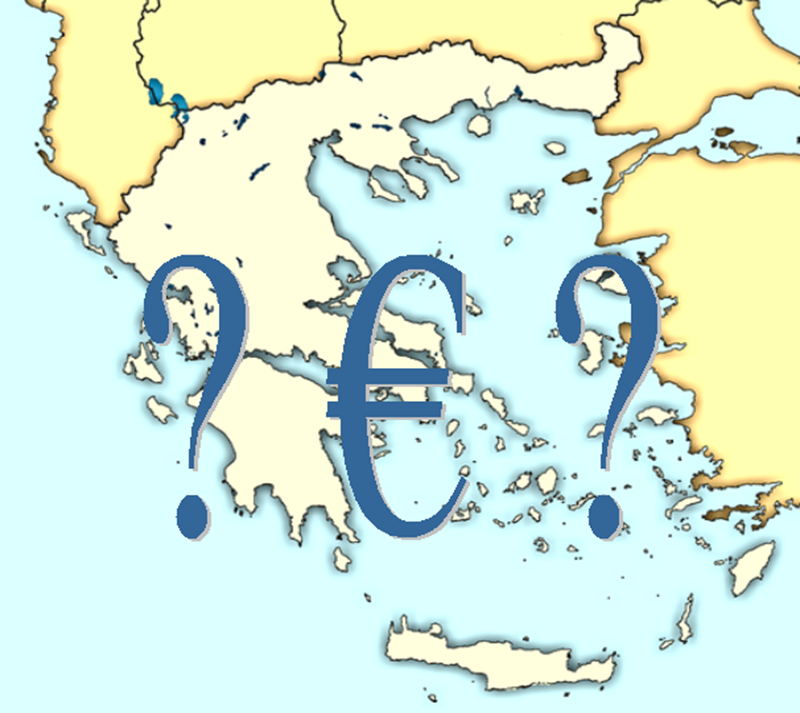 This could seriously harm all members and have large-scale repercussions for the global economy.
So neither side wants Greece to leave the euro. But is it a game of chicken, where if neither side backs down, ‘Grexit’ (Greek exit from the euro) will be the result? Yanis Varoufakis understands the dimensions of the ‘game’ very well. He is well aware of the quote from Keynes, ‘If you owe your bank a hundred pounds, you have a problem. But if you owe a million, it has.’ He will no doubt bring all his gaming skills to play in attempting to reach the best deal for Greece.
Greece’s last minute offer to Brussels changes absolutely nothing The Telegraph, Ambrose Evans-Pritchard (10/2/15)
The next card Yanis Varoufakis will play The Conversation, Partha Gangopadhyay (8/2/15)
Senior European official: ‘The Greeks are digging their own graves’ Business Insider, Mike Bird (10/2/15)
Greece: The Tie That Doesn’t Bind New York Times, Paul Krugman (9/2/15)
Greek finance minister says euro will collapse if Greece exits Reuters, Gavin Jones (8/2/15)
Greece is playing to lose the debt crisis poker game The Guardian, Project Syndicate and Anatole Kaletsky (9/2/15)
Greek markets find sliver of hope Financial Times, Elaine Moore, Kerin Hope and Daniel Dombey (10/2/15)
Greece: What are the options for its future? BBC News, Jamie Robertson (12/2/15)
‘If I weren’t scared, I’d be awfully dangerous’ The Guardian, Helena Smith (13/2/15)
Greek debt crisis: German MPs back bailout extension BBC News (27/2/15)
Questions
- Is a deal over the terms of repayment of Greek debt a zero sum game? Explain whether it is or not.
- What are Keynes Bisque bonds (or GDP-indexed bonds)? Do a Web search to find out whether they have been used and what their potential advantages and disadvantages are. Are they a good solution for both creditors and Greece in the current situation?
- What is meant by a ‘debt swap’? What forms can debt swaps take?
- Has Greece played its best cards too early?
- Should Greece insist on debt reduction and simply negotiate around the size and terms of that reduction?
- Are Greece’s new structural reform proposals likely to find favour with other EU countries and the Troika?
 In a post last August we looked at the rising number of workers employed on ‘zero-hours’ contracts. These are contracts where there are no guaranteed minimum hours. Such contracts give employers the flexibility to employ workers as much or as little as suits the business. Sometimes it benefits workers, who might be given the flexibility to request the hours that suit them, but usually workers simply have to take the hours on offer.