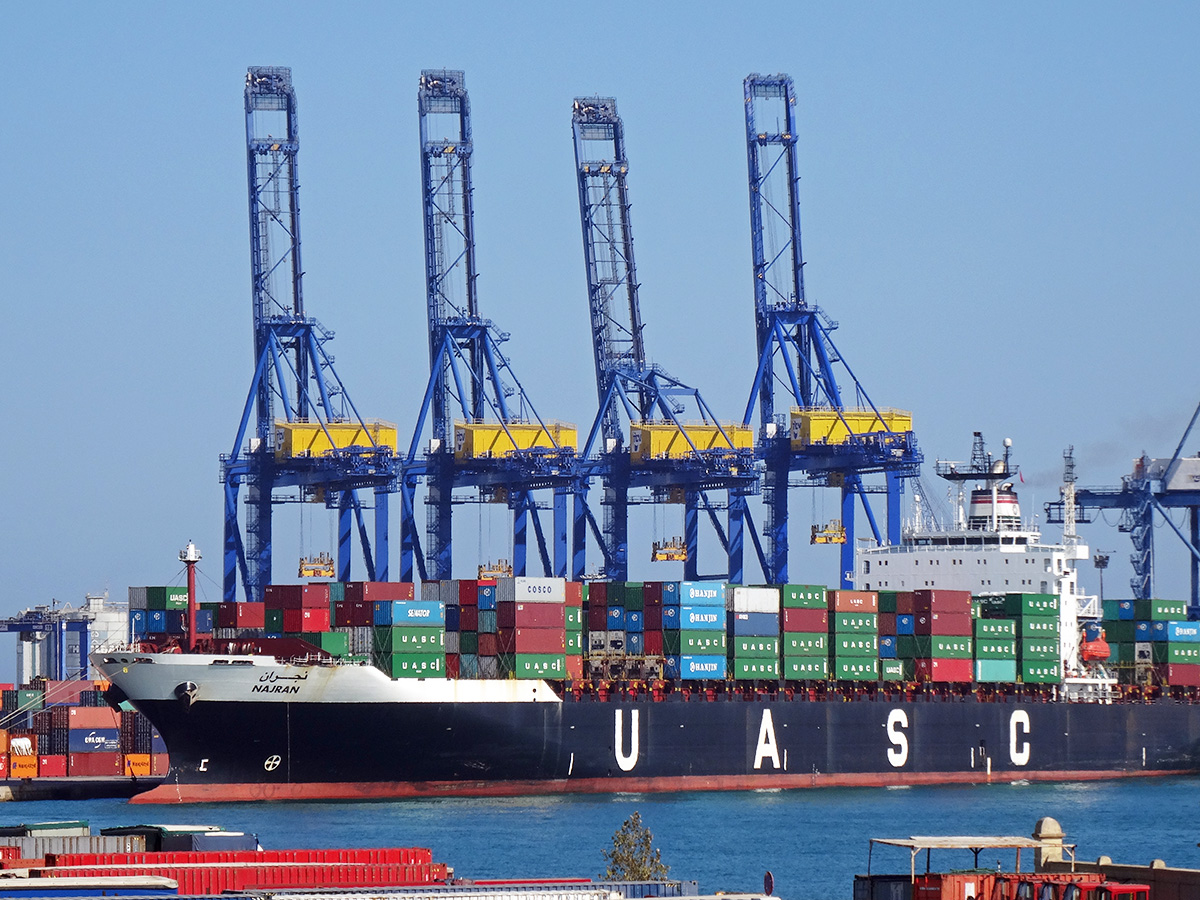
 According to a report by the McKinsey Global Institute, global debt is now higher than before the financial crisis. And that crisis was largely caused by excessive lending. As The Telegraph article linked below states:
The figures are as remarkable as they are terrifying. Global debt – defined as the liabilities of governments, firms and households – has jumped by $57 trillion, or 17% of global GDP, since the fourth quarter of 2007, which was supposed to be the peak of the bad old credit-fuelled days. In 2000, total debt was worth 246% of global GDP; by 2007, this had risen to 269% of GDP and today we are at 286% of GDP.
This is not how policy since the financial crisis was supposed to have worked out. Central banks and governments have been trying to encourage greater saving and reduced credit as a percentage of  GDP, a greater capital base for banks, and reduced government deficits as a means of reducing government debt. But of 47 large economies in the McKinsey study, only five have succeeded in reducing their debt/GDP ratios since 2007 and in many the ratio has got a lot higher. China, for example, has seen its debt to GDP ratio almost double – from 158% to 282%, although its government debt remains low relative to other major economies.
Part of the problem is that the lack of growth in many countries has made it hard for countries to reduce their public-sector deficits to levels that will allow the public-sector debt/GDP ratio to fall.
In terms of the UK, private-sector debt has been falling as a percentage of GDP. But this has been more than offset by a rise in the public-sector debt/GDP ratio. As Robert Peston says:
[UK indebtedness] increased by 30 percentage points, to 252% of GDP (excluding financial sector or City debts) – as government debts have jumped by 50 percentage points of GDP, while corporate and household debts have decreased by 12 and 8 percentage points of GDP respectively.
So what are the likely consequences of this growth in debt and what can be done about it? The articles and report consider these questions.
Articles
Instead of paying down its debts, the world’s gone on another credit binge The Telegraph, Allister Heath (5/2/15)
Global debts rise $57tn since crash BBC News, Robert Peston (5/2/15)
China’s Total Debt Load Equals 282% of GDP, Raising Economic Risks The Wall Street Journal, Pedro Nicolaci da Costa (4/2/15)
Report
Debt and (not much) deleveraging McKinsey Global Institute, Richard Dobbs, Susan Lund, Jonathan Woetzel, and Mina Mutafchieva (February 2015)
Questions
- Explain what is meant by ‘leverage’.
- Why does a low-leverage economy do better in a downturn than a high-leverage one?
- What is the relationship between deficits and the debt/GDP ratio?
- When might an increase in debt be good for an economy?
- Comment on the statement in The Telegraph article that ‘In theory, debt is fine if it is backed up by high-quality collateral’.
- Why does the rise is debt matter for the global economy?
- Is it possible for (a) individual countries; (b) all countries collectively to ‘live beyond their means’ by consuming more than they are producing through borrowing?
- What is the structure of China’s debt and what problems does this pose for the Chinese economy?
 Newspaper headlines this week read that the UK’s balance of trade deficit has widened to £34.8bn, the largest since 2010. And when you exclude services, the trade in goods deficit, at £119.9bn is the largest ever in nominal terms and is also likely to be the largest as a percentage of GDP.
So far so bad. But when you look a little closer, the picture is more mixed. The balance of trade deficit (i.e. on both goods and services) narrowed each quarter of 2014, although the monthly figure did widen in December 2014. In fact the trade in goods deficit increased substantially in December from £9.3bn to £10.2bn.
At first sight the widening of the trade deficit in December might seem surprising, given the dramatic drop in oil prices. Surely, with demand for oil being relatively inelastic, a large cut in oil prices should significantly reduce the expenditure on oil? In fact the reverse happened. The oil deficit in December increased from £598m to £940m. The reason is that oil importing companies have been stockpiling oil while low prices persist. Clearly, this is in anticipation that oil prices will rise again before too long. What we have seen, therefore, is a demand that is elastic in the short run, even though it is relatively inelastic in the medium run.
But the trade deficit is still large. Even when you strip out oil, the deficit in December still rose – from £8.7bn to £9.2bn. There are two main reasons for this deterioration.
The first is a strong pound. The sterling exchange rate index rose by 1.8% in December and a further 0.4% in January. With quantitative easing pushing down the value of the euro and loose monetary policies in China and Australia pushing down the value of their currencies, sterling is set to appreciate further.
The second is continuing weakness in the eurozone and a slowing of growth in some major developing countries, including China. This will continue to dampen the growth in UK exports.
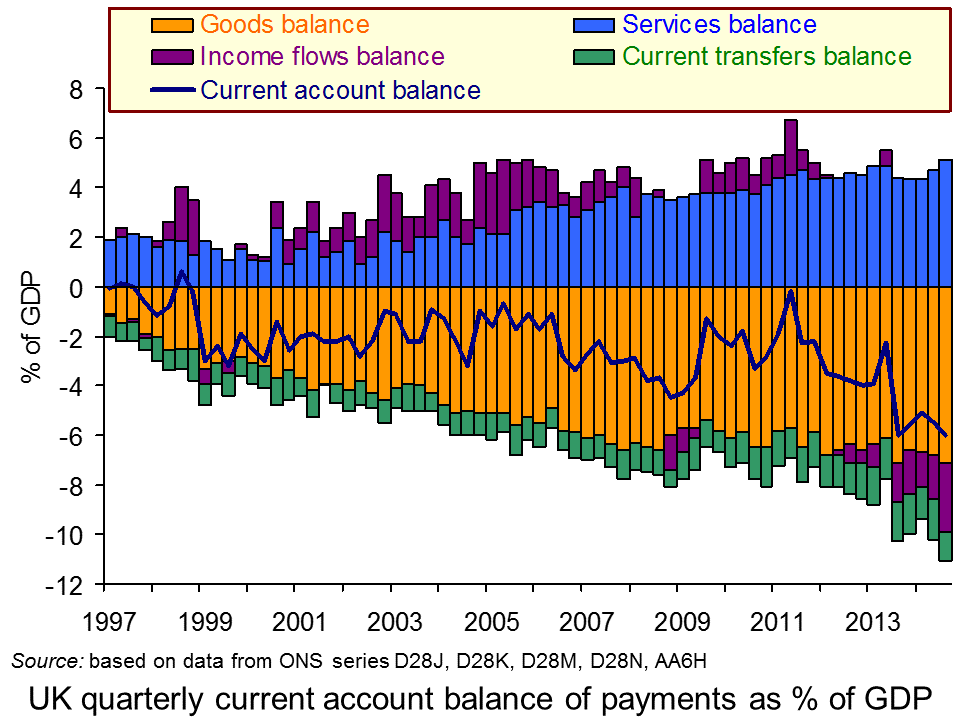 But what of the overall current account? Figures are at present available only up to 2014 Q3, but the picture is bleak (see the chart). As the ONS states:
The current account deficit widened in Q3 2014, to 6.0% of nominal Gross Domestic Product GDP, representing the joint largest deficit since Office for National Statistics (ONS) records began in 1955.
This deterioration in performance can be partly attributed to the recent weakness in the primary income balance [see]. This also reached a record deficit in Q3 2014 of 2.8% of nominal GDP; a figure that can be primarily attributed to a fall in UK residents’ earnings from investment abroad, and broadly stable foreign resident earnings on their investments in the UK
The primary income account captures income flows into and out of the UK economy, as opposed to current transfers (secondary income) from taxes, grants, etc. The large deficit reflects a decline in the holding by UK residents of foreign assets from 92% of GDP in 2008 to 67% by the end of 2014. This, in turn, reflects the poorer rate of return on many of these assets. By contrast, the holdings of UK assets by foreign residents has increased. They have been earning a higher rate of return on these assets than UK residents have on foreign assets. And so, despite UK interest rates having fallen, as the quote above says, foreign residents’ earnings on their holding of UK assets has remained broadly stable.
Articles
UK trade deficit last year widest since 2010 BBC News (6/2/15)
UK’s trade deficit widens to 2010 high as consumers take advantage of falling oil The Telegraph, Peter Spence (6/2/15)
UK trade deficit widens to four-year high The Guardian, Katie Allen (6/2/15)
UK trade deficit hits four-year high Financial Times, Ferdinando Giugliano (6/2/15)
Data
Balance of Payments ONS (topic link)
Summary: UK Trade, December 2014 ONS (6/2/15)
Current account, income balance and net international investment position ONS (23/1/15)
Pink Book – Tables ONS
Questions
- Distinguish between he current account, the capital account and the financial account of the balance of payments.
- If the overall balance of payments must, by definition, balance, why does it matter if the following are in deficit: (a) trade in goods; (b) the current account; (b) income flows?
- What would cause the balance of trade deficit to narrow?
- Discuss what policies the government could pursue to reduce the size of the current account deficit? Distinguish between demand-side and supply-side policies.
- Why has the sterling exchange rate index been appreciating in recent months?
- What do you think is likely to happen to the sterling exchange rate index in the coming months? Explain.
 Economics is about choices. But how can people be persuaded to make healthy choices, or socially responsible or environmentally friendly choices? Behavioural economists have studied how people can be ‘nudged’ into changing their behaviour. One version of nudge theory is ‘fun theory’. This studies how people can be persuaded into doing desirable things by making it fun to do so.
I came across the first video below a couple of days ago. It looks at a highly successful experiment at the Odenplan underground station in Stockholm to persuade people to make the healthy choice of using the stairs rather than the escalator. It made doing so fun. The stairs were turned into a musical keyboard, complete with sound. Each stair plays a piano note corresponding to its piano key each time someone treads on it. As you go up the stairs you play an ascending scale.
After installing the musical staircase, 66% more people than normal chose the stairs over the escalator.
 The fun theory initiative is sponsored by Volkswagen. The Fun Theory website is ‘dedicated to the thought that something as simple as fun is the easiest way to change people’s behaviour for the better. Be it for yourself, for the environment, or for something entirely different, the only thing that matters is that it’s change for the better.’
VW held a competition in 2009 to encourage people to invent fun products designed to change people’s behaviour. There were over 700 entries and you can see them listed on the site. The 13 finalists included the musical staircase, traffic lights with quiz questions on the red, a Connect Four beer crate, fun tram tickets (giving entry to an instant-win lottery), a pinball exercise machine, a speed camera lottery where a winner is chosen from those abiding by the speed limit, a jukebox rubbish bin (which plays when people add rubbish), a one-armed vending machine, a fun doormat, car safety belts linked to a car’s entertainment system, car safety belt with a gaming screen which turns on when buckled, a bottle bank arcade system and the world’s deepest bin (or at least one which sounds as if it is). The winner was the speed camera lottery.
The fun theory site
Thefuntheory.com
Fun theory videos
 Piano Staircase – Odenplan, Stockholm (on Vimeo)
The Speed Camera Lottery (on VIMP.com, Kevin Richardson)
Garbage Jukebox (on YouTube)
The World’s Deepest Bin (on Vimeo)
Bottle Bank Arcade (on YouTube)
Questions
- Does fun theory rely on rational choices?
- Other than through having fun, how else may people be nudged into changing their behaviour?
- Go through some of the entries to the Fun Theory Award and choose three that you particularly like. Explain why.
- Invent your own fun theory product. You might do this by discussing it groups and perhaps having a group competition.
 Virtually all manual toothbrushes sold in the UK are made by Oral B (Procter & Gamble), Colgate (Colgate-Palmolive) or Listerene Reach (Johnson & Johnson). This is a powerful oligopoly.
The manufacturers distribute toothbrushes primarily through large powerful retailers, such as supermarkets and Boots. It is difficult for new entrants to persuade these retailers to stock their product. What is more, with large advertising and marketing budgets, existing toothbrush manufacturers make it difficult for new brands to attract customers.
But one company has successfully entered the children’s section of the market when Boots  agreed to stock its product. The Rockabilly Kids toothbrush has a feature likely to appeal to both children and their parents. It wobbles! With a weight in the bottom, the brush rights itself, with a wobble, when dropped or simply placed on the basin or shelf.
This clearly appeals to small kids. It also appeals to their parents who can do away with unhygienic toothbrush holders. What is more, the self-righting wobbly toothbrush, by making the whole process of teeth cleaning fun for young kids, can help them gain good habits of oral hygiene.
So just how did the manufacturer overcome the barriers to entry into this well-established oligopoly? The following article examines how.
Can ‘wobbly’ kids toothbrushes shake the Oral B/Colgate oligopoly? The Telegraph, Rebecca Burn-Callander (10/1/15)
Questions
- What barriers to entry exist in the manual toothbrush market?
- How did Hamish Khayat overcome these barriers?
- Why did he decide against a toothbrush subscription service?
- How would you decide whether £6.99 is the right price?
- Is it a good idea for him to diversify into electric kids toothbrushes?
- How are the big toothbrush manufacturers likely to respond to the expansion of Rockabilly Kids?
 The first link below is to an excellent article by Noriel Roubini, Professor of Economics at New York University’s Stern School of Business. Roubini was one of the few economists to predict the 2008 financial crisis and subsequent recession. In this article he looks at the current problem of substantial deficiency of demand: in other words, where actual output is well below potential output (a negative output gap). It is no wonder, he argues, that in these circumstances central banks around the world are using unconventional monetary policies, such as virtually zero interest rates and quantitative easing (QE).
He analyses the causes of deficiency of demand, citing banks having to repair their balance sheets, governments seeking to reduce their deficits, attempts by firms to cut costs, effects of previous investment in commodity production and rising inequality.
 The second link is to an article about the prediction by the eminent fund manager, Crispin Odey, that central banks are running out of options and that the problem of over-supply will lead to a global slump and a stock market crash that will be ‘remembered in a hundred years’. Odey, like Roubini, successfully predicted the 2008 financial crisis. Today he argues that the looming ‘down cycle will cause a great deal of damage, precisely because it will happen despite the efforts of central banks to thwart it.’
I’m sorry to post this pessimistic blog and you can find other forecasters who argue that QE by the ECB will be just what is needed to stimulate economic growth in the eurozone and allow it to follow the USA and the UK into recovery. That’s the trouble with economic forecasting. Forecasts can vary enormously depending on assumptions about variables, such as future policy measures, consumer and business confidence, and political events that themselves are extremely hard to predict.
Will central banks continue to deploy QE if the global economy does falter? Will governments heed the advice of the IMF and others to ease up on deficit reduction and engage in a substantial programme of infrastructure investment? Who knows?
An Unconventional Truth Project Syndicate, Nouriel Roubini (1/2/15)
UK fund manager predicts stock market plunge during next recession The Guardian, Julia Kollewe (30/1/15)
Questions
- Explain each of the types of unconventional monetary policy identified by Roubini.
- How has a policy of deleveraging by banks affected the impact of quantitative easing on aggregate demand?
- Assume you predict that global economic growth will increase over the next two years. What reasons might you give for your prediction?
- Why have most commodity prices fallen in recent months? (In the second half of 2014, the IMF all-commodity price index fell by 28%.)
- What is likely to be the impact of falling commodity prices on global demand?
- Some neo-liberal economists had predicted that central bank policies ‘would lead to hyperinflation, the US dollar’s collapse, sky-high gold prices, and the eventual demise of fiat currencies at the hands of digital krypto-currency counterparts’. Why, according to Roubini, did the ‘root of their error lie in their confusion of cause and effect’?
 According to a report by the McKinsey Global Institute, global debt is now higher than before the financial crisis. And that crisis was largely caused by excessive lending. As The Telegraph article linked below states:
 GDP, a greater capital base for banks, and reduced government deficits as a means of reducing government debt. But of 47 large economies in the McKinsey study, only five have succeeded in reducing their debt/GDP ratios since 2007 and in many the ratio has got a lot higher. China, for example, has seen its debt to GDP ratio almost double – from 158% to 282%, although its government debt remains low relative to other major economies.