 The UK general election is on May 7. In the campaign during the run-up to the election the economy will be a major issue. All parties will use economic data to claim that the economy has performed well or badly and that the prospects are good or bad. As economics students you will, no doubt, be asked to comment on these claims by your friends. So where can you get analysis of the data that is not biased towards one party or another?
One source is the Institute for Fiscal Studies. It is respected by politicians of all parties as an impartial presenter and analyser of economic data. In fact, it is fiercely independent. But at election time, when often quite dramatic claims are made by politicians, the IFS often comments on whether the data support such claims.
An example occurred when David Cameron claimed that if Labour were elected, working families would face a £3028 tax rise to fund the party’s spending commitments. The IFS said that the claim was misleading as, even on the Conservatives’ assumptions, it was was based on the cumulative increase over five years, not the annual increase, and was not per household but only per working household. The IFS also said that the Conservatives’ assumptions were wrong and not in accordance with the Charter for Budget Responsibility, with which the Labour party agreed.
Expect the IFS to criticise more claims as the election campaign progresses: not just by the Conservative party but by the other parties too. After all, the IFS is not partisan and is prepared to challenge false economic claims from whatever party. Expect also that the political parties will cherry pick whatever statements by the IFS seen to favour them or criticise their opponents.
You can also expect political bias in the newspapers that report the campaigns. Even when they present facts, how they present them and which facts they choose to include and which to ignore will be a reflection of their political bias. So even newspaper reporting of what the IFS says is likely to be selective and nuanced!
Why IFS boss Paul Johnson counts in this tightest of general elections The Guardian, Larry Elliott (30/3/15)
David Cameron’s claim that Labour would raise taxes by £3,000 is ‘not sensible’, says the IFS Independent, Jon Stone (30/3/15)
‘tax rise’ is shot down by IFS The Guardian, Patrick Wintour (30/3/15)
We will borrow more if we win the election, Labour admits The Telegraph, Christopher Hope (29/3/15)
Chancellor accused of U-turn on austerity: Top economist says £20bn fiscal boost lurking in Budget is ‘remarkable reversal’ This is Money, Hugo Duncan (19/3/15)
Questions
- Distinguish between positive and normative statements. How might politicians blur the distinction in their claims and counter-claims?
- Identify three series of macroeconomic data from at least two independent organisations. For what reasons might the data be (a) unreliable; (b) used by political parties to mislead the electorate?
- In what ways can political parties use economic data to their own advantage without falsifying the data?
- How may public-sector deficit and debt statistics be interpreted in ways to suit (a) the current government’s case that the public finances have been well managed; (b) the opposition case that the public finances have been badly managed?
- Use data to analyse an economic claim by each of at least three political parties and the extent to which the claims are accurate.
- The above links are to articles from four UK national newspapers: The Guardian, the Independent, The Telegraph and the Daily Mail (This is Money). Identify political bias in the reporting in each of the articles.
The latest inflation figures, as detailed in February’s Consumer Price Inflation Statistical Bulletin, show that the annual rate of CPI inflation hit zero in February. This is down from 0.3 per cent in January. While inflation is now well outside the 1-3 per cent target range that the Bank of England is charged with meeting, perhaps a more pertinent question is whether the UK is teetering on the brink of deflation – and the risks that may carry.
To get a better sense of the latest inflation picture we need to delve deeper into the numbers and look at the patterns in the prices that make up the overall Consumer Price Index. Interestingly, these shows that five of the 12 principal product groups that make up the index are currently experiencing price deflation.
As explained in Consumer Price Inflation: The 2015 Basket of Goods and Services, produced by the ONS, around 180,000 prices quotations are collected each month for around 700 representative items. These goods and services fall into one of 12 broad product groups. These include, for example, food and non-alcoholic beverages and transport.
The items included in each of the 12 product groups are reviewed once a year so that the chosen items remain representative of today’s spending patterns. A monthly price index is calculated for these 12 broad groupings, known as divisions, and for sub-categories of these. For example meat is a category within food and non-alcoholic beverages. The overall CPI is a weighted average of the 12 broad groupings.
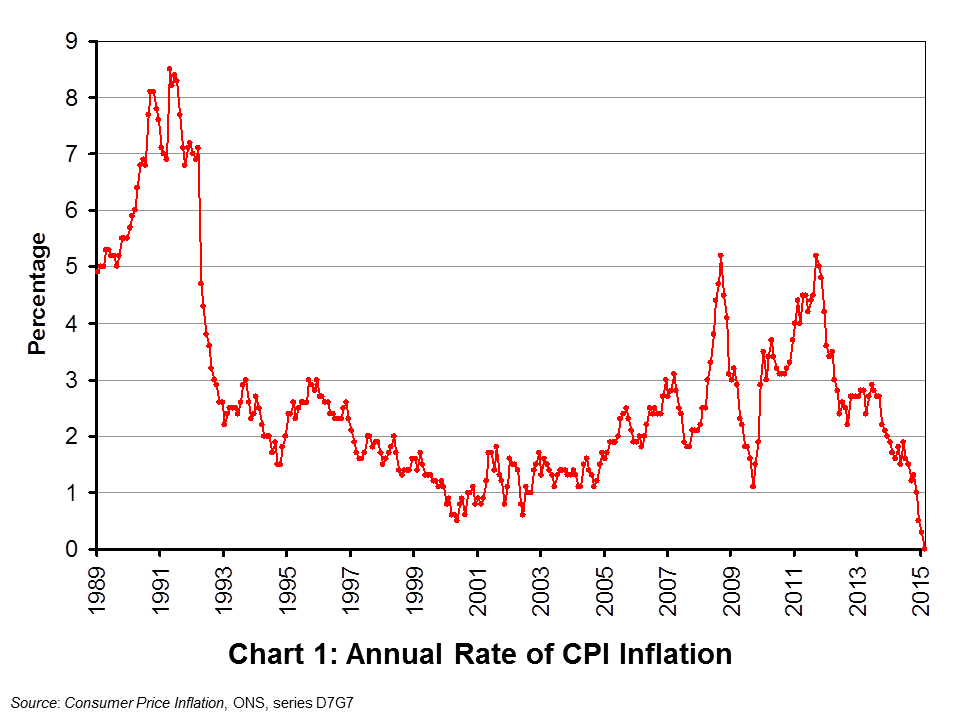 The annual rate of CPI inflation in February 2015 was zero. This means that the price of the representative basket of goods and services was unchanged from its level in February 2014. As Chart 1 shows (click here for a PowerPoint of the chart), the annual rate of CPI inflation series goes back to January 1989 and this is the first time it has fallen to zero. Its average over this period is in fact 2.7 per cent. The recent fall is quite stark with the rate of CPI inflation in June 2013 close to the top-end of the Bank of England’s target range at 2.9 per cent.
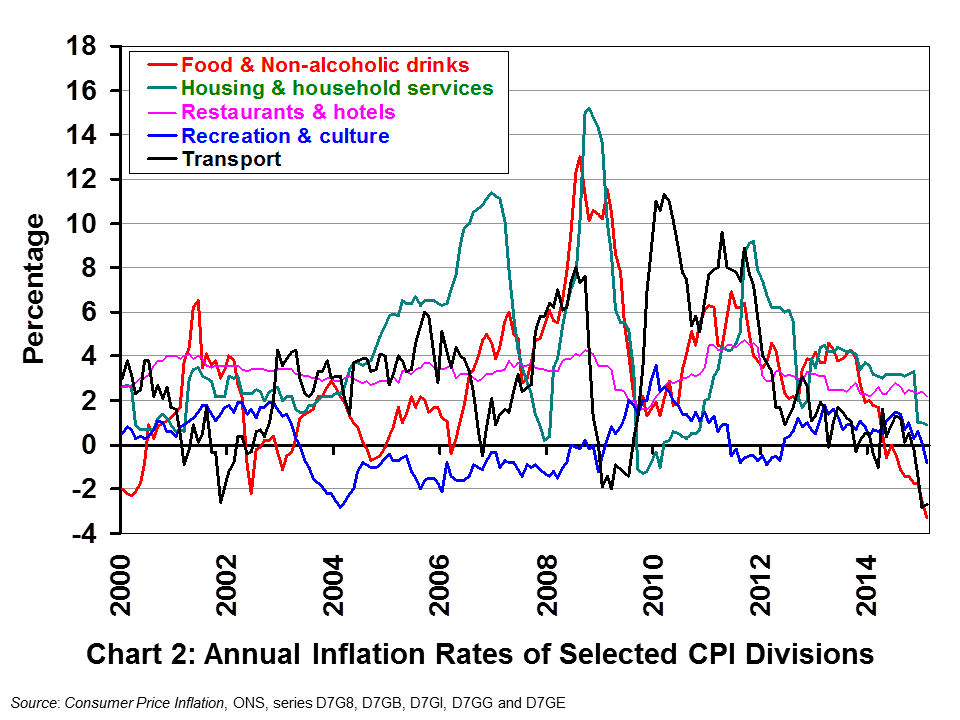 Of the 12 product groups, five constitute 10 per cent or more of the overall weight of the CPI index. These weights are dependent on the relative level of expenditure comprised by each division.
Chart 2 shows the annual rates of inflation for these five groups (click here for a PowerPoint of the chart). The most heavily-weighted component is transport (14.9%), which includes the price of fuel and passenger transport. Here we observe deflation with prices 2.7 per cent lower year-on-year in February. This is the fourth consecutive month where its annual rate of price inflation has been negative.
The second most heavily-weighted component within the CPI index is recreation and culture (14.7%), which includes games, toys and audio-visual equipment. Here too we see the emergence of deflation. In February 2015 prices were 0.8 per cent lower than in February 2014. Deflation is most prevalent in the fifth most heavily-weighted component (11.0%): food and non-alcoholic drinks. The price for this division of the CPI was 3.3 per cent lower in February 2015 as compared with February 2014. In nine of the last ten months the price of food and non-alcoholic drinks, helped by aggressive price competition in the grocery sector, has been lower year-on-year.
February also saw a negative annual rate of inflation emerge for the first time in the CPI division capturing furniture and household equipment and appliances (-0.3 per cent). Further, miscellaneous services, which include personal care and personal effects (e.g. jewellery) saw an annual rate of deflation for the eight consecutive month. The annual rate of inflation for miscellaneous services stood at -0.4 per cent in February. However, February did see an upturn in price inflation for clothing and footwear with prices 1.7 per cent higher than a year earlier while the price of alcohol and tobacco was 3.8 per cent higher year-on-year.
The detailed inflation numbers do reveal the extent to which many CPI divisions are already characterised by deflation. It is interesting to note that in A Comparison of Independent Forecasts published monthly by HM Treasury, the forecast for the final quarter of 2015 is for the annual rate of CPI inflation to be running at 0.8 per cent. An important reason for this is that the effect of falling fuel prices from November 2014 will begin to drop out of the year-on-year inflation rate calculations. The removal of this effect should help to prevent the specter of deflation provided that peoples’ inflationary expectations remain anchored, i.e. exhibit stickiness. If these were to be revised down, however, this would further contribute to downward pressure on prices since input price inflation – including wage inflation – would again be expected to fall.
Articles
U.K. on Brink of Falling Prices as Inflation Rate Drops to Zero Bloomberg, Tom Beardsworth (24/3/15)
UK inflation rate falls to zero in February BBC News (24/3/15)
Britain sees no inflation in February for first time on record Reuters, David Milliken and Andy Bruce (24/3/15)
Inflation hits a record zero boosting household incomes Independent, Clare Hutchinson (24/3/15)
Inflation Hits 0% As Food Costs Fall Further Sky News (24/3/15)
Inflation falls to zero in February as Britain heads to deflation Telegraph, Szu Ping Chan (24/3/15)
UK inflation hits zero for the first time on record Guardian, Angela Monaghan (24/3/15)
Data
Consumer Price Inflation, February 2015 Office for National Statistics
Consumer Price Indices, Time Series Data Office for National Statistics
Questions
- Explain the difference between a decrease in the level of prices and a decrease in the rate of price inflation. Can the rate of price inflation rise even if price levels are falling? Explain your answer
- Explain what is meant by deflation.
- In what ways might deflation affect the behaviour of people? What effect could this have on the macroeconomy?
- Why do you think policy-makers, such as the Monetary Policy Committee, would be interested in the inflation rates within the overall CPI inflation rate?
- What factors do you think lie behind the fall in the transport component of the CPI?
- Explain why the rate of inflation would be expected to rise in the late autumn, a year on from when the transport component of the CPI began falling.
- Does the possibility of deflation mean that inflation rate targeting has failed?
 The rate of inflation in the UK is measured using the Consumer Prices Index (CPI). This is made up of a basket of goods and the ONS updates this ‘basket’ each year to ensure it is representative of what the average UK household buys. The basket contains 703 items, with 110,000 individual prices collected each month.
In past years, items such as lip gloss have been added to the basket of goods, together with tablet computers and teenage fiction. In the recent update by the ONS, e-cigarettes have been added, together with specialist ‘craft’ beers and music streaming. On the other hand, other items have been removed, as the world changes. For example, during the recession, champagne was removed as an item that the representative household was no longer buying. In other cases, items are removed as they become outdated or obsolete with technology changing. This is the case with satellite navigation systems. As people turn to using their smartphones to navigate their way from A to B, satellite navigation systems are no longer seen as an item bought by the representative household.
The UK inflation rate is at an all-time low of 0.3% and there have been concerns that it may become negative, meaning we enter the world of deflation. However, if this does occur, many suggest that it is not bad deflation, as it is being driven by the extremely low oil prices. No matter what the inflation rate, the ONS will always continue to update the basket of goods that calculates inflation. It is therefore essential that these changes are made each year, as consumer buying habits do fluctuate considerably, as income changes, technology changes and general tastes change. The following articles consider what’s in and what’s out.
From craft beer to e-cigarettes, inflation basket reflects Britain’s changing shopping habits The Guardian, Katie Allen (17/3/15)
Inflation-measuring basket of goods adds protein powder, e-cigarettes The Grocer, Andrew Don (17/3/15)
E-cigareets and craft beers in updated inflation basket BBC News (17/3/15)
E-cigs added to inflation basket Mail Online (17/3/15)
Craft beer, e-cigarettes and protein shakes dded to price basket used to calculate inflation Independent, Hazel Sheffield (17/3/15)
U.K. hipsters and gym junkies win approval in new price basket Bloomberg, Tom Beardsworth (17/3/15)
Spotify in and sat navs out: take a look at the new inflation basket The Telegraph, Szu Ping Chan (17/3/15)
E-cigarettes, craft beer and Spotify enter UK inflation basket Reuters, Toby Melville (17/3/15)
Craft beer and e-cigarettes added to CPI basket Financial Times (17/3/15)
Questions
- What is the difference between the CPI and RPI? Which is usually higher? Explain your answer.
- Explain why champagne was removed from the basket of goods during the recession. What is sensible?
- How is the CPI calculated and hence how is inflation measured?
- Why has there been a movement towards chilled pizzas and away from frozen pizzas? Is the change likely to affect their relative price? Use a diagram to support your answer.
- What impact has technological progress had on the basket of goods that the representative household purchases? Do you think that technological progress make it more or less important for the basket of goods to be reviewed annually?
- Do you think products such as the iPad and e-cigarettes should be included in the CPI? Are they truly representative?
- In the BBC News article, you can access a list of the products that are ‘in and out’. Is there anything on there that you think should be in or that should be out? Be sure to justify your answer!
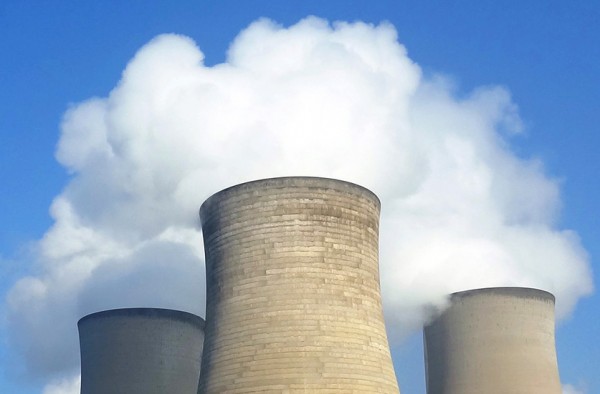 Many UK coal mines closed in the 1970s and 80s. Coal extraction was too expensive in the UK to compete with cheap imported coal and many consumers were switching away from coal to cleaner fuels. Today many shale oil producers in the USA are finding that extraction has become unprofitable with oil prices having fallen by some 50% since mid-2014 (see A crude indicator of the economy (Part 2) and The price of oil in 2015 and beyond). So is it a bad idea to invest in fossil fuel production? Could such assets become unusable – what is known as ‘stranded assets‘?
In a speech on 3 March 2015, Confronting the challenges of tomorrow’s world, delivered at an insurance conference, Paul Fisher, Deputy Governor of the Bank of England, warned that a switch to both renewable sources of energy and actions to save energy could hit investors in fossil fuel companies.
‘One live risk right now is of insurers investing in assets that could be left ‘stranded’ by policy changes which limit the use of fossil fuels. As the world increasingly limits carbon emissions, and moves to alternative energy sources, investments in fossil fuels and related technologies – a growing financial market in recent decades – may take a huge hit. There are already a few specific examples of this having happened.
… As the world increasingly limits carbon emissions, and moves to alternative energy sources, investments in fossil fuels and related technologies – a growing financial market in recent decades – may take a huge hit. There are already a few specific examples of this having happened.’
Much of the known reserves of fossil fuels could not be used if climate change targets are to be met. And investment in the search for new reserves would be of little value unless they were very cheap to extract. But will climate change targets be met? 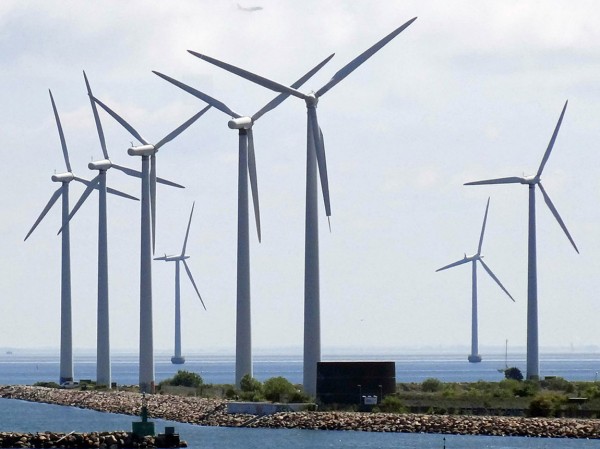 That is hard to predict and depends on international political agreements and implementation, combined with technological developments in fields such as clean-burn technologies, carbon capture and renewable energy. The scale of these developments is uncertain. As Paul Fisher said in his speech:
‘Tomorrow’s world inevitably brings change. Some changes can be forecast, or guessed by extrapolating from what we know today. But there are, inevitably, the unknown unknowns which will help shape the future. … As an ex-forecaster I can tell you confidently that the only thing we can be certain of is that there will be changes that no one will predict.’
The following articles look at the speech and at the financial risks of fossil fuel investment. The Guardian article also provides links to some useful resources.
Articles
Bank of England warns of huge financial risk from fossil fuel investments The Guardian, Damian Carrington (3/3/15)
PRA warns insurers on fossil fuel assets Insurance Asset Risk (3/3/15)
Energy trends changing investment dynamics UPI, Daniel J. Graeber (3/3/15)
Speech
Confronting the challenges of tomorrow’s world Bank of England, Paul Fisher (3/3/15)
Questions
- What factors are taken into account by investors in fossil fuel assets?
- Why might a power station become a ‘stranded asset’?
- How is game theory relevant in understanding the process of climate change negotiations and the outcomes of such negotiations?
- What social functions are filled by insurance?
- Why does climate change impact on insurers on both sides of their balance sheets?
- What is the Prudential Regulation Authority (PRA)? What is its purpose?
- Explain what is meant by ‘unknown unknowns’. How do they differ from ‘known unknowns’?
- How do the arguments in the article and the speech relate to the controversy about investing in fracking in the UK?
- Explain and comment on the statement by World Bank President, Jim Yong Kim, that sooner rather than later, financial regulators must address the systemic risk associated with carbon-intensive activities in their economies.
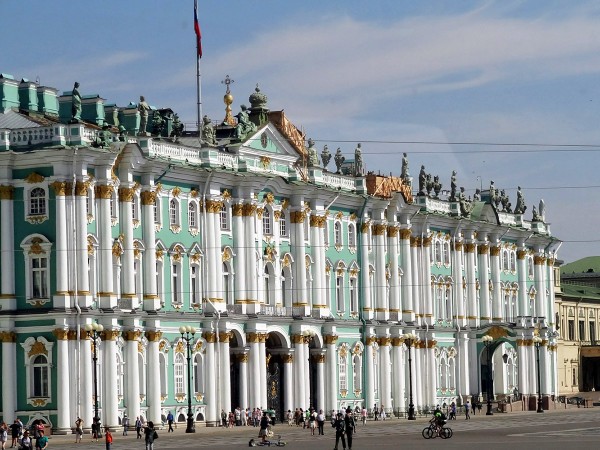 Many important economic changes have occurred over the past two years and many have occurred in the past two months. Almost all economic events create winners and losers and that is no different for the Russian economy and the Russian population.
There is an interesting article plus videos on the BBC News website (see link below), which consider some of the economic events that, directly or indirectly, have had an impact on Russia: the fall in oil prices; the conflict between Russia and the Ukraine; the fall in the value of the rouble (see chart); the sanctions imposed by the West.
Clearly there are some very large links between events, but an interesting question concerns the impact they have had on the everyday Russian consumer and business. Economic growth in 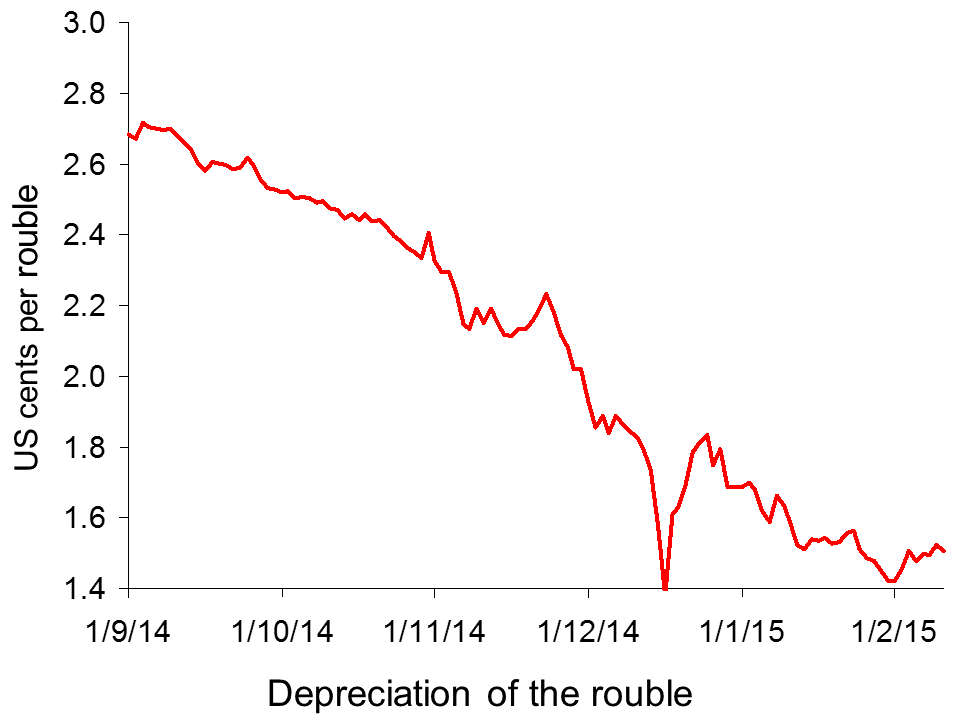 Russia has been adversely affected and estimates suggest that the economy will shrink further over the coming year. Oil and gas prices have declined significantly and while this is good news for many consumers across the world, it brings much sadder tidings for an economy, such as Russia, that is so dependent on oil exports.
However, is there a bright side to the sanctions or the falling currency? The BBC News article considers the winners and losers in Russia, including families struggling to feed their families following spending cuts and businesses benefiting from less competition.
 Russia’s economic turmoil: nightmare or opportunity? BBC News, Olga Ivshina and Oleg Bodyrev (5/2/15)
Questions
- Why has the rouble fallen in value? Use a demand and supply diagram to illustrate this.
- What does a cheap rouble mean for exporters and importers within Russia and within countries such as the UK or US?
- One of the businesses described in the article explain how the sanctions have helped. What is the explanation and can the effects be seen as being in the consumer’s interest?
- Oil prices have fallen significantly over the past few months. Why is this so detrimental to Russia?
- What is the link between the exchange rate and inflation?