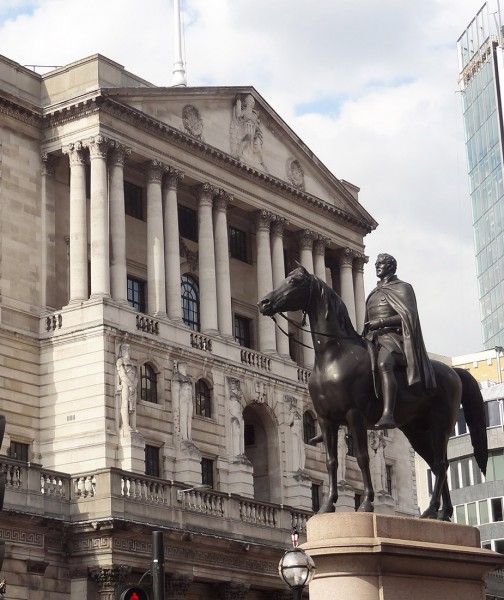
 In an interview with the Yorkshire Post, Mark Carney, Governor of the Bank of England, said that under current circumstances he did not feel that further quantitative easing was justified. He said:
My personal view is, given the recovery has strengthened and broadened, I don’t see a case for quantitative easing and I have not supported it.
In response to his speech, the pound strengthened against the dollar. It appreciated by just over 1 cent, or 0.7%. But why should the likelihood of no further quantitative easing lead to a strengthening of the pound?
The answer lies with people’s anticipation of future interest rates. If there is no further increase in money supply through QE, interest rates are likely to rise as the economy recovers and thus the demand for money rises.  A rise in interest rates, in turn, is likely to lead to an inflow of finance into the country, thereby boosting the financial account of the balance of payments. The increased demand for sterling will tend to drive up the exchange rate.
However, an increase in aggregate demand will result in an increase in imports and a likely increase in the balance of trade deficit. Indeed, in July (the latest figures available) the balance of trade deficit rose to £3.085bn from £1.256bn in June. As recovery continues, the balance of trade deficit is likely to deteriorate further. Other things being equal, this would lead to a depreciation of the pound.
So if the pound appreciates, this suggests that the effect on the financial account is bigger than the effect on the current account – or is anticipated to be so. In fact, given the huge volumes of short-term capital that move across the foreign exchanges each day, financial account effects of interest rate changes – actual or anticipated – generally outweigh current account effects.
Articles
Yorkshire can reap benefits from turnaround says Mark Carney Yorkshire Post (27/9/13)
Sterling Jumps as BOE Chief Signals No More Bond Buying Wall Street Journal, Nick Cawley and Jason Douglas (27/9/13)
Carney’s Northern Exposure Sends Sterling Soaring Wall Street Journal, David Cottle (27/9/13)
Pound Gains as Carney Sees No Case for QE, Confidence Improves Bloomberg, Anchalee Worrachate & David Goodman (28/9/13)
Exchange Rate Bounces as Strong UK Data Supports Sterling FCF (Future Currency Forecast), Laura Parsons (30/9/13)
Currency briefing: What if the pound sterling has been overbought? iNVEZZ, Tsvyata Petkova (30/9/13)
Pound rises after Carney rejects increasing QE BBC News (27/9/13)
Pound Rises for Fourth Day Versus Euro on Housing, Mortgage Data Bloomberg, Emma Charlton (30/9/13)
Data
$ per £ exchange rate (latest month) XE (You can access other periods and currencies)
Effective exchange rate indices (nominal and real) Bank for International Settlements
Balance of Payments, Q2 2013 Dataset ONS
Questions
- Explain how quantitative easing affects exchange rates.
- What is happening concerning quantitative easing in the USA? How is this likely to affect the exchange rate of the US dollar to sterling; other currencies to sterling?
- Why may an increase in the balance of trade deficit lead directly to an appreciation of the exchange rate?
- Why is an anticipation of a policy change likely to have more of an effect on exchange rates than the actual policy change itself? Why, indeed, may a policy change have the reverse effect once it is implemented?
- Under what circumstances may speculation against exchange rate changes be (a) stabilising; (b) destabilising?
- How is quantitative easing (or an anticipation of it) likely to affect each of the main components of the current and financial accounts of the balance of payments?
- For what reasons might sterling have been ‘overbought’ and hence be overvalued?
- What is meant by the real exchange rate (REER)? Why may reference to the REER suggest that sterling is not currently overvalued?
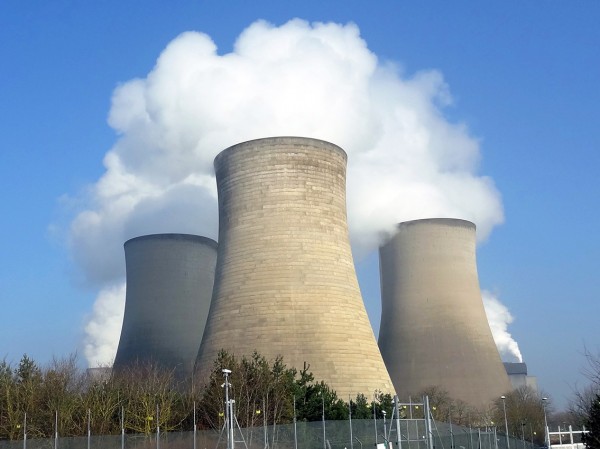 For all households, energy is considered an essential item. As electricity and gas prices rise and fall, many of us don’t think twice about turning on the lights, cooking a meal or turning on the heating. We may complain about the cost and want prices brought down, but we still pay the bills. But, is there anything that can be done about high energy prices? And if there is, should anything be done?
The worlds of politics and economics are closely linked and Ed Miliband’s announcement of his party’s plans to impose a 20-month freeze on energy prices if elected in 2015 showed this relationship to be as strong as ever. The price freeze would certainly help average households reduce their cost of living by around £120 and estimates suggest businesses would save £1800 over this 20 month period. The energy companies have come in for a lot of criticism, in particular relating to their control of the industry. The sector is dominated by six big companies – your typical oligopoly, and this makes it very difficult for new firms to enter. Thus competition is restricted. But is a price freeze a good policy?
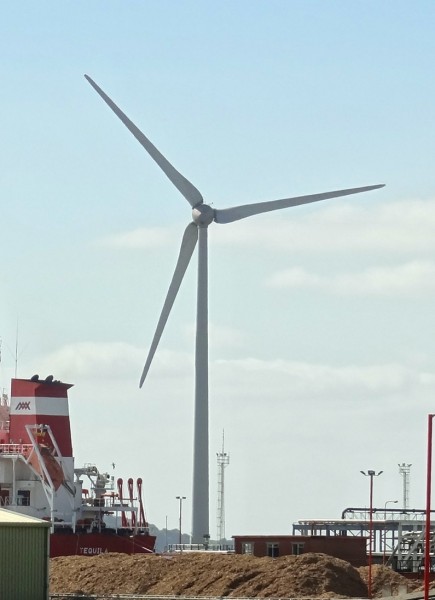 Part of the prices we pay go towards investment in cleaner and more environmentally friendly sources of energy. Critics suggest that any price freeze would deprive the energy sector of much needed investment, meaning our energy bills will be higher in the future. Furthermore, some argue this price freeze suggests that Labour is abandoning its environmental policy. Energy shortages have been a concern, especially with the cold weather the UK experienced a few years ago. This issue may reappear with price freezes. As Angela Knight, from Energy UK, suggests:
Freezing the bill may be superficially attractive, but it will also freeze the money to build and renew power stations, freeze the jobs and livelihoods of the 600,000-plus people dependent on the energy industry and make the prospect of energy shortages a reality, pushing up the prices for everyone.
There is a further concern and that is that large energy companies will be driven from the UK. This thought was echoed by many companies, in particular the British Gas owner Centrica, commenting that:
If prices were to be controlled against a background of rising costs it would simply not be economically viable for Centrica to continue to operate and far less to meet the sizeable investment challenge that the industry is facing…The impact of such a policy would be damaging for the country’s long-term prosperity and for our customers.
Share prices naturally fluctuate with global events and a political announcement such as this was inevitably going to cause an effect. But, perhaps the effect was not expected to be as big as the one we saw. 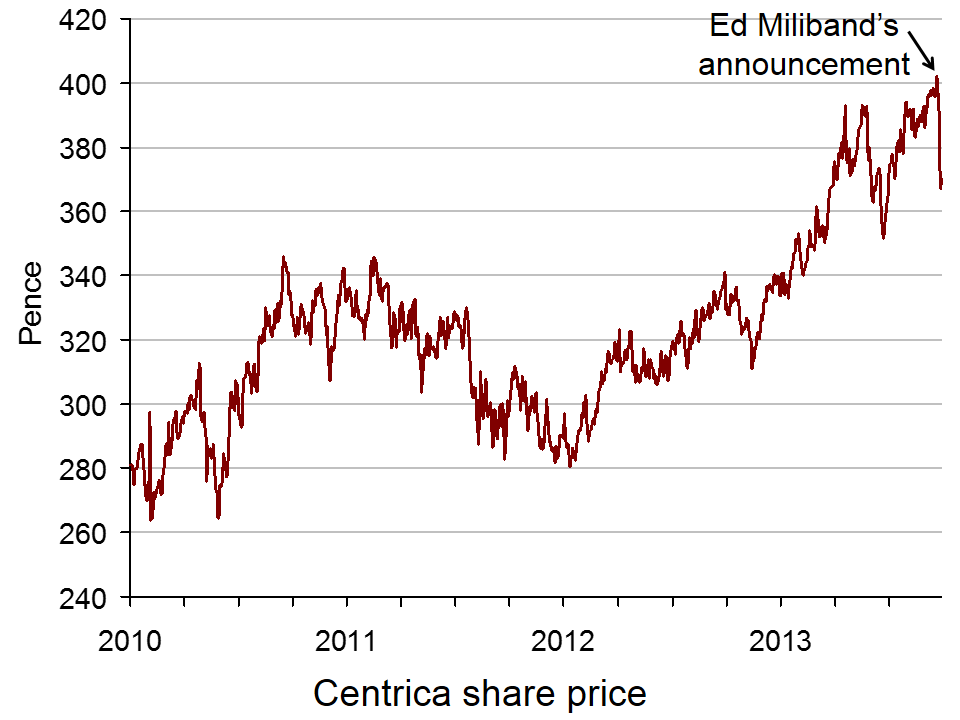 Share prices for Centrica and SSE fell following the announcement – perhaps no great shock – but then they continued to fall. The market value tumbled by 5% and share prices kept falling. This has led to Ed Miliband being accused of ‘economic vandalism’ by a major shareholder of Centrica, which is hardly surprising, given the estimated cost of such a price freeze would be £4.5 billion.
The economic implications of such a move are significant. The announcement itself has caused massive changes in the FTSE and if such a move were to go ahead if Labour were elected in 2015, there would be serious consequences. While families would benefit, at least in the short term, there would inevitably be serious implications for businesses, the environmental policy of the government, especially relating to investment and the overall state of the economy. The following articles consider the aftermath of Ed Miliband’s announcement.
Miliband stands firm in battle over fuel bills plan The Guardian, Patrick Wintour and Terry Macalister (25/9/13)
Michael Fallon calls Miliband’s energy prices pledge ‘dangerous’ Financial Times, Elizabeth Rigby and Jim Pickard (26/9/13)
Britain’s labour treads narrow path between populism and prudence Reuters (26/9/12)
Ed Miliband’s radical reforms will make the energy market work for the many Independent (26/9/13)
Has Labour fallen out of love with Business? BBC News (26/9/13)
Top Centrica shareholder Neil Woodford accuses Labour leader Ed Miliband of economic vandalism The Telegraph, Kamal Ahmed (25/9/13)
Centrica and SSE slide after Labour price freeze pledge The Guardian (26/9/13)
Ed Miliband’s energy price freeze pledge is a timely but risky move The Guardian, Rowena Mason (24/9/13)
Questions
- Why are energy prices such a controversial topic?
- How are energy prices currently determined? Use a diagram to illustrate your answer. By adapting this diagram, illustrate the effect of a price control being imposed. How could it create an energy shortage? What impact would this have after the 20-month price freeze
- Why would there be adverse effects on energy companies if prices were frozen and costs increased? Use a diagram to illustrate the problem and use your answer to explain why energy companies might leave the UK.
- How would frozen energy prices help households and businesses?
- Why were share prices in Centrica and SSE adversely affected?
- Is there an argument for regulating other markets with price controls?
- Why is there such little competition in the energy sector?
 Coffee prices have been falling on international commodity markets. In August, the International Coffee Organization’s ‘composite indicator price’ fell to its lowest level since September 2009 (see). This reflects changes in demand and supply. According to the ICO’s monthly Coffee Market Report for August 2013 (see):
“Total exports in July 2013 reached 9.1 million bags, 6.6% less than July 2012, but total exports for the first ten months of the coffee year are still up 3.6% at 94.5 million bags. In terms of coffee consumption, an increase of 2.1% is estimated in calendar year 2012 to around 142 million bags, compared to 139.1 million bags in 2011.”
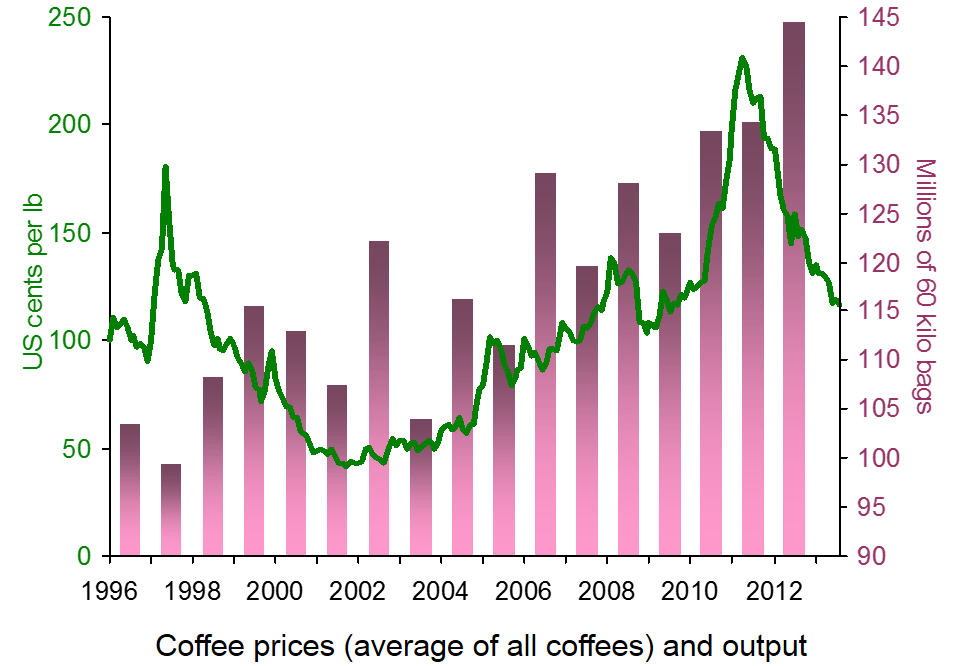 But despite the fall in wholesale coffee prices, the price of a coffee in your local coffee shop, or of a jar of coffee in the supermarket, has not been falling. Is this what you would expect, given the structure of the industry? Is it simply a blatant case of the abuse of market power of individual companies, such as Starbucks, or even of oligopolistic collusion? Or are more subtle things going on?
The following articles look at recent trends in coffee prices at both the wholesale and retail level.
Articles
Coffee Prices Continue Decline Equities.com, Joel Anderson (17/9/13)
Arabica coffee falls Business Recorder (19/9/13)
Brazil Launches Measures to Boost Coffee Prices N. J. Douek, Jeffrey Lewis (7/9/13)
 Coffee Prices Destroyed Bloomberg (4/9/13)
The surprising reality behind your daily coffee: The CUP costs twice as much as the beans that are flown in from South America Mail Online, Mario Ledwith (23/9/13)
Coffeenomics: Four Reasons Why You Can’t Get a Discount Latte Bloomberg Businessweek, Kyle Stock (19/9/13)
Here’s who benefits from falling coffee costs CNBC, Alex Rosenberg (9/9/13)
The great coffee rip-off is no myth Sydney Morning Herald, BusnessDay, Michael Pascoe (23/9/13)
Monthly Coffee Market Report International Coffee Organization (August 2013)
Data
Coffee Prices ICO
ICO Indicator Prices – Annual and Monthly Averages: 1998 to 2013 ICO
Coffee, Other Mild Arabicas Monthly Price – US cents per Pound Index Mundi
Coffee, Robusta Monthly Price – US cents per Pound Index Mundi
Questions
- Why have wholesale coffee prices fallen so much since 2011? Are the reasons on the demand side, the supply side or both? Illustrate your answer with a supply and demand diagram.
- What determines the price elasticity of demand for coffee (a) on international coffee markets; (b) in supermarkets; (c) in coffee shops?
- Why has the gap between Arabica and Robusta coffee prices narrowed in recent months?
- Identify the reasons why coffee prices have not fallen in coffee shops.
- The cost of the coffee beans accounts for around 4% of the cost of a cup of coffee in a coffee shop. If coffee beans were to double in price and other costs and profits were to remain constant, by what percentage would a cup of coffee rise?
- How would you set about establishing whether oligopolistic collusion was taking place between coffee shops?
- What is meant by ‘hedging’ in coffee markets? How does hedging affect wholesale coffee prices?
- Explain the statement “If they have hedged correctly, Starbucks and such competitors as Green Mountain Coffee Roasters (GMCR) are likely paying far more for beans right now than current market rates.”
- What are “buffer stocks”. How can governments use buffer stocks (e.g. of coffee beans) to stabilise prices? What is the limitation on their power to do so? Can buffer stocks support higher prices over the long term?
- What are “coffee futures”? What determines their price? What effect will coffee future prices have on (a) the current price of coffee; (b) the actual price of coffee in the future?
 As we saw in the news item The difficult exit from cheap money, central banks around the world have been operating an extremely loose monetary policy since the beginning of 2009. Their interest rates have been close to zero and trillions of dollars of extra money has been injected into the world economy through various programmes of quantitative easing.
For the past few months the Federal Reserve has been purchasing bonds under its most recent programme dubbed QE3, and thereby increasing narrow money, by $85 billion per month. Since the start of its QE programme in 2009, it has pumped around $2.8 trillion of extra money into the US and world economies. This huge increase in money supply has boosted the demand for assets worldwide and world stock markets have risen. Much of the money has flowed into developing countries, such as India, and has acted as a boost to their economies.
 Once the US economy is growing strongly again, the aim is to taper off, and ultimately end or even reverse, the QE programme. It was expected that the Fed would decide to start this tapering off process at its meeting on 18 September – perhaps reducing bond purchases initially by some $10 billion. (Note that this would still be an increase in money supply, just a slightly smaller one.) Over the past few days, US bond prices have been falling (and yields increasing) in anticipation of such a move.
As it turned out, the Fed decided to delay tapering off. It will continue with its assets purchase programme of $85 billion per month for the time being. The reason given was that the US economy was still too fragile and needed the monthly injections of money to stay at the current level.
Normally it might be expected that the announcement of a more fragile recovery would cause the US stock market, and others worldwide, to fall. In fact the opposite occurred, with investors relieved that the extra money, which allows extra asset purchases, would continue at the same rate.
But this then raises the question of just what will be the effect when tapering off does actually occur. Will stock markets then go into a tailspin? Or will they merely stop rising so fast. That depends very much on the role of speculation.
Webcasts
Bernanke’s Own Words on Asset Purchases, Economy Bloomberg (18/9/13)
Bernanke: Fed to delay bond tapering PBS Newshour on YouTube (full speech plus questions) (18/9/13)
No tapering announced by Fed CNBC on Yahoo Finance (18/9/113)
The impact of US stimulus moves at home and abroad BBC News, Stephanie Flanders (18/9/13)
Is the upturn reaching Americans? BBC World, Stephanie Flanders (17/9/13)
Shares hit high as Federal Reserve maintains stimulus BBC News, Stephanie Flanders (18/9/13)
US Fed decision to delay tapering was a relief ET Now (India), Bimal Jalan (19/9/13)
Articles
Federal Reserve surprises markets by delaying QE tapering The Telegraph, Katherine Rushton (18/9/13)
Federal Reserve delays QE tapering: the full statement The Telegraph (18/9/13)
Q&A: What is tapering? BBC News (18/9/13)
Fed delay is no reason to celebrate The Guardian, Larry Elliott (19/9/13)
Federal Reserve tapering decision has baffled the markets The Guardian, Larry Elliott (19/9/13)
Taper tiger The Economist (21/9/13)
Everything You Need to Know About the Fed’s Decision Not to Taper QE3 The Atlantic, Matthew O’Brien (18/9/13)
Fed’s dovish turn leaves Wall Street economists mulling taper timing: poll Reuters, Chris Reese (18/9/13)
Good news and bad news from the Fed BBC News, Stephanie Flanders (19/9/13)
Is the Fed frightened of its shadow? BBC News, Robert Peston (19/9/13)
The Federal Reserve and Janet Yellen face a tough task with insufficient tools The Guardian, Mohamed A. El-Erian (14/10/13)
Questions
- Why might a slowing down in the increase in US money supply cause asset prices to fall, rather than merely to rise less quickly?
- Why has the US QE programme led to a rise in asset prices overseas?
- Distinguish between stabilising and destabilising speculation. Which type of speculation has been occurring as a result of the US QE programme?
- How has QE affected unemployment in the UK and USA? How is the participation rate and the flexibility of labour markets relevant to the answer?
- Explain the following two statements by Stephanie Flanders and Robert Peston respectively. “The market conditions argument has a circularity to it: talk of tapering leads to higher market rates, which in turn puts the taper itself on hold.” “The Fed simply hinting that less money would be created, means that there will be no reduction in the amount of money created (for now at least).”
- Why have US long-term interest rates, including mortgage rates, risen since May of this year?
- What impact have higher US long-term interest rates had on economies in the developing world? Explain.
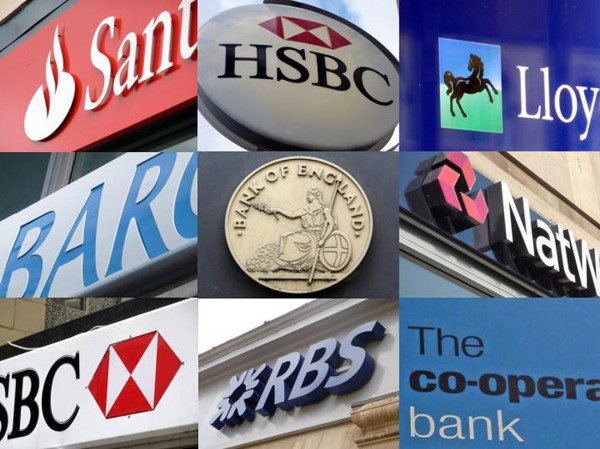 On 15 September 2008, Lehman Brothers, the fourth-largest investment bank in the USA, filed for bankruptcy. Although the credit crisis had been building since mid 2007, the demise of Lehmans was a pivotal event in the unfolding of the financial crisis and the subsequent severe recession in most developed economies. Banks were no longer seen as safe and huge amounts of government money had to be poured into banks to shore up their capital and prevent further bankruptcies. Partial nationalisation seemed the only way of rescuing several banks and with it the global financial system.
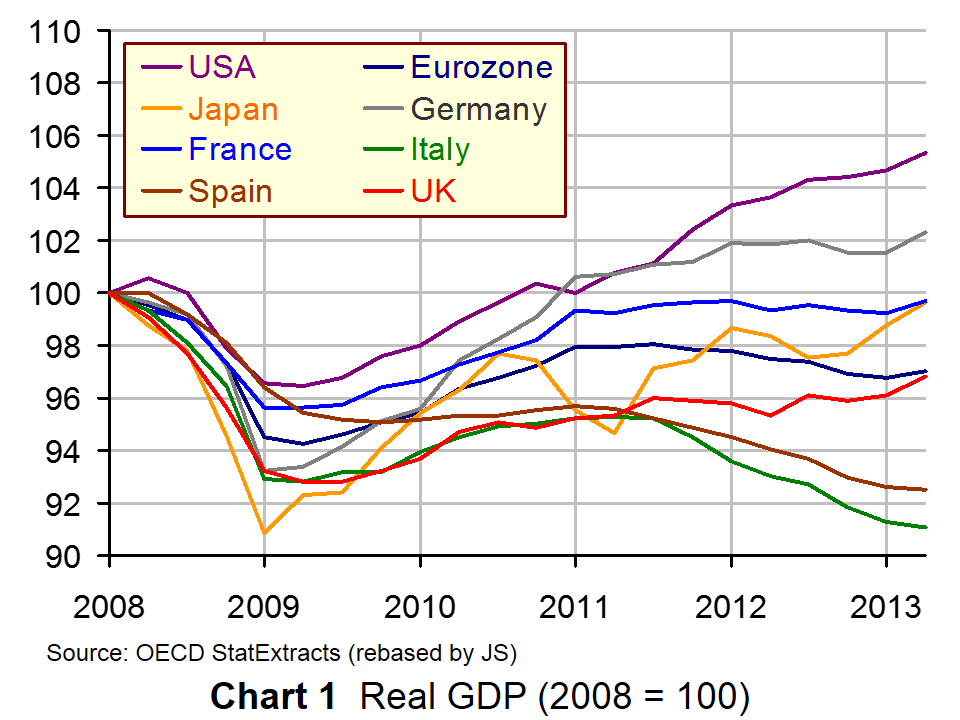 A deep and prolonged recession followed (see Chart 1: click here for a PowerPoint). In response, governments pursued expansionary fiscal policies – at least until worries about rising government deficits and debt caused a lurch to austerity policies. And central banks pursued policies of near zero interest rates and subsequently of quantitative easing. But all the time debate was taking place about how to reform banking to prevent similar crises occurring in the future.
Solutions have included reform of the Basel banking regulations to ensure greater capital adequacy. 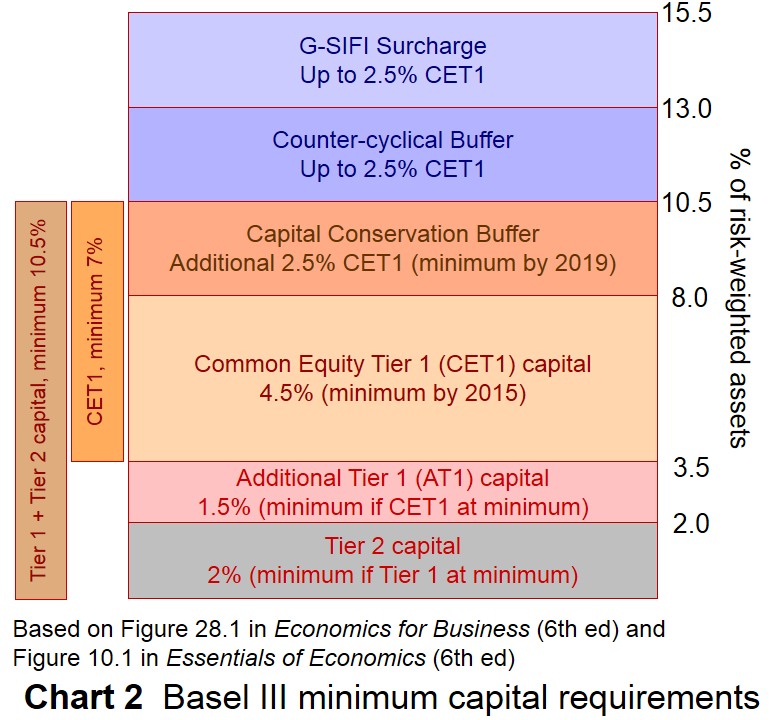 The Basel III regulations (see Chart 2) demand considerably higher capital ratios than the previous Basel II regulations.
Other solutions have included proposals to break up banks. Indeed, just this week, the Lloyds Banking Group has hived off 631 of its branches (one sixth of the total) into a newly reformed TSB. Another proposal is to ring-fence the retail side of banks from their riskier investment divisions. In both cases the aim has been to avoid the scenario where banks are seen as too big to fail and can thus rely on governments to bail them out if they run into difficulties. Such reliance can make banks much more willing to take excessive risks. Further details of the new systems now in place are given in the Robert Peston article below.
But many critics maintain that not nearly enough has been done. Claims include:
• The Basel III rules are not tough enough and banks are still being required to hold too little capital.
• Rewards to senior bankers and traders are still excessive.
• The culture of banking, as a result, is still too risk loving in banks’ trading arms, even though they are now much more cautious about lending to firms and individuals.
• This caution has meant a continuing of the credit crunch for many small businesses.
• Higher capital adequacy ratios have reduced bank lending and have thus had a dampening effect on the real economy.
• The so-called ring-fences may not be sufficient to insulate retail banking from problems in banks’ investment divisions.
• Banks are not being required to hold sufficient liquidity to allow them to meet customers’ demands for cash in all scenarios.
• Banks’ reliance on each other still leaves a systemic risk for the banking system as a whole.
• Fading memories of the crisis are causing urgency to tackle its underlying problems to diminish.
• Problems may be brewing in less regulated parts of the banking world, such as the growing banking sector in China.
The following articles look at the lessons of the banking crisis – those that have been learned and those that have not. They look at the measures put in place and assess whether they are sufficient.
Lehman Brothers collapse, five years on: ‘We had almost no control’ The Guardian, Larry Elliott and Jill Treanor (13/9/13)
Lehman Brothers collapse: five years on, we’re still feeling the shockwaves The Guardian, Larry Elliott (13/9/13)
Five years after Lehman, could a collapse happen all over again? The Observer, Larry Elliott and Jill Treanor (15/9/13)
Five years after Lehman, all tickety-boo? BBC News, Robert Peston (9/9/13)
What have we learned from the bank crash? Independent, Yalman Onaran, Michael J Moore and Max Abelson (14/9/13)
We’ve let a good financial crisis go to waste since Lehman Brothers collapsed The Telegraph, Jeremy Warner (12/9/13)
The Lehman legacy: Lessons learned? The Economist (9/9/13)
The dangers of debt: Lending weight The Economist (14/9/13)
The Lehman anniversary: Five years in charts The Economist (14/9/13)
Questions
- Why did Lehman Brothers collapse?
- Explain the role of the US sub-prime mortgage market in the global financial crisis of 2007/8.
- In the context of banking, what is meant by (a) capital adequacy; (b) risk-based capital adequacy ratios; (c) leverage; (d) leverage ratios?
- Explain the Basel III rules on (a) risk-based capital adequacy (see the textbook and the chart above); (b) non-risk-based leverage (introduced in 2013: see here for details).
- Explain and comment on the following statement by Adair Turner: ‘We created an over-leveraged financial system and an over-leveraged real economy. We created a system such that even if the direct cost of bank rescue was zero, the impact of their near-failure on the economy was vast.’
- Under what circumstances might the global financial system face a similar crisis to that of 2007/8 at some point in the future?
- Why is there an underlying conflict between increasing banks’ required capital adequacy and ensuring a sufficient supply of credit to consumers and business? What multiplier effects are likely to occur from an increase in the capital adequacy ratio?
 In an interview with the Yorkshire Post, Mark Carney, Governor of the Bank of England, said that under current circumstances he did not feel that further quantitative easing was justified. He said:
 A rise in interest rates, in turn, is likely to lead to an inflow of finance into the country, thereby boosting the financial account of the balance of payments. The increased demand for sterling will tend to drive up the exchange rate.