 The Big Four are well known: Deloitte, Ernst and Young, KPMG and PWC. They act as auditors for 90% of the UK’s stock-market listed companies. They have a very close relationship with the companies that they audit and because of this have faced criticism of not warning of the financial crisis. A further accusation is that the relationship between auditors and managers has become blurred.
In some sense, there is a problem of divorce of ownership from control. The companies that are audited by the Big Four have shareholders who are interested in profits and their dividends. But they employ managers who are responsible for the day-to-day running of the business. However, there are concerns that the auditors have become more concerned with meeting the interests of the managers and not of the shareholders. It has been suggested that the company’s management tend to ‘present their accounts in the most favourable light, whereas shareholder interests can be quite different.’ Laura Carstensen, the chair of the Audit Investigation Group said:
It is clear that there is significant dissatisfaction amongst some institutional investors with the relevance and extent of reporting in audited financial reports … management may have incentives to present their accounts in the most favourable light, whereas shareholder interests can be quite different.
 The Big Four have been criticised for limiting competition in the industry. The Competition Commission has said that companies typically stay with the same auditing firm and this acts to limit competition. One suggestion to encourage competition is to enforce rotation of Auditors. However, the Big Four have said that the market remains competitive, ‘healthy and robust’ and that any enforcement as noted above would not be in the public interest. Other, smaller auditing companies have praised the preliminary report of the Competition Commission. One firm said:
No one solution will achieve market correction, but rather a combination of tendering requirements, encouragement of transparency and dialogue between auditors, companies and investors, and reform of outdated exclusionary practices should provide a backdrop for a healthier FTSE 350 audit market.
The report is not yet final, but the future of the Big Four is somewhat uncertain, especially with the European Commission’s desire to break them up. The following articles look at this industry.
Big Four accountants reject claims over high prices and poor competition The Guardian, Josephine Moulds and David Feeney (22/2/13)
Competition Commission raps Big Four accountants BBC News (22/2/13)
Big Four’s rivals welcome audit shake-up Financial Times, Adam Jones (22/2/13)
UK’s “Big Four” accountants under fire from watchdog Reuters, Huw Jones (22/2/13)
Big Four chastised by Competition Commission The Telegraph, Helia Ebrahimi (22/2/13)
The uncompetitive culture of auditing’s big four remains undented The Guardian, Prem Sikka (23/2/13)
Big Four accountants ‘in closed club on audits’ Independent, Mark Leftly (23/2/13)
Questions
- What is the role of the Competition Commission?
- Explain with other examples the problem of the divorce of ownership from control. How might the interest of shareholders and managers differ? Can they ever be aligned?
- Is market share a good measure of the competitiveness of an industry?
- What are the benefits of competition?
- Why has the regulator suggested that the Big Four are limiting competition?
- What solutions have been proposed by the Competition Commission? Explain how they are likely to stimulate competition in this market.
 The news in many European countries has been dominated in February by the ‘horse meat scandal’. Small traces of horse meat may be the result of faulty quality control. But the significant amount of horse found in several processed meat products suggest fraud at one or more points in the supply chain from farm to supermarket or other outlet. Indeed several specific suppliers, from abattoirs to processors are facing criminal investigation.
The scandal has put the supply chain under intense scrutiny. Part of the problem is that the supply chain is often very long and complex. As the Guardian article states:
The food and retail industries have become highly concentrated and globalised in recent decades. A handful of key players dominate the beef processing and supermarket sectors across Europe. They have developed very long supply chains, particularly for their economy lines, which enable them to buy the ingredients for processed foods from wherever they are cheapest at any point, depending on exchange rates and prices on the global commodity markets. Networks of brokers, cold stores operators and subcontracted meat cutting plants have emerged to supply rapidly fluctuating orders “just in time”. Management consultants KPMG estimate there are around 450 points at which the integrity of the chain can break down.
Then there is the huge pressure on all parts of the supply chain to reduce costs.
 Supermarkets use their market power to drive down the prices of the products they buy from their suppliers and this has a knock-on effect backwards down the supply chain. This pressure has intensified as real wages have fallen and consumers have found their budgets squeezed.
At the same time, beef and other meat prices have been rising as the costs of animal feed have soared. This all puts tremendous pressure on suppliers to add cheaper ingredients. Again to quote the Guardian article:
Manufacturers add other cheap ingredients including water and fat, and use concentrated proteins to bind the water and fat in. They may appear on labels as ‘seasoning’. One of the cheapest sources of these protein additives is pork rind. It is possible that horse hide is now also being used. The widespread adulteration of cheap chicken breast with pig and beef proteins and water has been uncovered in previous scandals. The beef proteins were derived from hydrolysed cattle hides. It is not illegal to use these protein concentrates so long as they are identified correctly to the manufacturer.
It is not surprising that if cheap horse meat becomes available to suppliers, such as from old horses towards the end of their working lives, some processing companies may be tempted to add it fraudulently, stating that it is beef.
The articles look at the issues of long and complex supply chains in the processed food industry and assess why they have evolved into their current form and the difficulties in regulating them.
Horsegate: heed economics of the cold chain The Grocer, Andrew Godley (16/2/13)
Horsemeat scandal: the essential guide The Guardian, Felicity Lawrence (15/2/13)
After the horse has been bolted The Economist (16/2/13)
Slavery, not horse meat, is the real scandal on our doorstep The Telegraph, Fraser Nelson (14/2/13)
Industry must take the reins on food safety Globe and Mail (Canada)Sylvain Charlebois (15/2/13)
Supply chains changed the growth model The Economist, Richard Baldwin (15/8/12)
Supply-chain management The Economist (6/4/09)
Tesco pledges to open up supply chain after horse meat scandal The Telegraph (16/2/13)
Horse meat scandal: Shoppers who buy ‘cheapest food’ at risk The Telegraph, James Quinn, Jason Lewis and Patrick Sawer (16/2/13)
Let Them Eat Horse Bloomberg, Marc Champion (15/2/13)
Scandal shows meat supply chain must be policed heraldscotland (14/2/13)
MPs push for new powers for FSA as officials seize yet more suspect meat Independent, Martin Hickman (13/2/13)
Questions
- Why do supermarkets and their suppliers use long supply chains?
- Explain the concepts of ‘countervailing power’ and ‘monopsony or oligopsony power’? How do they apply in the processed meat supply chain?
- Identify the types of transactions costs in the processed meat industry.
- In what ways do consumers (a) gain and (b) lose from such supply chains?
- Why is the problem of fraud in processed food supply chains likely to have intensified in recent years?
- How have supermarkets reacted to the horse meat scandal? Why has it taken the scandal to make them react in this way?
- To what extent is the problem simply one of inaccurate labelling?
- To what extent is there a principal–agent problem in the processed meat supply chain?
 Few people have £18bn worth of funds to spend. But someone that does is Warren Buffett and a Brazilian firm, who look set to purchase Heinz for this sum. Heinz, known for things like baked beans and ketchup already has an exceptionally strong brand and is cash rich – these are two ingredients which Warren Buffett likes and have undoubtedly played their part in securing what looks to be a tasty deal.
The company’s Board has already approved the deal, but shareholders still need to have their say and have been offered $72.50 per share. 650 million bottles of Heinz ketchup are sold every year and its baked beans, at the least in the UK, are second to none. Products like this have given Heinz its global brand name and have provided the opportunity to shareholders to make significant gains. Its Chairman said:
The Heinz brand is one of the most respected brands in the global food industry and this historic transaction provides tremendous value to Heinz shareolders.
This statement was certainly reciprocated by Warren Buffett when he spoke to CNBC, saying:
It is our kind of company … I’ve sampled it many times … Anytime we see a deal is attractive and it’s our kind of business and we’ve got the money, I’m ready to do.
 The deal therefore looks to be profitable to both sides, but is there more to it? An investigation has already been launched by the Securities and Exchange Commission as to whether information about this purchase was leaked early and was used to make money. Insider trading occurs when someone is given information early about a merger such as the one described above. They then use this information, before it is made public, to buy up a company’s stock. It is incredibly difficult to prosecute and huge amounts of money can be made by hedge funds, amongst others. This is certainly one aspect of the deal to keep your eye on.
So, what does the future hold for Warren Buffett and Heinz? Buffett likes to extract extra value from companies he purchases and has in the past split up his businesses to create separate trading companies. However, given his taste for ketchup and his appreciation for strong global brands, it’s unlikely that we’ll see a change to the recipe of any of the well-known products. The following articles consider the takeover and the case of insider trading.
 Will Buffet ‘squeeze value’ from Heinz BBC News (15/2/13)
Heinz-Buffett deal: will anyone spill the beans on insider trading? The Guardian, Heidi Moore (15/2/13)
Heinz bought by Warren Buffett’s Berkshire Hathaway for $28bn BBC News (14/2/13)
Traders sued over Heinz share bets Independent, Nikhil Kumar (16/2/13)
Heinz deal brings it back to its roots Financial Times, Alan Rappeport, Dan McCrum and Anoushka Sakoui (14/2/13)
Beanz means Buffet: Heinz purchased in $28bn takeover The Guardian, Dominic Rush (14/2/13)
US SEC sues over Heinz option trading before buyout Reuters (15/2/13)
Warren Buffet and Brazil’s ‘Sage’ Jorge Leman strike £18bn Heinz deal The Telegraph, Richard Blackden (15/2/13)
Questions
- What type of take-over would you class this as?
- Consider the Boston matrix – in which category would you place Heinz when you think about its market share and market growth?
- Why is a company that has a global brand and that is cash rich so tempting?
- Given your answer to question 3, why have other investors not taken an interest in purchasing Heinz?
- If you were a shareholder in Heinz, what factors would you consider when deciding whether or not to vote for the takeover?
- What growth strategy has Heinz used to establish its current position in the global market place?
- What is insider trading? Explain how early information can be used to make money in the case of Heinz.
- Explain how the share price of $72.50 is set. How does the market have a role?
 The technology sector is highly complex and is led by Apple. However, as the tablet market is continuing to grow, it is becoming increasingly competitive with other firms such as Samsung gaining market share. Although both firms sell many products, it is the growing tablet market which is one of the keys to their continued growth.
Tablet PCs have seen a growth in the final quarter of 2012 to a high of 52.5 million units, according to IDC. Although Apple, leading the market, has seen a growth in its sales, its market share has declined to 43.6%. Over the same period, Samsung has increased its market share from 7.3% to 15.1%. While it is still a huge margin behind Apple in the tablet PC market, Samsung’s increase in sales from 2.2 million to 7.9 million is impressive and if such a trend were to continue, it would certainly cause Apple to take note.
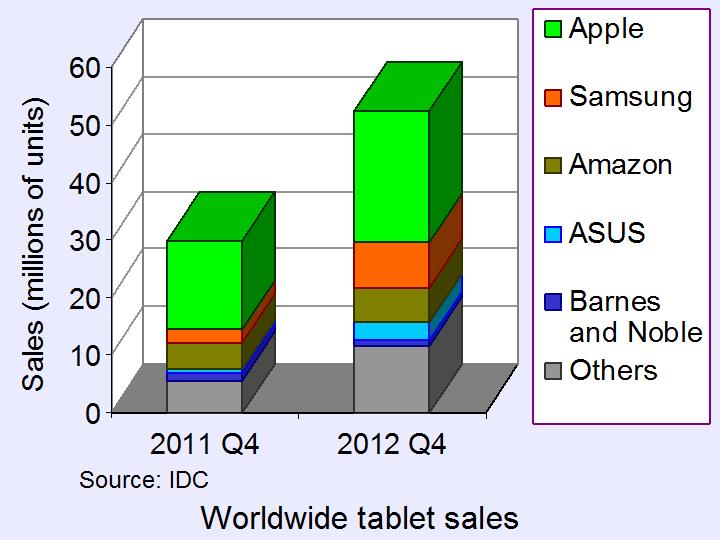 It’s not just these two firms trying to take advantage of this growing industry. Microsoft has recently launched a new tablet PC and although its reception was less than spectacular, it is expected that Microsoft will become a key competitor in the long run. There are many factors driving the growth in this market and the war over market share is surely only just beginning. The chart shows the 75.3% growth in sales in just one year. (Click here for a PowerPoint of the chart.)
A Research Director at IDC said:
We expected a very strong fourth quarter, and the market didn’t disappoint…New product launches from the category’s top vendors, as well as new entrant Microsoft, led to a surge in consumer interest and very robust shipments totals during the holiday season’
Apple has been so dominant in this sector that other companies until recently have had little success in gaining market share. However, with companies such as Samsung and ASUS now making in-roads, competition is likely to become fierce. There are already concerns that Apple’s best days are behind it and its share price reflects this. People are now less willing to pay a premium price for an Apple product, as the innovations of its competitors have now caught up with those of the leading brand name. The following articles consider this growing market.
Samsung gain tablet market share as Apple lead narrows BBC News (1/2/13)
Apple snatches US lead from Samsung Financial Times, Tim Bradshaw (1/2/13)
Apple revenues miss expectations despite high sales figures BBC News (24/1/13)
Samsung eats into Apple sales in the tablet market Mirror, Ruki Sayid (1/2/13)
MacWorld’s Apple celebration opens amid fears of tech giant’s decline Guardian, Rory Carroll (31/1/13)
Samsung’s tablet sales soar as Apple’s grip on market loosens Daily News and Analysis, Richard Blagden (2/2/13)
Samsung takes a nibble out of Apple’s tablet lead InfoWorld, Ted Samson(31/1/13)
Tablet Sales up 75% as Samsung and Asus Gain on Apple Interational Business Times, Edward Smith (31/1/13)
Questions
- Which factors are behind this exceptional growth in the tablet PC market?
- Using the Boston matrix, where do you think tablet PCs fit in terms of market size and market growth?
- Where would you place this market in terms of the product life cycle?
- What does the product life cycle say about the degree of competition, the impact on pricing on profits etc. in the phase that you placed the tablet PC market in your answer to question 3?
- Why have Apple’s shares fallen recently? Do you think this will be the new trend?
- Microsoft’s new tablet didn’t attract huge sales. What explanation was given for this? Use a diagram to help answer this question.
- Tablet PCs are relatively expensive, yet sales of them have increased significantly over the past few years. What explanation is there for this, given that we have been (and still are) in tough financial times?
 Over the past five years the Office of Fair Trading (OFT) has been closely studying the market for personal bank accounts in the UK. Last week, it announced its latest findings and the evidence seems to suggest that there remains a lack of competition in the market.
On the positive side, it reports that there has been a large fall in unarranged overdraft fees. However, despite this, according to the OFT banks still make on average £139 per year from every active current account. Furthermore, concentration has increased with the four largest banks (Barclays, Lloyds, HSBC and RBS) now accounting for 85% of the market and there has been little new entry. It appears that one of the key factors in enabling these main players to dominate the market and reap high profits is a lack of consumer switching behaviour. According to the OFT chief executive, Clive Maxwell:
Customers still find it difficult to assess which account offers the best deal and lack confidence that they can switch accounts easily. This prevents them from driving effective competition between providers.
Despite all these concerns, the OFT declined to refer the market to the Competition Commission for a more in-depth investigation and potential remedial action. Instead, the OFT will look at the market again in 2015. Richard Lloyd, the executive director at the consumer organisation Which?, was disappointed with this decision and was quoted in the The Guardian as saying:
Everyone – consumers, the government, leading bankers and now the OFT – seems to agree that big change is needed in banking, and that much greater competition on the high street is urgently needed to make the banks work for customers, not bankers.
Whilst at least for the moment, the Competition Commission will not get the chance to take action, there are still several reforms underway that may affect competition in the market. First, the OFT is increasing pressure on banks to allow consumers to have portable account numbers that they can take with them if they switch provider. Second, as a result of the Independent Commission’s review, banks will be required to switch a customer’s account in one week, rather than the average of 18 days it currently takes, and this process will become much more seamless. Finally, Lloyds has agreed to sell over 600 branches to the Co-op in order to meet the European Commission’s requirements following the government bail-out of the bank in 2008. This will increase the Co-op’s share of the current account market to 7%. It will be interesting to see how these reforms affect the market. If there is not substantial evidence of increased competition then the market is likely to face more scrutiny from the competition authorities.
Bank accounts: OFT says significant change needed BBC (25/01/13)
OFT: banks failing consumers The Economic Voice (25/01/13)
Let’s make bank accounts as easy to switch as mobiles The Telegraph, Andrew Oxlade (28/01/13)
OFT chief calls for more competitive banking sector The Telegraph, Denise Roland (30/01/13)
Questions
- What type of market structure best fits the banking industry?
- What are the barriers to entry in this market?
- What are the key features of the market that reduce consumer switching behaviour?
- Do you think most people are more likely to switch their mobile phone or current account provider? Explain.
- Why does limited consumer switching reduce the intensity of competition?
- Do you think the current reforms will result in a substantial increase in competition?