 The ONS has just released its annual publication, The Effects of Taxes and Benefits on Household Income. The report gives data for the financial year 2012/13 and historical data from 1977 to 2012/13.
The publication looks at the distribution of income both before and after taxes and benefits. It divides the population into five and ten equal-sized groups by household income (quintiles and deciles) and shows the distribution of income between these groups. It also looks at distribution within specific categories of the population, such as non-retired and retired households and different types of household composition.
The data show that the richest fifth of households had an average pre-tax-and-benefit income of £81,284 in 2012/13, 14.7 times greater than average of £5536 for the poorest fifth. The richest tenth had an average pre-tax-and-benefit income of £104,940, 27.1 times greater than the average of £3875 for the poorest tenth.
 After the receipt of cash benefits, these gaps narrow to 6.6 and 11.0 times respectively. When the effect of direct taxes are included (giving ‘disposable income’), the gaps narrow further to 5.6 and 9.3 times respectively. However, when indirect taxes are also included, the gaps widen again to 6.9 and 13.6 times.
This shows that although direct taxes are progressive between bottom and top quintiles and deciles, indirect taxes are so regressive that the overall effect of taxes is regressive. In fact, the richest fifth paid 35.1% of their income in tax, whereas the poorest fifth paid 37.4%.
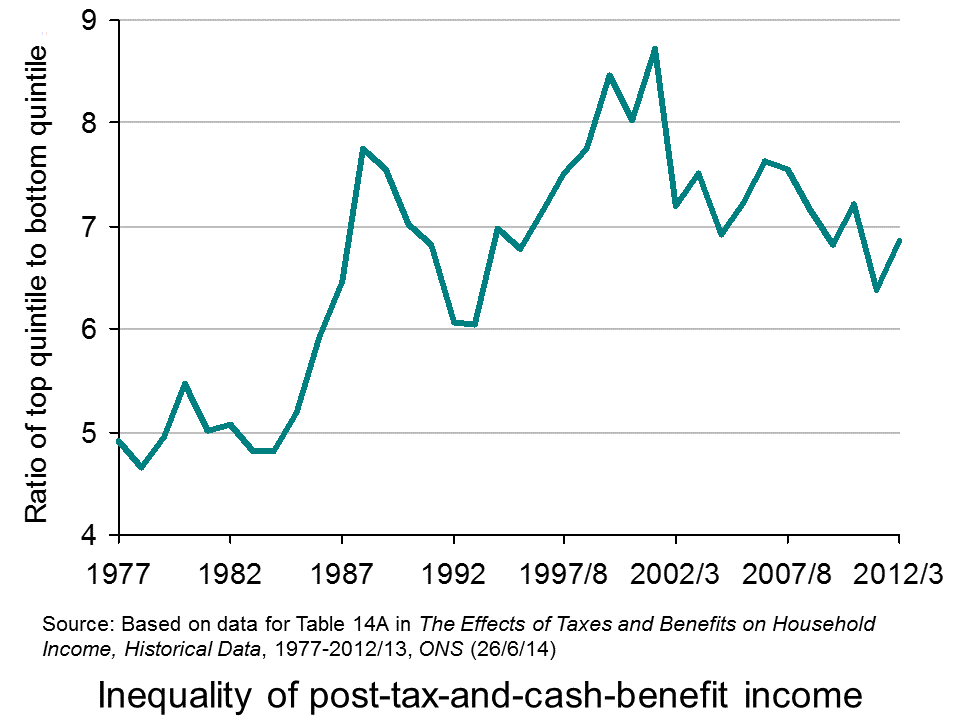
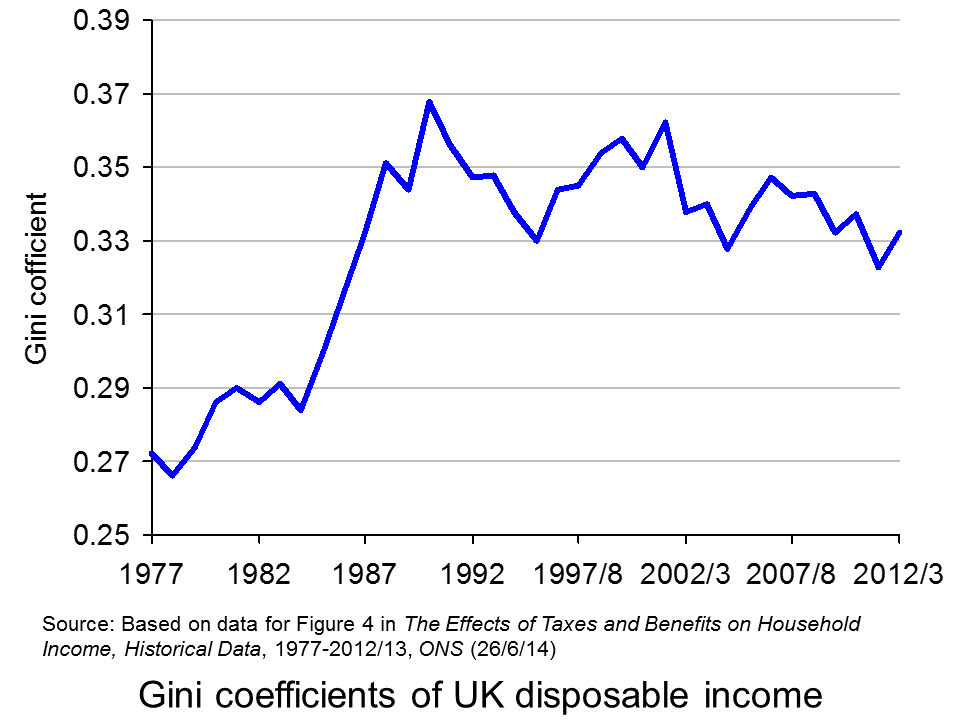 Taking the period from 1977 to 2012/13, inequality of disposable income (i.e. income after direct taxes and cash benefits) increased from 1977 to 1988, especially during the second two Thatcher governments (1983 to 1990) (see chart opposite). But then in the first part of the 1990s inequality fell, only to rise again in the late 1990s and early 2000s. However, with the Labour government giving greater cash benefits for the poor, inequality reduced once more, only to widen again in the boom running up to the banking crisis of 2007/8. But then, with recession taking hold, the incomes of many top earners fell and automatic stabilisers helped protect the incomes of the poor. Inequality consequently fell. But with the capping of benefit increases and a rise in incomes of many top earners as the economy recovers, so inequality is beginning to rise once more – in 2012/13, the Gini coefficient rose to 0.332 from 0.323 the previous year.
As far as income after cash benefits and both direct and indirect taxes is concerned, the average income of the richest quintile relative to that of the poorest quintile rose from 7.2 in 2002/3 to 7.6 in 2007/8 and then fell to 6.9 in 2012/13.
Other headlines in the report include:
Since the start of the economic downturn in 2007/08, the average disposable income has decreased for the richest fifth of households but increased for the poorest fifth.
Cash benefits made up over half (56.4%) of the gross income of the poorest fifth of households, compared with 3.2% of the richest fifth, in 2012/13.
The average disposable income in 2012/13 was unchanged from 2011/12, but it remains lower than at the start of the economic downturn, with equivalised disposable income falling by £1200 since 2007/08 in real terms. The fall in income has been largest for the richest fifth of households (5.2%). In contrast, after accounting for inflation and household composition, the average income for the poorest fifth has grown over this period (3.5%).
This is clearly a mixed picture in terms of whether the UK is becoming more or less equal. Politicians will, no doubt, ‘cherry pick’ the data that suit their political position. In general, the government will present a good news story and the opposition a bad news one. As economists, it is hoped that you can take a dispassionate look at the data and attempt to relate the figures to policies and events.
Report
The Effects of Taxes and Benefits on Household Income, 2012/13 ONS (26/6/14)
Data
Reference tables in The Effects of Taxes and Benefits on Household Income, 2012/13 ONS (26/6/14)
The Effects of Taxes and Benefits on Household Income, Historical Data, 1977-2012/13 ONS (26/6/14)
Rates of Income Tax: 1990-91 to 2014-15 HMRC
Articles
Inequality is on the up again – Osborne’s boast is over New Statesman, George Eaton (26/6/14)
Disposable incomes rise for richest fifth households only Money.com, Lucinda Beeman (26/6/14)
Half of families receive more from the state than they pay in taxes but income equality widens as rich get richer Mail Online, Matt Chorley (26/6/14)
Rich getting richer as everyone else is getting poorer, Government’s own figures reveal Mirror, Mark Ellis (26/6/14)
The Richest Households Got Richer Last Year, While Everyone Else Got Poorer The Economic Voice (27/6/14)
Questions
- Define the following terms: original income, gross income, disposable income, post-tax income, final income.
- How does the receipt of benefits in kind vary across the quintile groups? Explain.
- What are meant by the Lorenz curve and the Gini coefficient and how is the Gini coefficient measured? Is it a good way of measuring inequality?
- Paint a picture of how income distribution has changed over the past 35 years.
- Can changes in tax be a means of helping the poorest in society?
- What types of income tax cuts are progressive and what are regressive?
- Why are taxes in the UK regressive?
- Why has the fall in income been largest for the richest fifth of households since 2007/8? Does this mean that, as the economy recovers, the richest fifth of households are likely to experience the fastest increase in disposable incomes?
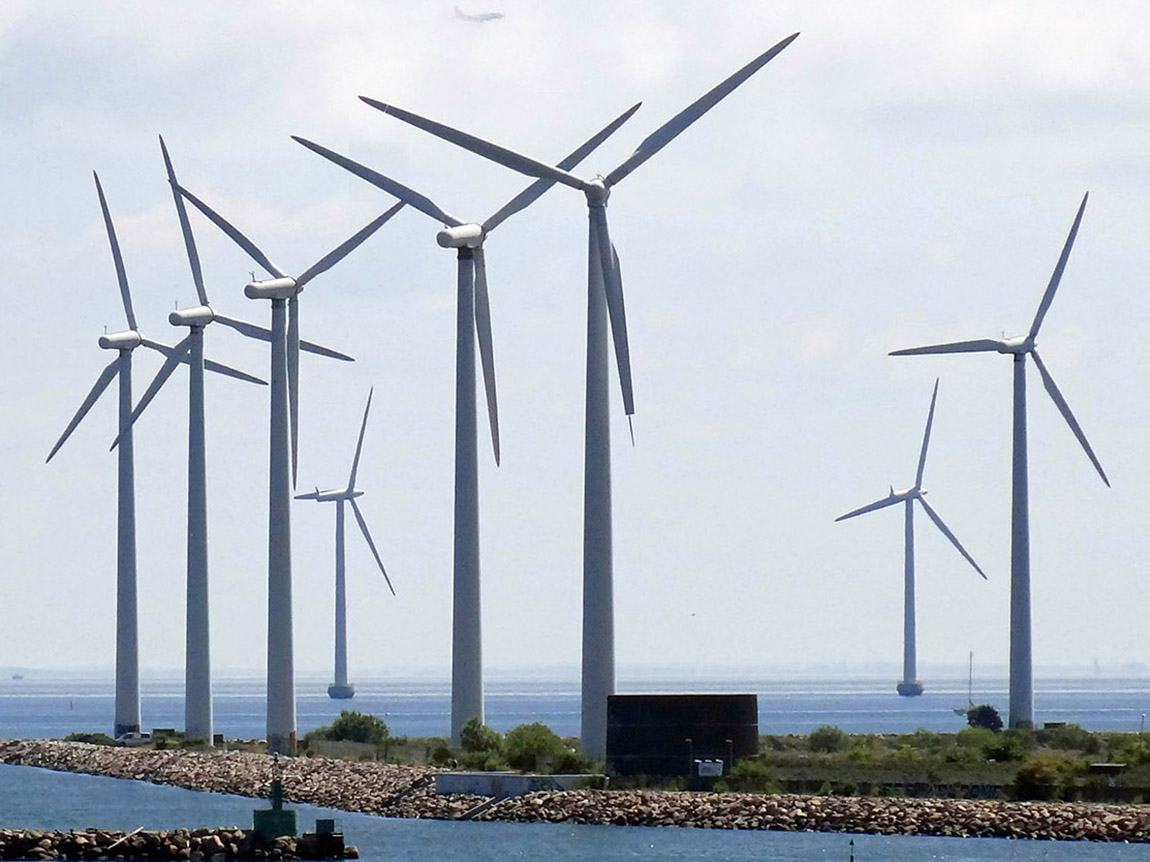 The Clean Energy Bill has been on the agenda for some time and not just in the UK. With climate change an ever growing global concern, investment in other cleaner energy sources has been essential. However, when it comes to investment in wind farms, developers have faced significant opposition. The balancing act for the government appears to be generating sufficient investment in wind farms, while minimising the negative externalities.
The phrase often thrown around with regards to wind farms, seems to be ‘not in my backyard’. That is, people recognise the need for them, but don’t want them to be built in the local areas. The reason is to do with the negative externalities. Not only are the wind farms several metres high and wide, creating a blight on the landscape, but they also create a noise, both of which impose a third party effect on the local communities. These factors, amongst others, have led to numerous protests whenever a new wind farm is suggested. The problem has been that with such challenging targets for energy, wind farms are essential and thus government regulation has been able to over-ride the protests of local communities.
However, planning guidance in the UK will now be changed to give local opposition the ability to override national energy targets. In some sense, more weight is being given to the negative externalities associated with a new wind farm. This doesn’t mean that the government is unwilling to let investment in wind farms stop. Instead, incentives are being used to try to encourage local communities to accept new wind farms. While acknowledging the existence of negative externalities, the government is perhaps trying to put a value on them. The benefits offered to local communities by developers will increase by a factor of five, thus aiming to compensate those affected accordingly. Unsurprisingly, there have been mixed opinions, summed up by Maria McCaffery, the Chief Executive of trade association RenewableUK:
Maria McCaffery, chief executive of trade association RenewableUK, said the proposals would signal the end of many planned developments and that was “disappointing”.
Developing wind farms requires a significant amount of investment to be made upfront. Adding to this cost, by following the government’s advice that we should pay substantially more into community funds for future projects, will unfortunately make some planned wind energy developments uneconomic in England.
That said, we recognise the need to ensure good practice across the industry and will continue to work with government and local authorities to benefit communities right across the country which are hosting our clean energy future.
The improved benefits package by the energy industry is expected to be in place towards the end of the year. The idea is that with greater use of wind farms, energy bills can be subsidised, thereby reducing the cost of living. Investment in wind farms (on-shore and off-shore) is essential. Current energy sources are non-renewable and as such new energy sources must be developed. However, many are focused on the short term cost and not the long term benefit that such investment will bring. The public appears to be in favour of investment in new energy sources, especially with the prospect of subsidised energy bills – but this positive outlook soon turns into protest when the developers pick ‘your back yard’ as the next site. The following articles consider this issue.
Residents to get more say over wind farms The Guardian, Fiona Harvey and Peter Walker (6/6/13)
Local communities offered more say over wind farms BBC News (6/6/13)
Locals to get veto power over wind farms The Telegraph, Robert Winnett (6/6/13)
Wind farms are a ‘complete scam’, claims the Environment Secretary who says turbines are causing ‘huge unhappiness’ Mail Online, Matt Chorley (7/6/13)
New planning guidance will make it harder to build wind farms Financial Times, Jim Pickard, Pilita Clark and Elizabeth Rigby (6/6/13)
Will more power to nimbys be the death of wind farms? Channel 4 News (6/6/13)
Locals given more ground to block wind farms Independent, Tom Bawden (6/6/13)
Questions
- What are the negative externalities associated with wind farms?
- Conduct a cost-benefit analysis as to whether a wind farm should be constructed in your local area. Which factors have you given greatest weight to?
- In question 2 above, were you concerned about the Pareto criterion or the Hicks-Kaldor criterion?
- If local communities can be compensated sufficiently, should wind farms go ahead?
- If the added cost to the development of wind farms means that some will no longer go ahead, is this efficient?
- Why is there a need to invest in new energy sources?
- To what extent is climate change a global problem requiring international (and not national) solution?
 Unemployment is a key macroeconomic objective for governments across the world. The unemployment rate for the UK now stands at 7.9% according to the ONS, which recorded 2.56 million people out of work. But why is unemployment of such importance? What are the costs?
The economy is already in a vulnerable state and with unemployment rising by 70,000 people between December and February 2013, the state of the economic recovery has been questioned. Indeed, following the news of the worsening unemployment data, the pound fell significantly against the dollar, suggesting a lack of confidence in the British economy.
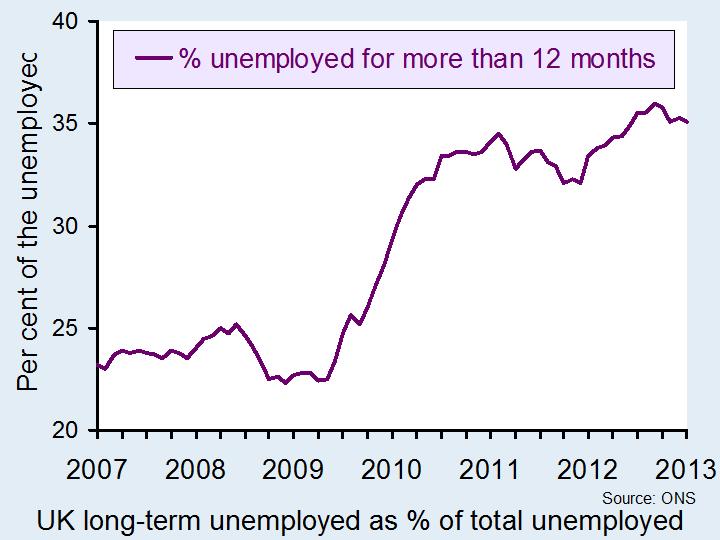 Although the increase in the number of people out of work is concerning, perhaps of more concern should be the number of long-term unemployed. The ONS suggests that more than 900,000 have now been out of work for more than a year. Not only does this pose costs for the individual in terms of lost earnings and skills, but it also imposes costs on friends and family and the wider economy. (Click here for a PowerPoint of the first chart, which shows the percentage of unemployed people out for work longer than 12 months.)
The chief executive of the Prince’s Trust focused on the costs of youth unemployment in particular, saying:
Thousands of these young people are long-term unemployed, often facing further challenges such as poverty and homelessness. We must act now to support these young people into work and give them the chance of a better future.
(Click here for a PowerPoint of the second chart, which shows how much higher the unemployment rate is for young people aged 18 to 24 than it is for the working age population as a whole.)
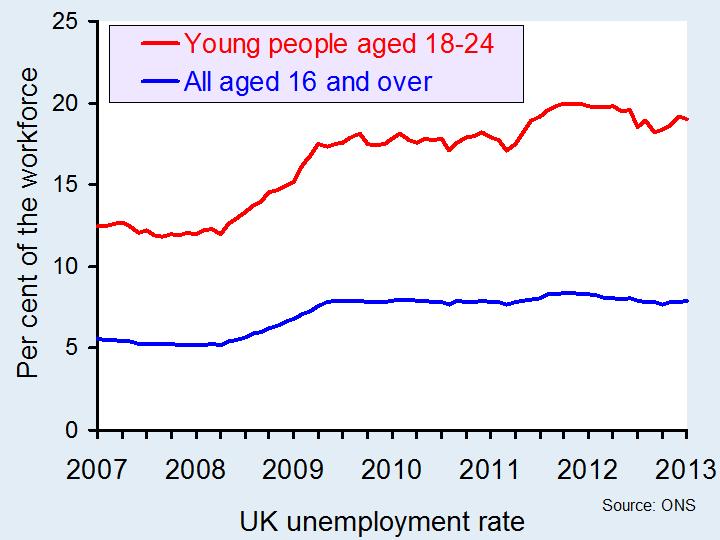 Furthermore, with so many people unemployed, we are operating below full-employment and thus below our potential output. Furthermore, the longer people are out of work, the more likely it is that they will lose their skills and thus require re-training in the future or find that there are now fewer jobs available to them based on their lower skill level.
In addition to this there are monetary costs for the government through lower tax receipts, in terms of income tax, national insurance contributions and even VAT receipts. With more people unemployed, the numbers claiming various unemployment-related benefits will rise, thus imposing a further cost on the government and the taxpayer. Another cost to the government of this latest data is likely to be the expectations of the future course of the economy. Numerous factors affect business confidence and unemployment data is certainly one of them. The concern is that business confidence affects many other variables as well and until we receive more positive data, the economy recovery is likely to remain uncertain. The following articles consider this topic.
UK unemployment rise adds to pressure on Osborne’s austerity strategy The Guardian, Phillip Inman (18/4/13)
Unemployment figures are ‘worrying’, David Cameron’s spokesman says The Telegraph, Peter Dominiczak (17/4/13)
UK unemployment rises to 2.56 million BBC News (17/4/13)
Unemployment jumps to 7.9% as rise in the number of young people out of work takes figure ‘dangerously’ close to a million Mail Online, Leon Watson (17/4/13)
Unemployment up as stay-at-home mothers head back to the job-centre Independent, Ben Chu (17/4/13)
Jobs data points to finely balanced market Financial Times, Brian Groom (18/4/13)
 Hugh’s review: making sense of the stats BBC News (19/4/13)
Questions
- How is unemployment measured?
- What are the costs to the individual of being unemployed?
- What are the wider non-monetary costs to society?
- Explain the main financial costs to the wider economy of a rising unemployment rate.
- Illustrate the problem of unemployment by using a production possibility frontier.
- Could there be a negative multiplier effect from a rise in unemployment?
 More and more food banks are opening every week across the developed world. In the UK alone, there are over 250 food banks. These are run by volunteers and provide food and other basic provisions to those who struggle to feed themselves and their children. The food is donated by people or sometimes supermarkets. Some food banks receive financial help from local authorities.
According to the Trussell Trust, which runs many food banks in the UK, “In 2011-12 food banks fed 128,687 people nationwide, 100% more than the previous year.” But why, in mixed economies, where the State is expected to provide benefits to the poor, do so many people have to resort to food handouts?

Partly the problem is a cut in benefits – a response of many countries to rising public-sector deficits; partly it’s delays in receiving benefits or the complexities in claiming; partly it’s because some people have had their benefits suspended because of a change in their circumstances or changes in the conditions for claiming benefits; partly it’s the inability of people to afford to feed their families properly in times of rising food and energy prices and rising rents, where incomes are not rising in line with the personal rates of inflation that poor households experience; partly it’s the sky-high interest rates that many poor people, often deep in debt, have to pay to continue obtaining credit – often from ‘payday loan companies’ or ‘doorstep lenders’; partly it’s the inability of many poor people to find work which pays enough to feed their families and pay all their other bills.
Food poverty is a real and growing problem. But are food banks the answer? The following videos and articles look at the issues.
Webcasts
UK
Growing demand for food banks in Britain BBC Newsnight, Paul Mason (5/9/12)
Children will go hungry warn Bristol food banks This is Bristol, (2/7/12)
Children going hungry ITV News (16/10/12)
Food bank: We need more food to feed UK’s hungry The Telegraph, Gregg Morgan (27/9/12)
Food banks help struggling London families BBC News (21/6/12)
Europe
EU food aid to dry up by 2014? France 24 (16/10/12)
Spain
Food banks squeezed in Spain Euronews (3/11/12)
USA
As donations dwindle, food banks are feeling the pinch Komo News, Elisa Jaffe (28/9/12)
Articles
UK
Breadline Britain: councils fund food banks to plug holes in welfare state The Guardian, Patrick Butler (21/8/12)
Councils to invest in food banks LocalGov, Dominic Browne (22/8/12)
The growing demand for food banks in breadline Britain BBC News, Paul Mason (4/9/12)
Food banks: ‘I had no-one else to turn to’ BBC News (4/9/12)
Poorest starved of dignity as charity food parcels double in just two years Daily Record (4/9/12)
More and more banking on generosity to others for food South Wales Evening Post (13/11/12)
USA
Northern Illinois Food Bank Kicks Off Hunger Action Month St. Charles Patch, Rick Nagel (1/9/12)
Australia
More families get help as food becomes discretionary spend Sydney Morning Herald (21/8/12)
Information
How a foodbank works The Trussell Trust
Questions
- Why do so many people find themselves trapped in food poverty?
- What factors are likely to lead to an increase in food poverty in the coming months?
- Should the government subsidise food banks?
- Discuss ways of tackling the problem of poor families being trapped in debt and having to pay very high interest rates.
- Is rent control a good means of tackling poverty?
 A modern day hindrance is spam email clogging up your inbox with, for example, offers for cheap drugs or notifications that you will inherit enough money to retire to the Bahamas. A recent paper by Justin Rao and David Reiley in the Journal of Economic Perspectives investigates the economics of spam mail (which, as I discovered, from the article gets it’s name from a Monty Python sketch). Remarkably, they quote figures suggesting that 88% of worldwide email traffic is spam. Their paper then provides a number of interesting insights into the business of spam mail.
First, given that most recipients simply delete it, why is spam mail sent out? For the benefits of sending it to exceed the costs, it must be that somebody is reading and responding to it and the costs must also be reasonably low. Rao and Reiley are able to quantify these costs and benefits. They estimate that if 8.3 million spam emails are sent, only 1.8% (approximately 150,000) will reach the intended recipients’ inboxes, with the remainder being blocked or filtered out. Of these 150,000, just 0.25% (375) are clicked on. Furthermore, these 375 clicks generate just a single sale of the advertised product which is typically sold for around $50. Assuming that free entry of spammers leads to them earning zero economic profit, this means that it costs the spammers around $50 to send the 8.3 million emails.
Second, spam mail clearly imposes a considerable negative externality on society. This includes wasted time for consumers and the costs of the extra server hardware capacity required. Rao and Reiley are also able to quantify the size of the negative externality created. First, they estimate that:
“American firms and consumers experience costs of almost $20 billion annually due to spam.”
This can then be compared to the benefits senders of spam get:
“….. we estimate that spammers and spam-advertised merchants collect gross worldwide revenues on the order of $200 million per year. Thus, the ‘externality ratio’ of external costs to internal benefits for spam is around 100:1.”
They then compare this to estimates for other negative externalities such as car pollution and conclude that the size of the negative externality from spam is significantly greater.
Finally, they also point out that it is predominantly the larger email service providers i.e. Yahoo! Mail, Microsoft Hotmail, and Google Gmail who have both the incentives and resources to fund interventions to eradicate spam. For example, in 2009 Microsoft and Pfizer (the manufacturer of Viagra which faces competition from counterfeit versions often advertised by spam) financially supported the successful operation to shut down the largest spam distributor. Clearly, such operations have large positive spillovers for email users. However, as they also discuss, anti-spam technology also increases the fixed costs of competing as an email provider and they suggest that this has contributed to the increased concentration in the market.
The unpalatable business of spam The undercover economist, Tim Harford (19/07/12)
Huge spam botnet Grum is taken out by security researchers BBC News (19/07/12)
Spammers make a combined $200 million a year while costing society $20 billion BGR, Dan Graziano (28/08/12)
Questions
- Explain why free entry results in zero economic profit.
- Explain how an increase in fixed costs can lead to an increase in concentration.
- Why does Microsoft have large incentives to eradicate spam mail?
- In what ways does the externality created by spam mail differ from other forms of advertising?
- How might government policies alter the costs and benefits of sending spam mail?
 The ONS has just released its annual publication, The Effects of Taxes and Benefits on Household Income. The report gives data for the financial year 2012/13 and historical data from 1977 to 2012/13.