 Each month the accountancy firm BDO publishes its Business Trends Indices. These indices “are ‘polls of polls’ that pull together the results of all the main UK business surveys”. The latest report shows that the January 2013 Optimism Index was its lowest since the report began 21 years ago.
The Optimism Index predicts business performance two quarters ahead. In January 2013 it was 88.9. The way the index is constructed, a reading of 95 or more suggests that firms are optimistic about business performance. Clearly, they were pessimistic.
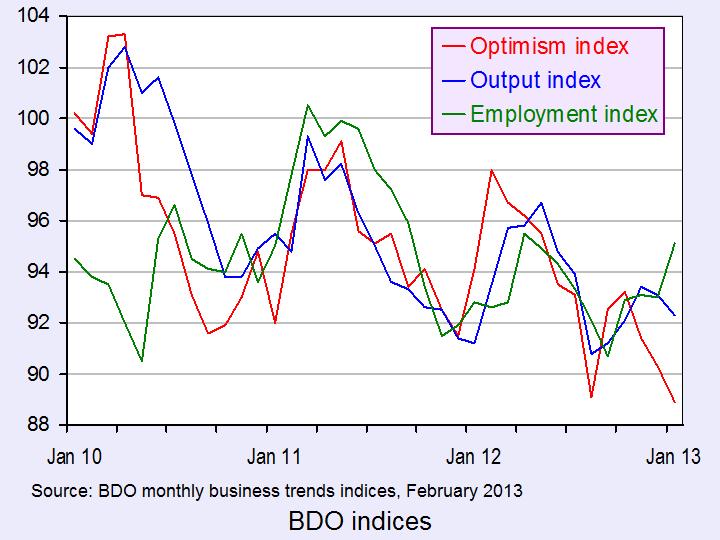 Although there was an increase in hiring intentions, firms were still predicting a fall in output. The indices for optimism, employment and output are shown in the chart. (Click here for a PowerPoint.)
As Peter Hemington, Partner, BDO LLP, commented:
In spite of a strengthening Labour Market, business confidence continues to weaken, and improved hiring intentions are not translating into growth plans. It seems the damaging effects on businesses of five years’ zigzagging economic growth, has left them wary of making concrete plans for expansion and resigned to the ‘new normal’ of economic stagnation.
To end this cycle, it is imperative that the Government implements plans to expedite growth. Without growth incentives, we will continue to see UK businesses reluctant to invest and expand, which poses a grave threat to the UK’s economic recovery.
The following articles comment on the gloomy mood of business and on its implications for output and investment. They also look at the implications for government policy.
Articles
Confidence slumps despite optimism from manufacturers Insider News (11/2/13)
Fears of a triple-dip recession return as survey puts business confidence at a 21-year low This is Money (11/2/13)
Pressure grows on ministers for growth strategy Yorkshire Post (11/2/13)
Triple-dip jitters as business confidence hits 21-yr low Management Today, Michael Northcott (11/2/13)
Report and data
Business Trends: Business confidence hits 21-year low signalling economic contraction BDO Press Release (11/2/13)
BDO Monthly Business Trends Indices, February 2013 – Full Report BDO (11/2/13)
Business and Consumer Surveys European Commission: Economic and Financial Affairs
Questions
- What reasons are given by the report for a decline in business optimism?
- Explain how an accelerator/multiplier interaction could compound the recession or help to cause a bounce back from recession.
- How does business sentiment in one country affect business sentiment in others?
- In the absence of a change in its fiscal stance, what policies could the government adopt to increase business confidence?
- Why might firms’ hiring intentions increase even though they are predicting a fall in output?
 The news in many European countries has been dominated in February by the ‘horse meat scandal’. Small traces of horse meat may be the result of faulty quality control. But the significant amount of horse found in several processed meat products suggest fraud at one or more points in the supply chain from farm to supermarket or other outlet. Indeed several specific suppliers, from abattoirs to processors are facing criminal investigation.
The scandal has put the supply chain under intense scrutiny. Part of the problem is that the supply chain is often very long and complex. As the Guardian article states:
The food and retail industries have become highly concentrated and globalised in recent decades. A handful of key players dominate the beef processing and supermarket sectors across Europe. They have developed very long supply chains, particularly for their economy lines, which enable them to buy the ingredients for processed foods from wherever they are cheapest at any point, depending on exchange rates and prices on the global commodity markets. Networks of brokers, cold stores operators and subcontracted meat cutting plants have emerged to supply rapidly fluctuating orders “just in time”. Management consultants KPMG estimate there are around 450 points at which the integrity of the chain can break down.
Then there is the huge pressure on all parts of the supply chain to reduce costs.
 Supermarkets use their market power to drive down the prices of the products they buy from their suppliers and this has a knock-on effect backwards down the supply chain. This pressure has intensified as real wages have fallen and consumers have found their budgets squeezed.
At the same time, beef and other meat prices have been rising as the costs of animal feed have soared. This all puts tremendous pressure on suppliers to add cheaper ingredients. Again to quote the Guardian article:
Manufacturers add other cheap ingredients including water and fat, and use concentrated proteins to bind the water and fat in. They may appear on labels as ‘seasoning’. One of the cheapest sources of these protein additives is pork rind. It is possible that horse hide is now also being used. The widespread adulteration of cheap chicken breast with pig and beef proteins and water has been uncovered in previous scandals. The beef proteins were derived from hydrolysed cattle hides. It is not illegal to use these protein concentrates so long as they are identified correctly to the manufacturer.
It is not surprising that if cheap horse meat becomes available to suppliers, such as from old horses towards the end of their working lives, some processing companies may be tempted to add it fraudulently, stating that it is beef.
The articles look at the issues of long and complex supply chains in the processed food industry and assess why they have evolved into their current form and the difficulties in regulating them.
Horsegate: heed economics of the cold chain The Grocer, Andrew Godley (16/2/13)
Horsemeat scandal: the essential guide The Guardian, Felicity Lawrence (15/2/13)
After the horse has been bolted The Economist (16/2/13)
Slavery, not horse meat, is the real scandal on our doorstep The Telegraph, Fraser Nelson (14/2/13)
Industry must take the reins on food safety Globe and Mail (Canada)Sylvain Charlebois (15/2/13)
Supply chains changed the growth model The Economist, Richard Baldwin (15/8/12)
Supply-chain management The Economist (6/4/09)
Tesco pledges to open up supply chain after horse meat scandal The Telegraph (16/2/13)
Horse meat scandal: Shoppers who buy ‘cheapest food’ at risk The Telegraph, James Quinn, Jason Lewis and Patrick Sawer (16/2/13)
Let Them Eat Horse Bloomberg, Marc Champion (15/2/13)
Scandal shows meat supply chain must be policed heraldscotland (14/2/13)
MPs push for new powers for FSA as officials seize yet more suspect meat Independent, Martin Hickman (13/2/13)
Questions
- Why do supermarkets and their suppliers use long supply chains?
- Explain the concepts of ‘countervailing power’ and ‘monopsony or oligopsony power’? How do they apply in the processed meat supply chain?
- Identify the types of transactions costs in the processed meat industry.
- In what ways do consumers (a) gain and (b) lose from such supply chains?
- Why is the problem of fraud in processed food supply chains likely to have intensified in recent years?
- How have supermarkets reacted to the horse meat scandal? Why has it taken the scandal to make them react in this way?
- To what extent is the problem simply one of inaccurate labelling?
- To what extent is there a principal–agent problem in the processed meat supply chain?
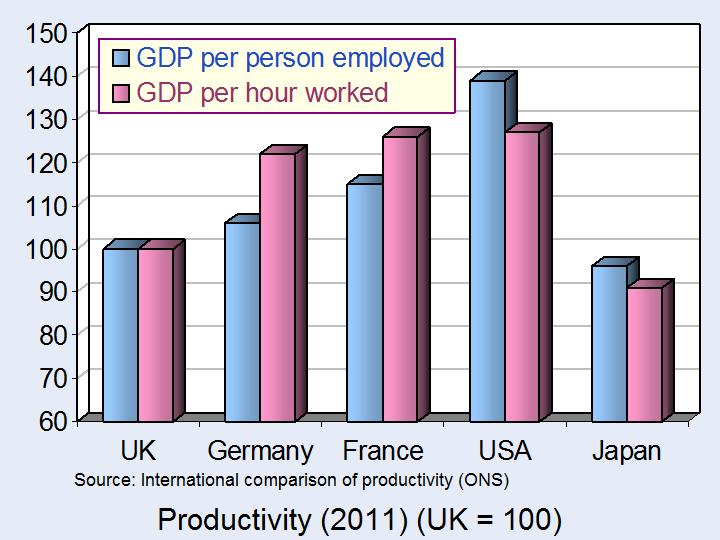 Recent figures from the ONS suggest that the UK lags well behind its competitors in terms of labour productivity. In terms of output per hour worked, Germany produces 22% more than the UK, France produces 26% more, the USA produces 27% more, the Netherlands 31% more and Ireland 43% more. The first chart illustrates some of these figures.
(Click here for a PowerPoint of this chart.)
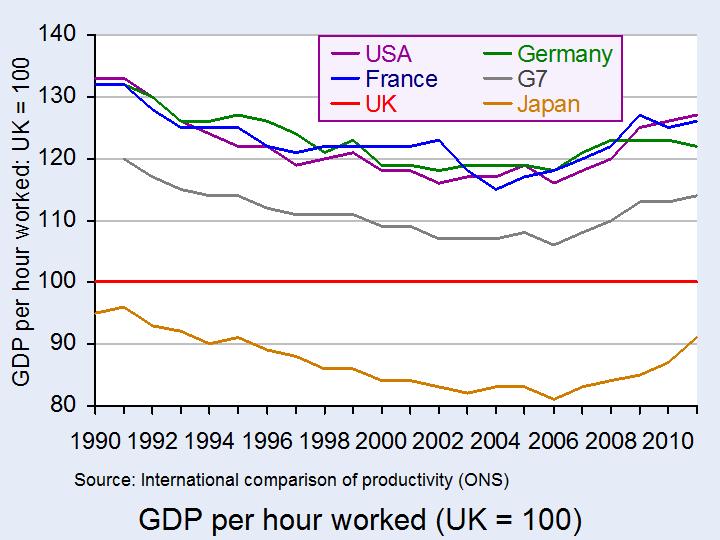
And in the past few years the problem has been getting worse. This is shown in the second chart. This, however, is a relatively recent phenomenon. Until 2006, the gap was narrowing, but since then it has widened. (Click here for a PowerPoint of the second chart.)
 What has caused this widening of the gap? Part of the problem is a historical lack of investment in the UK. Between 2005 and 2012, the UK invested on average 15.7% of GDP. The USA invested 16.5%, Germany 17.9% and France 20.1%. And part of the problem has been the cut back in private-sector investment in response to the recession (which has been deeper in the UK) and in public-sector investment as part of the government’s austerity measures.
Part of the problem has been lower levels of inward investment. Inward direct investment to the UK in 2011 was only 24 per cent of that in 2007. In France, Germany, Italy and the USA, the figures were 43, 50, 66 and 105 per cent respectively.
Part of the problem has been the size of the financial sector in the UK. This is considerably larger as a proportion of the economy than in most the UK’s major competitors. And it was this sector most hard hit by the crisis of 2007/8.
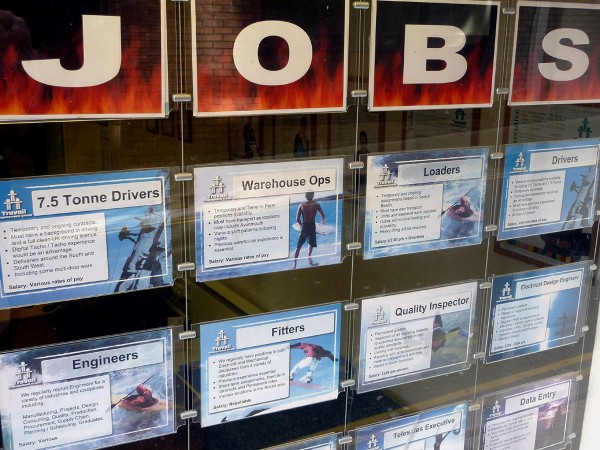 With this poor productivity performance, you might expect unemployment to have soared. In fact, the UK has one of the lowest unemployment rates of the developed countries and in recent months it has been falling while other countries have seen their unemployment rates rise.
In fact, low productivity and high employment are compatible. If people produce less than their counterparts abroad, then more people will be needed to produce the same level of output. The problem, of course, is that this only works if wages are kept down. Indeed, wages have fallen in real terms and now stand at the level of 10 years ago.
The problem of falling real wages is that this translates into a lack of demand – especially when people are trying to reduce their debts. Not only does this result in a lack of economic growth, it discourages firms from investing – and investment is one of the prime drivers of future productivity growth!
The following articles explore the problem of low productivity and its relationship with employment and with both short-term and long-term economic growth.
Articles
UK has widest productivity gap since 1993 City A.M., Ben Southwood (14/2/13)
Productivity ‘key to UK’s economic future’ SnowdropKCS (7/2/13)
Low wages and lack of investment – why UK’s productivity has slumped Wales Online, David Williamson (2/3/13)
Recovery in jobs gives a fillip before the news on growth Independent, Russell Lynch (23/1/13)
U.K. Triple-Dipping as Productivity Falls Slate, Matthew Yglesias (25/1/13)
UK productivity puzzle baffles economists BBC News, By Andrew Walker (18/10/12)
 Is low productivity a structural problem in the UK? BBC Today Programme, Bridget Rosewell and Andrew Sentance (4/1/13)
We Need to Talk About the Middle Huffington Post, Stewart Wood (14/2/13)
UK Wages Slump to Lowest Level in a Decade – ONS International Business Times, Shane Croucher (13/2/13)
Britain’s low-wage economy serves as a bind on the country The Guardian, Philip Inman (13/2/13)
Real wages fall back to 2003 levels in UK The Guardian, Hilary Osborne (13/2/13)
Data
International Comparisons of Productivity – Final Estimates for 2011 ONS (13/2/13)
International Comparisons of Productivity, datasets ONS (13/2/13)
Changes in real earnings in the UK and London, 2002 to 2012 ONS (13/2/13)
Questions
- Which is a better measure of productivity – output per worker or output per hour worked? Why, do you think, does the USA produce 39% more per worker, but only 27% more per hour worked?
- What policies should the government adopt in order to encourage a growth in productivity?
- If productivity growth increased, what would be the likely effect on employment? Explain.
- Why has unemployment not risen in recent months?
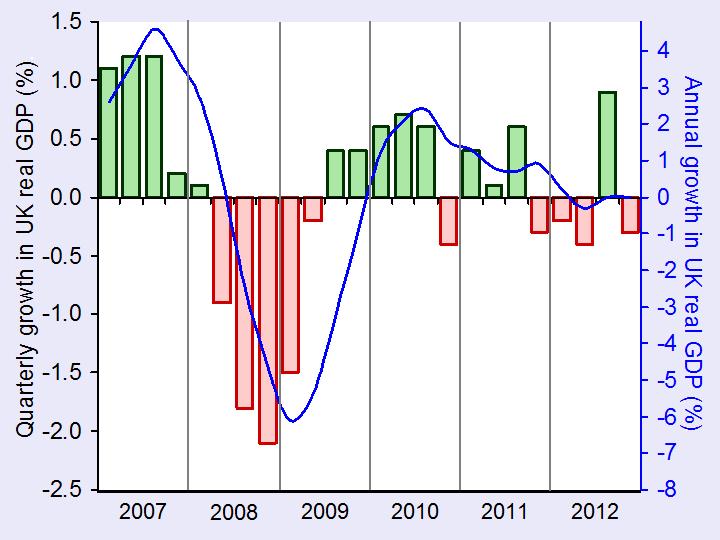
 According to the first estimate by the Office for National Statistics, the UK economy shrank by 0.3% in the final three months of 2012. This means that over the whole year growth was flat.
The biggest contributor to the fall in GDP in Q4 was the production industries, which include manufacturing. Output of the production sector fell by 1.8% in Q4. Construction sector output, by contrast, was estimated to have increased by 0.3%. Service sector output was flat. The chart below shows quarterly and annual growth in the UK from 2007 to 2012. (Click here for a PowerPoint.)
Latest estimates by the IMF are that the UK economy will grow by 1.0% in 2013 – well below the long-term growth in potential output (see also the last blog, High hopes in the Alps). But some forecasters are predicting that real GDP will continue to fall for at least one more quarter, which means that the economy would then be in a ‘triple-dip recession’.
 Not surprisingly politicians have interpreted the statistics very differently, as have economists. The government, while recognising that the UK faces a ‘very difficult economic situation’, argues that now is not the time to change course and that by continuing with policies to reduce the deficit the economy will be placed on a firmer footing for sustained long-term growth
The opposition claims that the latest figures prove that the government’s policies are not working and that continuing attempts to bear down on the deficit are depressing aggregate demand and thereby keeping the economy depressed.
The following webcasts, podcasts and articles expand on these arguments. Try to be dispassionate in using economic analysis and evidence to assess the arguments.
Webcasts and podcasts
Video Summary: Gross Domestic Product Preliminary Estimate, Q4 2012 Media Briefing (Click here for the following Q&A) ONS (25/1/13)
Triple dip on the menu? Channel 4 News, Siobhan Kennedy and Faisal Islam (25/1/13)
Getting and spending – the key to recovery Channel 4 News, Cathy Newman (25/1/13)
UK economy shrinks by 0.3% in the last three months of 2012 BBC News, Hugh Pym (25/1/13)
Danny Alexander on GDP figures and economic plans BBC Daily Politics (25/1/13)
Osborne defends government’s deficit reduction plan BBC News (25/1/13)
Ed Balls: UK economy urgently needs a ‘Plan B’ BBC News (25/1/13)
UK heads for triple dip as GDP contracts 0.3pc The Telegraph, Philip Aldrick (25/1/13)
Economist: Government may need to rethink its fiscal policy The Telegraph, Jim O’Neill (25/1/13)
Has austerity really been tried in Britain? BBC Today Programme, Jonathan Portes and Andrew Lilico (29/1/13)
Articles
UK GDP: Economy shrank at end of 2012 BBC News (25/1/13)
UK GDP shrinks by 0.3% in fourth quarter: what the economists say The Guardian (25/1/13)
New Bank of England head Mark Carney hints at big shift in policy The Guardian (26/1/13)
The Bank of England, the chancellor, and the target BBC News. Stephanie Flanders (29/1/13)
The Entire World Of Economics Is Secretly Thankful To The UK Right Now Business Insider, Joe Weisenthal (26/1/13)
Data
Gross Domestic Product: Preliminary Estimate, Q4 2012 ONS (25/1/13)
Video Summary: Gross Domestic Product Preliminary Estimate, Q4 2012 ONS (25/1/13)
Preliminary Estimate of GDP – Time Series Dataset 2012 Q4 ONS (25/1/13)
Business and Consumer Surveys DG ECFIN
Questions
- What are the reasons for the decline in GDP in 2012 Q4??
- Examine how likely it is that the UK will experience a triple-dip recession.
- What measures could be adopted to increase consumer and business confidence?
- If there is substantial spare capacity, is expansionary fiscal policy the best means of achieving economic growth?
- What additional monetary policy measures could be adopted to stimulate economic growth?
- Find out what has happened to the UK’s public-sector deficit and debt over the past three years. Explain what has happened.
 Each year world political and business leaders meet at the World Economic Forum in the Swiss resort of Davos. The aim is to assess the progress of the global economy and to look at challenges ahead and what can be done about them.
Cynics claim that the round of presentations, discussions, Champagne receptions and fine dining rarely leads to anything concrete. Those who are less cynical argue that the Forum gives a unique opportunity for considering policy options and helping to shape a global consensus.
This year the mood was more optimistic. Many believe that the worst of the financial crisis is behind us. Stock markets are buoyant; the banking system seems more secure; the eurozone has not collapsed; growth prospects seem a little brighter.
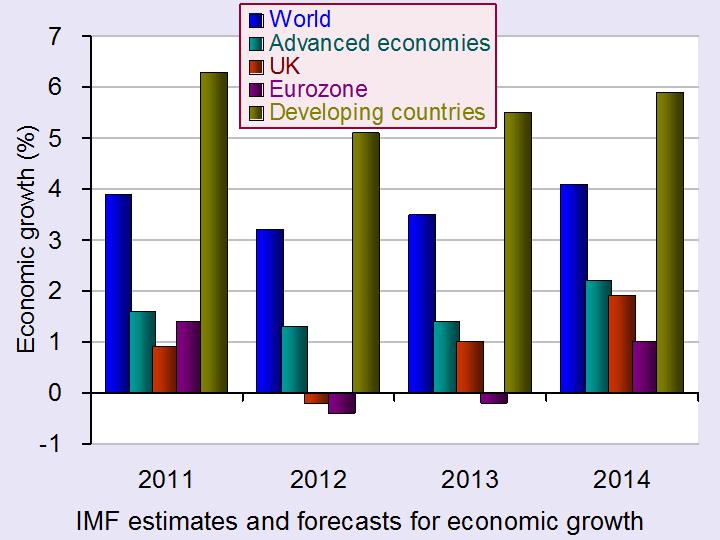 But perhaps ‘optimistic’ is an overstatement. ‘Less pessimistic’ might be a better description. As Christine Lagarde, head of the IMF, pointed out in her speech:
The recovery is still weak, and uncertainty is still high. As the IMF announced just a few hours ago in our World Economic Outlook, we expect global growth of only 3½ percent this year, not much higher than last year. The short-term pressures might have alleviated, but the longer-term pressures are still with us. (Click here for transcript).
In both her speech and her press conference, she went on to outline the policies the IMF feels should be adopted to achieve sustained global growth.
The articles below summarise the outcomes of the Forum and some of the views expressed.
Articles
Too soon for sighs of relief Deutsche Welle, Andreas Becker (27/1/13)
Davos 2013: The icy economic chill begins to thaw The Telegraph, Louise Armitstead (26/1/13)
IMF Projects Modest Pick-up in Economic Growth in 2013 IMF videos, Olivier Blanchard, IMF Chief Economist (23/1/13)
Managing Director’s New Year Press Briefing IMF videos, Christine Lagarde, IMF Managing Director
Mark Carney in Davos: what’s up next for the global economy Maclean’s (Canada), Erica Alini (26/1/13)
World Economic Forum ends on warning note over ‘complacency’ The Guardian, Graeme Wearden (26/1/13)
Angela Merkel tells Davos austerity must continue The Guardian, Graeme Wearden and Larry Elliott (24/1/13)
Davos 2013: A ‘sigh of relief’ at the World Economic Forum BBC News, Stephanie Flanders (27/1/13)
Happy talk The Economist (27/1/13)
Davos Man and his defects The Economist, Schumpeter (26/1/13)
Davos: are the captains of capitalism finally paying attention? The Observer (27/1/13)
Official site
The Global Agenda 2013 The World Economic Forum
IMF projections
Modest Growth Pickup in 2013, Projects IMF IMF Survey Magazine: In the News (23/1/13)
World Economic Outlook Update IMF (23/1/13)
Questions
- Why was the mood at the WEF less pessimistic than in 2012?
- What threats remain to sustained global recovery?
- What policies are being recommended by Christine Lagarde of the IMF? Explain the reasoning behind the recommendations.
- What disagreements are there between global leaders on the scope for fiscal and monetary policies to stimulate economic growth?
- In her press conference, Christine Lagarde stated that “the teams here have concluded that the fiscal multipliers were higher in the context of that unbelievable international crisis”. Do you agree with this statement? Explain.