 Six of the major tea producing countries – India, Kenya, Sri Lanka, Indonesia, Rwanda and Malawi – have formed an International Tea Producers’ Forum (ITPF). Together these countries produce slightly more than the world’s tea. The hope of the members of the new ITPF is that their cartel will allow them to increase the price of tea to the growers and to create greater price stability.
According to the Assam Tribune article below:
ITPF’s main objectives include – safeguarding the interests of the tea-producing countries, evolving collective solutions for the problems facing the producers, providing technical cooperation, sharing of technology and expertise by the member countries, undertaking market studies and research projects to address any specific issues concerning tea in general or any variety of tea, among others.
 And according to the article from Sri Lanka’s Daily News:
Chairman of the Planters’ Association of Ceylon, which represents the interests of 23 Regional Plantation Companies, Lalith Obeyesekere said this was a landmark occasion. Sri Lanka particularly looks to the forum to provide long-term sustainability to the tea industry in maintaining price stability and quality standards, among the other objectives set out in the mandate… The Planters’ Association said they were confident that Sri Lanka could use the ITPF to re-look at the industry in order that local tea producers realize their full potential.
Sri Lanka’s plantation industries minister Mahinda Samarasinghe said:
The bulk of production is in the hands of smallholders. So there’s a need to increase their incomes. Price stability is definitely important.
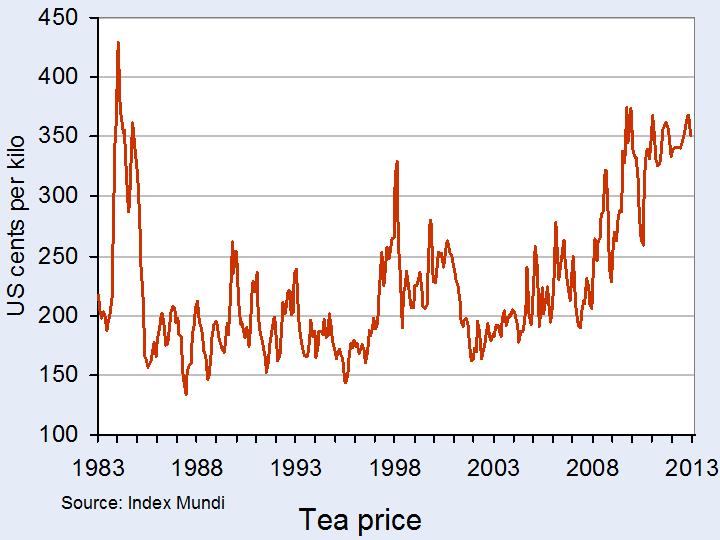 The main aim of the ITPF over the longer term is likely to be to raise tea prices. The chart shows international tea prices from 1983 to the present day. As you can see, they have fluctuated considerably. Note that these are prices in nominal terms and hence do not take inflation into account. Click here for a PowerPoint of the chart.
But if the main aim is to increase prices to tea growers, how could this be achieved? One objective of the ITPF is to stimulate demand for tea by ‘promoting tea consumption through generic promotional campaigns’. The aim would be to encourage people to switch from coffee and soft drinks.
 But to take advantage of its market power, the cartel might also want to reduce tea production, thereby pushing up the price. This, of course, would be more feasible if it had a larger than 50% share of the market.
Although production quotas are not currently part of the agreement, these are likely to be considered at future meetings, especially if the three other large producers – China, Vietnam and Iran – can be persuaded to join.
China, with some 38% of the market, is the world’s largest tea producer. Although it sent an observer to the meeting (as did Iran), it was not one of the signatories. If it could be persuaded to join the cartel, this would increase its power. Nevertheless, China specialises in different types of tea, mainly green teas, and is not the world’s biggest exporter – that is Kenya.
Articles
Tea nations join forces Radio New Zealand (25/1/13)
International Tea Producers’ Forum formed Assam Tribune, Ajit Patowary (23/1/13)
Planters’ Association upbeat on newly formed International Tea Producer’s Forum Daily News (Sri Lanka) (26/1/13)
Leaf Lobby: Sri Lanka hosts tea producer forum Lanka Business Online (24/1/13)
‘Tea cartel’ formed by biggest producing nation BBC News (23/1/13)
Tea producers brew up plan to raise prices Emirates 24/7 (23/1/13)
Data
Tea Monthly Price – US cents per Kilogram Index Mundi
Questions
- What are the stated aims of the newly formed ITPF? How realistic are they?
- What conditions are necessary for a cartel to be successful in raising prices over the long term?
- With reference to the chart, what can you say about the real price of tea over the period 1983 to 2013?
- To what extent are these conditions met by the ITPF?
- Why may a rise in tea prices in the supermarkets not result in a rise in prices to tea growers?
- How may tea growers benefit from the ITPF even if the Forum does not result directly in a rise in prices to growers?
- How can game theory help to explain the possible behaviour of members of a cartel and producers outside the cartel?
 What lies ahead for economic growth in 2013 and beyond? And what policies should governments adopt to aid recovery? These are questions examined in four very different articles from The Guardian.
The first is by Nouriel Roubini, Professor of Economics at New York University’s Stern School of Business. He was one of the few economists to predict the collapse of the housing market in the USA in 2007 and the credit crunch and global recession that followed. He argues that continuing attempts by banks, governments and individuals to reduce debt and leverage will mean that the advanced economies will struggle to achieve an average rate of economic growth of 1%. He also identifies a number of other risks to the global economy.
 In contrast to Roubini, who predicts that ‘stagnation and outright recession – exacerbated by front-loaded fiscal austerity, a strong euro and an ongoing credit crunch – remain Europe’s norm’, Christine Lagarde, head of the IMF and former French Finance Minister, predicts that the eurozone will return to growth. ‘It’s clearly the case’, she says, ‘that investors are returning to the eurozone, and resuming confidence in that market.’ Her views are echoed by world leaders meeting at the World Economic Forum in Davos, Switzerland, who are generally optimistic about prospects for economic recovery in the eurozone.
The third article, by Aditya Chakrabortty, economics leader writer for The Guardian, looks at the policies advocated at the end of World War II by the Polish economist, Michael Kalecki and argues that such policies are relevant today. Rather than responding to high deficits and debt by adopting tough fiscal austerity measures, governments should adopt expansionary fiscal policy, targeted at expanding infrastructure and increasing capacity in the economy. That would have an expansionary effect on both aggregate demand and aggregate supply. Sticking with austerity will result in continuing recession and the ‘the transfer of wealth and power into ever fewer hands.’
 But while in the UK and the eurozone austerity policies are taking hold, the new government in Japan is adopting a sharply expansionary mix of fiscal and monetary policies – much as Kalecki would have advocated. The Bank of Japan will engage in large-scale quantitative easing, which will become an open-ended commitment in 2014, and is raising its inflation target from 1% to 2%. Meanwhile the Japanese government has decided to raise government spending on infrastructure and other government projects.
So – a range of analyses and policies for you to think about!
Risks lie ahead for the global economy The Guardian, Nouriel Roubini (21/1/13)
Eurozone showing signs of recovery, says IMF chief The Guardian, Graeme Wearden (14/1/13)
Austerity? Call it class war – and heed this 1944 warning from a Polish economist The Guardian, Aditya Chakrabortty (14/1/13)
Bank of Japan bows to pressure with ‘epoch-making’ financial stimulus The Guardian, Phillip Inman (22/1/13)
Questions
- What are the dangers facing the global economy in 2013?
- Make out a case for sticking with fiscal austerity measures.
- Make out a case for adopting expansionary fiscal policies alongside even more expansionary monetary policies.
- Is is possible for banks to increase their capital-asset and liquidity ratios, while at the same time increasing lending to business and individuals? Explain.
- What are the implications of attempts to reduce public-sector deficits and debt on the distribution of income? Would it be possible to devise austerity policies that did not have the effect you have identified?
- What will be the effect of the Japanese policies on the exchange rate of the yen with other currencies? Will this be beneficial for the Japanese economy?
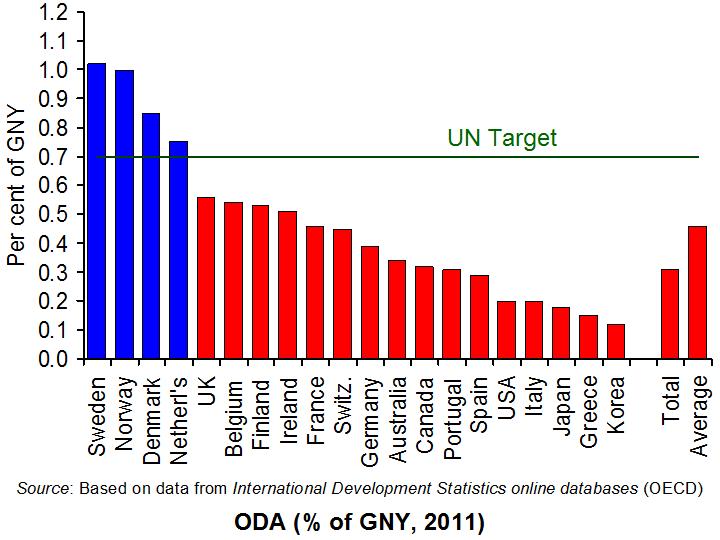 Many rich countries have made repeated commitments to the United Nations to give at least 0.7% of their gross national income (GNY) as international aid – or ‘official development assistance (ODA)’ as it is known. The first such commitments were made in 1970. Despite this, many of these countries’ aid to developing countries falls well short of the target.
In fact the average amount given in aid in 2011 by the 23 donor countries which are members of the OECD’s Development Assistance Committee (DAC) was a mere 0.31% of GNY, with the USA, the biggest donor in absolute terms, giving only 0.2% of GNY. (Click here for a PowerPoint of the chart.) Since 2003, the DAC average has been 0.29% as compared with 0.30% between 1970 and 2002.
 In 2005, at the Gleneagles G8 summit, the 15 members of the EU which are Development Assistance Committee members committed themselves to reaching an ODA target of 0.51% of GNY in 2010 and to reach the 0.7% target by 2015. In 2011, the UK’s ODA/GNY ratio stood at 0.56% and so was above the EU target.
Section 18 of the Coalition agreement pledges that the UK government will meet the 0.7% target by 2013 – a pledge initially made by the Labour government. So far, the government has stuck to this pledge and the aid budget has escaped cuts.
But with other parts of government expenditure facing cuts, pressure is mounting on the government to reduce the aid budget. There are two main parts to the argument. The first is that aid should face its ‘fair share’ of the cuts. The second is that aid is often an inefficient way of tackling poverty in developing countries and, when discussing aid, the focus should be on getting value for money rather than on the simple total amount of aid.
The following articles look at arguments for and against meeting aid targets and examine ways of making aid ‘smarter’.
Articles
Money may be tight, but ‘smart aid’ to developing countries can really work The Guardian, Larry Elliott (13/1/13)
International aid, but not as we know it The Guardian, Andy Sumner and Richard Mallett (31/12/12)
One in four support Britain’s foreign aid policies The Telegraph, Ben Leach (29/12/12)
Why is so much UK aid money still going to companies based in Britain? The Guardian, Claire Provost and Nicola Hughes (21/9/12)
Is the 0.7% aid target still relevant? The Guardian, Niels Keijzer (2/8/12)
What’s wrong with foreign aid? The Spectator (3/1/13)
Five reasons to deliver and legislate on international aid bond, UKAN (6/12)
The Political Economy of Bilateral Foreign Aid Working Knowledge, Harvard Business School, Eric D. Werker (4/1/13)
Misconceptions about aid Dawn (Pakistan), Niaz Murtaza (8/1/13)
Why political short-sightedness and randomised control trials can be a deadly mix for aid effectiveness Vox EU, Anders Olofsgård (13/10/12)
Aid in troubled times DfID, Paul Collier (2/7/12)
Data and information
Aid Effectiveness data World Bank
Aid statistics OECD
Aid effectiveness OECD
Aid Wikipedia
Questions
- What was agreed at the Gleneagles G8 summit?
- Examine the argument that aid crowds out private investment.
- Compare the relative benefits of tied and untied aid.
- Give some examples of ‘smart aid’.
- How would you establish whether or not it is ‘fair’ to cut the aid budget?
- Give three arguments for maintaining the aid budget and three arguments for cutting it. On which side do you come down and why?
 In the wake of the financial crisis of 2007/8, the international banking regulatory body, the Basel Committee on Banking Supervision, sought to ensure that the global banking system would be much safer in future. This would require that banks had (a) sufficient capital; (b) sufficient liquidity to meet the demands of customers.
The Basel III rules set new requirements for capital adequacy ratios, to be phased in by 2019. But what about liquidity ratios? The initial proposals of the Basel Committee were that banks should have sufficient liquid assets to be able to withstand for at least 30 days an intense liquidity crisis (such as that which led to the run on Northern Rock in 2007). Liquid assets were defined as cash, reserves in the central bank and government bonds. This new ‘liquidity coverage ratio’ would begin in 2015.
These proposals, however, have met with considerable resistance from bankers, who claim that higher liquidity requirements will reduce their ability to lend and reduce the money multiplier. This would make it more difficult for countries to pull out of recession.
 In response, the Basel Committee has published a revised set of liquidity requirements. The new liquidity coverage ratio, instead of being introduced in full in 2015, will be phased in over four years from 2015 to 2019. Also the definition of liquid assets has been significantly expanded to include highly rated equities, company bonds and mortgage-backed securities.
This loosening of the liquidity requirements has been well received by banks. But, as some of the commentators point out in the articles, it is some of these assets that proved to be wholly illiquid in 2007/8!
Articles
Banks Win 4-Year Delay as Basel Liquidity Rule Loosened BloombergJim Brunsden, Giles Broom & Ben Moshinsky (7/1/13)
Banks win victory over new Basel liquidity rules Independent, Ben Chu (7/1/13)
Banks win concessions and time on liquidity rules The Guardian, Dan Milmo (7/1/13)
Basel liquidity agreement boosts bank shares BBC News (7/1/13)
Banks agree minimum liquidity rules BBC News, Robert Peston (67/1/13)
The agreement
Group of Governors and Heads of Supervision endorses revised liquidity standard for banks BIS Press Release (6/1/13)
Summary description of the LCR BIS (6/1/13)
Basel III: The Liquidity Coverage Ratio and liquidity risk monitoring tools BIS (6/1/13)
 Introductory remarks from GHOS Chairman Mervyn King and the Basel Committee on Banking Supervision’s Chairman Stefan Ingves (Transcript) BIS (6/1/13)
Questions
- What is meant by ‘liquid assets’?
- How does the liquidity of assets depend on the state of the economy?
- What is the relationship between the liquidity ratio and the money multiplier?
- Does the size of the money multiplier depend solely on the liquidity ratio that banks are required to hold?
- Distinguish between capital adequacy and liquidity.
- What has been the effect of quantitative easing on banks’ liquidity ratios?
 Pressure has been growing in the UK for people to be paid no less than a living wage. The Living Wage Foundation claims that this should be £8.55 per hour in London and £7.45 in the rest of the UK. The current minimum wage is £6.19.
There has been considerable support for a living wage across the political spectrum. Ed Miliband, the Labour leader, has stated that a Labour government would ensure that government employees were paid at least the living wage and that government contracts would go only to firms paying living wages. Other firms that paid less could be ‘named and shamed’. The living wage has also been supported by Boris Johnson, Conservative Mayor of London. The Prime Minister said that a living wage is ‘an idea whose time has come’, although many Conservatives oppose the idea.
The hourly living wage rate is calculated annually by the Centre for Research in Social Policy and is based on the basic cost of living. The London rate is calculated by the Greater London Authority.
Advocates of people being paid at least the living wage argue that not only would this help to reduce poverty, it would also help to reduce absenteeism and increase productivity by improving motivation and the quality of people’s work.
 It would also bring in additional revenue to the government. According to a report by the Institute for Public Policy Research and the Resolution Foundation, if everyone were paid at least a living wage, this would increase the earnings of the low paid by some £6.5bn per year. Of this, some £3.6bn would go to the government in the form of higher income tax and national insurance payments and reduced spending on benefits and tax credits. Of this £6.5bn, an extra £1.3 billion would be paid to public-sector workers, leaving the Treasury with a net gain of £2.3bn.
But what would be the effect on employment? Would some firms be forced to reduce their workforce and by how much? Or would the boost to aggregate demand from extra consumer spending more than offset this and lead to a rise in employment?. The following articles look at the possible effects.
Articles
Living wage for all workers would boost taxes and GDP Independent, Nigel Morris (28/12/12)
Living wage could save £2bn – think tank research BBC News (28/12/12)
‘Living wage’ would save money, says study Financial Times, Helen Warrell (28/12/12)
Why the Resolution Foundation and IPPR can go boil their heads Adam Smith Institute, Tim Worstall (30/12/12)
Living wage for public servants moves a step closer The Observer,
Yvonne Roberts and Toby Helm (15/12/12/)
Living wage: Ed Miliband pledge over government contracts BBC News (5/11/12)
‘London Living Wage’ increased to £8.55 by mayor BBC News (5/11/12)
Q&A: The living wage BBC News (5/11/12)
Scrooges in UK firms must pay a Living Wage This is Money, John Sentamu (23/12/12)
Report
What price a living wage? IPPR and The Resolution Foundation, Matthew Pennycook (May 2012)
Questions
- How would you set about determining what the living wage rate should be?
- Distinguish between absolute and relative poverty. Would people being paid below a living wage be best described as absolute or relative poverty (or both or neither)?
- What do you understand by the term ‘efficiency wage’? How is this concept relevant to the debate about the effects of firms paying a living wage?
- Under what circumstances would raising the statutory minimum wage rate to the living wage rate result in increased unemployment? How is the wage elasticity of demand for labour relevant to your answer and how would this elasticity be affected by all firms having to pay at least the living wage rate?
- What would be the macroeconomic effects of all workers being paid at least the living wage rate? What would determine the magnitude of these effects?