 With Christmas approaching, sales will once again begin to rise and cards will be written. Mail services will be at their busiest as we post millions of cards and parcels every day. But, the question is: will they arrive? Workers in the supply chain at Royal Mail have voted to strike over pay.
Since the part privatisation of Royal Mail, many criticisms have emerged, ranging from the price at which shares were sold, the efficiency of the Royal Mail, suggestions of varying prices for delivery depending on location, and now over pay. As with any labour market, there is a demand and a supply of workers and the intersection of these curves creates our equilibrium wage. If the wage is forced up above the equilibrium wage by the actions of trade unions, then there is the potential for unemployment to be created.
The Communications Workers Union (CWU) feels that their pay is insufficient. Dave Ward, Deputy General Secretary of CWU said:
“Thanks entirely to the unreasonable attitude of Post Office management, a pre-Christmas national strike is looking inevitable…The workforce has made a major contribution to the company’s success and have every right to their fair share.”
However, the head of the supply chain at Royal Mail has responded to the threats of strike, referring to the 5% pay rise promised to its workers over the next three years, saying:
“We are undertaking the biggest modernisation programme in UK retail history to ensure we become commercially viable and reduce our reliance on public money…We urge the CWU to reconsider their unrealistic demands and discuss an affordable pay deal rather than call strike action which can only cost our people money.”
The row over pay is not the only way that job losses could emerge. A major criticism levelled at the Royal Mail is its lack of efficiency, especially in terms of cost reductions and work flexibility.  The Royal Mail has become increasingly concerned by competition, especially as its low-cost competitors can choose to whom they deliver. Those living in built up areas receive mail, but for those living in more rural areas, some of Royal Mail’s competitors will not deliver there, because of the higher costs. Royal Mail does not have this luxury and hence must deliver to loss-making places. Royal Mail says that this is creating unfair pressure to its business and is calling for these competitors to be forced to deliver to rural areas and small businesses. However, one such company, Whistl, has said that the figures from Royal Mail suggest that ‘productivity is not a sufficiently high enough management priority.
If the strike does go ahead in the build up to Christmas, then the management priorities of Royal Mail will certainly be under scrutiny. The following articles consider the current situation.
Articles
- Exclusive: Ofcom to criticise Royal Mail efficiency
- Post Office facing pre-Christmas strike action
- DPD seeks to put Royal Mail under further pressure with hiring
- Royal Mail’s Moya Greene should stop whinging and start delivering
- CWU deem Post Office strike over Christmas ‘inevitable’
Independent, Mark Leftly (24/11/14)
BBC News (18/11/14)
Financial Times, Fill Plimmer (23/11/14)
The Telegraph, Jeremy Warner (22/11/14)
Post&Parcel (19/11/14)
Questions
- If there is strike action in a labour market, what can we conclude about the market in question in terms of how competitive it is?
- Is strike action completely pointless?
- What actions could workers take, other than strike action, to achieve a resolution of their grievances? Discuss what employers could offer in an attempt to resolve the situation?
- What are the arguments for making Royal Mail’s competitors deliver to all places, just as the Royal Mail must do?
- The efficiency of the Royal Mail has been called into question. If efficiency improved, would this mean that pay rises were more or less feasible?
 Lloyds Banking Group has announced that it plans to reduce its labour force by 9000. Some of this reduction may be achieved by not replacing staff that leave, but some may have to be achieved through redundancies.
The reasons given for the reduction in jobs are technological change and changes in customer practice. More banking services are available online and customers are making more use of these services and less use of branch banking. Also, the increasingly widespread availability of cash machines (ATMs) means that fewer people withdraw cash from branches.
And it’s not just outside branches that technological change is impacting on bank jobs. Much of the work previously done by humans is now done by software programs.
One result is that many bank branches have closed. Lloyds says that the latest planned changes will see 150 fewer branches – 6.7% of its network of 2250.
What’s happening in banking is happening much more widely across modern economies. Online shopping is reducing the need for physical shops. Computers in offices are reducing the need, in many cases, for office staff. More sophisticated machines, often controlled by increasingly sophisticated computers, are replacing jobs in manufacturing.
So is this bad news for employees? It is if you are in one of those industries cutting employment. But new jobs are being created as the economy expands. So if you have a good set of skills and are willing to retrain and possibly move home, it might be relatively easy to find a new, albeit different, job.
As far as total unemployment is concerned, more rapid changes in technology create a rise in frictional and structural unemployment. This can be minimised, however, or even reduced, if there is greater labour mobility. This can be achieved by better training, education and the development of transferable skills in a more adaptive labour force, where people see changing jobs as a ‘normal’ part of a career.
Webcasts
 Lloyds Bank cuts 9,000 jobs – but what of the tech future? Channel 4 News, Symeon Brown (28/10/14)
Lloyds Bank confirms 9,000 job losses and branch closures BBC News, Kamal Ahmed (28/10/14)
Article
Lloyds job cuts show the technology axe still swings for white collar workers The Guardian, Phillip Inman (28/10/14)
Reports
Unleashing Aspiration: The Final Report of the Panel on Fair Access to the Professions Cabinet Office (July 2009)
Fair access to professional careers: a progress report Cabinet Office (30/5/12)
Questions
- Is a reduction in banking jobs inevitable? Explain.
- What could banks do to reduce the hardship to employees from a reduction in employment?
- What other industries are likely to see significant job losses resulting from technological progress?
- Distinguish between demand-deficient, real-wage, structural and frictional unemployment. Which of these are an example, or examples, of equilibrium unemployment?
- What policies could the government pursue to reduce (a) frictional unemployment; (b) structural unemployment?
- What types of industry are likely to see an increase in employment and in what areas of these industries?
 We have had a minimum wage in the UK for well over a decade and one its key purposes was to boost the pay of the lowest paid workers and in doing so reduce the inequality gap. Rising inequality has been a concern for many countries across the world and not even the nations with the most comprehensive welfare states have been immune.
Switzerland, known for its banking sector, has been very democratic in its approach to pay, holding three referenda in recent years to give the Swiss public the chance to decide on pay. Imposing restrictions on the bonuses available to the bosses of the largest companies was backed in the first referendum, but in this latest vote, the world’s highest minimum wage has been rejected. The proposed wage is the equivalent of £15 per hour and it is the hourly wage which proponents argue is the wage needed to ensure workers can afford to ‘live a decent life’. However, prices in Switzerland are considerably higher than those in the UK and this wage translates to around £8.33 per hour in purchasing power parity terms, according to the OECD. In the UK, much debate has surrounded the question of a living wage and the impact that a significant increase in the NMW would have on firms. The concern in Switzerland has been of a similar nature.
With a higher wage, costs of production will inevitably rise and this is likely to lead to firms taking on fewer workers and perhaps moving towards a different mix of factors of production. With less workers being employed, unemployment would be likely to increase and it may be that the higher costs of production are passed onto consumers in the form of a higher price. One problem is that as prices rise, the real wage falls. Therefore, while advocates of this high minimum wage suggest that it would help to reduce the gap between rich and poor, the critics suggest that it may lead to higher unemployment and would actually harm the lowest paid workers. It appears that the Swiss population agreed with the critics, when 76% voted against the proposal. Cristina Gaggini, who is the Director of the Geneva Office of the Swiss Business Association said:
I think [it would have been] an own goal, for workers as well as for small companies in Switzerland … Studies show that a minimum wage can lead to much more unemployment and poverty than it helps people … And for very small companies it would be very problematic to afford such a high salary.

The proposal was made by Swiss Unions, given the high cost of living in Switzerland’s suggest cities. It was rejected by the Swiss Business Federation and government and this was then echoed by the overwhelming majority in the referendum. Switzerland has been found to be the most expensive place to live in the world and the wages paid are insufficient to provide a decent life, with many claiming benefits to support their earnings. The debate over the minimum wage and the living wage will continue in countries across the world, but for now the Swiss people have had their say. The following articles consider this issue.
Switzerland rejects world’s highest minimum wage BBC News (18/5/14)
Swiss voters reject plan to establish world’s highest minimum wage The Guardian, Julia Kollewe (18/5/14)
Swiss voters reject setting world’s highest minimum wage Wall Street Journal, Neil Maclucas (18/5/14)
Swiss voters reject world’s highest minimum wage, block fighter jets Reuters, Caroline Copley (18/5/14)
Switzerland votes on world’s highest minimum wage at £15 per hour Independent, Loulla-Mae Eleftheriou-Smith (18/5/14)
Swiss reject highest minimum wage in world Financial Times, James Shotter (18/5/14)
Swiss reject world’s highest minimum wage, jet purchase Bloomberg, Catherine Bosley (18/5/14)
Questions
- Using a demand and supply diagram, illustrate the impact of a national minimum wage being imposed.
- Using the diagram above, explain the impact on unemployment and evaluate the factors that determine the amount of unemployment created.
- Given what you know about the proposed Swiss minimum wage, how much of an impact on unemployment do you think there would be?
- Draw a diagram to show the effect on a firm’s costs of production of the national minimum wage. Explain how such costs may affect the prices consumers pay for goods and services.
- How is it possible that a higher minimum wage could actually lead to more inequality within a country?
- Is there a chance that a minimum wage could lead to inflation? What type would it be?
 When you think about John Lewis, you think of a large department store. It is a department store celebrating its 150th anniversary. Many large retailers, such as John Lewis, have expanded their product range throughout their history and have grown organically, moving into larger and more prominent locations. What’s the latest location? St Pancras station.
The idea of a click-and-collect store has grown in popularity over the past decade. With more and more people working and leading very busy lives, together with the growth of online shopping, it is the convenience of this type of purchase which has led to many retailers developing click-and-collect. Indeed, for John Lewis, 33% of its internet sales do come through click-and-collect. However, John Lewis is going a step further and its new strategy is reminiscent of companies like Tesco. If you just need to pop into Tesco to get some milk, you’re likely to go to the local Tesco express. The first mover advantage of Tesco in this market was vital.
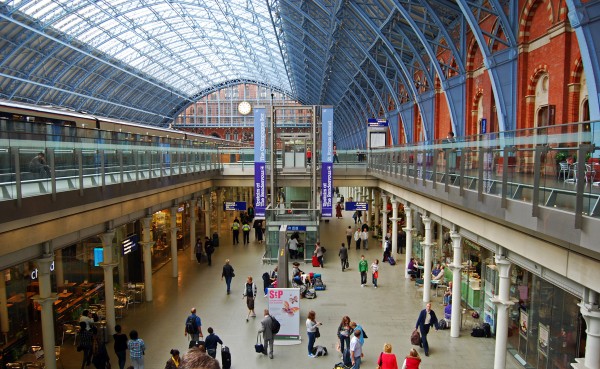
John Lewis is unusual in that it is owned by its employees and this ownership structure has proved successful. Despite a long history, John Lewis has moved with the times and this latest strategy is further evidence of that. In today’s world, convenience is everything and that is one of the key reasons behind its new St Pancras convenience store. It will allow customers to purchase items and then collect them on their way to and from work – click-and-commute, but it will also provide customers with an easily accessible place to buy electronic equipment and a range of household goods. The retail director, Andrew Murphy said:
In the battleground of convenience, we are announcing a new way for commuters to shop with us … Customers spend a huge amount of time commuting, and our research shows that making life easier and shopping more convenient is their top priority.
This appears to be the first of many smaller convenience stores, enabling John Lewis to gain a presence in seemingly impossible places, given the normal size of such Department stores. For many people, commuting to and from work often involves waiting at transport hubs – one of the big downsides to not driving. So it seems sensible for such an established retailer to take advantage of commuters waiting for their train or plane to arrive, who have time to kill. The following articles consider this new direction for an old retailer.
John Lewis to open St Pancras convenience store BBC News (2/5/14)
John Lewis thinks small with convenience store The Guardian, Zoe Wood (2/5/14)
John Lewis to trial convenience store click-and-collect format at St Pancras Retail Week, Ben Cooper (2/5/14)Why is click and collect proving so popular? BBC News, Phil Dorrell (2/5/14)The rise of click and collect for online shoppers BBC News, Phil Dorrell (2/5/14)
Questions
- What are the advantages and disadvantages of the organisational and ownership structure of John Lewis?
- How would you classify this new strategy?
- How do you think this new strategy will benefit John Lewis in terms of its market share, revenue and profit?
- Is it likely that John Lewis will be able to target new customers with this new convenience store strategy?
- How important is a first-mover advantage when it comes to retail? Using game theory, can you create a game whereby there is clear first mover advantage to John Lewis?
 Profits are maximised where marginal cost equals marginal revenue. And in a perfectly competitive market, where price equals marginal revenue, profits are maximised where marginal cost equals price. But what if marginal cost equals zero? Should the competitive profit-maximising firm give the product away? Or is there simply no opportunity for making a profit when there is a high degree of competition?
This is the dilemma considered in the articles linked below. According to Jeremy Rifkin, what we are seeing is the development of technologies that have indeed pushed marginal cost to zero, or close to it, in a large number of sectors of the economy. For example, information can be distributed over the Internet at little or no cost, other than the time of the distributor who is often willing to do this freely in a spirit of sharing. What many people are becoming, says Rifkin, are ‘prosumers’: producing, sharing and consuming.
Over the past decade millions of consumers have become prosumers, producing and sharing music, videos, news, and knowledge at near-zero marginal cost and nearly for free, shrinking revenues in the music, newspaper and book-publishing industries.
What was once confined to a limited number of industries – music, photography, news, publishing and entertainment – is now spreading.
A new economic paradigm – the collaborative commons – has leaped onto the world stage as a powerful challenger to the capitalist market.
A growing legion of prosumers is producing and sharing information, not only knowledge, news and entertainment, but also renewable energy, 3D printed products and online college courses at near-zero marginal cost on the collaborative commons. They are even sharing cars, homes, clothes and tools, entirely bypassing the conventional capitalist market.
So is a collaborative commons a new paradigm that can replace capitalism in a large number of sectors? Are we gradually becoming sharers? And elsewhere, are we becoming swappers?
Articles
Capitalism is making way for the age of free The Guardian, Jeremy Rifkin (31/3/14)
The End of the Capitalist Era, and What Comes Next Huffington Post, Jeremy Rifkin (1/4/14)
Has the Post-Capitalist Economy Finally Arrived? Working Knowledge, James Heskett (2/4/14)
Questions
- In what aspects of your life are you a prosumer? Is this type of behaviour typical of what has always gone on in families and society?
- If marginal cost is zero, why may average cost be well above zero? Illustrate with a diagram.
- Could a monopolist make a profit if marginal cost was zero? Again, illustrate with a diagram.
- Is it desirable for there to be temporary monopoly profits for inventors of new products and services?
- What is meant by a ‘collaborative commons’? Do you participate in such a commons and, if so, how and why?
- Should tweets and Facebook posts be regarded as output?
- What is meant by an internet-of-things infrastructure?
- What are the incentives for authors to contribute to Wikipedia?
- Could marginal cost ever be zero for new physical products?
- Think about the things you buy in the supermarket. Could any of these be produced at zero marginal cost?
- How can capitalists make profits as ‘aggregators of network services and solutions’?
- Provide a critique of Rifkin’s arguments.