 In recent times the notion that the financial sytem can be destabilising seems blindingly obvious. And, yet, for some time macroeconomic models of the economy tended to regard the financial system as benevolent. It served our interests. We were the masters; it was our servant. Now of course we accept that credit cycles can be destabilising. Policymakers, especially central banks, follow keenly the latest private-sector credit data. Here we look back at previous patterns in private-sector debt and crucially at what patterns are currently emerging.
First a bit of theory. The idea of credit cycles is not new. But the financial crisis of the late 2000s has helped to reignite analysis and interest. Economists are trying to gain a better understanding of the relationship between flows of credit and the state of the economy and, in particular, why might flows increase as the level of real GDP rises – why might they be endogenous variables in models of the determination of GDP. One possibility is the financial accelerator. This is the idea that as real GDP rises banks perceive lending to be less risky. After all, real incomes will tend to rise and collateral values (against which borrowing can be secured) are likely to be rising too.
Another possibility is growing exuberance as the economy grows. This has gained in popularity as an idea, with economists revisiting the work of Hyman Minsky (1919–96), an American economist. Here success breeds failure as the balance sheets of people and businesses deteriorate as they become increasingly burdened with debt. The balance sheets are said to be congested leading to a point when a deleveraging starts. A balance sheet recession then follows.
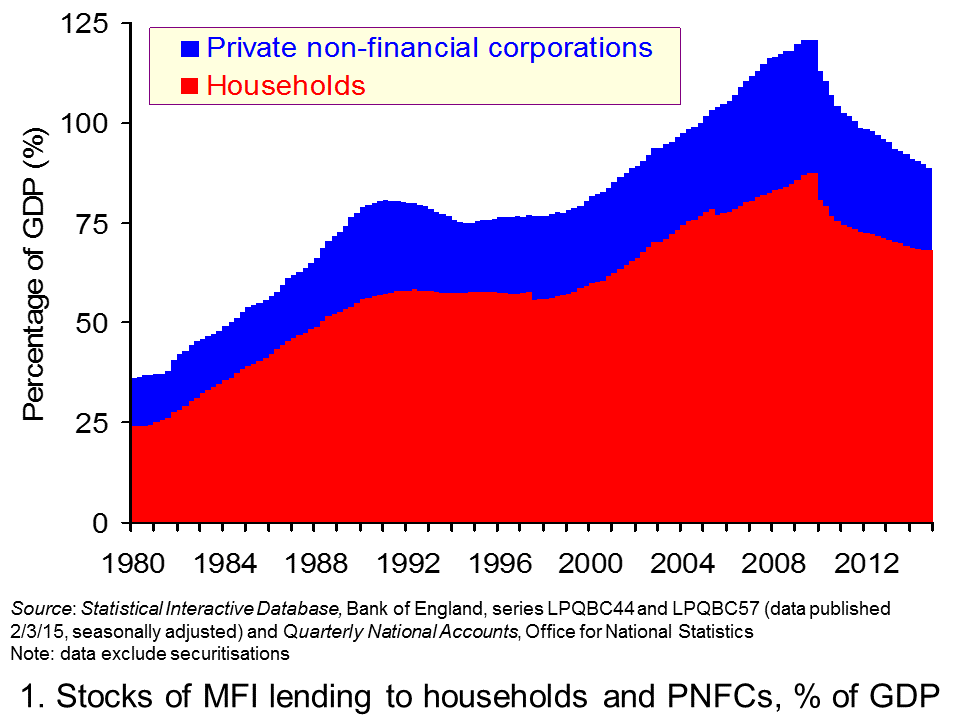 Now for the data. Consider first the stocks of debt acquired by households and private non-financial corporations from MFIs (Monetary Financial Institutions). The first chart shows debt stocks as a percentage of GDP. It illustrates nicely the phenomenon of financialisation. In essence, this is the increasing importance of MFIs to the economy. At the end of 2014, these two sectors had debt stocks outstanding equivalent to 90 per cent of GDP. In fact, this is down from a peak of 129 per cent in September 2009. (Click here for a PowerPoint of the chart.)
The growth in debt, especially in the 1990s and for much of the 2000s, was through financial innovation. In particular, the bundling of assets, such as mortgages, to form financial instruments which could then be purchased by investors helped to provide financial institutions with further funds for lending. This is the process of securitisation. Some argue that this was part of a super-cycle which works alongside the normal credit cycle, albeit over a much lengthier period. It can be argued that these cycles coincided during the 1990s and for much of the 2000s until financial distress hit. The distress was hastened by central banks raising interest rates to dampen the rising rate of inflation, partly attributable to rising global commodity prices, including oil.
Some refer to 2008 as a Minsky moment. Overstretched balance sheets needed repairing. But, the collective act of repair actually caused financial well-being to worsen as asset prices and aggregate demand fell.
The global response to the events of the financial crisis has been for policy-makers to pay more attention to the aggregate level of credit provision. The Bank of England’s Financial Policy Committee (FPC) has responsibility for monitoring and helping to ensure the soundness of the UK financial system.
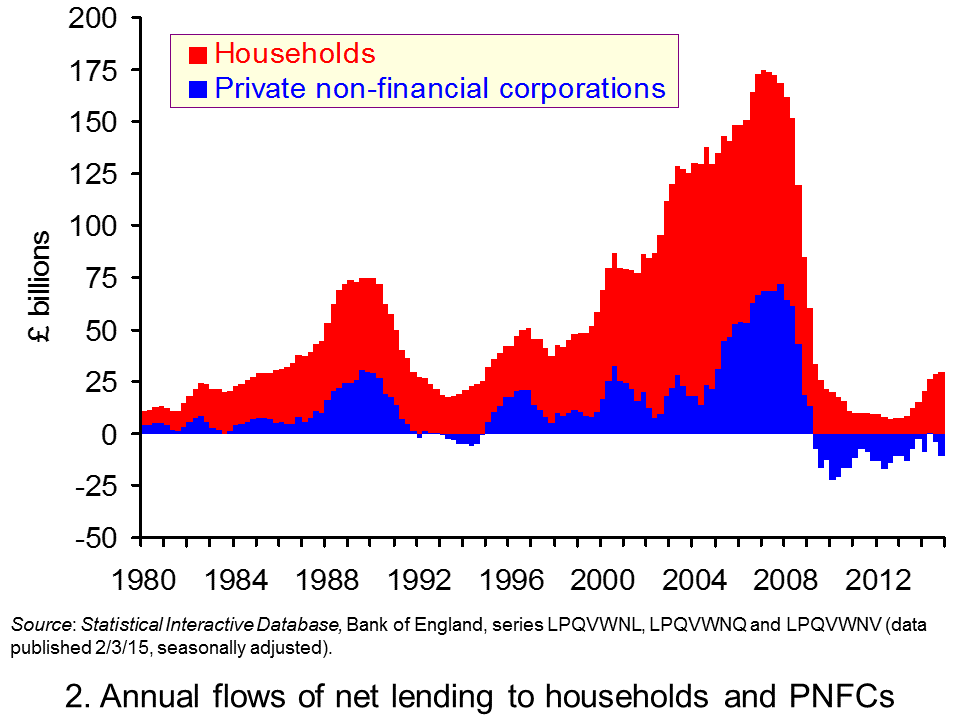 Undoubtedly, the FPC will have constructed a chart similar to our second chart. (Click here for a PowerPoint of the chart). This chart suggests some caution: the need for casting a ‘Minsky eye’ on lending patterns. Over 2014, the UK household sector undertook net lending (i.e. after deducting repayments) of £30 billion. While nothing like the £100 billion or so in 2007, this does mark something of a step up. Indeed it is almost exactly double the flow in 2013. In the months ahead we will continue to monitor the credit data. You can bet that the FPC will do too!
Articles
Comment: Household debt threatens return to spending Herald Scotland, Bill Jamieson (2/3/15)
Household debt rising at fastest rate for 10yrs moneyfacts.co.uk (10/2/15)
Housing starting to rally after home loan approvals rise in January London Evening Standard, Ben Chu (2/3/15)
Data
Bankstats (Monetary and Financial Statistics) – Latest Tables Bank of England
Statistical Interactive Database Bank of England
Questions
- What is meant by the term the business cycle?
- What does it mean for the determinants of the business cycle to be endogenous? What about if they are exogenous?
- Outline the ways in which the financial system can impact on the spending behaviour of households. Repeat the exercise for businesses.
- How might uncertainty affect spending and saving by households and businesses?
- What does it mean if bank lending is pro-cyclical?
- Why might lending be pro-cyclical?
- How might the differential between borrowing and saving interest rates vary over the business cycle?
- Explain what you understand by net lending to households or firms. How does net lending affect their stock of debt?
 ‘Employment has been strong, but productivity and real wages have been flat.’ This is one of the key observations in a new OECD report on the state of the UK economy. If real incomes for the majority of people are to be raised, then labour productivity must rise.
For many years, the UK has had a lower productivity (in terms of output per hour worked) than most other developed countries, with the exception of Japan. But from 1980 to the mid 2000s, the gap was gradually narrowing. Since then, however, the gap has been widening again. This is illustrated in Chart 1, which shows countries’ productivity relative to the UK’s (with the UK set at 100). (Click here for a PowerPoint.)
Compared with the UK, GDP per hour worked in 2013 (the latest data available) was 28% higher in France, 29% higher in Germany and 30% higher in the USA. What is more, GDP per hour worked 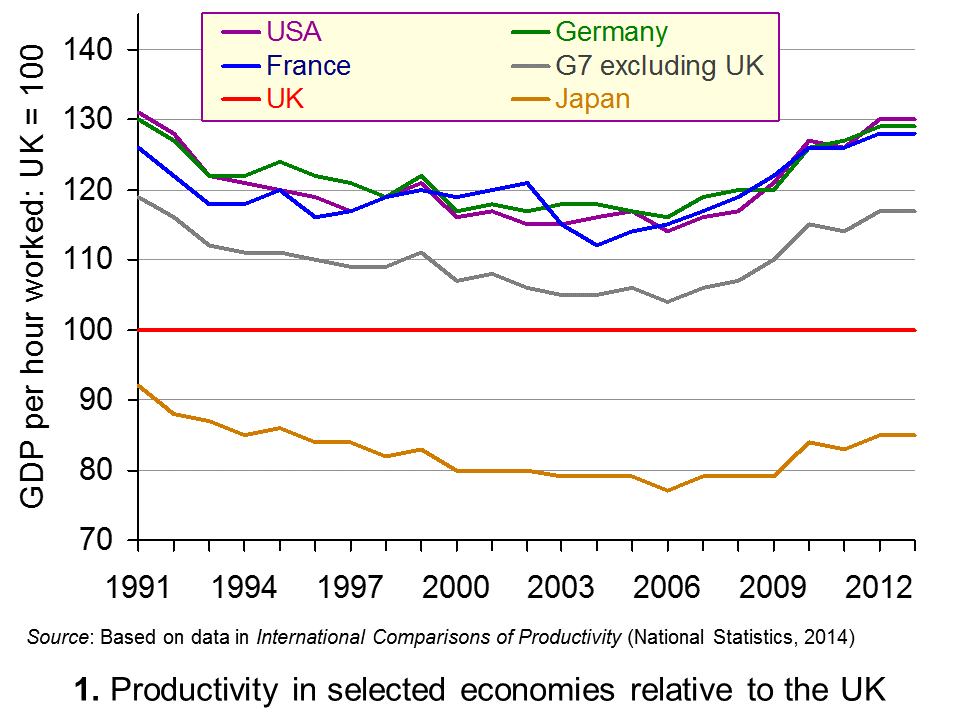 and GDP per capita in the UK fell by 3.8% and 6.1% respectively after the financial crisis of 2007/8 (see the green and grey lines in Chart 2). And while both indicators began rising after 2009, they were still both below their 2007 levels in 2013. Average real wages also fell after 2007 but, unlike the other two indicators, kept on falling and by 2013 were 4% below their 2007 levels, as the red line in Chart 2 shows. (Click here for a PowerPoint.)
Although productivity and even real wages are rising again, the rate of increase is slow. If productivity is to rise, there must be investment. 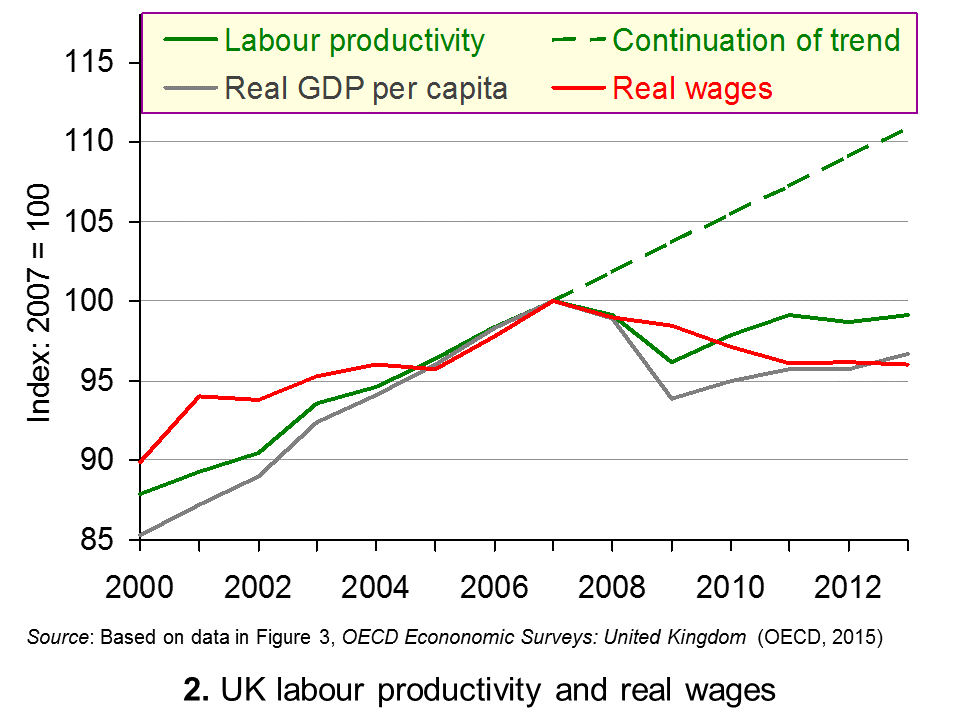 This could be in physical capital, human capital or, preferably, both. But for many years the UK has had a lower rate of investment than other countries, as Chart 3 shows. (Click here for a PowerPoint.) This chart measures investment in fixed capital as a percentage of GDP.
So how can investment be encouraged? Faster growth will encourage greater investment through the accelerator effect, but such an effect could well be short-lived as firms seek to re-equip but may be cautious about committing to increasing capacity. What is crucial here is maintaining 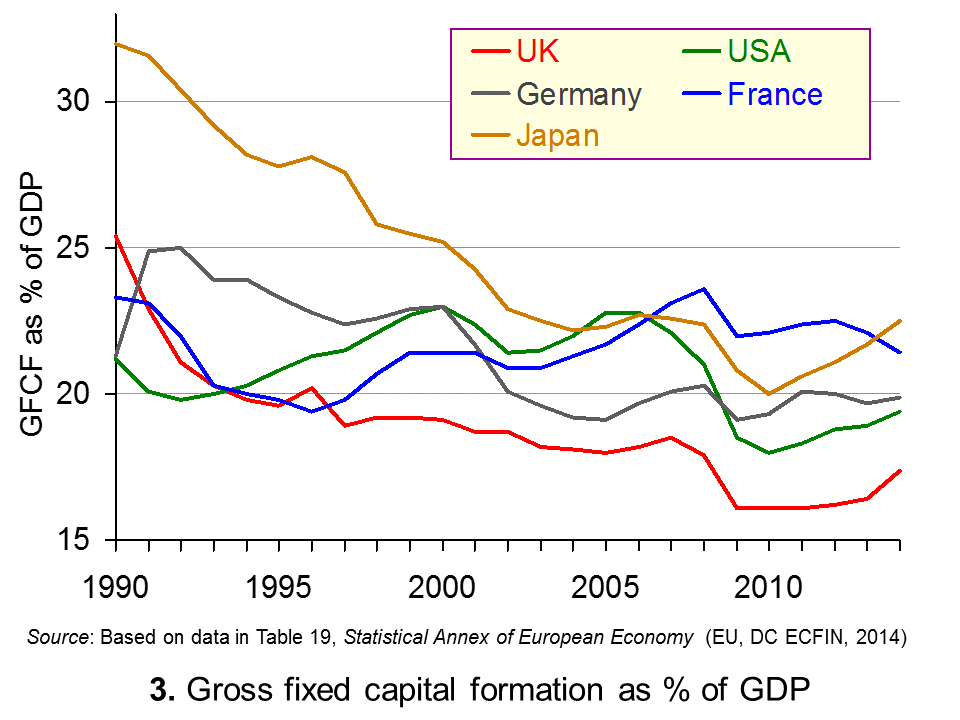 high degrees of business confidence over an extended period of time.
More fundamentally, there are structural problems that need tackling. One is the poor state of infrastructure. This is a problem not just in the UK, but in many developed countries, which cut back on public and private investment in transport, communications and energy infrastructure in an attempt to reduce government deficits after the financial crisis. Another is the low level of skills of many workers. Greater investment in training and apprenticeships would help here.
Then there is the question of access to finance. Although interest rates are very low, banks are cautious about granting long-term loans to business. Since the financial crisis banks have become much more risk averse and long-term loans, by their nature, are relatively risky. Government initiatives to provide finance to private companies may help here. For example the government has just announced a Help to Grow scheme which will provide support for 500 small firms each year through the new British Business Bank, which will provide investment loans and also grants on a match funding basis for new investment.
Articles
OECD: UK must fix productivity Economia, Oliver Griffin (25/2/15)
The UK’s productivity puzzle BBC News, Lina Yueh (24/2/15)
OECD warns UK must fix productivity problem to raise living standards The Guardian, Katie Allen (24/2/15)
Britain must boost productivity to complete post-crisis recovery, says OECD International Business Times, Ian Silvera (24/2/15)
OECD urges UK to loosen immigration controls on skilled workers Financial Times, Emily Cadman and Helen Warrell (24/2/15)
Report
OECD Economic Surveys, United Kingdom: Overview OECD (February 2015)
OECD Economic Surveys, United Kingdom: Full report OECD (February 2015)
Questions
- In what ways can productivity be measured? What are the relative merits of using the different measures?
- Why has the UK’s productivity lagged behind other industrialised countries?
- What is the relationship between income inequality and labour productivity?
- Why has UK investment been lower than in other industrialised countries?
- What are zombie firms? How does the problem of zombie firms in the UK compare with that in other countries? Explain the differences.
- What policies can be pursued to increased labour productivity?
- What difficulties are there in introducing effective policies to tackle low productivity?
- Should immigration controls be lifted to tackle the problem of a shortage of skilled workers?
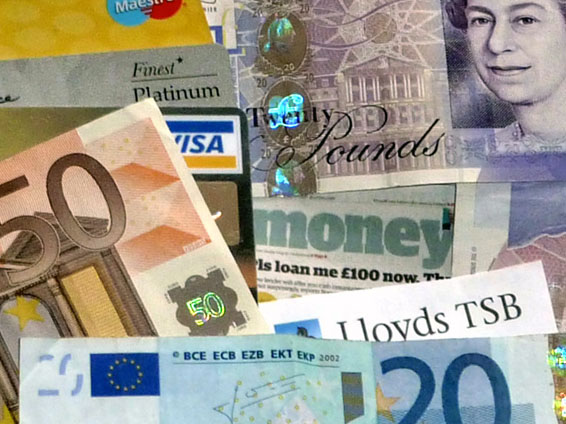 The first link below is to an excellent article by Noriel Roubini, Professor of Economics at New York University’s Stern School of Business. Roubini was one of the few economists to predict the 2008 financial crisis and subsequent recession. In this article he looks at the current problem of substantial deficiency of demand: in other words, where actual output is well below potential output (a negative output gap). It is no wonder, he argues, that in these circumstances central banks around the world are using unconventional monetary policies, such as virtually zero interest rates and quantitative easing (QE).
He analyses the causes of deficiency of demand, citing banks having to repair their balance sheets, governments seeking to reduce their deficits, attempts by firms to cut costs, effects of previous investment in commodity production and rising inequality.
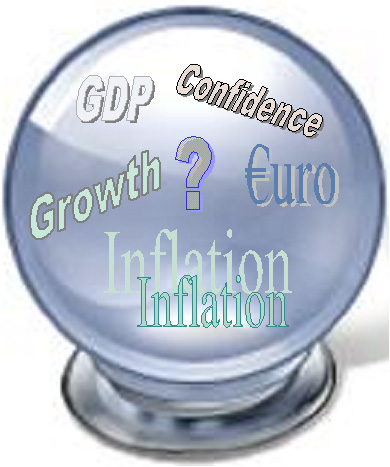 The second link is to an article about the prediction by the eminent fund manager, Crispin Odey, that central banks are running out of options and that the problem of over-supply will lead to a global slump and a stock market crash that will be ‘remembered in a hundred years’. Odey, like Roubini, successfully predicted the 2008 financial crisis. Today he argues that the looming ‘down cycle will cause a great deal of damage, precisely because it will happen despite the efforts of central banks to thwart it.’
I’m sorry to post this pessimistic blog and you can find other forecasters who argue that QE by the ECB will be just what is needed to stimulate economic growth in the eurozone and allow it to follow the USA and the UK into recovery. That’s the trouble with economic forecasting. Forecasts can vary enormously depending on assumptions about variables, such as future policy measures, consumer and business confidence, and political events that themselves are extremely hard to predict.
Will central banks continue to deploy QE if the global economy does falter? Will governments heed the advice of the IMF and others to ease up on deficit reduction and engage in a substantial programme of infrastructure investment? Who knows?
An Unconventional Truth Project Syndicate, Nouriel Roubini (1/2/15)
UK fund manager predicts stock market plunge during next recession The Guardian, Julia Kollewe (30/1/15)
Questions
- Explain each of the types of unconventional monetary policy identified by Roubini.
- How has a policy of deleveraging by banks affected the impact of quantitative easing on aggregate demand?
- Assume you predict that global economic growth will increase over the next two years. What reasons might you give for your prediction?
- Why have most commodity prices fallen in recent months? (In the second half of 2014, the IMF all-commodity price index fell by 28%.)
- What is likely to be the impact of falling commodity prices on global demand?
- Some neo-liberal economists had predicted that central bank policies ‘would lead to hyperinflation, the US dollar’s collapse, sky-high gold prices, and the eventual demise of fiat currencies at the hands of digital krypto-currency counterparts’. Why, according to Roubini, did the ‘root of their error lie in their confusion of cause and effect’?
The New Year is a time for reflection and prediction. What will the New Year bring? What does the longer-term future hold? Here are two articles from The Guardian that look into the future.
The first, by Larry Elliott, considers a number of scenarios and policy options. Although not totally doom laden, the article is not exactly cheery in its predictions. Perhaps ‘life will go on’ and the global economy will muddle through. But perhaps a new recession is around the corner or, even worse, the world is at a tipping point when things are fundamentally changing. Unless policy-makers are careful, clever and co-ordinated, perhaps a new dark age may be looming. But who knows?
Which brings us to the second article, by Gaby Hinsliff. This argues that people are pretty hopeless at predicting. “History is littered with supposed dead certs that didn’t happen – Greece leaving the euro, the premature collapse of the coalition – and wholly unimagined events that came to pass.” And economists and financial experts are little better.
Two years ago, The Observer challenged a panel of City investors to pick a portfolio of stocks and rated their performance against that of Orlando, a ginger cat who selected his portfolio by tossing a toy mouse at a sheet of paper. Inevitably, the cat triumphed.
But is this fair? If capital markets are relatively efficient, stock prices today already reflect knowable information about the future, but clearly not unknowable information.
It’s the same with economies. When information is already to hand, such as a pre-announced tax change, then its effects, ceteris paribus, can be estimated – at least roughly.
 But it’s the ‘ceteris paribus‘ assumption that’s the problem. Other things are not equal. The world is constantly changing and there are all sorts of unpredictable events that will influence the outcomes of economic policy and of economic decisions more generally. And central to the problem are people’s attitudes and confidence. Mood can swing quite dramatically, from irrational exuberance to deep pessimism. And such mood changes – often triggered by some exogenous factor, such as an international dispute, an election or unexpected economic news – can rapidly gather momentum and have significant effects.
Predicting the long-term future is both easier and more difficult: easier, in that short-term cyclical effects are less relevant; more difficult in that changes that have not yet happened, such as technological changes or changes in working practices, may themselves be key determinants of the future global economy.
One of the most salutary lessons is to look at predictions made in the past about the world today and at just how wrong they have proved to be. Perhaps we need to call on Orlando more frequently.
Why ‘life will go on’ thesis about global economy might not pass muster in 2015 The Guardian, Larry Elliott (28/12/14)
Who knows what the new year holds? Certainly none of us The Guardian, Gaby Hinsliff (26/12/14)
Questions
- Give some examples of factors that could have a major influence on the global economy, but which are unpredictable.
- Is economic forecasting still worthwhile? Explain.
- Look at some macroeconomic forecasts made in the past about the world today. You might want to look at forecasts of agencies such as the IMF, the OECD, the World Bank and the European Commission. You can find links in the Economics Network’s Economic Data freely available online. Explain why such forecasts have differed from the actual outcome.
- Why, if capital markets were perfect, might Orlando be just as good as a top investment manager at predicting the future course of share prices?
- In what ways is economic forecasting similar to and different from weather forecasting in its methods, its use of data and its reliability?
 What is the relationship between the degree of inequality in a country and the rate of economic growth? The traditional answer is that there is a trade off between the two. Increasing the rewards to those who are more productive or who invest encourages a growth in productivity and capital investment, which, in turn, leads to faster economic growth. Redistribution from the rich to the poor, by contrast, is argued to reduce incentives by reducing the rewards from harder work, education, training and investment. Risk taking, it is claimed, is discouraged.
Recent evidence from the OECD and the IMF, however, suggests that when income inequality rises, economic growth falls. Inequality has grown massively in many countries, with average incomes at the top of the distribution seeing particular gains, while many at the bottom have experienced actual declines in real incomes or, at best, little or no growth. 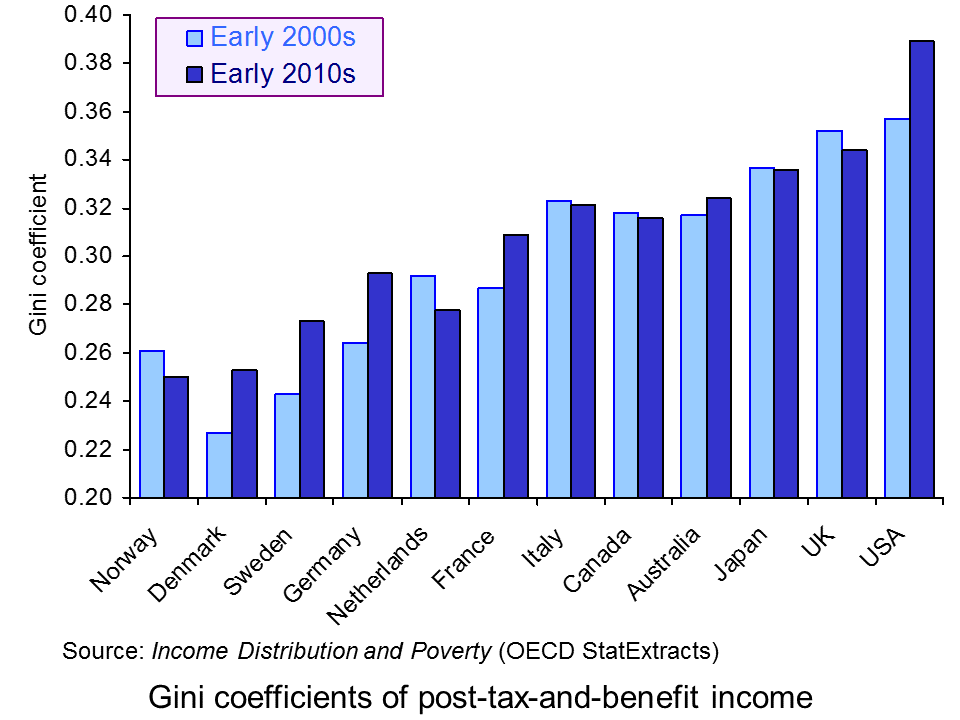 This growth in inequality can be seen in a rise in countries’ Gini coefficients. The OECD average Gini coefficient rose from 0.29 in the mid-1980s to 0.32 in 2011/12. This, claims the OECD, has led to a loss in economic growth of around 0.35 percentage points per year.
But why should a rise in inequality lead to lower economic growth? According to the OECD, the main reason is that inequality reduces the development of skills of the lower income groups and reduces social mobility.
By hindering human capital accumulation, income inequality undermines education opportunities for disadvantaged individuals, lowering social mobility and hampering skills development.
The lower educational attainment applies both to the length and quality of education: people from poorer backgrounds on average leave school or college earlier and with lower qualifications.
But if greater inequality generally results in lower economic growth, will a redistribution from rich to poor necessarily result in faster economic growth? According to the OECD:
Anti-poverty programmes will not be enough. Not only cash transfers but also increasing access to public services, such as high-quality education, training and healthcare, constitute long-term social investment to create greater equality of opportunities in the long run.
Thus redistribution policies need to be well designed and implemented and focus on raising incomes of the poor through increased opportunities to increase their productivity. Simple transfers from rich to poor via the tax and benefits system may, in fact, undermine economic growth. According to the IMF:
That equality seems to drive higher and more sustainable growth does not in itself support efforts to redistribute. In particular, inequality may impede growth at least in part because it calls forth efforts to redistribute that themselves undercut growth. In such a situation, even if inequality is bad for growth, taxes and transfers may be precisely the wrong remedy.
Articles
Inequality ‘significantly’ curbs economic growth – OECD BBC News (9/12/14)
Is inequality the enemy of growth? BBC News, Robert Peston (6/10/14)
Income inequality damages growth, OECD warns Financial Times, Chris Giles (8/10/14)
OECD finds increasing inequality lowers growth Deutsche Welle, Jasper Sky (10/12/14)
Revealed: how the wealth gap holds back economic growth The Guardian, Larry Elliott (9/12/14)
Inequality Seriously Damages Growth, IMF Seminar Hears IMF Survey Magazine (12/4/14)
Warning! Inequality May Be Hazardous to Your Growth iMFdirect, Andrew G. Berg and Jonathan D. Ostry (8/4/11)
Economic growth more likely when wealth distributed to poor instead of rich The Guardian, Stephen Koukoulas (4/6/15)
So much for trickle down: only bold reforms will tackle inequality The Guardian, Larry Elliott (21/6/15)
Videos
Record inequality between rich and poor OECD on YouTube (5/12/11)
The Price of Inequality The News School on YouTube, Joseph Stiglitz (5/10/12)
Reports and papers
FOCUS on Inequality and Growth OECD, Directorate for Employment, Labour and Social Affairs (December 2014)
Trends in Income Inequality and its Impact on Economic Growth OECD Social, Employment and Migration Working Papers, Federico Cingano (9/12/14)
An Overview of Growing Income Inequalities in OECD Countries: Main Findings OCED (2011)
Redistribution, Inequality, and Growth IMF Staff Discussion Note, Jonathan D. Ostry, Andrew Berg, and Charalambos G. Tsangarides (February 2014)
Measure to Measure Finance and Development, IMF, Jonathan D. Ostry and Andrew G. Berg (Vol. 51, No. 3, September 2014)
Data
OECD Income Distribution Database: Gini, poverty, income, Methods and Concepts OECD
The effects of taxes and benefits on household income ONS
Questions
- Explain what are meant by a Lorenz curve and a Gini coefficient? What is the relationship between the two?
- The Gini coefficient is one way of measuring inequality. What other methods are there? How suitable are they?
- Assume that the government raises taxes to finance higher benefits to the poor. Identify the income and substitution effects of the tax increases and whether the effects are to encourage or discourage work (or investment).
- Distinguish between (a) progressive, (b) regressive and (c) proportional taxes?
- How will the balance of income and substitution effects vary in each of the following cases: (a) a cut in the tax-free allowance; (b) a rise in the basic rate of income tax; (c) a rise in the top rate of income tax? How does the relative size of the two effects depend, in each case, on a person’s current income?
- Identify policy measures that would increase both equality and economic growth.
- Would a shift from direct to indirect taxes tend to increase or decrease inequality? Explain.
- By examining Tables 3, 26 and 27 in The Effects of Taxes and Benefits on Household Income, 2012/13, (a) explain the difference between original income, gross income, disposable income and post-tax income; (b) explain the differences between the Gini coefficients for each of these four categories of income in the UK.
 In recent times the notion that the financial sytem can be destabilising seems blindingly obvious. And, yet, for some time macroeconomic models of the economy tended to regard the financial system as benevolent. It served our interests. We were the masters; it was our servant. Now of course we accept that credit cycles can be destabilising. Policymakers, especially central banks, follow keenly the latest private-sector credit data. Here we look back at previous patterns in private-sector debt and crucially at what patterns are currently emerging.